

Download ICSE Class 10 Physics Solutions by Selina Concise
Review the Selina Concise Solutions for ICSE Class 10 Physics Chapter 9 Household Circuits designed for Class 10 Physics students. Published under the latest ICSE guidelines for 2026-27, these chapter-wise solutions provide the foundational knowledge required for exam success.
Access Chapter 09 Household Circuits Solutions for Class 10 Physics
Navigate directly to the Chapter 09 Household Circuits solutions using the digital viewer below. Organizing your study sessions chapter-by-chapter allows for seamless offline study and quick reference during revision.
Exercise- 9 (A)
Question 1. Write an expression for the electrical energy spent in flow of current through an electrical appliance in terms of current, resistance and time.
Answer: Electrical energy, W = \( I^2 Rt \) joule
In simple words: When current flows through a wire, it uses energy. This energy depends on how much current flows, how much the wire resists, and how long it flows.
📝 Teacher's Note: Show students that energy is like fuel being used up. More current or more time means more fuel used. More resistance also means more fuel used.
🎯 Exam Tip: Always write the formula as \( W = I^2 Rt \) with correct units (joule). Remember the current is squared.
Question 2. Write an expression for the electrical power spent in flow of current through a conductor in terms of (a) Resistance and potential difference, (b) current and resistance.
Answer:
(a) Electrical power, P = \( \frac{V^2}{R} \)
(b) Electrical power, P = \( I^2 R \)
In simple words: Power is how fast energy is used. You can calculate it using voltage and resistance, or using current and resistance.
📝 Teacher's Note: Tell students that power is like the speed of using energy. A 100W bulb uses energy faster than a 50W bulb.
🎯 Exam Tip: Learn both formulas. Use \( P = \frac{V^2}{R} \) when you have voltage. Use \( P = I^2 R \) when you have current.
Question 3. Electrical power p is given by the expression P = (Q × V) ÷ time (a) What do the symbols Q and V represent? (b) Express the power P in terms of current and resistance explaining the meaning of symbols used there in.
Answer:
(a) Q represents Charge and V represents Voltage.
(b) Electrical Power, P = \( I^2 R \)
Where I : current
And R : Resistance
In simple words: Q is the amount of charge (like number of electrons). V is voltage (like pressure pushing electrons). Current I is charge flow per second. Resistance R is how much the wire stops current.
📝 Teacher's Note: Compare charge to water amount, voltage to water pressure, and current to water flow rate. Students understand water examples easily.
🎯 Exam Tip: Always explain what each symbol means. Write Q = charge, V = voltage, I = current, R = resistance clearly.
Question 4. Name the S.I. unit of electrical energy. How is it related to Wh?
Answer: The S.I. unit of electrical energy is joule.
1Wh = 3600 J
In simple words: Joule is the proper scientific unit for energy. Wh (watt-hour) is used for electricity bills. One Wh equals 3600 joules.
📝 Teacher's Note: Show students their electricity bill. The kWh units there are energy units, not power units.
🎯 Exam Tip: Write "joule" as the S.I. unit. Remember the conversion: 1 Wh = 3600 J. This often comes in numerical questions.
Question 5. Name the S.I unit of electrical energy. How is it related to Wh?
Answer: The power of an appliance is 100 W. It means that 100 J of electrical energy is consumed by the appliance in 1 second.
In simple words: When we say power is 100 W, it means the appliance uses 100 joules of energy every second.
📝 Teacher's Note: This answer seems wrong for the question. The correct answer should be about S.I. unit being joule and relation to Wh.
🎯 Exam Tip: Read questions carefully. This question asks about energy units, not what power means.
Question 6. State the S.I. unit of electrical power.
Answer: The S.I. unit of electrical power is Watt.
In simple words: Watt is how we measure power. It tells us how fast energy is being used.
📝 Teacher's Note: Show students appliances at home. A 60W bulb uses less power than a 100W bulb. More watts means more electricity used per second.
🎯 Exam Tip: Simply write "Watt" or "W". Do not confuse power (Watt) with energy (Joule or Wh).
Question 7. (i) State and define the household unit of electricity. (ii) What is the voltage of the electricity that is generally supplied to a house?
Answer:
(i) The household unit of electricity is kilowatt-hour (kWh).
One kilowatt-hour (kWh) is the electrical energy consumed by an electrical appliance of power 1 kW when it is used for one hour.
(ii) The voltage of the electricity that is generally supplied to a house is 220 Volt.
In simple words: kWh is the unit on your electricity bill. It means using 1000 watts for 1 hour. In India, house electricity is 220 volts.
📝 Teacher's Note: Show a real electricity bill. Point out the kWh units. Explain that 220V is like the "strength" of electricity in our homes.
🎯 Exam Tip: Define kWh properly: energy used by 1 kW appliance in 1 hour. Remember 220V for Indian households.
Question 8. Name the physical quality which is measured in (i) Kw (ii) kWh
Answer:
(i) Electrical power is measured in kW and
(ii) Electrical energy is measured in kWh.
In simple words: kW measures how fast you use electricity. kWh measures how much total electricity you used.
📝 Teacher's Note: Compare to a car: kW is like speed (how fast), kWh is like distance traveled (how much total).
🎯 Exam Tip: Remember: kW = power (rate), kWh = energy (total amount). Never mix these up.
Question 9. Define the term kilowatt-hour and state its value in S.I unit
Answer: One kilowatt-hour (kWh) is the electrical energy consumed by an electrical appliance of power 1 kW when it is used for one hour.
Its value in SI unit is 1kWh = \( 3.6 \times 10^6 \) J
In simple words: kWh means using 1000 watts of power for 1 hour. In joules, this equals 3.6 million joules.
📝 Teacher's Note: Help students remember: 1 kWh = 1000W × 3600s = 3,600,000 J. Use a calculator to show this calculation.
🎯 Exam Tip: Write the definition completely. For conversion, write \( 1 \text{ kWh} = 3.6 \times 10^6 \text{ J} \) with proper scientific notation.
Question 10. Distinguish between kilowatt and kilowatt-hour.
Answer: Kilowatt is the unit of electrical power whereas kilowatt-hour is the unit of electrical energy.
In simple words: Kilowatt tells you how fast you use electricity. Kilowatt-hour tells you how much total electricity you used.
📝 Teacher's Note: Use the tap water example: kW is how fast water flows, kWh is total water that flowed out.
🎯 Exam Tip: Always write: kW = power unit, kWh = energy unit. Give clear definitions of both.
Question 11. Complete the following: (a) 1Kwh = (1volt × 1ampere × ...............)/1000 (b) 1kWh = …….. J
Answer:
(a) 1Kwh = (1volt × 1ampere × 1hour)/1000
(b) \( 3.6 \times 10^6 \) J
In simple words: To get kWh, you need volts × amperes × hours, then divide by 1000. One kWh equals 3.6 million joules.
📝 Teacher's Note: Remind students that power = voltage × current, so 1 watt = 1 volt × 1 ampere. Then 1 kWh needs 1000 of these for 1 hour.
🎯 Exam Tip: For part (a), write "1hour" clearly. For part (b), use scientific notation: \( 3.6 \times 10^6 \text{ J} \).
Question 12. What do you mean by power rating of an electrical appliance? How do you use it to calculate (a) the resistance of the appliance, and (b) the safe limit of current in it, while in use?
Answer: An electrical appliance such as electric bulb, geyser etc. is rated with power (P) and voltage (V) which is known as its power rating. For example: If an electric bulb is rated as 50W-220V, it means that when the bulb is lighted on a 220 V supply, it consumes 50 W electrical power.
(a) To calculate the resistance of the appliance, the expression is:
Resistance, R = \( \frac{V^2}{P} \)
(b) The safe limit of current I is: \( I = \frac{P}{V} \)
In simple words: Power rating tells you how much power an appliance uses at its correct voltage. You can find its resistance and safe current using simple formulas.
📝 Teacher's Note: Show students appliances at home with ratings like "100W, 220V" written on them. Explain this means safe power and voltage.
🎯 Exam Tip: Always write both formulas clearly: \( R = \frac{V^2}{P} \) and \( I = \frac{P}{V} \). Explain what power rating means first.
Question 13. An electric bulb is rated '100 W, 250 V'. What information does this convey?
Answer: It means that if the bulb is lighted on a 250 V supply, it consumes 100 W electrical power (which means 100J of electrical energy is converted in the filament of bulb into the light and heat energy in 1 second).
In simple words: The bulb is designed to work safely at 250 volts. At this voltage, it will use 100 watts of power and convert 100 joules every second into light and heat.
📝 Teacher's Note: Explain that if voltage is different from 250V, the bulb may be too dim, too bright, or get damaged.
🎯 Exam Tip: Explain three things: safe voltage (250V), power consumption (100W), and energy conversion (100J per second).
Question 14. List the names of three electrical gadgets used in your house. Write their power, voltage rating and approximate time for which each one is used in a day. Hence find the electrical energy consumed by each in a day.
Answer:
| Appliance | Power (in watt) | Voltage (in volts) | Time (hours) | Electrical energy (E = p × t) |
|---|---|---|---|---|
| Fluorescent tube | 40 | 220 | 12 | 0.48 kWh |
| Television set | 120 | 220 | 4 | 0.48 KWh |
| Refrigerator | 150 | 220 | 24 | 3.6 kWh |
In simple words: Different appliances use different amounts of power. Energy used = power × time. Refrigerator uses most energy because it runs all day.
📝 Teacher's Note: Ask students to check appliances at home and make their own table. This makes the lesson practical and real.
🎯 Exam Tip: Use the formula Energy = Power × Time. Convert watts to kilowatts (divide by 1000) before multiplying by hours to get kWh.
Question 15. Two lamps, one rated 220 V, 50 W and the other rated 220 V, 100 W, are connected in series with mains of 220 V. Explain why does the 50 W lamp consume more power.
Answer: Resistance of 220 V, 50 w lamp is
\( R_1 = \frac{V^2}{P_1} = \frac{220^2}{50} = 968 \Omega \)
Resistance of 220 V, 100 lamp is
\( R_2 = \frac{V^2}{P_2} = \frac{220^2}{100} = 484 \Omega \)
Since the two lamps are connected in series
So same current I passes through each lamp.
Power consumed in 220 v, 50 w lamp is \( P_1 = I^2 R_1 \)
Power consumed in 220 v, 100 w lamp is \( P_2 = I^2 R_2 \)
Since R₁ > R₂, P₁ > P₂
i.e. 50 w lamp consumes more power.
In simple words: In series connection, same current flows through both bulbs. The 50W bulb has higher resistance, so it uses more power when same current flows through it.
📝 Teacher's Note: Explain series connection: current is same everywhere, but voltage divides. Higher resistance gets more voltage and more power.
🎯 Exam Tip: Calculate both resistances first. Then use \( P = I^2 R \) to show that higher resistance gives more power in series connection.
Question 16. Name the factors on which the heat produced in a wire depends when current is passed in it, and state how does it depend on the factors stated by you.
Answer: When current is passed in a wire, the heat produced in it depends on the three factors: (i) on the amount of current passing through the wire, (ii) on the resistance of wire and (iii) on the time for which current is passed in the wire.
(i) Dependence of heat produced on the current in wire: The amount of heat H produced in the wire is directly proportional to the square of current I passing through the wire, i.e., \( H \propto I^2 \)
(ii) Dependence of heat produced on the resistance of wire: The amount of heat H produced in the wire is directly proportional to the resistance R of the wire, i.e., \( H \propto R \)
(iii) Dependence of heat produced on the time: The amount of heat H produced in the wire is directly proportional to the time t for which current is passed in the wire, i.e., \( H \propto t \)
In simple words: Heat in a wire depends on three things: how much current flows (more current = more heat), how much the wire resists (more resistance = more heat), and how long current flows (more time = more heat).
📝 Teacher's Note: Show students a heater coil. Explain why it gets hot: high resistance, high current, and time of use all make heat.
🎯 Exam Tip: List all three factors clearly. Write the proportionality symbols ∝ properly. Remember current is squared: \( H \propto I^2 \).
Multiple Choice Type
Question 1. When a current I flows through a resistance R for time t, the electrical energy spent is given by:
(a) IRt
(b) I²Rt
(c) IR²t
(d) I²R/t
Answer: (b) I²Rt
Note: Electrical energy (W) = \( I^2 Rt = VIt = \frac{V^2 t}{R} \)
In simple words: Energy used by current in a wire equals current squared times resistance times time. This is the basic formula for electrical energy.
📝 Teacher's Note: Show students that energy depends on current squared, not just current. Double current means four times more energy used.
🎯 Exam Tip: Remember the formula \( W = I^2 Rt \). Current is always squared in energy and power formulas.
Question 2. An electrical appliance has a rating 100 W, 120 V. the resistance of element of appliance when in use is:
(a) 1.2Ω
(b) 144 Ω
(c) 120 Ω
(d) 100 Ω
Answer: (b) 144 Ω
Solution:
Given, power (p) = 100 w
Potential difference, v = 120 volt
\( \therefore \text{Resistance}, r = \frac{V^2}{P} = \frac{120^2}{100} = 144 \Omega \)
In simple words: To find resistance from power rating, use the formula resistance = voltage squared divided by power.
📝 Teacher's Note: Teach students to use \( R = \frac{V^2}{P} \) when they have voltage and power ratings of appliances.
🎯 Exam Tip: Use the formula \( R = \frac{V^2}{P} \). Calculate: \( \frac{120 \times 120}{100} = \frac{14400}{100} = 144 \Omega \).
Numericals
Question 1. A current of 2 A is passed through a coil of resistance 75Ω for 2 minutes. (a) How much heat energy is produced? (b) How much charge is passed through the resistance?
Answer:
Given, current (I) = 2 A
Resistance, R = 75 Ω
Time, t = 2 min = 120s
(a) Heat produced, H = \( I^2 Rt \)
\( H = 2^2 \times 75 \times 120 = 4 \times 75 \times 120 = 36000 \text{ J} \)
(b) Charge passed, Q = I × t
\( Q = 2 \times 120 = 240 \text{ C} \)
In simple words: When current flows through resistance, it produces heat. The amount depends on current squared, resistance, and time. Charge is just current times time.
📝 Teacher's Note: Remind students to convert minutes to seconds. Heat formula has current squared. Charge formula is simple: current × time.
🎯 Exam Tip: Use \( H = I^2 Rt \) for heat and \( Q = It \) for charge. Always convert time to seconds first. Show all steps clearly.
Question 2:
Answer:
Given:
Power, p = 60 W
Voltage, v = 250 V
Step 1: Find current using P = VI
\( I = \frac{60}{250} = 0.24 \text{ A} \)
Step 2: Find resistance of bulb
\( R = \frac{V^2}{p} = \frac{250^2}{60} = 1041.6 \text{ Ω} \)
Step 3: Find power when voltage falls to 200 V
\( p = \frac{v^2}{R} = \frac{200^2}{1041.6} = 38.4 \text{ W} \)
The power consumed by the bulb reduces from 60 W to 38.4 W when voltage falls from 250 V to 200 V.
In simple words: When voltage goes down, power also goes down. The bulb becomes dimmer because less electricity flows through it.
📝 Teacher's Note: Show students how resistance stays the same but power changes with voltage. Use a dimmer switch example - when you lower voltage, the bulb gets dimmer.
🎯 Exam Tip: Always find resistance first using the given values, then use that same resistance to find new power. Write each step clearly.
Question 3:
Answer:
Given:
Power, P = 100 W
Voltage, V = 250 V
Using power formula P = VI
\( I = \frac{100}{250} = 0.4 \text{ A} \)
The bulb will draw 0.4 A current.
In simple words: We divide power by voltage to get current. It is like finding how much water flows when we know total flow and pressure.
📝 Teacher's Note: This is a direct formula question. Make students remember P = VI. Practice with different values so they become quick at this.
🎯 Exam Tip: Write the formula first, then substitute values. Always include units in your final answer - marks are lost without units.
Question 4:
Answer:
(a) Given:
Power, p = 100 W
Voltage, v = 220 V
Using \( P = \frac{V^2}{R} \)
\( \implies \) \( R = \frac{V^2}{P} = \frac{220^2}{100} = 484 \text{ Ω} \)
(b) Safe current using \( I = \frac{P}{V} \)
\( I = \frac{100}{220} = 0.45 \text{ A} \)
Resistance = 484 Ω, Safe current = 0.45 A
In simple words: Resistance tells us how much the bulb opposes current flow. Safe current is the normal current that should flow through the bulb.
📝 Teacher's Note: Explain that "safe current" means the current the bulb is designed for. More current will damage it, less current will make it dim.
🎯 Exam Tip: For resistance, use R = V²/P. For safe current, use I = P/V. These are the most common formulas in bulb questions.
Question 5:
Answer:
Energy consumed per day, E = p × t
= 40 × 12.5 = 500 Wh
Energy consumed for 30 days
E = 500 × 30 = 15000 Wh = 15 kWh
Total electrical energy consumed = 15 kWh
In simple words: We multiply power by time to get energy. Like how distance = speed × time. Then we multiply by 30 days to get total.
📝 Teacher's Note: Students often forget to convert Wh to kWh. Teach them that 1000 Wh = 1 kWh. Use examples from electricity bills at home.
🎯 Exam Tip: Always convert final answer to kWh if the numbers are big. Write Energy = Power × Time clearly in your working.
Question 6:
Answer:
Energy, E = power × time
= 750 × 16 = 12000 Wh
E = 12 kWh
The electrical energy consumed by the iron is 12 kWh.
In simple words: Energy is how much electricity something uses. We get it by multiplying its power with how long it runs.
📝 Teacher's Note: Connect this to real life - show students their home electricity bill and explain how units are calculated this way.
🎯 Exam Tip: Convert to kWh by dividing by 1000. This makes numbers easier to handle and is what electricity companies use.
Question 7:
Answer:
Given:
Resistance, R = 200 Ω
Voltage, v = 200 V
Time, t = 5 min = 5 × 60 sec = 300 sec
Using Energy, \( E = \frac{v^2 t}{R} \)
(i) In joules
\( E = \frac{(200)^2 × 300}{200} = 60000 \text{ J} \)
(ii) In kWh
As 1 kWh = 3.6 × 10⁶ J
\( 1 \text{ J} = \frac{1}{3.6 × 10^6} \text{ kWh} \)
\( 60000 \text{ J} = \frac{60000}{3.6 × 10^6} = 0.0167 \text{ kWh} \)
In simple words: Energy can be measured in joules or kWh. Joules are small units, kWh are big units. We use different formulas to convert between them.
📝 Teacher's Note: Teach the conversion factor 1 kWh = 3.6 × 10⁶ J. Students must memorize this. Show them both units are used in different situations.
🎯 Exam Tip: When question asks for both units, calculate in joules first, then convert. Remember the conversion factor - it is often asked in exams.
Question 8:
Answer:
Given:
Power, p = 24 W
Voltage, v = 12 V
Time = 20 minutes
(i) Current using P = VI
\( I = \frac{24}{12} = 2 \text{ A} \)
(ii) Energy, E = P × t
E = 24 × 20 × 60 sec = 28,800 J
Current = 2 A, Energy consumed = 28,800 J
In simple words: Current is how much electricity flows per second. Energy is total electricity used. We get current from power and voltage, energy from power and time.
📝 Teacher's Note: Make sure students convert minutes to seconds when calculating energy in joules. This is a common mistake.
🎯 Exam Tip: Always convert time to seconds when calculating energy in joules. Write "sec" clearly in your time conversion.
Question 9:
Answer:
Given:
Current, I = 0.2 A
Potential difference, v = 15 V
Time, t = 60 sec
(a) Using V = IR
\( R = \frac{15}{0.2} = 75 \text{ Ω} \)
(b) Heat energy, \( H = I^2 Rt \)
\( H = (0.2)^2 × 75 × 60 = 180 \text{ J} \)
Resistance = 75 Ω, Heat energy = 180 J
In simple words: Resistance opposes current flow. Heat energy is produced when current flows through resistance - like how a heater works.
📝 Teacher's Note: Show students a heater coil to explain how electrical energy becomes heat energy. The resistance creates heat when current flows.
🎯 Exam Tip: Use V = IR for resistance and H = I²Rt for heat energy. These are the most direct formulas for such questions.
Question 10:
Answer:
Given:
Voltage, v = 240 V
Power, p = 60 W
Using \( p = \frac{v^2}{R} \)
\( R = \frac{(240)^2}{60} = 960 \text{ Ω} \)
\( I = \frac{P}{V} = 0.25 \text{ A} \)
When one lamp is connected across the mains, it draws 0.25 A current. When two lamps are connected in series across the mains, current through each bulb becomes:
\( \frac{240v}{(960 + 960) Ω} = 0.125 \text{ A} \)
Current is halved, hence heating (\( = I^2 Rt \)) in each bulb becomes one-fourth, so each bulb appears less bright.
In simple words: In series connection, total resistance increases so current decreases. Less current means less heat and light, so bulbs become dimmer.
📝 Teacher's Note: Use Christmas lights example - when one bulb fails, others become dim because they are in series. Show how adding resistance reduces current.
🎯 Exam Tip: For series connection, add resistances. Less current means less brightness. Always explain the physics behind the observation.
Question 11:
Answer:
Given:
Voltage, V₁ = 220 V, V₂ = 110 V
Power, P₁ = P₂ = 60 W
Using \( R = \frac{V^2}{P} \)
\( R_1 = \frac{V_1^2}{P} = \frac{220 × 220}{60} \)
\( R_2 = \frac{V_2^2}{P} = \frac{110 × 110}{60} \)
Dividing R₁ and R₂:
\( \frac{R_1}{R_2} = \frac{220 × 220}{60} × \frac{60}{110 × 110} = \frac{4}{1} \)
∴ R₁ : R₂ = 4 : 1
In simple words: Even though both bulbs have same power, the one with higher voltage has higher resistance. It is like thicker pipes need more pressure for same water flow.
📝 Teacher's Note: Explain that for same power, higher voltage bulbs need higher resistance. This is why 220V and 110V bulbs are different even with same wattage.
🎯 Exam Tip: When comparing resistances, use R = V²/P formula. Set up the ratio carefully and simplify to get simple numbers like 4:1.
Question 12:
Answer:
Given:
Power, p = 250 W
Voltage, v = 230 V
(i) Energy in one hour
Time, t = 1 × 60 × 60 = 3600 sec
Energy, E = 250 × 3600 = 9 × 10⁵ J
(ii) Time for 1 kWh consumption
1000 Wh = 250 × t
Time, t = 1000/250 = 4 hours
Energy consumed in one hour = 9 × 10⁵ J, Time for 1 kWh = 4 hours
In simple words: In one hour, the bulb uses a fixed amount of energy. To use 1 kWh (1 unit), it takes 4 hours because it uses 0.25 kWh per hour.
📝 Teacher's Note: Connect 1 kWh to electricity bill units. Show students that 250W bulb running for 4 hours uses 1 unit of electricity.
🎯 Exam Tip: For time calculations, remember Power × Time = Energy. Rearrange to find time when energy is given.
Question 13:
Answer:
Given:
Three heaters each rated 250 W, 100 V connected in parallel to 100 V supply
(i) Current through each heater using P = VI
\( I = \frac{250}{100} = 2.5 \text{ A} \)
Total current = 3 × 2.5 = 7.5 A
(ii) Resistance of each heater
\( R = \frac{V^2}{P} = \frac{100^2}{250} = 40 \text{ Ω} \)
(iii) Total power = 3 × 250 = 750 W
Energy in 5 hours = 750 × 5 = 3750 Wh = 3.75 kWh
Total current = 7.5 A, Resistance = 40 Ω each, Energy = 3.75 kWh
In simple words: In parallel connection, each heater gets full voltage and works normally. We add their currents to get total current from supply.
📝 Teacher's Note: Use home appliances example - all appliances work at full power because they are connected in parallel to mains supply.
🎯 Exam Tip: In parallel connection, voltage is same for all, currents add up. Each device works at its rated power.
Question 13: Power of each heater is 250 W. Three such heaters are connected in parallel to 100 V source. Calculate: (i) current through each heater, (ii) resistance for each heater, (iii) energy for three heaters for 5 hours.
Answer:
Given:
Power, p = 250 W
Voltage, v = 100 V
(i) Current through each heater, I = ?
As p = VI
\( I = \frac{P}{V} \)
\( I = \frac{250}{100} = 2.5A \)
∴ Current taken for the three heaters = 3 × 2.5 = 7.5 A
(ii) Resistance for each heater:
\( R = \frac{V}{I} \)
\( R = \frac{100}{2.5} = 40 Ω \)
(iii) Time for which energy is supplied, t = 5h
As, Energy, E = p × t
E = 250 × 5 = 1250 Wh
Or E = 1.25 kWh
Energy for three heaters = 3 × 1.25 = 3.75 kWh
In simple words: When heaters are in parallel, each gets full voltage. We find current using P = VI. Then we find resistance using V = IR. Total energy is power times time for all three heaters.
📝 Teacher's Note: Show students that in parallel connection, each device gets the same voltage as the source. Each heater works independently. Draw simple circuit diagram to make this clear.
🎯 Exam Tip: Always write "Given:" first. For parallel connection, mention that voltage across each branch is same. Show all steps clearly with units.
Question 14: A bulb is connected to a battery of p.d 4 V and internal resistance 2.5 Ω. A steady current of 0.5 A flows through the circuit. Calculate: (i) the total energy supplied by the battery in 10 minutes (ii) the resistance of the bulb and (iii) the energy dissipated in the bulb in 10 minutes.
Answer:
Given:
Voltage, v = 4 V
Resistance of the battery, RB = 2.5 Ω
Current, I = 0.5 A
(i) Energy supplied by the battery:
\( E = \frac{V^2 t}{R} \)
T = 10 × 60 = 600 sec
\( R = \frac{V}{I} = \frac{4}{0.5} = 8Ω \)
\( E = \frac{4^2 \times 600}{8} = 1200J \)
(ii) Total resistance, R = 8 Ω
Resistance of the battery, RB = 2.5 Ω
Resistance of the bulb, Rb = 8 - 2.5 = 5.5 Ω
(iii) Energy dissipated in the bulb in 10 min:
\( E = I^2Rt \)
\( E = (0.5)^2 \times 5.5 \times 600 = 825 J \)
In simple words: Battery has its own resistance too. Total resistance is battery resistance plus bulb resistance. Energy goes to both battery (as heat loss) and bulb (as light).
📝 Teacher's Note: Explain that real batteries have internal resistance. This is why battery gets warm when used. Total circuit resistance includes both internal and external resistance.
🎯 Exam Tip: Remember to subtract internal resistance from total resistance to get bulb resistance. Use I²Rt formula for energy in specific component. Convert minutes to seconds.
Question 15: Two resistors A and B of resistance 4 Ω and 6 Ω respectively are connected in parallel. The combination is connected across a 6 volt battery of negligible resistance. Calculate: (i) the power supplied by the battery, (ii) the power dissipated in each resistor.
Answer:
Given:
Resistance, RA = 4Ω
Resistance, RB = 6Ω
Voltage, V = 6V
(i) As resistances are connected in parallel:
Equivalent Resistance = \( \frac{1}{R} = \frac{1}{R_A} + \frac{1}{R_B} \)
\( \frac{1}{R} = \frac{1}{4} + \frac{1}{6} = \frac{10}{24} \)
R = 2.4 Ω
As power, \( P = \frac{V^2}{R} \)
\( P = \frac{6^2}{2.4} = 15W \)
(ii) Power dissipation across each resistor, p = VI
Current across resistor RA, \( I_A = \frac{V}{R_A} \)
\( I_A = \frac{6}{4} = 1.5A \)
Power dissipation across resistor RA,
P = VIA = 6 × 1.5 = 9W
Current across resistor RB, \( I_B = \frac{V}{R_B} \)
\( I_B = \frac{6}{6} = 1A \)
Power dissipation across resistor RB,
P = VIB = 6 × 1 = 6W
In simple words: In parallel, each resistor gets full voltage. Smaller resistance takes more current and uses more power. Total power equals sum of individual powers.
📝 Teacher's Note: Use water flow analogy. Wider pipe (smaller resistance) allows more water flow (current). More flow means more power used. Voltage is like water pressure - same for both pipes.
🎯 Exam Tip: For parallel circuits, write "voltage across each branch is same." Find equivalent resistance first for total power. Then find current in each branch separately.
Question 16: A battery of e.m.f 15 V and internal resistance 2 Ω is connected to two resistors of resistance 4 ohm and 6 ohm joined in series. Find the electrical energy spent per minute in 6 ohm resistor.
Answer:
Given:
E.m.f. of battery, v = 15 V
Internal resistance of battery, RB = 2 Ω
Resistance given in circuit, R1 = 4Ω
R2 = 6Ω
(i) When resistors are connected in series:
Equivalent resistance, R = RB + R1 + R2 = 12 Ω
Current in the circuit, \( I = \frac{15}{12} = 1.25A \)
Now voltage across resistor R2, V2 = IR = 1.25 × 6
V2 = 7.50 V
Time, t = 1min = 60 sec
Energy across R2, \( E = \frac{V^2 t}{R} = \frac{7.5^2 \times 60}{6} \)
E = 562.5 J
In simple words: In series circuit, current is same everywhere. But voltage divides among resistors. Bigger resistance gets more voltage. Energy depends on voltage across that particular resistor.
📝 Teacher's Note: Draw series circuit clearly. Show that current flows through all parts equally. Voltage divides in proportion to resistance values. Use V = IR to find voltage across each resistor.
🎯 Exam Tip: In series: add all resistances including internal resistance. Current is same throughout. Use V = IR to find voltage across specific resistor before finding energy.
Question 17: Water in an electric kettle connected to a 220 V supply took 5 minutes to reach its boiling point. How long would it have taken if the supply voltage had fallen to 200 V?
Answer:
\( P = \frac{V^2}{R} \)
Heat gained = \( \frac{V^2}{R} \times t \)
\( \frac{V_1^2}{R} \times t_1 = \frac{V_2^2}{R} \times t_2 \)
\( t_2 = \frac{V_1^2}{V_2^2} \times t_1 \)
\( t_2 = \frac{220^2}{200^2} \times 300 = 363s = 6.05 min \)
In simple words: Same amount of heat is needed to boil water. Lower voltage gives less power. So it takes more time to get same heat. Time increases when voltage decreases.
📝 Teacher's Note: Explain that kettle resistance stays same. Only voltage changes. Less voltage means less power and more time needed. Like dimmer bulb taking longer to heat up.
🎯 Exam Tip: Write that "heat required remains same" as first step. Then use P = V²/R relationship. Time is inversely related to power when energy needed is constant.
Question 18: An electric toaster draws 8 A current in a 220 V circuit. It is used for 2 h. Find the cost of operating the toaster if the cost of electrical energy is Rs. 4.50 per kWh.
Answer:
Given:
Voltage, v = 220 V
Current, I = 8 A
Time, t = 2 h
Energy, E = VIt
E = 220 × 8 × 2 = 3520 Wh
⇒ E = 3.52 kWh
Cost of energy = Rs. 4.50 / kWh
∴ Cost of 3.52 kWh of energy = Rs. 4.50 × 3.52 kWh
= 15.84
In simple words: Energy consumed equals voltage times current times time. Convert Wh to kWh by dividing by 1000. Then multiply by rate per unit to get total cost.
📝 Teacher's Note: Relate to electricity bill at home. Show that 1 kWh = 1000 Wh = 1 unit on electricity bill. Students can calculate cost of running their home appliances.
🎯 Exam Tip: Always convert Wh to kWh before multiplying with rate. Write cost with currency symbol Rs. Show final answer clearly.
Question 19: An electric kettle is rated 2.5 kW, 250 V. Find the cost of running the kettle for two hours at Rs. 5.40 per unit.
Answer:
Given:
Power of kettle, p = 2.5 kW
Voltage, V = 250 V
Time, t = 2 h
As, Energy, E = P × t
= 2.5 × 2 = 5 kWh
Cost per unit of energy = Rs. 5.40
Cost for 5 kWh of energy = 5.40 × 5 = Rs. 27
In simple words: Energy equals power times time. Since power is already in kW and time in hours, answer is directly in kWh units. Multiply units by rate to get cost.
📝 Teacher's Note: Explain appliance rating labels. Show students how to read power rating on home appliances. 1 unit = 1 kWh is key concept for bill calculation.
🎯 Exam Tip: When power is given in kW and time in hours, energy is directly in kWh. No conversion needed. Always write "per unit" as "per kWh" for clarity.
Question 20: A geyser is rated 1500 W, 250 V. This geyser is connected to 250 V mains. Calculate: (i) the current drawn (ii) the energy consumed in 50 hours, and (iii) the cost of energy consumed at Rs. 4.20 per kWh
Answer:
Given:
Power of geyser, p = 1500 W
Voltage, v = 250 V
(i) Current: \( I = \frac{P}{V} \)
\( I = \frac{1500}{250} = 6A \)
(ii) Time, t = 50 h
Energy, E = p × t
= 1500 × 50 = 75000 Wh = 75 kWh
(iii) Cost per unit of energy = Rs. 4.20
Cost for 75 kWh of energy = 4.20 × 75 = Rs. 315
In simple words: Current is power divided by voltage. Energy is power times time. Cost is energy in units multiplied by rate per unit.
📝 Teacher's Note: Show connection between P = VI formula and current calculation. Emphasize conversion from Wh to kWh by dividing by 1000. Relate to real geyser energy consumption at home.
🎯 Exam Tip: Use I = P/V when voltage matches rating voltage. Convert Wh to kWh before cost calculation. Show all three parts clearly with proper units.
Exercise 9 B
Question 1: At what voltage and frequency is the electric power generated at the power generating station?
Answer: The electric power is generated at 11 kV, 50Hz at the power generating station.
In simple words: Power stations make electricity at 11000 volts and 50 cycles per second. This is the standard in India for power generation.
📝 Teacher's Note: Explain that kV means kilovolt (1000 volts). Hz means hertz (cycles per second). These are standard values used across India for power generation.
🎯 Exam Tip: Write "11 kV, 50 Hz" clearly. Remember kV is kilovolt, not just V. Frequency 50 Hz is important for Indian power system.
Question 2: Explain with the aid of a simple diagram, the transmission of electric power from the generating station to your house.
Answer:
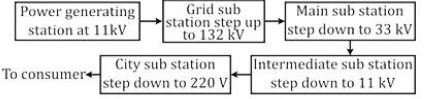
At a power generating station, the electric power is generated at 11 kV. From here, the alternating voltage is transmitted to the grid sub-station and stepped up to 132 kV using a step-up transformer. It is then transmitted to the main sub-station where the voltage is stepped down to 33 kV using a step-down transformer and is then transmitted to the intermediate sub-station. At the intermediate sub-station, the voltage is stepped down to 11 kV using a step-down transformer and is transmitted to the city sub-station, where the voltage is further stepped down to 220 V and is supplied to our houses.
In simple words: Electricity travels from power station to homes through many stations. Voltage goes up for long distance travel, then comes down step by step to safe level for homes.
📝 Teacher's Note: Draw the transmission path on board. Explain why voltage is increased for transmission (less energy loss) and decreased for safety. Like water flowing through pipes of different sizes.
🎯 Exam Tip: Draw simple box diagram showing voltage levels at each stage. Mention transformers are used to step up and step down voltage. Write final voltage as 220 V for homes.
Question 3: At what voltage is the electric power from the generating station transmitted? Give reason to your answer.
Answer: Electric power from the generating station is transmitted at 11 kV because voltage higher
In simple words: Power is sent at high voltage to reduce energy loss during transmission. High voltage means low current for same power, and low current means less heat loss in wires.
📝 Teacher's Note: Explain P = VI relationship. For same power, higher voltage means lower current. Lower current means less I²R losses in transmission lines. Like sending water through big pipes instead of thin ones.
🎯 Exam Tip: Write "to reduce transmission losses" as main reason. Explain that high voltage reduces current, which reduces I²R losses in transmission lines.
Question 4. At what voltage and frequency is the a.c. supplied to our houses?
Answer: At 220 V of voltage and 50 Hz of frequency, the a.c. is supplied to our houses.
In simple words: Our home gets electricity at 220 volts. It changes direction 50 times every second. This is safe for our appliances.
📝 Teacher's Note: Show students the voltage written on any home appliance like a bulb or fan. It will say 220V. This matches what comes from the wall socket.
🎯 Exam Tip: Always write both values: "220 V" and "50 Hz". Do not forget the units V and Hz.
Question 5. Name the device used to (a) increase the voltage at the generating station (b) decrease the voltage at the substation for its supply.
Answer:
(a) Step-up transformer
(b) Step-down transformer
In simple words: Step-up transformer makes voltage higher. Step-down transformer makes voltage lower. Like a volume control for electricity.
📝 Teacher's Note: Use the analogy of a water pump. Step-up is like increasing water pressure. Step-down is like reducing water pressure.
🎯 Exam Tip: Remember: "Step-up" = voltage goes up. "Step-down" = voltage goes down. Write the full names clearly.
Question 6. (a) Name the three connecting wires used in a household circuit (b) Which of the two wires mentioned in part (a) are at the same potential? (c) In which of the wire stated in part (a) the switch is connected?
Answer:
(a) The three connecting wires used in a household circuit are:
(i) Live (or phase) wire (L),
(ii) Neutral wire (N), and
(iii) Earth wire (E).
(b) Among them neutral and earth wires are at the same potential.
(c) The switch is connected in the live wire.
In simple words: Live wire brings electricity. Neutral wire takes it back. Earth wire keeps us safe. Neutral and earth have same voltage level.
📝 Teacher's Note: Show a three-pin plug. Point out each wire color: live is brown/red, neutral is blue/black, earth is green/yellow.
🎯 Exam Tip: Write all three wire names clearly. Remember switch is always in live wire, never in neutral or earth wire.
Question 7. What is the pole fuse? Write down its current rating.
Answer: Before the electric line is connected to the meter in a house, a fuse of rating (≈ 50 A) is connected in the live wire at the pole or just before the meter. This fuse is called the pole fuse. Its current rating is ≈ 50 A
In simple words: Pole fuse is the first safety device that protects your whole house. It is on the electric pole or near your meter.
📝 Teacher's Note: Point to the electric pole near school. The fuse box on top protects all houses connected to that pole.
🎯 Exam Tip: Write "50 A" as the current rating. Remember to include the unit "A" for amperes.
Question 8. State the function of each of the following in a house circuiting? (a) kWh meter (b) main fuse, and (c) main switch
Answer:
(a) After the company fuse, the cable is connected to a kWh meter and from this meter; connections are made to the distribution board through a main fuse and a main switch.
(b) Main fuse is connected in the live wire and in case of high current it gets burnt and cut the connections to save appliances.
(c) Main switch is connected in the live and neutral wires. It is used to cut the connections of the live as well as the neutral wires simultaneously from the main supply.
In simple words: kWh meter counts how much electricity you use. Main fuse protects from too much current. Main switch turns off all electricity to your house.
📝 Teacher's Note: Show the electricity meter at school. The spinning disk shows energy being used. Main switch is like the master power button.
🎯 Exam Tip: For kWh meter write "measures electrical energy consumed". For fuse write "safety device". For switch write "cuts off supply".
Question 9. In what unit does the electric meter in a house measure the electrical energy consumed? What is its value in S.I unit?
Answer: The electric meter in a house measures the electrical energy consumed in kWh. Its value in S.I. unit is 1kwh = \(3.6 \times 10^6\)J
In simple words: The meter measures energy in kWh units. This is what you pay for in your electricity bill.
📝 Teacher's Note: Bring an electricity bill to class. Show students the kWh units consumed. Explain this is what the family pays for.
🎯 Exam Tip: Write "kWh" for the unit and the conversion \(1 \text{ kWh} = 3.6 \times 10^6 \text{ J}\). Remember to use scientific notation.
Question 10. Where is the main fuse in a house circuit connected?
Answer: The main fuse in a house circuit is connected on the distribution board, in live wire before the main switch.
In simple words: Main fuse is in the main electrical box of your house. It is connected to the live wire before the main switch.
📝 Teacher's Note: Point to the main electrical board in the school. The main fuse is usually the biggest fuse at the top.
🎯 Exam Tip: Write "distribution board" and "live wire" clearly. Remember it comes before the main switch.
Question 11. Draw a circuit diagram to explain the ring system of house wiring. State two advantage of it.
Answer:
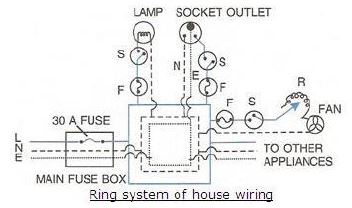
Advantages of ring system over tree system
(i) In a ring system the wiring is cheaper than tree system.
(ii) In ring system the sockets and plugs of same size can be used while in a tree system sockets and plugs are of different size.
(iii) In ring system, each appliance has a separate fuse due to which if there is a fault and the fuse of one appliance burns it does not affect other appliances; while in a tree system when fuse in one distribution line blows, it disconnects all the appliances connected to that distribution circuit.
In simple words: Ring system is like a loop of wires. It is cheaper and safer. If one appliance breaks, others keep working.
📝 Teacher's Note: Draw a simple ring on the board. Show how electricity can flow in two directions to reach any appliance.
🎯 Exam Tip: Always mention "cheaper wiring" and "separate fuse for each appliance" as the main advantages.
Question 12. Draw a labelled diagram with necessary switch, regulator, etc. to connect a bulb and a fan with the mains. In what arrangement are they connected to the mains : series or parallel?
Answer:
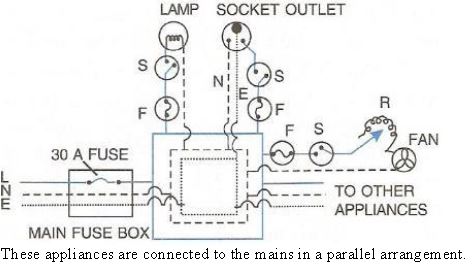
In simple words: Bulb and fan are connected side by side, not one after another. Each gets full voltage from the main supply.
📝 Teacher's Note: Show students two bulbs connected in parallel. When you switch off one, the other keeps glowing.
🎯 Exam Tip: Write "parallel arrangement" clearly. Draw separate switches for each appliance in your diagram.
Question 13. How should the electric lamps be connected with the mains so that the switching on or off a lamp has no effect on other lamps?
Answer: All the electrical appliances in a building should be connected in parallel at the mains, each with a separate switch and a separate fuse connected in the live wire so that the switching on or off in a room has no effect on other lamps in the same building.
In simple words: Connect all lamps in parallel. Each lamp has its own switch and fuse. This way one lamp does not affect others.
📝 Teacher's Note: Turn off one light in the classroom. Show students how other lights keep working. This is parallel connection.
🎯 Exam Tip: Write "parallel connection", "separate switch", and "separate fuse" as the three key points.
Question 14. Fig 9.15 shows two ways (a) and (b) of connecting the three lamps A, B and C to a.c. supply of 220 V. Name the two arrangements. Which of them would you prefer in a household circuit? Give reason for your answer.
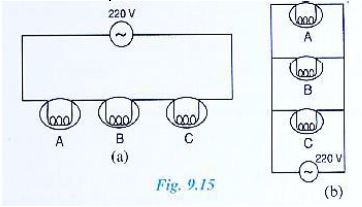
Answer: The two arrangements are (a) series arrangement, and (b) parallel arrangement. In a household circuit we will prefer the second circuit i.e., (b). In circuit (b) each appliance has same voltage of 220 V. Since all the appliances that we use have voltage rating of 220 V in our country, so each bulb works normally.
In simple words: Circuit (a) is series - bulbs are in a line. Circuit (b) is parallel - bulbs are side by side. Parallel is better for homes.
📝 Teacher's Note: Connect two bulbs in series - they will be dim. Connect them in parallel - they will be bright.
🎯 Exam Tip: Write "parallel arrangement is preferred" and give reason "each appliance gets full 220V".
Question 15. Two sets A and B of four bulbs each are glowing in two separate rooms. When one of the bulbs in set A is fused, the other three bulbs also cease to glow. But in set B, when one bulb fuses the other bulbs continue to glow. Explain the difference.
Answer: In set A, the bulbs are connected in series. Thus, when the fuse of one bulb blows off, the circuit gets broken and current does not flow through the other bulbs also. In set B, the bulbs are connected in parallel. Thus, each bulb gets connected to its voltage rating (= 220 V) and even when the fuse of one bulb blows off, others remain unaffected and continue to glow.
In simple words: Set A has bulbs in a line (series). If one breaks, all stop. Set B has bulbs side by side (parallel). If one breaks, others keep working.
📝 Teacher's Note: Use Christmas lights as example. Old ones were series - one bulb out, all go off. New ones are parallel - one out, others stay on.
🎯 Exam Tip: Clearly write "Set A = series connection" and "Set B = parallel connection". Explain what happens when one bulb fails.
Multiple Choice Type
Question 1. The main fuse is connected in:
(a) live wire
(b) neutral wire
(c) both the live and earth wires
(d) both earth and the neutral wire
Answer: (a) live wire
In simple words: Main fuse is always in the live wire. This wire brings electricity to your house. Fuse protects from too much current.
📝 Teacher's Note: Explain that fuse must be in live wire because that is where current enters the house. Never put fuse in neutral or earth wire.
🎯 Exam Tip: Remember fuse is always in live wire for safety. Write "live wire" clearly.
Question 2. The electrical appliances in a house are connected in:
(a) series
(b) parallel
(c) either in series or parallel
(d) both in series and parallel
Answer: (b) parallel
In simple words: All home appliances are connected in parallel. Each appliance works alone without affecting others.
📝 Teacher's Note: Ask students to turn on one light and one fan. Show that they work independently. This is parallel connection.
🎯 Exam Tip: Always choose "parallel" for household appliances. This gives each appliance full voltage.
Question 3. The electric meter in a house records:
(a) charge
(b) current
(c) energy
(d) power
Answer: (c) energy
In simple words: The meter counts how much electrical energy your house uses. You pay money based on this energy usage.
📝 Teacher's Note: Show an electricity bill. Point to the kWh units. Explain this is the energy consumed that the meter records.
🎯 Exam Tip: Electric meter always records "energy" in kWh units. Not current, not power, but energy.
Exercise 9 (C)
Question 1. What is a fuse? Name the material of fuse. State on characteristic of material used for fuse.
Answer: An electric fuse is a safety device, which is used to limit the current in an electric circuit. The use of fuse safeguards the circuit and appliances connected in that circuit from being damaged. An alloy of lead and tin is used as a material of fuse because it has low melting point and high resistivity.
In simple words: Fuse is like a safety guard for electricity. It is made of lead and tin metal. When too much current flows, it melts and stops the current.
📝 Teacher's Note: Show a blown fuse to students. Explain how the thin wire inside melts when current is too high. This protects expensive appliances.
🎯 Exam Tip: Write "safety device", "lead and tin alloy", and "low melting point" as the key points for full marks.
Question 2. Name the device used to protect the electric circuits from over loading and short circuit. On what effect of current does it work?
Answer: An electric fuse is a safety device, which is used to limit the current in an electric circuit. The use of fuse safeguards the circuit and appliances connected in that circuit from being damaged. An alloy of lead and tin is used as a material of fuse because it has low melting point and high resistivity. A fuse works on the heating effect of current.
In simple words: A fuse is like a safety guard for your home's electrical wires. When too much current flows, it melts and breaks the circuit to keep your home safe.
📝 Teacher's Note: Show students a real fuse wire and explain it's like a weak link in a chain. When you pull too hard, the weak link breaks first to protect the rest of the chain.
🎯 Exam Tip: Always write "heating effect of current" as the working principle. Also mention lead-tin alloy has low melting point and high resistivity.
Question 3. Complete the following sentences:
(a) A fuse is a short piece of wire of material of high …………and low ………..
(b) A fuse wire is made of an alloy of ………. and …..If the current in a circuit rises too high, the fuse wire ……….
(c) A fuse is connected in …… with the ………..wire.
Answer:
(a) A fuse is a short piece of wire of material of high resistivity and low melting point.
(b) A fuse wire is made of an alloy of lead and tin. If the current in a circuit rises too high, the fuse wire melts
(c) A fuse is connected in series with the live wire.
In simple words: The fuse material must resist current flow (high resistivity) and melt easily (low melting point). It connects in series with the live wire so all current passes through it.
📝 Teacher's Note: Use ice cube example - ice has low melting point so it melts easily when heated. Similarly, fuse wire melts easily when current is too high.
🎯 Exam Tip: Remember the three key words: "high resistivity", "low melting point", and "series with live wire". These exact phrases get you marks.
Question 4. Why is the fuse wire fitted in a porcelain casing?
Answer: The fuse wire is fitted in a porcelain casing because porcelain is an insulator of electricity.
In simple words: Porcelain does not let electricity pass through it. This keeps people safe from electric shock when they handle the fuse.
📝 Teacher's Note: Show students a porcelain cup and explain it doesn't conduct electricity. That's why electrical fittings use porcelain for safety.
🎯 Exam Tip: Write "porcelain is an insulator" clearly. This shows you understand why this material is chosen for safety.
Question 5. How is a fuse put in an electric circuit? State the purpose of using a fuse in a circuit.
Answer: The fuse wire is stretched between the two metallic terminals T₁ and T₂ in a porcelain holder (since porcelain is an insulator of electricity). This holder fits into a porcelain socket having two metallic terminals to which the live wires of the circuit are connected. A fuse is connected with each electrical appliance to safeguard it from the flow of excessive current through it.
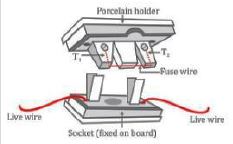
In simple words: The fuse sits between two metal ends in a safe porcelain box. It protects electrical devices by breaking the circuit when current becomes too high.
📝 Teacher's Note: Use the analogy of a bridge with a weak section. When too much weight (current) passes, the weak section (fuse) breaks to protect the rest of the bridge (circuit).
🎯 Exam Tip: Draw the diagram clearly showing porcelain holder, terminals, and live wire connections. Label all parts for full marks.
Question 6. Describe with the aid of a diagram some form of a fuse which is used in the electric lighting circuit of a house. Give two reasons why a fuse must not be replaced by an ordinary copper wire.
Answer: The figure shows the most common fuse arrangement in which the fuse wire is stretched between the two metallic terminals T₁ and T₂ in a porcelain holder. This holder fits into a porcelain socket having two metallic terminals to each of which the live wire of the circuit is connected. A fuse must not be replaced with a copper wire because copper has very low resistivity and high melting point.
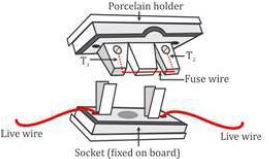
In simple words: Copper wire will not melt when current is too high, so it cannot protect the circuit. It has very low resistance and very high melting point.
📝 Teacher's Note: Compare copper wire to a strong rope and fuse wire to a thin thread. The thin thread breaks first to protect, but the strong rope won't break when needed.
🎯 Exam Tip: State both properties of copper: "very low resistivity" and "high melting point". Explain why each property makes copper unsuitable as a fuse.
Question 7. A fuse is always connected to the live wire of the circuit. Explain the reason.
Answer: The fuse wire is always connected in the live wire of the circuit because if the fuse is put in the neutral wire, then due to excessive flow of current when the fuse burns, current stops flowing in the circuit, but the appliance remains connected to the high potential point of the supply through the live wire. Now if a person touches the appliance, he may get a shock as the person will come in contact with the live wire through the appliance.
In simple words: If fuse is in neutral wire, even when it burns out, the appliance still stays connected to dangerous live wire. A person can get electric shock by touching the appliance.
📝 Teacher's Note: Explain that live wire is dangerous (high voltage) and neutral wire is safe (zero voltage). Fuse must cut off the dangerous wire first for safety.
🎯 Exam Tip: Write that appliance remains connected to "high potential point through live wire" even when neutral fuse burns. This shows you understand the safety risk.
Question 8. Two fuse wire of same length are rated 5 A and 20 A. Which of the two is thicker and why?
Answer: The 20 A fuse wire will be thicker so that its resistance be low.
In simple words: Thicker wire can carry more current safely. Just like a thicker water pipe can carry more water than a thin pipe.
📝 Teacher's Note: Use water pipe analogy. Thick pipe allows more water flow. Similarly, thick wire allows more current flow with less resistance.
🎯 Exam Tip: Write "20 A fuse is thicker" and explain "lower resistance allows higher current". Connect thickness to resistance to current capacity.
Question 9. Explain the meaning of the statement 'the current rating of a fuse is 5 A'.
Answer: It means that the line to which this fuse is connected has a current carrying capacity of 5 A.
In simple words: This fuse can safely handle up to 5 amperes of current. If current goes above 5 A, the fuse will melt and break the circuit.
📝 Teacher's Note: Compare to speed limit on roads. 5 A rating is like saying "maximum safe current is 5 A". Above this limit, fuse breaks for safety.
🎯 Exam Tip: Write "current carrying capacity of 5 A" exactly. This shows you understand what the rating number means.
Question 10. 'A fuse is rated 8 A'. can it be used with an electrical appliance of rating 5kW, 200V?
Answer: The safe limit of current which can flow through the electrical appliance is I = P/V = 5000/200 = 25 A; which is greater than 8 A. So, such fuse cannot be used.
In simple words: The appliance needs 25 A current but fuse can only handle 8 A. The fuse will burn out immediately, so it cannot be used.
📝 Teacher's Note: Always check if appliance current is less than fuse rating. Use formula I = P/V to find appliance current first.
🎯 Exam Tip: Show calculation clearly: I = P/V = 5000/200 = 25 A. Then compare with fuse rating and conclude "cannot be used".
Question 11. An electric kettle is rated 3 kW, 250 V. give reason whether this kettle can be used in a circuit which contains a 13 A fuse.
Answer: Yes, this kettle can be used in a circuit which contains a 13 A fuse because safe limit of current for kettle is, I = 3000W/250V = 12 A
In simple words: The kettle needs 12 A current and the fuse can handle 13 A. Since 12 A is less than 13 A, it's safe to use.
📝 Teacher's Note: Remind students to convert kW to W (3 kW = 3000 W) before calculating. This is a common mistake in exams.
🎯 Exam Tip: Write the calculation clearly and compare: "Kettle current = 12 A < Fuse rating = 13 A, therefore safe to use".
Question 12. What is the purpose of a switch in a circuit? Why is the switch put in the live wire? What precaution do you take while handling a switch?
Answer: A switch is an on-off device for current in a circuit (or in an appliance). The switch should always be connected in the live wire so that the appliance could be connected to the high potential point through the live wire. In this position the circuit is complete as the neutral wire provides the return path for the current. When the appliance does not work i.e., in off position of the switch, the circuit is incomplete and no current reaches the appliance.
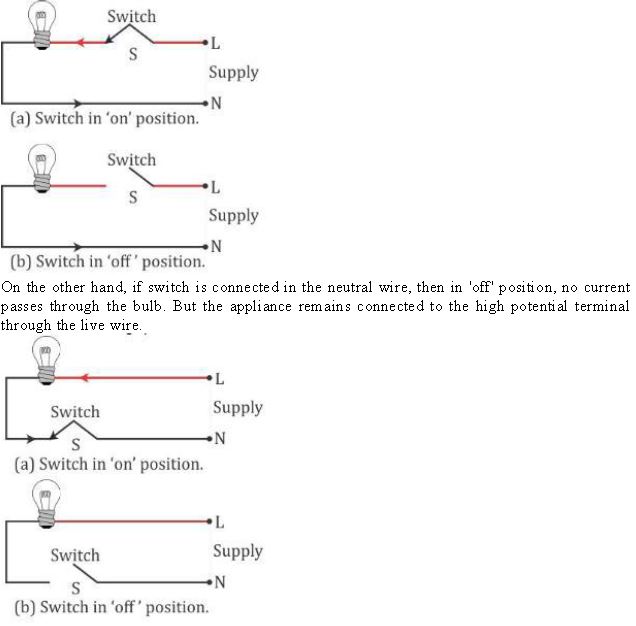
Thus, if the switch is connected in the neutral wire, it can be quite deceptive and even dangerous for the user.
Precaution while handling a switch: A switch should not be touched with wet hands.
In simple words: A switch controls current flow. It must be in live wire to fully disconnect the dangerous high voltage. Never touch switches with wet hands.
📝 Teacher's Note: Demonstrate with a simple circuit showing how switch in neutral wire leaves appliance connected to dangerous live wire even when "off".
🎯 Exam Tip: Explain three parts: switch purpose, why in live wire, and wet hands precaution. Each part carries marks in long answer questions.
Question 13. A switch is not touched with wet hands while putting it on or off. Give a reason for your answer.
Answer: A switch should not be touched with wet hands. If water reaches the live wire, it forms a conducting layer between the hand and the live wire of the switch through which the current passes to the hand and the person may get a fatal shock.
In simple words: Water conducts electricity. Wet hands create a path for current to flow from live wire to your body, causing dangerous electric shock.
📝 Teacher's Note: Explain that pure water doesn't conduct, but water on hands contains salts and minerals that make it conductive. Always keep hands dry around electricity.
🎯 Exam Tip: Write "water forms conducting layer" and "fatal shock". These key phrases show you understand the safety risk clearly.
Question 14. Draw a circuit diagram using the dual control switches to light a staircase electric light and explain its working.
Answer: Let a switch S1 be fitted at the bottom and a switch S2 at the top of the staircase. Fig. (a) shows the off position of the bulb.
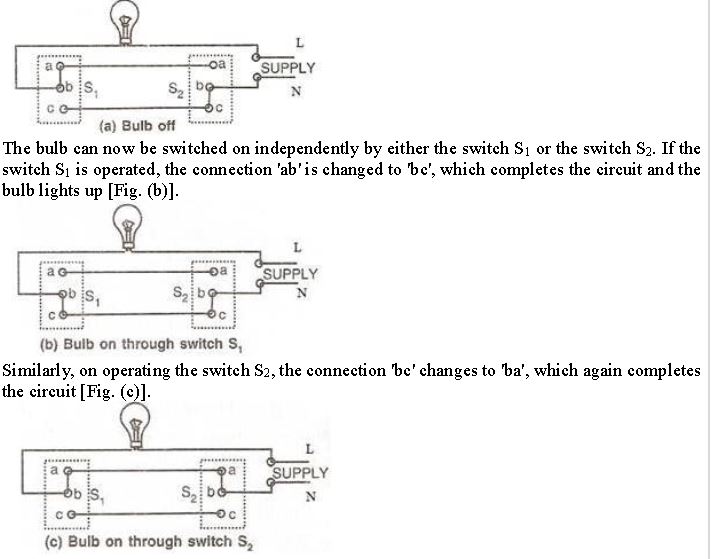
Similarly if the bulb is in on position as shown in Fig. (b) or (c), one can switch off the bulb either from the switch S1 or the switch S2.
In simple words: Two switches control one bulb. You can turn the staircase light on or off from either the bottom or top of the stairs. Very convenient!
📝 Teacher's Note: Explain this is like having two doors to the same room. You can enter or exit from either door. Similarly, you can control the light from either switch.
🎯 Exam Tip: Draw all three circuit diagrams clearly showing switch positions. Label connections 'ab', 'bc', 'ba' to show how circuit completes in different positions.
Question 15. The diagram in Fig. 9.27 shows a three pin plug. Label the three pins.
(a) why if the top pin thicker and longer than the other two?
(b) why are the pins splitted at the ends?
Answer: The three pins in the plug are labelled as:
Here E signifies the earth pin, L is for live wire, and N is for neutral wire.
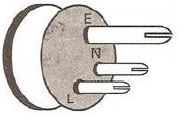
(a) The earth pin is made long so that the earth connection is made first. This ensures the safety of the user because if the appliance is defective, the fuse will blow off. The earth pin is thicker so that even by mistake it cannot be inserted into the hole for the live or neutral connection of the socket.
(b) The pins are splitted at the end to provide spring action so that they fit in the socket holes tightly.
In simple words: The earth pin is bigger and longer for safety. It connects first to protect us. The split ends help the pins stay tight in the socket holes.
📝 Teacher's Note: Show students a real plug and socket. Let them see how the earth pin is different. Explain that it is like a safety guard that works first.
🎯 Exam Tip: Always write "earth connection is made first" and "safety of user". Also mention "spring action for tight fitting" for the split ends.
Question 16. What purpose is served by the terminals of a three way pin plug? Draw a diagram and name the pins.
Answer: All electrical appliances are provided with a cable having a plug at one end to connect the appliance to the electric supply. In this three way pin plug, the top pin is for earthing (E), the live pin (L) in on the left and the neutral pin (N) is on the right.
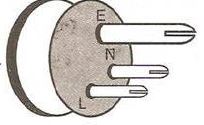
In simple words: The three pins connect the appliance to electricity supply safely. Each pin has a different job - earth for safety, live brings power, neutral completes the circuit.
📝 Teacher's Note: Compare it to a three-leg stool. Each leg has a purpose. Without any one leg, the stool becomes unsafe or useless.
🎯 Exam Tip: Draw the diagram clearly and label all three pins correctly. Write "E for earthing, L for live, N for neutral" to get full marks.
Question 17. Draw a labelled diagram of a three pin socket.
Answer:
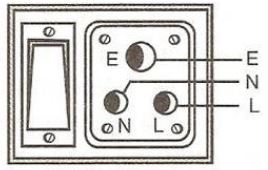
E: for earth pin
N: for neutral wire pin
L: for live wire pin.
In simple words: A socket has three holes that match the three pins of a plug. Each hole is for a specific pin to go in safely.
📝 Teacher's Note: Show students how the plug and socket fit together like puzzle pieces. Each hole is shaped to accept only the right pin.
🎯 Exam Tip: Draw a neat rectangle with three holes inside. Label each hole clearly as E, N, L. Don't forget to show the switch if asked.
Question 18. The diagram in Fig. 9.28 shows a three pin socket marked as 1, 2 and 3.
(a) Identify and write live (L) neutral (N) and earth (E) against the correct number
(b) To which part of the appliance is the terminal 1 connected?
(c) To which wire joined to 2 or 3, is the fuse connected and why?
Answer:
(a) 1 – Earth, 2 – Neutral, 3 – Live
(b) Terminal 1 is connected to the outer metallic case of the appliance.
(c) The fuse is connected to live wire joined to 3 so that in case of excessive flow of current fuse melts first and breaks down the circuit to protect appliances.
In simple words: Number 1 is earth (connects to metal body), 2 is neutral, 3 is live. The fuse goes with the live wire because it brings the dangerous electricity.
📝 Teacher's Note: Use a simple electric iron or heater to show students where the earth wire connects to the metal case. Explain that earth is like a safety exit for electricity.
🎯 Exam Tip: Remember the order: 1-Earth, 2-Neutral, 3-Live. Always write "fuse connected to live wire" and explain it protects the appliance.
Question 19. What do you mean by the term local earthing? Explain how it is done.
Answer: Local earthing is made near kWh meter. In this process a 2 - 3 metre deep hole is dug in the ground. A copper rod placed inside a hollow insulating pipe, is put in the hole. A thick copper plate of dimensions 50 cm × 50 cm is welded to the lower end of the copper rod and it is buried in the ground. The plate is surrounded by a mixture of charcoal and salt to make a good earth connection. To keep the ground damp, water is poured through the pipe from time to time. This forms a conducting layer between the plate and the ground. The upper end of the copper rod is joined to the earth connection at the kWh meter.
In simple words: Local earthing means making a safe path for electricity to go into the ground. We dig a deep hole, put a copper plate and rod in it, and connect it to our house wiring.
📝 Teacher's Note: Compare earthing to a drain pipe for water. Just like water needs a drain, dangerous electricity needs a safe path to the ground.
🎯 Exam Tip: Mention "2-3 metre deep hole", "copper plate 50cm × 50cm", and "charcoal and salt mixture". These specific details get you marks.
Question 20. The metal case of an electric appliance is earthed explain the reason.
Answer: If the live wire of a faulty appliance comes in to direct contact with the metallic case due to some reason then the appliance acquires the high potential of live wire. This may results in shock if any person touches the body of appliance. But if the appliance is earthed then as soon as the live wire comes in to contact with the metallic case, high current flows through the case to the earth. The fuse connected to the appliance will also blows off, so the appliance get disconnected.
In simple words: Earthing protects us from electric shock. If a wire inside breaks and touches the metal case, the earth wire takes the electricity safely to the ground instead of through our body.
📝 Teacher's Note: Explain that our body is also a conductor. Without earthing, we become the path for electricity to reach the ground - that causes shock.
🎯 Exam Tip: Write "prevents electric shock" and "current flows to earth through earth wire". Also mention that "fuse blows off" to disconnect the appliance.
Question 21. (a) the earthing of an electric appliance is useful only if the fuse is in the love wire. Explain the reason.
(b) Name the part of the appliance which is earthed.
Answer:
(a) The fuse must be connected in the live wire only. If the fuse is in the neutral wire, then although the fuse burns due to the flow of heavy current, but the appliance remains at the supply voltage so that on touching the appliance current flows through the appliance to the person touching it.
(b) Metallic case of the appliance should be earthed.
In simple words: The fuse must be on the live wire (the dangerous one). If fuse is on neutral wire, the appliance stays dangerous even after fuse breaks. The metal outer body of appliance is connected to earth.
📝 Teacher's Note: Think of fuse as a security guard. The guard must stop the danger (live wire) at the entrance, not at the exit (neutral wire).
🎯 Exam Tip: Write "fuse must be in live wire" and "metallic case should be earthed". Explain that neutral wire fuse does not make appliance safe.
Question 22. For earthing an electrical appliance, one has to remove the paint from the metal body of the appliance where the electrical contact is made. Explain the reason.
Answer: The paint provides an insulating layer on the metal body of the appliance. To make earth connection therefore, the paint must be removed from the body part where connection is to be made.
In simple words: Paint acts like a plastic cover. It stops electricity from flowing. So we must remove paint where we want electricity to flow to the earth wire.
📝 Teacher's Note: Show students how paint on wire connections prevents good contact. Like putting tape on battery terminals - no electricity flows.
🎯 Exam Tip: Write "paint is an insulator" and "prevents electrical contact". Mention that paint must be removed for proper earthing connection.
Question 23. What is the colour code for the insulation on the (a) live (b) neutral and (c) earth wire?
Answer: According to new international convention
(a) Live wire is brown in colour.
(b) Neutral is light blue and
(c) Earth wire is yellow or green in colour.
In simple words: Different coloured covers help us identify wires easily. Brown is live (dangerous), blue is neutral (safe return), yellow/green is earth (safety wire).
📝 Teacher's Note: Remember: Brown-Live, Blue-Neutral, Yellow/Green-Earth. Use the memory trick: "Brown Bear Lives, Blue Boy is Neutral, Green Grass is Earth".
🎯 Exam Tip: Learn the colour code exactly: Brown-Live, Light Blue-Neutral, Yellow or Green-Earth. Write "international convention" to show you know the standard.
Question 24. A power circuit uses a cable having three different wires.
(a) Name the three wires of the cable.
(b) to which of the two wires should the heating element of an electric geyser be connected?
(c) To which wire should the metal case of the geyser be connected?
(d) to which wire should the switch and fuse be connected?
Answer:
(a) The three wires are: Live wire, Earth wire and Neutral wire.
(b) The heating element of geyser should be connected to live wire and neutral wire.
(c) The metal case should be connected to earth wire.
(d) The switch and fuse should be connected to live wire.
In simple words: The three wires are live, neutral, and earth. Heating element uses live and neutral to work. Metal case connects to earth for safety. Switch and fuse go on live wire to control the dangerous electricity.
📝 Teacher's Note: Explain that heating element needs both live and neutral to complete the circuit, like a closed loop. But controls (switch/fuse) go only on the dangerous live wire.
🎯 Exam Tip: Remember: heating element needs live AND neutral, metal case needs earth, switch and fuse need live wire only.
Question 25. State two circumstances when one may get an electric shock from an electrical gadget. What preventive measure must be provided with the gadget to avoid it?
Answer: One may get an electric shock from an electrical gadget in the following two cases:
(i) If the fuse is put in the neutral wire instead of live wire and due to fault, if an excessive current flows in the circuit, the fuse burns, current stops flowing in the circuit but the appliance remains connected to the high potential point of the supply through the live wire. In this situation, if a person touches the faulty appliance, he may get an electric shock as the person will come in contact with the live wire through the appliance.
Preventive measure: The fuse must always be connected in the live wire.
(ii) When the live wire of a faulty appliance comes in direct contact with its metallic case due to break of insulation after constant use (or otherwise), the appliance acquires the high potential of the live wire. A person touching it will get a shock because current flows through his body to earth.
Preventive measure: Proper 'earthing' of the electric appliance should be done.
In simple words: We get shock in two ways: 1) When fuse is on wrong wire (neutral instead of live), 2) When live wire touches the metal case inside. Prevention: Put fuse on live wire and connect metal case to earth.
📝 Teacher's Note: Explain that our body conducts electricity like a wire. When we touch faulty appliances, we complete the circuit and get shocked.
🎯 Exam Tip: Write two clear situations and their preventive measures. Always mention "fuse in live wire" and "proper earthing" as solutions.
Question 26. Why is it necessary to have an earth wire installed in a power circuit, but not in a lighting circuit?
Answer: Power circuit carries high power and costly devices. If there is some unwanted power signal (noise) in the wire it can damage the device. To reduce this effect earth is necessary. Lighting circuit carries low power (current). So, we ignore the earth terminal.
In simple words: Power circuits use heavy current for big appliances like geysers and irons. These need earth wire for safety. Light bulbs use very little current, so earth wire is not always needed.
📝 Teacher's Note: Compare to water pipes - big pipes for heavy flow need better safety measures. Small pipes for light flow don't need as much protection.
🎯 Exam Tip: Write "high power devices need earth for safety" and "lighting circuits have low power". Mention that costly devices need more protection.
Question 27. Give two characteristic of a high tension wire.
Answer: A high tension wire has a low resistance and large surface area.
In simple words: High tension wires are thick (large surface area) and allow electricity to flow easily (low resistance). This helps carry lots of electricity over long distances.
📝 Teacher's Note: Show students thick power lines outside. Explain that thick wires carry more current just like wide roads carry more traffic.
🎯 Exam Tip: Write exactly "low resistance" and "large surface area". These are the two key characteristics examiners look for.
Question 28. Which of the cables, one rated 5 A and the other 15 A will be of thicker wire? Give a reason for your answer.
Answer: To carry larger current, the resistance of the wire should be low, so its area of cross section should be large. Therefore 15 A current rated wire will be thicker.
In simple words: The 15 A wire will be thicker. Thicker wires can carry more electricity safely, just like wider pipes can carry more water.
📝 Teacher's Note: Show students different thickness wires or cables. Explain that trying to push too much current through thin wire is dangerous - it heats up.
🎯 Exam Tip: Write "15 A wire will be thicker" and explain "larger current needs larger cross-section area". This reasoning gets you full marks.
Question 29. The diagram in Fig. 9.29 shows three lamps and three switches 1, 2 and 3
(a) Name the switch / switches to be closed so as to light all the three lamps.
(b) How are the lamps connected: in series or in parallel?
Answer:
(a) Switches 2 and 3.
(b) The lamps are connected in series.
In simple words: Close switches 2 and 3 to light all lamps. The lamps are in series - like beads on a string, current flows through each one after the other.
📝 Teacher's Note: Draw the circuit on board. Show students how series connection means current has only one path through all devices.
🎯 Exam Tip: Look at the diagram carefully. In series, devices are connected one after another. Write "switches 2 and 3" and "series connection".
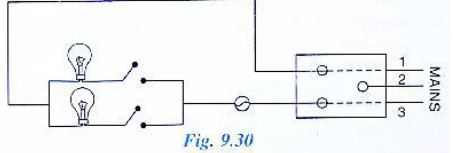
Question 30. Fig 9.30 below shows two bulbs with switches and fuse connected to mains through a socket.
(a) label each component
(b) Name and state the colour of insulation of each wire 1, 2 and 3
(c) How are the two bulbs joined : in series or in parallel?
Answer:
(a) Components should be labeled as: bulbs, switches, fuse, mains socket
(b) Wire 1: Earth wire (Yellow or Green insulation), Wire 2: Neutral wire (Light Blue insulation), Wire 3: Live wire (Brown insulation)
(c) The two bulbs are connected in parallel.
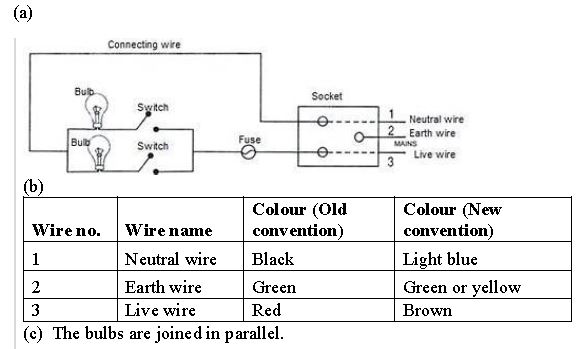
In simple words: Wire 1 is earth (yellow/green), wire 2 is neutral (blue), wire 3 is live (brown). The bulbs are in parallel - each has its own separate path from the main supply.
📝 Teacher's Note: In parallel connection, each bulb can work independently. If one bulb fails, the other still works. Like separate rooms in a house.
🎯 Exam Tip: Learn wire colours: 1-Earth (Yellow/Green), 2-Neutral (Blue), 3-Live (Brown). Parallel means separate paths for each device.
Multiple Choice Type:
Question 1: The rating of a fuse connected in the lighting circuit is:
(a) 15 A
(b) 5 A
(c) 10 A
(d) Zero
Answer: (b) 5 A
In simple words: Light and fan circuits use thin wires that can only carry 5 amperes of current safely. So we use a 5 A fuse to protect them.
📝 Teacher's Note: Show students a thin wire and thick wire. Thin wires get hot with too much current. The fuse breaks if current is more than 5 A to keep wires safe.
🎯 Exam Tip: Remember "lighting circuit = 5 A fuse" and "power circuit = 15 A fuse". Write the exact number clearly.
Question 2: A switch must be connected in:
(a) Live wire
(b) neutral wire
(c) earth wire
(d) either earth or neutral wire
Answer: (a) Live wire
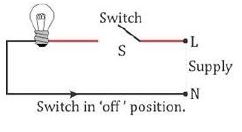
In simple words: The live wire brings electricity to your appliance. When you switch off, you want to stop electricity from reaching the appliance. So the switch must be on the live wire.
[Diagram: This diagram shows a simple circuit with a bulb, switch connected to the live wire (L), and neutral wire (N) going to the supply. The switch is in the 'off' position, breaking the live wire connection.]
📝 Teacher's Note: Think of live wire like a water tap. You put the tap handle on the pipe that brings water in, not on the drain pipe. Same way, switch goes on live wire.
🎯 Exam Tip: Always write "live wire" and explain that it stops current when switched off. Never say neutral wire - that is dangerous.
Wire Color Code Table:
| Wire no. | Wire name | Colour (Old convention) | Colour (New convention) |
|---|---|---|---|
| 1 | Neutral wire | Black | Light blue |
| 2 | Earth wire | Green | Green or yellow |
| 3 | Live wire | Red | Brown |
📝 Teacher's Note: Tell students to remember "Brown Live" (both start with consonants) and "Blue Neutral" (both start with consonants). Green is always earth wire.
🎯 Exam Tip: Learn both old and new color codes. Exams can ask either one. Write the colors exactly as given in the table.
Complete Guide and Answers: Class 10 Physics Chapter 09 Household Circuits
ICSE Chapter Solutions: Class 10 Physics Chapter 09 Household Circuits
Access structured ICSE solutions for Class 10 Physics Chapter 09 Household Circuits designed to match CISCE curriculum standards. These verified answers help clarify complex numericals and support daily homework revision.
Concept Clarification for Chapter 09 Household Circuits
Every exercise question in this chapter includes step-by-step working steps, allowing you to self-evaluate, catch mistakes early, and understand the underlying logic.
Effective Revision Strategies for Chapter 09 Household Circuits
Wrap up your chapter revision by verifying core concepts against standard ICSE question formats. All resources on our platform are free to access.
FAQs
You can download the verified Selina Concise solutions for Chapter 09 Household Circuits on StudiesToday.com. Our teachers have prepared answers for Class 10 Physics as per 2026-27 ICSE academic session.
Yes, our solutions for Chapter 09 Household Circuits are designed as per new 2026 ICSE standards. 40% competency-based questions required for Class 10, are included to help students understand application-based logic behind every Physics answer.
Yes, every exercise in Chapter 09 Household Circuits from the Selina Concise textbook has been solved step-by-step. Class 10 students will learn Physics conceots before their ICSE exams.
Yes, follow structured format of these Selina Concise solutions for Chapter 09 Household Circuits to get full 20% internal assessment marks and use Class 10 Physics projects and viva preparation as per ICSE 2026 guidelines.