

Download ICSE Class 10 Physics Solutions by Selina Concise
Explore the complete Selina Concise textbook solutions for Class 10 Physics. Tailored for the 2026-27 curriculum, this resource breaks down complex topics to support daily study and targeted revision.
Access Chapter 12 Radioactivity Solutions for Class 10 Physics
Navigate directly to the Chapter 12 Radioactivity solutions using the digital viewer below. Organizing your study sessions chapter-by-chapter allows for seamless offline study and quick reference during revision.
Exercise 12(A)
Solution 1. Three constituent of an atom are:
Answer:
- Electrons: mass is \(9.1 \times 10^{-31}\) kg, charge is \(-1.6 \times 10^{-19}\)C
- Neutron: mass is \(1.6749 \times 10^{-27}\) kg, charge is zero.
- Protons: mass is \(1.6726 \times 10^{-27}\) kg, charge is \(+1.6 \times 10^{-19}\) C
In simple words: Atoms have three tiny parts. Electrons are very light and have negative charge. Protons are heavy and have positive charge. Neutrons are heavy but have no charge.
📝 Teacher's Note: Use a simple model like marbles to show students. Big marbles are protons and neutrons in the center. Small marbles are electrons moving around outside.
🎯 Exam Tip: Always write the mass and charge values exactly as given. Remember electrons are the lightest particles.
Solution 2.
Answer:
Atomic number – the number of protons in the nucleus is called atomic number.
Mass number – the total number of nucleons in the nucleus is called mass number.
In simple words: Atomic number tells you how many protons are there. Mass number tells you how many protons and neutrons together are there.
📝 Teacher's Note: Nucleons means protons plus neutrons. Students often forget neutrons when calculating mass number.
🎯 Exam Tip: Write "number of protons" for atomic number and "total number of nucleons" for mass number. These exact phrases get you marks.
Solution 3.
Answer:
- The nucleus at the centre of atom, whose size is of the order of \(10^{-15}\) m to \(10^{-14}\) m.
- The size of a nucleus is \(10^{-5}\) to \(10^{-4}\) times the size of an atom. It consists of protons and neutrons.
- If Z is the atomic number and A is the mass number of an atom, then the atom contains Z number of electrons; Z number of protons and A – Z number of neutrons.
- The atom is specified by the symbol \(_Z X^A\) where X is the chemical symbol for the element.
In simple words: The nucleus is very tiny but has all the heavy particles. The atom symbol shows the element name, atomic number at bottom left, and mass number at top right.
📝 Teacher's Note: Draw a big circle for atom and tiny dot in center for nucleus. This shows how small nucleus is compared to atom.
🎯 Exam Tip: Remember the formula: Number of neutrons = Mass number - Atomic number. Write this clearly in answers.
Solution 4.
Answer:
Atomic number Z = 11
Mass number A = 23
Number of neutrons A – Z = 12
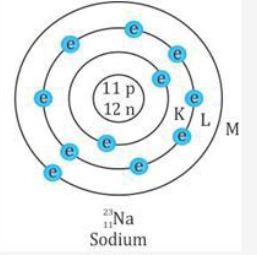
In simple words: This is sodium atom. It has 11 protons, 12 neutrons, and 11 electrons. The electrons move in circles around the nucleus.
📝 Teacher's Note: Show students that electrons equal protons in a neutral atom. The diagram helps them see where each particle is located.
🎯 Exam Tip: Always calculate neutrons using A - Z. Draw the electron arrangement in shells if asked for diagram.
Solution 5. Isotopes:
Answer: The atoms of the same element which have the same atomic number Z but differ in their mass number A are called isotopes.
Example: Hydrogen has three isotopes \(_1H^1\), \(_1H^2\), \(_1H^3\)
In simple words: Isotopes are atoms of the same element but with different weights. They have the same number of protons but different number of neutrons.
📝 Teacher's Note: Use the example of hydrogen isotopes. All have 1 proton but different numbers of neutrons - 0, 1, and 2 neutrons respectively.
🎯 Exam Tip: Write "same atomic number, different mass number" clearly. Give hydrogen isotopes as the best example.
Solution 6. Isobars:
Answer: The atoms of different elements which have the same mass number A, but differ in their atomic number Z are called isobars.
Example: \(_{11}Na^{23}\) & \(_{12}Mg^{23}\)
In simple words: Isobars are atoms of different elements but with the same total weight. They have different numbers of protons but the same mass number.
📝 Teacher's Note: Explain that isobars are different elements completely, unlike isotopes which are the same element. Use the sodium and magnesium example.
🎯 Exam Tip: Write "different atomic number, same mass number" for isobars. This is opposite of isotopes.
Solution 7.
Answer: Atoms of a substance having same atomic number, but different mass numbers are called isotopes.
Example: Hydrogen has three isotopes \(_1H^1\), \(_1H^2\), \(_1H^3\)
Structure of each isotope differs by the number of neutrons in its nuclei.
In simple words: Isotopes have the same number of protons but different number of neutrons. That is why they have different weights.
📝 Teacher's Note: Emphasize that isotopes are the same element chemically but physically different due to different neutron numbers.
🎯 Exam Tip: Always mention that isotopes differ by neutron number. This is the key point examiners look for.
Solution 8. Radioactivity:
Answer: Radioactivity is a nuclear phenomenon. It is the process of spontaneous emission of α or β and γ radiations from the nuclei of atoms during their decay.
Example: uranium, radium.
In simple words: Some atoms are unstable and break down on their own. When they break, they give out dangerous rays called radiations.
📝 Teacher's Note: Explain that radioactivity happens in the nucleus, not in the electron shells. Use examples of uranium and radium that students may have heard about.
🎯 Exam Tip: Write "spontaneous emission" and "nuclear phenomenon" - these are key phrases. Give uranium and radium as examples.
Solution 9.
Answer: There will be no change in the nature of radioactivity. This is because radioactivity is a nuclear phenomenon.
In simple words: External conditions like heat or cold do not change radioactivity. This is because radioactivity comes from inside the nucleus, not from outside.
📝 Teacher's Note: Students often think temperature or pressure can stop radioactivity. Explain that only nuclear changes can affect it, not physical changes.
🎯 Exam Tip: Write "nuclear phenomenon" as the reason. This shows you understand radioactivity happens in the nucleus.
Solution 10.
Answer:
(a) Three types of radiations: Alpha, beta and gamma.
(b) Alpha and beta radiations
(c) Gamma radiations
(d) Gamma radiations
(e) Alpha radiations
(f) Beta radiations
In simple words: Alpha and beta are particles with charge. Gamma rays have no charge. Alpha particles are the heaviest and gamma rays are the lightest.
📝 Teacher's Note: Make a simple table showing alpha (heavy, positive), beta (light, negative), and gamma (no mass, no charge) for easy comparison.
🎯 Exam Tip: Remember the pattern - alpha is heaviest and has most charge, gamma is lightest with no charge, beta is in between.
Solution 11.
Answer:
(a) Gamma radiations have zero mass.
(b) Gamma radiations have the lowest ionizing power.
(c) Alpha particles have lowest penetrating power.
(d) Alpha particle has positive charge equal to \(3.2 \times 10^{-19}\)C and rest mass equal to 4 times the mass of proton i.e. \(6.68 \times 10^{-27}\) kg.
(e) The gas is Helium.
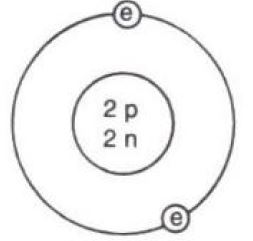
(f) These radiations come from nucleus of the atom.
In simple words: Alpha particles are actually helium atoms without electrons. They come from the nucleus when radioactive atoms break down.
📝 Teacher's Note: Explain that alpha particle is helium nucleus - 2 protons + 2 neutrons. When it gains electrons, it becomes helium gas.
🎯 Exam Tip: Write the exact charge and mass values given. Remember alpha particle = helium nucleus.
Solution 12.
Answer:
- Radiations labeled A, B and C are α, β and γ respectively.
- Radiation labeled A is gamma radiation because they have no charge and hence under action of magnetic field they go undeflected.
- Radiation B is alpha radiation because its mass is large and it would be deflected less in comparison to beta radiation. The direction of deflection is given by Fleming's left hand rule. Also directions of deflection of alpha and beta radiations are opposite as they have opposite charge.
In simple words: In a magnetic field, gamma rays go straight (no charge), alpha particles bend a little (heavy and positive), beta particles bend a lot (light and negative).
📝 Teacher's Note: Draw the magnetic field deflection pattern on board. Show students how charges bend in opposite directions based on Fleming's left hand rule.
🎯 Exam Tip: Remember - no deflection = gamma, less deflection = alpha, more deflection = beta. Mention Fleming's left hand rule for direction.
Solution 13.
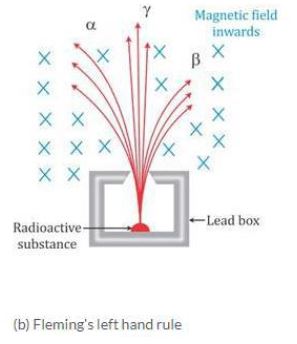
In simple words: The diagram shows how different radiations behave in a magnetic field. The straight line is gamma, the slightly curved line is alpha, and the highly curved line is beta.
📝 Teacher's Note: Use this diagram to explain the practical identification of radiations. Students should understand the pattern of deflection.
🎯 Exam Tip: In such diagrams, identify radiations by their deflection pattern. Gamma = straight, alpha = less curved, beta = more curved.
Solution 14.
Answer:
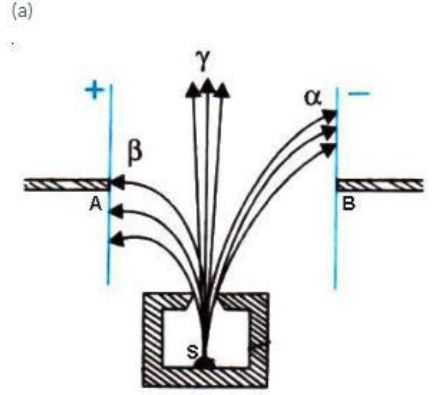
(b) The radioactive substances are kept in thick lead containers with a very narrow opening, so as to stop radiations coming out from other directions because they may cause biological damage.
[Diagram: This diagram shows a radioactive source in a thick lead container with alpha, beta, and gamma radiations emerging through a narrow opening.]
In simple words: Lead blocks radiations very well. We use thick lead boxes with small holes to control where the radiations go, so they do not harm people.
📝 Teacher's Note: Explain that lead is very dense and stops radiations. The narrow opening allows controlled use of radiations for medical or research purposes.
🎯 Exam Tip: Write "thick lead containers" and "biological damage" as key points. Lead is the best material for radiation shielding.
Solution 15.
Answer: This is because alpha and beta particles are charged particles, but gamma rays are neutral particles.
In simple words: Only charged particles can be deflected by electric or magnetic fields. Since gamma rays have no charge, they cannot be deflected.
📝 Teacher's Note: Remind students that only charged particles interact with electric and magnetic fields. Neutral particles like gamma rays are unaffected.
🎯 Exam Tip: Write "charged particles" for alpha and beta, "neutral particles" for gamma. This explains the deflection behavior.
Solution 16.
Answer: No, it is not possible to deflect gamma radiation in a way similar to alpha and beta particles, using the electric or magnetic field because they are neutral and hence do not deflected under the action of electric or magnetic field.
In simple words: Gamma rays cannot be bent by magnets or electric fields because they have no electric charge. Only charged particles can be deflected.
📝 Teacher's Note: Use the analogy of a magnet attracting iron nails but not plastic balls. Gamma rays are like plastic balls - no charge to interact with fields.
🎯 Exam Tip: Write "neutral" and "no deflection" clearly. This is a common exam question about gamma ray properties.
Solution 17.
Answer:
| Property | α-particle | β-particle | γ-particle |
|---|---|---|---|
| Nature | Stream of positively charged particles, i.e. helium nuclei. | Stream of negatively charged particles, i.e. energetic electrons. | Highly energetic electromagnetic radiation. |
| Charge | Positive charge (Two times that of a proton) = + \(3.2 \times 10^{-19}\) C (or +2e) | Negative charge = – \(1.6 \times 10^{-19}\) C (or -e) | No charge |
| Mass | Four times the mass of proton i.e., \(6.68 \times 10^{-27}\) kg | Equal to the mass of electron, i.e. \(9.1 \times 10^{-31}\) kg | No mass (Rest mass is zero) |
| Effect of electric field | Less deflected | More deflected than alpha particles but in direction opposite to those of α particles | Unaffected |
In simple words: Alpha is heavy and positive, beta is light and negative, gamma has no mass or charge. This table shows all the main differences.
📝 Teacher's Note: This comparison table is very important. Make students memorize the key differences - mass, charge, and deflection behavior.
🎯 Exam Tip: Learn this table by heart. Exam questions often ask to compare these three radiations. Include exact values for mass and charge.
Solution 18.
Answer: Ionizing power of alpha radiation is maximum i.e., 10000 times of gamma radiation while beta particles have lesser ionizing power i.e., 100 times of gamma radiation and gamma radiation have least ionizing power.
Penetration power is least for alpha particle and maximum for gamma radiation.
In simple words: Alpha rays can damage atoms easily but cannot go through things. Gamma rays can go through everything but damage atoms less. Beta rays are in between.
📝 Teacher's Note: Explain that ionizing power and penetrating power are opposite. Heavy particles ionize more but penetrate less.
🎯 Exam Tip: Remember the numbers - alpha is 10000 times, beta is 100 times compared to gamma for ionizing power. Write both ionizing and penetrating powers.
Solution 19.
Answer:
- Speed of α radiation is nearly \(10^7\) m/s.
- Speed of β radiation is about 90% of the speed of light or \(2.7 \times 10^8\) m/s.
- Speed of γ radiation is \(3 \times 10^8\) m/s in vacuum.
In simple words: Gamma rays are the fastest (speed of light), beta rays are very fast (90% of light speed), alpha rays are slowest but still very fast.
📝 Teacher's Note: Compare with everyday speeds. Even the slowest alpha rays are millions of times faster than a car.
🎯 Exam Tip: Remember gamma = speed of light, beta = 90% of light speed, alpha = much slower. Write the exact values given.
Solution 20.
Answer:
- Alpha radiations are composed two protons and two neutrons.
- Beta particles are fast moving electrons.
- Gamma radiations are photons or electromagnetic waves like X rays.
- Alpha radiations have the least penetrating power.
In simple words: Alpha particles are like tiny helium atoms. Beta particles are fast electrons. Gamma rays are like very powerful light rays.
📝 Teacher's Note: Help students understand that these are three completely different types of things - particles vs waves, heavy vs light, charged vs neutral.
🎯 Exam Tip: Write the composition clearly - alpha (2p + 2n), beta (electrons), gamma (electromagnetic waves). Mention penetrating power order.
Solution 21.
Answer:
- Gamma radiation are produced when a nucleus is in a state of excitation (i.e., it has an excess of energy). This extra energy is released in the form of gamma radiation.
- Gamma radiations like light are not deflected by the electric and magnetic field.
- Gamma radiations have the same speed as that of light.
In simple words: When a nucleus has too much energy, it gives out that energy as gamma rays. These rays travel at the speed of light and are not affected by magnets.
📝 Teacher's Note: Think of gamma rays like light from a torch. They move very fast and magnets cannot bend them. Show students how a magnet cannot bend light from a torch.
🎯 Exam Tip: Always write that gamma rays have "same speed as light" and are "not deflected by electric or magnetic fields." These are key marking points.
Solution 22.
Answer: It will become singly ionized helium \( He^+ \).
In simple words: The helium atom loses one electron and becomes a positive ion with a + charge.
📝 Teacher's Note: Explain that when an atom loses an electron, it becomes positive. Use the example of removing one marble from a balanced set.
🎯 Exam Tip: Write the correct symbol \( He^+ \) clearly. The + sign shows it has lost one electron.
Solution 23.
Answer: Any physical changes (such as change in pressure and temperature) or chemical changes (such as excessive heating, freezing, action of strong electric and magnetic fields, chemical treatment, oxidation etc.) do not alter the rate of decay of the radioactive substance. This clearly shows that the phenomenon of radioactivity cannot be due to the orbital electrons which could easily be affected by such changes. The radioactivity should therefore be the property of the nucleus. Thus radioactivity is a nuclear phenomenon.
In simple words: No matter how much you heat, cool, or change a radioactive material, it keeps decaying at the same rate. This proves radioactivity comes from the nucleus, not the outer electrons.
📝 Teacher's Note: Compare this to a ticking clock that keeps the same time whether you put it in hot or cold places. The radioactive nucleus is like that clock.
🎯 Exam Tip: Write "nuclear phenomenon" clearly and mention that external conditions do not affect the rate of decay. This shows you understand the concept.
Solution 24.
Answer: On emitting a β particle, the number of nucleons in the nucleus (i.e. protons and neutrons) remains same, but the number of neutrons is decreased by one and the number of protons is increased by one.
If a radioactive nucleus P with mass number A and atomic number Z emits a beta particle to form a daughter nucleus Q with mass number A and atomic number Z+1, then the change can be represented as follows:
(a) Atomic number 'Z' is not conserved. It is increased by 1.
(b) Mass number A is conserved.
In simple words: In beta decay, one neutron changes into one proton. The total number of particles stays the same, but the atom gets one more proton.
📝 Teacher's Note: Use marbles to show students. If you have 10 red (neutrons) and 5 blue (protons), beta decay changes 1 red to blue. Total marbles same, but more blue ones.
🎯 Exam Tip: Always write "atomic number increases by 1" and "mass number remains same" for beta decay. These are key points examiners look for.
Solution 25.
Answer: Beta particle. Its symbols \( _{-1}^0e \) or \( _{-1}^0β \).
In simple words: Beta particle is like an electron that comes out from the nucleus. It has no mass and negative charge.
📝 Teacher's Note: Tell students that beta particle is not the same as orbital electrons. It comes from inside the nucleus when a neutron breaks down.
🎯 Exam Tip: Write both symbols correctly: \( _{-1}^0e \) or \( _{-1}^0β \). The -1 shows negative charge and 0 shows no mass.
Solution 26.
Answer:
(a) Atomic number decreases by 2.
(b) Atomic number increases by 1.
(c) Atomic number does not change.
In simple words: Alpha decay reduces atomic number by 2, beta decay increases it by 1, gamma decay keeps it same.
📝 Teacher's Note: Make a simple chart: α = -2, β = +1, γ = 0. Students can memorize this easily for atomic number changes.
🎯 Exam Tip: Learn these changes by heart: alpha (-2), beta (+1), gamma (0). This is tested in many questions.
Solution 27.
Answer:
(a) After emitting an alpha particle the daughter element occupies two places to the left of the parent element in the periodic table.
Reason: If a parent nucleus X becomes a new daughter nucleus Y as a result of α-decay, then the α-decay can be represented as: Thus, the resulting nucleus has an atomic number equal to (Z-2). Hence, it shifts two places to the left of the parent element in the periodic table.
(b) After emitting a β-particle, the daughter element occupies one place to the right of the parent element in the periodic table.
Reason: If a parent nucleus X becomes a new daughter nucleus Y as a result of β-decay, then the β-decay can be represented as: Thus, the resulting nucleus has an atomic number equal to (Z+1). Hence, it shifts one place to the right of the parent element in the periodic table.
(c) After emitting γ-radiation, the element occupies the same position in the periodic table.
Reason: If a parent nucleus X becomes a new daughter nucleus Y as a result of γ-decay, then the γ-decay can be represented as: Thus, the resulting nucleus has atomic number equal to Z. Hence, it occupies the same position as the parent element in the periodic table.
In simple words: Alpha decay moves element 2 steps left, beta decay moves 1 step right, gamma decay keeps it in same place in periodic table.
📝 Teacher's Note: Use a periodic table and point with your finger. Show students the left-right movement for different decays. This makes it visual and easy to remember.
🎯 Exam Tip: Remember the directions: alpha = 2 left, beta = 1 right, gamma = same place. Draw arrows to show this in your answer.
Solution 28.
Answer: The following changes occur when an atom emits:
An alpha particle: atomic number decreases by 2 and mass number decreases by 4.
Example: \( ^{238}U_{92} \rightarrow ^{234}Th_{90} + ^4He_2 \)
A beta particle: atomic number increases by one, but mass number does not change.
Example: \( ^{14}C_6 \rightarrow ^{14}N_7 + ^0β_{-1} \)
Gamma particle: it does not change anything in the nucleus, the energy of the nucleus decreases.
Example: \( ^A_ZX^* \rightarrow ^A_ZX + γ \)
In simple words: Alpha takes away 4 mass and 2 protons, beta changes neutron to proton, gamma just releases energy without changing the nucleus.
📝 Teacher's Note: Use building blocks to show students. Alpha removes 4 blocks (2 protons + 2 neutrons). Beta changes color of 1 block. Gamma just makes light but no blocks change.
🎯 Exam Tip: Always write the changes in numbers: alpha (-4 mass, -2 atomic), beta (0 mass, +1 atomic), gamma (no change). Give one example for each.
Solution 29.
Answer:
(a) The composition of B – 82 protons and 126 neutrons.
(b) The composition of C – 83 protons and 125 neutrons.
(c) The mass number of nucleus A = no. of protons + no. of neutrons = 84+128=212.
(d) There will be no change in the composition of nucleus C.
In simple words: We count protons and neutrons to find the composition. Mass number is just adding protons plus neutrons together.
📝 Teacher's Note: Teach students the simple formula: Mass number = Protons + Neutrons. Use fingers to count and add them up.
🎯 Exam Tip: Always show your calculation clearly: Mass number = P + N = number + number = final answer. Don't skip the addition step.
Solution 30.
Answer:
(a) The alpha particle was emitted.
(b) This is because the atomic number has decreased by 2 and mass number has decreased by 4.
In simple words: When atomic number drops by 2 and mass number drops by 4, it means an alpha particle came out.
📝 Teacher's Note: Teach the pattern: if you see -2 atomic and -4 mass, it's always alpha. Make students remember this signature.
🎯 Exam Tip: Look for the changes in numbers. Alpha = -2 and -4, Beta = +1 and 0, Gamma = 0 and 0. The numbers tell you which particle was emitted.
Solution 31.
Answer:
(a) This is allowed.
(b) This is not allowed because mass number is not conserved.
In simple words: In nuclear reactions, mass number must stay the same on both sides. If it doesn't match, the reaction cannot happen.
📝 Teacher's Note: Compare this to a balance scale. Both sides must weigh the same. If mass numbers don't add up equally, the reaction is impossible.
🎯 Exam Tip: Always check if mass numbers add up equally on both sides. If they don't, write "not allowed" and state "mass number not conserved."
Solution 32.
Answer: An atom is specified by the symbol \( ^A_ZX \) where X is the chemical symbol for the element. Z is the atomic number and A is the mass number of an atom, then the atom contains Z number of electrons, Z number of protons and A - Z number of neutrons.
a. 24 is the mass number and 11 is the atomic number.
b. \( ^{24}Na_{11} \rightarrow ^{24}Mg_{12} + ^0e_{-1} \)
c. Isobar
In simple words: The big number on top is mass number (total particles). Small number below is atomic number (protons). Isobars have same mass but different protons.
📝 Teacher's Note: Draw the symbol \( ^A_ZX \) on the board clearly. Point to each number and explain what it means. Students often confuse which number is which.
🎯 Exam Tip: Always write the nuclear equation with correct symbols. Remember: top number is mass, bottom number is atomic. For isobars, write "same mass number, different atomic numbers."
Solution 33.
Answer: If Z is the atomic number and A is the mass number of an atom, then the atom contains Z number of electrons, Z number of protons and A - Z number of neutrons. The atom is specified by the symbol \( ^A_ZX \) where X is the chemical symbol for the element.
a. Atomic number is 15 and mass number is 31.
b. Atomic number is 15 and mass number is 32.
c. Atomic number is 16 and mass number is 32.
In simple words: Look at the symbol carefully. The top number is mass, bottom number is atomic. Use these to find protons, neutrons, and electrons.
📝 Teacher's Note: Give students practice reading nuclear symbols. Make them identify mass and atomic numbers from symbols like \( ^{31}P_{15} \).
🎯 Exam Tip: Read nuclear symbols carefully. Top = mass number, bottom = atomic number. Don't mix them up or you'll lose marks.
Solution 34.
Answer: The atomic number of P decreases by 2 and mass no. decreases by 4 due to the emission of one alpha particle and then increases by 1 due to the emission of each beta particle, so the atomic number of Q formed after the emission of one alpha and two beta particles is same as that of P. Hence P and Q are the isotopes.
In simple words: P loses 2 protons from alpha, then gains 2 protons from two betas. Net change is zero, so P and Q have same atomic number but different mass. They are isotopes.
📝 Teacher's Note: Use simple math: -2 (alpha) + 1 (beta) + 1 (beta) = 0. Show students how the atomic numbers end up the same.
🎯 Exam Tip: Calculate step by step: alpha (-2), beta (+1), beta (+1). Net change = -2+1+1 = 0. Therefore isotopes (same atomic number).
Solution 36.
Answer:
(a) The mass number (A) of an element is not changed when it emits beta and gamma radiations.
(b) The atomic number of a radioactive element is not changed when it emits gamma radiations.
(c) During the emission of a beta particle, the mass number remains same.
In simple words: Beta and gamma don't change mass number. Only gamma keeps atomic number same too. Alpha is the only one that changes both.
📝 Teacher's Note: Make a table showing what each radiation changes. Alpha changes both, beta changes only atomic number, gamma changes neither.
🎯 Exam Tip: Remember: only alpha particle changes mass number. Beta and gamma keep mass number unchanged.
Solution 37.
Answer:
(a) \( x + 1 ^3Q \)
(b) \( ^4He_2 \)
(c) \( ^{234}Q_{90}, ^{234}P_{91}, ^{234}S_{92} \)
(d) \( ^{A-4}_{Z-2}X_1, ^{A-4}_{Z-2}X_2, ^{A-4}_ZX_3 \)
(e) \( ^{176}X_{71}, ^{180}Y_{75}, ^{180}X_{72} \)
In simple words: These are nuclear symbols and equations. Each shows how atoms change when they emit particles.
📝 Teacher's Note: Work through each symbol step by step. Show students how to balance nuclear equations by checking mass and atomic numbers.
🎯 Exam Tip: Always balance nuclear equations. Mass numbers must add up equally on both sides, and atomic numbers must add up equally too.
Solution 38.
Answer: Radio isotopes: The isotopes of some elements with atomic number Z. Example: carbon (Z=6, A=14). Radio isotopes are used in medical and scientific and industrial fields. Radio isotopes such as \( ^{232}U_{92} \) are used as fuel for atomic energy reactors.
In simple words: Radio isotopes are unstable forms of atoms that give out radiation. They are used in hospitals, research, and power plants.
📝 Teacher's Note: Explain that radio isotopes are like regular elements but they break down over time, giving out energy. Like a battery that slowly runs out.
🎯 Exam Tip: Define radio isotopes as "unstable isotopes that emit radiation." Give one example and one use (medical, industrial, or research).
Solution 39.
Answer: Because they cannot penetrate the human skin.
In simple words: Alpha particles are too weak to go through skin. They get stopped by the top layer of our skin.
📝 Teacher's Note: Compare alpha particles to trying to throw cotton balls at a wall. They are too light and weak to go through even thin barriers.
🎯 Exam Tip: Write "cannot penetrate human skin" - this shows you know alpha particles have very low penetrating power.
Solution 40.
Answer: Gamma radiations have very high penetration power and can easily pass through the human body. Therefore they are used as radioactive tracers in medical science.
In simple words: Gamma rays can go through the whole body easily. Doctors use them to see inside patients and track medicines.
📝 Teacher's Note: Compare gamma rays to X-rays that doctors use. They can go through skin and organs to show what's happening inside the body.
🎯 Exam Tip: Write "high penetration power" and "can pass through human body" to explain why gamma rays are used in medicine.
Solution 41.
Answer: When the number of neutrons exceeds much than the number of protons in a nuclei, it become unstable or radioactive.
In simple words: If there are too many neutrons compared to protons, the nucleus becomes wobbly and unstable. It starts breaking down.
📝 Teacher's Note: Think of a stack of books. If you put too many on one side, the stack becomes unbalanced and falls. Too many neutrons make the nucleus unbalanced.
🎯 Exam Tip: Write "excess neutrons" or "neutron to proton ratio too high" to explain what makes nuclei unstable.
Solution 42.
Answer: (a) \( ^{14}C_6 \), (b) \( ^{32}P_{15} \), (c) \( ^{39}K_{19} \). The reason is that the number of neutrons exceeds the number of protons.
In simple words: These atoms have more neutrons than protons, which makes them radioactive. They will break down over time.
📝 Teacher's Note: Show students how to calculate neutrons = mass number - atomic number. When neutrons are much more than protons, the atom is radioactive.
🎯 Exam Tip: Always calculate neutrons and protons separately. If neutrons are much higher than protons, the isotope is likely radioactive.
Solution 43.
Answer: Many diseases such as leukemia, cancer, etc., are cured by radiation therapy. Radiations from cobalt-60 are used to treat cancer by killing the cells in the malignant tumor of the patient. The salt of weak radioactive isotopes such as radio-sodium chloride, radio-iron and radio-iodine are used for diagnosis. Such radio isotopes are called the tracers.
In simple words: Radiation can kill cancer cells and cure diseases. Weak radioactive materials help doctors see inside the body to find problems.
📝 Teacher's Note: Explain that radiation is like a strong medicine - it can kill bad cells but must be used carefully. Tracers are like colored dyes that help doctors see inside.
🎯 Exam Tip: Mention two uses: "radiation therapy for cancer treatment" and "radioactive tracers for diagnosis." Give examples like cobalt-60 and radio-iodine.
Solution 44.
Answer: α < β < γ
An α-particle rapidly loses its energy as it moves through a medium and therefore its penetrating power is quite small. It can penetrate only through 3-8 cm in air. It can easily be stopped by a thin card sheet or a thick paper.
The penetrating power of β-particles is more than that of the α-particles. They can pass through nearly 5 m in air, through thin card sheet, and even through thin aluminium foil, but a 5 mm thick aluminium sheet can stop them.
Whereas, the penetrating power of γ-rays is high. It is about \( 10^4 \) times that of α-particles and \( 10^2 \) times that of β-particles. They can pass through 500 m in air or through 30 cm thick sheet of iron. Thick sheet of lead is required to stop them.
In simple words: Alpha is weakest (stopped by paper), beta is medium (stopped by aluminum), gamma is strongest (needs thick lead to stop).
📝 Teacher's Note: Use everyday examples: alpha stopped by paper, beta stopped by aluminum foil, gamma needs thick metal. This makes penetrating power easy to remember.
🎯 Exam Tip: Write the order α < β < γ clearly. Give what can stop each: paper (alpha), aluminum (beta), lead (gamma). This shows you understand penetrating power.
Solution 45. Two main sources of nuclear radiations are:
Answer:
- Radioactive fallout from nuclear plants and other sources.
- Disposal of nuclear waste.
These radiations are harmful because when these radiations falls on the human body, they kill the human living tissues and cause radiation burns.
In simple words: Nuclear radiation comes mainly from nuclear power plants and nuclear waste. These rays are dangerous because they damage our body cells and burn our skin.
📝 Teacher's Note: Tell students that nuclear radiation is like invisible harmful rays. They come from nuclear power plants and nuclear waste. These rays can hurt our body badly.
🎯 Exam Tip: Write both sources clearly - radioactive fallout and nuclear waste disposal. Explain that these radiations kill living tissues. This gets full marks.
Solution 46. The following safety measures must be taken in a nuclear power plant:
Answer:
- The nuclear reactor must be shielded with lead and steel walls so as to stop radiations from escaping out to the environment during its normal operation.
- The nuclear reactor must be housed in an airtight building of strong concrete structure which can withstand earthquakes, fires and explosion.
- There must be back up cooling system for the reactor core, so that in case of failure of one system, the other cooling system could take its place and the core is saved from overheating and melting.
In simple words: Nuclear plants need thick walls to stop radiation. They need strong buildings to survive disasters. They need extra cooling systems so the reactor does not get too hot.
📝 Teacher's Note: Use the example of a bank vault with thick walls. Nuclear plants also need thick walls but to stop radiation, not thieves. Always have backup systems.
🎯 Exam Tip: Write all three points - lead/steel shielding, strong concrete building, backup cooling. Mention specific materials like lead and steel for full marks.
Solution 47. The radioactive material after its use is known as nuclear waste.
Answer: It must be buried in the specially constructed deep underground stores made quite far from the populated area.
In simple words: Used nuclear material becomes nuclear waste. We must bury it very deep underground, far away from cities and towns where people live.
📝 Teacher's Note: Explain that nuclear waste is like poisonous garbage that stays dangerous for many years. It must be buried deep like treasure, but to keep it away from people.
🎯 Exam Tip: Write "deep underground stores" and "far from populated areas." These are key phrases examiners look for.
Solution 48. Three safety precautions that we would take while handling the radioactive substances are:
Answer:
- Put on special lead lined aprons and lead gloves.
- Handle the radioactive materials with long lead tongs.
- Keep the radioactive substances in thick lead containers with a very narrow opening, so as to stop radiations coming out from other directions.
In simple words: When working with radioactive materials, wear lead clothes and gloves. Use long metal tools to hold them. Store them in thick lead boxes with small openings.
📝 Teacher's Note: Lead is like a shield against radiation. Show students that doctors wear lead aprons during X-rays. Same idea for nuclear materials.
🎯 Exam Tip: Always mention "lead" in all three points - lead aprons, lead tongs, lead containers. Lead is the key protective material.
Solution 49. Radioactive substance should not be touched by hands because these radiations are harmful; when radiation falls on the human body, they kill the human living tissues and cause radiation burns.
Answer: These radiations are harmful; when radiation falls on the human body, they kill the human living tissues and cause radiation burns.
In simple words: Never touch radioactive things with bare hands. The invisible rays will damage your body cells and burn your skin badly.
📝 Teacher's Note: Compare radioactive materials to very hot objects. Just as hot things burn your skin when touched, radioactive things harm your body with invisible rays.
🎯 Exam Tip: Write "kill living tissues" and "radiation burns." These exact phrases show you understand how radiation harms the body.
Solution 50. Background radiation: These are the radioactive radiations to which we all are exposed even in the absence of an actual visible radioactive source.
Answer: These are the radioactive radiations to which we all are exposed even in the absence of an actual visible radioactive source.
There are two sources of background radiation:
- Internal source: potassium, carbon and radium are present inside our body.
- External sources: cosmic rays, naturally occurring radioactive elements such as radon-222 and solar radiation.
It is not possible for us to keep ourselves away from the background radiations.
In simple words: Background radiation means we are always surrounded by small amounts of radiation. It comes from inside our body and from space and earth. We cannot avoid it completely.
📝 Teacher's Note: Tell students that background radiation is like background noise. It is always there but usually not harmful in small amounts. Our body has small amounts of radioactive elements naturally.
🎯 Exam Tip: Define background radiation first. Then list both internal sources (potassium, carbon, radium) and external sources (cosmic rays, radon, solar). Mention that we cannot avoid it.
Solution 1 (MCQ). α or β
Answer: α or β
Hint: In a single radioactive decay, α and β particles are never emitted simultaneously. There will be either an α-emission or a β-emission, which may be accompanied by γ emission.
In simple words: In one radioactive decay, either alpha or beta particles come out, never both together. Gamma rays can come with either one.
📝 Teacher's Note: Think of radioactive decay like choosing one door - either alpha door or beta door, never both at the same time. Gamma can come with either choice.
🎯 Exam Tip: Remember that α and β are never emitted together in one decay. Write "either α or β" clearly.
Solution 2 (MCQ). The nucleus of the atom.
Answer: The nucleus of the atom
Hint: Radioactivity is a nuclear phenomenon. Hence, electrons come out from the nucleus. Electron is created as a result of decay of one neutron into a proton inside the nucleus and it is not possible for the electron to stay inside the nucleus; thus, it is spontaneously emitted.
In simple words: Beta particles (electrons) come from the nucleus center of the atom. A neutron changes into a proton and releases an electron.
📝 Teacher's Note: The nucleus is like the center of an atom. When a neutron breaks down, it becomes a proton plus an electron. The electron flies out as beta radiation.
🎯 Exam Tip: Write "nucleus" clearly. Beta particles come from nuclear changes, not from electron shells around the nucleus.
Solution 3 (MCQ). (a) α – particles
Answer: (a) α – particles
An α – particle rapidly loses its energy as it moves through a medium and therefore its penetrating power is quite small. It can penetrate only through 3 – 8 cm in air. It can easily be stopped by a thin card sheet or a thick paper.
In simple words: Alpha particles are the weakest. They can only travel a few centimeters in air. Even thick paper can stop them.
📝 Teacher's Note: Think of alpha particles like heavy, slow balls. They cannot go very far and are easily stopped by paper, like catching a slow ball.
🎯 Exam Tip: Write "lowest penetrating power" and mention "stopped by paper." Alpha particles are the easiest to block.
Solution 4 (MCQ). (b) β-particles
Answer: (b) β-particles
β-particles are negatively charged, so they get deflected by the electric and magnetic fields. The deflection of β-particle is more than that of a-particle since a β-particle is lighter than the α-particle. Whereas, gamma radiations are not deflected by the electric and magnetic fields since they are not charged particles.
In simple words: Beta particles have negative charge, so magnets and electric fields can bend their path. They bend more than alpha because they are lighter.
📝 Teacher's Note: Beta particles are like small charged balls. When you bring a magnet near them, they curve away. Alpha particles are heavier so they curve less.
🎯 Exam Tip: Write "negatively charged" and "deflected more than alpha." Beta particles are lighter so they bend more in fields.
Exercise 12(B)
Solution 1. Energy released by combining of nuclei of an atom or by decay of an unstable radioactive nucleus during a nuclear reaction i.e., during fusion or fission is known as nuclear energy.
Answer: Energy released by combining of nuclei of an atom or by decay of an unstable radioactive nucleus during a nuclear reaction i.e., during fusion or fission is known as nuclear energy.
In simple words: Nuclear energy comes from breaking big atoms apart (fission) or joining small atoms together (fusion). Both release huge amounts of energy.
📝 Teacher's Note: Think of nuclear energy like breaking or joining Lego blocks. Breaking big blocks or joining small blocks can release energy, but nuclear energy is much more powerful.
🎯 Exam Tip: Mention both fusion (joining) and fission (splitting) in your definition. Write "nuclear reaction" as the key process.
Solution 1 (MCQ). (d) neutron A neutron is used in nuclear fission for bombardment.
Answer: (d) neutron
A neutron is used in nuclear fission for bombardment.
In simple words: Neutrons are used to hit heavy atoms and split them. Neutrons work best because they have no charge.
📝 Teacher's Note: Neutrons are like invisible bullets that can hit the nucleus easily because they have no electric charge to repel them.
🎯 Exam Tip: Write "neutron" and explain it is used for bombardment in fission. Neutrons are neutral so they penetrate easily.
Solution 1 (Num).
Answer:
1 a.m.u. = 1.66 × \(10^{-27}\) kg
→ 0.2 a.m.u. = 0.2 × 1.66 × \(10^{-27}\) kg
Δm = 0.332 × \(10^{-27}\) kg
\(E = 0.332 \times 10^{-27} \text{ kg} \times (3 \times 10^8)^2\)
\(E = 2.988 \times 10^{-11}\) J
\(E = \frac{2.988 \times 10^{-11}}{1.3 \times 10^{-13}}\)
In simple words: We convert mass units to kg, then use Einstein's formula \(E = mc^2\) to find the energy released.
📝 Teacher's Note: Show students the step-by-step conversion from a.m.u. to kg first, then apply the energy formula. Each step must be clear.
🎯 Exam Tip: Always convert a.m.u. to kg first. Use \(c = 3 \times 10^8\) m/s. Show all calculation steps clearly for full marks.
Solution 2. Einstein's mass-energy equivalence relation : E = Δmc²
Answer: Einstein's mass-energy equivalence relation : E = Δmc²
Where E is the energy released due to the loss in the mass Δm and c is the speed of light.
In simple words: Einstein's formula shows that mass can change into energy. When mass is lost, energy is created. The speed of light is used in the calculation.
📝 Teacher's Note: Tell students this is Einstein's famous formula. Even a tiny bit of mass can make huge energy because the speed of light is very big.
🎯 Exam Tip: Write the formula \(E = \Delta mc^2\) clearly. Define each symbol - E is energy, Δm is mass lost, c is speed of light.
Solution 2 (MCQ). (d) \(10^7\)K
Answer: (d) \(10^7\)K
To make the fusion possible, a high temperature of approximately \(10^7\) K and high pressure is required.
In simple words: Nuclear fusion needs extremely high temperature - about 10 million degrees. This is much hotter than the sun's surface.
📝 Teacher's Note: Compare this temperature to familiar things. The sun's surface is 6000K. Fusion needs 1000 times hotter than that!
🎯 Exam Tip: Write \(10^7\) K clearly. Mention that both high temperature and high pressure are needed for fusion.
Solution 2 (Num).
Answer:
Given that Δm = 0.0265 a.m.u.
1 a.m.u. liberates 931.5 MeV of energy. Thus, energy liberated equivalent to 0.0265 a.m.u. is
= 0.0265 a.m.u. × 931.5 MeV
= 24.7 MeV
In simple words: We know that 1 a.m.u. gives 931.5 MeV energy. So we multiply the mass loss by this value to get total energy.
📝 Teacher's Note: Teach students the conversion factor: 1 a.m.u. = 931.5 MeV. This is a standard value they must remember.
🎯 Exam Tip: Remember the conversion: 1 a.m.u. = 931.5 MeV. Multiply directly for quick energy calculation. Show units clearly.
Solution 3.
Answer:
(a) The mass of atomic particles is expressed in terms of atomic mass unit (a.m.u.). 1 a.m.u. of mass is equivalent to 931 MeV of energy.
(b) Mass of proton = 1.00727 a.m.u.
Mass of neutron = 1.00865 a.m.u.
Mass of electron = 0.00055 a.m.u.
In simple words: We measure atomic particle mass in special units called a.m.u. Each particle has a different mass value in these units.
📝 Teacher's Note: Tell students that a.m.u. is like a special weighing scale for tiny particles. Neutron is slightly heavier than proton. Electron is much lighter.
🎯 Exam Tip: Remember the conversion 1 a.m.u. = 931 MeV. Write all three particle masses with correct decimal places.
Solution 4. Nuclear fission is the process in which a heavy nucleus is splits into two light nuclei nearly of the same size by bombarding it with slow neutrons.
Answer: Nuclear fission is the process in which a heavy nucleus is splits into two light nuclei nearly of the same size by bombarding it with slow neutrons.
\(^{235}U + ^1_0n → (^{236}U) → ^{144}_{56}Ba + ^{89}_{36}Kr + 3^1_0n + Energy\)
In simple words: Nuclear fission means splitting a big atomic nucleus into two smaller pieces using neutrons. This releases lots of energy.
📝 Teacher's Note: Think of fission like breaking a big stone with a hammer. The neutron is the hammer, the uranium is the big stone.
🎯 Exam Tip: Write "heavy nucleus splits into two light nuclei" and "bombarded with slow neutrons." Include the uranium example equation.
Solution 5.
Answer:
(a) \(^{235}U\) and \(^{238}U\)
(b) Experimentally it is found that isotope of \(^{235}U\) is more easily fissionable because the fission of \(^{235}U\) is possible by slow neutron unlike \(^{238}U\) where fission is possible only by the fast neutrons.
(c) Slow and fast both.
In simple words: Uranium-235 breaks easily with slow neutrons. Uranium-238 needs fast neutrons to break. Both types of neutrons can cause fission.
📝 Teacher's Note: Compare this to breaking different types of glass. Some glass breaks easily with gentle tap (U-235), some needs hard hit (U-238).
🎯 Exam Tip: Write both isotopes U-235 and U-238. Mention that U-235 uses slow neutrons, U-238 needs fast neutrons.
Solution 6. Nearly 190 MeV of energy is released due to fission of one nucleus of \(^{235}U\). The cause of emission of this energy is the loss in mass i.e., the sum of masses of product nuclei is less than the sum of mass of the parent nucleus and neutron.
Answer: Nearly 190 MeV of energy is released due to fission of one nucleus of \(^{235}U\). The cause of emission of this energy is the loss in mass i.e., the sum of masses of product nuclei is less than the sum of mass of the parent nucleus and neutron.
In simple words: When uranium-235 splits, it releases 190 MeV energy. This energy comes because the products weigh less than the original uranium.
📝 Teacher's Note: The missing mass becomes energy according to Einstein's formula. It's like magic - mass disappears and energy appears!
🎯 Exam Tip: Write "190 MeV" and explain that energy comes from "mass defect" or "loss in mass." This shows you understand the source.
Solution 7.
Answer:
(a) \(^{235}U + ^1_0n → ^{141}_{56}Ba + ^{92}_{36}Kr + 3^1_0n + Energy\)
(b) \(^{235}U + ^1_0n → ^{143}_{57}La + ^{90}_{35}Br + 3^1_0n + energy\)
In simple words: These are two different ways uranium-235 can split when hit by a neutron. Both produce energy and more neutrons.
📝 Teacher's Note: Show students that uranium can break in different ways, like breaking a stick at different points. The products are different but energy is always released.
🎯 Exam Tip: Balance the equation properly - mass numbers and atomic numbers must be equal on both sides. Always include energy term.
Solution 8. A chain reaction is a series of nuclear fissions whereby the neutrons produced in each fission cause additional fissions, releasing enormous amount of energy.
Answer: A chain reaction is a series of nuclear fissions whereby the neutrons produced in each fission cause additional fissions, releasing enormous amount of energy.
It is controlled by absorbing some of the neutrons emitted in the fission process by means of moderators like graphite, heavy water, etc. then the energy obtained in fission can be utilized for the constructive purposes.
In simple words: Chain reaction means one fission causes more fissions, like dominoes falling. We control it by absorbing some neutrons with special materials.
📝 Teacher's Note: Use the domino analogy - one domino falls and hits others, causing a chain. In nuclear fission, one split creates neutrons that cause more splits.
🎯 Exam Tip: Define chain reaction as "series of fissions" and mention control using moderators like graphite or heavy water.
Solution 9.
Answer:
(i) It is used in a nuclear bomb.
(ii) It is used in a nuclear reactor where the rate of release of energy is slow and controlled which is used to generate electric power.
In simple words: Chain reactions can be used in two ways - fast and uncontrolled in bombs, slow and controlled in power plants.
📝 Teacher's Note: Compare to fire - uncontrolled fire is destructive (bomb), controlled fire is useful (power plant). Same nuclear reaction, different control.
🎯 Exam Tip: Write both uses - nuclear bomb (uncontrolled) and nuclear reactor (controlled). Mention "controlled release" for power generation.
Solution 10.
Answer:
| Radioactive decay | Nuclear Fission |
|---|---|
| It is a self process. | It does not occur by itself. Neutrons are bombarded on a heavy nucleus. |
| The nucleus emits either the α or β particles with the emission of energy in form of γ rays which is not very large. | A tremendous amount of energy is released when a heavy nucleus is bombarded with neutrons and the nucleus splits in two nearly equal fragments. |
| The rate of radioactive decay cannot be controlled. | The rate of nuclear fission can be controlled. |
In simple words: Radioactive decay happens naturally and cannot be controlled. Nuclear fission needs neutron bombardment but can be controlled.
📝 Teacher's Note: Radioactive decay is like natural aging - it happens by itself. Fission is like breaking things with a hammer - you control when and how fast.
🎯 Exam Tip: Make a clear table with three differences - natural vs induced, energy amount, and controllability. Use proper table format.
Solution 11. Nuclear fission is the process in which a heavy nucleus is splits into two light nuclei nearly of the same size by bombarding it with slow neutrons.
Answer: Nuclear fission is the process in which a heavy nucleus is splits into two light nuclei nearly of the same size by bombarding it with slow neutrons.
When uranium with Z = 92 is bombarded with neutron, it splits into two fragments namely barium (Z = 56) and krypton (Z = 36) and a large amount of energy is released which appears due to decrease in the mass.
Nuclear fusion is also known as thermo-nuclear reaction. This is because nuclear fusion takes place at very high temperature.
In simple words: Fission splits big atoms into smaller ones using neutrons. Fusion joins small atoms at very high temperature. Both release energy.
📝 Teacher's Note: Fission is like breaking, fusion is like joining. Both are opposite processes but both release energy because they make more stable atoms.
🎯 Exam Tip: Define both processes clearly. Mention that fusion is called "thermo-nuclear" because it needs very high temperature.
Solution 12. When two nuclei approach each other, due to their positive charge, the electrostatic force of repulsion between them becomes too strong that they do not fuse.
Answer: When two nuclei approach each other, due to their positive charge, the electrostatic force of repulsion between them becomes too strong that they do not fuse. Thus, nuclear fusion is not possible at ordinary temperature and ordinary pressure.
Hence to make the fusion possible, a high temperature of approximately \(10^7\) K and high pressure is required. At such a high temperature, due to thermal agitations both nuclei acquire sufficient kinetic energy so as to overcome the force of repulsion between them when they approach each other, and so they get fused.
In simple words: Nuclei have positive charges, so they push each other away. Very high temperature gives them enough energy to overcome this pushing force.
📝 Teacher's Note: Think of two magnets with same poles - they push away. Nuclear fusion is like forcing these magnets together using very high energy.
🎯 Exam Tip: Explain electrostatic repulsion between positive nuclei. Mention \(10^7\) K temperature needed to overcome repulsion. High temperature gives kinetic energy.
Solution 13.
Answer:
a. \(^2_1H\) + \(^2_1H\) → \(^3_2He\) + \(^1_0n\) + 3.3MeV
(deuterium) (deuterium) (helium isotope) (neutron)
\(^3_2He\) + \(^2_1H\) → \(^4_2He\) + \(^1_1H\) + 18.3MeV
(helium isotope) (deuterium) (helium) (proton)
(b) In all three deuterium nuclei fuse to form a helium nucleus with a release of 21.6 MeV energy.
(c) When two deuterium nuclei (\(^2_1H\)) fuse, nucleus of helium isotope (\(^3_2He\)) is formed and 3.3 MeV energy is released. This helium isotope again gets fused with one deuterium nucleus to form a helium nucleus (\(^4_2He\)) and 18.3 MeV of energy is released in this process.
In simple words: Two deuterium atoms join to make helium-3 and release energy. Then helium-3 joins with another deuterium to make helium-4 and more energy.
📝 Teacher's Note: This is a two-step fusion process. First step makes helium-3, second step makes normal helium-4. Both steps release energy.
🎯 Exam Tip: Write both equations clearly with energy values. Explain that total energy is 3.3 + 18.3 = 21.6 MeV from three deuterium nuclei.
Solution 14.
Answer:
(a)
(a) \(^3_2He + ^2_1H → ^4_2He + ^1_1H + energy\)
(b) \(^2_1H + ^2_1H → ^3_2He + ^1_0n + energy\)
In simple words: These are two common fusion reactions. Light atoms join together to form heavier atoms and release energy.
📝 Teacher's Note: Show students that in fusion, small atomic numbers add up to make bigger ones. Mass numbers and atomic numbers must balance.
🎯 Exam Tip: Balance both mass numbers (top) and atomic numbers (bottom). Always include energy term in fusion equations.
Solution 15.
Answer:
(a) Nuclear fusion
(b) Nuclear fission
In simple words: Part (a) shows light atoms joining (fusion). Part (b) shows heavy atom splitting (fission).
📝 Teacher's Note: Help students identify processes by looking at atomic numbers - small numbers joining = fusion, big number splitting = fission.
🎯 Exam Tip: Look at the direction - light to heavy is fusion, heavy to light is fission. Check atomic numbers to confirm.
Solution 16. Both fission and fusion create release of neutrons and large amount of energy.
Answer: Both fission and fusion create release of neutrons and large amount of energy.
Nuclear fission: A heavy nucleus splits in two nearly equal light fragments when bombarded with neutrons. It is possible at very ordinary temperature and pressure.
Nuclear fusion: Two light nuclei combine to form a heavy nucleus at very high temperature and high pressure. Possible only at a very high temperature (≈\(10^7\) K) and a very high pressure.
In simple words: Both processes release lots of energy and neutrons. Fission works at normal temperature, but fusion needs extremely high temperature.
📝 Teacher's Note: Both processes make energy because they create more stable atomic arrangements. Fission is easier to achieve than fusion.
🎯 Exam Tip: Mention energy and neutron release for both. State temperature difference - fission at ordinary temperature, fusion at \(10^7\) K.
Solution 17.
Answer:
1. \(^1_1H\) + \(^1_1H\) → \(^2_1H\) + 0.42 MeV
(proton) (proton) (deuterium)
2. \(^2_1H\) + \(^2_1H\) → \(^3_2He\) + \(^1_1H\) + 4.0 MeV
(deuterium) (deuterium) (tritium) (proton)
In simple words: These are fusion reactions where hydrogen atoms join to make heavier atoms and release energy.
📝 Teacher's Note: First reaction makes deuterium from two protons. Second reaction shows two deuterium atoms fusing. Both release energy.
🎯 Exam Tip: Write the nuclear symbols correctly with mass and atomic numbers. Include energy values with correct units (MeV).
Solution 18.
Answer: The source of energy in the Sun and stars is the nucleus fusion of light nuclei such as hydrogen present in them in their inner part. This takes place at a very high temperature and high pressure due to which helium nucleus is formed with the release of high amount of energy.
In simple words: The Sun gets its energy by joining small hydrogen atoms together to make bigger helium atoms. This happens because the Sun is very hot and has huge pressure inside. When atoms join, lots of energy comes out as heat and light.
📝 Teacher's Note: Show students how two small things can join to make one bigger thing and release energy. Like when you clap your hands together - they make a sound and heat. But in the Sun, it makes huge amounts of light and heat.
🎯 Exam Tip: Write "nuclear fusion" clearly. Mention that light nuclei like hydrogen join to form heavier nuclei like helium. Always write that huge energy is released in this process.
Solution 19.
Answer:
(a) Nuclear fission
(b) Nuclear fusion
In simple words: Fission means breaking apart - big atoms split into smaller pieces. Fusion means joining together - small atoms combine to make bigger ones.
📝 Teacher's Note: Use your hands to show fission (pull apart) and fusion (push together). Students remember better when they see actions. Fission is like breaking a cookie into pieces. Fusion is like joining two pieces of clay.
🎯 Exam Tip: Remember: fission = splitting (like in nuclear power plants), fusion = joining (like in the Sun). Don't mix these up in exams.
ICSE Study Resources for Class 10 Physics Chapter 12 Radioactivity
Download ICSE Answers for Class 10 Physics Chapter 12 Radioactivity
Strengthen your preparation with comprehensive answers for Class 10 Physics Chapter 12 Radioactivity. These expert-reviewed solutions make tracking your academic progress straightforward and efficient.
How to Use These Class 10 Physics Solutions
Verify your answers instantly using the comprehensive breakdowns provided for each problem, ensuring complete syllabus coverage across all sub-topics.
Complete Your ICSE Chapter Revision
Explore our broader library of study materials and chapter notes to support your continuous revision and secure higher marks.
FAQs
You can download the verified Selina Concise solutions for Chapter 12 Radioactivity on StudiesToday.com. Our teachers have prepared answers for Class 10 Physics as per 2026-27 ICSE academic session.
Yes, our solutions for Chapter 12 Radioactivity are designed as per new 2026 ICSE standards. 40% competency-based questions required for Class 10, are included to help students understand application-based logic behind every Physics answer.
Yes, every exercise in Chapter 12 Radioactivity from the Selina Concise textbook has been solved step-by-step. Class 10 students will learn Physics conceots before their ICSE exams.
Yes, follow structured format of these Selina Concise solutions for Chapter 12 Radioactivity to get full 20% internal assessment marks and use Class 10 Physics projects and viva preparation as per ICSE 2026 guidelines.