

Class 6 Social Science Solved Model Papers: CBSE Class 6 Social Science Sample Paper Set 17
Review targeted exam resources with the CBSE Class 6 Social Science Sample Paper Set 17. Built according to official CBSE standards for the 2026-27 academic year, these downloadable Class 6 Social Science sample papers support effective revision and performance tracking.
Download Class 6 Social Science Sample Paper PDF
View or download the dedicated CBSE Class 6 Social Science Sample Paper Set 17 resource below. Engaging with these sample papers under timed conditions ensures continuous academic progress and mastery of the 2026-27 exam format.
CBSE Class 6 Social Science Sample Paper Set Q. Sample Papers are the very important for every student. The sample papers should be practiced to gain extra marks in examinations. The sample papers have been prepared based on summative assessment1 and summative assessment 2 pattern. The sample papers have been prepared based on pattern of last year examinations and as per latest changes in the syllabus. Students, teachers and parents can download all CBSE educational material and very well prepared worksheets from this website. All CBSE educational material is developed by our panel of teachers, have also been submitted by CBSE teachers and students.
HISTORY- [30]
Q.15. Fill in the blanks: [½×6 = 3]
(i) ___________ ___________ is the story between a king named Dushyant and a young woman named Shakuntala.
(ii) The mother of Samundra Gupta, Kumar devi, belonged to the ___________ gana.
(iii) Chinese pilgrim__________ __________ spent a lot of time at Harsha’s court and left a detailed account of what he saw.
(iv) The Prashasti of Pulkehin II was composed by his court poet ___________.
(v) The __________ was a village assembly found in areas where the land owners were not brahmins.
(vi) ___________ meant a minister of war and peace.
Q.16. Define these terms: [1 × 4 = 4]
(i) Prashasti
(ii) Aryavarta
(iii) Genealogy
(iv) Samanta
Q.17. Answer the questions in brief: [2 × 3= 6]
(i) What was the condition of untouchables according to Fa- xian?
(ii) Who were the Pallavas and Chalukyas? Explain briefly.
(iii) How did Samundragupta treat the Gana Sangha and the Kushanas and Shakas?
Q.18. (A) Study each picture and answer the following questions: [3]
(i) Identify and name it.
(ii) Where is it situated?
(iii) During whose time was it built.
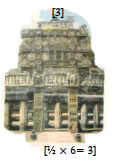
(B) Study the picture and fill in the blanks:
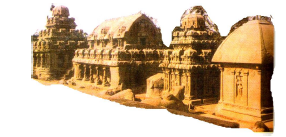
(a) This is _________ at __________.
(b) Each of these was carved out of a huge, single piece of __________.
(c) That is why they are known as __________.
(d) While brick structures are built up by adding layers of bricks from the bottom upwards, in this case the stone cutters had to work from top __________.
(e) It was built by __________.
Q.19. Answer the following in detail. (Any two) [3 × 2= 6]
(i) What changes do you find in the army at the time of formation new empires and kingdoms?
(ii) Describe the main events of Harshavardhan’s career.
(iii) Pulkeshin II was the best known Chalukya ruler. Explain in brief.
Q.20. On a physical map of India, mark and label these places: [1 × 5= 5]
(i) Sanchi
(ii) Pataliputra
(iii) Kalinga
(iv) Cheras
(v) Aihole
CIVICS- [20]
Q.11. Fill in the blanks: [½ × 4= 2]
(i) The ____________ is a meeting of all adults who live in the area covered by Panchayat
(ii) While the councillors take decisions, the administrative staff led by the commissioner ____________ these.
(iii) ___________ actually makes developmental plan at district level.
(iv) The city of __________ had a plague scare in 1994.
Q.12. Write ‘true’ or ‘false’ for each statement. [½ × 4= 2]
(i) Yasmin Khala was a retired judge.
(ii) The secretary of the Gram Sabha is an elected person.
(iii) It is the secretary who calls the meeting of the Gram Sabha and Gram Panchayat.
(iv) Every village Panchayat is divided into wards i.e. smaller areas.
Q.13. Define the following : [1 × 4=4]
(i) Alderman
(ii) Tax
(iii) Sarpanch
(iv) Toll Tax
Q.14. Answer the following questions briefly: [2 × 3= 6]
(i) What are elected head and Chief Executive officers of Municipal corporation known as?
(ii) Describe the functions of Gram Sabha.
(iii) Explain committees.
Q.15. Answer the following questions in detail: (Any two) [3 × 2=6]
(vii) How does the Municipal corporation earn the money to do its work.
(viii) Explain Zila Parishad.
(ix) Name the three administrative institutions in the urban areas.
GEOGRAPHY- [30]
Q.14. Fill in the blanks: [½ × 6= 3]
(i) The ___________ range in India is the oldest fold Mountains.
(ii) The permanently frozen rivers of ice are known as ___________.
(iii) The _________ __________ is the continuous wearing down and rebuilding of land surface.
(iv) ___________ delta is the largest delta of the world.
(v) A small river or stream that joins the main river from either side is known as ___________.
(vi) The Western Ghats are also known as __________.
Q.15. Define the following terms: [1 × 3= 3]
(i) Internal process
(ii) Sub- Continent
(iii) Alluvial deposit
Q.16. Give reasons: [2 × 3= 6]
(i) Plains are thickly populated regions of the world.
(ii) Plateaus are called Tableland.
(iii) Deserts have very little vegetation.
Q.17. Answer in following questions: [3 × 2= 6]
(i) Name three parallel ranges of the Himalayas and write one important feature of each range.
(ii) Name three types of mountains and state the formation of each.
Q.18. Distinguish between the Western Coastal Plains and the Eastern Coastal Plains. [2 + 2= 4]
Q.19. How are mountains useful to us? [4]
Q.20. On the given map of India, shade and label any four physical features of India and attach to your answer sheet.
Please click the below link to access CBSE Class 6 Social Science Sample Paper Set Q.
Free study material for Social Science
Download CBSE Sample Papers: Class 6 Social Science
Class 6 Social Science CBSE Class 6 Social Science Sample Paper Set 17 PDF Download Guide
Review model practice papers for Class 6 Social Science. Working through the CBSE Class 6 Social Science Sample Paper Set 17 under simulated test conditions at home ensures complete familiarity with upcoming school evaluations.
Why Practice Class 6 Social Science Sample Papers?
- Exam Blueprint: Understand mark allocations and structural guidelines relevant to Class 6 evaluations.
- Targeted Improvement: Identify weak areas in Class 6 Social Science requiring focused revision.
- Pacing & Precision: Practice mixed question formats to build execution speed and ensure timely paper completion.
How to Analyze Your Performance in CBSE Class 6 Social Science Sample Paper Set 17
- Self-Evaluation: Score your answers using official guidance to track your academic progress.
- Mistake Correction: Class 6 pupils must re-solve questions answered incorrectly to master the correct method.
- Continuous Practice: Take additional Social Science sample modules online to maximize preparedness for CBSE evaluations.
FAQs
You can download the complete PDF for CBSE Class 6 Social Science Sample Paper Set 17 for free from StudiesToday.com. Our resources for Class 6 Social Science are updated for the latest academic session and follow the official exam pattern.
Yes, CBSE Class 6 Social Science Sample Paper Set 17 comes with detailed, teacher-verified solutions. We have provided step-by-step answers for Social Science to help students of Class 6 understand correct methodology and marking scheme.
Practicing this Social Science paper helps in time management and identifying important topics. For Class 6, solving mock papers is the best way to gain confidence and reduce exam-day anxiety.
Yes, all our study materials for Class 6 Social Science are provided in a mobile-friendly PDF format. You can easily download CBSE Class 6 Social Science Sample Paper Set 17 on your mobile device.