

Sample Question Papers for Class 6 Social Science
Access comprehensive sample question papers for Class 6 Social Science using the CBSE Class 6 Social Science Sample Paper Set 14. Designed to align with the 2026-27 CBSE academic guidelines, these model papers help students assess their exam readiness and understand current marking schemes.
Practice Class 6 Social Science Exam Papers
Navigate directly to the solved Social Science model papers using the digital viewer below. Each practice set includes detailed solutions, allowing students to instantly cross-check their work and identify areas requiring further revision.
CBSE Class 6 Social Science Sample Paper Set N. It’s always recommended to practice as many sample papers as possible before the examinations. Students can download the sample papers and also question papers of previous years to practice and score better marks in examinations. Refer to other links too for more sample papers.
SECTION – A
Q.1 Fill in the blanks. (1×6=6)
i) Blue planet is to Earth what Red planet is to ________.
ii) In a world map, the maximum distortion is at the ________.
iii) Baked utensils were necessary for storing ________.
iv) A structure believed to be a dockyard was discovered at ________.
v) ________is a site where megalithic burial has been found.
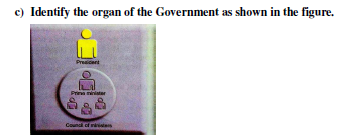
vi) The system of courts is known as the ________.
Q.2 Choose the correct option. (1×6=6)
i) Which of the following was not an important GOD of the later vedic period?
(a) Brahma (b) Vishnu
(c) Indra (d) Shiva
ii) The form of government in India can best be described as :
(a) Democracy (b) Parliamentary democracy
(c) Monarchy (d) Presidential democracy
iii) Which of the following Harappan site is in Gujarat?
(a) Rupar (b) Kalibanga
(c) Dholavira (d) none of these
iv) A map uses a scale in which 1 cm on the map covers 50 meters on the ground. If two places are 4 cm apart on the map, the actual distance between them is.
(a) 50 meters (b) 100 meters
(c) 150 meters (d) 200 meters
v) Neolithic people used the wheel:
(a) In transportation (b) In pot making
(c) In spinning thread (d) Possibly in all these things
vi) Palaeolithic man's life span was about:
(a) 20-25 years (b) 50-60 years
(c) 70-75 years (d) 100 years
Q.3 Define the following. (1×6=6)
i) Constellation ii) North Line
iii) Greenwich Mean time iv) Terracotta
v) Domestication vi) Franchise
Q.4 Name the following. (1×6=6)
i) The largest and the brightest thing in the night sky.
ii) The parallel that lies 23½0 N of Equator.
iii) The first metal to be used by man.
iv) Yagna performed by vedic kings to expand their kingdoms.
v) The highest court in India.
vi) Name a country which is in the southern hemisphere.
Q.5 Match the following. (1×5=5)
A B
a) Sacrifice to gain more power i) Nilgiri Hills
b) Megalith ii) Implementing Laws
c) Executive iii) Rajasuya
d) Todas iv) Large stone blocks
e) Science of map making v) Cartography
Q.6 Draw a well labelled diagram of the Heat zones of the Earth. (4)
Q.7 a) Identify the following symbols.
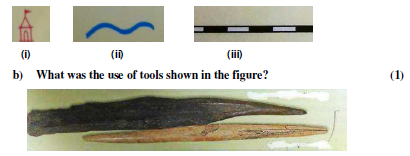
Q.8 Locate and label the places mentioned below on an outline map of
India.
(1×5=5)
a) Lothal b) Adichanallur c) Mehrgarh
d) Burzahom e) Daojali Hading
SECTION – B
Q.9 Give reasons for the following. (Any 3) (2×3=6)
a) Representative democracy is a better form of government.
b) The Indus Valley civilization is also called the Harappan civilization.
c) Man needed to stay at one place for a longer time.
d) The pointers were important to the navigators.
Q.10 Distinguish the following. (Any 3) (2×3=6)
a) Political and physical map b) Rotation and Revolution
c) Sabha and Samiti d) Core tools and-flake tools
Q.11 Answer the following in not more than 40 words. (Any 5) (3×5=15)
a) How can you recognise the planets Venus, Mars and Saturn in the sky?
b) What are conventional symbols? Why are they needed?
c) In how many time zones is the world divided? On what is the standard time in a zone based?
d) What do Mesolithic paintings usually depict? What information do they give us?
e) What possibly led to the decline of the Indus valley civilization?
f) How did the method of religious worship change from the early Vedic period to the later Vedic period?
g) At what levels do we have governments in India?
h) What was man's first discovery? Mention any two of its uses.
SECTION – C
Q.12 Answer the following questions in not more than 80 words.
(Any 5)
i) Why is life found only on the Earth?
ii) How are maps more useful than globes? What is the main disadvantage in using maps?
iii) Define latitude and longitude of a place. Explain with an example how they help to locate a place.
iv) Why did Palaeolithic man form groups? Describe life within such a group.
v) How did farming and herding change man's life?
vi) How many castes were there in Early Vedic society? Name them and explain their social functions.
vii) Why do we need a government?
Q.13 “There are certain age old stereotypes about the roles of different members in family. Earlier, only the male members went out of the house to earn money. The women stayed back at home to take care of the house and children. However, with time, this has changed, especially in the cities. With growing education among women, more women have started working outside home. In their families, we often see the men doing a large share of the household work. These changes in the roles of members are due to the changing conditions. This does not mean that families in which women work outside are better or worse than families in which women do not work outside. It is important to understand that whatever the differences, the basic purpose of all the families is the same- to take care of the needs of the members and to impart values to them.”
Answer the following questions in context with the above paragraph.
i) What is the basic purpose of all families? (1)
ii) Explain how working women can contribute in family? (2)
iii) Female education leads to development of society. Explain on the basis of above passage.
Please click the link below to download CBSE Class 6 Social Science Sample Paper Set N.
Free study material for Social Science
Download CBSE Sample Papers: Class 6 Social Science
Get Started with CBSE Class 6 Social Science Sample Paper Set 14 (CBSE)
Review model practice papers for Class 6 Social Science. Working through the CBSE Class 6 Social Science Sample Paper Set 14 under simulated test conditions at home ensures complete familiarity with upcoming school evaluations.
Maximize Your Scores with Model Papers
- Curriculum Insights: Clarify chapter-wise weightage rules and question trends across Class 6.
- Gap Analysis: Check performance drops across sets to isolate specific Class 6 Social Science topics needing extra attention.
- Time Efficiency: Working through objective and descriptive problems builds critical pacing to finish exams comfortably.
How to Analyze Your Performance in CBSE Class 6 Social Science Sample Paper Set 14
- Self-Evaluation: Score your answers using official guidance to track your academic progress.
- Mistake Correction: Class 6 pupils must re-solve questions answered incorrectly to master the correct method.
- Continuous Practice: Take additional Social Science sample modules online to maximize preparedness for CBSE evaluations.
FAQs
You can download the complete PDF for CBSE Class 6 Social Science Sample Paper Set 14 for free from StudiesToday.com. Our resources for Class 6 Social Science are updated for the latest academic session and follow the official exam pattern.
Yes, CBSE Class 6 Social Science Sample Paper Set 14 comes with detailed, teacher-verified solutions. We have provided step-by-step answers for Social Science to help students of Class 6 understand correct methodology and marking scheme.
Practicing this Social Science paper helps in time management and identifying important topics. For Class 6, solving mock papers is the best way to gain confidence and reduce exam-day anxiety.
Yes, all our study materials for Class 6 Social Science are provided in a mobile-friendly PDF format. You can easily download CBSE Class 6 Social Science Sample Paper Set 14 on your mobile device.