CBSE Class 6 Social Science Motions of The Earth Worksheet Set 01

Practice Worksheets for Class 6 Social Science: The Earth our Habitat Chapter 03 Motions of the Earth

Explore reliable practice materials for The Earth our Habitat Chapter 03 Motions of the Earth tailored for Class 6 learners. Utilizing these Social Science worksheets ensures thorough preparation and strengthens problem-solving speed for upcoming school assessments.

Practice The Earth our Habitat Chapter 03 Motions of the Earth Worksheets for Class 6 Social Science

View or download the dedicated The Earth our Habitat Chapter 03 Motions of the Earth practice resource below. Engaging with these objective and subjective questions daily ensures continuous academic progress and mastery of the 2026-27 curriculum.
Motions of the Earth
 
A. Answer the following questions in brief:
 
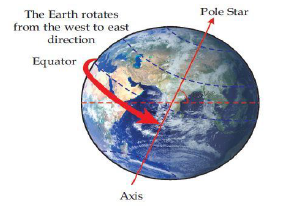
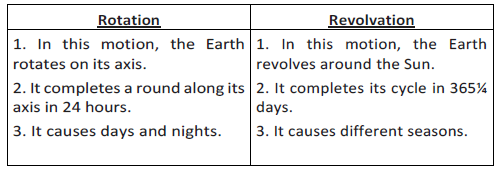
Q 1. What is rotation of Earth?
Ans. Earth rotates on its axis. It completes its round in 24 hours. This is called Rotation of the earth.
6th SS Eng.Medium July 2021 Exam Solved Syllabus 3
 
Q 2. What causes the cycles of season?
Ans. 1. The revolvation of the earth around the Sun.
2. The inclinations of the earth’s axis at an angle 66½0 to the plane of its orbit.
 
Q 3. Where do the vertical rays of the Sun fall on June 21st?
Ans. On the Tropic of Cancer.
 
Q 4. On September 23rd, which seasons are experienced in the Northern Hemisphere and Southern Hemisphere?
Ans. Northern Hemisphere- Autumn
Southern Hemisphere- Spring
 
Q 5. Distinguish between Rotation and Revolvation
6th SS Eng.Medium July 2021 Exam Solved Syllabus 4
C. Give Reasons:
 
Q 6.The Sun rises in the east and sets in the west.
Ans. The Earth rotates from West to East. It is because of the earth’s rotation that the Sun seems to be rising in the East and setting in the West.
 
Q 7. Days and nights are not always equal.
Ans. The axis of the Earth is inclined to the plane of it’s orbit, at an angle of 66½o. For half of the year, Northern pole is inclined and for half of the year Southern pole is inclined towards the Sun. That’s why days and nights are not always equal.
 
Q 8. On June 21st, the South Pole is in continuous darkness.
Ans. On June 21st, North Pole is inclined towards the Sun and the South Pole is away from Sun rays. That’s why it is continuous darkness on South Pole.
 
Q 9. Why do the Sun, the Moon and the stars appear moving round the Earth, from East to West?
Ans. The Earth rotates from West to East. It is because of the Earth’s rotation that the Sun, the Moon and the stars appear moving round the Earth, from East to West.
 
Fill in the Blanks:
 
1. The Earth rotates from West to East.
 
2. The axis is the line around which the earth turns.
 
3. The path along which Earth travels around the Sun is called the Planetary Path.
 
4. The polar areas experience six months long day and six months long night.


More questions-

 
I NAME THE FOLLOWING:
 
a. Two types of the Earth’s motion :_________________, _________________
 
b. The movement of the Earth on its axis: _________________
 
c. The movement of the Earth around the Sun in an orbit. ______________
 
d. It is known as the period of rotation: _______________
 
e. The whole Earth experiences equal days and equal nights on this day: _____________
 
f. The position of the Earth on 21st June. _____________________
 
g. The position of the Earth on 22nd December. ___________________
 
II FILL IN THE BLANKS:
 
a. The axis of the Earth which is an imaginary line makes an angle of ________with its orbital plane.
 
b. The circle that divides the day from the night on the globe is called the ____________________________
 
c. The _____________________ of the Earth and the inclination of the Earth’s _______ in a fixed direction cause seasons.
 
d. A year with 366 days is called a ___________ year.
 
e. The Earth revolves around the Sun in an __________________ orbit.
 
f. The longest day and the shortest night occurs on ______________.
 
g. The equal days and equal nights occur on _______________ and _______________________.
 
h. Christmas is celebrated in Australia in the _______________ season. .
 
i. The Circle of illumination does not coincide with the Earth’s ________
 
j. On 23rd September it is ______________ season in the Northern Hemisphere and _______________ season in the Southern Hemisphere.
 
k. On 21st March it is spring in the ________________ Hemisphere and autumn in the ______________ Hemisphere.
 
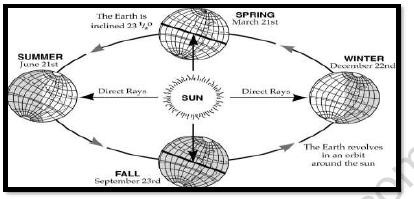
III OBSERVE THE DIAGRAM AND FILL IN WITH APPROPRIATE ANSWERS:
 
CBSE Class 6 Social Science Motions of The Earth Worksheet Set A
 
1. The position of the Earth on 21st June: _____________________
 
2. _________________________ occurs on 22nd December
 
3. Spring Equinox occurs on ________________
 
4. The position of the Earth on 23rd September; _____________________
 
IV ANSWER THE FOLLOWING QUESTIONS IN 2 POINTS:
 
1 Define Rotation and Revolution. 
 
2 Give reasons: Life would not have been possible if the Earth stopped rotating. 
 
3. Describe Equinox. 
 
V ANSWER THE FOLLOWING QUESTION IN 3 POINTS:
 
4. Explain Earth day. 
 
VI ANSWER THE FOLLOWING QUESTIONS IN FOUR POINTS:
 
5 What do you understand by a Leap year? 
 
6. Write a short note on Summer Solstice. 
 
7. Describe Winter Solstice.
 

Please click on below link to download CBSE Class 6 Social Science Motions of The Earth Worksheet Set A

Download CBSE Practice Material: Class 6 Social Science The Earth our Habitat Chapter 03 Motions of the Earth

Download Practice Sheet: The Earth our Habitat Chapter 03 Motions of the Earth (Class 6 Social Science)

Access structured practice worksheets for The Earth our Habitat Chapter 03 Motions of the Earth designed in alignment with the latest CBSE curriculum for Class 6 Social Science. These printable problem sets help students build accuracy and prepare effectively for school tests.

Concept Clarification for The Earth our Habitat Chapter 03 Motions of the Earth

Cross-reference your completed exercises with comprehensive NCERT solutions for Class 6 Social Science to ensure absolute clarity across all sub-topics in this chapter.

Additional Study Resources for Class 6 Social Science

Wrap up your chapter revision by testing your knowledge against standard question formats. Everything on our platform is provided free of charge.

FAQs

Where can I download the latest PDF for CBSE Class 6 Social Science Motions of The Earth Worksheet Set 01?

You can download the teacher-verified PDF for CBSE Class 6 Social Science Motions of The Earth Worksheet Set 01 from StudiesToday.com. These practice sheets for Class 6 Social Science are designed as per the latest CBSE academic session.

Are these Social Science Class 6 worksheets based on the 2026-27 competency-based pattern?

Yes, our CBSE Class 6 Social Science Motions of The Earth Worksheet Set 01 includes a variety of questions like Case-based studies, Assertion-Reasoning, and MCQs as per the 50% competency-based weightage in the latest curriculum for Class 6.

Do you provide solved answers for CBSE Class 6 Social Science Motions of The Earth Worksheet Set 01?

Yes, we have provided detailed solutions for CBSE Class 6 Social Science Motions of The Earth Worksheet Set 01 to help Class 6 and follow the official CBSE marking scheme.

How does solving CBSE Class 6 Social Science Motions of The Earth Worksheet Set 01 help in exam preparation?

Daily practice with these Social Science worksheets helps in identifying understanding gaps. It also improves question solving speed and ensures that Class 6 students get more marks in CBSE exams.

Is there any charge for the Class 6 Social Science practice test papers?

All our Class 6 Social Science practice test papers and worksheets are available for free download in mobile-friendly PDF format. You can access CBSE Class 6 Social Science Motions of The Earth Worksheet Set 01 without any registration.