

Download CBSE MCQs for Class 5 Science: NSO Olympiad
Review structured MCQ sets for Class 5 Science NSO Olympiad. Built according to official CBSE guidelines, these downloadable questions support daily revision and core concept reinforcement.
Chapter-wise Objective Questions: NSO Olympiad
View or download the dedicated NSO Olympiad MCQ resource below. Practicing these 50 objective questions regularly builds familiarity with standard exam patterns and helps secure higher marks in final Science evaluations.
LOGICAL REASONING
Question. In which of the following figures, Fig. (X) is exactlyembedded as one of its parts?
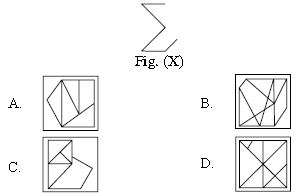
Answer : D
Question. Which of the following Venn diagrams best represents the relationship amongst, “Singers, Males, Teachers”?
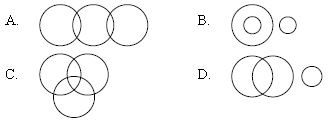
Answer : C
Question. Select the odd one out.
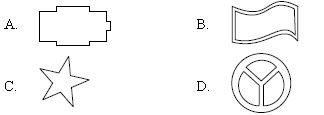
Answer : B
Question. Arrange the following words in a logical sequence.
Stem, Fruit, Root, Seed, Flower
1 2 3 4 5
A. 4, 3, 1, 2, 5
B. 4, 1, 3, 5, 2
C. 4, 3, 1, 5, 2
D. 4, 1, 3, 2, 5
Answer : C
Question. Find the mirror image of Fig. (X), if the mirror is placed vertically to the left.
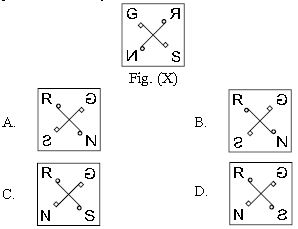
Answer : A
Question. Bhavna is facing the Shopping Centre. She made a 90° clockwise turn, followed by 225° anti-clockwise turn. Where will she be facing now?
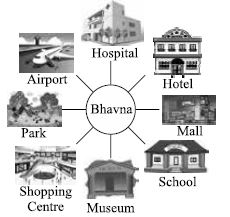
A. Mall
B. Hospital
C. School
D. Hotel
Answer : A
Question. Find the missing number, if same rule is followed in all the three figures.
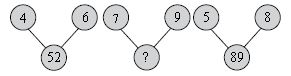
A. 127
B. 130
C. 141
D. 137
Answer : B
Question. Find the number of triangles in the given figure.
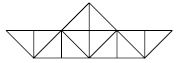
A. 23
B. 24
C. 21
D. None of these
Answer : A
Question. Five students participated in an exam.
• Kavya ranked higher than Abhay.
• Abhay ranked higher than Sumit.
• Kavya ranked lower than Nancy.
• Anshu ranked between Kavya and Abhay.
Who ranked the highest?
A. Kavya
B. Anshu
C. Nancy
D. Abhay
Answer : C
Question. Kavleen starts her piano classes from 2nd Monday of August 20XX. If she takes leaves on the days which are multiples of 5, then how many days she goes for piano classes in that month? (Assume that every Sunday is a holiday.)
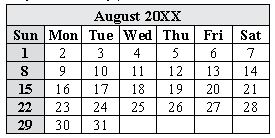
A. 17
B. 15
C. 18
D. 16
Answer : D
SCIENCE
Question. Refer to the given flow chart and select the correct statement regarding X, Y and Z.
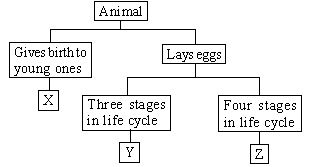
A. X could be a warm blooded animal which possesses a covering of feathers on its body.
B. Z could breathe through spiracles while X could breathe through blowholes.
C. Body of Z may be covered with hair whereas body of X may be covered with shell.
D. Example of Y could be butterfly whereas example of Z could be bat.
Answer : B
Question. While brushing, Rohit’s gums bleed. He has wobbly teeth, feels tired most of the time and has pain in the joints.
Select the disease he is suffering from and its cause.
A. Rickets, deficiency of vitamin D
B. Anaemia, deficiency of vitamin A
C. Scurvy, deficiency of vitamin C
D. Beri-beri, deficiency of vitamin B
Answer : C
Question. Vedant grouped plants on the basis of dispersal of their seeds. By mistake, he placed one wrong member in one of the groups. Identify this group and select the correct option.
A. Lotus, Coconut, Xanthium
B. Maple, Hiptage, Dandelion
C. Urena, Litchi, Watermelon
D. Pea, Geranium, Balsam
Answer : A
Question. The given table shows melting and boiling points of some substances P, Q and R.
| Substance | Melting point (°C) | Boiling point (°C) |
| P | 999 | 1800 |
| Q | –15 | 78 |
| R | –139 | 4 |
Which of these substances are solid, liquid and gas at room temperature (25°C)?
Solid Liquid Gas
A. P R Q
B. P Q R
C. R P Q
D. Q P R
Answer : B
Question. Select the incorrect match.
(i) Exosphere – Air is very thin
(ii) Thermosphere – Meteors burn
(iii) Mesosphere – Radio waves are reflected
(iv) Stratosphere – Most jetplanes fly
(v) Troposphere – Weather changes take place
A. (iv) and (v) only
B. (iii), (iv) and (v)only
C. (ii) and (iii) only
D. (i), (ii) and (iii) only
Answer : C
Question. Select the option which correctly identifies joints involved in performing the following actions.
(i) Moving your arm in a circle
(ii) Kneeling down
(iii) Twisting your wrist
(iv) Twisting your neck from side to side
| (i) | (ii) | (iii) | (iv) | |
| A | Hinge | Pivot | Ball and socket | Gliding |
| B | Ball and socket | Hinge | Gliding | Pivot |
| C | Pivot | Hinge | Ball and socket | Gliding |
| D | Gliding | Pivot | Ball and socket | Hinge |
Answer : B
Question. Meena had arranged three bar magnets as shown in the figure.
Which of the following is another possible arrangement of these magnets?
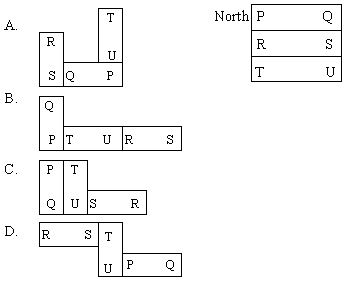
Answer : A
Question. Refer to the given figure of soil profile.
Identify different layers of soil labelled as P, Q and R and select the incorrect option regarding these.
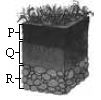
A. P is rich in humus.
B. Q is rich in organic matter.
C. Water is present in less quantity in R.
D. Both B and C
Answer : D
Question. Refer to the given flow chart and select the option which correctly identifies P, Q, R and S.

| P | Q | R | S | |
| A | Fossil fuel | Metal | Forest | Sunlight |
| B | Air | Water | Metal | Sunlight |
| C | Water | Petroleum | Coal | Metal |
| D | Sunlight | Forest | Metal | Fossil fuel |
Answer : D
Question. The gravitational pull of Moon is ______ of that of Earth.
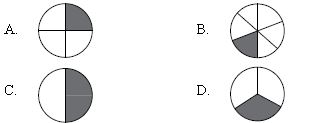
Answer : B
Question. The following graphs show changes in the populations of animals Y and Z inhabiting a community when a population of animal X was introduced in this community
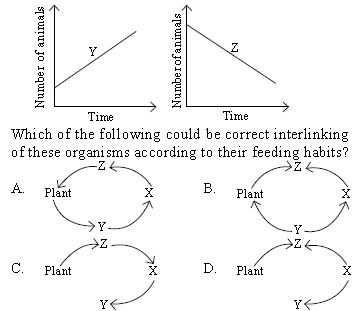
Answer : C
Question. The diagram below shows the path taken by a ball when Sundram kicks it.
The potential energy of the ball is highest at _______.
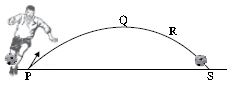
A. P
B. Q
C. R
D. S
Answer : B
Question. Refer to the given figure and select the incorrect statement regarding it.
A. Continents and oceans are present in R.
B. P contains iron and nickel in molten state.
C. Q is the thickest layer of the Earth.
D. S is composed of silicate rocks rich in iron and magnesium.
Answer : C
Question. Select the option which correctly identifies X (first class lever), Y (second class lever) and Z (third class lever) from the list of the objects given in the table.
(i) Pliers (ii) Bottle opener
(iii) Tweezers (iv) Scissors
(v) Wheelbarrow (vi) Ice tongs
(vii) Fishing rod (viii) Nutcracker
| X | Y | Z | |
| A | (i), (iv), (v) | (ii), (vii), (viii) | (iii), (vi) |
| B | (i), (ii), (v) | (iv), (vii) | (iii), (vi), (viii) |
| C | (i), (iv) | (ii), (v), (viii) | (iii), (vi), (vii) |
| S | (i), (ii), (iv) | (iii), (viii) | (v), (vi), (vii) |
Answer : C
Question. Following events took place when hunters killed all the lions in a jungle.
P : The grass population decreased.
Q : The deer population rapidly increased.
R : The deer population slowly decreased.
S : There was insufficient food for the deer.
Which of the following is the correct sequence of these events?
A. Q → R → S → P
B. Q → P → S → R
C. Q → S → P → R
D. Q → R → P → S
Answer : B
Question. Arrange the following planets in decreasing order regarding time required by them to complete one revolution around the Sun.
(i) Mars (ii) Earth
(iii) Jupiter (iv) Mercury
A. (iv) > (ii) > (iii) > (i)
B. (i) > (ii) > (iv) > (iii)
C. (iii) > (i) > (ii) > (iv)
D. (ii) > (i) > (iv) > (iii)
Answer : C
Question. Tanu took two identical insulated cups, one with hot water (X) and other with cold water (Y) and then covered them with metal cover. After 2 minutes she observed water droplets on the inner surface of the metal cover of cup X and outer surface of metal cover of cup Y.
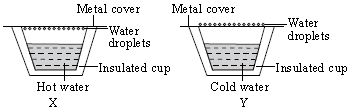
Which of the following statements is correct regarding this observation?
A. Water vapour in the surrounding warmer air condense on the cooler metal cover of cup Y.
B. In cup X, water vapour condense when they meet the cooler inner surface of the metal cover.
C. The insulated sides maximise heat loss and gain from the cups X and Y.
D. Both A and B
Answer : D
Question. Four items P, Q, R and S were buried at different places in the same ground for a month. The table shows the mass of the items before and after they were buried
| Items | Before | After |
| P | 12 g | 8 g |
| Q | 24 g | 14 g |
| R | 18 g | 17 g |
| S | 28 g | 24 g |
The least and most easily biodegradable items are respectively
A. P and S
B. Q and R
C. R and Q
D. R and P.
Answer : C
Question. Three glasses P, Q and R having equal amount of water were taken at room temperature and equal amount of salt was added to each one of them. After that, P was cooled, Q was heated and R was left undisturbed.
Water in which glass will now taste most salty?

A. P
B. Q
C. R
D. All will taste the same.
Answer : B
Question. Read the following statements and select the option which correctly identifies the true (T) and false (F) ones.
(i) The last two pairs of ribs are called floating ribs.
(ii) Motor nerves carry messages from the sense organs to the brain or the spinal cord.
(iii) Cerebrum is the largest part of human brain.
(iv) Medulla controls many necessary involuntary activities of the body.
(i) (ii) (iii) (iv)
A. F T F T
B. F T F F
C. T T T F
D. T F T T
Answer : D
Question. The given table shows adaptations of birds matched to their functions. Select the incorrect match
| S.No. | Adaptation | Function |
| (i) | Feathers | Keep body warm |
| (ii) | Hollow bones | Reduce body weight |
| (iii) | Webbed feet | Grip onto prey |
| (iv) | Streamlined body shape | Reduces air resistance during flight |
A. (iii) only
B. (i) and (iii) only
C. (ii) and (iv) only
D. None of these
Answer : A
Question. In an experiment, two different substances, P and Q were dissolved in a beaker of water. The beaker was then left undisturbed for few minutes. The result of the experiment is shown in the given figure.
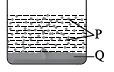
P and Q could be
P Q
A. Salt Sugar
B. Salt Sand particles
C. Sand particles Chalk
D. Chalk Sugar
Answer : B
Question. Select the animal that is found in the similar habitat as the animal shown here.
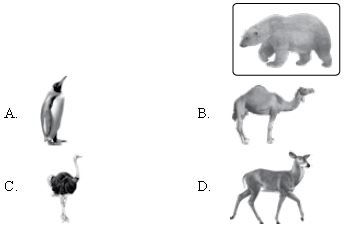
Answer : A
Question. Refer to the given paragraph.
P is formed when strong thunderstorm updrafts and carry water droplets well above the freezing level.
In winters water vapour condenses to form Q on the surface of leaves. When temperature is very low then the Q freezes into R.
Select the option which correctly identifies P, Q and R.
P Q R
A. Dew Hail Frost
B. Dew Frost Hail
C. Hail Dew Frost
D. Hail Frost Dew
Answer : C
Question. Shalini heated some tap water in a kettle until it reached its boiling point. She boiled the water for few minutes. She then placed the kettle of boiled water on the table for sometime to allow it to cool. Which of the following graphs correctly represents changes in the temperature of water in the kettle with time during the experiment?
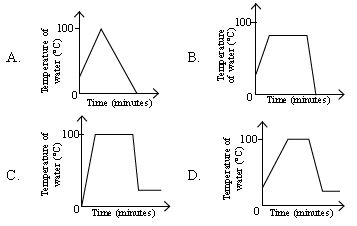
Answer : D
Question. Correct the given statements by replacing the underlined words and select the correct option.
(i) Iris is the light sensitive tissue lining the back of our eye, where image is formed.
(ii) Eardrum transforms sounds into electrical impulses which are carried to brain via nerves.
(i) (ii)
A. Cornea Inner ear
B. Pupil Middle ear
C. Retina Inner ear
D. Cornea Middle ear
Answer : C
Question. Refer to the given graph which indicates temperatures of different habitats.
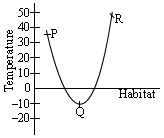
Select the incorrect statement regarding it.
A. Animals found in region P may show camouflage, e.g., chameleon.
B. Polar bear, penguin and fur seal are found in Q region.
C. Plants like cactus and animals like kangaroo rat and camel are found in R region.
D. Animals found in R region possess thick fat layer below skin and thick fur coat.
Answer : D
Question. Refer to the given graph representing changes in amount of pollutant in four rivers W, X, Y and Z overtime. Select the river that will continue to support highest number of aquatic plants and animals.
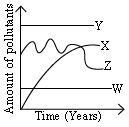
A. W
B. X
C. Y
D. Z
Answer : A
Question. Radhika paired one kharif and one rabi crop as shown here.
Rice :: Mustard
Select the option that pairs crops in the similar manner as done by Radhika.
A. Wheat :: Groundnut
B. Coriander :: Oat
C. Soybean :: Chickpea
D. Cowpea :: Bitter gourd
Answer : C
Question. Refer to the given figure of structure of human tooth. Identify X, Y and Z and select the incorrect statement.
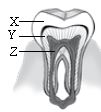
A. X is the hardest substance in our body.
B. X supports Y on the tooth
C. Z has nerve and blood vessels.
D. Y is quite hard whereas Z is soft.
Answer : B
Question. Refer to the given flow chart.
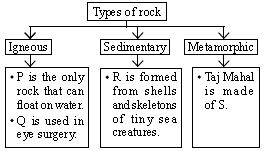
Identify P, Q, R and S and select the incorrect statement regarding them.
A. P is often used as body scrubber and Q is formed by quick cooling of lava.
B. Chalk is an example of R whereas gneiss is an example of S.
C. P is porous and light weight rock.
D. Calcite or calcium carbonate is the main minerals present in R.
Answer : B
Question. Which of the following options groups all greenhouse gases?
A. Carbon dioxide, Methane, Water vapour and Oxygen
B. Carbon dioxide, Methane, Water vapour and Ozone
C. Nitrogen, Oxygen, Carbon dioxide and Methane
D. Oxygen, Carbon dioxide, Water vapour and Methane
Answer : B
Question. Refer to the given Venn diagram and select the correct option regarding it.
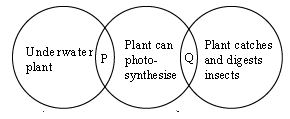
P Q
A. Duckweed Water lily
B. Tapegrass Venus flytrap
C. Pond weed Croton
D. Lotus Wolffia
Answer : B
Question. Ridhaan conducted an experiment on fabrics for measuring their degree of absorbency. He placed same sized pieces of fabric P, Q, R and S separately into identical beakers of coloured water for ten minutes. His observations are recorded in the given graph.
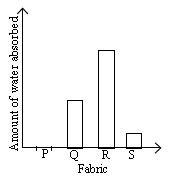
Which of the following options correctly identifies the fabrics P – S?
| P | Q | R | S | |
| A | Polyester | Silk | Cotton | Wool |
| B | Wool | Cotton | Polyester | Silk |
| C | Polyester | Cotton | Wool | Silk |
| D | Wool | Silk | Cotton | Polyester |
Answer : C
Question. A frosted glass and a wooden block were placed near a screen as shown in the figure. Which of the following shadows would probably be obtained on the screen when a torch is shone directly on both the objects?
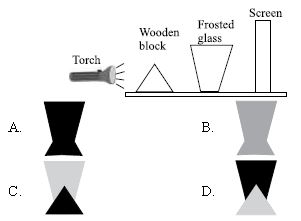
Answer : C
ACHIEVERS SECTION
Question. Ritu set-up an experiment as shown here to find out the effect of muddy water on the rate of photosynthesis in water plants.
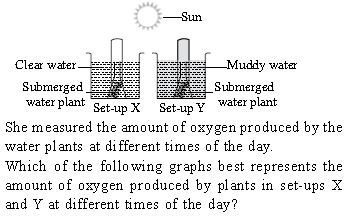
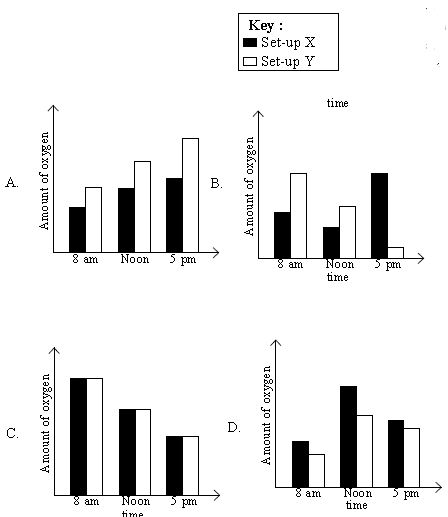
Answer : D
Question. The given figure shows a river flowing downstream.
Water samples were collected from five different locations of the river viz L, M, N, O and P to determine the amount of chemical waste present in them.
The results obtained were recorded in the given graph.
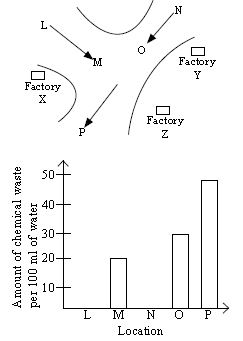
Based on the above given information, select the incorrect statements.
(i) Factory X discharged more chemical waste into the river than factory Y.
(ii) Water at locations L and N is more fit for domesticuse than water at location P.
(iii) Location P is the most suitable for fish culture.
A. (i) and (iii) only
B. (ii) and (iii) only
C. (i) and (ii) only
D. (i), (ii) and (iii)
Answer : A
Question. Read the given statements carefully and select the correct option.
(i) P is a strong and elastic tissue that binds a bone to another bone.
(ii) Q is a tissue that attaches muscles to bones.
(iii) R is a tough tissue found between the joints
which is softer and much more flexible than the bone.
A. P could be tendon while R could be cartilage.
B. P could be ligament while R could be cartilage.
C. P could be cartilage while Q could be ligament.
D. P could be tendon while Q could be ligament.
Answer : B
Question. Refer to the given figure in which ball is tied to a string and released from K. The ball swung from K to L and then to M before it swung back.
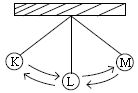
Which of the following statements are incorrect regarding this?
(i) The ball had maximum potential energy at K whereas minimum kinetic energy at L.
(ii) The ball had maximum kinetic energy at K whereas minimum potential energy at L.
(iii) K and M have same potential energy.
(iv) The ball had maximum potential energy and minimum kinetic energy at M.
(v) The ball had minimum potential energy and maximum kinetic energy at L.
A. (i) and (v) only
B. (i) and (ii) only
C. (i), (ii) and (iv) only
D. (iii), (iv) and (v) only
Answer : B
Question. Match column I (Diseases) with column II (Deficient vitamins/minerals) and column III (Symptoms) and select the correct option from the given codes.
| Column I | Column II | Column III | |
| (i) | Night blindness | (a) Vitamin C | (P) Bleeding gums |
| (ii) | Rickets | (b) Vitamin D | (Q) Brittle bones |
| (iii) | Scurvy | (c) Vitamin A | (R) Swelling inneck |
| (iv) | Goitre | (d) Iodine | (S) Weakness and fatigue |
| (v) | Anaemia | (e) Iron | (T) Poor vision |
A. (i)-(d)-(T), (ii)-(e)-(S), (iii)-(b)-(R), (iv)-(c)-(Q), (v)-(a)-(P)
B. (i)-(c)-(T), (ii)-(a)-(P), (iii)-(b)-(Q), (iv)-(d)-(R), (v)-(e)-(S)
C. (i)-(d)-(T), (ii)-(c)-(Q), (iii)-(a)-(P), (iv)-(b)-(R), (v)-(e)-(S)
D. (i)-(c)-(T), (ii)-(b)-(Q), (iii)-(a)-(P), (iv)-(d)-(R), (v)-(e)-(S)
Answer : D
Free study material for Science Olympiad NSO
Multiple Choice Questions (MCQs) for Class 5 Science NSO Olympiad
Download Multiple Choice Questions: NSO Olympiad (Class 5 Science)
Test your conceptual understanding of NSO Olympiad with these targeted multiple-choice questions. Designed in alignment with the latest CBSE curriculum for Class 5 Science, these problem sets build accuracy and prepare students for objective exams.
Concept Clarification for NSO Olympiad
Built using the official NCERT book for Class 5, these Science objective sets provide reliable academic guidance. Pair your practice with our recommended NCERT solutions to master optimal problem-solving approaches.
Additional Study Resources for Class 5 Science
Follow up your worksheet practice by attempting the interactive online Science MCQ test for this chapter to evaluate your execution speed. All platform resources are free to access.
FAQs
You can get most exhaustive CBSE Class 5 Science NSO Olympiad MCQs with Answers Set 10 for free on StudiesToday.com. These MCQs for Class 5 Science are updated for the 2026-27 academic session as per CBSE examination standards.
Yes, our CBSE Class 5 Science NSO Olympiad MCQs with Answers Set 10 include the latest type of questions, such as Assertion-Reasoning and Case-based MCQs. 50% of the CBSE paper is now competency-based.
By solving our CBSE Class 5 Science NSO Olympiad MCQs with Answers Set 10, Class 5 students can improve their accuracy and speed which is important as objective questions provide a chance to secure 100% marks in the Science.
Yes, Science MCQs for Class 5 have answer key and brief explanations to help students understand logic behind the correct option as its important for 2026 competency-focused CBSE exams.
Yes, you can also access online interactive tests for CBSE Class 5 Science NSO Olympiad MCQs with Answers Set 10 on StudiesToday.com as they provide instant answers and score to help you track your progress in Science.