

Multiple Choice Questions (MCQs) for BITSAT Physics: Work Energy and Power
Access targeted multiple-choice questions for Work Energy and Power designed to align with the latest BITSAT academic syllabus for BITSAT Physics. These objective practice sets help students evaluate their conceptual understanding and improve exam readiness.
Practice Work Energy and Power MCQs for BITSAT Physics
Navigate directly to the 50 objective questions for Work Energy and Power using the digital viewer below. Each practice set includes verified answer keys, allowing students to instantly cross-check their work and identify areas requiring further revision.
Question: A particle of mass m moving in the x direction with speed 2v is hit by another particle of mass 2m moving in the y direction with speed v. If the collision is perfectly inelastic, the percentage loss in the energy during the collision is close to
- a) 56%
- b) 62%
- c) 44%
- d) 50%
Answer: 56%
Question: Consider elastic collision of a particle of mass m moving with a velocity u with another particle of the same mass at rest. After the collision the projectile and the struck particle move in directions making angles θ1 and θ2 respectively with the initial direction of motion. The sum of the angles θ1 + θ2, is :
- a) 45°
- b) 90°
- c) 135°
- d) 180°
Answer: 90°
Question: A neutron moving with speed v makes a head on collision with a hydrogen atom in ground state kept at rest. The minimum kinetic energy of the neutron for which inelastic collision takes place is
- a) 10.2 eV
- b) 20.4 eV
- c) 12.1 eV
- d) 16.8 eV
Answer: 20.4 eV
Question: An elastic string of unstretched length L and force constant k is stretched by a small length x. It is further stretched by another small length y. The work done in the second stretching is
- a) 1/2 Ky2
- b) 1/2 Ky(2x + y)
- c) 1/2 K(x2 + y2)
- d) 1/2 k (x + y)2
Answer: 1/2 Ky(2x + y)
Question: A small block of mass m is kept on a rough inclined surface of inclination q fixed in a elevator. The elevator goes up with a uniform velocity v and the block does not slide on the wedge. The work done by the force of friction on the block in time t will be :
- a) zero
- b) mgvt cos2θ
- c) mgvt sin2θ
- d) mgvt sin 2θ
Answer: mgvt sin2θ
Question: A 3.628 kg freight car moving along a horizontal rail road spur track at 7.2 km/hour strikes a bumper whose coil springs experiences a maximum compression of 30 cm in stopping the car. The elastic potential energy of the springs at the instant when they are compressed 15 cm is
- a) 12.1 × 10⁴J
- b) 121 × 104J
- c) 1.21 × 10⁴J
- d) 1.21 × 10⁶J
Answer: 1.21 × 10⁴J
Question: Work done by a conservative force is positive if
- a) P.E. of the body increases
- b) P.E. of the body decreases
- c) K.E. of the body increases
- d) K.E. of the body decreases
Answer: P.E. of the body decreases
Question: If the unit of force and length be each increased by four times, then the unit of energy is increased by
- a) 16 times
- b) 8 times
- c) 2 times
- d) 4 times
Answer: 16 times
Question: Which of the following must be known in order to determine the power output of an automobile?
- a) Final velocity and height
- b) Mass and amount of work performed
- c) Force exerted and distance of motion
- d) Work performed and elapsed time of work
Answer: Work performed and elapsed time of work
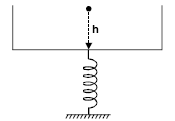
Question: A massless platform is kept on a light elastic spring as shown in fig. When a sand particle of mass 0.1 kg is dropped on the pan from a height of 0.24 m, the particle strikes the pan and spring is compressed by 0.01 m. From what height should the particle be dropped to cause a compression of 0.04 m.
- a) 3.96 m
- b) 0.396 m
- c) 4 m
- d) 0.4 m
Answer: 0.396 m
Question: The potential energy for a force field  r is given by U (x,y) = cos (x + y). The force acting on a particle at position given by coordinates (0, π / 4) is –
- a)

- b)

- c)

- d)

Answer:
Question: A long string is stretched by 2 cm and the potential energy is V. If the spring is stretched by 10 cm, its potential energy will be
- a) V / 25
- b) V/5
- c) 5 V
- d) 25 V
Answer: 25 V
Question: A chain of mass M is placed on a smooth table with 1/n of its length L hanging over the edge. The work done in pulling the hanging portion of the chain back to the surface of the table is
- a) MgL/n
- b) MgL/2n
- c) MgL/n2
- d) MgL/2n2
Answer: MgL/2n2
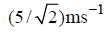
Question: A particle of mass 10 kg moving eastwards with a speed 5 ms–1 collides with another particle of the same mass moving north-wards with the same speed 5 ms–1. The two particles coalesce on collision. The new particle of mass 20 kg will move in the north-east direction with velocity
- a) 10 ms–1
- b) 5 ms–1
- c)
- d) None of these
Answer:
Question: A ball is allowed to fall from a height of 10 m. If there is 40% loss of energy due to impact, then after one impact ball will go up to
- a) 10 m
- b) 8 m
- c) 4 m
- d) 6 m
Answer: 6 m
Question: When two bodies stick together after collision, the collision is said to be
- a) Partially elastic
- b) Elastic
- c) Inelastic
- d) Perfectly inelastic
Answer: Perfectly inelastic
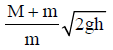
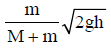
Question: A sphere of mass m, moving with velocity V, enters a hanging bag of sand and stops. If the mass of the bag is M and it is raised by height h, then the velocity of the sphere was –
- a)
- b)

- c)
- d)

Answer:
Question: Which one of the following statements does not hold good when two balls of masses m1 and m2 undergo elastic collision
- a) When m1 < m2 and m2 at rest, there will be maximum transfer of momentum.
- b) When m1 > m2 and m2 at rest, after collision the ball of mass m2 moves with four times the velocity of m1.
- c) When m1 = m2 and m2 at rest, there will be maximum transfer of K. E.
- d) When collision is oblique and m2 at rest with m1 = m2 after collision the ball moves in opposite directions.
Answer: When collision is oblique and m2 at rest with m1 = m2 after collision the ball moves in opposite directions.
Question: In the figure shown the potential energy U of a particle is plotted against its position ‘x’ from origin. Then which of the following statement is correct. A particle at –
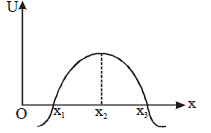
- a) x1 is in stable equilibrium
- b) x2 is in stable equilibrium
- c) x3 is in stable equilibrium
- d) None of these
Answer: None of these
Question: A mass m1 moves with a great velocity. It strikes another mass m2 at rest in a head on collision. It comes back along its path with low speed, after collision. Then
- a) m1 > m2
- b) m1 < m2
- c) m1 = m2
- d) m1 ³ m2
Answer: m1 < m2
Free study material for Physics
Multiple Choice Questions (MCQs) for BITSAT Physics Work Energy and Power
About Work Energy and Power MCQs for BITSAT Physics
Review structured objective questions for BITSAT Physics Work Energy and Power. Built according to official BITSAT guidelines, these MCQ sets support daily revision and core concept reinforcement.
How to Verify Your MCQ Answers
Cross-reference your completed choices with comprehensive NCERT solutions for BITSAT Physics to ensure absolute clarity across all sub-topics in this chapter.
Enhance Speed with Online MCQ Tests
Follow up your worksheet practice by attempting the interactive online Physics MCQ test for this chapter to evaluate your execution speed. All platform resources are free to access.
FAQs
You can get most exhaustive BITSAT Physics Work Energy and Power MCQs for free on StudiesToday.com. These MCQs for BITSAT Physics are updated for the 2026-27 academic session as per BITSAT examination standards.
Yes, our BITSAT Physics Work Energy and Power MCQs include the latest type of questions, such as Assertion-Reasoning and Case-based MCQs. 50% of the BITSAT paper is now competency-based.
By solving our BITSAT Physics Work Energy and Power MCQs, BITSAT students can improve their accuracy and speed which is important as objective questions provide a chance to secure 100% marks in the Physics.
Yes, Physics MCQs for BITSAT have answer key and brief explanations to help students understand logic behind the correct option as its important for 2026 competency-focused BITSAT exams.
Yes, you can also access online interactive tests for BITSAT Physics Work Energy and Power MCQs on StudiesToday.com as they provide instant answers and score to help you track your progress in Physics.