

Download BITSAT MCQs for BITSAT Physics: Waves
Review structured MCQ sets for BITSAT Physics Waves. Built according to official BITSAT guidelines, these downloadable questions support daily revision and core concept reinforcement.
Chapter-wise Objective Questions: Waves
Access the complete set of multiple-choice questions for Waves below. This focused format allows students to isolate specific topics for thorough review and uninterrupted practice alongside official BITSAT textbooks.
Question: A tuning fork of frequency 392 Hz, resonates with 50 cm length of a string under tension (T). If length of the string is decreased by 2%, keeping the tension constant, the number of beats heard when the string and the tuning fork made to vibrate simultaneously is :
- a) 4
- b) 6
- c) 8
- d) 12
Answer: 8
Question: A sonometer wire resonates with a given tuning fork forming standing waves with five antinodes between the two bridges when a mass of 9 kg is suspended from the wire. When this mass is replaced by a mass M, the wire resonates with the same tuning fork forming three antinodes for the same positions of the bridges. The value of M is
- a) 25 kg
- b) 5 kg
- c) 12.5 kg
- d) 1/25 kg
Answer: 25 kg
Question: A source of sound S emitting waves of frequency 100 Hz and an observor O are located at some distance from each other. The source is moving with a speed of 19.4 ms–1 at an angle of 60° with the source observer line as shown in the figure. The observor is at rest. The apparent frequency observed by the observer is (velocity of sound in air 330 ms–1)

- a) 103 Hz
- b) 106 Hz
- c) 97 Hz
- d) 100 Hz
Answer: 103 Hz
Question: A string of length l is fixed at both ends. It is vibrating in its 3rd overtone with maximum amplitude 'a'. The amplitude at a distance l/3 from one end is
- a) a
- b) 0
- c)

- d)

Answer:
Question: The frequency of a sonometer wire is 100 Hz. When the weights producing the tensions are completely immersed in water, the frequency becomes 80 Hz and on immersing the weights in a certain liquid, the frequency becomes 60 Hz. The specific gravity of the liquid is
- a) 1.42
- b) 1.77
- c) 1.82
- d) 1.21
Answer: 1.77
Question: Two tuning forks with natural frequencies 340Hz each move relative to a stationary observer. One fork moves away from the observer, while the other moves towards the observer at the same speed. The observer hears beats of frequency 3 Hz. Find the speed of the tuning forks.
- a) 1.5 m/s
- b) 2 m/s
- c) 1 m/s
- d) 2.5 m/s
Answer: 1.5 m/s
Question: A sound source, emitting sound of constant frequency, moves with a constant speed and crosses a stationary observer. The frequency (n) of sound heard by the observer is plotted against time (t). Which of the following graphs represents the correct variation ?
- a)

- b)

- c)

- d)

Answer:
Question: When a string is divided into three segments of length l1, l2, and l3 the fundamental frequencies of these three segments are v1, v2 and v3 respectively. The original fundamental frequency (v) of the string is
- a) √v = √v1 + √v2 + √v3
- b) v = v1 + v2 + v3
- c)

- d)
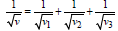
Answer:
Question: Two waves of wavelengths 99 cm and 100 cm both travelling with velocity 396 m/s are made to interfere. The number of beats produced by them per second is
- a) 1
- b) 2
- c) 4
- d) 8
Answer: 4
Question: If equation of transverse wave is y = x0 cos  Maximum velocity of particle is twice of wave velocity, if λ is-
- a) π/2x0
- b) 2πx0
- c) πx
- d) πx0
Answer: πx0
Question: The transverse displacement y(x, t) of a wave on a string is given by  This represents a
- a) wave moving in – x direction, speed

- b) standing wave of frequency √b
- c) standing wave of frequency

- d) wave moving in + x direction, speed

Answer: wave moving in – x direction, speed
Question: The fundamental frequency of an open organ pipe is 300 Hz. The first overtone of this pipe has same frequency as first overtone of a closed organ pipe. If speed of sound is 330 m/s, then the length of closed organ pipe is
- a) 41 cm
- b) 37 cm
- c) 31 cm
- d) 80 cm
Answer: 41 cm
Question: A wave y = a sin (ωt – kx) on a string meets with another wave producing a node at x = 0. Then the equation of the unknown wave is
- a) y = a sin (ωt + kx)
- b) y = –a sin (ωt + kx)
- c) y = a sin (ωt – kx)
- d) y = –a sin (ωt – kx)
Answer: y = –a sin (ωt + kx)
Question: A source of sound produces waves of wavelength 60 cm when it is stationary. If the speed of sound in air is 320 m s–1 and source moves with speed 20 m s–1, the wavelength of sound in the forward direction will be nearest to
- a) 56 cm
- b) 60 cm
- c) 64 cm
- d) 68 cm
Answer: 56 cm
Question: Two tuning forks A and B sounded together give 6 beats per second. With an air resonance tube closed at one end, the two forks give resonance when the two air columns are 24 cm and 25cm respectively. Calculate the frequencies of forks.
- a) 120 Hz, 124 Hz
- b) 110 Hz, 114 Hz
- c) 150 Hz, 144 Hz
- d) 170 Hz, 118 Hz
Answer: 150 Hz, 144 Hz
Question: When a source of sound crosses a stationary observer then the change in apparent frequency of sound observed by the observer, when Vs < < V, will be -
- a)

- b)

- c)
Dn = 2nVsV
- d)

Answer:
Question: The equation of a wave is represented by 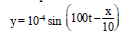 m, then the velocity of wave will be
- a) 100 m/s
- b) 4 m/s
- c) 1000 m/s
- d) 10 m/s
Answer: 1000 m/s
Question: A cylindrical tube open at both ends has a fundamental frequency n in air. The tube is dipped vertically in water so that half of it is immersed in water. The fundamental frequency of air column is
- a) n/2
- b) n
- c) 2 n
- d) 4 n
Answer: n
Question: A source of sound of frequency 256Hz is moving rapidly towards a wall with a velocity of 5m/s. How many beats per second will be heard if sound travels at a speed of 330 m/s by an observer behind the source.
- a) 1.7
- b) 5.2
- c) 3.5
- d) 7.7
Answer: 7.7
Question: The loudness and pitch of a sound depends on
- a) Intensity and velocity
- b) Frequency and velocity
- c) Intensity and frequency
- d) Frequency and number of harmonics
Answer: Intensity and frequency
Free study material for Physics
Waves Objective Questions & Solutions for BITSAT Physics
About Waves MCQs for BITSAT Physics
Review structured objective questions for BITSAT Physics Waves. Built according to official BITSAT guidelines, these MCQ sets support daily revision and core concept reinforcement.
How to Verify Your MCQ Answers
Each question includes structured solution keys mapped directly to standard BITSAT textbooks, helping students evaluate their reasoning and correct mistakes early in their revision.
Enhance Speed with Online MCQ Tests
Explore our broader library of printable assignments, chapter notes, and mock tests designed to support continuous revision and secure higher marks in BITSAT assessments.
FAQs
You can get most exhaustive BITSAT Physics Waves MCQs for free on StudiesToday.com. These MCQs for BITSAT Physics are updated for the 2026-27 academic session as per BITSAT examination standards.
Yes, our BITSAT Physics Waves MCQs include the latest type of questions, such as Assertion-Reasoning and Case-based MCQs. 50% of the BITSAT paper is now competency-based.
By solving our BITSAT Physics Waves MCQs, BITSAT students can improve their accuracy and speed which is important as objective questions provide a chance to secure 100% marks in the Physics.
Yes, Physics MCQs for BITSAT have answer key and brief explanations to help students understand logic behind the correct option as its important for 2026 competency-focused BITSAT exams.
Yes, you can also access online interactive tests for BITSAT Physics Waves MCQs on StudiesToday.com as they provide instant answers and score to help you track your progress in Physics.