

Physics Objective Questions and Answers: Mechanical Properties Of Fluids
Access targeted multiple-choice questions for Mechanical Properties Of Fluids designed to align with the latest BITSAT academic syllabus for BITSAT Physics. These objective practice sets help students evaluate their conceptual understanding and improve exam readiness.
Download Mechanical Properties Of Fluids MCQs with Answers
Access the complete set of multiple-choice questions for Mechanical Properties Of Fluids below. This focused format allows students to isolate specific topics for thorough review and uninterrupted practice alongside official BITSAT textbooks.
Question: A mercury drop of radius 1 cm is sprayed into 106 drops of equal size. The energy expressed in joule is (surface tension of Mercury is 460 × 10–3 N/m)
- a) 0.057
- b) 5.7
- c) 5.7 × 10⁻⁴
- d) 5.7 × 10⁻⁶
Answer: 0.057
Question: A capillary tube of radius R is immersed in water and water rises in it to a height H. Mass of water in the capillary tube is M. If the radius of the tube is doubled, mass of water that will rise in the capillary tube will now be :
- a) M
- b) 2 M
- c) M/2
- d) 4 M
Answer: 2 M
Question: A capillary tube of radius r is immersed vertically in a liquid such that liquid rises in it to height h (less than the length of the tube). Mass of liquid in the capillary tube is m. If radius of the capillary tube is increased by 50%, then mass of liquid that will rise in the tube, is
- a)

- b) m
- c)

- d)

Answer:
Question: The approximate depth of an ocean is 2700 m. The compressibility of water is 45.4 × 10⁻¹¹ Pa–1 and density of water is 103 kg/m3.What fractional compression of water will be obtained at the bottom of the ocean ?
- a) 1.0 × 10⁻²
- b) (1.2 × 10⁻²
- c) 1.4 × 10⁻²
- d) 0.8 × 10⁻²
Answer: (1.2 × 10⁻²
Question: A glass capillary tube of internal radius r = 0.25 mm is immersed in water. The top end of the tube projected by 2 cm above the surface of the water. At what angle does the liquid meet the tube? Surface tension of water = 0.7 N/m.
- a) 90°
- b) 70°
- c) 45°
- d) 35°
Answer: 70°
Question: Water is flowing on a horizontal fixed surface, such that its flow velocity varies with y (vertical direction) as  If coefficient of viscosity for water is h, what will be shear stress between layers of water at y =a.
- a)

- b)

- c)

- d) None of these
Answer:
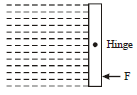
Question: A square gate of size 1 m × 1m is hinged at its mid-point. A fluid of density r fills the space to the left of the gate. The force F required to hold the gate stationary is
- a)

- b)

- c)

- d)

Answer:
Question: Two capillary tubes are of the same diameters. One is dipped in a liquid of relative density 0.8 while the other in a liquid of relative density 0.6. If surface tensions of these liquids are 60 and 50 milli N/m, respectively, and the angles of the contact are equal, compare the rise of liquids in the capillary tubes.
- a) 9 : 10
- b) 7 : 10
- c) 3 : 10
- d) 1 : 10
Answer: 9 : 10
Question: Two liquids of densities d1 and d2 are flowing in identical capillary tubes uder the same pressure difference. If t1 and t2 are time taken for the flow of equal quantities (mass) of liquids, then the ratio of coefficient of viscosity of liquids must be
- a)

- b)

- c)

- d)

Answer:
Question: An ice block floats in a liquid whose density is less than water. A part of block is outside the liquid. When whole of ice has melted, the liquid level will
- a) Rise
- b) Go down
- c) Remain same
- d) First rise then go down
Answer: Go down
Question: A large drop of oil (density 0.8 g/cm3 and viscosity η0) floats up through a column of another liquid (density 1.2 g/cm3 and viscosity ηL ). Assuming that the two liquids do not mix, the velocity with which the oil drop rises will depend on :
- a) η0 only
- b) ηLonly
- c) both on η0 and hL
- d) neither η0 nor ηL
Answer: ηLonly
Question: Viscosity is the property of a liquid due to which it :
- a) Occupies minimum surface area
- b) Opposes relative motion between its adjacent layers
- c) Becomes spherical in shape
- d) Tends to regain its deformed position
Answer: Opposes relative motion between its adjacent layers
Question: A spherical ball is dropped in a long column of a viscous liquid. The speed (n) of the ball as a function of time (t) may be best represented by
- a)

- b)

- c)

- d)

Answer:
Question: Two mercury drops (each of radius r) merge to form a bigger drop. The surface energy of the bigger drop, if T is the surface tension, is
- a) 25/3 πr2T
- b) 4 πr2T
- c) 2 πr2T
- d) 28/3 πr2T
Answer: 28/3 πr2T
Question: Two circular plates of radius 5 cm each, have a 0.01 mm thick water film between them. Then what will be the force required to separate these plate (S.T. of water = 73 dyne/cm) ?
- a) 125 N
- b) 95 N
- c) 115 N
- d) 105 N
Answer: 115 N
Question: A liquid is flowing through a non-sectional tube with its axis horizontally. If two points X and Y on the axis of tube has a sectional area 2.0 cm3 and 25 mm2 respectively then find the flow velocity at Y when the flow velocity at X is 10m/s.
- a) 20 m/s
- b) 40 m/s
- c) 80 m/s
- d) 60 m/s
Answer: 80 m/s
Question: A cylindrical vessel filled with water is released on an inclined surface of angle θ as shown in figure. Fixed The friction coefficient of surface with vessel is μ (< tan θ). Then the contact angle made by the surface of water with the incline will be –
- a) tan–1 μ
- b) q – tan–1 μ
- c) q + tan–1 μ
- d) cot–1 μ
Answer: tan–1 μ
Question: The lift of an air plane is based on
- a) Torricelli's theorem
- b) Bernoulli's theorem
- c) Law of gravitation
- d) Conservation of linear momentum
Answer: Bernoulli's theorem
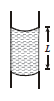
Question: A vertical glass capillary tube of radius r open at both ends contains some water (surface tension T and density ρ). If L be the length of the water column, then :
- a)

- b)

- c)

- d)

Answer:
Question: Two pieces of metals are suspended from the arms of a balance and are found to be in equilibrium when kept immersed in water. The mass of one piece is 32 g and its density 8 g cm–3. The density of the other is 5 g per cm3. Then the mass of the other is
- a) 28 g
- b) 35 g
- c) 21 g
- d) 33.6 g
Answer: 35 g
Free study material for Physics
Practice MCQs for BITSAT Physics Mechanical Properties Of Fluids
Chapter MCQs with Answers for BITSAT Physics
Test your conceptual understanding of Mechanical Properties Of Fluids with these targeted multiple-choice questions. Designed in alignment with the latest BITSAT curriculum for BITSAT Physics, these problem sets build accuracy and prepare students for objective exams.
Expert Practice Material for BITSAT Physics
Each question includes structured solution keys mapped directly to standard BITSAT textbooks, helping students evaluate their reasoning and correct mistakes early in their revision.
Complete Your Chapter Revision
Wrap up your chapter revision by testing your knowledge against standard question formats. Everything on our platform is provided free of charge.
FAQs
You can get most exhaustive BITSAT Physics Mechanical Properties Of Fluids MCQs for free on StudiesToday.com. These MCQs for BITSAT Physics are updated for the 2026-27 academic session as per BITSAT examination standards.
Yes, our BITSAT Physics Mechanical Properties Of Fluids MCQs include the latest type of questions, such as Assertion-Reasoning and Case-based MCQs. 50% of the BITSAT paper is now competency-based.
By solving our BITSAT Physics Mechanical Properties Of Fluids MCQs, BITSAT students can improve their accuracy and speed which is important as objective questions provide a chance to secure 100% marks in the Physics.
Yes, Physics MCQs for BITSAT have answer key and brief explanations to help students understand logic behind the correct option as its important for 2026 competency-focused BITSAT exams.
Yes, you can also access online interactive tests for BITSAT Physics Mechanical Properties Of Fluids MCQs on StudiesToday.com as they provide instant answers and score to help you track your progress in Physics.