

Download BITSAT MCQs for BITSAT Physics: Laws Of Motion
Explore reliable objective questions for Laws Of Motion tailored for BITSAT learners. Utilizing these Physics multiple-choice formats ensures thorough preparation and strengthens problem-solving speed for upcoming school assessments.
Chapter-wise Objective Questions: Laws Of Motion
Navigate directly to the 50 objective questions for Laws Of Motion using the digital viewer below. Each practice set includes verified answer keys, allowing students to instantly cross-check their work and identify areas requiring further revision.
Question: Two equal heavy spheres, each of radius r, are in equilibrium within a smooth cup of radius 3r. The ratio of reaction between the cup and one sphere and that between the two sphere is
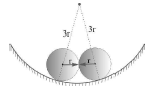
- a) 1
- b) 2
- c) 3
- d) 4
Answer: 2
Question: The masses of blocks A and B are m and M respectively. Between A and B, there is a constant frictional force F and B can slide on a smooth horizontal surface. A is set in motion with velocity while B is at rest.What is the distance moved by A relative to B before they move with the same velocity?
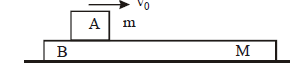
- a)

- b)

- c)

- d)

Answer:
Question: In figure, two blocks are separated by a uniform strut attached to each block with frictionless pins. Block A weighs 400N, block B weighs 300N, and the strut AB weigh 200N. If μ = 0.25 under B, determine the minimum coefficient of friction under A to prevent motion
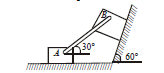
- a) 0.4
- b) 0.2
- c) 0.8
- d) 0.1
Answer: 0.4
Question: A rifle man, who together with his rifle has a mass of 100 kg, stands on a smooth surface and fires 10 shots horizontally. Each bullet has a mass 10 g and a muzzle velocity of 800 ms–1. The velocity which the rifle man attains after firing 10 shots is
- a) 8 ms–1
- b) 0.8 ms–1
- c) 0.08 ms–1
- d) – 0.8 ms–1
Answer: 0.8 ms–1
Question: A person with his hand in his pocket is skating on ice at the rate of 10m/s and describes a circle of radius 50 m. What is his inclination to vertical: (g = 10 m/sec2)
- a) tan–1(½)
- b) tan–1 (1/5)
- c) tan–1 (3/5)
- d) tan–1(1/10)
Answer: tan–1 (1/5)
Question: The minimum velocity (in ms-1) with which a car driver must traverse a flat curve of radius 150 m and coefficient of friction 0.6 to avoid skidding is
- a) 60
- b) 30
- c) 15
- d) 25
Answer: 30
Question: A bob is hanging over a pulley inside a car through, a string. The second end of the string is in the hand of a person standing in the car. The car is moving with constant acceleration 'a' directed horizontally as vertically. The tension in the string is equal to –
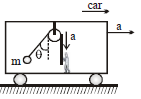
- a)

- b)
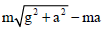
- c)
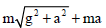
- d) m (g + a)
Answer:
Question: A man of mass 100 kg. is standing on a platform of mass 200 kg. which is kept on a smooth ice surface. If the man starts moving on the platform with a speed 30 m/sec relative to the platform then calculate with what velocity relative to the ice the platform will recoil?
- a) 5 m/sec
- b) 10 m/sec
- c) 15 m/sec
- d) 20 m/sec
Answer: 10 m/sec
Question: An object experiences a net force and accelerates from rest to its final position in 16s. How long would the object take to reach the same final position from rest if the object's mass was four times larger ?
- a) 64 s
- b) 32 s
- c) 16 s
- d) 8s
Answer: 32 s
Question: Three blocks of masses m1, m2 and m3 are connected by massless strings, as shown, on a frictionless table. They are pulled with a force T3 = 40 N. If m1 = 10 kg, m2 = 6 kg and m3 = 4kg, the tension T2 will be
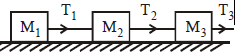
- a) 20 N
- b) 40 N
- c) 10 N
- d) 32 N
Answer: 32 N
Question: Two blocks are connected over a massless pulley as shown in fig. The mass of block A is 10 kg and the coefficient of kinetic friction is 0.2. Block A slides down the incline at constant speed. The mass of block B in kg is:
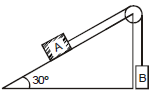
- a) 3.5
- b) 3.3
- c) 3.0
- d) 2.5
Answer: 3.3
Question: A spring is compressed between two toy carts of mass m1 and m2. When the toy carts are released, the springs exert equal and opposite average forces for the same time on each toy cart. If v1 and v2 are the velocities of the toy carts and there is no friction between the toy carts and the ground, then :
- a) v1/v2 = m1/m2
- b) v1/v2 = m2/m1
- c) v1/v2 = –m2/m1
- d) v1/v2 = –m1/m2
Answer: v1/v2 = –m2/m1
Question: A block of mass M is pulled along a horizontal frictionless surface by a rope of mass M/2. If a force 2Mg is applied at one end of the rope, the force which the rope exerts on the block is –
- a) 2Mg/3
- b) 2Mg
- c) 4Mg/3
- d) zero
Answer: 4Mg/3
Question: A reference frame attached to earth cannot be an inertial frame because
- a) Earth is revolving around the sun
- b) Earth is rotating about its axis
- c) Newton’s laws are applicable in this frame
- d) Both (a) and (b)
Answer: Newton’s laws are applicable in this frame
Question: The mass of the lift is 100 kg which is hanging on the string. The tension in the string, when the lift is moving with constant velocity, is (g = 9.8 m/sec2)
- a) 100 newton
- b) 980 newton
- c) 1000 newton
- d) None of these
Answer: 980 newton
Question: A shell explodes and many pieces fly off indifferent directions. The following is conserved:
- a) Kinetic energy
- b) Momentum
- c) Neither momentum nor KE
- d) Momentum and KE.
Answer: Momentum
Question: In the figure shown the velocity of lift is 2 m/s while string is winding on the motor shaft with velocity 2 m/s and block A is moving downwards with a velocity of 2 m/s, then find out the velocity of block B –
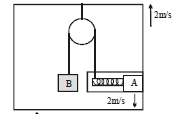
- a) 2 m/s ↑
- b) 2 m/s↑
- c) 4 m/s↑
- d) None of these
Answer: None of these
Question: Inside a horizontally moving box, an experimenter finds that when an object is placed on a smooth horizontal table and is released, it moves with an acceleration of 10 m/s2. In this box if 1 kg body is suspended with a light string, the tension in the string in equilibrium position (w.r.t. experimenter) will be (Take g = 10 m/s2)
- a) 10 N
- b)

- c) 20 N
- d) zero
Answer:
Question: The minimum velocity (in ms-1) with which a car driver must traverse a flat curve of radius 150 m and coefficient of friction 0.6 to avoid skidding is
- a) 60
- b) 30
- c) 15
- d) 25
Answer: 30
Question: A shell explodes and many pieces fly off in different directions. The following is conserved:
- a) Kinetic energy
- b) Momentum
- c) Neither momentum nor KE
- d) Momentum and KE.
Answer: Momentum
Free study material for Physics
Multiple Choice Questions (MCQs) for BITSAT Physics Laws Of Motion
Chapter MCQs with Answers for BITSAT Physics
Test your conceptual understanding of Laws Of Motion with these targeted multiple-choice questions. Designed in alignment with the latest BITSAT curriculum for BITSAT Physics, these problem sets build accuracy and prepare students for objective exams.
Expert Practice Material for BITSAT Physics
Built using the official NCERT book for BITSAT, these Physics objective sets provide reliable academic guidance. Pair your practice with our recommended NCERT solutions to master optimal problem-solving approaches.
Complete Your Chapter Revision
Follow up your worksheet practice by attempting the interactive online Physics MCQ test for this chapter to evaluate your execution speed. All platform resources are free to access.
FAQs
You can get most exhaustive BITSAT Physics Laws Of Motion MCQs for free on StudiesToday.com. These MCQs for BITSAT Physics are updated for the 2026-27 academic session as per BITSAT examination standards.
Yes, our BITSAT Physics Laws Of Motion MCQs include the latest type of questions, such as Assertion-Reasoning and Case-based MCQs. 50% of the BITSAT paper is now competency-based.
By solving our BITSAT Physics Laws Of Motion MCQs, BITSAT students can improve their accuracy and speed which is important as objective questions provide a chance to secure 100% marks in the Physics.
Yes, Physics MCQs for BITSAT have answer key and brief explanations to help students understand logic behind the correct option as its important for 2026 competency-focused BITSAT exams.
Yes, you can also access online interactive tests for BITSAT Physics Laws Of Motion MCQs on StudiesToday.com as they provide instant answers and score to help you track your progress in Physics.