

Practice MCQs for BITSAT Physics Gravitation
Explore reliable objective questions for Gravitation tailored for BITSAT learners. Utilizing these Physics multiple-choice formats ensures thorough preparation and strengthens problem-solving speed for upcoming school assessments.
Access Gravitation Questions and Solutions
View or download the dedicated Gravitation MCQ resource below. Practicing these 50 objective questions regularly builds familiarity with standard exam patterns and helps secure higher marks in final Physics evaluations.
Question: A body moves in a circular orbit of radius R under the action of a central force. Potential due to the central force is given by V(r) = kr (k is a positive constant). Period of revolution of the body is proportional to :
- a) R1/2
- b) R–1/2
- c) R–3/2
- d) R–5/2
Answer: R1/2
Question: What is the minimum energy required to launch a satellite of mass m from the surface of a planet of mass M and radius R in a circular orbit at an altitude of 2R?
- a)

- b)

- c)

- d)

Answer:
Question: Kepler's third law states that square of period of revolution (T) of a planet around the sun, is proportional to third power of average distance r between sun and planet i.e. T2 = Kr3 here K is constant. If the masses of sun and planet are M and m respectively then as per Newton's law of gravitation force of attraction between them is F

here G is gravitational constant. The relation between G and K is described as
- a) GMK = 4π2
- b) K = G
- c)

- d) GK = 4π2
Answer: GMK = 4π2
Question: What should be the velocity of rotation of earth due to rotation about its own axis so that the weight of a person becomes  of the present weight at the equator. Equatorial radius of the earth is 6400 km.
- a) 8.7 × 10⁻⁷ rad/s
- b) 7.8 × 10⁻⁴ rad/s
- c) 6.7 × 10⁻⁴ rad/s
- d) 7.4 × 10⁻³ rad/s
Answer: 7.8 × 10⁻⁴ rad/s
Question: An artificial satellite is moving in a circular orbit around the earth with a speed equal to half the magnitude of the escape velocity from the earth. The height (h) of the satellite above the earth’s surface is (Take radius of earth as Re)
- a) h = R2e
- b) h = Re
- c) h = 2Re
- d) h = 4Re
Answer: h = Re
Question: A spherically symmetric gravitational system of particles has a mass density  where ρ0 is a constant. A test mass can undergo circular motion under the influence of the gravitational field of particles. Its speed V as a function of distance r (0 < r < ∞) from the centre of the system is represented by
- a)

- b)

- c)

- d)

Answer:
Question: If the radius of the earth were to shrink by one per cent, its mass remaining the same, the value of g on the earth’s surface would
- a) increase by 0.5%
- b) increase by 2%
- c) Decrease by 0.5%
- d) Decrease by 2%.
Answer: increase by 2%
Question: A man of mass m starts falling towards a planet of mass M and radius R. As he reaches near to the surface, he realizes that he will pass through a small hole in the planet. As he enters the hole, he sees that the planet is really made of two pieces a spherical shell of negligible thickness of mass 2M/3 and a point mass M/3 at the centre. Change in the force of gravity experienced by the man is
- a)

- b) 0
- c)

- d)

Answer:
Question: Geo-stationary satellite is one which
- a) Remains stationary at a fixed height from the earth’s surface
- b) Revolves like other satellites but in the opposite direction of earth’s rotation
- c) Revolves round the earth at a suitable height with same angular velocity and in the same direction as earth does about its own axis
- d) None of these
Answer: Revolves round the earth at a suitable height with same angular velocity and in the same direction as earth does about its own axis
Question: Suppose the gravitational force varies inversely as the nth power of distance. Then the time period of a planet in circular orbit of radius ‘R’ around the sun will be proportional to
- a) Rn
- b)

- c)

- d)

Answer:
Question: Two planets A and B have the same material density. If the radius of A is twice that of B, then the ratio of the escape velocity vA/vB is
- a) 2
- b)

- c)

- d) 1/2
Answer: 2
Question: The rotation of the earth having radius R about its axis speeds upto a value such that a man at latitude angle 600 feels weightless. The duration of the day in such case will be :
- a)

- b)

- c)

- d)

Answer:
Question: The gravitational field in a region is given by 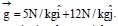 The change in the gravitational potential energy of a particle of mass 1 kg when it is taken from the origin to a point (7 m, – 3 m) is:
- a) 71 J
- b) 13√58J
- c) – 71 J
- d) 1 J
Answer: 1 J
Question: A particle released at a large distance from a planet reaches the planet only under gravitational attraction and passes through a smooth tunnel through its centre. If ve is the escape velocity of a body at centre of the planet, then the particle’s speed at the centre of the planet is :
- a) ve
- b) √1.5 ve
- c) 1.5 ve
- d) 2ve
Answer: ve
Question: A geostationary satellite is orbiting the earth at a height of 5R above that surface of the earth, R being the radius of the earth. The time period of another satellite in hours at a height of 2R from the surface of the earth is
- a) 5
- b) 10
- c) 6√2
- d) 6/ √2
Answer: 6√2
Question: The potential energy of a satellite of mass m and revolving at a height Re above the surface of earth where Re = radius of earth, is
- a) – m g Re
- b)

- c)

- d)

Answer:
Question: Geo-stationary satellite is one which
- a) Remains stationary at a fixed height from the earth’s surface
- b) Revolves like other satellites but in the opposite direction of earth’s rotation
- c) Revolves round the earth at a suitable height with same angular velocity and in the same direction as earth does about its own axis
- d) None of these
Answer: Revolves round the earth at a suitable height with same angular velocity and in the same direction as earth does about its own axis
Question: Two planets A and B have the same material density. If the radius of A is twice that of B, then the ratio of the escape velocity vA/vB is
- a) 2
- b) 2
- c) 1/ √2
- d) 1/2
Answer: 2
Question: A geostationary satellite is orbiting the earth at a height of 5R above that surface of the earth, R being the radius of the earth. The time period of another satellite in hours at a height of 2R from the surface of the earth is
- a) 5
- b) 10
- c) 6 √2
- d) 6/ √2
Answer: 6 √2
Question: A particle released at a large distance from a planet reaches the planet only under gravitational attraction and passes through a smooth tunnel through its centre. If ve is the escape velocity of a body at centre of the planet, then the particle’s speed at the centre of the planet is :
- a) ve
- b) √1.5 ve
- c) 1.5 ve
- d) 2ve
Answer: ve
Free study material for Physics
Gravitation Objective Questions & Solutions for BITSAT Physics
Chapter MCQs with Answers for BITSAT Physics
Explore reliable practice questions for Gravitation tailored for BITSAT Physics learners. Use these multiple-choice formats to evaluate preparedness and strengthen problem-solving skills.
Expert Practice Material for BITSAT Physics
Built using the official NCERT book for BITSAT, these Physics objective sets provide reliable academic guidance. Pair your practice with our recommended NCERT solutions to master optimal problem-solving approaches.
Complete Your Chapter Revision
Wrap up your chapter revision by testing your knowledge against standard question formats. Everything on our platform is provided free of charge.
FAQs
You can get most exhaustive BITSAT Physics Gravitation MCQs for free on StudiesToday.com. These MCQs for BITSAT Physics are updated for the 2026-27 academic session as per BITSAT examination standards.
Yes, our BITSAT Physics Gravitation MCQs include the latest type of questions, such as Assertion-Reasoning and Case-based MCQs. 50% of the BITSAT paper is now competency-based.
By solving our BITSAT Physics Gravitation MCQs, BITSAT students can improve their accuracy and speed which is important as objective questions provide a chance to secure 100% marks in the Physics.
Yes, Physics MCQs for BITSAT have answer key and brief explanations to help students understand logic behind the correct option as its important for 2026 competency-focused BITSAT exams.
Yes, you can also access online interactive tests for BITSAT Physics Gravitation MCQs on StudiesToday.com as they provide instant answers and score to help you track your progress in Physics.