

Multiple Choice Questions (MCQs) for BITSAT Physics: Electrostatic Potential and Capacitance
Explore reliable objective questions for Electrostatic Potential and Capacitance tailored for BITSAT learners. Utilizing these Physics multiple-choice formats ensures thorough preparation and strengthens problem-solving speed for upcoming school assessments.
Practice Electrostatic Potential and Capacitance MCQs for BITSAT Physics
View or download the dedicated Electrostatic Potential and Capacitance MCQ resource below. Practicing these 50 objective questions regularly builds familiarity with standard exam patterns and helps secure higher marks in final Physics evaluations.
Question: What is equivalent capacitance of circuit between points A and B?
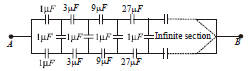
- a)

- b)

- c) Infinite
- d) 1 + √3) μF
Answer:
Question: A long, hollow conducting cylinder is kept coaxially inside another long, hollow conducting cylinder of larger radius. Both the cylinders are initially electrically neutral. Then
- a) A potential difference appears between the two cylinders when a charge density is given to the inner cylinder.
- b) A potential difference appears between two cylinders when a charge density is given to the outer cylinder
- c) No potential difference appears between the two cylinders when a uniform line charge is kept along the axis of the cylinders
- d) No potential difference appears between the two cylinders when same charge density is given to both the cylinders
Answer: A potential difference appears between the two cylinders when a charge density is given to the inner cylinder.
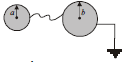
Question: Two conducting shells of radius a and b are connected by conducting wire as shown in figure. The capacity of system is :
- a)

- b) 4 πε0 (a + b)
- c) zero
- d) Infinite
Answer: Infinite
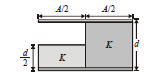
Question: A parallel plate capacitor of area ‘A’ plate separation ‘d’ is filled with two dielectrics as shown. What is the capacitance of the arrangement ?
- a)

- b)

- c)

- d)
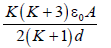
Answer:
Question: In the figure below, what is the potential difference between the point A and B and between B and C respectively in steady state
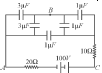
- a) VAB = VBC = 100V
- b) VAB = 75V, VBC = 25V
- c) VAB = 25V, VBC = 75V
- d) VAB = VBC = 50V
Answer: VAB = 25V, VBC = 75V
Question: A parallel plate capacitor of capacitance C is connected to a battery and is charged to a potential difference V. Another capacitor of capacitance 2C is similarly charge to a potential difference 2V. The charging battery is now disconnected and the capacitors are connected in parallel to each other in such a way that the positive terminal of one is connected to the negative terminal of the other. The final energy of the configuration is
- a) Zero
- b)

- c)

- d)

Answer:
Question: Four point charges –Q, –q, 2q and 2Q are placed, one at each corner of the square. The relation between Q and q for which the potential at the centre of the square is zero is
- a) Q = – q
- b)

- c) Q = q
- d)

Answer: Q = – q
Question: Two capacitors C1 and C2 are charged to 120 V and 200 V respectively. It is found that by connecting them together the potential on each one can be made zero. Then
- a) 5C1 = 3C2
- b) 3C1 = 5C2
- c) 3C1 + 5C2 = 0
- d) 9C1 = 4C2
Answer: 3C1 = 5C2
Question: A hollow metal sphere of radius 5 cm is charged such that the potential on its surface is 10 V. The potential at a distance of 2 cm from the centre of the sphere is
- a) zero
- b) 10 V
- c) 4 V
- d) 10/3 V
Answer: 10 V
Question: Two identical capacitors, have the same capacitance C. One of them is charged to potential V1 and the other to V2. The negative ends of the capacitors are connected together. When the positive ends are also connected, the decrease in energy of the combined system is –
- a)

- b)

- c)

- d)

Answer:
Question: If the potential of a capacitor having capacity 6 μF is increased from 10 V to 20 V, then increase in its energy will be
- a) 4 × 10⁻⁴ J
- b) 4 × 10⁻⁴ J
- c) 9 × 10⁻⁴ J
- d) 12 × 10–6 J
Answer: 9 × 10⁻⁴ J
Question: In a region, the potential is represented by V(x, y, z) = 6x – 8xy – 8y + 6yz, where V is in volts and x, y, z are in metres. The electric force experienced by a charge of 2 coulomb situated at point (1, 1, 1) is :
- a) 6 √5 N
- b) 30 N
- c) 24 N
- d) 4 √35 N
Answer: 4 √35 N
Question: If on combining two charged bodies, the current does not flow then
- a) Charge is equal on both
- b) Capacitance is equal on both
- c) Potential is equal on both
- d) Resistance is equal on both
Answer: Potential is equal on both
Question: Calculate the area of the plates of a one farad parallel plate capacitor if separation between plates is 1 mm and plates are in vacuum
- a) 18 × 108 m2
- b) 0.3 × 10⁸ m2
- c) 1.3 × 10⁸ m2
- d) 1.13 × 10⁸ m2
Answer: 1.13 × 10⁸ m2
Question: A capacitor is charged to store an energy U. The charging battery is disconnected. An identical capacitor is now connected to the first capacitor in parallel. The energy in each of the capacitors is
- a) 3 U/2
- b) U
- c) U/4
- d) U/2
Answer: U/4
Question: A parallel plate capacitor is charged and then isolated. What is the effect of increasing the plate separation on charge, potential, capacitance, respectively?
- a) Constant, decreases, decreases
- b) Increases, decreases, decreases
- c) Constant, decreases, increases
- d) Constant, increases, decreases
Answer: Constant, increases, decreases
Question: Figure shows a solid hemisphere with a charge of 5nC distributed uniformly through its volume. The hemisphere lies on a plane and point P is located on the plane, along a radial line from the centre of curvature at distance 15 cm. The electric potential at point P due to the hemisphere, is
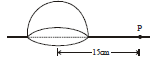
- a) 150V
- b) 300V
- c) 450V
- d) 600V
Answer: 300V
Question: Two parallel metal plates having charges + Q and –Q face each other ata certain distance between them. If the plaves are now dipped in kerosene oil tank, the electric field between the plates will
- a) Remain same
- b) Become zero
- c) Increases
- d) Decrease
Answer: Decrease
Question: Two capacitors C1 and C2 = 2C1 are connected in a circuit with a switch between them as shown in the figure. Initially the switch is open and C1 holds charge Q. The switch is closed. At steady state, the charge on each capacitor will be

- a) Q, 2Q
- b)

- c)

- d)

Answer:
Question: A hollow metal sphere of radius 5 cm is charged such that the potential on its surface is 10 V. The potential at a distance of 2 cm from the centre of the sphere is
- a) Zero
- b) 10 V
- c) 4 V
- d) 10/3 V
Answer: 10 V
Free study material for Physics
Electrostatic Potential and Capacitance Objective Questions & Solutions for BITSAT Physics
BITSAT Physics Electrostatic Potential and Capacitance Objective Test Questions
Test your conceptual understanding of Electrostatic Potential and Capacitance with these targeted multiple-choice questions. Designed in alignment with the latest BITSAT curriculum for BITSAT Physics, these problem sets build accuracy and prepare students for objective exams.
NCERT-Aligned Objective Questions and Solutions
Built using the official NCERT book for BITSAT, these Physics objective sets provide reliable academic guidance. Pair your practice with our recommended NCERT solutions to master optimal problem-solving approaches.
Next Steps in Your Exam Preparation
Explore our broader library of printable assignments, chapter notes, and mock tests designed to support continuous revision and secure higher marks in BITSAT assessments.
FAQs
You can get most exhaustive BITSAT Physics Electrostatic Potential and Capacitance MCQs for free on StudiesToday.com. These MCQs for BITSAT Physics are updated for the 2026-27 academic session as per BITSAT examination standards.
Yes, our BITSAT Physics Electrostatic Potential and Capacitance MCQs include the latest type of questions, such as Assertion-Reasoning and Case-based MCQs. 50% of the BITSAT paper is now competency-based.
By solving our BITSAT Physics Electrostatic Potential and Capacitance MCQs, BITSAT students can improve their accuracy and speed which is important as objective questions provide a chance to secure 100% marks in the Physics.
Yes, Physics MCQs for BITSAT have answer key and brief explanations to help students understand logic behind the correct option as its important for 2026 competency-focused BITSAT exams.
Yes, you can also access online interactive tests for BITSAT Physics Electrostatic Potential and Capacitance MCQs on StudiesToday.com as they provide instant answers and score to help you track your progress in Physics.