

Voyage Solutions for Class 8 Geography: Chapter 08 Asia Climate And Natural Vegetation
Explore the complete Voyage textbook solutions for Class 8 Geography. Tailored for the 2026-27 curriculum, this resource breaks down complex topics to support daily study and targeted revision.
Chapter-wise Solutions: Chapter 08 Asia Climate And Natural Vegetation
Access the complete PDF for Chapter 08 Asia Climate And Natural Vegetation below. This focused excerpt allows students to isolate specific topics for thorough review and uninterrupted reading, complementing standard ICSE textbooks.
A. Fill in the blanks
Question 1. A few regions of South-west Asia receive winter rainfall from the ___________ that originate over the Mediterranean Sea. (tropical cyclones, temperate cyclones, north-east winds, south-east winds)
Answer: temperate cyclones
In simple words: Some parts of Western Asia get rain in winter from storms called temperate cyclones that start over the Mediterranean Sea.
Exam Tip: Remember that Mediterranean storms bring winter rain specifically to South-west Asian countries.
Question 2. The ___________ climate is ideally suited growing citrus fruits. (equatorial, warm temperate east coast, Mediterranean, tropical monsoon)
Answer: Mediterranean
In simple words: A Mediterranean climate is the best kind of weather for growing juicy fruits like oranges and lemons.
Exam Tip: Citrus fruits thrive in Mediterranean regions due to their mild, wet winters and dry summers.
Question 3. The ___________ of Asia are dense and impenetrable. (steppes, mangrove forests, monsoon forests, tropical rain forests)
Answer: tropical rain forests
In simple words: Tropical rain forests in Asia are very thick, making them extremely hard to walk through.
Exam Tip: High heat and heavy rainfall all year round make tropical rain forests dense and thick.
Question 4. About ___________ of the land area of Asia is covered with forest.
Answer: one-third
In simple words: If you divide all the land in Asia into three equal parts, one of those parts is covered with forests.
Exam Tip: Knowing that nearly 33 percent of Asian land has forest cover is a useful statistic for geography answers.
Question 5. Thermal electricity is produced by burning ___________ and ___________.
Answer: coal and petroleum
In simple words: We generate thermal power by burning fossil fuels like coal and oil.
Exam Tip: Coal and petroleum are the main fossil fuels used for thermal power generation.
B. Match the following
Question. Match the climatic regions of Asia with their typical plant and animal life.
Answer:
| Climatic Region | Tree Plant Species | Wildlife Species |
|---|---|---|
| Arctic | Moss, lichen | Walruses, reindeer |
| Equatorial | Ebony, Mahogany | Monkeys, apes, colourful birds |
| Cold temperate | Pine, larch | Lynx, sable |
| Warm temperate eastern margin | Camphor, Magnolia | Pheasants, peacocks |
| Mid-latitude deserts | Thorny bushes, tufts of grass | Lizards, insects |
In simple words: Different weather zones have their own special plants and animals that are suited to live there, such as reindeer in the cold Arctic and monkeys in the warm equatorial forests.
Exam Tip: Be sure to match cold climates with softwood trees like pine, and hot, wet climates with hardwood trees like ebony.
C. Answer the following questions in brief
Question 1. When does most of Asia receive maximum rainfall? Give a reason for your answer.
Answer: A large part of the Asian continent gets its highest amount of rain during April, May, and June. During the summer season, temperatures across much of Asia average around 32°C. As the land heats up, the warm air rises, which develops a low-pressure zone over the region. Meanwhile, the cooler air over the neighboring seas and oceans creates high pressure. This difference causes damp, warm winds to blow from the water onto the land, known as monsoons. These wet winds bring heavy downpours to the continent.
In simple words: During summer, the land gets hot and pulls in wet winds from the ocean. These winds are called monsoons and they bring a lot of rain.
Exam Tip: Remember to explain how low pressure on land and high pressure over the ocean drive the monsoon winds.
Question 2. Name any two countries that experience Mediterranean climate.
Answer: Countries such as Syria, Turkey, Lebanon, and Israel enjoy a Mediterranean climate.
In simple words: Syria and Turkey are two countries that have mild, wet winters and warm, dry summers.
Exam Tip: Always memorize at least two Middle Eastern countries that lie along the Mediterranean coast for this question.
Question 3. Explain how the climate of the cold temperate regions of Asia has affected the :
1. Vegetation
2. Wildlife
Answer:
1. Vegetation of the cold temperate regions of Asia - This area goes through long, harsh winters with high snowfall, while the summers are brief, cool, and dry. Plants here have evolved to survive these rough conditions. The local evergreen trees have a cone-like shape and needle-shaped leaves to shed snow easily. They are known as coniferous trees because their seeds grow inside cones. Examples of these trees include pine, fir, spruce, larch, and cedar. These vast woodlands are also referred to as the taiga.
2. Wildlife - Many small and medium-sized creatures like the fox, sable, bear, mink, lynx, and squirrel live in this zone. They possess thick, warm fur to protect themselves from the freezing climate.
In simple words: Plants in the cold areas have needles instead of leaves so snow can slide off, and the animals have thick fur coats to stay warm.
Exam Tip: Mention the term 'Taiga' for vegetation and highlight 'thick fur' as a key physical adaptation for the wildlife.
Question 4. Name some wildlife species found in the taiga region, the tundra region, and the tropical deciduous forests of Asia..
Answer: Animals that live in the taiga are the fox, sable, bear, mink, lynx, and squirrel. In the cold tundra zone of Asia, you can find polar bears, reindeer, foxes, seals, and walruses. The tropical deciduous forests are home to larger animals, including rhinoceroses, elephants, bears, deer, monkeys, lions, tigers, and leopards.
In simple words: Different animals live in different zones, like fluffy squirrels in the cold woods, polar bears on the icy plains, and tigers in the warm forests.
Exam Tip: Be sure to group your answers clearly under each of the three regions: Taiga, Tundra, and Tropical Deciduous.
Question 5. Trees cannot grow of survive in the regions beyond the Arctic Circle in Asia. Why ?
Answer: No forests or trees can survive north of the Arctic Circle in Asia because the winters are extremely cold and lasting, and the ground underneath is permanently frozen. This frozen soil prevents tree roots from taking hold, leaving the area bare of trees.
In simple words: It is too cold for trees to grow past the Arctic Circle because the ground deep down is frozen solid all year.
Exam Tip: Mention 'frozen subsoil' (permafrost) as the main physical barrier preventing tree roots from growing.
D. Answer the following questions in one or two paragraphs
Question 1. Identify the main factors that affect the climate of Asia. Explain any two of them.
Answer: The primary elements that shape the climate of Asia are:
1. Size and latitudinal extent - Being the largest continent, Asia has a huge span from east to west. It also reaches across all three thermal zones: the hot, temperate, and freezing zones.
2. Distance from the sea - Vast interior regions of Asia are too far from the ocean to feel its cooling or warming effects, which leads to harsh continental weather. In contrast, coastal areas experience moderate and pleasant weather.
3. Relief features - High mountain ranges running from east to west block freezing winds from the north and rain-bearing winds from the south.
4. Wind - Weather is greatly affected by damp winds moving from the south and chilly winds blowing down from the north.
5. Ocean Currents - The temperatures of Japan's coast are influenced by the icy Oyashio and warm Kuroshio ocean currents.
In simple words: Asia's huge size, mountains, distance from the sea, winds, and ocean currents all shape its climate.
Exam Tip: Be sure to write the names of all five factors, and then provide a clear explanation for at least two of them to get full marks.
Question 2. Describe the climatic conditions in Asia from October to March.
Answer: From October to March, Asia undergoes its winter season because the northern hemisphere is tilted away from the sun, receiving only slanted rays. Temperatures drop to 0°C and plunge well below freezing in northern parts of the continent. The heavy, cold air settles over the land, creating a high-pressure zone. Meanwhile, the neighboring seas stay warmer and have lower air pressure, which causes chilly winds to blow from the land toward the ocean. Since these winds originate over land, they are dry and bring no rain to most areas. However, as they cross open water, they pick up moisture and bring rain to South-East Asia, Japan, South-Eastern India, and Sri Lanka. Additionally, some parts of South-West Asia get winter rain from storms starting over the Mediterranean Sea.
In simple words: In winter, cold dry winds blow from the freezing land to the warmer ocean. This is why most of Asia is dry in winter, except for a few coastal areas and islands.
Exam Tip: Explain the wind movement from high pressure (land) to low pressure (sea) and point out the exceptions that get winter rain.
Question 3. Write about the Mediterranean climate experienced in Asia.
Answer: The Mediterranean weather in Asia features warm, dry summers alongside cool, wet winters. Because summers are very dry, local plants have adapted by growing deep roots and thick, sponge-like bark to store moisture. Evergreen trees like oak, acacia, laurel, chestnut, walnut, and olive are widespread. Today, many of these natural forests have been cleared to make way for citrus fruit orchards, vineyards, and grain fields. Due to the loss of their natural surroundings, native wild animals are rare, and the area is now dominated by farm animals like donkeys, sheep, and cattle.
In simple words: Mediterranean regions have hot, dry summers and wet winters. People here grow a lot of citrus fruits like lemons and oranges.
Exam Tip: Be sure to highlight the unique feature of 'wet winters and dry summers' along with plant adaptations like long roots and spongy bark.
Question 4. Describe each of these forests :
1. Tropical deciduous
2. Equatorial rainforest.
Answer:
1. Tropical deciduous forests - Located in regions with a monsoon climate, these areas have hot, rainy summers and dry, cool winters. Commonly known as monsoon forests, they consist of broad-leaved hardwood trees that drop their leaves during the dry winter months. Standard tree varieties include teak, sal, shisham, and mango. Where rainfall is lower, dry shrubs and grasses take over. These forests are home to wildlife like elephants, rhinoceroses, bears, deer, apes, tigers, and leopards. You can find these forests in countries like India, Pakistan, Bangladesh, Myanmar, Thailand, Vietnam, Laos, Cambodia, and Southern China.
2. Equatorial rainforest - Growing near the equator, these forests experience hot temperatures around 28-30°C and rain throughout the year. This constant warmth and moisture support thick, hardwood forests with trees like mahogany, ebony, rosewood, cinchona, coconut, and rubber. Vines, climbers, tall grasses, and bamboo grow thickly between the trees, making the jungle nearly impossible to walk through. The forest floor is dark because the high treetops create a thick canopy that blocks out the sun. Most of the wildlife consists of tree-dwelling creatures like monkeys, apes, and bright birds, while the wet forest floor is full of snakes, lizards, crocodiles, and insects. Large mammals like elephants live mostly on the outer edges because the inner forest is too crowded. These jungles are found in equatorial nations such as Malaysia, Indonesia, and the Southern Philippines.
In simple words: Monsoon forests have trees that drop their leaves in the dry season, while equatorial rainforests stay green and wet all year, making them incredibly thick and dark.
Exam Tip: Differentiate these two by noting that deciduous trees shed their leaves to save water, whereas rainforest trees are evergreen and have a multi-layered canopy.
Question 5. How has modernization changed the natural vegetation of the Mediterranean and steppe regions ?
Answer:
- Mediterranean region: Human development has cleared away the native plants to establish vast grain fields, grape vineyards, and orchards filled with citrus fruits like oranges and lemons.
- Steppes region (Temperate Grassland): Large stretches of open grasslands have been turned into productive agricultural fields to cultivate crops like wheat, barley, and other food grains.
In simple words: Humans have cleared the original grass and trees in these areas to build large farms for growing wheat, grapes, and citrus fruits.
Exam Tip: Focus on how natural landscapes were converted into commercial farmlands for fruits (Mediterranean) and food grains (Steppes).
Question 6. How are forests useful to the people of Asia?
Answer: Around 33% of Asia is forested, and these areas offer many resources. Hardwood, bamboo, sandalwood, and camphor are harvested from them. They also yield useful materials like lac, resin, turpentine, honey, and healing herbs. In addition, natural rubber comes from the milky sap of rubber trees. The wet equatorial jungles and hot monsoon forests are the main providers of these goods. Meanwhile, northern softwood forests provide raw wood used to manufacture paper, cardboard, newsprint, matches, and synthetic fabrics like rayon. These materials come from trees like birch, pine, cedar, and fir, which are abundant in the cold northern taiga of Siberia.
In simple words: Asia's forests provide wood for building and paper, as well as rubber, honey, medicines, and bamboo.
Exam Tip: Divide your answer into the uses of hardwood (from equatorial/monsoon forests) and softwood (from coniferous/taiga forests) to show a structured understanding.
Question 7. Give an account of the mineral resources of Asia.
Answer: Asia contains massive reserves of diverse minerals. Iron ore is found in countries like India, Malaysia, China, Russia, Japan, the Philippines, and North Korea. Major coal deposits lie in China, India, Kazakhstan, and Russia. Bauxite is mined in India, Indonesia, and Russia. Petroleum is highly abundant in Middle Eastern nations like Saudi Arabia, the United Arab Emirates, Bahrain, Kuwait, Iran, and Iraq, as well as in Malaysia, Indonesia, China, and Russia.
In simple words: Asia is rich in minerals, with plenty of iron, coal, bauxite for making aluminum, and oil in the Middle East.
Exam Tip: List the major minerals (iron ore, coal, bauxite, petroleum) as sub-headings and write the key countries producing each for clarity.
E. Map study
Question. On an outline map of Asia, mark the following:
- area affected by the monsoons
- regions of equatorial climate
- regions of Mediterranean climate
- areas under the steppes
Answer: To mark these regions on a map of Asia:
- **Area affected by the monsoons:** Shade South Asia (such as India, Pakistan, Bangladesh) and South-East Asia (including Myanmar, Thailand, and Southern China).
- **Regions of equatorial climate:** Shade the islands situated very close to the equator, such as Indonesia, Malaysia, and the Southern Philippines.
- **Regions of Mediterranean climate:** Color the narrow coastal belt in South-West Asia bordering the Mediterranean Sea, including parts of Turkey, Syria, Lebanon, and Israel.
- **Areas under the steppes:** Highlight the vast mid-latitude grassland plains in Central Asia, primarily covering Mongolia and North-West China.
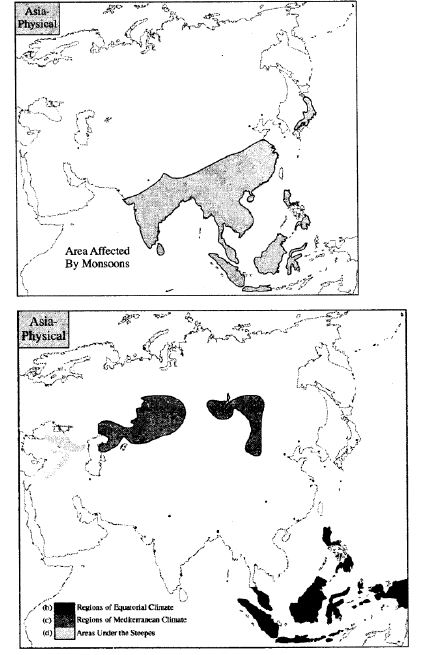
In simple words: Shade South Asia for monsoons, the islands near the equator for equatorial climate, the western coastline for Mediterranean, and Central Asia for grasslands.
Exam Tip: Use distinct colors or shading patterns (like dots, stripes, or solid colors) for each region and include a clear index key at the corner of your map.
F. Picture study
Question 1. Identify the animal seen in the photograph.
Answer: The animal shown in the image is a yak.
In simple words: The animal is a yak.
Exam Tip: Identify the yak by its long, shaggy coat, which is an adaptation for cold mountain climates.
Question 2. In which climatic region of Asia can you find this animal ?
Answer: This animal is commonly found in the temperate or mid-latitude desert areas of Asia.
In simple words: You can find this animal in the cold deserts of Central Asia.
Exam Tip: Specify 'temperate desert' or 'mountain regions' like the Tibetan Plateau as the typical habitat for yaks.
Extra Questions
Question 1. Write a short note on summer conditions in Asia.
Answer: Between April and June, direct sunlight hits the northern hemisphere. By June, the sun shines right above the Tropic of Cancer. Consequently, almost all of Asia becomes quite warm, maintaining an average temperature around 32°C, with only the far northern lands past the Arctic Circle remaining cold. These months also bring the highest amount of rainfall to a major part of the continent.
In simple words: From April to June, the sun is high in the sky over Asia, making it warm with a lot of rain.
Exam Tip: Mention the position of the sun over the Tropic of Cancer in June and the average summer temperature of 32°C.
Question 2. Why is Siberia so sparsely populated ?
Answer: Very few people live in Siberia because of its extremely cold climate. The winters there are long and incredibly harsh with intense snow, while the summers remain brief and cool.
In simple words: Siberia has very few people because it is freezing cold with long, snowy winters and very short summers.
Exam Tip: Use terms like 'extreme climate' and 'harsh winters' to justify the low population density of Siberia.
Question 3. Write a short note on the tropical or hot desert climate and the natural vegetation and wildlife found there.
Answer: A hot, tropical desert climate exists in Arabia, Iran, and the Thar Desert of India and Pakistan. These areas go through scorching, dry summers and chilly winters. The temperature shifts drastically between day and night, as well as between seasons, and the yearly rainfall stays below 25 cm. Because of these tough conditions, plant life is sparse, consisting mainly of scattered thorny shrubs, cacti, and patches of dry grass. Date palms grow only around water sources called oases. Typical desert animals include camels, horses, mules, gazelles, insects, and lizards.
In simple words: Hot deserts get very little rain and have extreme temperatures. Only tough plants like cacti grow there, and animals like camels live there.
Exam Tip: Mention the low annual rainfall (less than 25 cm) and adaptative features of plants like thorns and cacti.
Question 4. What type of climate do China, Japan and Korea experience?
Answer: China, Japan, and Korea have a warm temperate eastern margin climate, which is also known as the China-type climate. This weather is quite like the monsoon type, but the winters are much colder. It rains during the summer months, while snow falls in the winter.
In simple words: These countries have warm summers with rain and cold winters with snow, which is called a China-type climate.
Exam Tip: Remember the two names for this climate: 'China-type' and 'warm temperate eastern margin'.
Question 5. Which is the most common domesticated animal in Tibet ? What kind of climate is found in the Plateau of Tibet and the Gobi Desert ?
Answer: The most widespread domestic animal in Tibet is the yak. A temperate or mid-latitude desert climate covers both the Tibetan Plateau and the Gobi Desert. These high areas receive minimal rain, experiencing freezing winters and very hot summers.
In simple words: The yak is the most common farm animal in Tibet. The region has a cold desert climate with freezing winters and very little rain.
Exam Tip: Address both parts of the question clearly: name the yak first, then describe the temperate desert climate.
Question 6. What increases the commercial value of forests in cool temperature eastern margin climate ?
Answer: These forests feature trees like oak, beech, maple, and birch. Their commercial value is very high because these trees grow together in large, uniform groups of just a few species, making logging and processing much easier.
In simple words: Because only a few types of trees like oak and maple grow together in large groups, they are much easier and cheaper to harvest.
Exam Tip: Explain that 'pure stands' (forests consisting of primarily one tree species) are highly valuable for lumbering.
Question 7. List the major types of climate of Asia.
Answer: The main climate zones across Asia are:
1. Equatorial climate
2. Tropical monsoon climate
3. Tropical or hot desert climate
4. Warm temperate eastern margin (or China-type) climate
5. Temperate (or mid-latitude) desert climate
6. Mediterranean climate
7. Cool temperate eastern margin climate
8. Temperate grassland (or steppe) climate
9. Cold temperate (or taiga) climate
10. Arctic (or tundra) climate
In simple words: Asia has ten main climate zones, ranging from hot, wet equatorial areas to freezing, icy Arctic regions.
Exam Tip: Try to list these climates in order from the equator to the poles (South to North) to show systematic learning.
Question 8. What are the different types of vegetation found in varied climatic conditions of Asia ?
Answer: Due to its diverse weather, Asia supports many plant types. These include thick evergreen hardwood jungles, tropical deciduous forests, prickly desert shrubs, short wild grasses, softwood evergreen trees, and simple plants like mosses and lichens.
In simple words: Asia's plants vary from thick rainforests and deciduous trees to dry grasses and mosses in the cold north.
Exam Tip: Match each vegetation type with its typical climate zone when writing a comprehensive answer.
9. Fill in the blanks.
Question 9.1. The areas away from the coasts experience ___________ climate while places closer to the coasts experience ___________ climate.
Answer: continental (extreme), maritime (equable)
In simple words: Places deep inside the land have very hot summers and cold winters, while places near the sea stay pleasant all year.
Exam Tip: Remember 'continental' means extreme weather and 'maritime' means mild, ocean-influenced weather.
Question 9.2. World’s highest surface temperature of 71°C has been recorded in ___________ in Iran.
Answer: Dasht-eLut
In simple words: The hottest land temperature on Earth, 71°C, was measured in Iran's Dasht-e Lut desert.
Exam Tip: Dasht-e Lut is a salt desert in Iran famous for holding extreme heat records.
Question 9.3. ___________ in Meghalaya receives the heaviest rainfall in the world.
Answer: Mawsynram
In simple words: Mawsynram is a village in India that gets more rain than any other place on Earth.
Exam Tip: Be sure to spell 'Mawsynram' correctly as it is a highly common geography question.
Question 9.4. ___________ in Russia is the coldest region in Asia with an average temperature of -51 °C.
Answer: Verkhoyansk
In simple words: Verkhoyansk is an extremely cold town in Siberia, Russia.
Exam Tip: Verkhoyansk is known as the cold pole of the Northern Hemisphere.
Question 9.5. Most of the Asia receives ___________ rainfall in winter.
Answer: no
In simple words: Almost the entire continent of Asia stays dry with no rain during winter.
Exam Tip: The dry winter is caused by offshore winds blowing from the cold land towards the sea.
Question 9.6. ___________ rainfall occurs almost daily around 4 o’ clock in equatorial climate region of Asia.
Answer: Convectional
In simple words: Near the equator, hot air rises during the day and falls back as heavy rain almost every afternoon around 4 o'clock.
Exam Tip: Convectional rain is typical of equatorial regions and is often called the '4 o'clock rain'.
Question 9.7. ___________ is the milky sap of rubber tree which is collected and used to make rubber for commercial purposes.
Answer: Latex
In simple words: Latex is the white, sticky liquid that comes out of rubber trees to make tires and bands.
Exam Tip: Latex is tapped from the bark of rubber trees and processed into natural rubber.
Question 9.8. The equatorial (tropical) rainforests are different from the rainforests of the Amazon and Zaire basins because of their ___________ to the sea.
Answer: nearness
In simple words: Asia's rainforests are close to the sea, which makes them different from the vast landlocked jungles in South America and Africa.
Exam Tip: The maritime influence makes Asian rainforests unique compared to other tropical forests.
Question 9.9. India has ___________ climate and ___________ forests.
Answer: tropical monsoon, tropical deciduous (monsoon)
In simple words: India has a hot monsoon climate, so most of its trees drop their leaves during the dry season.
Exam Tip: Tropical monsoon climates support deciduous trees that shed leaves to conserve water.
Question 9.10. ___________ are found in the Oases in hot deserts.
Answer: Date palms
In simple words: Date palms are the sweet-fruit trees that grow around water pools in hot deserts.
Exam Tip: Date palms are the most iconic and economically useful trees in desert oasis regions.
Question 9.11. The ___________ Desert stretches across large parts of Mongolia and China.
Answer: Gobi
In simple words: The Gobi Desert is a large cold desert located in Northern China and Mongolia.
Exam Tip: The Gobi is a prominent rain-shadow desert in Central Asia.
Question 9.12. ___________ is one of the most commonly domesticated animals in the temperature desert regions of Asia.
Answer: Yak
In simple words: Yaks are kept by people in cold Asian deserts to help carry heavy loads and provide milk.
Exam Tip: The yak is adapted to high altitudes and cold climates, making it essential in Tibet.
Question 9.13. The ___________ camel is a well-known animal of temperate grassland or ___________.
Answer: two-humped Bactrian, steppe
In simple words: The Bactrian camel has two humps and lives in the cold grasslands of Central Asia.
Exam Tip: Remember that Bactrian camels have two humps, unlike the single-humped dromedary camels of hot deserts.
Question 9.14. The temperate grassland region of Central Asia is called ___________.
Answer: steppe
In simple words: The open, grassy plains of Central Asia are known as the steppes.
Exam Tip: Steppe is the specific geographical term for temperate grasslands in Eurasia.
Question 9.15. The forests of the cold temperate regions, have ___________ trees with ___________ like leaves.
Answer: coniferous, needle
In simple words: In cold regions, trees have cones and thin needles instead of wide leaves.
Exam Tip: Needle-like leaves reduce water loss and prevent heavy snow from breaking branches.
Question 9.16. The coniferous forests in cold temperate climate are called as ___________.
Answer: Taiga
In simple words: The huge pine forests in the cold north are called the Taiga.
Exam Tip: Taiga is the largest continuous land biome on Earth, dominated by conifers.
Question 9.17. The treeless plains in the Arctic climate are called ___________.
Answer: Tundra
In simple words: The icy, flat lands near the North Pole where no trees can grow are called the Tundra.
Exam Tip: The Tundra is defined by extreme cold, low biodiversity, and a lack of trees.
Map Skills
Question. On a physical map of Asia, show the different types of climate and natural vegetation.
Answer: To show the varied climates and vegetation types on a physical map of Asia, use a legend with different colors to represent each zone:
- **Equatorial forest:** Shade green in Indonesia, Malaysia, and the southern islands.
- **Tropical monsoon:** Use a lighter green for India, Myanmar, Bangladesh, and Thailand.
- **Hot desert:** Color yellow for Arabia, Iraq, Iran, and the Thar Desert of India-Pakistan.
- **Warm temperate:** Color orange for Southern China, Japan, and Korea.
- **Mid-latitude desert:** Use light brown for the Gobi Desert and the Tibetan Plateau.
- **Mediterranean:** Color purple for the coastal strip of Turkey, Syria, and Israel.
- **Steppes:** Color light green for the grasslands of Mongolia and Central Asia.
- **Cool temperate:** Use light blue for Northern Japan and North-Eastern China.
- **Coniferous (Taiga):** Shade dark blue or dark green across Siberia.
- **Tundra:** Color grey for the extreme northern Arctic coast.
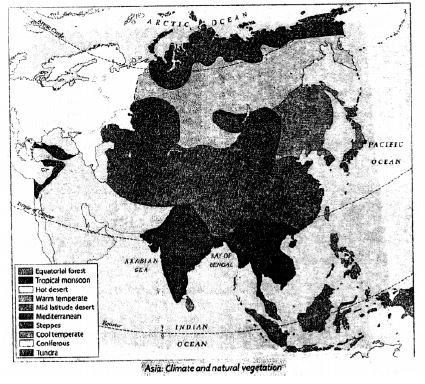
In simple words: You can show Asia's weather zones on a map by coloring each region, like yellow for deserts and green for wet rainforests, using a color key.
Exam Tip: Ensure that your map color scheme uses standard geographical representations (e.g., green for forests, yellow/brown for deserts, and blue/grey for cold regions).
Free study material for Geography
ICSE Textbook Solutions for Class 8 Geography Chapter 08 Asia Climate And Natural Vegetation
Detailed Textbook Solutions: Chapter 08 Asia Climate And Natural Vegetation (Class 8 Geography)
Strengthen your preparation with comprehensive answers for Class 8 Geography Chapter 08 Asia Climate And Natural Vegetation. These expert-reviewed solutions make tracking your academic progress straightforward and efficient.
Step-by-Step Explanations and Breakdown
Tackle complex theorems and numerical problems easily by cross-referencing your working steps with our structured solution guides.
More Study Resources for Class 8 Geography
Wrap up your chapter revision by verifying core concepts against standard ICSE question formats. All resources on our platform are free to access.
FAQs
You can download the verified Voyage solutions for Chapter 08 Asia Climate And Natural Vegetation on StudiesToday.com. Our teachers have prepared answers for Class 8 Geography as per 2026-27 ICSE academic session.
Yes, our solutions for Chapter 08 Asia Climate And Natural Vegetation are designed as per new 2026 ICSE standards. 40% competency-based questions required for Class 8, are included to help students understand application-based logic behind every Geography answer.
Yes, every exercise in Chapter 08 Asia Climate And Natural Vegetation from the Voyage textbook has been solved step-by-step. Class 8 students will learn Geography conceots before their ICSE exams.
Yes, follow structured format of these Voyage solutions for Chapter 08 Asia Climate And Natural Vegetation to get full 20% internal assessment marks and use Class 8 Geography projects and viva preparation as per ICSE 2026 guidelines.