

Official Voyage Textbook Solutions for Class 8 Geography
Access the official Voyage textbook solutions for Class 8 Geography, updated for the 2026-27 academic year. This digital resource is structured to help students build strong conceptual clarity and prepare effectively for school examinations.
Read and Download Chapter 06 Disaster Management Solutions
Navigate directly to the Chapter 06 Disaster Management solutions using the digital viewer below. Organizing your study sessions chapter-by-chapter allows for seamless offline study and quick reference during revision.
A. Fill in the blanks
Question 1. Proper ________ can help in limiting and minimizing damages and losses caused by natural or man-made disasters.
Answer: planning
In simple words: Making a good plan helps reduce the damage from disasters.
Exam Tip: Remember that planning is the key step before a disaster strikes.
Question 2. Floods can be prevented in vulnerable areas by properly maintaining ________ along rivers.
Answer: dykes
In simple words: Keeping river walls strong prevents water from flooding nearby areas.
Exam Tip: "Dykes" and "embankments" are synonyms, but "dykes" is the specific term used here.
Question 3. Rainwater harvesting goes a long way in replenishing the depleting supply of ________.
Answer: ground water
In simple words: Saving rainwater helps fill up the water stored deep underground.
Exam Tip: Groundwater is written as either one or two words; follow your textbook's exact spelling.
Question 4. We should always turn off the knob of our ________ when it is not in use.
Answer: LPG cylinders
In simple words: Make sure to turn off the gas cylinder knob to stop leaks.
Exam Tip: Always mention "LPG cylinders" fully instead of just "gas" to secure full marks.
Question 5. Every house should have an emergency ________ kit.
Answer: first-aid
In simple words: Every home needs a box with medical supplies for quick treatment.
Exam Tip: "First-aid" is hyphenated; ensure correct spelling.
B. Match the following
Question. Match the items in Column A with Column B:
| Column A | Column B |
|---|---|
| 1. Earthquake | a. Dykes and embankments |
| 2. Floods | b. Extinguisher |
| 3. Droughts | c. Drop, cover, hold |
| 4. Fire | d. Rainwater harvesting |
Answer:
The correctly matched pairs are shown in the table below:
| Column A | Column B |
|---|---|
| 1. Earthquake | c. Drop, cover, hold |
| 2. Floods | a. Dykes and embankments |
| 3. Droughts | d. Rainwater harvesting |
| 4. Fire | b. Extinguisher |
In simple words: Match earthquakes to "drop, cover, hold"; floods to "dykes"; droughts to "rainwater harvesting"; and fire to "extinguisher".
Exam Tip: Draw straight lines or present a clean matched table rather than writing messy numbers in the margins.
C. Write true or false
Question 1. The geographical location and landscape of India exposes it to earthquakes.
Answer: True. India's geography and geological features make many of its regions highly prone to seismic activity.
In simple words: Yes, India's location on Earth makes it likely to have earthquakes.
Exam Tip: Remember that Northern and North-Eastern parts of India are especially prone to seismic tremors.
Question 2. When a natural disaster occurs in a developing country like India, it is the rich of the country that suffer the most.
Answer: False. During natural disasters in developing countries, underprivileged and low-income populations are typically the ones who face the greatest hardships.
In simple words: No, the poorest people suffer the most because they do not have safe houses or resources.
Exam Tip: When justifying a False statement, write the corrected statement clearly to score full marks.
Question 3. If you are outdoors during a tremor, the best strategy is to stand under a tree.
Answer: False. The safest approach during an earthquake when outside is to move to a clear, open area away from trees and overhead structures.
In simple words: No, standing under a tree is dangerous because branches or the tree itself can fall on you.
Exam Tip: Explain why standing under a tree is hazardous to make your answer more complete.
Question 4. It is essential to plan in advance to prevent floods and contain the losses resulting from them.
Answer: True. Advanced preparation and infrastructural measures are vital to keep floodwaters in check and lower the destruction they cause.
In simple words: Yes, planning ahead of time is very important to stop floods and save lives.
Exam Tip: Planning and mitigation are key concepts in managing any water-related disaster.
Question 5. It is not possible to prepare in advance to mitigate the impact of a drought.
Answer: False. There are several proactive measures, such as water conservation and planting trees, that help minimize the severity of droughts.
In simple words: No, we can prepare for a dry season by saving water and planting trees before it starts.
Exam Tip: Highlight "rainwater harvesting" as a practical way to prepare for droughts.
D. Answer the following questions in brief
Question 1. What is disaster management ?
Answer: Disaster management refers to the systematic process of organizing and directing resources to prepare for, respond to, and recover from emergencies. It includes taking protective measures before, during, and after a crisis to minimize damage and help affected communities.
In simple words: It is the plan we make to deal with emergencies so that people are protected and can get help quickly.
Exam Tip: Be sure to mention the three critical phases: before, during, and after the disaster.
Question 2. Why is disaster management important ?
Answer: Preparedness is essential because natural and human-caused crises occur unexpectedly and can cause severe destruction. In vulnerable regions like India, terrain features make the country highly susceptible to events like earthquakes and cyclones. Since poorer communities bear the heaviest burden, planned strategies by local authorities and non-profits are crucial to save lives and resources.
In simple words: It is important because we cannot predict disasters, and having a plan keeps everyone - especially poor families - safe.
Exam Tip: Highlight India's specific vulnerability to diverse weather events and seismic activity in your explanation.
Question 3. What safety measures can be followed against floods ?
Answer: Flooding can be controlled by constructing and maintaining protective barriers along river paths. It is vital for governments to establish safe shelter zones in flood-prone areas for quick evacuation. Additionally, rescue teams must have boats and communication lines ready, and stocks of clean water, dry rations, and basic medicines must be prepared to prevent diseases.
In simple words: We can build river walls, set up high shelters, keep rescue boats on standby, and store clean food and medicine.
Exam Tip: Always list both preventative structural steps (like dykes) and relief steps (like food and medical aid) in your response.
Question 4. Mention any three safety measures against a fire.
Answer: 1. Every person should understand standard fire safety rules and protocols.
2. Individuals should find out about various types of fire extinguishers and know which one is suitable for different fires.
3. When inside public spaces like theaters, take note of where the emergency exits are located.
4. Always use stairs instead of elevators if you need to exit a burning building.
5. Basic training in first-aid and techniques to control small fires is highly useful.
6. Ensure matchsticks are fully put out and safely thrown away after use.
7. Turn off the valves of LPG cylinders when cooking is done, and keep kitchen windows open for proper ventilation.
In simple words: Learn basic fire rules, do not use lifts during a fire, know your nearest exits, and handle matches and gas cylinders with care.
Exam Tip: Although the question asks for three points, knowing all seven helps you recall the most practical ones in the exam.
Question 5. Write any two safety measures taken against biological disaster.
Answer: 1. Avoid touching suspicious materials and immediately inform the local police.
2. Public administrative departments must guide citizens through news channels and mass media.
3. People should wear face masks to protect themselves from breathing in harmful biological agents.
In simple words: Keep away from weird packages, wear a face mask to protect your breathing, and follow news instructions.
Exam Tip: Mentioning "personal protection" (like masks) and "official alerts" (like mass media) covers both individual and community safety levels.
Question 6. What safety measures should be taken in case of a travel- related disaster?
Answer: 1. Ensure rapid evacuation of injured individuals from the accident zone and provide medical first-aid immediately.
2. Carry an identification card that clearly shows your blood group and includes emergency contact numbers of family members.
In simple words: Get injured people away from the crash site for medical help, and always carry an ID card with your blood type on it.
Exam Tip: Mentioning the inclusion of "blood group" and "emergency contacts" on ID cards is a high-scoring detail.
Question 7. What role can social organizations play in disaster management ?
Answer: Humanitarian groups like the Red Cross, international agencies, and non-governmental organizations provide crucial relief during emergencies. They focus on meeting the direct needs of survivors by distributing meals, medical supplies, and shelter. Their presence also offers emotional comfort, reducing the sense of isolation and despair among victims.
In simple words: Charity groups help by giving food, medicine, and shelter, making sure people do not feel abandoned after a disaster.
Exam Tip: Name-drop recognized entities like "Red Cross" and "NGOs" to show a strong understanding of social organizations.
E. Answer the following questions in one or two paragraphs
Question 1. What safety measures should be taken during an earthquake ?
Answer: If you are indoors during seismic tremors, remember the "drop, cover, and hold" rule to protect yourself from falling debris. Immediately crawl under a sturdy table or bed. If you are outdoors, move quickly into an open space away from high-rise buildings, utility poles, trees, and power lines. Avoid standing near or under bridges and flyovers during and immediately after the earthquake.
In simple words: Hide under a strong table if you are inside. If you are outside, run to a clear area away from trees and power lines.
Exam Tip: Focus your answer on two distinct scenarios: "indoors" safety rules versus "outdoors" safety rules.
Question 2. Write a note on the safety measures to lessen the impact of droughts.
Answer: 1. Use existing water resources like lakes, rivers, and reservoirs carefully and maintain them to preserve water.
2. Practice rainwater harvesting to replenish declining underground water levels with guidance from local groups.
3. Build small check dams in hilly terrains to capture run-off water during rains.
4. Stop cutting down trees near river basins and focus on afforestation, as trees attract rainfall and keep soil moist.
5. Practice water-saving habits in your daily household activities.
In simple words: To prepare for droughts, we must collect rain, build tiny dams, plant more trees, and avoid wasting household water.
Exam Tip: A comprehensive answer must highlight both modern methods (like rainwater harvesting) and natural methods (like afforestation).
Question 3. Write any five safety measures against fires.
Answer: 1. Learn basic fire safety guidelines and follow them carefully.
2. Understand the different classes of fire extinguishers and make sure you know which one to use.
3. Identify emergency exits and doors when entering any public theater or hall.
4. Avoid using elevators during a fire outbreak; always use the stairs to escape.
5. Undergo training in basic first-aid and simple fire suppression methods.
6. Fully extinguish matchsticks before throwing them away.
7. Turn off the main gas valves of LPG cylinders when not cooking, and keep kitchen areas well-ventilated.
In simple words: Learn how to use fire tools, spot the exits in public halls, use the stairs during a fire, and turn off your kitchen gas.
Exam Tip: Since the question asks for five, structure them as clear, separate numbered points to make it easy for the examiner to grade.
Question 4. Write some ways in which the government can tackle man-made disasters.
Answer: 1. Set up dedicated disaster management departments with sufficient budget allocations.
2. Install advanced monitoring, tracking, and early warning systems.
3. Utilize modern digital technologies and communication systems to manage emergencies.
4. Form dedicated relief groups to coordinate rehabilitation and reconstruction work.
5. Improve and secure communication networks so that affected regions do not lose contact.
6. Deploy inspection teams to regularly check safety compliance in public buildings like malls, hotels, and theaters.
In simple words: Governments can fund rescue teams, use smart technology to predict issues, and inspect public places for safety.
Exam Tip: Use terms like "rehabilitation", "warning systems", and "regular inspections" to demonstrate technical knowledge.
Question 5. What role can people play in disaster management ?
Answer: Since official emergency aid can sometimes take time to reach a disaster site, citizens should learn basic first-aid to help those who are injured. Every household should maintain a medical emergency kit. Spreading awareness about safety plans is also crucial; for instance, business owners must follow safety codes regarding escape routes and fire systems. In war-torn regions, people can build underground bunkers for safety. Those in coastal areas can plant trees or build protective sea walls to reduce the impact of tsunamis. People must also remain vigilant and report suspicious activities to prevent human-made hazards.
In simple words: People can help by learning first-aid, keeping a medical kit at home, and watching out for suspicious things to prevent attacks.
Exam Tip: Emphasize that community-level response is the first line of defense before professional emergency services arrive.
Question 6. Briefly explain the steps to be taken to mitigate the impact of cyclone.
Answer: 1. Stay updated with weather warnings and announcements from meteorological services and radio broadcasts, and act promptly.
2. Construct durable community shelters in high-risk zones that are accessible to everyone.
3. Design houses in coastal areas to withstand powerful winds.
4. Protect and grow coastal forests, such as mangroves, which help slow down wind and wave energy.
5. Keep an emergency supply kit with dry food, water, and essential medicines ready in a waterproof bag.
6. Stay alert to safety hazards like fallen electric poles, hanging wires, and snakebites after the storm.
In simple words: Pay attention to storm warnings, build wind-proof homes, keep a waterproof emergency bag, and watch out for fallen wires after the storm.
Exam Tip: Pointing out the natural protective role of "mangrove forests" is a great way to show a deep understanding of coastal safety.
Question 7. What precautions should be taken against nuclear disaster?
Answer: 1. Stay inside solid buildings with all doors and windows closed, as thick walls block radiation.
2. Avoid touching any outdoor dust, water, or objects as they might be contaminated.
3. Rely on official radio and TV broadcasts for safety instructions.
4. Ensure that nuclear plants are constructed far from populated zones and active earthquake areas.
In simple words: Stay indoors with windows closed, do not touch anything outside, and follow official emergency instructions.
Exam Tip: Highlight both personal protection (staying indoors) and policy-level protection (safe plant locations) in your answer.
Question 8. What safety measures can be taken in case of
1. a chemical disaster
2. terror attack?
Answer: 1. In case of a chemical disaster:
(a) Avoid building chemical factories near crowded residential neighborhoods.
(b) Government authorities should run regular safety and pollution audits on chemical plants. Emergency systems must be fully prepared with medical antidotes and treatments for exposure.
2. In case of a terror attack:
(a) Stay alert and report any suspicious individuals or activities in your neighborhood to the authorities.
(b) Never touch unclaimed bags or objects left in public places; report them to the police immediately.
(c) Keep emergency contacts, such as police, medical, and neighbor numbers, easily accessible.
In simple words: Keep chemical plants away from homes and inspect them often. For terror attacks, stay alert, do not touch abandoned bags, and keep emergency phone numbers handy.
Exam Tip: For multi-part questions, organize your answer with clear subheadings for "Chemical Disaster" and "Terror Attack".
F. Picture study
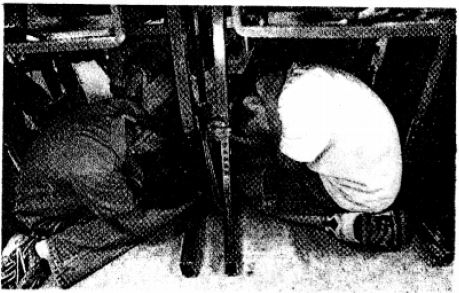
Question. The photograph shows children practicing the ‘drop, cover and hold’ strategy during an earthquake. What are the precautions that should be taken during an earthquake and the tremors that follows?
Answer: When inside a building during an earthquake, the simple action of crouching down, taking cover under a solid table, and holding on can protect you from harm. If the ground shakes, drop down immediately. For those who are outdoors, moving to an open space away from utility poles, tall buildings, and trees is the safest plan. Avoid driving or walking on bridges and overpasses until the shaking has completely stopped.
Furthermore, engineers must follow strict safety guidelines when building houses, dams, and bridges. Existing structures should be reinforced using modern safety upgrades. Keeping an emergency medical kit at home and in classrooms is also highly recommended.
In simple words: Hide under a desk if you are indoors, or move to an open field if you are outside. Buildings should be made strong, and we should keep first-aid kits ready.
Exam Tip: Mentioning "retrofitting" for older buildings is an excellent keyword that examiners look for.
Extra Questions
Question 1. Which simple strategy or three steps can protect people from getting severely injured during an earthquake while indoor ?
Answer: The three crucial steps are dropping down, covering your head under a sturdy object, and holding on.
In simple words: Drop to the ground, crawl under a table, and hold on tight.
Exam Tip: Memorize the phrase "Drop, Cover, and Hold" as it is the standard advice for earthquake safety worldwide.
Question 2. When and why was the Disaster Management Act passed in India ?
Answer: On December 23, 2005, the Government of India enacted the Disaster Management Act. This law led to the formation of the National Disaster Management Authority (NDMA) headed by the Prime Minister, and State-level authorities (SDMAs) led by Chief Ministers. The core objective of this act is to build a safer and disaster-ready nation.
In simple words: This law was passed on December 23, 2005, to set up national and state groups to help India stay prepared and safe from disasters.
Exam Tip: Be sure to mention the exact date (23 December 2005) and the names of the leaders (Prime Minister and Chief Ministers) who head these authorities.
Question 3. Give full form of NDMA and SDMA and NGO
Answer: The full expansions are:
- NDMA: National Disaster Management Authority
- SDMA: State Disaster Management Authority
- NGO: Non-Governmental Organization
In simple words: These letters stand for the national disaster team, the state disaster team, and charity groups.
Exam Tip: Be careful with spelling, especially for "Governmental" and "Authority".
Question 4. What do you mean by Dyke ?
Answer: A dyke is a long, raised barrier or embankment designed to block water and prevent flooding from seas or rivers.
In simple words: A dyke is a long wall built to hold back water and protect land from floods.
Exam Tip: Keep your definition short and focused on its purpose: preventing floods.
Question 5. What do you mean by a school Disaster Management System ?
Answer: A School Disaster Management System is a coordinated plan of risk evaluation, safety measures, and training designed to:
1. Protect students and faculty members from physical injuries.
2. Minimize disruptions to ensure classes can continue smoothly for children.
3. Foster and maintain a strong culture of safety within the school community.
In simple words: It is a school plan to keep kids safe, make sure lessons don't stop, and teach everyone about safety.
Exam Tip: List the three main objectives clearly using bullet points or numbers to secure full marks.
6. Fill in the blanks
Question (1). Proper planning can help in limiting and ________ damages and losses resulting from any disaster-natural or man-made.
Answer: minimizing
In simple words: Making plans ahead of time helps keep damage as small as possible.
Exam Tip: "Minimizing" means making something as small as possible.
Question (2). If you are outdoor during an earthquake, move towards an ________ area.
Answer: open
In simple words: Run to a clear, open space if you are outside when the ground shakes.
Exam Tip: Avoid going near trees, buildings, or power poles when seeking an open area.
Question (3). Unlike most of the other natural disasters, a ________ is not a sudden occurrence.
Answer: drought
In simple words: Unlike other sudden disasters, a drought takes a long time to happen.
Exam Tip: A drought is characterized as a slow-onset disaster.
Question (4). ________ help to collect run-off water in hilly areas.
Answer: Check dams
In simple words: Small walls called check dams are built in the hills to catch rainwater.
Exam Tip: Check dams are crucial for local water harvesting in elevated terrains.
Question (5). ________ help in drawing moisture and rainfall to a region.
Answer: Trees
In simple words: Trees help bring moisture and rain to the land.
Exam Tip: Planting trees (afforestation) is a highly effective way to combat dry climates.
Question (6). We should make an effort to know more about the different kinds of fire ________ to use in case of fire.
Answer: extinguishers
In simple words: Learn how to use different fire safety tools.
Exam Tip: Knowing the correct fire extinguisher class is essential for safety.
Question (7). While entering a public place like cinema hall or auditorium, we should make note of the ________ exits.
Answer: fire
In simple words: Always spot the emergency exit doors when you enter a large hall.
Exam Tip: Knowing exit paths beforehand can save lives during unexpected evacuations.
Question (8). Regular inspection should be done by the government to check if public places adhere to ________ regulations.
Answer: safety
In simple words: Public officials must check buildings to ensure they follow safety rules.
Exam Tip: Inspections make sure that businesses maintain proper emergency exits and fire safety gear.
Question (9). ________ is the process of collecting and storing rainwater for future use.
Answer: Rainwater harvesting
In simple words: Collecting and saving rain to use later is called rainwater harvesting.
Exam Tip: Rainwater harvesting is an important answer for both drought prevention and water conservation questions.
Free study material for Geography
ICSE Study Resources for Class 8 Geography Chapter 06 Disaster Management
Detailed Textbook Solutions: Chapter 06 Disaster Management (Class 8 Geography)
Access structured ICSE solutions for Class 8 Geography Chapter 06 Disaster Management designed to match CISCE curriculum standards. These verified answers help clarify complex numericals and support daily homework revision.
Step-by-Step Explanations and Breakdown
Tackle complex theorems and numerical problems easily by cross-referencing your working steps with our structured solution guides.
More Study Resources for Class 8 Geography
Explore our broader library of study materials and chapter notes to support your continuous revision and secure higher marks.
FAQs
You can download the verified Voyage solutions for Chapter 06 Disaster Management on StudiesToday.com. Our teachers have prepared answers for Class 8 Geography as per 2026-27 ICSE academic session.
Yes, our solutions for Chapter 06 Disaster Management are designed as per new 2026 ICSE standards. 40% competency-based questions required for Class 8, are included to help students understand application-based logic behind every Geography answer.
Yes, every exercise in Chapter 06 Disaster Management from the Voyage textbook has been solved step-by-step. Class 8 students will learn Geography conceots before their ICSE exams.
Yes, follow structured format of these Voyage solutions for Chapter 06 Disaster Management to get full 20% internal assessment marks and use Class 8 Geography projects and viva preparation as per ICSE 2026 guidelines.