

Class 8 Geography Chapter 05 Natural And Man Made Disasters With Case Studies: Voyage Study Material
Review the Voyage Solutions for ICSE Class 8 Geography Chapter 5 Natural And Man Made Disasters With Case Studies designed for Class 8 Geography students. Published under the latest ICSE guidelines for 2026-27, these chapter-wise solutions provide the foundational knowledge required for exam success.
Chapter 05 Natural And Man Made Disasters With Case Studies Answer Guide
View or download the dedicated Chapter 05 Natural And Man Made Disasters With Case Studies resource below. This chapter-by-chapter structuring ensures easy navigation for daily study routines and immediate access to core academic concepts.
A. Fill in the blanks
Question 1. Some disasters like ________ may begin slowly and later increase in extent and intensity.
Answer: droughts
In simple words: Droughts are slow-moving disasters that start with a lack of rain and gradually become much more severe over time.
Exam Tip: Always remember that droughts, unlike earthquakes or cyclones, are slow-onset disasters that develop gradually.
Question 2. Earthquake is an example of a major ________ disaster.
Answer: natural
In simple words: An earthquake is a natural disaster because it is caused by the Earth's movement, not by human actions.
Exam Tip: Be sure to classify earthquakes under geological natural disasters caused by tectonic plate movements.
Question 3. Cyclones are ________ areas that occur over warm ocean waters of temperate and tropical regions.
Answer: low-pressure
In simple words: Cyclones are powerful spinning storms that form around low-pressure centers over warm ocean waters.
Exam Tip: Low-pressure systems are the core atmospheric driver for the formation of tropical cyclones.
Question 4. The ________ of the earth’s plates caused the earthquake in Nepal in April 2015.
Answer: collision
In simple words: The 2015 Nepal earthquake happened because the giant rock plates under the Earth crashed into each other.
Exam Tip: Nepal sits directly on a major fault boundary where the Indian plate is colliding with the Eurasian plate.
Question 5. The Bhopal gas tragedy was caused by the accidental leakage of a highly toxic gas called ________ from the Union Carbide factory.
Answer: methyl isocyanate
In simple words: The Bhopal disaster happened in 1984 when a very poisonous gas called methyl isocyanate accidentally leaked from a chemical factory.
Exam Tip: Memorize the name of the toxic gas "methyl isocyanate" (MIC) as it is frequently asked in industrial disaster case studies.
B. Match the following columns
Question. Match the items in Column A with their correct classifications in Column B.
| A | B |
|---|---|
| 1. Drought | a. Man-made disaster |
| 2. Hiroshima bombing | b. Chemical disaster |
| 3. Underwater earthquakes that cause tsunamis | c. Largest oil spill disaster |
| 4. Accidental release of toxins into the environment from factories | d. Insufficient rainfall |
| 5. Deepwater Horizon | e. Natural disaster |
Answer:
| A | B |
|---|---|
| 1. Drought | d. Insufficient rainfall |
| 2. Hiroshima bombing | a. Man-made disaster |
| 3. Underwater earthquakes that cause tsunamis | e. Natural disaster |
| 4. Accidental release of toxins into the environment from factories | b. Chemical disaster |
| 5. Deepwater Horizon | c. Largest oil spill disaster |
In simple words: This table matches disasters with their causes or types. For example, droughts are caused by insufficient rain, while Hiroshima was a man-made nuclear disaster.
Exam Tip: Review standard case studies like the Deepwater Horizon (oil spill) and Hiroshima (intentional man-made disaster) for matching exercises.
C. Choose the correct answer
Question 1. Droughts are caused by insufficient _______ over a long period of time.
(a) flood
(b) storm
(c) rainfall
(d) sunlight
Answer: (c) rainfall
In simple words: Droughts happen when a place does not get enough rain for a very long time, making the land dry and causing water shortages.
Exam Tip: Droughts are slow-onset natural disasters primarily triggered by meteorological factors like lack of precipitation.
Question 2. In 1986, an accidental explosion at a nuclear plant at ________ in the former USSR caused radiation to spread across Ukraine and other regions, killing over 12,000 people.
(a) Kiev
(b) Chernobyl
(c) Astana
(d) St Petersburg
Answer: (b) Chernobyl
In simple words: The Chernobyl nuclear disaster in 1986 released dangerous radiation across Europe after a major accident at the power plant.
Exam Tip: Chernobyl is the classic historical case study for an unintentional man-made nuclear disaster.
Question 3. Chemical disasters are caused by _______.
(a) gases
(b) germs
(c) pollen
(d) virus
Answer: (a) gases
In simple words: Chemical disasters happen when toxic gases or harmful industrial chemicals leak out into the air or environment.
Exam Tip: The accidental leakage of hazardous gases, like methyl isocyanate in Bhopal, is the most common cause of industrial chemical disasters.
Question 4. Biological disasters occur when______, which are grown in laboratories, get released in the air.
(a) chemical
(b) germs
(c) pollen
(d) blossoms
Answer: (b) germs
In simple words: Biological disasters can happen if dangerous germs or disease-causing bacteria grown in a lab accidentally escape into the air.
Exam Tip: Biological disasters involve pathogens like bacteria, viruses, or toxins that can cause widespread illness in humans, plants, or animals.
Question 5. Chemicals from ______ kill marine life and coral reefs and also affect birds and mammals.
(a) cyclones
(b) drought
(c) earthquakes
(d) oil spills
Answer: (d) oil spills
In simple words: When oil spills into the ocean, it poisons fish and coral, and sticks to the feathers of birds and fur of animals, hurting them badly.
Exam Tip: Oil spills are classified as marine environmental disasters that have devastating, long-term impacts on coastal and oceanic ecosystems.
D. State whether the following are true or false
Question 1. Earthquakes also trigger landslides, avalanches, and tsunamis.
Answer: True
In simple words: Yes, the violent shaking from earthquakes can shake loose mountain snow and dirt, or move ocean water to cause giant waves.
Exam Tip: Secondary hazards triggered by earthquakes (like landslides and tsunamis) often cause more damage than the shaking itself.
Question 2. Floods wash away the top layer of the soil, which is the most infertile.
Answer: False Flooding washes away the highly fertile topsoil layer, leading to severe soil erosion.
In simple words: False. Floodwaters wash away the top layer of soil, which is actually the most fertile part used for growing crops.
Exam Tip: Topsoil is rich in organic nutrients; its removal by floods leads to land degradation and loss of agricultural productivity.
Question 3. West Bengal is most vulnerable to floods.
Answer: False. Bihar is recognized as the state most susceptible to flooding in India.
In simple words: False. Bihar experiences the most frequent and severe flooding among Indian states.
Exam Tip: Bihar's vulnerability is primarily due to several major rivers, like the Kosi, flowing rapidly down from the mountains of Nepal into its plains.
Question 4. Oil spills harm marine life.
Answer: True. Oil discharges severely disrupt and damage aquatic ecosystems and marine organisms.
In simple words: True. Oil spills poison ocean life and coat animals in toxic oil.
Exam Tip: Marine mammals and seabirds are particularly vulnerable to hypothermia and poisoning from oil slick exposure.
Question 5. The attacks carried out on Hiroshima and Nagasaki by the United States during World War II were an example of unintentional nuclear disaster.
Answer: False. The atomic bombings of Hiroshima and Nagasaki in World War II represent deliberate or intentional nuclear disasters.
In simple words: False. The atomic bomb attacks during World War II were planned military actions, making them intentional nuclear disasters.
Exam Tip: Distinguish between intentional nuclear disasters (warfare) and unintentional ones (accidents like Chernobyl or Fukushima).
E. Answer the following questions in brief
Question 1. How are earthquakes caused ?
Answer: The Earth's outermost layer consists of several massive rock plates that sit atop the semi-molten mantle. When these tectonic plates shift and collide, they generate powerful shockwaves that travel outward through the crust, causing the ground and surface structures to shake violently.
In simple words: The Earth's outer shell is made of giant pieces of rock that float. When these pieces slide or crash into each other, they cause the ground to shake, creating an earthquake.
Exam Tip: Mention tectonic plates and mantle currents to explain the geological mechanism behind earthquakes.
Question 2. What causes floods ? What kind of environmental damage does a flood cause ?
Answer: Floods are triggered by an excessive volume of water overflowing onto dry land, typically caused by heavy monsoon rainfall that makes rivers burst their banks. This annually recurring hazard causes extensive environmental damage, notably by sweeping away nutrient-rich topsoil, which triggers severe soil erosion and degrades land quality.
In simple words: Floods happen when rivers overflow from heavy rains, covering dry land with water. This washes away the rich top layer of soil, causing soil erosion.
Exam Tip: Ensure you address both parts of the prompt: define the cause (heavy rain/river overflow) and the environmental impact (soil erosion and topsoil loss).
Question 3. What is a drought ? What are the effects of a drought ?
Answer: A drought is a prolonged period of abnormally low rainfall that leads to severe water scarcity. The primary consequences in affected regions include a drop in the water table, widespread crop failure, and acute shortages of food, animal feed, and rural employment. This can lead to famine, forcing populations to migrate, while also encouraging the spread of waterborne diseases and epidemics.
In simple words: A drought happens when it does not rain for a long time. This dries up water wells, ruins crops, causes food shortages, and forces people to move away to survive.
Exam Tip: Explain the domino effect of drought: lack of rain leads to groundwater drop, which leads to crop failure, famine, and forced migration.
Question 4. What should people do in the event of a nuclear disaster ?
Answer: During a radiological or nuclear emergency, individuals should immediately seek shelter inside, sealing all doors and windows to prevent radioactive fallout from entering. Solid building materials act as a barrier against radiation, so people must remain indoors until official instructions or rescue operations are announced.
In simple words: If there is a nuclear accident, go inside immediately, close all doors and windows, and stay there. Thick walls block the dangerous radiation, so wait for help inside.
Exam Tip: Highlight the safety strategy: 'Shelter-in-place' by closing all ventilation points, as solid structures block radioactive particles.
Question 5. How do chemical disasters occur ?
Answer: Chemical emergencies are typically caused by the unintentional escape of hazardous substances, toxic industrial fluids, or gases from manufacturing plants and storage facilities. Once released, these volatile substances disperse rapidly through the air or water, causing widespread ecological and physical damage.
In simple words: Chemical disasters happen when toxic chemicals or gases accidentally leak from factories. These gases spread quickly in the air and can harm thousands of people.
Exam Tip: Mention that the rapid dispersion of toxic gases makes chemical disasters highly dangerous to surrounding populations.
Question 6. How do biological disasters occur?
Answer: Biological disasters occur when infectious pathogens or bio-engineered germs escape from containment or laboratory facilities into the environment. These microscopic agents can infect humans through inhalation or open wounds, and even microscopic quantities of virulent viruses (like smallpox or plague) can trigger widespread epidemics and high mortality rates.
In simple words: Biological disasters happen when dangerous germs or viruses escape from labs. If people breathe them in or get them in cuts, it can start a deadly disease outbreak.
Exam Tip: Use terms like "pathogens", "transmission" (inhalation or open wounds), and "epidemics" when explaining biological disasters.
Question 7. Give some examples of travel-related disaster.
Answer: Common examples of transit-related disasters include aviation crashes, major train derailments or head-on collisions, and the capsizing of maritime vessels. These transport accidents often occur suddenly and result in high casualties and extensive damage.
In simple words: Travel-related disasters are major accidents like plane crashes, train crashes, or sinking ships that hurt or kill many passengers.
Exam Tip: Identify the three main categories of transport: aviation (air crashes), rail (train derailments), and maritime (ship capsizings).
F. Answer the following questions in one or two paragraphs
Question 1. Write a short note on the earthquake zones of India.
Answer: The geological vulnerability of India is highly concentrated along the Himalayan range, which sits directly on the collision boundary of the Indian and Eurasian tectonic plates. This active fault makes the entire region extremely prone to seismic events, classifying it under the highest-risk category, Seismic Zone V, where earthquakes frequently damage infrastructure and claim lives. Additionally, other regions like the Kachchh peninsula in Gujarat and the vast Ganga-Brahmaputra plain are classified under Seismic Zone IV, indicating a high risk of strong earthquake activity.
In simple words: The Himalayan mountains are very prone to earthquakes because they sit where two giant tectonic plates crash together. This high-risk area is called Zone V. Other areas like Kachchh in Gujarat are in the high-risk Zone IV.
Exam Tip: Identify the specific seismic zones of India by name (such as Zone V for the Himalayas and Zone IV for Kachchh and the Ganges basin) to get full marks.
Question 2. How is a cyclone caused ? Which coastal region of India is cyclone-prone ?
Answer: Cyclones develop as intense low-pressure atmospheric systems over warm ocean waters in tropical and temperate latitudes. These massive spiraling storm systems generate torrential rain, extreme storm surges, and high-velocity winds that can exceed 300 km/h. When these storm surges combine with high tides, they create devastating coastal floods. In India, the highly vulnerable cyclone-prone coastal states are West Bengal, Odisha, Andhra Pradesh, and Tamil Nadu along the eastern seaboard.
In simple words: Cyclones are massive spinning storms that form over warm ocean waters. They bring heavy rain, giant waves, and winds up to 300 km/h. Coastal states like Odisha, West Bengal, Andhra Pradesh, and Tamil Nadu are most affected by them.
Exam Tip: Explain the dual threat of cyclones: the high-speed winds (up to 300 km/h) and the highly destructive storm surges that inundate coastal lands.
Question 3. What are the conditions people face during a drought ?
Answer: When a region experiences a prolonged lack of rainfall, it triggers a severe drought. The local population faces critical challenges: groundwater reserves drop, agricultural crops dry up and fail, and there are acute shortages of food, animal fodder, and agricultural jobs. As food supplies dwindle and starvation sets in, families are often forced to migrate, leading to homelessness. Additionally, poor sanitation and water shortages under these conditions frequently lead to disease outbreaks and epidemics, worsening human distress.
In simple words: During a drought, water tables dry up, crops fail, and food and jobs disappear. People go hungry and are forced to leave their homes, which often leads to disease outbreaks.
Exam Tip: Break down the socio-economic impacts of drought: agricultural failure, unemployment, famine, forced migration, and public health crises.
Question 4. Briefly explain the various causes of fire.
Answer: Destructive fires are generally triggered by several common factors, with faulty electrical installations and poor wiring being the leading causes of building fires. To prevent short-circuits, old or damaged wires must be regularly inspected and replaced with certified materials. Another significant hazard is gas leaks; regular maintenance of domestic gas stoves, cylinders, and commercial pipelines is critical to prevent explosions. Human negligence, such as discarding lit matches or cigarettes carelessly, is also a major trigger for both urban and forest fires. Additionally, structures built primarily of wood are highly vulnerable to rapid fire spread, which can lead to high casualties, particularly in densely populated areas.
In simple words: Fires are mostly caused by bad electrical wiring, leaking cooking gas, or carelessly dropped matches and cigarettes. Wood buildings in crowded areas are especially dangerous if a fire breaks out.
Exam Tip: In fire safety discussions, categorize causes into electrical malfunctions, gas leaks, and human negligence (like cigarette disposal).
Question 5. Why is nuclear disaster so harmful?
Answer: Nuclear disasters have devastating consequences because nuclear materials release lethal ionizing radiation that acts as a long-term "silent killer". A nuclear blast produces blinding light, intense thermal waves, and massive shockwaves that instantly destroy life and property. Beyond the immediate blast zone, radioactive particles from elements like uranium and plutonium disperse across vast areas, causing acute radiation sickness (characterized by nausea, dizziness, and vomiting) and chronic, life-threatening illnesses like cancer. Because radioactive fallout persists in the environment for decades, it can cripple local ecosystems and trigger the complete collapse of social, political, and economic systems.
In simple words: Nuclear disasters are incredibly harmful because they instantly destroy property with heat and force, while releasing invisible, long-lasting radiation that causes blindness, severe sickness, and cancer for generations.
Exam Tip: Focus on the dual impacts: the immediate physical destruction (heat wave, shockwave) and the long-term biological effects of radioactive fallout (cancer, mutation).
Question 6. Which man-made nuclear disaster shook the world during World War II ? Give details.
Answer: The most significant intentional nuclear disaster occurred in August 1945 during the final stages of World War II, when the United States dropped atomic bombs on the Japanese cities of Hiroshima and Nagasaki. The two bombs, code-named "Little Boy" and "Fat Man", caused unprecedented destruction, instantly killing around 100,000 people and injuring or exposing a similar number to lethal radiation. The immense devastation and lingering radioactive fallout crippled both cities and fundamentally altered global military and political history.
In simple words: The intentional nuclear disaster during World War II was the dropping of atomic bombs on Hiroshima and Nagasaki by the US in 1945. The bombs, named 'Little Boy' and 'Fat Man', killed about 100,000 people and injured many more.
Exam Tip: Identify "Little Boy" (Hiroshima) and "Fat Man" (Nagasaki) as the two atomic bombs used, and classify this event as an "intentional" man-made disaster.
Question 7. Write a short note terror attacks attacks with examples.
Answer: Terrorist attacks are deliberate acts of violence carried out by extremist groups using firearms, bomb blasts, or hijacked vehicles to cause mass casualties and destroy public infrastructure like bridges and transport lines. These attacks are driven by radical ideologies whose followers believe they can achieve their political or religious goals through terror. Key historical examples include the September 11, 2001 attacks in the United States, where hijacked commercial airplanes were crashed into the World Trade Center, killing nearly 3,000 people. In India, notable examples include the December 13, 2001 assault on Parliament and the coordinated November 26, 2008 attacks in Mumbai.
In simple words: Terror attacks are planned acts of violence where extremists use weapons or bombs to kill innocent people for political or religious reasons. Examples include the 9/11 attacks in the US, and the 2008 Mumbai attacks.
Exam Tip: Classify terror attacks as intentional, violent man-made disasters, and cite 9/11 and the 26/11 Mumbai attacks as key case studies.
Question 8. Write a short note on the Nepal earthquake of 2015.
Answer: On April 25, 2015, a massive 7.8 magnitude earthquake struck Nepal, with its epicenter near the capital city of Kathmandu. The disaster resulted in nearly 9,000 fatalities, thousands of injuries, and the destruction of over 600,000 buildings and historical structures. The geological cause of this event was tectonic collision along a major thrust fault, where the Indian plate is sliding under the Eurasian plate. The main shock was followed within an hour by two powerful aftershocks of 6.6 and 6.7 magnitude, causing widespread damage to infrastructure, with tremors felt across neighboring countries including India, Bangladesh, Pakistan, and parts of China.
In simple words: On April 25, 2015, Nepal was hit by a huge 7.8 magnitude earthquake near Kathmandu, killing nearly 9,000 people. It was caused by the Indian plate sliding under the Eurasian plate, and damaged over 600,000 buildings.
Exam Tip: Be sure to state the key facts of the Nepal earthquake: April 25, 2015 date, 7.8 magnitude on the Richter scale, and the plate tectonic cause (Indian plate colliding with the Eurasian plate).
Question 9. What makes Bihar the most flood-prone state among all north Indian states ?
Answer: Bihar is exceptionally vulnerable to severe flooding because several major river systems, including the Kosi, Bagmati, and Gandaki, originate in the high-altitude mountains of Nepal. These rivers flow down steep gradients and rapidly enter the flat plains of Bihar over short distances, gaining immense velocity and volume. Consequently, during periods of heavy rainfall in Nepal, massive volumes of water surge into Bihar's river channels, causing them to easily breach their embankments. This inundates large agricultural lands, displacing thousands of families and livestock, and leaving over 76 percent of North Bihar's population living under a constant flood threat.
In simple words: Bihar experiences frequent floods because major rivers like the Kosi flow rapidly down from the steep mountains of Nepal into Bihar's flat plains. Heavy rains in Nepal cause these rivers to quickly overflow, threatening over 76% of North Bihar's population.
Exam Tip: Explain how topography acts as a catalyst: steep mountain rivers from Nepal enter flat plains in Bihar, losing velocity but gaining wide area coverage, leading to massive floods.
G. Picture study
Question 1. Identify the type of disaster as shown in the picture.
Answer: This image illustrates a drought, which is characterized by dry, cracked soil due to an extreme shortage of water. This leads to complete crop failure and forces families to migrate in search of livelihood and food.
In simple words: The picture shows a drought, where a severe lack of water cracks the dry ground, ruins crops, and forces people to move elsewhere.
Exam Tip: Cracked clay soil is the classic visual indicator of severe agricultural drought and moisture depletion.
Question 2. Is it man-made or natural?
Answer: Droughts have both natural and human-induced (man-made) causes. While the primary natural cause is a prolonged deficit in precipitation, human activities like deforestation, excessive groundwater extraction, and unsustainable farming practices significantly worsen the severity of the water scarcity.
In simple words: Drought is both natural and man-made. It is naturally triggered by lack of rain, but human actions like cutting down trees and wasting groundwater make it much worse.
Exam Tip: Explain that while meteorological drought is natural, human mismanagement of water resources and deforestation accelerate agricultural and hydrological drought.
Question 3. What are the causes of this kind of disaster?
Answer: Droughts are primarily triggered by a lack of seasonal rainfall. However, environmental degradation from deforestation, depletion of groundwater tables through over-extraction, and poor water management in agriculture also directly cause and intensify drought conditions.
In simple words: Droughts are caused by a lack of rain, but are made worse by cutting down forests, overusing underground water, and poor farming habits.
Exam Tip: Always list both the primary meteorological cause (low rainfall) and secondary human causes (deforestation, over-irrigation) to give a complete answer.
H. Map work
Question. On an outline map of India mark the following :
1. Earthquake zones with moderate damage risk and high damage risk.
2. Any two flood-prone areas
3. Any two cyclone zones
4. Any two drought-prone areas
Answer:
**1. Seismic (Earthquake) Risk Zones:**
(a) Moderate damage risk areas include: Jabalpur (Madhya Pradesh) and Ratnagiri (Maharashtra).
(b) High damage risk areas include: Chamoli (Uttarakhand) and Sikkim.
(c) Very high damage risk areas include: Kangra (Himachal Pradesh) and Bhuj (Kachchh, Gujarat).
**2. Flood-Prone Areas:**
Two major flood-susceptible regions are the fertile plains around the rivers of Punjab and the delta basin of the River Krishna in southern India.
**3. Cyclone-Prone Coastal Zones:**
Two major regions highly vulnerable to tropical cyclones are the coastal strips of Andhra Pradesh and Tamil Nadu along the Bay of Bengal.
**4. Drought-Prone Regions:**
Two extensive drought-susceptible states in western and northwestern India are Gujarat and Rajasthan.
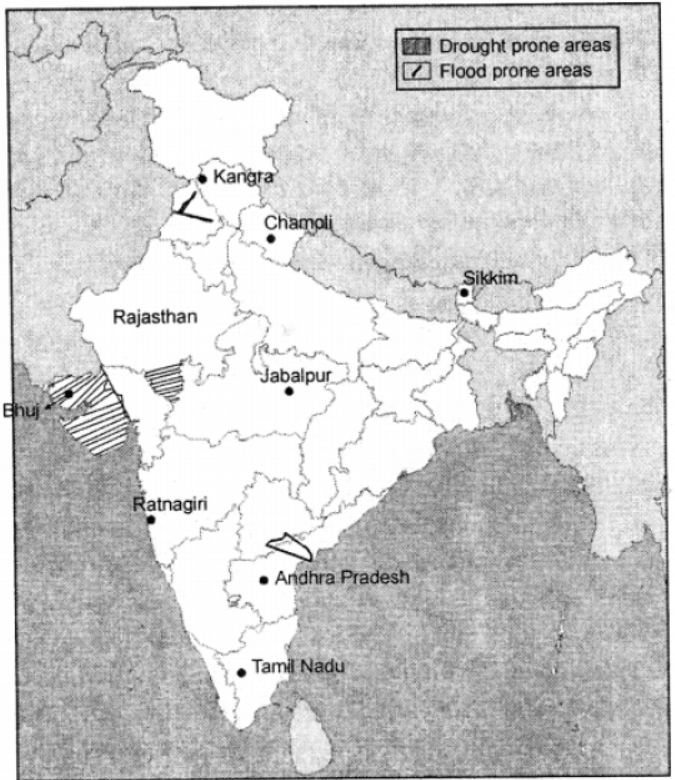
In simple words: These are specific regions on the map of India: Jabalpur and Ratnagiri are moderate risk for earthquakes; Punjab and Krishna basins are flood-prone; Tamil Nadu and Andhra Pradesh are cyclone zones; Rajasthan and Gujarat are drought-prone.
Exam Tip: Familiarize yourself with India's hazard map to locate these highly vulnerable risk zones accurately.
Extra Questions
Question 1. What do you mean by disasters ? How are they classified?
Answer: A disaster is a sudden, catastrophic event that causes severe disruption, widespread damage, and loss of life and property, resulting in major environmental changes that communities cannot cope with on their own.
Disasters are classified into two broad categories:
1. **Natural Disasters:** Extreme events triggered by natural forces without human involvement, such as volcanic eruptions, earthquakes, tsunamis, floods, and droughts.
2. **Man-made Disasters:** Crises caused by human error, negligence, or deliberate acts of violence, such as industrial gas leaks, transit accidents, oil spills, chemical explosions, and terrorist acts.
In simple words: A disaster is a major event that causes massive damage to life and property. They are grouped into natural disasters (like floods and earthquakes) and man-made disasters (like plane crashes and chemical leaks).
Exam Tip: Use the terms "natural" and "man-made" to establish the primary classification of disasters, providing clear examples for each.
Question 2. Which countries are more adversely affected by disasters? Why?
Answer: Developing and underdeveloped nations suffer much more severe consequences from disasters compared to highly developed countries. This is because poorer nations often lack the financial resources, sturdy infrastructure, and advanced disaster preparedness and mitigation systems required to respond effectively.
In simple words: Underdeveloped countries are hurt more by disasters because they do not have the money, strong buildings, or rescue systems that rich countries have to prepare for emergencies.
Exam Tip: Point out that economic limitations directly impact a nation's infrastructure strength and disaster response systems.
Question 3. What do you understand by natural disasters ?
Answer: Natural disasters are extreme environmental events triggered entirely by natural forces that cause widespread devastation to human communities, infrastructure, and ecosystems. Well-known examples include volcanic eruptions, earthquakes, tsunamis, hurricanes, and severe droughts.
In simple words: Natural disasters are extreme events caused by nature - like earthquakes, floods, and hurricanes - that cause massive damage to people and the environment.
Exam Tip: Define natural disasters by their cause (natural forces) and their extensive impact on human populations and biodiversity.
Question 4. What is the difference between a hazard and a disaster ?
Answer: A hazard is a potentially dangerous physical event or phenomenon (natural or man-made) that has the potential to cause harm. A disaster, however, is the actual occurrence of that hazard on a vulnerable community, resulting in widespread casualties, economic loss, and environmental damage. For instance, a tropical storm in the open ocean is a hazard, but if it strikes a populated coastline, it transforms into a disaster.
In simple words: A hazard is a dangerous threat (like a wild river or a storm in the ocean), while a disaster is the actual event that hits a town and causes damage and loss of life.
Exam Tip: Remember the formula: Hazard + Vulnerability = Disaster. A hazard is only a potential threat, whereas a disaster is the realized catastrophe.
Question 5. What is an earthquake ? What are its effects ?
Answer: An earthquake is a sudden, rapid shaking of the Earth's crust caused by the release of energy along fault lines deep below the surface. The consequences of a strong earthquake are catastrophic: they collapse residential houses, high-rise buildings, bridges, and dams, while severing transport networks, power grids, and communication systems. Furthermore, they often trigger secondary hazards such as landslides, snow avalanches, and ocean tsunamis.
In simple words: An earthquake is the sudden shaking of the ground when rocks deep inside the Earth move. It can collapse buildings, break bridges, and cause landslides or tsunamis.
Exam Tip: Explain both primary effects (ground shaking, building collapse) and secondary effects (landslides, tsunamis) of earthquakes.
Question 6. Name the states worst affected by water scarcity in India.
Answer: The Indian states most severely impacted by water shortages and drought are Rajasthan, Gujarat, Chhattisgarh, Madhya Pradesh, Maharashtra, Karnataka, and Odisha.
In simple words: The states in India that suffer the most from water shortages are Rajasthan, Gujarat, Chhattisgarh, Madhya Pradesh, Maharashtra, Karnataka, and Odisha.
Exam Tip: Protected geographical names cannot be changed, but remember to list these central and western Indian states which regularly face low monsoon rainfall.
Question 7. What do you mean by man-made disasters ?
Answer: Man-made disasters are major crises triggered directly by human actions, negligence, or technical failures, which can be intentional or unintentional. Unintentional man-made disasters include industrial accidents, such as toxic gas leaks or accidental building fires, whereas intentional man-made disasters involve deliberate acts of violence, such as planned bombings, acts of terrorism, or wartime attacks.
In simple words: Man-made disasters are emergencies caused by human actions or mistakes. They can be accidents (like a gas leak or fire) or planned attacks (like bombings).
Exam Tip: Clearly classify man-made disasters into two subcategories: intentional (terror attacks, wars) and unintentional (industrial accidents, fires).
Question 8. What causes fire ? Give one example.
Answer: Destructive fires are typically caused by faulty electrical equipment, degraded wiring, cooking gas leaks, or human carelessness, such as discarding lit matches or cigarettes. A famous historical example in India is the Uphaar Cinema fire tragedy in New Delhi on July 13, 1997, which resulted from a transformer malfunction and poor building safety.
In simple words: Fires are usually caused by bad electrical wires, leaking gas, or careless use of matches. A famous example is the Uphaar Cinema fire in New Delhi in 1997.
Exam Tip: Cite the Uphaar Cinema tragedy (1997) as a classic case study of an electrical fire exacerbated by poor emergency exits.
Question 9. Give an example of the intentional nuclear disaster and unintentional nuclear disaster.
Answer: The atomic bombings of Hiroshima and Nagasaki in August 1945 represent the clearest example of an intentional nuclear disaster. In contrast, the Chernobyl power plant explosion in the former USSR in 1986 is a prime example of an unintentional nuclear disaster, where an accidental reactor failure released lethal radiation across Ukraine and Europe, claiming thousands of lives.
In simple words: The atomic bombs dropped on Hiroshima and Nagasaki in 1945 are intentional nuclear disasters, while the accidental explosion at the Chernobyl power plant in 1986 is an unintentional nuclear disaster.
Exam Tip: Contrast Hiroshima/Nagasaki (intentional military attack) with Chernobyl (unintentional industrial accident) to show the difference.
Question 10. Give an example of a chemical disaster.
Answer: The most prominent example of a chemical disaster is the Bhopal Gas Tragedy, which occurred in Madhya Pradesh, India, in December 1984. It was caused by the accidental release of the highly toxic gas methyl isocyanate from a pesticide plant, which instantly killed over 2,500 people and left thousands more with chronic, intergenerational health conditions.
In simple words: The 1984 Bhopal Gas Tragedy in India is the worst chemical disaster, where toxic gas leaked from a factory and killed thousands of people.
Exam Tip: The Bhopal Gas Tragedy (1984) caused by methyl isocyanate is the world's most catastrophic industrial chemical disaster case study.
Question 11. What are biological disasters ?
Answer: Biological disasters are catastrophic events caused by the release or spread of harmful pathogens, such as bacteria, viruses, or toxins, either accidentally from labs or intentionally as bioweapons. These dangerous microorganisms infect people through inhalation or open wounds, and even small amounts can trigger massive, deadly epidemics.
In simple words: Biological disasters are caused by dangerous germs or viruses escaping into the air, which can infect people and start deadly disease outbreaks.
Exam Tip: Define biological disasters through the transmission of pathogens (microbes) and their ability to trigger devastating epidemics.
Question 12. How and why are terror attacks carried out ? Give examples.
Answer: Terrorist attacks are planned acts of violence carried out by extremist groups using firearms, bomb blasts, or hijacked vehicles to cause mass casualties and destroy public infrastructure like bridges and transport lines. These attacks are driven by radical ideologies whose followers believe they can achieve their political or religious goals through terror. Key historical examples include:
1. The September 11, 2001 attacks in the US, where hijacked commercial airplanes were crashed into the World Trade Center, killing nearly 3,000 people.
2. The December 13, 2001 armed attack on the Indian Parliament in New Delhi.
3. The highly coordinated November 26, 2008 shooting and bombing attacks in Mumbai.
In simple words: Terror attacks are planned acts of violence where extremists use weapons or bombs to kill innocent people for political or religious reasons. Examples include the 9/11 attacks in the US, and the 2008 Mumbai attacks.
Exam Tip: Explain that terror attacks target highly populated areas and public infrastructure to create widespread panic and disrupt normal life.
Question 13. Name the world’s worst industrial disaster.
Answer: The Bhopal Gas Tragedy of 1984 in India is recognized as the world's most catastrophic industrial disaster.
In simple words: The Bhopal Gas Tragedy of 1984 is the worst industrial disaster in history.
Exam Tip: The Bhopal Gas Tragedy involved a toxic gas leak of methyl isocyanate and is the prime example of an industrial chemical disaster.
Question 14. What causes travel-related disasters ?
Answer: Travel-related disasters are major transit accidents that result in mass casualties. They are commonly caused by technical malfunctions (like bus brake failure or plane radar loss), human negligence (such as a driver falling asleep or missing a signal), or extreme natural events (like landslides, storms, or earthquakes) that disrupt transport paths.
In simple words: Travel-related disasters are major transit accidents caused by mechanical failures, driver mistakes, or natural hazards like storms and landslides.
Exam Tip: Explain that travel disasters are triggered by a combination of human error, technical failures, and environmental hazards.
Question 15. How do oil spills occur ? What are its effect ?
Answer: Oil spills are major marine disasters caused by the release of crude petroleum into oceans or seas during deep-sea drilling, oil tanker cleaning, pipeline leaks, or offshore rig explosions.
Effects of Oil Spills:
* **Marine Toxicity:** Toxic chemicals in the oil directly poison fish, invertebrates, and delicate coral reefs.
* **Wildlife Damage:** The sticky oil slick coats the feathers of seabirds and the fur of marine mammals, destroying their insulation and causing them to drown or die of hypothermia.
* **Economic Impact:** If the oil reaches the coastline, it ruins local commercial fishing and tourism industries.
In simple words: Oil spills happen when oil accidentally leaks into the ocean from ships or offshore rigs, poisoning marine life, coating seabirds in sticky oil, and destroying coastal fishing and tourism.
Exam Tip: Highlight both the ecological impacts (loss of marine life and coated feathers) and economic impacts (destruction of fishing and coastal tourism).
Question 16. Which disaster is considered to be one of the worst spills to have happened in recent times ? Elaborate.
Answer: The Deepwater Horizon oil spill in 2010 (also known as the BP oil spill) is considered one of the worst marine disasters in history. It began with an explosion on the Macondo offshore drilling rig in the Gulf of Mexico, which killed 11 workers and injured 16 others. Over the following months, approximately 4.9 million barrels of crude oil leaked into the ocean. The disaster had catastrophic environmental and economic consequences, severely damaging marine habitats, killing record numbers of dolphins and seabirds, and crippling local fishing and tourism industries for years.
In simple words: The 2010 Deepwater Horizon explosion leaked 4.9 million barrels of oil into the Gulf of Mexico, killing workers, destroying marine habitats, and killing thousands of dolphins and birds.
Exam Tip: The Deepwater Horizon (2010) is the most significant modern case study for a massive offshore oil spill, releasing roughly 4.9 million barrels of oil.
Question 17. Name two state of India where floods cause massive damages every year.
Answer: Assam and Bihar are the two Indian states that experience severe, destructive flooding every year.
In simple words: Assam and Bihar are the two states in India that suffer from heavy flooding every year.
Exam Tip: Both Assam and Bihar are highly flood-prone due to massive, rapidly flowing rivers (like the Brahmaputra and Kosi) crossing their flat plains.
Question 18. Name two wildlife sanctuaries of Assam.
Answer: Two famous wildlife reserves in Assam are Kaziranga National Park and Pobitora Wildlife Sanctuary.
In simple words: Two well-known wildlife sanctuaries in Assam are Kaziranga National Park and Pobitora Wildlife Sanctuary.
Exam Tip: Kaziranga and Pobitora are highly vulnerable to annual flooding from the Brahmaputra River, which directly threatens their wildlife populations.
Question 19. Define —
1. Avalanche
2. Tsunami
3. Epidemic
4. Storm surge
5. Water table
Answer: 1. **Avalanche:** A sudden, rapid slide of a massive quantity of snow, ice, or rock down a steep mountain slope.
2. **Tsunami:** A series of exceptionally high, powerful ocean waves generated by an undersea earthquake, volcanic eruption, or landslide.
3. **Epidemic:** A sudden outbreak of an infectious disease that spreads rapidly and affects a large number of individuals in a community at the same time.
4. **Storm surge:** A temporary, abnormal rise in sea level along a coastline, caused by the strong onshore winds and low pressure of an approaching tropical cyclone.
5. **Water table:** The underground depth below which the soil and rocks are completely saturated with water.
In simple words: An avalanche is snow sliding down a mountain; a tsunami is a giant wave from an undersea quake; an epidemic is a fast-spreading disease; a storm surge is a cyclone-driven coastal wave; and the water table is the underground water level.
Exam Tip: Memorize these definitions, paying special attention to the triggers (e.g., undersea earthquakes for tsunamis, cyclonic winds for storm surges).
Question 20. Fill in the blanks
1. ________ are incidents that cause significant damage or destruction to life and property.
2. While most disasters happen suddenly like earthquake, nuclear explosion, others like ________ may have a slow beginning and later increase in extent and intensity.
3. Disasters affect people living in ________ countries more adversely.
4. Earthquakes usually occur without ________.
5. An ________ is a sudden violent movement of a portion of the earth’s crust.
6. ________ are mostly caused due to the overflowing of rivers in the monsoon.
7. About ________ per cent of the land area in India is drought-prone.
8. ________ lead to acute shortage of water and crop failure.
9. ________ nuclear disasters mostly occur due to accidents in nuclear power reactors.
10. The Bhopal Gas tragedy is an incident of ________ disaster.
11. The terror attack on Parliament of India took place on ________.
12. Nepal lies on the fault called ________.
13. ________ explosion is the largest oil spill in the history of petroleum industry.
14. Heavy rainfall in Assam causes the ________ river and its tributaries to overflow.
15. ________ is the most flood-prone region amongst the great northern plains of India with almost ________ per cent of the state affected by floods.
Answer: 1. Disasters
2. droughts
3. underdeveloped
4. warning
5. earthquake
6. Floods
7. 30
8. Droughts
9. Unintentional
10. chemical
11. 13 December 2001
12. Thrust Fault
13. Deep water horizon
14. Brahmaputra
15. Bihar, 73
In simple words: These are correct fill-in-the-blank terms that complete sentences about natural disasters and historic case studies in India.
Exam Tip: Ensure precise spelling for specific geographical terms such as 'Brahmaputra' and technical names like 'Thrust Fault'.
Free study material for Geography
Complete Guide and Answers: Class 8 Geography Chapter 05 Natural And Man Made Disasters With Case Studies
Detailed Textbook Solutions: Chapter 05 Natural And Man Made Disasters With Case Studies (Class 8 Geography)
Access structured ICSE solutions for Class 8 Geography Chapter 05 Natural And Man Made Disasters With Case Studies designed to match CISCE curriculum standards. These verified answers help clarify complex numericals and support daily homework revision.
How to Use These Class 8 Geography Solutions
Every exercise question in this chapter includes step-by-step working steps, allowing you to self-evaluate, catch mistakes early, and understand the underlying logic.
Complete Your ICSE Chapter Revision
Explore our broader library of study materials and chapter notes to support your continuous revision and secure higher marks.
FAQs
You can download the verified Voyage solutions for Chapter 05 Natural And Man Made Disasters With Case Studies on StudiesToday.com. Our teachers have prepared answers for Class 8 Geography as per 2026-27 ICSE academic session.
Yes, our solutions for Chapter 05 Natural And Man Made Disasters With Case Studies are designed as per new 2026 ICSE standards. 40% competency-based questions required for Class 8, are included to help students understand application-based logic behind every Geography answer.
Yes, every exercise in Chapter 05 Natural And Man Made Disasters With Case Studies from the Voyage textbook has been solved step-by-step. Class 8 students will learn Geography conceots before their ICSE exams.
Yes, follow structured format of these Voyage solutions for Chapter 05 Natural And Man Made Disasters With Case Studies to get full 20% internal assessment marks and use Class 8 Geography projects and viva preparation as per ICSE 2026 guidelines.