

Official Voyage Textbook Solutions for Class 8 Geography
Access the official Voyage textbook solutions for Class 8 Geography, updated for the 2026-27 academic year. This digital resource is structured to help students build strong conceptual clarity and prepare effectively for school examinations.
Read and Download Chapter 03 Migration Solutions
View or download the dedicated Chapter 03 Migration resource below. This chapter-by-chapter structuring ensures easy navigation for daily study routines and immediate access to core academic concepts.
A. Fill in the blanks
Question 1. The movement of people from one place or country to another is known as _______.
Answer: migration
In simple words: Moving from one place or country to live in another is called migration.
Exam Tip: Remember that migration is the most general term used for any movement of people to a new living location.
Question 2. _______ migration could be annual, seasonal or daily.
Answer: Temporary
In simple words: When people move to a new place for just a short period, it is called temporary migration.
Exam Tip: The words "annual, seasonal or daily" indicate that the movement is not permanent, so the answer must be "Temporary".
Question 3. _______ is also known as human capital flight.
Answer: Brain drain
In simple words: Brain drain is when highly skilled and educated workers leave their home country to work elsewhere.
Exam Tip: Memorize "human capital flight" as the scientific or economic synonym for "brain drain" to earn quick marks.
Question 4. Both the _______ factors and the _______ factors are responsible for brain drain.
Answer: push, pull
In simple words: Negative things at home and positive opportunities abroad both cause skilled people to move away.
Exam Tip: Always pair push (negative) and pull (positive) factors when describing the causes of any form of migration.
Question 5. The migrant’s country prospers as _______ enters the country.
Answer: money (foreign exchange)
In simple words: A country becomes wealthier when workers abroad send money back to their families.
Exam Tip: "Foreign exchange" is the formal term for international money entering a country's economy, which is a major benefit of migration.
B. Choose the correct answer
Question 1. When a person leaves one country to move to another he is known as
(a) an emigrant
(b) an immigrant
(c) a labourer
(d) a worker
Answer: (a) an emigrant
In simple words: An emigrant is a person who leaves their own country to go live in another country.
Exam Tip: A helpful trick is to associate the 'E' in "emigrant" with "Exit" (leaving a place) and the 'I' in "immigrant" with "In" (entering a place).
Question 2. The type of migration in which people move from the rural areas to the city mainly in search of better job opportunities is known as
(a) rural to urban
(b) rural to rural
(c) urban to rural
(d) urban to urban
Answer: (a) rural to urban
In simple words: Moving from a village to a big city to find work is called rural to urban migration.
Exam Tip: "Rural" refers to the countryside or villages, while "urban" refers to towns and cities.
Question 3. The reason people are forced to leave a place is called the
(a) pull factor
(b) economic factor
(c) push factor
(d) commercial
Answer: (c) push factor
In simple words: A push factor is a bad thing - like war or no jobs - that forces people to leave their homes.
Exam Tip: Think of "push" factors as forces that actively drive people away from a location due to hardship or danger.
Question 4. Migrants willing to happily take up unskilled jobs are known as
(a) cheap labour
(b) technical labour
(c) businessmen
(d) agricultural labourer
Answer: (a) cheap labour
In simple words: Cheap labour refers to workers who are willing to do basic, hands-on tasks for low pay.
Exam Tip: Unskilled workers moving internationally often fill low-wage positions, providing what industries call cheap labour.
Question 5. One of the advantages to the migrant’s home country is
(a) loss of skilled labour
(b) increased foreign exchange
(c) fall in demand of certain goods and services
(d) political uncertainty
Answer: (b) increased foreign exchange
In simple words: When workers send money back to their families, it brings valuable foreign cash into their home country.
Exam Tip: Sending money home (remittances) is the most significant economic benefit a developing country receives from its citizens working abroad.
C. State whether the following are true or false:
Question 1. State whether the following statement is true or false: Migration can be internal or external.
Answer: True
In simple words: People can move to different places inside their own country, or they can move to another country entirely.
Exam Tip: Internal migration means moving within the same nation, while external means crossing international borders.
Question 2. State whether the following statement is true or false: The urban-rural migration is uncommon in conservative countries like Pakistan and Afghanistan.
Answer: False
In simple words: Moving from cities back to villages is actually quite common in conservative countries like Pakistan and Afghanistan.
Exam Tip: Read True/False statements carefully, as a single word like "uncommon" can change the entire factual meaning.
Question 3. State whether the following statement is true or false: Jobs in a new country is not a pull factor.
Answer: False
In simple words: Getting a good job in another country is a very strong reason that attracts people to move there.
Exam Tip: Since "pull" factors are positive reasons that attract people, job opportunities are always a major pull factor.
Question 4. State whether the following statement is true or false: Immigrants don’t bring rich cultural diversity and traditions to their new country.
Answer: False
In simple words: Immigrants bring their own colorful cultures, foods, and celebrations, making their new country more diverse.
Exam Tip: Cultural enrichment is considered one of the primary social benefits of international migration.
Question 5. State whether the following statement is true or false: Social and civic pressures develop as migrants entering the new country put pressure on the existing resources.
Answer: True
In simple words: When many new people arrive, there is a lot of demand on public services like schools, clinics, and clean water.
Exam Tip: Rapid population growth in city areas often leads to resource scarcity, causing social and civic stress.
D. Answer the following questions in brief
Question 1. Define migration.
Answer: Migration is defined as the physical movement of individuals or groups from one location or nation to another in order to settle down.
In simple words: Migration is when people pack up and move to live in a new place or country.
Exam Tip: To get full marks, define migration clearly by mentioning movement from one place to another for the purpose of settling.
Question 2. What do you understand by rural-urban migration ?
Answer: Rural-urban migration refers to people relocating from villages to towns or cities, primarily to find better jobs, better schools, and a city lifestyle. Some key reasons for this movement include:
1. Villages are often unable to sustain a rapidly expanding population.
2. Food supplies may become limited in rural areas.
3. There is a lack of agricultural land for farming.
4. Modern machines are replacing human workers in farming tasks.
This form of migration is highly common in growing nations such as India, South Africa, and Brazil.
In simple words: It means moving from a village to a city to find work and get a better lifestyle.
Exam Tip: Be sure to write the definition first, and then list at least two specific reasons why people leave villages to get full marks.
Question 3. What is primitive migration?
Answer: Primitive migration is a type of movement where people leave an unfavorable physical environment to search for a more suitable and hospitable place to live.
In simple words: It is when people move because their natural surroundings or climate have become too harsh to survive in.
Exam Tip: Focus on how ecological factors and harsh natural surroundings trigger primitive migration.
Question 4. Differentiate between free and forced migration.
Answer:
In free migration, people can choose on their own whether to stay in their home or relocate to a new place.
In contrast, forced migration happens when people have no choice but to leave their homes due to severe hardships like poverty, political bias, persecution, wars, famines, or disasters.
In simple words: Free migration is done by personal choice, while forced migration is when safety issues or disasters make you leave.
Exam Tip: Use the word "choice" as the central point of comparison between these two types of migration.
Question 5. What is illegal migration?
Answer: Illegal migration occurs when individuals move to and settle in a foreign country by violating that nation's entry laws.
In simple words: It is when people enter and live in another country without getting official permission from the government.
Exam Tip: Highlighting the violation of immigration laws is essential to a correct definition of illegal migration.
Question 6. Name any two pull factors for migration.
Answer: Pull factors are positive conditions that attract people to a new destination. Two examples are:
1. Good career options - many workers migrate to countries like Canada or Australia for high-paying jobs.
2. Better education - many students leave their home countries to study at top foreign colleges.
In simple words: Pull factors are nice things - like great jobs and schools - that make people want to move to a new country.
Exam Tip: Always state what "pull factors" are before providing the requested examples.
Question 7. What does brain drain mean ?
Answer: Brain drain refers to a trend where highly educated, talented, and skilled professionals permanently leave their native country to work and live in a foreign nation that provides better career growth and a higher standard of living. This is also called human capital flight.
In simple words: Brain drain is when a country's smartest and most skilled workers move away to work in other countries.
Exam Tip: Do not forget to mention that brain drain is also called "human capital flight" as it is a key technical term.
Question 8. Give two positive effects of brain drain.
Answer: Two beneficial outcomes of brain drain include:
1. It offers highly qualified professionals superior career paths and jobs that may not be available in their home nation.
2. The home nation gains wealth as migrants send foreign currency back home, helping the local economy grow.
In simple words: It helps skilled workers find better jobs, and the money they send home helps their native country prosper.
Exam Tip: Focus on career opportunities and foreign money (remittances) as they are the two clearest positive impacts.
E. Answer the following questions in detail
Question 1. Explain the different types of migrations.
Answer: The primary forms of migration are:
1. Internal migration - When people relocate from one city, town, or state to another within the boundaries of the same country.
2. External migration - When people move across borders to reside in a completely different country or continent.
3. Temporary migration - Short-term movement that can be daily, seasonal, or annual. For instance, mountain communities may move down to lower, warmer valleys during cold winter months.
4. Emigration - The act of leaving one's native country to live permanently in another. For example, when someone leaves India to settle in Canada, they have emigrated from India.
5. Immigration - The act of entering and settling in a new foreign country. In the previous example, that person is an immigrant in Canada.
In simple words: People migrate in many ways - inside their own country, to other nations, for short seasons, or by permanently leaving or arriving in a country.
Exam Tip: Clearly define each type and provide simple examples (like the India-to-Canada scenario) to show the difference between emigration and immigration.
Question 2. Name and write brief notes on the four types of migration based on direction of movement.
Answer: Based on the path of movement, migration is divided into four types:
1. Rural to Urban - People move from villages to cities. They are drawn by better job offers, modern schools, medical care, and a city lifestyle. This is very common in developing countries like India, South Africa, and Brazil.
2. Rural to Rural - This is moving from one village to a different village. It is usually caused by marriage, buying new farm properties, or searching for better soil and farming resources.
3. Urban to Urban - Moving from one city to another, usually to a larger one, in search of better jobs, colleges, and services. For example, students and workers move from Lucknow to larger cities like Delhi. It also happens when a city becomes too crowded and families relocate to nearby suburbs like Gurugram.
4. Urban to Rural - This is when people leave cities to return to villages. Common reasons include ancestral property, marriage, high costs of living, traffic, pollution, or not being able to find proper housing. Countries like Pakistan and Afghanistan show this trend.
In simple words: The four directions are: village to city, village to village, city to city, and city to village.
Exam Tip: List all four types using distinct headings, and provide at least one clear cause or example for each direction.
Question 3. Distinguish between the pull and push factors.
Answer:
Push Factors of Migration:
1. These are negative conditions that force or compel people to leave their home.
2. Examples include lack of jobs, war, natural disasters, and political unrest.
3. For instance, thousands of Syrian families fled their country due to war, and the 2015 earthquake in Nepal forced many people to cross into India.
Pull Factors of Migration:
1. These are positive conditions that attract and draw people to a new location.
2. Examples include good career options, advanced schools, and excellent healthcare services.
3. For instance, many Indian students go abroad to study, and families relocate to Canada or Australia for better job offers.
In simple words: Push factors are bad things that force you to run away from home. Pull factors are good things that welcome you to a new place.
Exam Tip: Draw a T-chart or use clean subheadings to list the differences clearly for the examiner.
Question 4. Briefly explain any four pull factors of migration.
Answer: Pull factors are beneficial things that attract people to a new place. Four major pull factors are:
1. Job Opportunities - Many people move to other cities or countries to secure better careers, higher pay, and a modern lifestyle, such as Indian IT experts moving to the United States.
2. Education - High-quality schools and colleges draw many young students abroad to get degrees in medicine, engineering, and management.
3. Medical Care - Cities with large hospitals, expert doctors, and modern healthcare facilities attract people seeking better treatment.
4. Attraction of Wealth - Finding valuable minerals like oil or gold can quickly draw people to a region, as seen historically in the gold mines of South Africa and Australia.
In simple words: People are pulled to new places by good career paths, excellent schools, top-quality hospitals, and opportunities to earn wealth quickly.
Exam Tip: Use brief, clear headings for each of the four points to make your answer easy to read and grade.
Question 5. Briefly explain any four push factors of migration.
Answer: Push factors are painful conditions that force people to leave their homes. Four common push factors are:
1. Lack of Job Opportunities - When there are no jobs in villages, workers must move to cities. In India, many people from Bihar and West Bengal move to Delhi and Punjab for work.
2. Lack of Available Land - If farm plots are too small or the soil quality is too poor to grow crops, farmers must relocate to find better land.
3. Religious Tolerance - If people are bullied or persecuted for their faith, they will flee to safer regions where they can practice their religion freely.
4. Political Freedom - People often escape their country if they dislike a harsh government, or to run away from dangerous wars that destroy their homes.
In simple words: People are pushed away from home by a lack of jobs, tiny farm plots, religious bullying, and dangerous wars.
Exam Tip: Mention real-world examples, like regional movements or escape from war zones, to make your push factor explanations much stronger.
Question 6. What are the socio-economic advantages of migration which the destination country experiences ?
Answer: The host nation receives several positive social and economic benefits, including:
1. Cheap labour - Migrants are often willing to work in basic, unskilled positions for lower pay than local workers. For example, many Indian workers help build infrastructure in Saudi Arabia and the UAE.
2. Technical and skilled labour - Highly trained migrants bring immense talent in areas like computer science and healthcare. For instance, America's Silicon Valley has a vast number of expert scientists and engineers from India and China.
3. Cultural Diversity - New arrivals bring their unique traditions, foods, and celebrations. Sharing these customs reduces discrimination and helps local people understand different cultures better.
In simple words: Host countries get hard-working laborers for low wages, highly smart scientists for tech jobs, and colorful new cultural traditions.
Exam Tip: Categorize your points into labor benefits (both cheap and highly skilled) and cultural benefits to cover all aspects of the question.
Question 7. What are the causes of brain drain ?
Answer: The migration of skilled professionals is driven by two main sets of forces:
1. Push factors - These include negative issues in the home country, such as low pay, lack of good jobs, poverty, unfair promotions, political unrest, or social and religious discrimination.
2. Pull factors - These are positive attractions in the destination country, including higher salaries, comfortable living standards, advanced school systems, fair career growth, peaceful governments, and excellent healthcare.
In simple words: Smart people leave when their home country has low pay and fewer opportunities, while other countries offer great wealth and better lifestyles.
Exam Tip: Structure this response by showing how a negative factor in the home country is balanced by a positive attraction in the host country.
F. Picture study
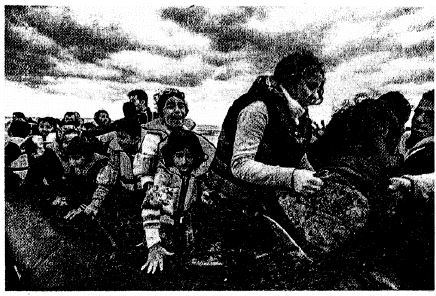
Question 1. This is the picture of refugees leaving their country and moving to another country.
Answer: Syrian refugees leaving their country and moving to another country.
In simple words: This picture shows families from Syria fleeing their war-torn homeland to find a safe place to live.
Exam Tip: Clearly state "Syrian refugees" to secure full marks for this picture identification question.
Question 2. What does the picture tell us?
Answer: The picture shows Syrian families escaping a dangerous, war-torn environment with the hope of finding a peaceful, secure place to live in a new land.
In simple words: It shows families escaping a scary war zone so they can find a safe place to live.
Exam Tip: Use key phrases like "escaping a war-torn country" and "seeking a safer environment" to describe the scene.
Question 3. What is the main cause of this migration?
Answer: The primary cause is armed conflict. Because of the brutal war in Syria, millions of people had to make dangerous journeys to seek safety in neighboring nations.
In simple words: The main reason is a violent war that made their home country too dangerous to live in.
Exam Tip: Identify "War" as the main cause of this forced migration.
Question 4. Is this migration because of a pull factor or a push factor?
Answer: This migration is because of a push factor.
In simple words: This happens because of a push factor, which is the scary war forcing them to leave.
Exam Tip: Remember that war and danger are always classified as push factors because they force people to leave.
Question G. On an outline map of the world mark any five regions affected by international migration.
Answer:
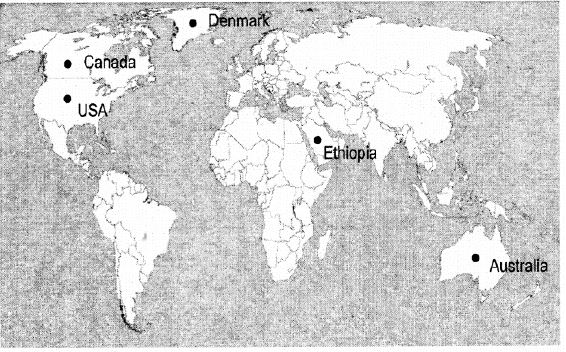
The world map above highlights five major countries highly affected by global migration: Canada, the USA, Denmark, Ethiopia, and Australia.
Exam Tip: When marking maps in exams, use clear dots and place the names of the countries neatly next to them.
Extra Question-Answers
Question 1. When did the early human migration start ?
Answer: Early human migration is believed to have started when Homo Erectus first migrated out of Africa to Eurasia about 1.8 million years ago.
In simple words: Early humans first started moving from Africa to Europe and Asia about 1.8 million years ago.
Exam Tip: Remember the specific species name (Homo Erectus) and the timeline (1.8 million years ago) to score full marks.
Question 2. Why do people migrate ? Explain with examples.
Answer:
Human migration occurs because of two types of forces:
1. Push Factors - These are bad situations that compel people to leave their homeland:
- A shortage of jobs in their own nation.
- War and conflict - For example, millions of families have fled the violent war in Syria to find safety elsewhere.
- Shortage of food and essential goods - For instance, a major financial crisis in Greece in 2015 caused extreme food and medicine shortages, while severe grain shortages in Nigeria in 2016 drove many people to move to nearby lands.
- Natural calamities - For example, the massive earthquake in Nepal in 2015 led many citizens to cross into India.
2. Pull Factors - These are positive benefits that draw people to a new country:
- Excellent job prospects - For example, many professionals from India move to Canada and Australia to build their careers.
- Advanced learning options - Many students go abroad to get a better college education.
- High-quality hospital and healthcare options.
In simple words: People move either because bad things like wars and disasters push them away, or because good things like jobs and colleges pull them in.
Exam Tip: Organize your response into two distinct parts: push factors with their examples, and pull factors with their examples.
Question 3. What are the socio-economic advantages of migration which the home country experiences ?
Answer: The country that people leave behind gains several economic and social benefits:
1. Reduced competition for jobs - When many citizens move away to work, it frees up more local job opportunities for the people who stay behind.
2. New skills and business growth - Returning migrants bring back valuable technical skills, knowledge, and fresh concepts. They often start new businesses, which helps create jobs locally. For instance, in Kerala, people returning from Gulf countries have set up schools, malls, and restaurants.
3. Family financial support - Migrants send money back home to care for their families. These payments, known as remittances, provide a strong boost to the nation's economy.
In simple words: The home country gets more jobs for the people left behind, new business ideas from those who return, and extra money sent home by workers.
Exam Tip: Be sure to define the term "remittance" and mention the real-world example of Kerala to make your answer highly descriptive.
Question 4. What are the disadvantages of migration to the migrants as well as the destination countries ?
Answer: Both the moving individuals and the host countries face several distinct drawbacks:
1. Local employment worries - Migrants are often willing to work for smaller salaries, which can make local citizens feel that their jobs are being taken away. For example, some people in the US show unhappiness toward incoming workers from places like Asia and Latin America.
2. Strain on public facilities - A rapid increase in population puts heavy pressure on local water, transport, schools, and clinics. This extra demand can cause prices to rise, making life harder for everyone.
3. Bias and unfair treatment - New arrivals can face harsh discrimination and racism because they have different ways of dressing, speaking, or worshiping. This makes it difficult for them to feel accepted by the community.
4. Cultural friction - The arrival of foreign customs can cause tension or feelings of exclusion on both sides, especially when local residents are unfamiliar with the cultural and religious habits of the incoming groups.
In simple words: Migration can cause local people to worry about losing their jobs, put too much stress on schools and hospitals, and lead to unfair treatment of newcomers.
Exam Tip: Make sure to write about how migration affects both the migrants themselves (discrimination, adjustment) and the host country (resource strain, job concerns).
Question 5. What are the disadvantages of migration to the home country of the migrants ?
Answer: The nation that people leave behind faces these negative impacts:
1. Loss of talent and skills - The smartest, most highly trained young professionals go to work in other nations instead of helping their own country progress.
2. Economic slowdown - When a large portion of the young population departs, there is a drop in the demand for local products and services, which can slow down national business growth.
3. Emotional strain on families - Young parents often leave their elderly parents and young children behind. This separation causes deep sadness, loneliness, and emotional neglect.
In simple words: The home country loses its smartest workers, local businesses sell fewer goods, and families are left lonely and sad without their relatives.
Exam Tip: Group your answer into three clear points: loss of talent (brain drain), drop in economic demand, and the emotional impact on left-behind family members.
Question 6. What are the negative impacts of brain drain ?
Answer: Some of the harmful consequences of losing highly educated workers include:
1. A major decline in the number of citizens with high-level professional and technical degrees.
2. A slower rate of progress and industrial growth because of the lack of qualified experts.
3. A drop in financial support sent back home over time, especially as local costs of living rise.
4. A decline in the quality of vital local services, particularly in hospitals and schools, as top doctors and teachers leave.
5. Public and private funds spent on student scholarships end up benefiting foreign nations rather than the home country.
6. A growing gap in wealth between local families and wealthy returning migrants, which can cause social tension.
In simple words: Brain drain leaves the home country with fewer skilled doctors and teachers, slows down national growth, and creates a large gap between the rich and the poor.
Exam Tip: Highlight the impact on critical sectors like healthcare and education, as these are the most immediate negative effects of brain drain.
Question 7. What do you mean by diaspora ?
Answer: This term refers to communities of people who have left their native lands to settle in various foreign countries while continuing to share and keep their cultural heritage alive.
In simple words: A diaspora is a group of people living far from their original homeland but still practicing their native culture.
Exam Tip: Focus on two main parts in your definition: people moving away from their homeland, and the spread of their native culture in their new homes.
Question 8. What is remittance ?
Answer: Remittance is the money which a migrant working abroad sends home to support his family.
In simple words: Remittance is simply the money sent home by a migrant worker to help their family.
Exam Tip: Remember that remittance is an economic term for money sent across international borders back to a migrant's home.
9. Fill in the blanks
Question 9(1). People moving from one place to another within a country is called _______ migration.
Answer: internal
In simple words: Moving around inside your own country is called internal migration.
Exam Tip: "Internal" always indicates that the movement is restricted to the boundaries of a single nation.
Question 9(2). Many people from Mexico migrate illegally to the neighbouring US in search of _______.
Answer: jobs
In simple words: Many Mexican migrants enter the US without papers to find work and earn money.
Exam Tip: Finding employment is the largest economic driver for migration across borders.
Question 9(3). People from Delhi moving to Gurugram is an example of _______ to _______ migration.
Answer: urban, urban
In simple words: Moving from one city to another nearby city is urban to urban migration.
Exam Tip: Since both Delhi and Gurugram are cities, the movement between them is classified as urban-to-urban.
Question 9(4). _______ are people who leave their country and move to another country.
Answer: Emigrants
In simple words: Emigrants are the people who go away from their own country to settle in a new one.
Exam Tip: "Emigrants" are counted as people leaving, while "Immigrants" are counted as people arriving.
Question 9(5). _______ are people who arrive in another country after leaving their own country.
Answer: Immigrants
In simple words: Immigrants are people who arrive and settle in a new country after leaving their homeland.
Exam Tip: Focus on the act of arriving in a destination country to define "Immigrants" correctly.
Question 9(6). _______ factors are reasons that force people to leave a place.
Answer: Push
In simple words: Push factors are bad situations that drive or push you away from your home.
Exam Tip: Always associate "push" factors with negative triggers like conflict, poverty, or disaster.
Question 9(7). _______ factors are reasons that attract people to a new place.
Answer: Pull
In simple words: Pull factors are good things that attract or pull you to live in a new place.
Exam Tip: Pull factors represent positive attractions like better job prospects, high-quality schools, and safety.
Free study material for Geography
ICSE Textbook Solutions for Class 8 Geography Chapter 03 Migration
Verified Problem Answers for Class 8 Geography Chapter 03 Migration
Strengthen your preparation with comprehensive answers for Class 8 Geography Chapter 03 Migration. These expert-reviewed solutions make tracking your academic progress straightforward and efficient.
How to Use These Class 8 Geography Solutions
Verify your answers instantly using the comprehensive breakdowns provided for each problem, ensuring complete syllabus coverage across all sub-topics.
Complete Your ICSE Chapter Revision
Explore our broader library of study materials and chapter notes to support your continuous revision and secure higher marks.
FAQs
You can download the verified Voyage solutions for Chapter 03 Migration on StudiesToday.com. Our teachers have prepared answers for Class 8 Geography as per 2026-27 ICSE academic session.
Yes, our solutions for Chapter 03 Migration are designed as per new 2026 ICSE standards. 40% competency-based questions required for Class 8, are included to help students understand application-based logic behind every Geography answer.
Yes, every exercise in Chapter 03 Migration from the Voyage textbook has been solved step-by-step. Class 8 students will learn Geography conceots before their ICSE exams.
Yes, follow structured format of these Voyage solutions for Chapter 03 Migration to get full 20% internal assessment marks and use Class 8 Geography projects and viva preparation as per ICSE 2026 guidelines.