

Download ICSE Class 8 Geography Solutions by Voyage
Access the official Voyage textbook solutions for Class 8 Geography, updated for the 2026-27 academic year. This digital resource is structured to help students build strong conceptual clarity and prepare effectively for school examinations.
Access Chapter 02 Population Solutions for Class 8 Geography
Navigate directly to the Chapter 02 Population solutions using the digital viewer below. Organizing your study sessions chapter-by-chapter allows for seamless offline study and quick reference during revision.
A. Fill in the blanks
Question A1. ________ has the largest population in the world.
Answer: China
In simple words: China has more citizens living in it than any other country on Earth.
Exam Tip: Remember that China was historically the most populous, though India is now very close.
Question A2. ________ is the number of deaths per year per 1,000 of the population.
Answer: Death rate
In simple words: The death rate measures how many people die out of every thousand people in a year.
Exam Tip: Always specify that death rate is calculated per 1,000 individuals to get full marks.
Question A3. ________ is the number of years that a person is likely to live.
Answer: Life expectancy
In simple words: This term means the average lifespan or length of time a person can expect to live.
Exam Tip: Think of life expectancy as a measure of the health and development level of a region.
Question A4. Urban areas generally have a ________ population density.
Answer: higher
In simple words: Cities and towns usually have more people packed into the same amount of space than villages.
Exam Tip: Urban density is higher due to jobs, schools, and better facilities drawing people to cities.
Question A5. A ________ is a diagram that shows the age and sex composition of a population.
Answer: population pyramid
In simple words: A population pyramid is a chart that lets us see the split of ages and genders in a group of people.
Exam Tip: Another term for population pyramid is "age-sex pyramid" - both are acceptable in exams.
B. Choose the correct answer
Question B1. Which continent has the highest population?
(a) Asia
(b) Europe
(c) North America
(d) South America
Answer: (a) Asia
In simple words: Asia is the continent where the largest number of the world's population resides.
Exam Tip: Asia is both the largest continent by land area and has the highest population.
Question B2. Which of these is an adverse effect of over population?
(a) Environmental degradation
(b) Poverty
(c) Unemployment
(d) All of the options
Answer: (d) All of the options
In simple words: Having too many people can damage nature, cause job shortages, and lead to more poverty.
Exam Tip: When all choices are harmful consequences of high population, "All of the options" is the correct choice.
Question B3. Which of these is not a positive effect of under population?
(a) Adequate employment
(b) fewer taxpayers
(c) Lesser environmental degradation
(d) Lower levels of poverty
Answer: (b) fewer taxpayers
In simple words: Having fewer people to pay taxes is actually a bad thing because the government has less money for roads and schools.
Exam Tip: Read the question carefully: "not a positive effect" means you must look for a negative consequence.
Question B4. Which of these is a part of the demographic structure of a population?
(a) Age composition
(b) Sex ratio
(c) Rural and urban populations
(d) All of the options
Answer: (d) All of the options
In simple words: Demographic structure includes all basic details about a group, like their ages, genders, and where they live.
Exam Tip: Demographic structure is a broad term covering age, sex, residence, literacy, and occupation.
Question B5. Which type of population is shown in a bell-shaped population pyramid?
(a) Expanding population
(b) Declining population
(c) Constant population
(d) None of the options
Answer: (c) Constant population
In simple words: A bell-shaped pyramid shows a stable population where the number of births and deaths is mostly balanced.
Exam Tip: Remember the association: bell-shaped corresponds to a constant or stable population.
C. State whether the following are true or false
Question C1. In 2016 alone, the population of the world increased by more than 80 million.
Answer: True
In simple words: The Earth gained over 80 million more people in the year 2016.
Exam Tip: Keep this statistical fact in mind for direct factual questions on population growth.
Question C2. Immigration is a factor that can cause overpopulation.
Answer: True
In simple words: When a massive number of people move into a country from other places, it can make that nation overcrowded.
Exam Tip: Immigration increases the population of a destination country, while emigration decreases it.
Question C3. In rural areas, people are typically engaged in secondary activities.
Answer: False. People in rural areas are mostly engaged in primary activities like agriculture.
In simple words: People living in villages usually work in farming or fishing, which are primary activities, rather than factories.
Exam Tip: Primary activities are directly connected to nature, whereas secondary activities involve manufacturing in factories.
Question C4. An adverse sex ratio shows the high position given to women in society.
Answer: False. An adverse sex ratio shows the low position given to women in society.
In simple words: A very low number of females compared to males indicates that women face bias and a lower status in that society.
Exam Tip: "Adverse" means unfavorable, which reflects gender discrimination and inequality against women.
Question C5. In a population pyramid, the youngest age group is shown at the bottom.
Answer: True
In simple words: The lowest bars on a population pyramid chart always represent the newborn babies and children.
Exam Tip: The base of the pyramid represents the birth rate, which is why newborns are placed at the bottom.
D. Answer the following questions in brief
Question D1. Define the term 'population'.
Answer: The term population refers to the total group of people residing within a particular geographic boundaries, such as a city, province, or nation.
In simple words: Population means all the people who live together in a specific town or country.
Exam Tip: Always specify that population is defined within a particular area or region.
Question D2. Define population density.
Answer: Population density is the measurement of the number of individuals living within a specific unit of land area, typically calculated per square kilometer.
In simple words: It shows how crowded an area is by counting how many people live in each square kilometer of land.
Exam Tip: Mentioning the unit "per square kilometer" is essential to secure full marks for this definition.
Question D3. Distinguish between immigration and emigration.
Answer: Immigration refers to the movement of individuals into a foreign country to establish a permanent home. On the other hand, emigration is the act of leaving one's home nation to live permanently in another country.
In simple words: Immigration means moving 'into' a new country, while emigration means exiting or leaving your own country.
Exam Tip: Remember 'I' in Immigration stands for coming 'In' and 'E' in Emigration stands for 'Exit'.
Question D4. Write any two causes of overpopulation?
Answer: Two main causes of overpopulation are:
1. Rising birth rates combined with declining death rates, primarily driven by superior healthcare and medicine.
2. High levels of immigration, where many people relocate permanently from other regions.
In simple words: Overpopulation is caused when medicine helps people live longer, and when many people move into a country.
Exam Tip: Stating the connection between better medical facilities and a lower death rate provides a stronger answer.
Question D5. Mention any two factors that cause population growth in a developed country.
Answer: In wealthier nations, population increases are historically driven by:
1. Economic growth and industrial development, which create stable livelihoods and high prosperity.
2. Influx of migrants attracted by superior employment opportunities and better living standards.
In simple words: Developed nations grow because they have great job opportunities and advanced healthcare systems.
Exam Tip: Focus on economic prosperity and immigration as key drivers for advanced nations.
Question D6. Mention any two factors that cause population growth in a developing country.
Answer: In developing nations, rapid population expansion is usually due to:
1. Introduction of modern medical treatments, which rapidly lower the death rate and increase lifespans.
2. Deeply rooted traditional beliefs, lack of education, and customs that favor having larger families.
In simple words: Developing countries grow because medicine saves more lives, and traditional views often encourage bigger families.
Exam Tip: Differentiate clearly between developed and developing nations: developing nations are highly affected by cultural beliefs and rapid drops in mortality.
Question D7. What do the rural and urban population consist of?
Answer: The rural population is made up of citizens who reside in countryside villages. In contrast, the urban population consists of people residing in towns and cities.
In simple words: Rural means village residents, while urban means town and city residents.
Exam Tip: Use the direct connection: Rural = Villages, Urban = Cities/Towns.
Question D8. What do you understand by the term ‘working population’?
Answer: The working population refers to the segment of a nation's citizens aged between 14 and 60 years. This demographic is viewed as an economic asset because they are willing and eligible to provide the labor required for national development.
In simple words: The working population includes people from 14 to 60 years old who are able to work and help the country's economy.
Exam Tip: Stating the age range of 14 to 60 is critical for scoring maximum marks.
E. Answer the following questions in one or two paragraphs
Question E1. Write a note on the distribution of population in the world.
Answer: The global population, currently around 7.35 billion, is spread very unevenly. China is the most populated nation on Earth with over 1.3 billion residents, closely followed by India with more than 1.2 billion. The USA and Indonesia rank next with roughly 321 million and 257 million people, while small island groups in the Pacific Ocean may have only a few thousand residents each.
Looking at continents, Asia holds the largest share of humanity with over 4.4 billion residents, followed by Africa with 1.18 billion. Europe, North America, and South America have populations of about 738 million, 573 million, and 418 million respectively. Oceania is the least populated continent with slightly over 39 million people living across its islands.
In simple words: Most of the world's 7 billion people live in Asia, with China and India being the most crowded, while Oceania and Pacific islands have very few residents.
Exam Tip: Be ready to list the top three most populous countries (China, India, USA) and the order of the continents by population.
Question E2. Briefly explain any four factors that affect the population of a place.
Answer: The population distribution of any region is determined by several factors:
1. Physical features: Flat lands, fertile soils, and moderate climates attract denser settlements than dry deserts or cold mountains.
2. Birth and death rates: Higher birth rates paired with lower death rates naturally cause population numbers to rise.
3. Jobs and economy: Industrial areas, cities, and trading centers draw large groups of people looking for employment.
4. Healthcare and living standards: Advanced medical treatments reduce mortality rates and raise life expectancy, leading to population growth.
In simple words: People prefer to live where the weather is nice, where they can find good jobs, and where they have access to medicine and healthcare.
Exam Tip: Categorize your points clearly into environmental, social, and economic factors to present a structured answer.
Question E3. What is the impact of overpopulation?
Answer: Overpopulation has severe consequences across three major areas:
1. Environmental damage: A large population overuses natural resources like fresh water, forests, and minerals. This leads to massive deforestation, water scarcity, loss of animal habitats, and increased pollution.
2. Economic pressure: High population density causes unemployment, inflation, and shortages of basic resources, which slows down a country's economic development.
3. Lower living standards: Crowded areas suffer from a lack of affordable housing, poor sanitation, limited schooling, and a rise in health issues and crime.
In simple words: Overpopulation harms the environment, makes it hard to find jobs, and leads to crowded, unhealthy living conditions.
Exam Tip: Group your points into Environmental, Economic, and Quality of Life impacts to write a high-scoring answer.
Question E4. Write the positive as well as negative effects of under population.
Answer: Under-population carries distinct benefits and drawbacks.
Positive Effects:
- Sufficient jobs: There are plenty of employment opportunities for the entire workforce.
- Less crowding: Cities are quiet and comfortable, with less pressure on public schools and hospitals.
- Lower poverty rates: Standard of living improves with fewer people competing for basic resources.
- Ecological benefits: Reduced demand on nature means less pollution and minimal damage to forests and water.
Negative Effects:
- Labor shortages: A small workforce leads to low industrial output and slow economic progress.
- Dependent population: A larger share of the population might be too young or too old to work.
- Low tax revenues: Fewer taxpayers mean the government has less budget to maintain infrastructure.
- Unused resources: There are not enough people to fully develop the nation's natural minerals and land.
In simple words: Having fewer people means clean cities and plenty of jobs, but it can also lead to worker shortages and less economic growth.
Exam Tip: Clearly separate your answer into "Positive Effects" and "Negative Effects" sub-headings.
Question E5. Write the main differences between rural and urban populations.
Answer: The primary distinctions between rural and urban populations are:
| Feature | Rural Population | Urban Population |
|---|---|---|
| Primary Settlement | People live in village communities. | People reside in towns and cities. |
| Population Density | Generally low concentration of residents. | Highly crowded with dense settlements. |
| Main Occupations | Mostly primary work like farming, fishing, or mining. | Secondary and tertiary jobs like trade, industry, and services. |
| Facilities and Services | Basic and less-developed healthcare and schools. | Highly advanced health, learning, and civic facilities. |
| Transport and Links | Basic road networks and limited transit facilities. | Highly modern, well-connected transport and communication. |
| Social Bonds | Close-knit communities with deep roots in culture. | More formal and weaker socio-cultural ties between residents. |
In simple words: Rural communities are small, quiet, and focus on farming, while urban areas are busy cities with modern facilities, high-tech jobs, and dense populations.
Exam Tip: Presenting differences in a comparative table makes it easier to read and secures maximum marks.
Question E6. What is sex ratio? What is the meaning of favourable and unfavourable sex ratios?
Answer: The sex ratio is the proportion of females for every 1000 males in a given population. This is calculated using the following formula: \[ \text{Sex Ratio} = \frac{\text{Female Population}}{\text{Male Population}} \times 1000 \] For instance, a ratio of 940 indicates that there are 940 women for every 1000 men in that area.
- Favourable sex ratio: This occurs when the number of females is equal to or higher than the number of males. For example, Latvia in Europe has a highly favorable ratio of 1179 women for every 1000 men.
- Unfavourable sex ratio: This means there is a lower number of females per 1000 males. Social evils like female foeticide, infant neglect, and gender bias lead to this imbalance. Nations like India, China, and Pakistan exhibit such unfavorable ratios.
In simple words: The sex ratio compares the number of females to males. A good ratio has equal or more women, while a bad one has fewer women due to social discrimination.
Exam Tip: Remember to write the mathematical formula clearly and provide Latvia as a positive example.
G Picture study
Question G1. What does the picture tell us?
Answer: The image depicts a highly crowded and congested street scene in Mumbai, which is the most populous metropolitan city in India.
In simple words: The picture shows a highly packed and busy street in Mumbai.
Exam Tip: Mention Mumbai and its status as India's most populous city to provide a complete answer.
Question G2. Mention any three impacts of such a condition.
Answer: Three major impacts of severe overpopulation and urban crowding are:
1. Severe environmental degradation: Rapid depletion of clean water, forest lands, and air quality.
2. Depletion of resources: Excessive consumption of fuel, food, and mineral resources, leading to scarcity.
3. Poor living conditions: Inadequate housing, lack of clean sanitation, and easier spread of diseases.
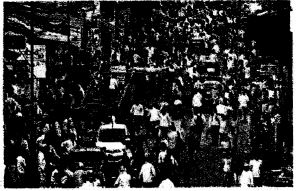
In simple words: Too much crowding damages nature, uses up clean water and forests, and leads to poor housing conditions.
Exam Tip: Keep your points distinct by focusing on environmental, economic, and health impacts.
G Map work
Question G3. On an outline map of the world mark the top five populous countries of the world.
Answer: On a world map, the five most populated countries are located as follows:
1. China - located in East Asia.
2. India - located in South Asia.
3. USA - located in North America.
4. Indonesia - located in Southeast Asia.
5. Brazil - located in South America.
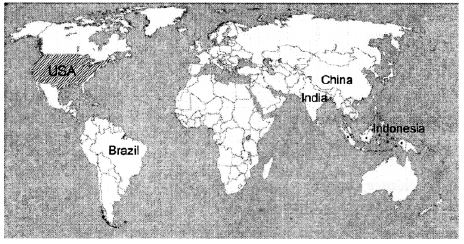
In simple words: Locate these five largest population centers on your map: China, India, USA, Indonesia, and Brazil.
Exam Tip: Practice identifying these five major nations on a blank outline map of the world before the exam.
Extra Questions
Question Extra1. Define the following -
1. Birth rate
2. Death rate
3. Life expectancy
4. Family planning
5. Demography
6. Overpopulation
7. Under population
8. Population pyramid
Answer:
1. Birth rate: The number of live births recorded per year for every 1000 people in a population. It is calculated as: \[ \text{Birth Rate} = \frac{\text{Number of Births}}{\text{Total Population}} \times 1000 \]
2. Death rate: The number of deaths occurring per year for every 1000 individuals in a population. It is calculated as: \[ \text{Death Rate} = \frac{\text{Number of Deaths}}{\text{Total Population}} \times 1000 \]
3. Life expectancy: The average number of years a person is expected to live, representing the average lifespan of a community.
4. Family planning: The method of managing family size and the spacing between consecutive childbirths using reproductive healthcare and education.
5. Demography: The scientific study of human populations, focusing on changes, size, structure, and characteristics like age, sex, and education.
6. Overpopulation: A condition where the number of inhabitants in a region exceeds the carrying capacity of its available natural and civic resources.
7. Under population: A state where a region's population is too small to efficiently develop and utilize its natural resources and lands.
8. Population pyramid: A specialized bar chart that illustrates the distribution of various age brackets and genders within a population.
In simple words: These scientific terms help us track how populations grow, how long people live, and how resources are shared.
Exam Tip: Be ready to define these terms and write out the calculations for birth rate and death rate using MathJax format.
Question Extra2. List few countries with high population density (over population) and few with low population density (under population) ?
Answer: Here are the tables representing countries with high and low population density:
Countries with High Population Density:
| Country | Population | Density (per sq. km) |
|---|---|---|
| Singapore | 5.60 million | 8005.3 |
| Bahrain | 1.38 million | 1,812.2 |
| Bangladesh | 161.0 million | 1,236.8 |
| Maldives | 0.36 million | 1,212.2 |
| Lebanon | 5.85 million | 571.9 |
Countries with Low Population Density:
| Country | Population | Density (per sq. km) |
|---|---|---|
| Mongolia | 2.96 million | 1.9 |
| Namibia | 2.46 million | 3.0 |
| Australia | 23.97 million | 3.1 |
| Iceland | 0.33 million | 3.3 |
| Suriname | 0.5 million | 3.5 |
In simple words: High-density places like Singapore are extremely packed with thousands of people per square kilometer, while low-density nations like Mongolia have lots of empty space.
Exam Tip: Remember Singapore as an example of extremely high density and Mongolia as an example of extremely low density.
Question Extra3. Mention the causes of underpopulation ?
Answer: Underpopulation can be triggered by several factors:
1. Natural or man-made disasters: Sudden increases in the death rate due to earthquakes, tsunamis, wars, or floods.
2. Decline in birth rates: Reductions in births due to health, economic, or genetic factors.
3. Biological infertility: Inability within a population segment to have children.
4. Emigration: Large groups of citizens permanently leaving the nation to live abroad.
In simple words: Underpopulation happens when there are many deaths from disasters, a drop in birth rates, or when people move out of the country.
Exam Tip: State at least three distinct causes, including both environmental and social drivers like disasters and migration.
Question Extra4. What do you mean by composition of population or demographic structure? What is its significance? Name any two characteristics of a population.
Answer: Demographic structure, or population composition, refers to the measurable social, physical, and economic features of a population. This includes age, sex, residence (rural/urban), religion, literacy, and occupation.
- Significance: These features allow demographers to measure, analyze, and compare different social groups.
Two main characteristics are:
1. Rural and Urban Composition: Shows where residents settle, splitting them between country villages and developed cities.
2. Age and Sex Composition: Details the share of people in different age brackets and the ratio of females to males.
In simple words: Demographic structure means the characteristics that make up a population, like how old they are, their genders, and where they live.
Exam Tip: Mentioning what population composition is and its measurable significance will ensure a high score.
Question Extra5. What do you understand by age composition of a population ?
Answer: Age composition refers to the percentage of citizens in different age brackets within a given population. This split varies globally and is generally categorized into the active working group (aged 14 to 60 years) and the dependent group (children under 14 and elderly adults over 60).
In simple words: Age composition shows how a population is divided between children, working-age adults, and elderly seniors.
Exam Tip: Clearly define the active cohort (14 to 60) and the dependent cohort (below 14 and above 60) in your definition.
Question Extra6. What is the working population of India ?
Answer: In India, the active working cohort constitutes 62.5 percent of the total population. Meanwhile, 29.5 percent falls under the 0 to 14 age group, and approximately 8 percent is comprised of seniors above 60 years of age.
In simple words: Over 62% of India's population is in the working age bracket, while children make up nearly 30% and seniors make up about 8%.
Exam Tip: Learn these three statistics (62.5% working, 29.5% youth, and 8% elderly) to present precise facts in your answer.
Question Extra7. What leads to unfavourable sex ratio at some places ? Name few social practices leading to it ?
Answer: The primary cause of an imbalanced or unfavourable sex ratio is gender discrimination, which assigns lower social value to females. Social practices contributing to this issue are:
1. Selective prenatal termination of female pregnancies (female foeticide).
2. Neglect or killing of female infants (female infanticide).
3. Domestic abuse and poor healthcare access for girls and women.
In simple words: Bias against girls leads to fewer females because of unfair treatment, neglect, or choosing not to have baby girls.
Exam Tip: Be direct and use precise terms like female foeticide and gender discrimination to answer this question.
Question Extra8. Name one scheme launched by the government of India that works towards generating awareness and improving the efficiency of welfare services meant for women in the country.
Answer: The Government of India introduced the "Beti Bachao, Beti Padhao" initiative, aimed at protecting female children and promoting their education.
In simple words: The government launched the "Beti Bachao, Beti Padhao" program to save and educate girl children.
Exam Tip: Make sure to spell the scheme's name correctly and state its dual goal of saving and educating girls.
Question Extra9. What is the most effective way to show the age and sex structure of a population ?
Answer: The most efficient and visual method to show this structure is a population pyramid, also known as an age-sex pyramid.
In simple words: A population pyramid is a special bar graph that clearly shows the age and gender of a group.
Exam Tip: You can use the terms 'population pyramid' and 'age-sex pyramid' interchangeably in the exam.
Question Extra10. Explain the diagram of a population pyramid. Also show the three types of pyramids.
Answer: A population pyramid consists of horizontal bars stacked on top of one another. The bars show age cohorts, with male data represented on the left and female data on the right. The youngest groups sit at the base of the diagram, while the oldest are at the peak.
The three major shapes of population pyramids are:
1. Expanding population: A triangular-shaped pyramid with a wide base and a narrow top. This indicates high birth rates and rapid growth (e.g., India, Mexico, Nigeria).
2. Constant population: A bell-shaped pyramid with a relatively stable middle and tapering top, showing birth and death rates are nearly equal (e.g., USA).
3. Declining population: A pyramid with a narrow base, bulging middle, and slightly tapering top, indicating low birth rates and an aging population (e.g., Japan, Germany, Italy).
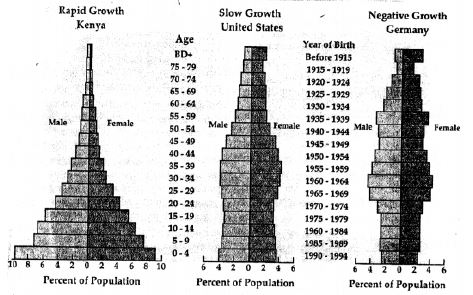
In simple words: A population pyramid is a graph of age and sex. Expanding shapes are triangular, constant shapes are like bells, and declining shapes bulge in the middle.
Exam Tip: Practice drawing the basic outlines of expanding, constant, and declining pyramids as it helps explain demographic patterns clearly.
Question Extra11. Why is it important to study the population?
Answer: Understanding demographic trends is essential because it shows how populations shape the resources and systems of the world. It provides governments with vital data to manage public welfare, plan infrastructure, and support sustainable development.
In simple words: Studying population helps governments plan schools, hospitals, roads, and food for everyone's future.
Exam Tip: Focus your explanation on resource planning and national development as key goals of demography.
12. Fill in the blanks
Question 12(1). Population refers to all the ________ who live in a particular area.
Answer: people
In simple words: Population means the total number of individuals in any given city or country.
Exam Tip: "People" or "citizens" is the standard term used to define population.
Question 12(2). At present, the population of the world stand at ________ billion.
Answer: 7.35
In simple words: The overall global population is estimated at around 7.35 billion.
Exam Tip: Use the specific number (7.35 billion) mentioned in your textbook to score full marks.
Question 12(3). Second most populated country in the world is ________.
Answer: India
In simple words: India ranks as the second most populous nation globally, right after China.
Exam Tip: Remember the top rankings: China is first, and India is second in this textbook's data.
Question 12(4). Continent-wise, Asia has the largest population, followed by ________.
Answer: Africa
In simple words: Asia is the most populated continent on Earth, and Africa comes in second place.
Exam Tip: The order of continents by population size is a very common objective question.
Question 12(5). India’s most populous city is ________.
Answer: Mumbai
In simple words: Mumbai is the city with the highest concentration of residents in India.
Exam Tip: Keep Mumbai in mind as India's premier crowded metropolitan city.
Question 12(6). Population Density refers to the number of people living in a ________ area of space.
Answer: unit
In simple words: Density counts the average number of people located in a set block or unit of space.
Exam Tip: A "unit area" is the standard geographical term for calculating population density.
Question 12(7). In ________ condition, the number of people in a particular area is more than the available resources.
Answer: Overpopulation
In simple words: Overpopulation means having too many people for the resources available in an area.
Exam Tip: Overpopulation occurs when resources cannot sustain the local resident numbers.
Question 12(8). ________ population puts less pressure on the environment.
Answer: Under
In simple words: Under-population means there are fewer people, which keeps natural areas cleaner and safer.
Exam Tip: Under-population results in lower environmental strain and less pollution.
Question 12(9). Sex ratio of 940 means there are 940 girls for every ________ boys.
Answer: 1000
In simple words: A sex ratio of 940 tells us that there are 940 girls for every 1000 boys in that population.
Exam Tip: The baseline for calculating sex ratio is always per 1000 males.
Question 12(10). The sex ratio is usually unfavourable in those countries where ________ discrimination is widespread.
Answer: gender
In simple words: When girls are discriminated against, it leads to fewer females in that society.
Exam Tip: Gender discrimination is the fundamental social root cause of low sex ratios.
Question 12(11). The average sex ratio in the world is ________ females to every 1000 males.
Answer: 982
In simple words: Across the entire globe, there are about 982 women for every 1000 men.
Exam Tip: Remember the worldwide average figure of 982 for multiple-choice questions.
Question 12(12). ________ in Europe has the highest sex ratio with 1179 females for every 1000 males.
Answer: Latvia
In simple words: Latvia is the country in Europe with the highest proportion of females to males.
Exam Tip: Latvia is the prime textbook example of a highly favorable sex ratio.
Question 12(13). ________ shaped population pyramid indicates rapid population growth.
Answer: Triangular
In simple words: A triangular pyramid has a broad base of children, meaning the population is growing very quickly.
Exam Tip: The broad-based triangular pyramid represents a rapidly expanding demographic.
Question 12(14). Not being able to have babies or produce young ones is called ________.
Answer: infertility
In simple words: Infertility refers to the medical inability to reproduce or have offspring.
Exam Tip: Learn the scientific term 'infertility' for direct definition-based questions.
Question 12(15). In India 69 % population is rural and ________ % urban.
Answer: 31
In simple words: About 31% of Indian citizens live in cities, while 69% live in villages.
Exam Tip: Keep both numbers (69% rural and 31% urban) linked together in memory.
Free study material for Geography
Verified Textbook Solutions for Class 8 Geography Chapter 02 Population
Detailed Textbook Solutions: Chapter 02 Population (Class 8 Geography)
Review accurate ICSE solutions for Chapter 02 Population tailored for Class 8 Geography students. Use these step-by-step notes to simplify difficult textbook exercises and improve exam readiness.
How to Use These Class 8 Geography Solutions
Verify your answers instantly using the comprehensive breakdowns provided for each problem, ensuring complete syllabus coverage across all sub-topics.
Complete Your ICSE Chapter Revision
Wrap up your chapter revision by verifying core concepts against standard ICSE question formats. All resources on our platform are free to access.
FAQs
You can download the verified Voyage solutions for Chapter 02 Population on StudiesToday.com. Our teachers have prepared answers for Class 8 Geography as per 2026-27 ICSE academic session.
Yes, our solutions for Chapter 02 Population are designed as per new 2026 ICSE standards. 40% competency-based questions required for Class 8, are included to help students understand application-based logic behind every Geography answer.
Yes, every exercise in Chapter 02 Population from the Voyage textbook has been solved step-by-step. Class 8 students will learn Geography conceots before their ICSE exams.
Yes, follow structured format of these Voyage solutions for Chapter 02 Population to get full 20% internal assessment marks and use Class 8 Geography projects and viva preparation as per ICSE 2026 guidelines.