

Class 8 History Civics Chapter 08 The Great Uprising Of 1857: Goyal Brothers Study Material
Explore the complete Goyal Brothers textbook solutions for Class 8 History Civics. Tailored for the 2026-27 curriculum, this resource breaks down complex topics to support daily study and targeted revision.
Chapter 08 The Great Uprising Of 1857 Answer Guide
Navigate directly to the Chapter 08 The Great Uprising Of 1857 solutions using the digital viewer below. Organizing your study sessions chapter-by-chapter allows for seamless offline study and quick reference during revision.
Time To Learn
I. Fill in the blanks:
1. By his policy of Doctrine of Lapse Lord Dalhousie annexed Nagpur and Jhansi.
2. Rani Laxmibai captured Gwalior with Tantya Tope’s help.
3. In Lucknow Hazrat Mahal led the revolt.
4. The rebels proclaimed Bahadur Shah Zafar as the emperor of India.
II. Match the contents of Column A and Column B:
| Column A | Column B (Correct Match) |
|---|---|
| 1. Jhansi | (c) Rani Laxmibai |
| 2. Kanpur | (a) Nana Saheb |
| 3. Enfield | (b) rifle |
| 4. Raja of Jodhpur | (e) did not join the revolt |
| 5. Bahadur | (d) exiled to Rangoon |
III. State whether the following statements are True or False:
1. Awadh was annexed on the ground of malad-ministration.
Answer: True
2. The British supported Sati.
Answer: False
3. The Indian soldiers were given lesser salary as compared to their British counterparts.
Answer: True
4. The Revolt of 1857 did not involve the masses.
Answer: True
IV. Answer the following questions:
Question 1. How were the economic policies of the British responsible for the Revolt of 1857?
Answer: The economic policies introduced by the British colonial government completely disrupted and damaged India's traditional economic framework, acting as a major cause for the 1857 outbreak:
1. Peasants were severely impacted by new, rigid land revenue systems. These laws allowed the government to easily seize agricultural lands and strictly demanded payments in cash, causing immense rural hardship.
2. The rise of the Industrial Revolution in England led to Indian markets being flooded with cheap, machine-made British textiles. Unable to compete, traditional Indian handicrafts and spinning industries declined, ruining millions of local artisans.
3. The aggressive annexation of native kingdoms resulted in local administrations being replaced by Company officials. Consequently, hundreds of local administrative employees, soldiers, and court artisans lost their livelihoods, creating widespread economic distress and deep anger.
In simple words: British economic rules ruined India's economy. High cash taxes led to peasants losing their land, cheap British imports destroyed local weavers, and annexing native kingdoms left many local soldiers and officials jobless.
Exam Tip: To write a comprehensive answer, list three distinct areas of economic distress: peasant exploitation, the ruin of local industries, and the unemployment of former state officials.
Question 2. Discuss the social and religious causes responsible for the Revolt of 1857.
Answer: The colonial administration introduced several changes that deeply offended the social and religious sentiments of both Hindus and Muslims:
1. Social Reforms: While progressive, measures such as banning Sati, outlawing female infanticide, prohibiting child marriage, and legalizing widow remarriage caused widespread unease. Many orthodox Indians viewed these laws as direct interference by a foreign government in their sacred ancestral customs.
2. Modern Inventions: The introduction of modern technologies like steam railways and electric telegraphs was viewed with fear and distrust, with many believing these systems were tools of Western magic designed to undermine local traditions.
3. Western Education: The promotion of Western-style schools was seen as a threat to traditional Sanskrit and Arabic learning, creating fears of forced conversion to Christianity.
4. Racial Arrogance: The open policy of racial bias and superiority practiced by British officers, who treated Indians with contempt, fueled intense anger.
In simple words: Many Indians felt their culture was under attack because the British banned old customs like Sati, introduced Western schools, and built railways, which were viewed with fear. British racial arrogance further angered the public.
Exam Tip: Explain that while reforms like banning Sati were positive, they were unpopular because they were introduced by a foreign, unsympathetic government.
Question 3. Why do you think the Revolt of 1857 failed? Discuss four, causes for its failure.
Answer: The Great Revolt of 1857 failed to overthrow British rule due to several major shortcomings:
1. Limited Scale and Support: The uprising remained geographically confined and failed to unite all sections of Indian society. Many wealthy merchants, western-educated middle-class intellectuals, and powerful rulers - such as the Scindias, Holkars, and the Raja of Jodhpur - actively supported the British rather than the rebels.
2. Military and Leadership Disadvantage: British troops possessed superior, modern weaponry and were led by highly experienced, disciplined generals. In contrast, Indian soldiers relied on outdated weapons and lacked unified military planning.
3. Resource Constraints: The revolutionaries faced a severe shortage of funds, modern arms, and reliable supplies, whereas the British Empire possessed vast military and economic resources to sustain long campaigns.
4. Poor Organization: The movement lacked a single coordinating plan, with different regional leaders fighting for their own local goals. Additionally, the British took full advantage of the modern postal and telegraph networks to share military intelligence and coordinate rapid counter-attacks.
In simple words: The revolt failed because it did not spread across the entire country, and many powerful kings and educated elites supported the British. Furthermore, the British had better weapons, highly experienced generals, and used telegraphs to plan their attacks quickly.
Exam Tip: To write a high-scoring answer, list four distinct reasons for failure: lack of nationwide unity, superior British arms and generals, poor organizational structure, and the British use of modern communication lines.
Question 4. Discuss the nature of the Uprising/Revolt of 1857.
Answer: Historians hold highly divergent viewpoints regarding the true nature of the 1857 uprising:
1. Military Mutiny: Early British writers, supported by some contemporary Indian observers like Munshi Jiwan Lal, Moinuddin, and Durgadas Bandopadhyaya, argued that the conflict was simply a localized sepoy mutiny that lacked broad public support.
2. Racial and Cultural Conflict: Other scholars described it as a racial clash for dominance between European and Indian races, or as a fundamental struggle between Eastern and Western cultures and values.
3. Political Conspiracy: Some early British officials claimed it was a pre-planned Hindu-Muslim conspiracy to overthrow British authority in India.
4. War of Independence: In contrast, prominent Indian nationalists and historians view the uprising as an organized, united struggle for freedom, famously naming it the "First War of Indian Independence."
In simple words: British historians viewed the 1857 revolt as a simple army mutiny with no public backing. However, Indian nationalists argue it was a well-organized national campaign, calling it the First War of Indian Independence.
Exam Tip: Explain both major perspectives: the British view of a localized 'Sepoy Mutiny' and the Indian nationalist view of the 'First War of Indian Independence'.
V. Give reasons why:
Question 1. State of Awadh was annexed by the British.
Answer: The state of Awadh was annexed by Lord Dalhousie on the official pretext of widespread misgovernance and maladministration by its ruler.
In simple words: The British annexed Awadh because they accused its ruler of poor governance.
Exam Tip: Use the term 'maladministration' as the official ground cited by Lord Dalhousie for the annexation.
Question 2. Indian artisans, weavers and craftsmen lost their means of livelihood.
Answer: With the expansion of the Industrial Revolution in England, Indian markets were flooded with cheap, mass-produced British textiles and manufactured goods. Traditional Indian handicraft industries could not compete with these low-priced imports, leading to the economic ruin of local weavers and craftsmen.
In simple words: Local weavers and craftsmen lost their jobs because cheap, machine-made clothes imported from England flooded Indian markets, and local hand-made goods could not compete.
Exam Tip: Explain that the rise of the Industrial Revolution in England led to the dumping of cheap, machine-made goods, destroying India's handloom sector.
Question 3. The Indian sepoys refused to bite the cartridges of the Enfield rifle.
Answer: The Indian soldiers refused to use the new paper cartridges because of widespread reports that the grease used to seal them contained cow and pig fat. To load the Enfield rifle, soldiers had to bite off the ends of these cartridges, which deeply offended both Hindu sepoys, who hold the cow sacred, and Muslim sepoys, who view the pig as unclean.
In simple words: Soldiers refused to bite the cartridges because they believed they were greased with cow and pig fat. This offended both Hindu and Muslim religious beliefs, as cows are sacred to Hindus and pigs are taboo for Muslims.
Exam Tip: Explain that having to bite the cartridges greased with animal fat was seen as a deliberate attempt to defile their religious beliefs, acting as the immediate spark for the revolt.
VI. Picture Study
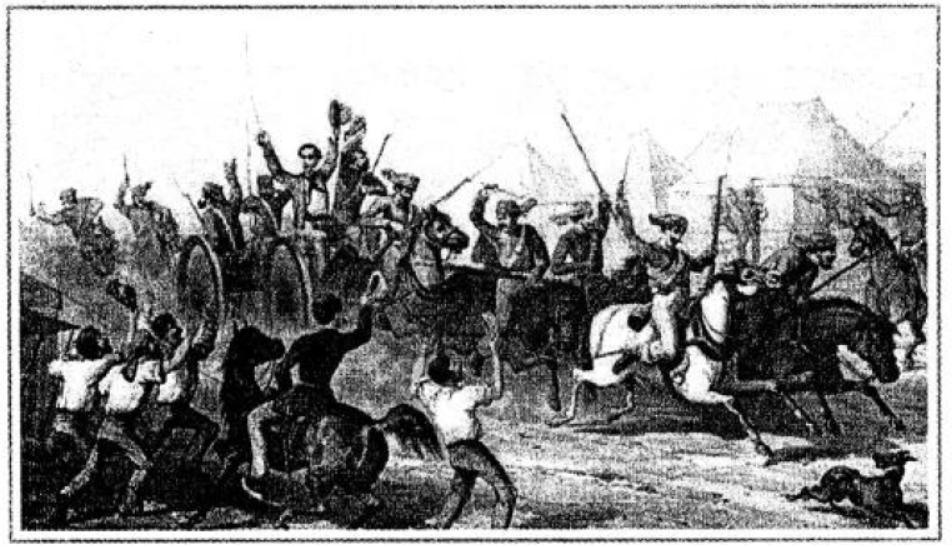
Question 1. How far were the greased catridges responsible for the Revolt?
Answer: The controversy surrounding the greased cartridges served as the immediate trigger - the spark that ignited a highly explosive situation. Deep-rooted grievances, including oppressive taxation, aggressive annexation policies, and British interference in social and religious traditions, had already created widespread anger. The reports that the new cartridges were greased with cow and pig fat deeply offended both Hindu and Muslim soldiers, acting as the final provocation that pushed them into open rebellion.
In simple words: The greased cartridges were the immediate spark that started the fire. Deep anger over high taxes, annexations, and religious interference had already built up, and the cartridge rumor pushed the soldiers over the edge.
Exam Tip: Define the greased cartridges as the 'immediate cause' or the 'spark' that ignited long-standing political, economic, and social grievances.
Question 2. Give your opinion as to how the Revolt would have been successful.
Answer: In my view, the Uprising could have succeeded if the revolutionaries had established a coordinated, nationwide plan and gained the active support of all social classes. Had wealthy merchants, the educated middle class, and prominent zamindars joined the movement instead of supporting the British, and had Indian soldiers possessed modern firearms and unified military command under experienced generals, they could have successfully overthrew British authority.
In simple words: The revolt could have succeeded if it had been well-planned across the nation, and if wealthy merchants, landowners, and educated elites had joined the struggle alongside soldiers equipped with modern weapons.
Exam Tip: Focus on the need for unified planning, modern weaponry, and the participation of all social classes for a successful outcome.
Exercises
A. Fill in the blanks:
1. Dalhousie annexed the states of Satara, Nagpur, and Jhansi on the basis of the Doctrine of Lapse.
2. Prior to the outbreak of the Revolt, Bahadur Shah Zafar lived in Delhi as a Pensioner of the British.
3. The Revolt of 1857 started as a Mutiny of the sepoys.
4. The immediate cause of the Revolt was the issue of the greased cartridges.
5. The Revolt ended the rule of the English East India Company.
B. Match the following:
| Column A | Column B (Correct Match) |
|---|---|
| 1. Nana Saheb | (c) adopted son of Peshwa Baji Rao II |
| 2. Bentinck and Dalhousie | (a) confiscation of jagirs |
| 3. Hindu and Muslim sepoys | (e) greased cartridges |
| 4. Bahadur Shah Zafar | (b) exiled to Rangoon |
| 5. Commander of Nana Saheb | (d) Tantya Tope |
C. Choose the correct answer:
Question 1. When which state was annexed, the estates of the zamindars and talukdars were confiscated by the British?
(a) Awadh
(b) Nagpur
(c) Jhansi
(d) None of the options
Answer: (a) Awadh
In simple words: Following the annexation of Awadh on grounds of misgovernance, the British confiscated the properties of local landlords and talukdars.
Exam Tip: Recall that the confiscation of estates in Awadh turned influential landholders into bitter enemies of the British.
Question 2. The rumour regarding greased cartridges started in which city?
(a) Madras
(b) Calcutta
(c) Delhi
(d) None of the options
Answer: (b) Calcutta
In simple words: The reports that cartridges were greased with cow and pig fat originally started in the military cantonment at Dum Dum near Calcutta.
Exam Tip: Identify Calcutta as the starting point of the cartridge controversy.
Question 3. Mangal Pandey was a sepoy stationed at which cantonment, who refused to use the greased cartridges in 1857?
(a) Barrackpore
(b) Nagpur
(c) Satara
(d) None of the options
Answer: (a) Barrackpore
In simple words: Stationed at Barrackpore near Calcutta, Mangal Pandey was the first soldier to openly rebel against the greased cartridges.
Exam Tip: Clearly write 'Barrackpore' as the historical location of Mangal Pandey's famous protest in March 1857.
Question 4. The Revolt in Kanpur was led by which leader?
(a) Nana Saheb
(b) Hazrat Mahal
(c) Rani Lakshmibai
(d) None of the options
Answer: (a) Nana Saheb
In simple words: Nana Saheb, the adopted son of Peshwa Baji Rao II, led the uprising against the British forces in Kanpur.
Exam Tip: Match Kanpur directly with Nana Saheb, who sought to reclaim his father's pension rights.
Question 5. Who led the Revolt of 1857 in Lucknow?
(a) Nana Saheb
(b) Hazrat Mahal
(c) Rani Lakshmibai
(d) None of the options
Answer: (b) Hazrat Mahal
In simple words: Begum Hazrat Mahal of Awadh took charge and led the revolutionary forces in Lucknow against the British.
Exam Tip: Name 'Begum Hazrat Mahal' as the key female leader who headed the rebellion in Awadh.
D. State whether the following are true or false:
1. Indian rulers were quite satisfied with Lord Dalhousie’s expansionist policies.
Answer: False (Correct statement: Indian rulers were highly dissatisfied with Lord Dalhousie's aggressive expansionist policies.)
2. Peasants benefitted from the land revenue system of the British.
Answer: False (Correct statement: Indian peasants did not benefit from the high and rigid land revenue systems introduced by the British.)
3. Social reforms such as the abolition of sati and female infanticide, and the Widow Remarriage Act caused deep resentment among the orthodox sections of society.
Answer: True
4. The Doctrine of Lapse was abolished after the Revolt.
Answer: True
5. The Revolt of 1857 had come as a shock to the British.
Answer: True
E. Answer the following questions in one or two words/ sentences:
Question 1. Why did Rani of Jhansi become a staunch enemy of the British?
Answer: Under his aggressive expansion policies, Lord Dalhousie annexed the states of Satara, Nagpur, and Jhansi by applying the Doctrine of Lapse, refusing to recognize Rani Lakshmibai's adopted son as successor. This unjust annexation transformed the brave Rani of Jhansi into a fierce enemy of British colonial rule.
In simple words: Lord Dalhousie used the Doctrine of Lapse to annex Jhansi, refusing to recognize the Rani's adopted son as heir. This turned her into a strong enemy of the British.
Exam Tip: Identify the 'Doctrine of Lapse' as the specific policy used by Dalhousie to annex Jhansi, driving the Rani to rebel.
Question 2. Why did Nana Saheb fight against the British during the Revolt of 1857?
Answer: Nana Saheb, the adopted son of Peshwa Baji Rao II, was refused his adoptive father's state pension by the British administration after the Peshwa passed away. Angered by this denial of his rights, Nana Saheb joined and led the uprising to reclaim his family's status.
In simple words: The British refused to pay the royal pension of Peshwa Baji Rao II to his adopted son, Nana Saheb, after his death. This led Nana Saheb to fight against them.
Exam Tip: Mention that the denial of Peshwa Baji Rao II's pension to his adopted heir, Nana Saheb, was his main grievance.
Question 3. Why did the zamindars and talukdars became sworn enemies of the British?
Answer: Following the annexation of Awadh on grounds of misgovernance, the British administration confiscated the land estates and hereditary tax collection rights of the local zamindars and talukdars, turning them into bitter enemies of the colonial government.
In simple words: When the British annexed Awadh, they seized the land estates of local landlords, turning them into enemies.
Exam Tip: Link the annexation of Awadh directly with the confiscation of landlord estates to explain their hostility.
Question 4. What happened to the nawab’s army when Awadh was annexed?
Answer: Following the annexation of Awadh, the royal army of the Nawab was completely disbanded. Thousands of local soldiers lost their jobs and livelihoods, significantly increasing anger and resentment toward the British.
In simple words: When Awadh was annexed, the Nawab's army was dissolved, leaving thousands of soldiers jobless and extremely angry at the British.
Exam Tip: Point out that disbanding the state army caused sudden military unemployment, fueling the rebellion.
Question 5. When and where did the Revolt of 1857 begin?
Answer: The Great Uprising of 1857 formally began on May 10, 1857, at the military cantonment in Meerut, North India.
In simple words: The Revolt began on Sunday, May 10, 1857, at the military camp in Meerut.
Exam Tip: Provide the correct date and location to write a complete, high-scoring answer.
Question 6. Name any two main centres of Revolt.
Answer: Two of the primary centers of the 1857 uprising were Delhi and Jhansi.
In simple words: Two of the main centers of the revolt were Delhi and Jhansi.
Exam Tip: Listing 'Delhi' and 'Jhansi' is the easiest way to answer this question.
Question 7. What step was taken by the British to reorganize the army after the Revolt?
Answer: To prevent future rebellions, the British thoroughly reorganized and strengthened the military. They increased the ratio of European soldiers to Indian sepoys and placed all crucial artillery divisions strictly under British control.
In simple words: The British increased the number of European soldiers in India and placed all heavy weapons and artillery under their exclusive control.
Exam Tip: Emphasize that placing all artillery divisions under exclusive British control was the main safety measure taken.
Question 8. Mention any two important results of the Revolt.
Answer: Two highly significant outcomes of the 1857 Uprising were:
1. The formal end of the East India Company's rule, transferring direct control of India to the British Crown and Parliament.
2. An official declaration promising that the British government would respect local treaties and stop interfering in the social and religious traditions of the Indian people.
In simple words: First, the rule of the East India Company ended, and the British Crown took direct control of India. Second, the British promised to stop interfering in Indian religious and social customs.
Exam Tip: The transfer of power from the Company to the Crown is the most critical result of the Uprising to mention.
F. Answer the following questions briefly:
Question 1. In the context of the Revolt of 1857, answer the following questions:
1. Mention any three political causes of the Revolt.
2. Mention the three economic factors that led to the outbreak of the great Revolt.
3. Explain briefly any four social and religious causes that led to the Revolt of 1857.
Answer:
(a) Political Causes of the Revolt:
1. Application of the Doctrine of Lapse: Lord Dalhousie annexed states like Satara, Nagpur, and Jhansi, refusing to recognize their adopted heirs. This policy turned rulers like Rani Lakshmibai into bitter enemies of the British.
2. Disrespect to the Mughal Dynasty: The Mughal Emperor Bahadur Shah Zafar was treated with disrespect. Dalhousie announced that his successor would not be allowed to reside in the historic Red Fort and would be moved to the outskirts of Delhi near the Qutb Minar, which deeply offended the Muslim community.
3. Unjust Annexation of Awadh: Awadh was annexed on the ground of maladministration despite having been a loyal ally of the British. Its ruler was exiled to Calcutta, angering both the nobles and the local population.
(b) Economic Causes of the Revolt:
1. Oppressive Land Revenue: Rigid tax systems like the Zamindari system caused great misery. Farmers who failed to pay taxes or loans on time faced torture, jail, or eviction, leading to widespread poverty and famines.
2. Confiscation of Estates: Under Bentinck and Dalhousie, the government seized thousands of jagirs from landlords who could not produce written titles of ownership, causing insecurity among the landholding class.
3. Decline of Native Handicrafts: British trade policies flooded India with cheap, machine-made goods from England, causing the collapse of local handloom industries and ruining millions of weavers and artisans.
(c) Social and Religious Causes:
1. Backlash Against Social Reforms: Western reforms like the abolition of Sati, banning of female infanticide, and the Widow Remarriage Act of 1856 were viewed by orthodox groups as direct interference in their religious customs.
2. Fear of Forced Conversion: The aggressive work of Christian missionaries, who sometimes mocked local customs, raised widespread fears that the government was trying to convert the population.
3. Modern Infrastructure Fears: The introduction of steam railways and electric telegraphs was viewed with suspicion by villagers, who feared these technologies were tools of foreign magic designed to control them.
4. Policy of Racial Arrogance: The British practiced open racial bias, excluding Indians from social spaces and treating them with systematic contempt, which fueled intense national anger.
In simple words: Political causes included taking away kingdoms using the Doctrine of Lapse and disrespecting the Mughal Emperor. Economic causes included high cash taxes that ruined farmers and cheap British goods that destroyed local artisans. Social causes included fears of forced conversion and anger over British interference in local customs.
Exam Tip: Divide your answer into three clear sections and use specific historical terms like the 'Doctrine of Lapse' and the 'Zamindari system'.
Question 2. In the context of the military causes of the Revolt of 1857, answer the following questions:
1. Mention any three grievances that the sepoys had against their British masters.
2. How did the Act passed in 1856 by the British hurt the sentiments of the Hindu sepoys?
3. Explain the immediate cause of the great Revolt?
Answer:
(a) Grievances of the Indian Sepoys:
1. Lack of Recognition and Respect: Although Indian soldiers helped the British conquer and build their empire, they were treated with contempt and received no rewards or appreciation from their officers.
2. Systematic Discrimination: Indian sepoys faced severe bias in pay and promotion. Regardless of their experience or merit, an Indian soldier could not rise above the low rank of Subedar.
3. The General Service Enlistment Act of 1856: This new law made it compulsory for new recruits to serve overseas if required. This hurt the sentiments of the Hindus because they believed that overseas travel would lead to a loss of caste.
(b) Impact of the 1856 General Service Enlistment Act:
The Act made overseas deployment mandatory for new recruits. This deeply hurt the religious sentiments of Hindu sepoys, as traditional orthodox beliefs held that crossing the 'black water' led to a loss of caste and social purity. They viewed the regulation as a direct attack on their religious beliefs.
(c) The Immediate Cause of the Uprising:
In January 1857, reports spread at the Dum Dum military camp near Calcutta that the new paper cartridges for the Enfield rifle were greased with cow and pig fat. Since soldiers had to bite these cartridges to load the rifles, both Hindu and Muslim sepoys felt the government was trying to defile their faiths. This outrage led to open rebellion. On March 29, 1857, Mangal Pandey, a sepoy at Barrackpore, refused to use the cartridges and attacked his officers, leading to his execution and sparking the wider revolt.
In simple words: Soldiers were angry because of low pay, poor treatment by British officers, and a new 1856 law that forced them to serve overseas, which offended Hindu religious beliefs. The immediate spark was the introduction of cartridges greased with cow and pig fat, which forced Mangal Pandey to rebel at Barrackpore in March 1857.
Exam Tip: For part (a), focus on unequal pay and promotion limits. For part (b), identify the 1856 Act, and for part (c), describe the greased cartridges and the role of Mangal Pandey.
Question 3. In the context of the Revolt of 1857, briefly discuss:
1. The decline of the Mughal dynasty
2. Any four results of the Revolt of 1857
3. Nature of the Revolt of 1857
Answer:
(a) The Final Collapse of the Mughal Dynasty:
On May 11, 1857, the rebelling sepoys declared the elderly Mughal Emperor Bahadur Shah Zafar as the Emperor of Hindustan. However, this symbolic revival of Mughal power was short-lived. In September 1857, British forces captured Delhi. Bahadur Shah Zafar was arrested, tried for treason, and exiled to Rangoon, where he later passed away. To completely eliminate any future claims to the throne, British officers executed his sons and grandson, bringing a final end to the once-mighty Mughal Empire.
(b) Results of the 1857 Uprising:
The rebellion brought fundamental political changes to India:
1. The administrative rule of the East India Company was abolished.
2. Direct political control of India was assumed by the British Crown and Parliament.
3. Queen Victoria issued a landmark Proclamation promising to protect the welfare of Indian subjects.
4. The British government promised to respect existing treaties with princely states and stop annexations.
5. A general amnesty was offered to all rebels, except those directly involved in killing British subjects.
6. The government adopted a policy of non-interference in Indian social and religious customs.
7. The military was reorganized, significantly increasing the proportion of European soldiers and placing all heavy artillery under direct British control.
(c) The True Nature of the Revolt:
The Uprising of 1857 was a massive anti-colonial struggle with several defining features:
1. It represented a unified output of long-standing grievances from diverse groups, including peasants, artisans, and nobles, rather than a simple military mutiny.
2. Although participants had different individual goals, they were unified by their shared opposition to foreign rule.
3. It enjoyed extensive public backing, as shown by the fact that out of the estimated casualties, nearly 100,000 were civilians.
4. The struggle fostered deep Hindu-Muslim unity, with both communities fighting together against a common adversary.
In simple words: The Mughals ended because the British captured Delhi, executed Zafar's sons, and exiled the last emperor to Rangoon. The results included the end of Company rule, the start of direct rule by the British Queen, and a promise of non-interference in Indian customs. The nature of the revolt was a popular, united struggle for freedom that brought Hindus and Muslims together.
Exam Tip: For this detailed question, provide three structured parts: the end of the Mughal line under Zafar, the administrative shift from Company to Crown rule, and the popular anti-colonial nature of the struggle.
G. Picture study
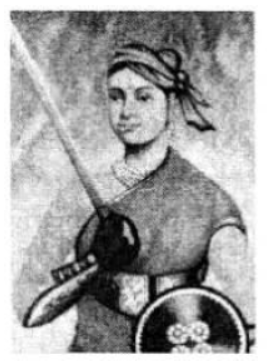
Question 1. Identify the queen.
Answer: The portrait depicts Rani Lakshmibai, the brave queen of Jhansi.
In simple words: The picture is of Rani Lakshmibai of Jhansi.
Exam Tip: Clearly identify her as Rani Lakshmibai of Jhansi, a key leader of the 1857 Uprising.
Question 2. Name the city where she led the Revolt.
Answer: She led the revolutionary forces and the uprising in the city of Jhansi.
In simple words: She led the revolt in the city of Jhansi.
Exam Tip: Jhansi is the correct city to name for her leadership.
Question 3. What were the economic causes of the Revolt of 1857?
Answer: The economic causes that led to the Uprising include:
1. Rigid Land Revenue: The high, cash-based tax systems introduced by the British caused severe hardship, forcing many peasants to lose their land.
2. Ruin of Local Handicrafts: Cheap, machine-made goods imported from England flooded Indian markets, destroying local handloom industries and ruining artisans.
3. Loss of Livelihood: Annexing native states led to sudden unemployment for hundreds of court officials, soldiers, and local administrators.
In simple words: The economic causes were high taxes that took land away from farmers, cheap British imports that ruined local weavers, and annexations that left many soldiers and officials jobless.
Exam Tip: Identify high land revenue systems, the ruin of traditional artisans, and sudden military unemployment as the primary economic causes.
Question 4. What was the major outcome of the Revolt of 1857?
Answer: The primary and most significant outcome of the 1857 Revolt was the abolition of the British East India Company's administration. Direct political control of India was transferred to the British Crown and Parliament under the Government of India Act of 1858.
In simple words: The biggest outcome was that the East India Company's rule ended, and the British Queen and Parliament took direct control of India.
Exam Tip: Specify the Government of India Act of 1858 and the transfer of power from the Company to the Crown as the primary outcome.
Free study material for History Civics
Verified Textbook Solutions for Class 8 History Civics Chapter 08 The Great Uprising Of 1857
About ICSE Solutions for Class 8 History Civics Chapter 08 The Great Uprising Of 1857
Access structured ICSE solutions for Class 8 History Civics Chapter 08 The Great Uprising Of 1857 designed to match CISCE curriculum standards. These verified answers help clarify complex numericals and support daily homework revision.
Concept Clarification for Chapter 08 The Great Uprising Of 1857
Tackle complex theorems and numerical problems easily by cross-referencing your working steps with our structured solution guides.
Effective Revision Strategies for Chapter 08 The Great Uprising Of 1857
Pair your solution review with additional practice papers to test your execution speed and ensure total preparedness for school exams.
FAQs
You can download the verified Goyal Brothers solutions for Chapter 08 The Great Uprising Of 1857 on StudiesToday.com. Our teachers have prepared answers for Class 8 History Civics as per 2026-27 ICSE academic session.
Yes, our solutions for Chapter 08 The Great Uprising Of 1857 are designed as per new 2026 ICSE standards. 40% competency-based questions required for Class 8, are included to help students understand application-based logic behind every History Civics answer.
Yes, every exercise in Chapter 08 The Great Uprising Of 1857 from the Goyal Brothers textbook has been solved step-by-step. Class 8 students will learn History Civics conceots before their ICSE exams.
Yes, follow structured format of these Goyal Brothers solutions for Chapter 08 The Great Uprising Of 1857 to get full 20% internal assessment marks and use Class 8 History Civics projects and viva preparation as per ICSE 2026 guidelines.