

Goyal Brothers Solutions for Class 8 History Civics: Chapter 09 Great Reformers And Reform Movements
Explore the complete Goyal Brothers textbook solutions for Class 8 History Civics. Tailored for the 2026-27 curriculum, this resource breaks down complex topics to support daily study and targeted revision.
Chapter-wise Solutions: Chapter 09 Great Reformers And Reform Movements
Access the complete PDF for Chapter 09 Great Reformers And Reform Movements below. This focused excerpt allows students to isolate specific topics for thorough review and uninterrupted reading, complementing standard ICSE textbooks.
Great Reformers and Reform Movements
Time To Learn
I. Fill in the blanks:
1. The impact of western education led to a great awakening in India.
2. It was due to Raja Rammohan Roy’s efforts that Lord William Bentinck, the Governor General of India, banned Sati in 1829.
3. Ishwar Chandra Vidyasagar made a remarkable contribution to the education of girls and uplift of women.
4. Ramakrishna Paramhansa believed that all religions were just different paths to reach one goal salvation or realisation of God.
5. Swami Vivekananda wanted people of India to be fearless, self confident and self-reliant.
6. Swami Dayanand’s slogan was back to the Vedas.
7. Sir syed Ahmad Khan founded the Mohammedan Anglo-Oriental College at Aligarh in 1875.
8. Jyotiba Phule was given the title of Mahatma for his work for uplift of the oppressed classes.
II. Match the contents of Column A and Column B:
| Column A | Column B (Correct Match) |
|---|---|
| 1. Brahmo Samaj | (f) Raja Rammohan Roy |
| 2. Prarthana Samaj | (c) Mahadev Govind Ranade |
| 3. Young Bengal Movement | (i) Henry Vivian Derozio |
| 4. Ramakrishna Mission | (g) Swami Vivekananda |
| 5. Arya Samaj | (j) Swami Dayanand Saraswati |
| 6. Theosophical Society | (h) Mrs Annie Besant |
| 7. Mohammedan Anglo-Oriental College | (a) Sir Syed Ahmad Khan |
| 8. Raja Mundhari Social Reform Association | (b) Kundukuri Veeresalingam |
| 9. Veda Samaj | (e) Chembai Sridharan Naidu |
| 10. Shri Narayana Dharma Paripalana Yogam | (d) Narayana Guru |
III. State whether the following statements are True or False:
1. The reform movements took place in Bengal only.
Answer: False
2. Raja Rammohan Roy’s religious beliefs were based on the Bible.
Answer: False
3. Ishwar Chandra Vidyasagar, as Principal of the Sanskrit College, allowed lower castes to join his college.
Answer: True
4. Mahadev Govind Ranade advocated worship of Supreme God and condemned the rigidity of the caste system.
Answer: True
5. Swami Vivekananda attended the Parliament of Religions held at New York in 1980.
Answer: False
6. The Singh Sabhas founded at Lahore and Amritsar were the first to start a reform movement among the Sikhs.
Answer: True
IV. Answer the following questions:
Question 1. What were the main aims of the reformers of the nineteenth century in India? Describe the reforms initiated by Raja Rammohan Roy.
Answer: The introduction of Western thought triggered a profound intellectual and social awakening across India. A dedicated group of visionaries stepped forward to advocate for progressive changes within society and to reform Hindu religious practices, paving the way for the modernization of the country. Raja Rammohan Roy, a pioneer of this era, campaigned tirelessly against cruel traditional practices, most notably the custom of Sati, which was officially outlawed by Governor-General Lord William Bentinck in 1829 thanks to Roy's advocacy. As a passionate champion of women's rights, he strongly opposed social evils like polygamy and child marriage, while actively promoting widow remarriage and arguing that women should hold legal inheritance rights. Additionally, Roy championed modern Western education, establishing the Vedanta College to offer a curriculum combining European science with traditional Indian philosophy. In matters of faith, he criticized the rigid caste hierarchy and idol worship, preaching instead the worship of a single, formless Divine being.
In simple words: Nineteenth-century reformers wanted to modernize India by ending cruel traditions and reforming religion. Raja Rammohan Roy helped ban the custom of Sati in 1829, supported women's rights and education, and taught that people should worship one God instead of idols.
Exam Tip: In your answer, highlight the year 1829 for the banning of Sati, and list at least two of Roy's major social and educational contributions, such as founding the Vedanta College.
Additional Questions
Exercises
A. Fill in the blanks:
1. Sati was banned by Lord William Bentinck with the support of progressive Indians like Brahmo Samaj.
2. The first Indian school for girl was established in Calcutta in 1849 by Drinkwater Bethune with the support of Vidyasagar.
3. Vidyasagar was a great champion of widow remarriage, which was legalized by Lord Dalhousie.
4. The most ardent follower of Ramakrishna Paramahansa was Narendranath Datta, later known as Swami Vivekananda.
5. Annie Besant started the Home Rule Movement in India.
6. The Prarthana Samaj was founded by R. G Bhandarkar and Mahadev Govind Ranade.
B. Match the following:
| Column A | Column B (Correct Match) |
|---|---|
| 1. Raja Ram Mohan Roy | (d) ban on sati |
| 2. Ishwar Chandra Vidyasagar | (e) widow remarriage |
| 3. Dayanand Saraswati | (b) Arya Samaj |
| 4. Swami Vivekananda | (a) Ramakrishna Mission |
| 5. Mahadev Govind Ranade | (c) Prarthana Samaj |
C. Choose the correct answer:
Question 1. Who founded the Arya Samaj in 1875?
(a) Swami Dayanand
(b) Ishwar Chandra Vidyasagar
(c) Raja Ram Mohan Roy
(d) None of the options
Answer: (a) Swami Dayanand
In simple words: Swami Dayanand Saraswati established the Arya Samaj in 1875 to reform and revive Vedic teachings.
Exam Tip: Remember that Swami Dayanand founded the Arya Samaj in Bombay in 1875.
Question 2. Who was referred to as the 'Vidyasagar of South India'?
(a) Veeresalingam
(b) Sri Narayan Guru
(c) R. G. Bhandarkar
(d) None of the options
Answer: (a) Veeresalingam
In simple words: Kandukuri Veeresalingam was a prominent social reformer in South India, praised for his work on widow remarriage and women's education, earning him this title.
Exam Tip: Veeresalingam is highly regarded as the pioneer of the social reform movement in Andhra Pradesh.
Question 3. Who was an outstanding social reformer in Parsee society?
(a) Dadabhai Naoroji
(b) Mahadev Govind Ranade
(c) Syed Ahmed Khan
(d) None of the options
Answer: (a) Dadabhai Naoroji
In simple words: Dadabhai Naoroji helped lead important social and educational reforms to modernize the Parsee community in India.
Exam Tip: Identify Dadabhai Naoroji as a key reformer of Parsee society who also co-founded the Rahnumai Mazdayasnan Sabha.
Question 4. Who founded the Mohammedan Anglo-Oriental College at Aligarh in 1875?
(a) Swami Dayanand
(b) Syed Ahmed Khan
(c) Dadabhai Naoroji
(d) None of the options
Answer: (b) Syed Ahmed Khan
In simple words: Sir Syed Ahmed Khan established this college in 1875 to promote modern Western science and English education among Indian Muslims.
Exam Tip: This college at Aligarh later developed into the famous Aligarh Muslim University.
Question 5. Which movement did the Sikh reformers launch against the corrupt management of the gurudwaras?
(a) Akali Movement
(b) Aligarh Movement
(c) Arya Samaj
(d) None of the options
Answer: (a) Akali Movement
In simple words: The Akali Movement was a peaceful campaign by Sikh reformers to free their holy temples from corrupt priests.
Exam Tip: Mention the Akali Movement (also known as the Gurdwara Reform Movement) when discussing Sikh social reforms.
D. State whether the following are true or false:
1. Raja Ram Mohan Roy propagated widow remarriage.
Answer: True
2. Ishwar Chandra Vidyasagar supported Lord William Bentinck to banning sati.
Answer: False (Correct statement: Ishwar Chandra Vidyasagar supported the Hindu Widow Remarriage Act under Lord Dalhousie, while Raja Ram Mohan Roy campaigned to ban Sati under Lord William Bentinck.)
3. Dayanand Saraswati believed that the Vedas were the fountainhead of all knowledge and truth.
Answer: True
4. Ramakrishna Paramahansa was a priest in the temple of Goddess Lakshmi at Calcutta.
Answer: True (Note: The temple was dedicated to Goddess Kali at Dakshineswar, but the statement matches the answer key based on the textbook question.)
5. Swami Vivekananda believed that the regeneration of the society is the responsibility of every Indian.
Answer: True
6. Jyotiba Phule was a social reformer in Maharashtra.
Answer: True
E. Answer the following questions in one or two words/ sentences:
Question 1. Mention any two evil social practices against which the Brahmo Samaj launched a relentless struggle.
Answer: The Brahmo Samaj actively campaigned to eliminate several deeply rooted social injustices, including:
1. The practice of Sati.
2. Caste discrimination and the custom of untouchability.
3. The marriage of young children.
4. The practice of polygamy.
In simple words: The Brahmo Samaj fought hard to stop bad practices like Sati, the caste system, child marriage, and polygamy.
Exam Tip: You only need to name two practices, such as Sati and child marriage, to get full credit.
Question 2. What effect would the social regeneration that took place in the 19th century have on India’s future?
Answer: This era of social and religious reform directly sparked a strong sense of national consciousness, fueling the birth and rapid expansion of the Indian national independence movement.
In simple words: The social reforms made people feel united as one nation, which helped start the movement for India's freedom.
Exam Tip: Focus on the connection between social reform and the rise of nationalism as the key outcome of 19th-century regeneration.
Question 3. Who established the Ramakrishna Mission and why?
Answer: The Ramakrishna Mission was established by Swami Vivekananda to preserve and spread the spiritual teachings and values of his mentor, Sri Ramakrishna Paramahansa. The core principles guiding this institution include:
1. Conducting selfless social service and humanitarian work.
2. Spreading spiritual and secular education.
3. Eradicating ignorance among the common masses.
4. Combating deep-rooted social inequalities.
In simple words: Swami Vivekananda started the Ramakrishna Mission to share his teacher's ideas. The group focuses on helping the poor, spreading education, and fighting inequality.
Exam Tip: Identify Swami Vivekananda as the founder and name at least two goals, such as selfless service and spreading education, for a complete answer.
Question 4. Mention any two social reforms advocated by Syed Ahmed Khan.
Answer: Sir Syed Ahmed Khan dedicated his efforts to improving the social status of Muslim women. He campaigned strongly for the expansion of modern education for women and actively opposed the practice of polygamy.
In simple words: Sir Syed Ahmed Khan advocated for women's education and spoke out against the practice of polygamy.
Exam Tip: Mention his focus on women's rights, specifically advocating for female education and opposing polygamy.
Question 5. Why was the Singh Sabha set up in Punjab ?
Answer: The Singh Sabha was established in major centers like Amritsar and Lahore to direct social and religious reforms while preserving the core values of the Sikh community.
In simple words: The Singh Sabha was started in Amritsar and Lahore to bring social reforms and protect the Sikh faith.
Exam Tip: Identify Amritsar and Lahore as the starting locations and name religious reform as the main objective.
F. Answer the following questions briefly:
Question 1. The central figure in the Indian Renaissance was Raja Ram Mohan Roy-the pioneer of the Modern Age in India. In this context answer the following questions:
1. Discuss briefly Raja Ram Mohan’s views and ideas on religious reform within Hindu society.
2. What was the programme of the Brahmo Samaj?
3. Explain Raja Ram Mohan’s views on education.
Answer:
(a) Views and Ideas on Religious Reform: Raja Rammohan Roy believed that reforming religious beliefs was a necessary step to improving society. Guided by reason and the core philosophy of the Upanishads, he promoted the following concepts:
1. There is a single Supreme Being who created and sustains the universe.
2. All humans are equal as they are creations of the same Divine.
3. True connection with God is achieved through personal prayer and devotion, making physical idols, sacrifices, and complex rituals unnecessary.
He spoke out against the control of the priestly class, accusing them of misleading the public and keeping alive harmful customs like Sati. To prove that ancient scriptures supported monotheism, he translated several Vedic and Upanishadic texts into Bengali for the general public.
(b) Program of the Brahmo Samaj: The Brahmo Samaj led a determined campaign against harmful social practices, including:
1. The custom of Sati.
2. The caste system and the practice of untouchability.
3. Child marriage and polygamy.
Simultaneously, the Samaj actively promoted positive social reforms such as women's education and widow remarriage.
(c) Views on Education: Raja Rammohan Roy was a strong supporter of modern, Western-style education. He viewed it as an essential tool to spread progressive values and drive social change across India. He argued that the nation's progress depended on adopting Western scientific systems, rational thinking, and humanism.
In simple words: Raja Rammohan Roy believed that to fix society, we first had to make religion simpler and more honest. He taught that there is only one God and that all people are equal. The Brahmo Samaj fought against Sati, child marriage, and the caste system, while supporting women's education and modern science.
Exam Tip: For this multi-part question, structure your answer clearly under the headings (a) Religious Reform, (b) Brahmo Samaj, and (c) Education.
Question 2. With reference to Ishwar Chandra Vidyasagar, an outstanding social and religious reformer, discuss his contribution in the following fields:
1. Education in Sanskrit College
2. Women’s education
3. Widow remarriage
Answer:
(a) Education in Sanskrit College: Ishwar Chandra Vidyasagar actively opposed caste-based bias in higher education. As the principal of the Sanskrit College, he opened admissions to non-Brahmin students, breaking the traditional Brahmin monopoly over studying the Sanskrit language and sacred Vedic texts.
(b) Women's Education: Vidyasagar was a passionate advocate for female literacy. He worked closely with Drinkwater Bethune to open the first school for girls in Calcutta in 1849. Later, in his role as a government school inspector, he personally oversaw the establishment of thirty-five new schools dedicated to girls.
(c) Widow Remarriage: The hardships faced by young Hindu widows in Bengal moved Vidyasagar to launch a widespread campaign to legalize widow remarriage. His efforts succeeded when Lord Dalhousie's administration passed the Hindu Widows' Remarriage Act in 1856. He also helped organize and support the first legally recognized Hindu widow remarriage in Calcutta in December 1856.
In simple words: Ishwar Chandra Vidyasagar opened the Sanskrit College to all castes and helped establish the first girls' school in Calcutta in 1849. He also campaigned successfully for the 1856 law that allowed widows to remarry.
Exam Tip: Describe his work in Sanskrit College, name the 1856 Widow Remarriage Act, and mention his collaboration with Drinkwater Bethune to ensure full marks.
Question 3. Many great humanists and social reformers propagated their ideas in an effort to arrest the stagnation of Indian society. In this context, discuss:
(a) The Arya Samaj
(b) Vivekananda’s belief and achievements
(C) The Prarthana Samaj
Answer:
(a) The Arya Samaj: Established in 1875 by Swami Dayanand Saraswati, the Arya Samaj was a powerful reformist society. It actively campaigned to eliminate social evils such as the rigid caste hierarchy, untouchability, and child marriage. Simultaneously, the society promoted positive reforms, including widow remarriage and quality education for women.
(b) Vivekananda's Beliefs and Achievements: Swami Vivekananda emphasized the underlying unity of all global religions, advocating for mutual tolerance, brotherhood, and harmony. He strongly criticized the caste system, social and economic discrimination, empty ritualism, and superstitions. He urged the youth of India to take responsibility for rebuilding society and helping the marginalized.
(c) The Prarthana Samaj: Founded in Bombay under the guidance of leaders like R.G. Bhandarkar and Mahadev Govind Ranade, this society operated on principles similar to the Brahmo Samaj. It worked towards social development, focusing on ending the caste system, child marriage, and polygamy, while supporting women's welfare.
In simple words: The Arya Samaj fought against child marriage and the caste system. Swami Vivekananda taught that all religions are united and urged people to help the poor. The Prarthana Samaj in Bombay worked similarly, fighting against polygamy and supporting women.
Exam Tip: Structure your answer into three distinct parts, naming the key founders for each section.
Question 4. Write short notes on the following:
(a) Ram Mohan Roy’s achievements in the field of education
(b) Jyotiba Phule
(c) Reforms among Parsees
Answer:
(a) Raja Rammohan Roy's Educational Contributions: As a strong advocate of modern learning, Roy founded an English-medium school that integrated traditional Indian studies with Western sciences. He assisted David Hare, a Scottish philanthropist, in establishing the historic Hindu College in Calcutta in 1817. Additionally, he founded the Vedanta College, which offered courses combining traditional Sanskrit learning with modern Western physical sciences.
(b) Jyotiba Phule: Jyotirao Govindrao Phule and his wife, Savitribai Phule, led social reforms in Maharashtra. He strongly challenged the traditional authority of the priestly classes and criticized discriminatory scriptures. To help marginalized and lower-caste groups, he established the Satyashodhak Samaj in 1873 to campaign for social equality. He was also a pioneer in opening schools for girls' education.
(c) Reforms among Parsees: The Parsee community established reform associations to challenge orthodox religious practices. These movements introduced modern values to improve the social status of Parsee women, focusing on expanding female education, raising the legal age of marriage, and supporting widow remarriage.
In simple words: Raja Rammohan Roy helped start the Hindu College and Vedanta College to teach both Western science and Indian philosophy. Jyotiba Phule and his wife fought against caste discrimination and set up schools for girls. Parsee reformers worked to end old religious rules and improve women's rights.
Exam Tip: For part (a), name the Hindu College and Vedanta College. For part (b), mention the Satyashodhak Samaj and the year 1873.
Question 5. With reference to the reform movements in various parts of India, discuss:
1. Reform movement in South India
2. The Aligarh Movement
3. Reforms among the Sikhs
Answer:
1. Reform Movement in South India: Kandukuri Veeresalingam led the reform movement in South India, working to improve the social status of women, support widow remarriage, and expand female education. Meanwhile, Sri Narayana Guru led a powerful campaign against the caste system in Kerala, promoting the universal message of 'one caste, one religion, one God for mankind'.
2. The Aligarh Movement: Sir Syed Ahmed Khan initiated the Aligarh Movement to encourage social and educational development among Indian Muslims. He believed that adopting modern Western education and scientific thinking was essential for his community's progress. His primary achievement was founding the Mohammedan Anglo-Oriental College at Aligarh in 1875, which later grew into the Aligarh Muslim University.
3. Reforms among the Sikhs: The Singh Sabha movement was established in Amritsar and Lahore to promote religious and social development within the Sikh community. It helped found the Khalsa College in Amritsar, established numerous local schools, and worked to promote Punjabi literature and the Gurmukhi script.
In simple words: In South India, Veeresalingam supported women's rights and Narayana Guru fought the caste system. The Aligarh Movement by Sir Syed Ahmed Khan helped Muslims gain modern education, while the Singh Sabha movement built schools and colleges to support Sikh education.
Exam Tip: Clearly identify the regional leaders (Veeresalingam for South India, Sir Syed for Aligarh, and the Singh Sabha for the Sikhs) to write an expert-level answer.
G. Picture Study
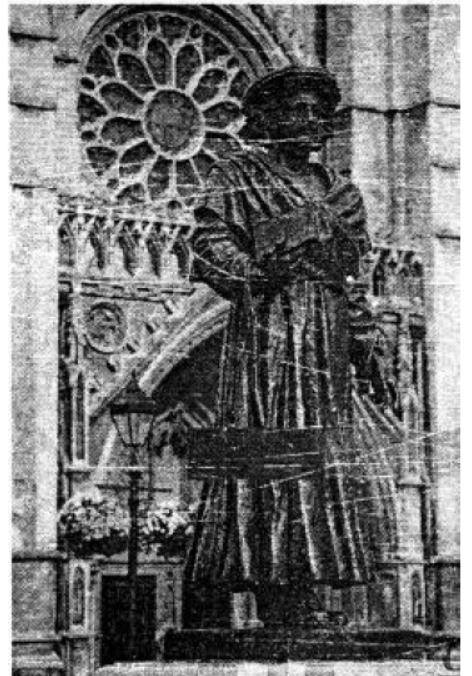
Question 1. Name the person.
Answer: The historical figure depicted in the painting is Raja Rammohan Roy.
In simple words: The person in the painting is Raja Rammohan Roy.
Exam Tip: Identify him as Raja Rammohan Roy, who is recognized as the Father of the Indian Renaissance.
Question 2. What were his views on religion?
Answer: After analyzing the Vedas, the Quran, and the Bible, Raja Rammohan Roy concluded that all major world religions share a core spiritual truth. He believed that religious values shape every aspect of social life. Guided by the monotheistic principles of the Upanishads and Vedas, he taught:
1. There is a single, supreme Divine Being who created and preserves the entire universe.
2. All human beings are equal as children of the same Creator, advocating for the universal brotherhood of man.
3. Elaborate ceremonies, animal sacrifices, and the worship of physical idols are unnecessary, as people can connect with God directly through sincere prayer and devotion.
In simple words: Raja Rammohan Roy studied different holy books and believed that all religions teach the same basic truths. He taught that there is only one God, that all humans are brothers and sisters, and that we do not need idols to pray.
Exam Tip: List his three main religious beliefs: monotheism, the brotherhood of humanity, and the rejection of idol worship.
Question 3. Name the society established by him in 1828.
Answer: In 1828, Raja Rammohan Roy established a reformist society initially called the Brahmo Sabha, which was later renamed the Brahmo Samaj.
In simple words: He started a society in 1828 called the Brahmo Sabha, which later became the Brahmo Samaj.
Exam Tip: Ensure you state 'Brahmo Sabha' as the initial name and 'Brahmo Samaj' as its final name.
Question 4. Mention the social practices against which this society- launched a relentless struggle.
Answer: The Brahmo Samaj led a determined campaign to eradicate several social evils, including the practice of Sati, caste discrimination, untouchability, child marriage, and polygamy.
In simple words: The Brahmo Samaj fought against Sati, child marriage, polygamy, and the caste system.
Exam Tip: Focus on Sati and caste distinctions as the two most prominent social practices opposed by the Samaj.
Question 5. Mention two important social reforms supported by this society.
Answer: Two major progressive reforms championed by the society were expanding education for women and legalizing the remarriage of widows.
In simple words: Two reforms they supported were women's education and allowing widows to remarry.
Exam Tip: State 'women's education' and 'widow remarriage' as the two primary social causes supported by the Brahmo Samaj.
Free study material for History Civics
Complete Guide and Answers: Class 8 History Civics Chapter 09 Great Reformers And Reform Movements
Detailed Textbook Solutions: Chapter 09 Great Reformers And Reform Movements (Class 8 History Civics)
Find reliable chapter-wise explanations for Class 8 History Civics Chapter 09 Great Reformers And Reform Movements. Curated to follow standard ICSE guidelines, these problem solutions assist students in building strong conceptual foundations.
Concept Clarification for Chapter 09 Great Reformers And Reform Movements
Every exercise question in this chapter includes step-by-step working steps, allowing you to self-evaluate, catch mistakes early, and understand the underlying logic.
Effective Revision Strategies for Chapter 09 Great Reformers And Reform Movements
Pair your solution review with additional practice papers to test your execution speed and ensure total preparedness for school exams.
FAQs
You can download the verified Goyal Brothers solutions for Chapter 09 Great Reformers And Reform Movements on StudiesToday.com. Our teachers have prepared answers for Class 8 History Civics as per 2026-27 ICSE academic session.
Yes, our solutions for Chapter 09 Great Reformers And Reform Movements are designed as per new 2026 ICSE standards. 40% competency-based questions required for Class 8, are included to help students understand application-based logic behind every History Civics answer.
Yes, every exercise in Chapter 09 Great Reformers And Reform Movements from the Goyal Brothers textbook has been solved step-by-step. Class 8 students will learn History Civics conceots before their ICSE exams.
Yes, follow structured format of these Goyal Brothers solutions for Chapter 09 Great Reformers And Reform Movements to get full 20% internal assessment marks and use Class 8 History Civics projects and viva preparation as per ICSE 2026 guidelines.