

Goyal Brothers Solutions for Class 8 History Civics: Chapter 02 The Growth Of Nationalism
Access the official Goyal Brothers textbook solutions for Class 8 History Civics, updated for the 2026-27 academic year. This digital resource is structured to help students build strong conceptual clarity and prepare effectively for school examinations.
Chapter-wise Solutions: Chapter 02 The Growth Of Nationalism
Navigate directly to the Chapter 02 The Growth Of Nationalism solutions using the digital viewer below. Organizing your study sessions chapter-by-chapter allows for seamless offline study and quick reference during revision.
I. Fill in the blanks:
Question 1. The Congress of Vienna was hosted by __________.
Answer: The Austrian Chancellor, Duke Metternich.
In simple words: The leader of Austria, Duke Metternich, hosted the big meeting in Vienna.
Exam Tip: Always write the full title 'Austrian Chancellor' along with the name 'Duke Metternich'.
Question 2. The American Revolution began in __________.
Answer: 1776.
In simple words: The fight for freedom in America started in the year 1776.
Exam Tip: Do not confuse this year with 1789, which is when the French Revolution started.
Question 3. The first clear expression of nationalism came up with the __________ Revolution.
Answer: French.
In simple words: People first showed a strong love for their own country during the revolution in France.
Exam Tip: Remember that 'French' is the correct answer here, as it was the starting point of modern nationalism.
Question 4. The French Revolution began in __________.
Answer: 1789.
In simple words: The big revolution in France started in the year 1789.
Exam Tip: Associate 1789 with the storming of the Bastille to easily recall the start of the French Revolution.
Question 5. England had __________ colonies in North America.
Answer: Thirteen.
In simple words: There were 13 different areas in North America ruled by England.
Exam Tip: These thirteen colonies later united to form the United States of America.
Question 6. American thinker __________, asked the people to rebel against the tyrannical rule of England.
Answer: Thomas Jefferson.
In simple words: Thomas Jefferson was the American writer who told people to fight against the cruel rule of England.
Exam Tip: Spelled carefully, 'Thomas Jefferson' is one of the most prominent thinkers of the American Revolution.
Question 7. A new country called __________ was born after the American Revolution.
Answer: The United States of America.
In simple words: After the war, a new nation called the United States of America was created.
Exam Tip: This name was officially adopted after the thirteen colonies won their independence from Great Britain.
Question II. Match the contents of Column A and Column B:
| Column A | Column B |
|---|---|
| 1. Boston Tea Party | (a) French thinkers and philosophers |
| 2. Battle of Waterloo | (b) First President of the United States of America |
| 3. Death of Napoleon | (c) England recognised independence of 13 colonies |
| 4. Louis XVI | (d) King of France |
| 5. 4th July, 1776 | (e) Storming of Bastille |
| 6. 1783 | (f) Declaration of Independence at Philadelphia |
| 7. George Washington | (g) 1773 |
| 8. Rousseau, Voltaire, Montesquieu | (h) 1815 |
| 9. 14th July 1789 | (i) 1821 |
Answer:
1. Boston Tea Party - (g) 1773
2. Battle of Waterloo - (h) 1815
3. Death of Napoleon - (i) 1821
4. Louis XVI - (d) King of France
5. 4th July, 1776 - (f) Declaration of Independence at Philadelphia
6. 1783 - (c) England recognised independence of 13 colonies
7. George Washington - (b) First President of the United States of America
8. Rousseau, Voltaire, Montesquieu - (a) French thinkers and philosophers
9. 14th July 1789 - (e) Storming of Bastille
In simple words: This list matches key events from history with their correct dates or descriptions. For example, the Boston Tea Party happened in 1773, and George Washington was the first US President.
Exam Tip: When matching, read through both columns first to pair up the easiest, most certain dates before matching the others.
III. State whether the following statements are true or false:
Question 1. The 13 colonies of North America were dissatisfied with the rule of the master country, England.
Answer: True.
In simple words: Yes, the thirteen American colonies were unhappy being ruled by Great Britain.
Exam Tip: Remember that this unhappiness was the main reason they revolted against British rule.
Question 2. The French society was divided into three classes, each enjoying similar rights and privileges.
Answer: False.
In simple words: This statement is false because only the first two classes had special privileges, while the poor had none.
Exam Tip: The inequality of the Three Estates was a key cause of the French Revolution.
Question 3. The French Revolution began with the storming of Bastille in 1789.
Answer: True.
In simple words: Yes, the revolution in France started when a crowd attacked the Bastille prison in 1789.
Exam Tip: Bastille was seen as a symbol of the king's cruel power, which is why attacking it was so important.
Question 4. A new constitution was framed by the French Assembly in 1785.
Answer: False.
In simple words: This is false because the new constitution was actually made in 1791, not 1785.
Exam Tip: Remember that the French Revolution itself started in 1789, so a revolutionary constitution could not have been drafted before that in 1785.
Question 5. The French Revolution led to rise of nationalism in Europe.
Answer: True.
In simple words: Yes, the French Revolution helped make other European countries want their own freedom and national pride.
Exam Tip: Always associate the French Revolution with the birth of modern ideas of freedom and nationhood.
Question 6. India was greatly inspired by both the American and French Revolutions.
Answer: True.
In simple words: Yes, Indian leaders were inspired by these revolutions to fight for their own freedom from the British.
Exam Tip: Many Indian leaders, including Tipu Sultan and Raja Rammohan Roy, were deeply moved by the ideas of the French Revolution.
IV. Answer the following questions:
Question 1. What do you know about the Congress of Vienna?
Answer: After Napoleon was finally defeated at the Battle of Waterloo in 1815, the leaders of Europe gathered in Vienna. They wanted to make a new plan for the continent. Austria's Chancellor, Duke Metternich, served as the host of this large gathering. At this meeting, they made the Treaty of Vienna. Their main goal was to undo the changes made by Napoleon during his wars. They gave back kingdoms to the rulers who had been removed by Napoleon. Countries like Austria, Russia, Prussia, Great Britain, Sweden, and Holland were given a lot of new land. In this way, the meeting completely changed the political map of Europe.
In simple words: After Napoleon lost his final battle in 1815, European leaders met in Vienna. They brought back the old kings and redrew the borders of different countries.
Exam Tip: Mention the year (1815), the host (Duke Metternich), and the goal (reversing Napoleon's changes) to secure full marks for this question.
Question 2. What is nationalism? Discuss.
Answer: Nationalism is a powerful feeling of devotion and love that people have for their own nation. It grows when people share similar lives and history. This can come from having the same language, history, beliefs, or way of life. Having love for one's country, or patriotism, is also a key part of nationalism.
In simple words: Nationalism is when people love their country deeply. It happens when they share the same language, history, and culture.
Exam Tip: Always list some of the common factors that unite people, like language, culture, and shared history, to get full marks.
Question 3. What were the causes for the American War of Independence?
Answer: The major causes of the war were:
1. Colonists in America were forbidden from setting up their own factories. They could only trade with Great Britain and no other country. They lacked the same rights as people living in Britain. Furthermore, they had no voice in the British Parliament and were forced to pay very high taxes.
2. The settlers were deeply moved by great European thinkers like John Locke, Rousseau, Voltaire, and Montesquieu. These thinkers talked about human rights, equality, and personal freedom.
3. Britain introduced the Stamp Act in 1765, which taxed all business papers. This created a lot of anger among the colonists.
4. Writers like Thomas Jefferson urged the people to stand up and fight against the cruel British government.
5. The most famous protest was the Boston Tea Party. A group of colonists boarded British ships and dumped 340 chests of tea into the ocean to protest the unfair taxes. Soon after, all thirteen colonies rose in rebellion, starting the American War of Independence.
In simple words: The Americans revolted because England taxed them unfairly without letting them have a say in the government. They were also inspired by ideas of freedom and equality.
Exam Tip: Be sure to list key terms like 'Stamp Act' (1765) and 'Boston Tea Party' as they carry high weight in exam marking schemes.
Question 4. Explain the significance of the American Revolution.
Answer: The American Revolution was a major turning point in world history. It gave hope to people in other colonies, such as India, to stand up against their rulers. It also showed countries how to set up a democratic government.
In simple words: This revolution was important because it showed other colonies, like India, how to fight for freedom and build a democracy.
Exam Tip: Mention how it inspired other colonial nations, specifically India, and paved the way for modern democracy.
Question 5. Why did the French Revolution take place?
Answer: At that time, French society was split into three groups called estates. The First Estate consisted of church leaders, and the Second Estate was made up of wealthy nobles who owned almost all the land. The Third Estate included everyone else, such as doctors, lawyers, teachers, farmers, and workers. Although the first two estates lived in luxury and paid no taxes, the poor Third Estate had to pay all the taxes and lived in deep misery.
King Louis XVI did not care about the suffering of his subjects and spent heavily on his own luxury. Meanwhile, the people of France read the works of French thinkers like Rousseau, Voltaire, and Montesquieu. These thinkers criticized the church and the nobles, teaching that citizens have a right to remove a bad ruler. They spread ideas of freedom, brotherhood, and equality. Seeing the success of the American War of Independence also encouraged the French to fight for justice.
In simple words: The French Revolution happened because the poor were taxed heavily while the rich lived in luxury. Thinkers and the American Revolution also inspired people to demand their rights.
Exam Tip: Be sure to describe the three Estates and name the three key philosophers (Voltaire, Rousseau, and Montesquieu) to get maximum marks.
Question 6. Discuss the significance of the French Revolution.
Answer: The French Revolution was an event of immense importance in world history. It brought in democratic values and ended the absolute power of kings. The wealthy nobility and the church lost their vast lands, which were shared among the poor farmers. Slavery was also abolished in France's colonies. The famous slogans of freedom, equality, and brotherhood helped build a new democratic society across Europe. Most importantly, it awakened strong feelings of love for one's nation. Everyday people were willing to fight to protect their new rights. It also motivated other people in Europe to stand up against their cruel rulers.
In simple words: This revolution ended the king's rule, gave land to the poor, and freed slaves. It spread the ideas of freedom and equality all over Europe.
Exam Tip: Be sure to include the watchwords 'liberty, equality, and fraternity' as these are essential keywords for this topic.
Question 7. Write a short note on Napoleon.
Answer: In 1799, Napoleon took control of France by overthrowing the government known as the Directorate. He established a new ruling body called the Consulate, becoming the First Consul, and later made himself Consul for life in 1802.
He went on to defeat Austria in Italy, as well as Britain in 1802, setting up small republics in countries like Italy, Germany, and Belgium. Following these wins, he crowned himself the Emperor of France in 1804. His power was at its peak between 1808 and 1810. But in 1815, his forces lost the Battle of Waterloo. He was sent away to St. Helena Island, where he passed away in 1821.
In simple words: Napoleon took over France in 1799 and became its Emperor. He won many wars and ruled much of Europe, but was finally defeated at Waterloo in 1815.
Exam Tip: Memorize the three key years: 1804 (became Emperor), 1815 (defeat at Waterloo), and 1821 (death at St. Helena).
V. Write short notes on:
Question 1. The role of philosophers and thinkers of the 18th century.
Answer: French citizens were deeply moved by the writings of famous philosophers, including Rousseau, Voltaire, and Montesquieu. In their books, they spoke out against the unfair power of the church and the nobles. Rousseau argued that if a king does not protect his people's wishes, the citizens have every right to remove him. These thinkers spread the key values of liberty, brotherhood, and equality.
In simple words: Thinkers like Voltaire and Rousseau wrote about freedom and equality. They taught the French people that they could stand up to a bad king.
Exam Tip: Mention the names of Rousseau, Montesquieu, and Voltaire, and write how they challenged the absolute authority of the King and Church.
Question 2. Storming of the Bastille
Answer: On July 14, 1789, a large crowd in Paris attacked the Bastille prison and set the prisoners free. This act marked the beginning of the end for the French monarchy. King Louis XVI and Queen Marie Antoinette were captured, put in prison, and later executed in 1793. Following this, France faced a period of extreme disorder known as the Reign of Terror from 1793 to 1794, during which thousands of nobles, priests, and citizens were put to death. Later, in 1795, the National Assembly approved the Declaration of the Rights of Man, stating that all people are born free and equal, and a new constitution was created.
In simple words: On July 14, 1789, people attacked the Bastille prison. The king and queen were later put to death, and a new government was formed.
Exam Tip: Be sure to write the exact date, July 14, 1789, and explain that the Bastille was attacked because it was a hated symbol of the king's power.
Question 3. Boston Tea Party
Answer: Anger against Britain was growing across the American colonies. The most famous protest took place in 1773, known as the Boston Tea Party. A group of colonists boarded British ships anchored in Boston harbor and threw 340 crates of tea into the water. They did this to show their anger toward the new taxes set by the British rulers, particularly the tax on tea.
In simple words: In 1773, angry colonists threw 340 boxes of tea into the sea. They did this to protest against British taxes on tea.
Exam Tip: Mention the year (1773) and the exact number of tea crates (340) to make your answer precise and complete.
Additional Questions - Exercises
Fill in the blanks:
Question 1. The American War of Independence was the first __________ political revolution in the history of the world.
Answer: Organized.
In simple words: The war in America was the very first planned political revolution in history.
Exam Tip: Focus on the word 'organized' as it highlights how the revolution was structured.
Question 2. The discovery of the American continent was followed by the establishment of __________ European settlements in the 16th century.
Answer: Permanent.
In simple words: After America was found, Europeans set up lasting homes there in the 1500s.
Exam Tip: Remember the century (16th) and the key word 'permanent'.
Question 3. The colonists argued that the British Parliament had no right to tax the colonists because they had no __________.
Answer: representatives in the parliament.
In simple words: Colonists said Britain could not tax them because they had no one speaking for them in the government.
Exam Tip: This argument led directly to the famous revolutionary rallying cry of 'No taxation without representation.'
Question 4. __________ was chosen as the commander of the American troops in the war against the British.
Answer: George Washington.
In simple words: George Washington was picked to lead the American army against Britain.
Exam Tip: Always capitalize proper nouns like 'George Washington' correctly.
Question 5. In 1776, the representatives of the colonists met at Philadelphia and adopted a __________.
Answer: Declaration of Independence.
In simple words: In 1776, American leaders met in Philadelphia and approved a document declaring their freedom.
Exam Tip: The Declaration was adopted at Philadelphia, which is an important historical location to remember.
Question 6. In about 200 years, the United States of America transformed itself into the __________ country of the world.
Answer: most powerful.
In simple words: Over two centuries, the United States grew to be the strongest nation on Earth.
Exam Tip: Make sure to write the full term 'most powerful' to complete this sentence accurately.
Question 7. The Constitution of the United States has served as a __________ to several countries.
Answer: model and an inspiration.
In simple words: The US Constitution has been an example and a guide for many other nations.
Exam Tip: The Indian Constitution also drew inspiration from the US Constitution, particularly in its Bill of Rights.
Question 8. French society was divided into three main classes, namely the first, the second and the __________.
Answer: Third Estate.
In simple words: The three groups in French society were the first, the second, and the third estates.
Exam Tip: Keep in mind that the Third Estate comprised 95% of the French population.
Question 9. The revolutionary writings of political philosophers like __________ greatly influenced the middle-class intellectuals in France.
Answer: Voltaire, Rousseau and Montesquieu.
In simple words: The writings of Voltaire, Rousseau, and Montesquieu had a big impact on educated people in France.
Exam Tip: These three names are the most fundamental ones to remember for any question on the causes of the French Revolution.
Question 10. The French administration was __________ and __________.
Answer: Corrupt and inefficient.
In simple words: The French government was dishonest and did not do its job well.
Exam Tip: This administrative weakness was one of the major political reasons for the outbreak of the revolution.
B. Match the following:
Question. Match the following:
| Column A | Column B |
|---|---|
| 1. Boston Tea Party | (a) 1789 |
| 2. Declaration of Independence | (b) protest against new taxes |
| 3. Treaty of Paris | (c) middle class |
| 4. French Revolution | (d) 1776 |
| 5. Third Estate | (e) British government and the colonists |
Answer:
1. Boston Tea Party - (b) protest against new taxes
2. Declaration of Independence - (d) 1776
3. Treaty of Paris - (e) British government and the colonists
4. French Revolution - (a) 1789
5. Third Estate - (c) middle class
In simple words: This list matches events and groups with their correct details, such as the French Revolution beginning in 1789.
Exam Tip: Be sure to match the Treaty of Paris with the agreement between Britain and the colonists, as it ended the American War of Independence.
C. Choose the correct answer:
Question 1. By the mid-18th century, how many British colonies had been established on the east coast of North America?
(a) 11
(b) 13
(c) 19
(d) None of the options
Answer: (b) 13
In simple words: By the middle of the 1700s, there were 13 British colonies along the eastern coast of America.
Exam Tip: These thirteen colonies later declared their independence to become the USA.
Question 2. Which of the following dates is celebrated as American Independence Day?
(a) 4 July
(b) 14 July
(c) 17 June
(d) None of the options
Answer: (a) 4 July
In simple words: The United States celebrates its Independence Day on July 4 every year.
Exam Tip: This holiday is celebrated because the Declaration of Independence was adopted on July 4, 1776.
Question 3. The Second Estate consisted of which group?
(a) clergy
(b) peasants
(c) nobles
(d) None of the options
Answer: (c) nobles
In simple words: The Second Estate was made up of the wealthy nobility in France.
Exam Tip: Remember the order: First Estate is Clergy, Second Estate is Nobility, and Third Estate is everyone else.
Question 4. Marie Antoinette was the queen of which country?
(a) England
(b) France
(c) Austria
(d) None of the options
Answer: (b) France
In simple words: Marie Antoinette was the wife of King Louis XVI, making her the Queen of France.
Exam Tip: Even though she was born an Austrian princess, she ruled as the Queen of France during the revolution.
Question 5. Which of the following dates is celebrated as a national holiday in France?
(a) 14 July
(b) 4 July
(c) 20 June
(d) None of the options
Answer: (a) 14 July
In simple words: July 14 is France's national holiday, celebrating the storming of the Bastille.
Exam Tip: This holiday is also known as Bastille Day in English-speaking countries.
D. State whether the following are true or false:
Question 1. By the middle of the 18th century eleven British colonies had been established along the east coast of North America.
Answer: False.
In simple words: This is false because there were actually thirteen British colonies, not eleven.
Exam Tip: Always remember the number 13 when studying the early history of the United States.
Question 2. The American colonists were rigid and conservative.
Answer: False.
In simple words: This is false because the colonists in America were open-minded and simple, not strict or old-fashioned.
Exam Tip: The colonists' open-minded and liberal attitude helped them accept revolutionary ideas of freedom.
Question 3. The American revolutionaries were greatly impressed by the ideas of European philosophers.
Answer: True.
In simple words: Yes, the people fighting for freedom in America were deeply influenced by European thinkers.
Exam Tip: Mentioning the influence of European philosophers helps explain the intellectual causes of the American Revolution.
Question 4. George Washington was the first elected President of the United States of America.
Answer: True.
In simple words: Yes, George Washington was chosen as the very first President of the USA.
Exam Tip: Do not confuse his role as military commander with his later role as President; he was both.
Question 5. The French Revolution laid the foundation of a democratic government.
Answer: True.
In simple words: Yes, the revolution in France helped establish the ideas of democratic rule in Europe.
Exam Tip: Even though Napoleon later took power, the revolution permanently changed how countries were governed.
E. Answer the following questions in one or two words/ sentences:
Question 1. Which particular incident sparked off the American War of independence? What is the importance of this event?
Answer: The American War of Independence was triggered by the event called the Boston Tea Party.
In 1773, a group of American settlers dressed up as Native Americans, went onto British ships in Boston harbor, and threw 340 chests of tea into the ocean. They did this to protest against the new taxes, especially the tax on tea. The event was highly important because it showed that the colonists were ready to openly defy British rule.
In simple words: The Boston Tea Party started the war. Colonists threw British tea into the ocean in 1773 to show they would no longer obey British tax laws.
Exam Tip: Always make sure to answer both parts of the question: name the incident and explain why it was important.
Question 2. Name any two European philosophers whose ideas inspired and influenced the American revolutionaries.
Answer: The American fighters were deeply inspired by the thoughts of European thinkers like John Locke, Voltaire, and Rousseau, who motivated them to struggle for their freedom.
In simple words: Two important European philosophers who inspired the Americans were John Locke and Voltaire.
Exam Tip: You only need to name two philosophers, but writing three (Locke, Voltaire, Rousseau) ensures you get full marks.
Question 3. What is the significance of the 4th of July in American history?
Answer: The fourth of July is celebrated as the day America gained its independence.
In simple words: July 4 is celebrated as American Independence Day.
Exam Tip: Make sure to state that July 4, 1776, is when the Declaration of Independence was adopted in Philadelphia.
Question 4. Mention two characteristic features of the French monarchy.
Answer: Two key features of the French monarchy were:
1. The French king had absolute power and his decisions were the law. There was no parliament to limit his authority.
2. He believed he ruled by divine right and was responsible only to God, not to his people.
In simple words: The French king had total power and could make any law he wanted. He believed God gave him the right to rule, so he did not answer to the people.
Exam Tip: Remember to use terms like 'autocrat' or 'divine right' and explain them in simple terms to show a deep understanding of the topic.
Question 5. In what way did the American Revolution influence the Indian Constitution?
Answer: The United States Constitution was used as a guide by the creators of the Indian Constitution. They took several key ideas from it, such as having a federal system of government, protecting basic citizen freedoms through Fundamental Rights, and setting up a system of checks and balances.
In simple words: India's constitution makers copied good ideas from the US Constitution, like basic rights for citizens and a shared power system.
Exam Tip: Mentioning 'Fundamental Rights' and 'federal form of government' is crucial for high marks on this question.
Question 6. Why is the French Revolution of 1789 considered a turning point in human history?
Answer: The French Revolution in 1789 is a historic landmark because it completely changed the social, economic, and political life of France. These new ideas then spread across Europe and eventually shaped the rest of the world.
In simple words: This revolution changed society, money, and power in France. Soon, these ideas spread and changed the whole world.
Exam Tip: Explain that its effects were not limited to France but had a massive global impact on how societies are structured.
Question 7. Mention the role of the political philosophers in the overthrow of the French monarchy.
Answer: The books and views of powerful thinkers like Voltaire, Rousseau, and Montesquieu got the people of France thinking deeply. Educated middle-class citizens were inspired by these opinions. By writing about the problems in French society and the king's rule, these thinkers encouraged everyday people to stand up and demand their rights.
In simple words: Thinkers showed the people how corrupt their government was. Their books encouraged the public to rise up and fight for equality.
Exam Tip: Focus on how these philosophers exposed social evils, which gave the people the reasons they needed to start a revolution.
Question 8. What effect did the American Revolution have on the French people?
Answer: Many French military leaders and soldiers who helped in the American War of Independence brought these new, free ideas back home with them. They encouraged the French public to stand up to their own cruel king. In this way, the American victory gave the French the confidence to rebel.
In simple words: French soldiers who fought in America came back with ideas about freedom. This made the French people want to rebel against their own king.
Exam Tip: Explain that direct participation of French soldiers in America acted as a bridge for revolutionary ideas to travel to France.
F. Answer the following questions briefly:
Question 1. The American War of Independence was the first organized political revolution in the history of the world. In this context answer the following questions:
(a) How was an American colony governed? Why were the colonists resentful?
(b) How did the American colonists differ from the British?
(c) Why did the American colonists refuse to pay taxes imposed by the British Parliament in London? Give an account of the Boston Tea Party incident.
Answer:
(a) Every American colony had its own assembly chosen by the local people, but the governor was picked directly by the British crown. Since this governor did not have to answer to the local assembly, he ruled solely in the interest of Great Britain instead of the colonists. This caused deep anger among the hard-working American settlers who felt they were not allowed to enjoy the rewards of their labor.
(b) In terms of society and culture, the settlers in America had become quite different from the British. The colonists were generally simple and open-minded, while the British Puritans back home were strict and traditional. Over time, the colonists built a unique American identity that made them want the freedom to grow as a separate, independent country.
(c) The colonists refused to pay British taxes because they had no one representing them in the Parliament in London. In 1773, a group of settlers dressed up as Native Americans, went onto British ships in Boston harbor, and threw 340 chests of tea into the water. This event, known as the Boston Tea Party, was a direct protest against tea taxes and other levies. This act was highly important because it showed that the colonists were ready to openly defy British rule.
In simple words: The colonies were governed by a British-appointed governor who ignored local needs, and the colonists developed an open-minded American culture distinct from Britain. When taxed without representation, they threw British tea into the harbor to protest.
Exam Tip: Structure your answer clearly with sub-points (a), (b), and (c) to match the question structure exactly, ensuring you answer every part.
Question 2. The British monarch, King George III, refused to withdraw the unjust and oppressive Acts imposed on the colonists and declared war on them. In this context discuss:
(a) The revolutionary principles and ideas in the Declaration of Independence of 1776
(b) The terms and long-term impact of the Treaty of Paris
(C) The important features of the newly established United States of America
Answer:
(a) The Declaration of Independence of 1776 made it clear that the colonists had a right to break away from the cruel British rule and create their own government. It stated that everyone is born equal and has basic rights, including the right to live, the right to be free, and the right to seek happiness.
(b) By signing the Treaty of Paris in 1783, Great Britain officially accepted that the thirteen colonies were now independent. This group of colonies then became known as the United States of America.
(C) The main features of the newly formed United States were:
1. They wrote down a constitution and set up a democratic government where states shared power.
2. The government promised to protect citizens' freedoms, like the right to speak freely, have a free press, practice any religion, and get fair treatment under the law.
3. A President chosen by the people would lead the nation following the rules written in the Constitution.
In simple words: The Declaration of Independence said all people are equal and free. The Treaty of Paris ended the war in 1783, and the new US government was set up with a written constitution and basic rights for everyone.
Exam Tip: Be ready to explain the three key features of the new US government (written constitution, fundamental rights, and an elected President).
Question 3. The French Revolution of 1789 was a milestone and a major turning point in human history. In this context discuss the following causes
(a) An unjust, unequal social order of the Ancien Regime
(b) The growing power of the middle class
(c) An inefficient, corrupt administration
Answer:
(a) Feudal inequality: French society was divided into three groups called Estates:
1. The First Estate was made up of the clergy (church leaders).
2. The Second Estate consisted of the nobility.
3. The Third Estate held 95% of the population, which included workers, peasants, and middle-class professionals.
The first two Estates had great wealth and held most of the land without paying any taxes. The Third Estate had to bear the full weight of taxation, paying taxes on everything, including basic goods like salt. This made life very difficult for the poor.
(b) Rise of the middle class: In the 1800s, the middle class became quite rich and economically strong. However, they were not given political voice or social equality. This created deep anger, causing them to use their influence to challenge the old system.
(c) Poor and dishonest government: The rulers did not care about the needs of the citizens. King Louis XVI spent heavily on luxuries and ignored the hardships of the public. He was also highly influenced by his wife, Marie Antoinette. Together, they spent all the nation's money on celebrations, leaving the treasury completely empty.
In simple words: France's poor paid all the taxes while the rich clergy and nobles paid nothing. The rich middle class had no political voice, and the king wasted the country's money on himself and his queen.
Exam Tip: Use headings for each cause ((a), (b), (c)) to show structural clarity, and emphasize that the Third Estate comprised 95% of the population but paid all the taxes.
Question 4. With reference to the French Revolution, discuss the following
(a) The Tennis Court Oath
(b) The storming of the Bastille
(c) The adoption of the Declaration of the Rights of Man and Citizen and its fundamental principles
Answer:
(a) On June 20, 1789, representatives of the Third Estate gathered on an indoor tennis court. They swore a famous promise not to disband until they had written a new constitution for France. This event is called the Tennis Court Oath.
(b) The attack on the Bastille stood for the victory of the French public and the collapse of the king's rule. This event started the revolution. Today, France celebrates July 14 as its national day.
(c) The newly formed National Assembly, made of Third Estate leaders, took control of France. They passed the historic Declaration of the Rights of Man and Citizen, which was a massive step forward for human rights. Soon after, they drafted a new constitution in 1791.
In simple words: The Tennis Court Oath was a promise to write a constitution. The storming of Bastille started the revolution, and the new assembly promised human rights and wrote a constitution.
Exam Tip: Make sure you state the key dates: June 20, 1789 (Tennis Court Oath), July 14, 1789 (Bastille), and 1791 (Constitution).
Question 5. With reference to the consequences of the French Revolution, answer the following:
(a) Mention any four revolutionary changes that took place in France after the Revolution of 1789.
(b) What effect did the French Revolution have on the rest of Europe?
(c) What impact did the French revolutionary principles have on political developments in India in the middle of the 19th century?
Answer:
(a) Four major changes in France after 1789 were:
1. It ended the power of the King and opened the way for a republic.
2. It set up the beginnings of a democratic government.
3. It ended feudal systems and forced labor, putting the church under government control.
4. It made freedom, equality, and brotherhood the main goals of the country.
(b) The ideas and slogans of the revolution quickly spread across Europe. Oppressed people rose in rebellion against their rulers to set up fair systems, which greatly strengthened national pride.
(c) These values also reached India, inspiring local leaders to develop a democratic view. This helped start the freedom movement, which eventually led to India gaining independence from British rule in 1947.
In simple words: The revolution ended the French monarchy and brought democracy. These ideas of freedom spread to Europe and reached India, helping Indian leaders start their struggle for independence.
Exam Tip: Be ready to name the four main revolutionary changes in France and describe their direct link to India's freedom struggle.
G. Picture Study
This picture depicts a very important event in world history where in a great mob is shown attacking a state prison.
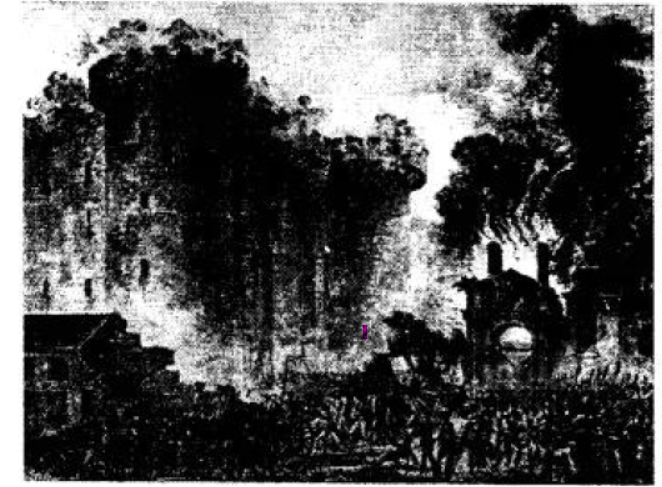
Question 1. Name the event.
Answer: On July 14, 1789, a large crowd attacked the Bastille, a state prison holding political prisoners. This prison was highly hated as a symbol of the old royal rule. The prisoners were set free and joined the revolution.
In simple words: The event is the Storming of the Bastille. A crowd attacked the prison, freed the prisoners, and started the revolution.
Exam Tip: State clearly that the event is the 'Storming of the Bastille' and remember the date July 14, 1789.
Question 2. In which country did it take place and when?
Answer: This took place in France on July 14, 1789.
In simple words: It happened in France on July 14, 1789.
Exam Tip: Make sure you state both the country (France) and the full date (July 14, 1789).
Question 3. What is the significance of this event?
Answer: The setting free of prisoners who then joined the revolution was highly significant. It stood for the triumph of the French public and the collapse of the monarchy.
In simple words: This event was important because it showed that the people had won against the king's rule.
Exam Tip: Explain that the Bastille was a symbol of royal despotism, so its fall was a symbolic victory for the common people.
Question 4. Give a brief account of the developments that followed this event.
Answer: This event marked the start of the French Revolution. The National Assembly, formed by leaders of the Third Estate, took charge of the country's government. They passed the historic Declaration of the Rights of Man and of the Citizen. By 1791, they had written a new constitution for France.
In simple words: After this, the National Assembly took control of France. They promised human rights to everyone and wrote a new constitution by 1791.
Exam Tip: Mention the creation of the National Assembly, the Declaration of Rights, and the framing of the 1791 Constitution to show a complete timeline.
Free study material for History Civics
ICSE Textbook Solutions for Class 8 History Civics Chapter 02 The Growth Of Nationalism
ICSE Chapter Solutions: Class 8 History Civics Chapter 02 The Growth Of Nationalism
Strengthen your preparation with comprehensive answers for Class 8 History Civics Chapter 02 The Growth Of Nationalism. These expert-reviewed solutions make tracking your academic progress straightforward and efficient.
Detailed Problem Solving for ICSE Class 8 History Civics
Verify your answers instantly using the comprehensive breakdowns provided for each problem, ensuring complete syllabus coverage across all sub-topics.
Next Steps in Your Class 8 History Civics Preparation
Explore our broader library of study materials and chapter notes to support your continuous revision and secure higher marks.
FAQs
You can download the verified Goyal Brothers solutions for Chapter 02 The Growth Of Nationalism on StudiesToday.com. Our teachers have prepared answers for Class 8 History Civics as per 2026-27 ICSE academic session.
Yes, our solutions for Chapter 02 The Growth Of Nationalism are designed as per new 2026 ICSE standards. 40% competency-based questions required for Class 8, are included to help students understand application-based logic behind every History Civics answer.
Yes, every exercise in Chapter 02 The Growth Of Nationalism from the Goyal Brothers textbook has been solved step-by-step. Class 8 students will learn History Civics conceots before their ICSE exams.
Yes, follow structured format of these Goyal Brothers solutions for Chapter 02 The Growth Of Nationalism to get full 20% internal assessment marks and use Class 8 History Civics projects and viva preparation as per ICSE 2026 guidelines.