

Goyal Brothers Solutions for Class 8 History Civics: Chapter 01 A Period of Transition
Explore the complete Goyal Brothers textbook solutions for Class 8 History Civics. Tailored for the 2026-27 curriculum, this resource breaks down complex topics to support daily study and targeted revision.
Chapter-wise Solutions: Chapter 01 A Period of Transition
View or download the dedicated Chapter 01 A Period of Transition resource below. This chapter-by-chapter structuring ensures easy navigation for daily study routines and immediate access to core academic concepts.
A Period of Transition
I. Fill in the blanks:
1. The Renaissance thinkers believed in life in this World.
2. The term Reformation refers to two major developments, the Protestant Reformation and the Catholic Reformation.
3. Vasco-da-Gama reached Calicut on the West Coast of India.
4. The Industrial Revolution began in England in about 1750.
5. In 1793, Eli Whitney invented a Cotton gin.
II. Match the contents of Column A and Column B:
| Column A | Column B (Correct Match) |
|---|---|
| 1. John Kay | (g) Flying Shuttle |
| 2. James Hargreaves | (f) Spinning Jenny |
| 3. Arkwright | (e) Water frame |
| 4. Samuel Crompton | (a) Mule |
| 5. Cartwright | (c) Powerloom |
| 6. Whitney | (b) Cotton gin |
| 7. James Watt | (d) Steam engine |
III. State whether the following statements are true or false:
1. The Renaissance and the Reformation alongwith new voyages ushered in the Modern Age.
Answer: True
2. The Industrial Revolution began in Germany.
Answer: False
3. Me Adam devised railway tracks.
Answer: False
4. The Rise of capitalism and imperialism can be attributed to the industrial Revolution.
Answer: True
5. The East India Company gradually became rulers from being traders.
Answer: True
IV. Answer the following questions:
Question 1. How did the Renaissance, Reformation and the new geographical discoveries lead to the Modern Age?
Answer: The modern era was introduced by the combined impact of the Renaissance, the Protestant Reformation, and major maritime explorations. The Renaissance fostered a cultural shift based on rational thinking, humanism, and scientific inquiry among the general public. Simultaneously, the Reformation movement led to the establishment of the Protestant Church and inspired the internal Catholic Counter-Reformation, removing corruption and outdated dogmas from Christian institutions. As unscientific superstitions declined, a rational scientific temper emerged.
Furthermore, advancements in geography encouraged sailors to discover new lands, opening up global sea routes, expanding trade networks, and motivating further scientific explorations. Together, these developments laid the social, intellectual, and economic foundation for the Modern Age, setting the stage for the Industrial Revolution.
In simple words: The Renaissance taught people to think logically and scientifically, the Reformation cleaned up corruption in the church, and sea voyages led to the discovery of new lands. Together, these changes broke old superstitions and brought about the Modern Age.
Exam Tip: Break your explanation into three key parts: the rational/humanist mindset of the Renaissance, the religious cleansing of the Reformation, and the economic opportunities of the new sea routes.
Question 2. Give reasons why did the Industrial Revolution first begin in England?
Answer: By the late 18th century, England possessed several unique advantages that allowed the Industrial Revolution to begin there:
1. Accumulation of Capital: Extensive international maritime trade allowed British merchants and banks to accumulate massive profits, providing the necessary investment capital to fund new factories and machinery.
2. Colonial Territories: England's growing global colonial empire served as a guaranteed source of cheap raw materials and a captive market to sell British manufactured goods.
3. Abundant Natural Resources: The country possessed large, accessible domestic deposits of iron ore and coal situated close to each other, which served as the essential fuel and material for heavy industries.
4. Available Labor Force: The agricultural enclosure movement forced small farmers off their lands, creating a large, mobile population of landless and unemployed citizens who moved to cities to work in the new factories.
5. Advanced Shipping Infrastructure: Britain's dominant merchant navy and advanced shipping industry made transporting raw materials and finished goods across the globe highly efficient and cost-effective.
In simple words: The Industrial Revolution started in England because British merchants had accumulated massive wealth to build factories, their colonies supplied cheap materials, they had lots of coal and iron resources, and the enclosure movement provided plenty of workers looking for factory jobs.
Exam Tip: Be ready to list at least four distinct causes: capital from trade, raw materials from colonies, close proximity of coal and iron, and the availability of cheap labor due to the enclosure movement.
Question 3. Discuss the impact of the Industrial Revolution on society, economy and polity.
Answer: The shift to industrial manufacturing transformed social, economic, and political structures across the world:
1. Imperialist Expansion: Mass production created a massive surplus of manufactured goods, forcing European nations to capture and establish colonies in Asia and Africa to serve as captive markets and raw material sources.
2. Mass Urbanization: The concentration of factories in urban areas caused a massive migration of rural populations to cities. This rapid growth led to overcrowded cities, the rise of unhygienic slums, and severe challenges in housing, public sanitation, and healthcare.
3. Global Interconnectedness: The need for raw materials and trade routes connected different regions and people, speeding up the process of globalization.
4. Class Polarization: It divided society into two distinct economic classes: the wealthy capitalists and the working class. This division led to the exploitation of laborers, safe work challenges, and stark social inequalities.
In simple words: The Industrial Revolution led to European nations conquering colonies to sell their surplus goods. It caused massive numbers of people to move to crowded, unhealthy cities, and divided society into wealthy factory owners and poorly paid, exploited workers.
Exam Tip: In corporate exam answers, organize the impacts clearly under the three requested dimensions: social, economic, and political.
Question 4. The rise of socialism and communism can be attributed to the reaction against the evils of capitalism. What is the imperialism? Discuss the factors which give rise to imperialism.
Answer: Imperialism is defined as the political, territorial, and economic domination of one powerful nation over the life and government of another weaker country or region.
The primary driving forces behind the rise of modern imperialism in the 18th and 19th centuries were:
1. Market for Surplus Production: Industrialized nations produced more goods than their local markets could consume, prompting capitalists to lobby their governments to secure colonies in Asia and Africa to sell their surplus products.
2. Securing Raw Materials: The rapid growth of European factories created an urgent need for massive quantities of raw materials, leading to the colonization of resource-rich areas.
3. Improved Transportation and Communication: Inventions like steamships, railways, telegraphs, and postal systems bridged geographic distances, making it much easier for European powers to administer and control distant colonies.
4. Demographics: Rapid population growth in Europe led governments to establish overseas settlements and colonies to relocate their surplus citizens.
5. Export of Capital: The rise of industrial wealth generated surplus capital that bankers and investors sought to invest in safe, high-yielding overseas projects, driving imperial expansion.
6. Aggressive Nationalism: Driven by competitive, chauvinistic nationalism, European nations viewed acquiring colonies as a symbol of national prestige, power, and global status.
7. Missionary Work: Sincere but culturally biased Christian missionaries traveled to Africa and Asia to convert local populations, unintentionally paving the way for political colonization.
8. The 'Civilizing Mission' Bias: Europeans used the ethnocentric concept of the 'White Man's Burden' to justify colonization, claiming it was their duty to spread Western civilization and culture to backward societies.
In simple words: Imperialism is when a strong nation takes political and economic control of another country. It was caused by the need to find new markets for surplus goods, secure raw materials for factories, invest surplus capital, and show off national power, along with the belief that they were civilizing other nations.
Exam Tip: Define imperialism clearly, and list at least four distinct causes, making sure to contrast economic motives with political motives.
Question 5. Describe the general impact of imperialism with special reference to South Asia.
Answer: Imperialism dramatically reshaped the political and economic landscape of Asia and Africa, especially in South Asia:
1. Colonial Domination and World Wars: The competitive drive to acquire colonies created intense rivalries among European powers, which served as a major underlying cause of both the First World War (1914-1918) and the Second World War (1939-1945).
2. Political and Economic Subjugation: South Asian nations like India, Sri Lanka, and Burma were conquered by Great Britain. These colonies were economically exploited, acting as cheap sources of raw materials for British factories and dumping grounds for their finished industrial imports, which destroyed local craft economies.
3. Infrastructure Development: On the positive side, to facilitate trade and military control, colonial rulers built modern infrastructure in these regions, including railway networks, postal services, telegraph lines, and roads.
4. Rise of National Movements: The shared struggle against foreign colonial oppression brought diverse local groups together, fostering a strong sense of national identity, patriotism, and unity that eventually led to independence movements in countries like India, Burma, and Vietnam.
In simple words: Imperialism led to the colonization of South Asian nations like India and Burma by Britain, which exploited their resources and flooded their markets with imports. However, it also introduced modern infrastructure like railways and brought people together in a shared struggle for national independence.
Exam Tip: Address both the negative impacts and the unintended positive impacts.
V. Tell me why
Question 1. Most of the countries in South Asia became colonies of Europe.
Answer: Most South Asian nations were colonized by European powers because of several key factors:
1. Political Disunity: These regions lacked a unified national identity or shared patriotism, and were frequently divided by internal conflicts and rivalries among local rulers.
2. Military and Industrial Disadvantage: Despite having large populations, South Asian states lacked the modern military technology, weaponry, and industrial organization of European powers.
3. Wealth of Resources and Markets: The region possessed massive reserves of valuable raw materials and offered a huge consumer market, making it highly attractive to European industrial capitalists.
In simple words: South Asian countries were colonized because they had rich natural resources and huge markets that European factories needed. At the same time, local kingdoms were politically divided and lacked the modern weapons to resist European armies.
Exam Tip: Focus on the combination of South Asia's economic wealth and its political weaknesses.
Question 2. New inventions and discoveries led to the Industrial Revolution.
Answer: The rapid succession of scientific inventions and technological discoveries during the 18th century transformed manufacturing:
1. Mechanization of Textiles: Inventions like John Kay's flying shuttle, James Hargreaves' spinning jenny, Richard Arkwright's water frame, Samuel Crompton's mule, and Edmund Cartwright's power loom revolutionized yarn spinning and weaving.
2. Steam Power and Metallurgy: James Watt's improved steam engine provided a powerful, reliable source of mechanical energy that freed factories from having to locate near rivers, while advancements like the blast furnace and Eli Whitney's cotton gin made processing materials highly efficient.
3. Industrial Growth: These machines enabled the mass production of goods, significantly lowering costs, increasing profits, and driving rapid industrialization and urbanization.
In simple words: Inventions like the spinning jenny, power loom, and steam engine allowed factories to produce goods much faster and cheaper. This mass production boosted profits and led to the rapid growth of modern industrial cities.
Exam Tip: To write an expert-level answer, list specific key inventions and explain how they enabled mass production.
Additional Questions
EXERCISES
Fill in the blanks:
1. The Modern Age in India began with the conquest of India by the British.
2. India was ruled by the British for nearly 200 years.
3. The two kinds of source material for the Modern period are primary sources and secondary sources.
4. The Renaissance ushered in revolutionary changes in Europe and marked the transition from the Medieval Age to the Modern Age.
5. The four characteristic features of the Renaissance period are advent of new and powerful ideas of Humanism, rationalism, scientific spirit and spirit of inquiry.
B.Match the Following:
| Column A | Column B (Correct Match) |
|---|---|
| 1. Archaeological sources like monuments | (b) Primary source |
| 2. Renaissance | (a) Humanism |
| 3. Constantionople | (e) Capital of the Byzantine empire |
| 4. Reformation | (c) Martin Luther |
| 5. Tithe and Peter’s Pence | (d) Taxes levied by Roman church |
C. Choose the correct answer:
Question I. In India the Modern Period is generally regarded as having begun in the:
(a) mid-15th century
(b) mid-18th century
(c) mid-16th century
(d) None of the options
Answer: (b) mid-18th century
In simple words: While the Modern Age started around the 15th century in Europe, in India it is considered to have started in the mid-18th century with the decline of the Mughals and the rise of British power.
Exam Tip: Note the difference in timelines: the 15th century for Europe, and the mid-18th century for India.
Question 2. The primary sources for the study of the Modern Period are preserved in:
(a) archives
(b) banks
(c) factories
(d) None of the options
Answer: (a) archives
In simple words: Hand-written documents, official files, and historical papers from the Modern Period are safely preserved in government archives and museums.
Exam Tip: State 'archives' as the designated places where primary written records are preserved.
Question 3. The wealthy merchants and the professional class consisting of doctors, lawyers, teachers etc., formed the:
(a) upper class
(b) middle class
(c) lower class
(d) None of the options
Answer: (b) middle class
In simple words: The rise of trade and modern education led to the growth of a new social class made up of wealthy traders, doctors, and lawyers, known as the middle class.
Exam Tip: Group professional categories like lawyers, doctors, and teachers into the 'middle class' for social history questions.
Question 4. Which invention helped to spread the ideas of the Renaissance thinkers far and wide?
(a) printing press
(b) telegraph
(c) telephone
(d) None of the options
Answer: (a) printing press
In simple words: The invention of the printing press allowed books to be printed quickly and cheaply, helping to share revolutionary ideas with millions of people.
Exam Tip: The printing press was the single most important technology that facilitated the rapid spread of humanist and scientific ideas across Europe.
Question 5. Martin Luther was what type of Christian monk?
(a) Italian
(b) German
(c) French
(d) None of the options
Answer: (b) German
In simple words: Martin Luther was a German monk who famously spoke out against corruption in the Roman Catholic Church, starting the Protestant Reformation.
Exam Tip: Identify Martin Luther as a German monk who pioneered the Protestant Reformation from Wittenberg.
D.State whether the following are true or false:
1. The source material of the Modern period is of two kinds - primary and secondary.
Answer: True
2. Primary sources of history includes books, reviews, reports and articles.
Answer: False (Correct statement: Secondary sources of history include books, reviews, reports, and articles, whereas primary sources include original documents, coins, and monuments.)
3. Renaissance scholars shifted the focus from divine affairs to human affairs.
Answer: True
4. The voyages of discoveries led to a decline of trade and commerce.
Answer: False (Correct statement: The voyages of discoveries opened up new global routes, leading to a massive expansion of trade and commerce.)
5. The Reformation was also known as the Protestant Movement.
Answer: True
E.Answer the following questions in one or two words/ sentences:
Question 1. The history of most nations can be divided into a number of periods. Name them.
Answer: The history of most countries is broadly classified into three major periods: Ancient, Medieval, and Modern. Each era is characterized by distinct political, social, religious, and economic features that differentiate it from other periods.
In simple words: History is split into three main parts: Ancient, Medieval, and Modern, with each part having its own unique social and political features.
Exam Tip: List all three periods - Ancient, Medieval, and Modern - as the standard divisions of history.
Question 2. What distinguishes one historical period from another ?
Answer: Historical periods are distinguished from one another by the unique stages of cultural, technological, political, and economic development achieved by a specific society or region over time.
In simple words: Different periods are marked by major changes in technology, society, and how advanced the country was at that time.
Exam Tip: Explain that the transition of periods is decided by the level of social, political, and economic development of a region.
Question 3. In what way is the classification of historical periods useful to us ?
Answer: Categorizing history into distinct periods is highly useful as it organizes hundreds of years of human events, helping us understand the continuity and gradual evolution of societies in a structured way.
In simple words: Dividing history into periods helps us organize past events so we can easily understand how society changed over time.
Exam Tip: Focus on how periodization brings a sense of order and highlights the continuity of historical processes.
Question 4. When did the Modern Period begin in (a) Europe (b) India?
Answer: The Modern Period began at different times in different regions:
(a) In Europe: It is considered to have started in the 15th century with the Renaissance.
(b) In India: It is generally regarded as having started in the mid-18th century with the decline of the Mughals and the rise of British power.
In simple words: The Modern Period started in the 15th century in Europe, but in India, it began much later in the mid-18th century.
Exam Tip: Make sure to list both distinct dates: the 15th century for Europe, and the mid-18th century for India.
Question 5. Mention any four characteristic features of the Modern Period?
Answer: Four defining features of the Modern Period are:
1. Rapid Urbanization: The shift of populations from rural areas to growing cities.
2. Industrialization: The transition from hand-made goods to mass production using machines.
3. Rise of Democracy: The establishment of representative governments and democratic institutions.
4. Rationalism and Humanism: A focus on logic, reason, and human welfare rather than blind faith.
In simple words: Four main features are the growth of cities (urbanization), factory-based manufacturing (industrialization), democratic governments, and using logic and reason (rationalism) to solve problems.
Exam Tip: You can name any four features - such as industrialization, urbanization, democracy, and rationalism - to write a complete answer.
Question 6. Mention any two (a) primary and (b) secondary source materials of the Modern Period.
Answer: The two categories of historical sources are:
(a) Primary Sources (Original records):
1. Official government records, such as British administrative files preserved in archives.
2. Physical archaeological remains, including buildings, monuments, and coins from that period.
(b) Secondary Sources (Interpretive works):
1. Biographies and books written by later historians based on original research.
2. Articles, reviews, and analytical reports published in academic journals.
In simple words: Primary sources are original things from the past, like official government documents and historical monuments. Secondary sources are books and articles written by later scholars who studied those original records.
Exam Tip: List two clear examples for both: official records and monuments for primary sources; and history books and academic reviews for secondary sources.
Question 7. Why is it important to study developments in Europe to understand the history of modern India ?
Answer: Because the Modern Age in India began with the establishment of British rule, the events that shaped this transition originated in Europe. To fully understand how British policies impacted India's society, economy, and politics, we must first study the scientific, religious, and economic changes happening in Europe at that time.
In simple words: Since modern Indian history was shaped by British rule, we must study what was happening in Europe to understand why the British came to India and how they behaved.
Exam Tip: Explain that because British colonial rule connected India with Europe, European events directly influenced modern Indian history.
Question 8. What is the meaning of Renaissance ?
Answer: The Renaissance refers to a major cultural and intellectual movement of renewal that swept across Europe, transforming people's lives and ways of thinking. Originating from a French word meaning 'the rebirth' or 'revival', it represented a new spirit of rationalism, scientific inquiry, and artistic expression.
In simple words: Renaissance is a French word meaning 'rebirth' or 'revival'. It was a major movement in Europe that encouraged new ways of thinking, science, and art.
Exam Tip: State the literal French meaning and explain it as an intellectual and cultural awakening.
F.Answer the following questions briefly:
Question 1. The capture of Constantinople by the Ottoman Ttirks led to the beginnings of Renaissance in Europe. With reference to this statement answer the following questions:
(a) How did it lead to the revival of classical Greek and Roman learning in Europe ?
(b) What effect did it have on the outlook and attitudes of the people of Europe ?
(c) What effect did it have on trade ?
Answer:
(a) Revival of Classical Learning: When the Ottoman Turks captured Constantinople, many Greek scholars fled the city - which had served as a major center of classical knowledge - and took refuge in Italy, bringing rare ancient manuscripts with them. These scholars received active patronage and financial support from wealthy merchants and rulers in Italian cities like Florence, Rome, and Venice. This support led to the establishment of new libraries and universities dedicated to promoting classical Greek and Roman studies.
(b) Impact on People's Outlook: The rediscovery of classical knowledge inspired Europeans to challenge traditional ideas, superstitious beliefs, and the absolute authority of the church and monarchs. People refused to accept decrees blindly, demanding logical and rational explanations instead. This rise of rationalism led to a scientific temper and a spirit of inquiry, sparking exceptional advancements in art, architecture, literature, and science.
(c) Impact on Trade and Commerce: The Renaissance encouraged a spirit of adventure, exploration, and geographic discovery, leading to the opening of new sea routes and a massive expansion of international trade. This trade boom led to the rise of a wealthy merchant class. These merchants provided financial support to local rulers, helping them build strong, stable, and centralized states, which significantly reduced the political influence of feudal lords.
In simple words: Greek scholars fled Constantinople to Italy, bringing rare ancient books that inspired a revival of classical learning. This new mindset encouraged people to use logic and reason to challenge the church and kings, leading to major scientific and artistic discoveries. It also boosted trade, creating a wealthy merchant class that helped kings build strong states.
Exam Tip: Structure your answer into parts (a), (b), and (c) to address the migration of scholars to Italy, the rise of a rational scientific temper, and the growth of the merchant class.
Question 2. With reference to the causes of the Reformation, how did the following contribute to the movement:
(a) Renaissance
(b) Evil practices of the Roman catholic Church
(c) Rise of strong and powerful rulers
Answer:
(a) Contribution of the Renaissance: The Renaissance completely transformed the intellectual outlook of the European public by introducing revolutionary ideas of humanism, rationalism, and scientific inquiry. It encouraged people to rely on reason rather than blind faith. Consequently, citizens began to question the teachings and absolute authority of the Roman Catholic Church. Additionally, the invention of the printing press allowed these reformist ideas to be distributed quickly and widely, preparing the public for change.
(b) Role of Church Corruption: Over time, many members of the clergy began leading luxurious, materialistic, and immoral lives, neglecting their spiritual duties. The Church owned nearly one-third of Europe's agricultural land and levied heavy taxes, such as the 'tithe' and 'Peter's Pence', on all Christians. Corruption, bribery, and the sale of church offices became widespread. The final provocation was the sale of 'Indulgences' - certificates sold as divine pardons for sins, which were marketed as a direct passport to heaven without any spiritual penance.
(c) Rise of Strong Monarchs: The decline of feudalism led to the rise of powerful, centralized monarchs in Europe. These rulers wanted complete authority over their territories and strongly opposed the Pope's interference in their internal administrative affairs. They also resented the drain of national wealth to Rome through papal taxes, leading them to support reformist movements that challenged the Pope's authority.
In simple words: The Renaissance taught people to use reason and question blind faith, while the printing press spread these ideas. At the same time, the Church had become highly corrupt, charging heavy taxes and selling 'Indulgences' as fake pardons for sins. Finally, newly powerful European kings supported reforms because they wanted to stop the Pope from interfering in their countries and draining their wealth.
Exam Tip: Explain how the Renaissance provided the intellectual spark, Church corruption acted as the direct cause, and powerful monarchs provided the political support needed for the Reformation.
G Picture study:
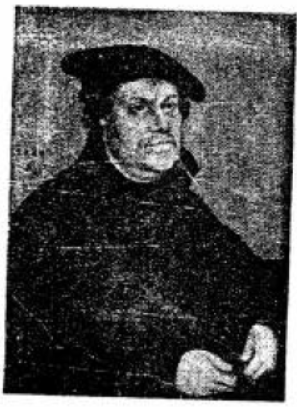
Question 1. Identify the person in the picture.
Answer: The portrait depicts Martin Luther, the celebrated German theologian and reformer.
In simple words: The person in the picture is Martin Luther.
Exam Tip: Identify him as Martin Luther, the pioneer of the Protestant Reformation.
Question 2. With which great religious movement is his name associated?
Answer: His name is associated with the Protestant Reformation, a major religious movement that split the Western Christian Church.
In simple words: His name is associated with the Protestant Reformation movement.
Exam Tip: Identify him as the leader who started the Protestant Reformation in Germany.
Question 3. Where was he born and in which country did he lead his movement ?
Answer: Martin Luther was born in Germany. He served as a Christian monk and a professor of theology at the university town of Wittenberg, where he launched his reform movement.
In simple words: He was born in Germany and led his religious movement from the university town of Wittenberg.
Exam Tip: State Germany as his home country and Wittenberg as the town where he launched his movement.
Question 4. Mention any four effects of the movement started by him.
Answer: The Protestant Reformation started by Martin Luther had several major historical effects:
1. Permanent Division: It permanently split the Western Christian Church into Roman Catholic and Protestant denominations.
2. Religious Wars: It triggered a series of bitter civil wars and military conflicts between Catholic and Protestant factions across Europe, such as in Germany and France.
3. Rise of Intolerance: It led to a period of intense religious intolerance, where Protestants were persecuted in Catholic-majority nations, and Catholics faced similar treatment in Protestant-majority states.
4. Colonization of America: Severe religious persecution of Puritans and other Protestants in England forced many to migrate to North America. These colonists established early settlements in New England, which eventually led to the founding of the United States of America.
In simple words: His movement permanently split the Christian Church into Catholics and Protestants, triggered violent religious wars across Europe, and led to the persecution of religious minorities. This persecution forced many English Protestants to migrate to North America, where they eventually established the United States.
Exam Tip: Name at least four effects clearly: the permanent split of the Church, the outbreak of religious wars, rise of intolerance, and the migration of Puritans to North America.
Free study material for History Civics
Verified Textbook Solutions for Class 8 History Civics Chapter 01 A Period of Transition
ICSE Chapter Solutions: Class 8 History Civics Chapter 01 A Period of Transition
Find reliable chapter-wise explanations for Class 8 History Civics Chapter 01 A Period of Transition. Curated to follow standard ICSE guidelines, these problem solutions assist students in building strong conceptual foundations.
Concept Clarification for Chapter 01 A Period of Transition
Tackle complex theorems and numerical problems easily by cross-referencing your working steps with our structured solution guides.
Effective Revision Strategies for Chapter 01 A Period of Transition
Explore our broader library of study materials and chapter notes to support your continuous revision and secure higher marks.
FAQs
You can download the verified Goyal Brothers solutions for Chapter 01 A Period of Transition on StudiesToday.com. Our teachers have prepared answers for Class 8 History Civics as per 2026-27 ICSE academic session.
Yes, our solutions for Chapter 01 A Period of Transition are designed as per new 2026 ICSE standards. 40% competency-based questions required for Class 8, are included to help students understand application-based logic behind every History Civics answer.
Yes, every exercise in Chapter 01 A Period of Transition from the Goyal Brothers textbook has been solved step-by-step. Class 8 students will learn History Civics conceots before their ICSE exams.
Yes, follow structured format of these Goyal Brothers solutions for Chapter 01 A Period of Transition to get full 20% internal assessment marks and use Class 8 History Civics projects and viva preparation as per ICSE 2026 guidelines.