

Goyal Brothers Solutions for Class 8 History Civics: Chapter 12 The Union Legislature
Review the Goyal Brothers Solutions for ICSE Class 8 History Civics Chapter 12 The Union Legislature designed for Class 8 History Civics students. Published under the latest ICSE guidelines for 2026-27, these chapter-wise solutions provide the foundational knowledge required for exam success.
Chapter-wise Solutions: Chapter 12 The Union Legislature
View or download the dedicated Chapter 12 The Union Legislature resource below. This chapter-by-chapter structuring ensures easy navigation for daily study routines and immediate access to core academic concepts.
I. Fill in the blanks:
Question 1. The elections to the Lok Sabha are held by __________.
Answer: secret ballot.
In simple words: People vote for the Lok Sabha in secret, so no one else knows who they chose.
Exam Tip: A secret ballot is a key feature of democratic elections that protects the voter's privacy.
Question 2. A person should have acquired the age of __________ to become a Member of Lok Sabha.
Answer: 25 years.
In simple words: You must be at least 25 years old to stand for elections to the Lok Sabha.
Exam Tip: Do not confuse this with the Rajya Sabha, where the minimum age required is 30 years.
Question 3. The maximum strength of the members of Lok Sabha is __________.
Answer: 545 members.
In simple words: The maximum number of members in the Lok Sabha is usually counted as 545.
Exam Tip: Note that while the actual constitutional limit is 552, your textbook lists the maximum strength as 545 for this question.
Question 4. The Rajya Sabha is the __________.
Answer: upper House of Parliament.
In simple words: The Rajya Sabha is known as the higher or upper house of our parliament.
Exam Tip: The Lok Sabha is the Lower House (House of the People), and the Rajya Sabha is the Upper House (Council of States).
Question 5. The President can nominate __________ members in the Rajya Sabha.
Answer: 12 members.
In simple words: The President can choose 12 special members to join the Rajya Sabha.
Exam Tip: These 12 members are nominated from fields like science, art, literature, and social service.
II. Match the contents of Column A with those of Column B.
| Column A | Column B |
|---|---|
| 1. The Speaker | (a) Presides over the Rajya Sabha |
| 2. The Vice President | (b) The legislative organ of the Union Government. |
| 3. The Rajya Sabha | (c) The House of People. |
| 4. The Parliament | (d) Presiding Officer of the Lok Sabha. |
| 5. The Lok Sabha | (e) Permanent House |
Answer:
1. The Speaker - (d) Presiding Officer of the Lok Sabha.
2. The Vice President - (a) Presides over the Rajya Sabha.
3. The Rajya Sabha - (e) Permanent House.
4. The Parliament - (b) The legislative organ of the Union Government.
5. The Lok Sabha - (c) The House of People.
In simple words: This list matches key parts of the Indian parliament with their descriptions, such as the Rajya Sabha being a permanent house that never dissolves.
Exam Tip: Always associate the Vice President of India as the ex-officio chairman who presides over the Rajya Sabha.
III. Tick mark (✓) the correct statements and cross mark (X) the wrong ones.
Question 1. The Rajya Sabha is presided over the Vice President of India.
Answer: ✓ (Correct)
In simple words: This is correct because the Vice President of India runs the meetings of the Rajya Sabha.
Exam Tip: The Vice President of India is the ex-officio Chairperson of the Rajya Sabha.
Question 2. A money bill has to be moved first in the Lok Sabha.
Answer: ✓ (Correct)
In simple words: This is correct because any bill dealing with money or taxes must start in the Lok Sabha first.
Exam Tip: Remember that a Money Bill can only be introduced in the Lok Sabha on the recommendation of the President.
Question 3. The Parliament meets at least twice a year.
Answer: ✓ (Correct)
In simple words: This is correct because the law says there cannot be more than a six-month gap between two sessions of Parliament.
Exam Tip: Although the minimum requirement is twice a year, India's Parliament usually meets three times a year (Budget, Monsoon, and Winter sessions).
Question 4. The members of the Rajya Sabha are elected for a term of six years.
Answer: ✓ (Correct)
In simple words: This is correct because each member of the Rajya Sabha serves for a period of six years.
Exam Tip: The Rajya Sabha itself is permanent and never dissolves, but its individual members serve a fixed six-year term.
IV. Answer the following questions:
Question 1. Name the two Houses of the Union Parliament|
Answer: The two chambers of India's Parliament are the Lok Sabha, which is the Lower House, and the Rajya Sabha, which is the Upper House.
In simple words: The two parts of the Indian parliament are the Lok Sabha and the Rajya Sabha.
Exam Tip: The Lok Sabha represents the people of India, while the Rajya Sabha represents the states and union territories.
Question 2. How are the members to the Lok Sabha elected?
Answer: Citizens of adult age vote directly to elect the members of the Lok Sabha. This voting is done in secret, and members are elected for a term of five years.
In simple words: Adult citizens vote directly in secret to choose the members of the Lok Sabha for a five-year term.
Exam Tip: Key terms to include are 'directly elected,' 'secret ballot,' and 'five-year term.'
Question 3. What is a bicameral legislature?
Answer: A bicameral legislature is a system where the parliament has two separate chambers: an Upper House and a Lower House. Since India's Parliament is made of two houses, it is called a bicameral legislature.
In simple words: A bicameral legislature is a parliament with two houses. India has a bicameral legislature because it has both the Lok Sabha and Rajya Sabha.
Exam Tip: When defining bicameralism, always give India's Parliament as an example, naming the Lok Sabha and Rajya Sabha.
Question 4. Mention the essential qualifications for a person to be a member of the Lok Sabha.
Answer: To become a member of the Lok Sabha, a person must meet these conditions:
1. They must be an Indian citizen.
2. They must be at least 25 years old.
3. They must be of sound mind.
4. They must not be insolvent, meaning they can pay their debts and meet money duties.
5. They must not hold a paid government job.
6. They must not be a declared criminal or offender.
7. Their name must be on the voting list of some area in India.
In simple words: To be in the Lok Sabha, you must be an Indian citizen, at least 25 years old, of sound mind, and have no major debts or criminal records.
Exam Tip: Be sure to write at least four main qualifications, emphasizing citizenship and the minimum age of 25.
Question 5. What is the composition of the Rajya Sabha ?
Answer: The Rajya Sabha is the Upper House of India's Parliament, also known as the Council of States. It can have a maximum of 250 members. Out of these, 238 members are chosen indirectly by the elected members of the State Legislative Assemblies. The other 12 members are chosen by the President from fields like science, literature, art, and social work. Right now, the House has 245 members, with 233 elected and 12 nominated by the President.
In simple words: The Rajya Sabha has a maximum of 250 members. Currently, it has 245 members - 233 are elected by state assemblies, and 12 are chosen by the President.
Exam Tip: Clearly state the difference between the maximum possible strength (250) and the current active strength (245).
Question 6. What are the functions of the Lok Sabha?
Answer: The main functions of the Lok Sabha are:
1. Law-making duties: The House reviews, discusses, and passes bills on subjects in the Union or Concurrent lists of our Constitution.
2. Money controls: It holds full control over the nation's funds. No government money can be spent or raised without the Lok Sabha's approval, and Money Bills must start only in this House.
3. Control of Ministers: The Council of Ministers answers directly to the Lok Sabha. The government can stay in power only as long as it has the support of a majority in this House.
In simple words: The Lok Sabha passes new laws, controls the country's money, and can remove the government from power if it loses support.
Exam Tip: Make sure you list the three main headings: Legislative, Financial, and Control over the Council of Ministers.
Question 7. Describe the law making functions of the Parliament.
Answer: The Union Parliament is the official body that drafts laws for our national government. Its main law-making functions are:
1. It creates, changes, or removes laws on the 97 items listed under the Union List, as well as any other topics not mentioned in other lists.
2. In special situations, it can also pass laws on topics in the State List.
3. Together with state assemblies, it can create laws on the 47 topics found in the Concurrent List.
4. It is the only body that can propose changes (amendments) to the Indian Constitution, though some changes must be approved by most states.
In simple words: Parliament makes national laws, can make state laws in emergencies, and is the only body that can propose changes to our Constitution.
Exam Tip: Memorize the three main lists: Union List (97 subjects), State List, and Concurrent List (47 subjects).
Question 8. How does the Parliament exercise control over the Government?
Answer: Controlling the national government is a highly vital duty of Parliament. It does this through the following steps:
1. The government must answer for all of its actions. Parliament can remove the Prime Minister and ministers from office by passing a vote of no-confidence.
2. Members can bring up adjournment motions to pause normal business and debate urgent public issues that need immediate focus.
3. MPs can ask ministers questions about their work and departments, which ministers are required to answer. This helps monitor their actions.
4. It can limit government spending by voting for a cut in the annual budget.
In simple words: Parliament controls the government by asking questions, moving motions to discuss urgent topics, cutting the budget, or voting the ministers out of power.
Exam Tip: Mention key terms like 'Question Hour,' 'Adjournment Motion,' 'Cut Motion,' and 'No-Confidence Vote' as these are the tools of parliamentary control.
V. Write short notes on the following:
Question 1. Adjournment motion
Answer: While the daily schedule of the House is planned ahead of time, an unexpected crisis of major public importance can occur. In such cases, members can ask to put aside the scheduled topics to discuss this urgent matter right away.
In simple words: An adjournment motion is a way for members to stop normal meetings and talk about a sudden, highly important public issue immediately.
Exam Tip: Explain that an adjournment motion requires the support of at least 50 members to be admitted, as it halts the normal schedule of the house.
Question 2. Universal Adult Franchise
Answer: Universal Adult Franchise means that every adult citizen has the right to vote. No one can be denied this right based on caste, class, gender, skin color, or religion. This idea is based on equality, which is a key value of any democracy.
In simple words: This means every grown-up citizen gets one vote, regardless of who they are, so everyone is treated equally in elections.
Exam Tip: Highlight that the voting age in India under this system is 18 years and above.
Question 3. Secret Ballot
Answer: A secret ballot is an election method where the voter's choice is kept completely private. This prevents bad practices like threats, bribery, or pressure. Voters are given printed papers showing the candidates' names. Special voting booths are set up at the polling stations to let people mark their choices in total privacy, ensuring that no outside influence can affect their vote.
In simple words: A secret ballot lets people vote in private so no one else can see who they chose, protecting them from threats or bribes.
Exam Tip: Note that today, Electronic Voting Machines (EVMs) have replaced printed paper ballots in most Indian elections to maintain this secrecy.
Additional Questions - Exercises
Fill in the blanks:
Question 1. The functions of the government are divided into three branches, namely, the __________, the __________ and the __________.
Answer: Legislature, the Executive and the Judiciary.
In simple words: The three main parts of the government are the law-makers, the leaders who run the country, and the judges in courts.
Exam Tip: These three branches work independently under a system of separation of powers.
Question 2. Subjects for legislation are divide into three lists-the __________, the __________ and the __________.
Answer: Union List, the State List and the Concurrent List.
In simple words: The topics that laws can be made on are divided into three lists: the Central list, the State list, and the Shared list.
Exam Tip: These three lists are found under the Seventh Schedule of the Indian Constitution.
Question 3. The Union Parliament has two Houses-the __________ and the __________.
Answer: Lok Sabha and the Rajya Sabha.
In simple words: The two houses of our national parliament are the Lok Sabha and the Rajya Sabha.
Exam Tip: Make sure you know both the Hindi names and their English equivalents (House of the People and Council of States).
Question 4. The __________ is a permanent house. It cannot be dissolved.
Answer: Rajya Sabha.
In simple words: The Rajya Sabha is a permanent body and can never be completely ended or dissolved.
Exam Tip: While Rajya Sabha members serve for six years, the House itself is permanent and never dissolves.
Question 5. The Parliament is __________ to the legislature.
Answer: answerable.
In simple words: The government must explain its actions and answer directly to the Parliament.
Exam Tip: Note that this matches your textbook's specific phrasing, representing the accountability of the government.
B. Match the following:
Question. Match the following:
| Column A | Column B |
|---|---|
| 1. The President | (a) is the Chairman of the Rajya Sabha |
| 2. The Vice-President | (b) is a permanent house |
| 3. The Speaker | (c) nominates 12 members to the Rajya Sabha |
| 4. Parliament | (d) is the presiding officer of the Lok Sabha |
| 5. The Rajya Sabha | (e) can introduce a bill to amend the Constitution. |
Answer:
1. The President - (c) nominates 12 members to the Rajya Sabha.
2. The Vice-President - (a) is the Chairman of the Rajya Sabha.
3. The Speaker - (d) is the presiding officer of the Lok Sabha.
4. Parliament - (e) can introduce a bill to amend the Constitution.
5. The Rajya Sabha - (b) is a permanent house.
In simple words: This list matches key national leaders and bodies with their roles, such as the President choosing 12 members for the Rajya Sabha.
Exam Tip: Remember that only Parliament can propose bills to make changes to the Indian Constitution.
C. Choose the correct answer:
Question 1. On whose advice does the President carry out his/her functions?
(a) the Lok Sabha
(b) the Council of Ministers
(c) the Rajya Sabha
(d) None of the options
Answer: (b) the Council of Ministers
In simple words: The President does all of his or her official duties based on the advice of the Council of Ministers.
Exam Tip: Under Article 74 of the Indian Constitution, the President must act in accordance with the advice of the Council of Ministers headed by the Prime Minister.
Question 2. On which list can both the central and state governments make laws?
(a) Union List
(b) State List
(c) Concurrent List
(d) None of the options
Answer: (c) Concurrent List
In simple words: Both the central government and the state governments have the power to make laws on the Concurrent List.
Exam Tip: If there is any conflict between a central law and a state law on a Concurrent List subject, the central law will prevail.
Question 3. Which of the following is also known as the Council of States?
(a) The Lok Sabha
(b) Rajya Sabha
(c) Vidhan Sabha
(d) None of the options
Answer: (b) Rajya Sabha
In simple words: The Rajya Sabha is the other name for the Council of States.
Exam Tip: It is called the Council of States because its members are elected by the state legislative assemblies.
Question 4. How many members from the Anglo-Indian community can the President nominate to the Lok Sabha?
(a) 2
(b) 10
(c) 12
(d) None of the options
Answer: (a) 2
In simple words: The President has the power to choose 2 members from the Anglo-Indian community for the Lok Sabha.
Exam Tip: Historically, 2 members were nominated, but this provision was discontinued by the 104th Constitutional Amendment Act.
Question 5. At present, how many members does the Lok Sabha consist of?
(a) 454
(b) 645
(c) 525
(d) 545
Answer: (d) 545
In simple words: Currently, the Lok Sabha has 545 active members.
Exam Tip: Although 545 is the active strength in older textbook editions, note that today the active strength of the Lok Sabha stands at 543.
D. State whether the following are true or false:
Question 1. The State List includes subjects of national importance.
Answer: False.
In simple words: This is false because the Union List, not the State List, contains subjects of national importance.
Exam Tip: The State List includes subjects of local or state-level importance like police, public health, and sanitation.
Question 2. A member of the Lok Sabha should be at least 30 years of age.
Answer: False.
In simple words: This statement is false because you only need to be 25 years old to join the Lok Sabha. The age requirement of 30 is for the Rajya Sabha.
Exam Tip: Pay close attention to this common error: the minimum age for Lok Sabha is 25, while the minimum age for Rajya Sabha is 30.
Question 3. The Rajya Sabha is a permanent House and cannot be dissolved by the President.
Answer: True.
In simple words: This is true because the Rajya Sabha never ends all at once, so it is permanent.
Exam Tip: Only individual members retire from the Rajya Sabha, but the chamber itself cannot be dissolved.
Question 4. The money bill has to be introduced in the Rajya Sabha.
Answer: False.
In simple words: This is false because money bills can only be started in the Lok Sabha.
Exam Tip: Under Article 109 of the Indian Constitution, a Money Bill cannot be introduced in the Rajya Sabha.
Question 5. The Vice-President is the presiding officer of the Rajya Sabha.
Answer: True.
In simple words: This is true because the Vice-President of India runs the meetings of the Rajya Sabha.
Exam Tip: The Vice President of India is the ex-officio Chairperson of the Rajya Sabha.
E. Answer the following questions in one or two words/ sentences:
Question 1. Who is the nominal executive head of the government of India?
Answer: The President of India serves as the nominal executive head of the country's government.
In simple words: The President of India is the official, nominal leader of the government.
Exam Tip: While the President is the nominal head, the Prime Minister is the real executive head.
Question 2. How do we know that the Parliament has supreme authority in the government?
Answer: We know Parliament is supreme because the Lok Sabha directly controls the Council of Ministers, which must answer to it for all actions. Furthermore, Parliament holds the ultimate power to accept or turn down any executive decision.
In simple words: Parliament is supreme because it can review, accept, or reject any decision made by the ministers and can even vote them out of office.
Exam Tip: The accountability of the Council of Ministers to the Lok Sabha is the core feature that demonstrates parliamentary supremacy.
Question 3. Which branch of government interprets and defines laws?
Answer: The Judiciary is the branch responsible for defining and explaining national laws, while also working to ensure that no one violates constitutional rules.
In simple words: The Judiciary, which means the courts, explains the laws of the country and makes sure everyone follows the Constitution.
Exam Tip: The Supreme Court of India is the ultimate interpreter and guardian of the Constitution.
Question 4. What is the minimum age qualification of an Indian voter?
Answer: Any Indian citizen who is at least 18 years old has the right to vote.
In simple words: You must be at least 18 years old to vote in India.
Exam Tip: This minimum voting age was reduced from 21 to 18 years by the 61st Constitutional Amendment in 1989.
Question 5. Who conducts the meetings of the Lok Sabha?
Answer: The Speaker is the officer who leads and manages the meetings of the Lok Sabha.
In simple words: The Speaker is the person who runs the meetings of the Lok Sabha.
Exam Tip: The Speaker is elected by the members of the Lok Sabha from amongst themselves.
Question 6. How are the members of the Rajya Sabha elected?
Answer: Members of the Rajya Sabha are chosen through indirect voting by the elected representatives of the State Legislative Assemblies. Additionally, the President nominates 12 members who have achieved great success in literature, science, art, or social work.
In simple words: State assembly members vote to elect most of the Rajya Sabha members, while the President directly chooses 12 members from fields like science and art.
Exam Tip: Remember to name the fields from which the 12 members are nominated: art, literature, science, and social service.
Question 7. What is meant by the term ‘budget’?
Answer: The term 'budget' refers to a yearly estimate of the expected earnings and spending of the Indian government.
In simple words: A budget is a plan that shows how much money the government expects to earn and spend in a year.
Exam Tip: The budget is presented to Parliament every year by the Union Finance Minister.
Question 8. What happens when a vote of no-confidence is passed against the Council of Ministers ?
Answer: A vote of no-confidence is a formal motion in the Lok Sabha to show that members no longer support the ruling government. If the majority votes in favor of this motion, the entire Council of Ministers must resign immediately.
In simple words: A no-confidence vote means the parliament has lost trust in the government. If passed, the entire cabinet of ministers must resign.
Exam Tip: The vote of no-confidence can only be moved in the Lok Sabha, not in the Rajya Sabha.
Question 9. Explain the meaning of the term ‘quorum’.
Answer: Quorum is the minimum count of representatives who must be in attendance for a legislative meeting to officially begin.
In simple words: Quorum is the lowest number of members needed to be present before a meeting can start.
Exam Tip: In the Indian Parliament, the quorum is exactly one-tenth (10%) of the total membership of the House.
F. Answer the following questions briefly:
Question 1. In the context of the Parliamentary form of government, answer the following questions:
(a) What are the main features of the parliamentary form of government?
(b) Name the three branches of government and state their respective functions.
(c) Why are powers distributed between the central and the state governments?
Answer:
(a) Key features of a parliamentary system are:
1. There is a very close and shared relationship between the law-making body (legislature) and the governing body (executive).
2. The members of the governing body are chosen from the winning party in the legislature.
3. Following national elections, the people's representatives form the Lok Sabha.
4. The Council of Ministers is then created from these elected Lok Sabha members.
(b) The three branches of government and their functions are:
1. The Legislature: This branch has the duty to frame and make laws.
2. The Executive: This branch is responsible for carrying out and implementing these laws.
3. The Judiciary: This branch explains, interprets, and protects these laws, ensuring justice.
These three branches are set up to keep powers balanced equally.
(c) Because India is such a large nation, a single central government cannot handle all the specific local needs of citizens in every region. To make governing easier, the country is split into states, each with its own state government. The central and state governments share powers to run the country efficiently.
In simple words: A parliamentary government has a close link between law-makers and ministers. The three branches of government are the legislature (makes laws), executive (implements laws), and judiciary (interprets laws). Powers are shared between the central and state governments because India is too large for one single government to manage.
Exam Tip: Clearly label your answers as (a), (b), and (c) to match the layout of the question and help the examiner evaluate your answer easily.
Question 2. Give an account of the Lok Sabha with reference to:
(a) Its composition
(b) Basic qualifications of its members
(c) Its term
Answer:
(a) Structure and Composition:
1. The total number of members in the Lok Sabha can go up to 552.
2. Up to 530 members are voted in directly by the public from various state areas.
3. A maximum of 20 members can represent the union territories.
4. The President can choose 2 members from the Anglo-Indian community.
5. Currently, the House operates with 545 members.
(b) Essential qualifications for a member:
1. They must be a citizen of India.
2. They must be at least 25 years old.
3. They must not hold any paid government office.
(c) Term length of the House:
The Lok Sabha is chosen for a period of five years. However, the President can dissolve the House earlier if the ruling government loses its majority support. In a national emergency, this term can be extended by one year at a time.
In simple words: The Lok Sabha has up to 552 members (currently 545). Members must be Indian citizens, at least 25 years old, and serve a term of five years, which can be dissolved early if the government loses support.
Exam Tip: Be sure to divide your answer into three clear sections (a), (b), and (c) to completely address every part of the question.
Question 3. Give an account of the Rajya Sabha with reference to :
(a) Its composition
(b) Basic qualifications of its members
(c) Its term
Answer:
(a) House Composition:
1. The Rajya Sabha has a maximum limit of 250 members.
2. Out of these, 238 members represent states and union territories, with seats given based on population. These members are chosen through indirect elections by state assembly members.
3. The President nominates the remaining 12 members who have shown great talent in art, science, literature, or social service.
(b) Qualifications for membership:
1. They must be citizens of India.
2. They must be at least 30 years old.
3. They must be registered to vote.
(c) House Term:
The Rajya Sabha is a permanent chamber and cannot be dissolved by the President. Members are elected for a term of six years, with one-third of the members retiring every two years. Members are allowed to run for re-election.
In simple words: The Rajya Sabha has up to 250 members. Members must be citizens, at least 30 years old, and serve a term of six years. The Rajya Sabha is a permanent house and never dissolves, with a third of its members retiring every two years.
Exam Tip: Emphasize that the Rajya Sabha is a permanent body and name the fractional retirement rate (1/3rd of the members retire every 2 years).
Question 4. With reference to the functions of the Parliament, explain the following:
(a) Law-making functions
(b) Control over the executive
(c) Judicial functions
Answer:
(a) Law-Making Duties:
1. Parliament has the power to draft new laws or change existing ones for any subject in the Union or Concurrent lists.
2. It can also create laws for subjects in the State List in specific situations.
3. It holds the sole right to introduce bills to amend the Constitution.
(b) Executive Oversight:
1. It closely monitors the government. The Council of Ministers must answer to the Lok Sabha for all their choices and policies.
2. The entire ministry must resign if the Lok Sabha passes a vote of no-confidence.
3. MPs can question ministers and debate their actions, keeping a close eye on their work.
4. Members can introduce adjournment motions to pause normal work and debate critical, urgent issues like natural disasters or security crises.
(c) Judicial Powers:
Parliament can impeach and remove the President, Vice-President, or judges of the Supreme Court and High Courts if they go against the Constitution or abuse their official power.
In simple words: Parliament makes laws on Union and Concurrent subjects, controls the executive by questioning them or passing a no-confidence vote, and can impeach high officials like the President or judges if they abuse their power.
Exam Tip: Be sure to structure your response under the headings of Legislative, Executive (Oversight), and Judicial functions, keeping the sub-parts clear.
G. Picture study
This is the picture of an important government building in India.
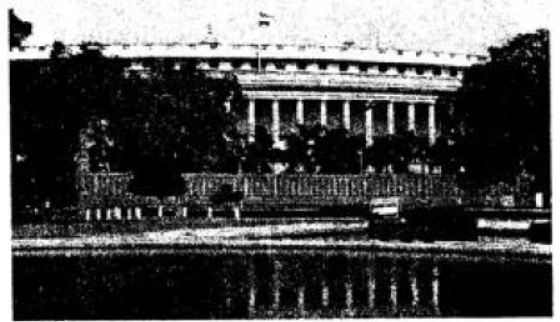
Question 1. Identify the building.
Answer: This building is the Parliament House of India (Sansad Bhavan).
In simple words: The picture shows the Parliament House of India.
Exam Tip: This building is the historic Parliament House located in New Delhi.
Question 2. Which branch of the government functions in this building?
Answer: The legislative branch of the Indian government, which includes both the Lok Sabha and the Rajya Sabha, conducts its work in this building.
In simple words: The legislative branch of our government, which makes laws, works inside this building.
Exam Tip: Both Houses of India's legislative branch meet and work inside the Parliament House.
Question 3. Who are the members of this branch of the government?
Answer: The members of this branch are the elected representatives chosen by the citizens of India. The Lok Sabha serves as the Lower House of Parliament, with a maximum possible limit of 552 members:
1. Up to 530 members are voted in directly by the people from different constituencies.
2. Up to 20 members represent the union territories.
3. The President can nominate up to 2 members from the Anglo-Indian community.
4. Currently, the Lok Sabha is made of 545 active members.
In simple words: The members are the elected representatives of the people. The Lok Sabha has up to 552 members, with 530 from states, 20 from union territories, and 2 nominated. Currently, it has 545 members.
Exam Tip: Be sure to write out the breakdown of Lok Sabha members (states, union territories, and nominated members) to get full marks.
Question 4. What are the basic qualifications of the members?
Answer: To qualify as a member of the Lok Sabha, a person:
1. Must be a citizen of India.
2. Must be at least 25 years old.
3. Must be a registered voter in the country.
In simple words: A member must be an Indian citizen, at least 25 years old, and a registered voter.
Exam Tip: These three are the most basic and fundamental qualifications for any Lok Sabha candidate.
Question 5. What is their primary function? Mention any two other important functions.
Answer: The main law-making functions of the Parliament are:
1. It can create new laws or update existing ones on any subject in the Union or Concurrent lists.
2. It holds the power of the purse, meaning no government money can be spent or raised without the Lok Sabha's approval.
3. In special cases, it can pass laws on subjects listed in the State List.
4. Only Parliament has the right to initiate a Bill to amend the Constitution.
The other two vital functions are:
(a) Judicial power (such as impeaching high officials like the President or judges).
(b) Elective power (such as electing the President and Vice-President).
In simple words: The main job of Parliament is to make and update laws and control the country's budget. It also has judicial and elective functions, like choosing the President or removing judges.
Exam Tip: Be sure to write the primary legislative functions first and then clearly label the judicial and elective functions under 'other functions' to get full marks.
Free study material for History Civics
Verified Textbook Solutions for Class 8 History Civics Chapter 12 The Union Legislature
Download ICSE Answers for Class 8 History Civics Chapter 12 The Union Legislature
Access structured ICSE solutions for Class 8 History Civics Chapter 12 The Union Legislature designed to match CISCE curriculum standards. These verified answers help clarify complex numericals and support daily homework revision.
Detailed Problem Solving for ICSE Class 8 History Civics
Tackle complex theorems and numerical problems easily by cross-referencing your working steps with our structured solution guides.
Next Steps in Your Class 8 History Civics Preparation
Wrap up your chapter revision by verifying core concepts against standard ICSE question formats. All resources on our platform are free to access.
FAQs
You can download the verified Goyal Brothers solutions for Chapter 12 The Union Legislature on StudiesToday.com. Our teachers have prepared answers for Class 8 History Civics as per 2026-27 ICSE academic session.
Yes, our solutions for Chapter 12 The Union Legislature are designed as per new 2026 ICSE standards. 40% competency-based questions required for Class 8, are included to help students understand application-based logic behind every History Civics answer.
Yes, every exercise in Chapter 12 The Union Legislature from the Goyal Brothers textbook has been solved step-by-step. Class 8 students will learn History Civics conceots before their ICSE exams.
Yes, follow structured format of these Goyal Brothers solutions for Chapter 12 The Union Legislature to get full 20% internal assessment marks and use Class 8 History Civics projects and viva preparation as per ICSE 2026 guidelines.