

Official Goyal Brothers Textbook Solutions for Class 8 History Civics
Access the official Goyal Brothers textbook solutions for Class 8 History Civics, updated for the 2026-27 academic year. This digital resource is structured to help students build strong conceptual clarity and prepare effectively for school examinations.
Read and Download Chapter 11 Struggle For Freedom Ii Solutions
View or download the dedicated Chapter 11 Struggle For Freedom Ii resource below. This chapter-by-chapter structuring ensures easy navigation for daily study routines and immediate access to core academic concepts.
Time To Learn
I. Fill in the blanks:
1. The Swaraj Party was led by CR. Das and Motilal Nehru.
2. All India Trade Union Congress was founded by N.M. Joshi in 1920.
3. The Quit India Movement took place in the year 1942.
4. Congress Socialist Party was formed in 1934.
5. The chairman of the Simon Commission was Sir John Simon.
6. The Congress session of March 1940 was presided over by Maulana Abul Kalam Azab.
7. Subhash Chandra Bose formed the Forward Bloc in 1939.
8. “Diii Chalo” and “Jal Hind” were two slogans given to us by Netaji Subhash Chandra Bose.
9. Lord Mountbatten came to India in 1947 as Viceroy.
II. Match the contents of Column A and Column B:
| Column A | Column B (Correct Match) |
|---|---|
| 1. Lord Mountbatten | (d) Viceroy |
| 2. ‘Do or Die’ | (c) Mahatma Gandhi |
| 3. Revolt of Royal Indian Navy | (g) 1946 |
| 4. Subhash Chandra Bose resigned from Congress presidentship | (f) 1939 |
| 5. Quit India Movement | (e) 1942 |
| 6. Azad Hind Fauj | (b) Subhash Chandra Bose |
| 7. Interim government | (a) Jawaharlal Nehru |
III. State whether the following statements are True or False:
1. The Charkha was a symbol of progress.
Answer: True
2. The Congress participated in the first Round Table Conference.
Answer: False
3. The Congress swept the polls in 8 provinces in the 1937 elections.
Answer: True
4. Sir Stafford Cripps was an American officer sent to India.
Answer: False
5. Netaji started the Quit India movement.
Answer: False
6. It was because of British presence in India that the country was made a target for Japanese attack.
Answer: True
7. Netaji was the commander of the Indian National Army.
Answer: True
8. In 1956, the British government announced its decision to quit India.
Answer: False
IV. Answer the following questions:
Question 1. Discuss the main aspects of the Non-Cooperation Movement.
Answer: Rising anger among Indian citizens against British colonial policies culminated in the Khilafat and Non-Cooperation movements. Mahatma Gandhi viewed the Khilafat protests as a historic, once-in-a-century opportunity to forge solid unity between Hindus and Muslims. The Non-Cooperation campaign was based on a collective refusal to work with or support the colonial government. This was achieved by giving up state-awarded titles, boycotting legislative councils, resigning from government jobs, and lawyers withdrawing from courts. Additionally, students left British-run schools and colleges, and the public boycotted foreign goods. Many citizens also refused to pay taxes, declaring that they no longer recognized the British administration as legitimate.
In simple words: The Non-Cooperation Movement was started to show the British that Indians would no longer work with them. People gave up titles, left government schools and jobs, boycotted British goods, and refused to pay taxes to protest their rule.
Exam Tip: Mention that the movement combined Khilafat issues with non-cooperation tactics, listing key boycott methods like giving up titles and leaving state schools.
Question 2. How and when did the Civil Disobedience Movement start? How did the government suppress it?
Answer: The Civil Disobedience Movement began on March 12, 1930, when Mahatma Gandhi launched his historic Dandi March from Sabarmati Ashram in Gujarat to the coastal village of Dandi, situated 375 km from Ahmedabad. Accompanied by 78 dedicated followers, he walked to the coast to break the salt monopoly by collecting natural salt left by evaporating sea water. This protest sparked civil disobedience across the country, drawing active participation from women. The movement spread to the Northwest Frontier Province under the leadership of Khan Abdul Ghaffar Khan, who was known as the 'Frontier Gandhi'. To crush the movement, the British government responded with harsh measures, banning the Indian National Congress and declaring it illegal. Despite these crackdowns, public protests intensified nationwide, with citizens refusing to pay the Chaukidari tax, violating restrictive forest laws, boycotting foreign merchandise, and refusing land revenue payments.
In simple words: The movement started on March 12, 1930, with Mahatma Gandhi's Dandi March to break the British salt law. It spread across the country, leading to tax strikes and boycotts, which the British tried to stop by arresting leaders and declaring the Congress illegal.
Exam Tip: Specify the exact start date and the route of the Dandi March, and name 'Frontier Gandhi' Khan Abdul Ghaffar Khan as the key regional leader.
Question 3. Why did the Congress pass the Quit India Resolution? How did the government react to it?
Answer: On August 8, 1942, the All India Congress Committee met in Bombay and officially adopted the Quit India Resolution. Following the failure of the Cripps Mission, the Congress launched this major mass movement to demand complete independence from colonial rule. It became a powerful challenge to British authority, shaking the very foundations of their administration. During his address, Mahatma Gandhi declared, "I therefore want freedom immediately, this very night before dawn if it can be had." He also gave the nation the famous slogan, 'Do or Die', stating, "We shall either free India or die in the attempt." The campaign demonstrated the immense determination of the Indian masses to endure hardships for their freedom. The colonial government responded with immediate and harsh measures to crush the protests, arresting major national leaders and declaring the Congress illegal.
In simple words: The Congress passed the Quit India Resolution on August 8, 1942, after the Cripps Mission failed, demanding immediate independence. Gandhi gave the slogan 'Do or Die'. The British reacted by arresting all major leaders and banning the Congress.
Exam Tip: State the date of the resolution, quote the 'Do or Die' slogan, and explain that the British reacted with mass arrests of Congress leaders.
Question 4. Discuss the main features of the Government of India Act, 1935.
Answer: The Government of India Act of 1935 proposed a new administrative framework with several key features:
1. Limited Franchise: The right to vote was highly restricted, extending to only about 14 percent of the population in British India.
2. Restricted Federal Powers: The proposed bicameral federal legislature lacked real authority, as critical departments like Defense and Foreign Affairs were kept under direct British control, and the Viceroy held absolute veto powers.
3. Provincial Autonomy: The act introduced provincial autonomy, allowing elected ministers who were answerable to local assemblies to manage regional administrative departments.
4. Governor's Veto: Despite local assemblies, provincial Governors held the ultimate power to veto laws, pass independent legislation, and maintain direct control over the police and civil services.
5. British Accountability: Both the Viceroy and the regional Governors continued to be appointed by and held accountable to the British Government, rather than the Indian electorate.
In simple words: The 1935 Act planned a federal system where only 14% of people could vote. It gave provinces some self-government (autonomy), but left ultimate power in the hands of the British Viceroy and Governors, who controlled defense, foreign affairs, and the police.
Exam Tip: Be ready to list at least three main features, such as the limited 14% franchise, the introduction of provincial autonomy, and the Viceroy's ultimate veto powers.
Question 5. Why did India accept the partition proposal even though it did not accept the two-nation theory?
Answer: In March 1947, Lord Mountbatten arrived as the new Viceroy and proposed a plan to divide India into two independent sovereign states, India and Pakistan. This decision followed a period of intense communal violence across Bihar, Bengal, and other regions in 1946. The announcement of partition triggered further widespread riots, especially in Punjab, leading to thousands of deaths and leaving millions of people homeless. Ultimately, the Congress leadership accepted the partition plan not out of agreement with the two-nation theory, but because they realized it was the only practical way to secure independence, end the ongoing violence, and prevent further nationwide destruction.
In simple words: India accepted partition because of the terrible communal riots that broke out in 1946 and 1947, costing thousands of lives. The Congress leaders felt that accepting partition was the only way to get freedom and stop further bloodshed.
Exam Tip: Clarify that the Congress rejected the two-nation theory on principle, but accepted partition as a tragic necessity to stop the widespread communal violence of 1946-1947.
Question 6. Discuss the contribution of INA in the freedom struggle.
Answer: The Indian National Army was established with the goal of liberating India from British rule, utilizing Indian prisoners of war captured in Southeast Asia. Under the dynamic leadership of Subhash Chandra Bose as its Supreme Commander, the INA gained significant momentum. He inspired the nation with slogans like 'Dilli Chalo' and 'Jai Hind'. In 1943, Netaji formally announced the establishment of the Azad Hind Government in Singapore. He took administrative control of the Andaman and Nicobar Islands (which had been captured from the British by the Japanese) and hoisted the Indian national flag there. INA forces marched toward India's eastern borders, temporarily capturing Imphal and Kohima. However, this military success was short-lived. British forces launched a massive counter-offensive in Burma, defeating the INA, while the surrender of Japan following the atomic bomb attacks brought an end to their campaign.
In simple words: The INA was formed by Subhash Chandra Bose using Indian prisoners of war to fight for freedom. In 1943, they established the Azad Hind government in Singapore, took over the Andaman Islands, and advanced to Imphal and Kohima before being pushed back by the British.
Exam Tip: Name Subhash Chandra Bose as the Supreme Commander, list his slogans 'Dilli Chalo' and 'Jai Hind', and mention the capture of Imphal and Kohima as key military milestones.
Question 7. Discuss the main clauses of the Indian Independence Act of 1947.
Answer: The Indian Independence Act of 1947 laid down the legal framework for the transfer of power through several key clauses:
1. Creation of Two Dominions: On August 15, 1947, two independent dominions - India and Pakistan - were established. Pakistan included Sindh, Balochistan, the North-West Frontier Province, West Punjab, and East Bengal, while the remaining territories formed India.
2. Termination of British Control: The British government surrendered all administrative and legislative control over the dominions, transferring absolute power to their respective constituent assemblies.
3. End of the Viceroyalty: The office of the Viceroy was abolished, replaced by a separate Governor-General appointed for each dominion.
4. Constitutional Sovereignty: The constituent assemblies of both dominions were granted full authority to draft their respective constitutions and decide whether to remain within the British Commonwealth.
5. Interim Governance: Until new constitutions were drafted, both dominions and their provinces were to be governed according to the modified Government of India Act of 1935.
6. Princely States: The princely states were released from British suzerainty, receiving the choice to join either India or Pakistan, or to remain independent.
In simple words: The 1947 Act ended British rule by creating two independent countries, India and Pakistan, on August 15, 1947. It ended the office of the Viceroy, gave both nations the power to write their own constitutions, and allowed princely states to choose which country to join.
Exam Tip: To write an expert-level answer, focus on the creation of the two dominions on August 15, 1947, the transfer of power to their assemblies, and the options given to princely states.
V. Picture Study
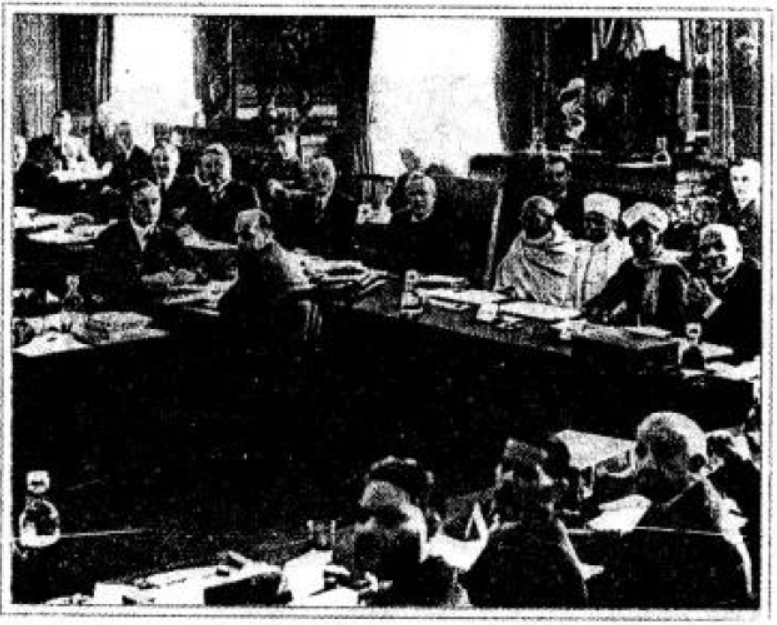
Question 1. Which conference is in progress.
Answer: The photograph captures a session of the historic Second Round Table Conference.
In simple words: The picture shows the Second Round Table Conference.
Exam Tip: Identify it as the Second Round Table Conference, which was highly significant as the only one Mahatma Gandhi attended.
Question 2. When and where was this conference held?
Answer: The conference took place in London in the year 1931.
In simple words: This conference was held in London in 1931.
Exam Tip: Remember both the location (London) and the year (1931) for this conference.
Question 3. Who were the main participants in this conference?
Answer: The prominent leaders attending this conference included Mahatma Gandhi, Dr. B.R. Ambedkar, Madan Mohan Malaviya, and the Aga Khan, among other Indian and British representatives.
In simple words: Some of the main leaders who attended were Mahatma Gandhi, Dr. B.R. Ambedkar, Madan Mohan Malaviya, and the Aga Khan.
Exam Tip: Name Mahatma Gandhi (representing the Congress) and Dr. B.R. Ambedkar as the key participants.
Question 4. What was the result of this conference?
Answer: The discussions failed to reach any consensus, and the conference ended without resolving the constitutional deadlock.
In simple words: The conference failed because the leaders could not agree on a final solution.
Exam Tip: State that the conference ended in failure due to disagreements over separate electorates.
Additional Questions
EXERCISES
A. Fill in the blanks:
1. Gandhi spent about 22 years in South Africa as a practicing lawyer.
2. Under Gandhiji leadership, the Indian national movement was transformed into a mass movement.
3. To protest against the arrest of their leaders, a public meeting was held at Jallianwala Bagh in Amritsar in the year 1919.
4. After the British brutalities in Amritsar, Gandhiji declared that it would be a sin to cooperate with the satanic government.
5. At the Lahore session of the Congress in 1929, Poorna Swaraj was declared as its goal.
B. Match the following:
| Column A | Column B (Correct Match) |
|---|---|
| 1. Gandhiji | (e) Truth and non-violence |
| 2. Charkha | (a) Symbol of swadeshi |
| 3. Jallianwala Bagh | (d) 13 April 1919 |
| 4. Dandi March | (c) Salt Satyagraha |
| 5. Non-cooperation Movement | (b) Boycott of British goods |
C. Choose the correct answer:
Question 1. Gandhiji studied law in which country?
(a) England
(b) South Africa
(c) France
(d) None of the options
Answer: (a) England
In simple words: Mahatma Gandhi went to London, England, to complete his higher studies in law before returning to practice.
Exam Tip: Note that he studied law in England, though he famously practiced as a lawyer in South Africa.
Question 2. Gandhiji organized a workers' strike against the exploitative Indian mill owners in which city?
(a) Ahmedabad
(b) Kheda
(c) Champaran
(d) None of the options
Answer: (a) Ahmedabad
In simple words: In 1918, Gandhiji led a peaceful strike in Ahmedabad to support local cotton mill workers demanding fair wages from their employers.
Exam Tip: The 1918 Ahmedabad Mill Strike was his first hunger strike used as a political tool in India.
Question 3. The Non-Cooperation Movement was launched by Gandhiji in which year?
(a) 1920
(b) 1930
(c) 1940
(d) None of the options
Answer: (a) 1920
In simple words: The Non-Cooperation campaign was officially started in 1920 to protest against the Rowlatt Act and Jallianwala Bagh massacre.
Exam Tip: Pair the Non-Cooperation Movement with the year 1920, and the Civil Disobedience Movement with 1930.
Question 4. A resolution declaring 'Poorna Swaraj' was declared as its goal at which session of the Congress?
(a) Lahore session
(b) Surat session
(c) Bombay session
(d) None of the options
Answer: (a) Lahore session
In simple words: The Congress officially declared its demand for 'Poorna Swaraj' (Complete Independence) during the historic Lahore session in December 1929.
Exam Tip: The 1929 Lahore session, presided over by Jawaharlal Nehru, is landmark for the Poorna Swaraj resolution.
Question 5. Which movement was started with the Salt Satyagraha in 1930?
(a) Non-Cooperation Movement
(b) Civil Disobedience Movement
(c) Quit India Movement
(d) None of the options
Answer: (b) Civil Disobedience Movement
In simple words: The Civil Disobedience Movement began in 1930 when Gandhiji marched to Dandi to break the British salt monopoly.
Exam Tip: Clearly state that the Salt Satyagraha served as the official starting point of the Civil Disobedience campaign.
D. State whether the following are true or false:
1. Gandhiji did not have faith in the capacity of the common masses.
Answer: False
2. In 1919, General Dyer had issued an order banning all public meetings.
Answer: True
3. The Non-Cooperation Movement had ended in failure after the Chauri Chaura incident.
Answer: True
4. Independence Day was celebrated on 26 January in 1930.
Answer: True
5. Sarojini Naidu was one of the leaders of the Civil disobedience Movement.
Answer: True
E. Answer the following questions in one or two words/ sentences:
Question 1. What technique of resistance did Gandhiji evolve in South Africa? What was its basic principle ?
Answer: During his campaign against racial discrimination in South Africa, Mahatma Gandhi developed a unique method of peaceful protest known as Satyagraha. The core principle of this technique is a commitment to truth and non-violence, resisting injustice through peaceful non-cooperation and self-suffering.
In simple words: In South Africa, he developed Satyagraha, a peaceful method of protest based on the twin principles of truth and non-violence.
Exam Tip: Define Satyagraha as the technique and state that 'truth and non-violence' are its basic principles.
Question 2. Why did Gandhiji lead campaigns in (a) Champaran (b) Kheda ?
Answer: Gandhiji led these localized campaigns to address peasant grievances:
(a) Champaran: He led protests to support local tenant farmers in Bihar, who were being heavily exploited and forced to grow indigo by British landlords. The campaign succeeded in gaining compensation for the farmers.
(b) Kheda: He supported Kheda farmers whose crops had failed due to drought, encouraging them to refuse paying land taxes until the government granted tax relief, which was eventually accepted.
In simple words: In Champaran, he fought to protect poor farmers from being exploited by British indigo planters. In Kheda, he helped farmers whose crops had failed get relief from heavy land taxes.
Exam Tip: Match Champaran with 'indigo planters' and Kheda with 'crop failure and tax relief' to keep your answer clear.
Question 3. Which incident marked the end of the Non-Cooperation Movement and when?
Answer: The Non-Cooperation campaign was abruptly suspended in February 1922 following the Chauri Chaura incident, where a crowd set fire to a police station, killing twenty-two policemen.
In simple words: The movement was ended in 1922 because of the Chauri Chaura incident, where a protest turned violent.
Exam Tip: Identify 'Chauri Chaura' and the year '1922' as the key details for the end of the campaign.
Question 4. Under whose leadership was the Lahore session of the Congress held in 1929? What resolution was passed in this session?
Answer: The 1929 Lahore session of the Indian National Congress was held under the leadership of Jawaharlal Nehru. During this historic session, the Congress passed a resolution declaring 'Poorna Swaraj' as its ultimate goal, declaring January 26, 1930, as India's first Independence Day.
In simple words: The session was led by Jawaharlal Nehru in December 1929, where they passed a resolution demanding Complete Independence (Poorna Swaraj) and declared January 26, 1930, as Independence Day.
Exam Tip: Name Jawaharlal Nehru as the president of this session and 'Poorna Swaraj' as the key resolution.
F. Answer the following questions briefly:
Question 1. With reference to Gandhiji, discuss his views on the following: (a) Truth and non-violence (b) Hindu-Muslim unity (c) Social justice
Answer:
(a) Truth and Non-Violence: Satyagraha is a combination of two Sanskrit words: 'satya' (truth) and 'agraha' (firmness). It is built on the core values of truth and non-violence. A satyagrahi was expected to be peaceful, brave, and resolute, resisting injustice through moral courage and self-suffering. The goal of this protest was not to defeat or humiliate the opponent, but to appeal to their conscience, transforming and enlightening them. Gandhiji insisted that non-violence was a weapon of the strong, requiring immense discipline to remain peaceful even under provocation.
(b) Hindu-Muslim Unity: Gandhiji held a deep belief in the equality of all religions. He was convinced that India's strength and progress depended on solid harmony between Hindus and Muslims. He dedicated his life to promoting inter-faith peace and ultimately died defending this cause.
(c) Social Justice: Gandhiji worked tirelessly for social justice and equality. He campaigned for the rights of the marginalized, fought for women's emancipation, and worked to end the social stigma of untouchability, calling the lower castes 'Harijans'. He maintained that political freedom was meaningless without deep social reforms to help the poor and remove prejudices.
In simple words: Gandhiji's method of Satyagraha aimed to change an opponent's heart through peaceful protest and moral courage. He believed that India could only progress if Hindus and Muslims lived in unity, and he worked tirelessly to end untouchability and protect women's rights.
Exam Tip: For this multi-part question, divide your answer under three headings: (a) Satyagraha and non-violence, (b) Hindu-Muslim unity, and (c) Social reforms for the marginalized.
Question 2. In the context of the Jallianwala Bagh tragedy, answer the following: (a) Why was a public meeting held in Jallianwala Bagh on 13 April 1919? (b) Why did the troops open fire on the gathering? What happened as a result of the shooting? (c) How did the entire nation and Gandhiji react to the events in Amritsar?
Answer:
(a) Purpose of the Public Meeting: The British administration used harsh measures to suppress protests against the Rowlatt Act of 1919. In Punjab, these protests led to clashes, and two popular local leaders, Dr. Saifuddin Kitchlew and Dr. Satyapal, were arrested. To protest these arrests and celebrate the Baisakhi festival, a peaceful public meeting was organized on April 13, 1919, at Jallianwala Bagh in Amritsar.
(b) The Firing and Its Casualties: The gathering consisted of peaceful, unarmed citizens, including families who were unaware that General Dyer had banned all public assemblies. Dyer marched his troops into the park, blocked the only narrow exit, and ordered his soldiers to fire on the trapped crowd without warning. The firing continued until their ammunition was exhausted, killing nearly 400 people and wounding over 1,000 others.
(c) Impact and Reaction: The tragedy shocked the entire nation. The government declared martial law in Punjab, subjecting citizens to public humiliation and torture. Horrified by this brutality, Mahatma Gandhi lost all faith in British intentions, declaring that it was a 'sin' to work with what he described as a 'Satanic' government.
In simple words: A peaceful meeting was held on April 13, 1919, to protest the arrest of local leaders and celebrate Baisakhi. General Dyer blocked the exit and ordered his troops to fire on the unarmed crowd, killing nearly 400 people. This brutal act shocked the country and led Gandhi to declare the British government as 'Satanic'.
Exam Tip: For part (a), mention Rowlatt Act protests and the arrest of local leaders. For part (b), mention the exit blockade and key casualty figures (400 killed, 1000 wounded).
Question 3. In the context of the Non-Cooperation Movement, answer the following questions: (a) Discuss the programme of the Non-Cooperation Movement. (b) Why did Gandhiji abruptly suspend the Non-Cooperation Movement? (c) State the significance of the Non-Cooperation Movement.
Answer:
(a) Program of the Movement: The Non-Cooperation campaign utilized peaceful boycott tactics:
1. Refusing to buy foreign goods.
2. Withdrawing from government-run schools, colleges, law courts, legislative bodies, and all British establishments.
3. Boycotting government elections and official state ceremonies.
4. Surrendering titles and honors received from the British government.
(b) Reason for Suspension: In early 1922, a peaceful demonstration by peasants at Chauri Chaura in Uttar Pradesh was fired upon by the police. The outraged crowd retaliated by setting fire to the local police station, killing twenty-two police officers. Committed to non-violence, Mahatma Gandhi immediately suspended the national movement.
(c) Historical Significance: The movement (1920-1922) was a major milestone in the freedom struggle. It proved that non-violent resistance could effectively challenge British rule. By encouraging the use of hand-spun Khadi and boycotting imports, it promoted self-reliance. Most importantly, it transformed the nationalist struggle into a mass movement, demonstrating Gandhi's ability to mobilize hundreds of thousands of ordinary citizens.
In simple words: The program involved boycotting British schools, jobs, and goods while giving up honors. The campaign was suspended in 1922 after a crowd burned down the Chauri Chaura police station, killing 22 officers. The movement was significant because it transformed the freedom struggle into a massive, non-violent popular campaign.
Exam Tip: Ensure you discuss all three parts: the four main boycott methods in (a), the Chauri Chaura tragedy in (b), and the mass mobilization effect in (c).
Question 4. In the context of the Civil Disobedience Movement, answer the following: (a) Give an account of the Salt Satyagraha. (b) How did the government react to the movement? (c) What impact did the Civil Disobedience Movement (1930-34) have on the nation?
Answer:
(a) The Salt Satyagraha: The campaign began with the historic Dandi March. On March 12, 1930, Gandhiji set out from Sabarmati Ashram with 78 followers on a 385-km journey to the coastal village of Dandi, drawing massive crowds along the way. Upon reaching the coast, he collected a handful of natural salt, symbolically violating the British salt monopoly. This served as a signal for citizens across India to manufacture and trade salt in defiance of colonial laws.
(b) Government Crackdown: The British administration used harsh police force to suppress the protests. They arrested Mahatma Gandhi, Jawaharlal Nehru, and other major leaders. Police used lathi charges and firing on peaceful demonstrators, injuring hundreds and imprisoning over 90,000 participants.
(c) Impact on the Nation: The Civil Disobedience campaign established non-violent non-cooperation as a powerful weapon against unjust laws. It successfully mobilized all sections of society, including women and rural populations, on an unprecedented scale. This mass participation shook British confidence, proving that the colonial government could no longer rule without the consent of the Indian public.
In simple words: The Salt Satyagraha began with the 385-km Dandi March to break the salt law, inspiring people across India to make their own salt. The British cracked down brutally, arresting leaders like Gandhi and Nehru, and jailing over 90,000 people. The movement was highly significant because it united the entire country in peaceful defiance of British rule.
Exam Tip: Describe the Dandi March route and its length in part (a), and note that over 90,000 people were jailed as a result of the crackdown in part (b).
G. Picture study:
Question 1. Identify the person.
Answer: The photograph depicts Mahatma Gandhi, the pre-eminent leader of the Indian national movement.
In simple words: The person in the picture is Mahatma Gandhi.
Exam Tip: Identify him as Mahatma Gandhi, the Father of the Nation.
Question 2. What method did he use in the Indian struggle for freedom?
Answer: Mahatma Gandhi utilized the method of Satyagraha to resist British rule, which was based on the core values of truth and non-violence.
In simple words: He used the method of Satyagraha, which means protesting peacefully using truth and non-violence.
Exam Tip: Identify 'Satyagraha' as his primary method, built on the twin pillars of truth and non-violence.
Question 3. What are the principles on which his method is based?
Answer: Satyagraha is derived from two Sanskrit words: 'satya', meaning truth, and 'agraha', meaning firmness or insistence. This method is based on the twin principles of truth and non-violence. It relies on the patience and voluntary suffering of the protester to appeal to the opponent's conscience, seeking to transform and enlighten them rather than to destroy them.
In simple words: His method is based on truth and non-violence. The goal is to change an opponent's heart through peaceful patience and moral courage, rather than trying to hurt or destroy them.
Exam Tip: Explain the literal meaning of Satyagraha (insistence on truth) and emphasize that its goal is to transform the opponent through peaceful means.
Question 4. Why is he called the leader of the masses?
Answer: He is known as the leader of the masses because he held deep faith in the strength and capacity of ordinary people to resist oppression. Under his guidance, the nationalist movement expanded beyond elite circles to include millions of peasants, workers, and women, converting it into a true mass movement.
In simple words: He is called the leader of the masses because he trusted ordinary citizens and successfully brought millions of peasants, workers, and women into the freedom struggle.
Exam Tip: Explain how his leadership expanded the nationalist struggle from a middle-class campaign into a broad-based mass movement.
Question 5. Mention the features of his non-violent struggle against the British.
Answer: The primary features of his non-violent campaign against British rule were:
1. Organizing peaceful public protests and assemblies.
2. Direct and peaceful defiance of unjust colonial laws.
3. Boycotting British goods, educational institutions, and government services.
4. Promoting the use of the charkha and hand-woven khadi to encourage self-reliance and the Swadeshi spirit.
5. Organizing tax strikes and refusing to pay oppressive land revenues to peacefully bring the colonial administration to a standstill.
In simple words: The key features were peaceful marches, defying unjust laws, boycotting British goods, spinning Khadi to be self-reliant, and refusing to pay taxes to bring the government to a halt.
Exam Tip: List at least three features - such as peaceful demonstrations, boycotts of British goods, and the use of the charkha - to write a complete answer.
Free study material for History Civics
Step-by-Step Solutions for Class 8 History Civics Chapter 11 Struggle For Freedom Ii
Detailed Textbook Solutions: Chapter 11 Struggle For Freedom Ii (Class 8 History Civics)
Review accurate ICSE solutions for Chapter 11 Struggle For Freedom Ii tailored for Class 8 History Civics students. Use these step-by-step notes to simplify difficult textbook exercises and improve exam readiness.
Detailed Problem Solving for ICSE Class 8 History Civics
Verify your answers instantly using the comprehensive breakdowns provided for each problem, ensuring complete syllabus coverage across all sub-topics.
Next Steps in Your Class 8 History Civics Preparation
Wrap up your chapter revision by verifying core concepts against standard ICSE question formats. All resources on our platform are free to access.
FAQs
You can download the verified Goyal Brothers solutions for Chapter 11 Struggle For Freedom Ii on StudiesToday.com. Our teachers have prepared answers for Class 8 History Civics as per 2026-27 ICSE academic session.
Yes, our solutions for Chapter 11 Struggle For Freedom Ii are designed as per new 2026 ICSE standards. 40% competency-based questions required for Class 8, are included to help students understand application-based logic behind every History Civics answer.
Yes, every exercise in Chapter 11 Struggle For Freedom Ii from the Goyal Brothers textbook has been solved step-by-step. Class 8 students will learn History Civics conceots before their ICSE exams.
Yes, follow structured format of these Goyal Brothers solutions for Chapter 11 Struggle For Freedom Ii to get full 20% internal assessment marks and use Class 8 History Civics projects and viva preparation as per ICSE 2026 guidelines.