

Class 8 History Civics Chapter 13 The Union Executive: Goyal Brothers Study Material
Review the Goyal Brothers Solutions for ICSE Class 8 History Civics Chapter 13 The Union Executive designed for Class 8 History Civics students. Published under the latest ICSE guidelines for 2026-27, these chapter-wise solutions provide the foundational knowledge required for exam success.
Chapter 13 The Union Executive Answer Guide
Navigate directly to the Chapter 13 The Union Executive solutions using the digital viewer below. Organizing your study sessions chapter-by-chapter allows for seamless offline study and quick reference during revision.
Time To Learn
I. Fill in the blanks:
1. A person to be appointed a minister must be a member of either House of Parliament.
2. The Prime Minister decides the business to be carried on by the Cabinet.
3. The Vice President is elected for a period of five years.
4. The Prime Minister distributes portfolios among the ministers.
5. The public servants constitute the permanent executives.
II. Match the contents of Column A with that of Column B : Column A
| Column A | Column B (Correct Match) |
|---|---|
| 1. The Prime Minister | (e) heads the Council of Ministers. |
| 2. The President | (d) appoints the Prime Minister. |
| 3. The Cabinet | (a) takes all important decisions. |
| 4. The Council of Ministers | (b) consisted of all the Ministers. |
| 5. A Department | (c) under the control of a Minister is called portfolio. |
III. Tick mark (✓) the correct statements and cross mark (X) the wrong ones :
1. The Prime Minister is the vital link between the President and the Cabinet.
Answer: ✓ (True)
2. The Prime Minister acts on the advice of the President.
Answer: X (False)
3. A money bill cannot be introduced without the President’s authority.
Answer: ✓ (True)
4. The President can appoint anyone as the Prime Minister.
Answer: X (False)
5. Most of the Civil Servants at the Centre are selected by the Union Public Service Commission.
Answer: ✓ (True)
IV. Answer the following:
Question 1. Who is the Chief Executive of the Indian Union? Who votes for him?
Answer: The constitutional head and Chief Executive of the Republic of India is the President. The President is chosen by an electoral college consisting of the elected members of both the Lok Sabha and Rajya Sabha (the two Houses of Parliament), as well as the elected members representing the state Legislative Assemblies across the country.
In simple words: The President is the Chief Executive of India. They are elected by a special group of voters made up of elected MPs from Parliament and elected MLAs from all state assemblies.
Exam Tip: Identify the President as the Chief Executive and clearly list both groups of electors: elected MPs and elected MLAs.
Question 2. State two executive and two judicial powers of the President.Under what circumstances can the President proclaim a state of emergency?
Answer: The executive and judicial authority of the President, along with their emergency powers, include several key functions:
Executive Powers:
1. Appoints the Prime Minister of India and other Union Ministers on the Prime Minister's advice.
2. Appoints senior state and federal officers, including State Governors, judges of the Supreme Court and High Courts, the Comptroller and Auditor-General, the Attorney General, and the members of the Union Public Service Commission.
Judicial Powers:
1. Holds the authority to grant pardons, reprieves, or reductions of sentences issued by courts-martial, including commuting a death sentence.
2. Maintains legal immunity, meaning they are not answerable to any court of law for performing their official duties, except during a formal impeachment trial in Parliament.
Emergency Powers:
The President can proclaim a state of emergency under three situations:
1. National Emergency: When the security or territorial integrity of India is threatened by war, external aggression, or armed rebellion.
2. President's Rule: When the constitutional machinery of a state breaks down, preventing the local government from functioning.
3. Financial Emergency: When the financial stability or credit of India is seriously threatened.
In simple words: The President has the power to appoint the Prime Minister, judges, and governors, and can reduce or pardon court punishments, including death sentences. The President can also declare an emergency if India's security, a state's government, or the country's finances are in danger.
Exam Tip: For this multi-part question, clearly separate your answer into three sections: Executive Powers, Judicial Powers, and the three distinct grounds for declaring an Emergency.
Question 3. What are the two main functions of the Cabinet?
Answer: The two primary roles of the Cabinet within the Indian executive are:
1. Acting as the supreme decision-making body, where ministers deliberate on and approve all crucial state matters.
2. Planning and formulating the national policies, legislative programs, and foreign strategies of the government.
In simple words: The Cabinet is responsible for making all major decisions for the country and creating the plans and policies that the government will follow.
Exam Tip: Define the Cabinet as the inner core of the Council of Ministers, emphasizing its role in policy formulation and decision-making.
Question 4. Name the three categories of the union ministers.
Answer: The Council of Ministers is divided into three distinct ranks:
1. Cabinet Ministers: Senior-most leaders who hold independent charge of major ministries.
2. Ministers of State: Mid-level ministers who may either assist Cabinet Ministers or hold independent charge of smaller departments.
3. Deputy Ministers: Junior ministers appointed to assist Cabinet Ministers or Ministers of State in their administrative duties.
In simple words: The three ranks of ministers are Cabinet Ministers, Ministers of State, and Deputy Ministers.
Exam Tip: List all three ranks in descending order of seniority: Cabinet Ministers, Ministers of State, and Deputy Ministers.
Question 5. What is the position of the Prime Minister? Mention his powers.
Answer: The Prime Minister holds the pivotal position of the actual head of the government, serving as the leader of the party or coalition that commands a majority in the Lok Sabha.
The primary powers of the Prime Minister are:
1. Parliamentary Leadership: Acts as the leader of the Lok Sabha.
2. Executive Administration: Manages both the domestic and foreign affairs of the nation.
3. Official Voice: Serves as the chief spokesperson of the Union Government.
4. Cabinet Formation: Selects the members of the Council of Ministers for appointment by the President.
5. Portfolio Allocation: Distributes and reshuffles administrative departments among the ministers.
6. Ministerial Control: Can ask any minister to resign or advise the President to dismiss them.
7. Chief Advisor: Advises the President on key appointments, such as governors, ambassadors, and heads of commissions.
8. Cabinet Meetings: Presides over and guides all Cabinet meetings, determining their agenda.
In simple words: The Prime Minister is the real leader of the country and the head of the majority party in the Lok Sabha. They choose the other ministers, assign their departments, run the country's internal and foreign affairs, and preside over cabinet meetings.
Exam Tip: Explain that the Prime Minister is the real executive head of the nation, and list at least four of their key administrative and cabinet-related powers.
Question 6. Do you think the President of India should be directly elected by the people? Why/why not?
Answer: In India's parliamentary democracy, the Prime Minister serves as the real executive head of the government, while the President holds the position of a nominal, constitutional head of state. If the President were directly elected by the entire population, they would command a direct democratic mandate, making them extremely powerful and politically dominant. This would create a severe conflict of authority and a clash of powers between the Prime Minister and the President. To prevent such instability and ensure the smooth functioning of the cabinet system, it is preferable that the President is elected indirectly by the representatives of the people.
In simple words: No, because India has a parliamentary system where the Prime Minister is the real head of government and the President is only a nominal head. If the President were directly elected by the public, it would create a clash of power between the two leaders.
Exam Tip: Explain how a direct presidential election would conflict with India's parliamentary system, where the Cabinet led by the Prime Minister holds the real executive power.
V. Explain the following statements:
Question 1. “The President is a nominal head.”
Answer: This statement means that under India's parliamentary system of governance, the President acts as the constitutional and symbolic head of the republic, holding de jure authority. The real executive powers of the state are vested in the Council of Ministers, led by the Prime Minister, who manages the day-to-day administration and runs the government.
In simple words: This means that while the President is the official head of the country on paper, the real power to run the government belongs to the Prime Minister and the cabinet.
Exam Tip: Use terms like 'constitutional head' or 'de jure head' for the President, and 'real head' or 'de facto head' for the Prime Minister to write a precise answer.
Question 2. “All the ministers, including the Prime Minister, swim and sink together.”
Answer: This phrase describes the principle of "collective responsibility" of the Council of Ministers to the Lok Sabha. Because the entire ministry operates as a single, unified team under the Prime Minister, if the Lok Sabha passes a vote of no-confidence against even a single minister, the entire Council of Ministers, including the Prime Minister, must resign from office together.
In simple words: This refers to collective responsibility. Since the ministers work as a team, if Parliament passes a vote of no-confidence against one minister, the whole cabinet, including the Prime Minister, must resign.
Exam Tip: Define the constitutional principle of 'collective responsibility' to the Lok Sabha as the core meaning of this statement.
Additional Questions
EXERCISES
A. Fill in the blanks:
1. The President can be removed from office by a procedure known as Impeachment.
2. The President appoints the judges of the Supreme Court and the High Court.
3. The President can call a joint session of the Parliament if there is a deadlock regarding a bill.
4. The Cabinet is the inner core of the Council of Ministers. The Cabinet Ministers hold important portfolios.
5. The Prime Minister is the link between the President, the people and the Parliament.
B. Name the following:
1. The current Prime Minister of India
Answer: Narendra Modi
2. The current Chairperson of the Rajya Sabha –
Answer: Mohammad Hamid Ansari
3. The current Supreme Commander of the Defence Forces
Answer: Pranab Mukherjee
4. The current ministers in charge of (a) Defence (b) External Affairs (c) Finance (d) Health
Answer:
(a) Defence Minister - Manohar Parrikar
(b) External Affairs - Sushma Swaraj
(c) Finance Minister - Arun Jaitley
(d) Health Minister - Jagat Prakash Nadda
C. Choose the correct answer:
Question 1. Who is the nominal head of the government of India?
(a) The President
(b) The Prime Minister
(c) The Vice President
(d) None of the options
Answer: (a) The President
In simple words: The President of India acts as the constitutional and symbolic head of state, while the Prime Minister holds the real executive power.
Exam Tip: Remember that the President is the nominal head, whereas the Prime Minister is the real executive head of government.
Question 2. The President is the Supreme Commander of which of the following?
(a) Indian Administrative Service
(b) Defense Forces
(c) Indian Foreign Service
(d) None of the options
Answer: (b) Defense Forces
In simple words: The President holds the constitutional post of Supreme Commander of all three wings of India's armed forces.
Exam Tip: Specify 'Defense Forces' as the President's military command under the Constitution.
Question 3. The Vice-President is the Chairperson of which house?
(a) Lok Sabha
(b) Rajya Sabha
(c) Vidhan Sabha
(d) None of the options
Answer: (b) Rajya Sabha
In simple words: The Vice-President of India automatically serves as the ex-officio Chairperson of the Rajya Sabha, presiding over its sessions.
Exam Tip: The Vice-President of India acts as the ex-officio Chairperson of the Rajya Sabha.
Question 4. After the elections, the President appoints the leader of the majority party as the:
(a) Vice President
(b) Speaker
(c) Prime Minister
(d) None of the options
Answer: (c) Prime Minister
In simple words: Following a general election, the President invites the leader of the party or coalition with a majority in the Lok Sabha to become the Prime Minister.
Exam Tip: This appointment is a key constitutional duty of the President, guided by the majority command in the Lok Sabha.
Question 5. The Council of Ministers is the real executive but the administration is carried on in the name of the:
(a) Prime Minister
(b) President
(c) Vice-President
(d) None of the options
Answer: (b) President
In simple words: While the Cabinet led by the Prime Minister makes all administrative decisions, all official government orders and treaties are signed in the name of the President.
Exam Tip: Under Article 77, all executive actions of the Government of India are formally taken in the name of the President.
D. State whether the following are true or false:
1. The President is elected for a term of 4 years.
Answer: False
2. The President can pardon a death sentence.
Answer: True
3. The President can declare war or conclude peace.
Answer: True
4. The Prime Minister choose the Cabinet Ministers.
Answer: True
5. Civil servants belong to the majority party in Parliament.
Answer: False
E. Answer the following questions in one or two words/ sentences:
Question 1. Who is the real executive head in a parliamentary form of government?
Answer: Under a parliamentary system of government, the Prime Minister serves as the real, de facto executive head of the administration.
In simple words: In a parliamentary system, the Prime Minister is the actual executive head of the government.
Exam Tip: Identify the Prime Minister as the real executive head, while the President is the nominal head.
Question 2. Name the body that elects the President of India.
Answer: The President of India is chosen by a specialized voting body known as the Electoral College.
In simple words: The President is elected by a special group of electors called the Electoral College.
Exam Tip: State 'Electoral College' as the correct term for the body that elects the President.
Question 3. Name any two officials appointed by the President?
Answer: Two high-ranking officials appointed by the President of India are state Governors and the Comptroller and Auditor-General.
In simple words: The President has the power to appoint state Governors and the Comptroller and Auditor-General of India.
Exam Tip: You can name any two officials, such as state Governors and the Attorney General, to secure full marks.
Question 4. What is an ordinance?
Answer: An ordinance is a temporary executive order carrying the force of law, issued by the President when Parliament is in recess to meet urgent legislative demands.
In simple words: An ordinance is a temporary law passed by the President when Parliament is not meeting, to handle urgent matters.
Exam Tip: Define an ordinance as a temporary law issued by the President specifically when Parliament is not in session.
Question 5. What can the President do when the security of the country is threatened by external aggression or armed rebellion?
Answer: Under Article 352 of the Constitution, the President has the power to proclaim a National Emergency across the country if its security is seriously threatened by war, external aggression, or an armed rebellion.
In simple words: The President can declare a National Emergency to protect the country if there is a threat of war, invasion, or an armed uprising.
Exam Tip: Name 'National Emergency' as the specific constitutional declaration made by the President during such security threats.
Question 6. Whose advice is the President bound to follow in carrying out his/her functions?
Answer: The President of India is constitutionally bound to act in accordance with the aid and advice offered by the Prime Minister and the Council of Ministers while performing their official duties.
In simple words: The President must follow the advice and decisions of the Prime Minister and the Council of Ministers when making official decisions.
Exam Tip: Specify that the President is constitutionally bound to follow the advice of the 'Prime Minister and the Council of Ministers'.
Question 7. Who is the head of the Council of Ministers?
Answer: The official who leads and heads the Council of Ministers is the Prime Minister.
In simple words: The Prime Minister is the leader and head of the Council of Ministers.
Exam Tip: The Prime Minister sits at the apex of the Council of Ministers as its designated head.
Question 8. When two or more political parties form the government, what is it called?
Answer: An administration formed when multiple political parties agree to collaborate and share power to command a majority in the legislature is known as a Coalition Government.
In simple words: When different political parties join together to form a government, it is called a Coalition Government.
Exam Tip: Use the precise term 'Coalition Government' to describe this multi-party alliance.
Question 9. What is meant by allotment of portfolios?
Answer: The allotment of portfolios refers to the process where the Prime Minister assigns specific administrative departments - such as Defense, Finance, Agriculture, or External Affairs - to individual ministers within the Council.
In simple words: Allotment of portfolios means the Prime Minister assigns a specific government department, like health or agriculture, to each minister to manage.
Exam Tip: Define 'portfolio' as an individual administrative department and state that the Prime Minister holds the authority to allocate them.
Question 10. What happens when a vote of no-confidence is passed against any one Cabinet Minister?
Answer: Due to the principle of collective responsibility, if the Lok Sabha passes a vote of no-confidence against even a single Cabinet Minister, the entire Council of Ministers must immediately resign from office.
In simple words: If Parliament passes a vote of no-confidence against any single minister, the entire cabinet has to resign immediately.
Exam Tip: Link this outcome to the constitutional principle of 'collective responsibility' of the ministry to the Lok Sabha.
F. Answer the following questions briefly:
Question 1. In the context of the President of India, answer the following questions:
(a) Mention the qualifications required for the post of the President.
(b) How is the President elected ?
(c) How can the services of the President be terminated ?
Answer:
(a) Qualifications for the Office of President: To qualify for candidacy, an individual must fulfill these criteria:
1. Hold citizenship of India.
2. Have reached a minimum age of 35 years.
3. Meet all eligibility requirements to be elected as a member of the Lok Sabha.
4. Must not hold any office of profit under the central, state, or municipal governments.
(b) System of Presidential Election: The President is elected indirectly through an Electoral College, which consists of:
1. The elected representatives of both Houses of Parliament.
2. The elected representatives of all state Legislative Assemblies.
(c) Removal and Impeachment: The President's term can be terminated before completion through the constitutional process of impeachment by Parliament. Impeachment can be initiated if the President is found guilty of violating the Constitution, committing treason, or engaging in high-level corruption.
In simple words: To become President, a person must be an Indian citizen of at least 35 years of age, eligible for the Lok Sabha, and not hold any government job. They are elected indirectly by an Electoral College of elected MPs and MLAs, and can be removed by Parliament through a process called impeachment if they violate the Constitution.
Exam Tip: For part (a), note the age requirement of 35. For part (b), emphasize that only 'elected' members of Parliament and assemblies participate in the Electoral College.
Question 2. With reference to the powers of the President, discuss:
(a) Any four executive powers
(b) Military powers
(c) Any four legislative powers
Answer:
(a) Executive Powers of the President: 1. Appoints the Prime Minister, inviting the leader of the majority party or coalition commanding a majority in the Lok Sabha to take office.
2. Appoints other Union Ministers on the official advice of the Prime Minister.
3. Appoints key federal officials, such as state Governors, Supreme Court and High Court judges, and heads of commissions.
4. Formally directs the civil and administrative services of the Union.
(b) Military Powers: The President holds the supreme military command of India's Armed Forces. They can officially declare war or sign peace treaties, and all major international agreements and defense contracts are signed in their name.
(c) Legislative Powers:
1. Holds the authority to summon or prorogue sessions of Parliament, delivering an opening policy address to the joint houses annually.
2. Can dissolve the Lok Sabha before its term ends on the Prime Minister's advice and call for fresh elections.
3. Can call a joint sitting of both Houses of Parliament to resolve a legislative deadlock over a non-money bill.
4. Signs bills passed by Parliament to make them law, holding the right to return a non-money bill once for reconsideration.
5. Nominates 12 distinguished members to the Rajya Sabha and, historically, two representatives from the Anglo-Indian community to the Lok Sabha.
6. Issues temporary executive orders when Parliament is not in session, which must be approved within six weeks of Parliament reconvening.
In simple words: The President appoints the Prime Minister and other ministers. As Supreme Commander, they declare war and sign treaties. Their legislative powers include opening parliament sessions, calling joint sessions to break deadlocks, signing bills into law, and passing temporary ordinances when parliament is in recess.
Exam Tip: For part (c), name at least four distinct legislative powers, such as summoning sessions, dissolving the Lok Sabha, signing bills, or issuing ordinances.
Question 3. The President is an integral part of the Parliament. In this context explain the following:
(a) The financial powers of the President
(b) The judicial powers of the President
(C) The emergency powers of the President.
Answer:
(a) Financial Powers:
1. The annual financial statement (the Union Budget) is presented in Parliament on behalf of and in the name of the President.
2. No money bill or tax proposal can be introduced in the Lok Sabha without obtaining the President's prior recommendation.
(b) Judicial Powers:
1. The President holds the power of clemency, allowing them to pardon, remit, reduce, or suspend court-martial punishments or commute a death sentence.
2. The President enjoys legal immunity, meaning they cannot be sued or prosecuted in any court of law for their official actions, except in an impeachment trial in Parliament.
(c) Emergency Powers:
The President can proclaim three types of emergencies:
1. National Emergency: If the country's security is threatened by war, foreign invasion, or internal armed rebellion.
2. State Emergency (President's Rule): If a state government's constitutional machinery breaks down.
3. Financial Emergency: If India's financial credit or stability is seriously threatened.
In simple words: Financially, the President approves the budget and money bills before they are presented. Judicially, they can pardon punishments and have legal immunity. In emergencies, they can declare a National Emergency, place a state under President's Rule, or declare a Financial Emergency.
Exam Tip: For part (a), note that all Money Bills require the President's prior permission. For part (c), identify the three distinct types of emergencies: National, State, and Financial.
Question 4. With reference to the functions of the Parliament, explain the following:
(a) Law-making functions
(b) Control over the executive
(c) Judicial functions
Answer:
(a) Legislative Functions:
1. Parliament has the power to draft new laws or modify existing ones on all subjects listed under the Union List and the Concurrent List.
2. Under special circumstances (such as an emergency), Parliament can also legislate on matters listed under the State List.
3. Parliament has the exclusive power to initiate and pass bills to amend the Constitution of India.
(b) Control Over the Executive:
1. Direct Accountability: The Council of Ministers is collectively responsible and answerable to the Lok Sabha for all its administrative choices.
2. Vote of No-Confidence: The entire ministry must resign immediately if the Lok Sabha passes a vote of no-confidence against them.
3. Question Hour and Debates: MPs can question ministers about their departments, enabling the legislature to monitor and check government actions.
4. Adjournment Motions: Parliament can halt daily proceedings to discuss urgent matters of public safety or emergency, such as natural disasters or civil disturbances.
(c) Judicial Functions:
Parliament acts as a judicial body to protect the Constitution. It holds the power to impeach and remove the President, the Vice-President, and judges of the Supreme Court and High Courts if they are found guilty of constitutional violations or corruption.
In simple words: Parliament makes laws on national subjects, amends the Constitution, and monitors the government through questions and no-confidence votes. It also performs judicial duties by holding the power to impeach the President, Vice-President, and high-court judges.
Exam Tip: For part (b), describe specific methods of executive control: question hour, debates, adjournment motions, and no-confidence votes.
Question 5. Discuss the powers and position of the Prime Minister with reference to his relationship with the following:
(a) Parliament
(b) the President
(c) the Council of Ministers.
Answer:
(a) Relationship with Parliament: The Prime Minister serves as the real executive head of India and the official leader of the Lok Sabha, commanding the support of the majority party or ruling coalition in Parliament. This political command allows them to direct the legislative agenda and run the government.
(b) Relationship with the President: The Prime Minister acts as the chief advisor to the President, informing them about all major Cabinet decisions and administrative policies. Under the Constitution, the executive advice of the Prime Minister and their Cabinet is binding on the President.
(c) Relationship with the Council of Ministers: The Prime Minister directs and coordinates the entire ministry:
1. They select other ministers for appointment by the President.
2. They allocate and reshuffle administrative portfolios and preside over all Cabinet meetings.
3. They coordinate the work of different ministries, acting as the vital link of communication between the President and the Cabinet.
4. They have the authority to reshape the Cabinet and demand the resignation of any minister.
In simple words: The Prime Minister is the real leader of the country and the head of the majority party in Parliament. They advise the President on all major decisions and have complete control over choosing, assigning, and managing the other ministers in their Cabinet.
Exam Tip: For this structured question, use clear headings for (a) Parliament, (b) the President, and (c) the Council of Ministers to explain their central coordinating role.
Question 6. In the context of the Prime Minister and the Council of Ministers, explain the following:
(a) Appointment of the Prime Minister
(b) Formation of the Council of Ministers
(c) The Cabinet
Answer:
(a) Appointment of the Prime Minister: Under the Constitution, the Prime Minister is officially appointed by the President of India. However, the President's personal choice is limited: they must appoint the leader of the political party or coalition that commands an absolute majority in the Lok Sabha. If no single party holds a clear majority, the President uses their discretionary power to invite the leader who is most likely to form a stable coalition. The appointed Prime Minister must be a member of either the Lok Sabha or the Rajya Sabha, or obtain a seat within six months of taking office.
(b) Formation of the Council of Ministers: The Prime Minister selects other members of the ministry, presenting their names to the President for formal appointment. This process forms the Council of Ministers, which is divided into three distinct ranks: Cabinet Ministers, Ministers of State, and Deputy Ministers.
(c) The Cabinet: All ministers must hold a seat in either House of Parliament, or secure one within six months of their appointment. The Cabinet represents the inner, senior-most core of the Council of Ministers, holding the most important portfolios and making all major policy decisions. It exercises the real executive power of the state. The Cabinet remains in office only as long as it retains the majority support of the Lok Sabha. Under the principle of collective responsibility, if a vote of no-confidence is passed against any single Cabinet Minister, the entire Council of Ministers must resign immediately, making them collectively accountable for any administrative failures.
In simple words: The President appoints the leader of the majority party in the Lok Sabha as the Prime Minister. The Prime Minister then chooses other ministers to form the Council of Ministers. The Cabinet is the small, senior group of these ministers who make all the major decisions for the country, and they must all resign together if they lose a vote of no-confidence in Parliament.
Exam Tip: For part (c), define the Cabinet as the 'inner core' of the ministry and explain the rule requiring non-member ministers to get elected to Parliament within six months.
G Picture study:
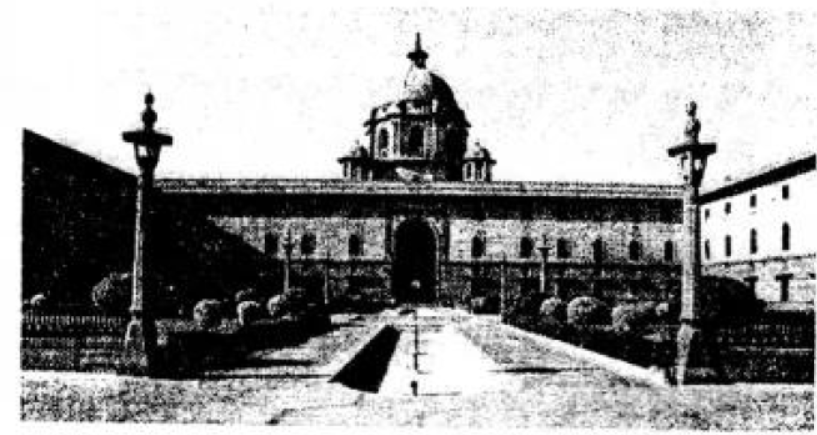
Question 1. Identify the building. Whose official residence is it now?
Answer: The building shown in the illustration is Rashtrapati Bhavan, which serves as the official residence of the President of India.
In simple words: The building is Rashtrapati Bhavan, which is the official home of the President of India.
Exam Tip: Identify the building as Rashtrapati Bhavan, located in New Delhi.
Question 2. How is he or she elected?
Answer: The President of India is elected indirectly through an Electoral College, reflecting their role as the nominal head of state. This Electoral College consists of:
1. The elected representatives from both Houses of Parliament (Lok Sabha and Rajya Sabha).
2. The elected representatives from all state Legislative Assemblies.
In simple words: The President is elected indirectly by a special Electoral College made up of elected MPs from Parliament and elected MLAs from all state assemblies.
Exam Tip: Be sure to state that the election is 'indirect' and specify that only 'elected' members of Parliament and state assemblies can vote.
Question 3. What is his/her term of office?
Answer: The President of India is elected for a standard term of five years and is eligible to run for re-election after completing their term.
In simple words: The President is elected for a term of five years and can be re-elected again.
Exam Tip: State 'five years' as the standard term of office and mention that there is no constitutional bar on re-election.
Question 4. Mention two powers each held by this person of with reference to the following:
(a) Financial power (b) Judicial Power
Answer: The financial and judicial powers of the President of India are described below:
(a) Financial Powers:
1. The annual Union Budget is laid before Parliament in the name of the President.
2. No Money Bill can be introduced in Parliament without obtaining the prior permission and recommendation of the President.
(b) Judicial Powers:
1. The President has the power of clemency, allowing them to pardon, reduce, suspend, or remit court-martial punishments, including commuting a death sentence.
2. The President enjoys complete legal immunity and is not answerable to any court of law for performing their official duties, except during impeachment trials in Parliament.
In simple words: Financially, the President authorizes the presentation of the budget and must approve all money bills first. Judicially, they can reduce or pardon court sentences (including death sentences) and cannot be sued in court for doing their job.
Exam Tip: For this structured question, clearly list two points under (a) Financial powers and two points under (b) Judicial powers to get full marks.
Free study material for History Civics
Complete Guide and Answers: Class 8 History Civics Chapter 13 The Union Executive
About ICSE Solutions for Class 8 History Civics Chapter 13 The Union Executive
Find reliable chapter-wise explanations for Class 8 History Civics Chapter 13 The Union Executive. Curated to follow standard ICSE guidelines, these problem solutions assist students in building strong conceptual foundations.
Detailed Problem Solving for ICSE Class 8 History Civics
Tackle complex theorems and numerical problems easily by cross-referencing your working steps with our structured solution guides.
Next Steps in Your Class 8 History Civics Preparation
Wrap up your chapter revision by verifying core concepts against standard ICSE question formats. All resources on our platform are free to access.
FAQs
You can download the verified Goyal Brothers solutions for Chapter 13 The Union Executive on StudiesToday.com. Our teachers have prepared answers for Class 8 History Civics as per 2026-27 ICSE academic session.
Yes, our solutions for Chapter 13 The Union Executive are designed as per new 2026 ICSE standards. 40% competency-based questions required for Class 8, are included to help students understand application-based logic behind every History Civics answer.
Yes, every exercise in Chapter 13 The Union Executive from the Goyal Brothers textbook has been solved step-by-step. Class 8 students will learn History Civics conceots before their ICSE exams.
Yes, follow structured format of these Goyal Brothers solutions for Chapter 13 The Union Executive to get full 20% internal assessment marks and use Class 8 History Civics projects and viva preparation as per ICSE 2026 guidelines.