

Goyal Brothers Solutions for Class 7 History Civics: Chapter 06 The Vijayanagar And Bahmani Kingdom
Review the Goyal Brothers Solutions for ICSE Class 7 History Civics Chapter 6 The Vijayanagar And Bahmani Kingdom designed for Class 7 History Civics students. Published under the latest ICSE guidelines for 2026-27, these chapter-wise solutions provide the foundational knowledge required for exam success.
Chapter-wise Solutions: Chapter 06 The Vijayanagar And Bahmani Kingdom
Access the complete PDF for Chapter 06 The Vijayanagar And Bahmani Kingdom below. This focused excerpt allows students to isolate specific topics for thorough review and uninterrupted reading, complementing standard ICSE textbooks.
The Vijayanagar and Bahmani Kingdom
Important Words
- Harihara I and Bukka Raya I: The two brothers who established the Vijayanagar kingdom.
- Raichur Doab: The fertile area lying between river Krishna and river Tungabhadra.
- Domingo Paes: A Portuguese traveller who visited the Vijayanagar kingdom in the 16th century CE.
- Abdur Razzaq: A Persian traveller who visited the Vijayanagar kingdom in the 15th century CE.
- Deccanis: The local nobles in the Bahmani kingdom.
- Pardesis: The foreign nobles in the Bahmani kingdom.
I. Fill in the blanks:
1. After the death of Mahmud Gawan the Bahamani kingdom declined.
2. The Vijayanagara rulers built the Vithalswami temple.
3. The Battle of Talikota was fought in 1565.
4. The Vijayanagara empire was founded by Harihara and Bukka Raya.
5. Occupation of Golconda, Konkan coast was the main reason behind the Bahamani-Vijayanagara conflict.
II. Match Column A with Column B
| Column A | Column B (Correct Match) |
|---|---|
| 1. After the fall of the Bahamani Empire | (f) there arose five independent states. |
| 2. Gulbarga | (c) was the capital of the Bahamani kingdom. |
| 3. Muhammad Shah II’s reign | (d) was peaceful. |
| 4. The Vijayanagara empire | (e) was founded by Harihara and Bukka Raya. |
| 5. The Bahamani kingdom | (a) was founded by Hasan Gangu. |
| 6. Krishnadev Raya | (b) was the most popular king of the Vijayanagara empire. |
III. State whether the following statements are True or False:
1. The battle of Talikota was fought in
Answer: False (The battle of Talikota was fought in 1565.)
2. Before coming to the Bahamani kingdom, Mahmud Gawan was a Persian merchant.
Answer: True
3. The Bahamani rulers fought with the Vijayanagara rulers over the occupation of the Gangetic Doab.
Answer: False (The Bahamani rulers fought with the Vijayanagara rulers over the occupation of the Raichur Doab.)
4. Nicoli Conti and Abdul Razzak visited the Vijayanagara kingdom as foreign travellers.
Answer: True
IV. Answer the following questions briefly:
Question 1. Describe briefly the administration of Vijayanagara rulers.
Answer: The administration of the Vijayanagar Empire featured several key aspects:
1. Focus on Public Welfare: The kings prioritized the well-being of their subjects, directing a major portion of land revenues and other taxes toward public welfare and infrastructure.
2. Judicial System: The monarch acted as the supreme judicial authority and the highest court of appeal, enforcing a strict penal code where criminals faced severe punishments.
In simple words: The Vijayanagar kings used most of their tax money to help the public. The king acted as the highest judge and gave out strict punishments to keep order.
Exam Tip: Mention their focus on utilizing tax revenues for public welfare and highlight the king's role as the supreme judge.
Question 2. Why did the Bahamani kingdom break up and what was the result?
Answer: Several internal and external challenges led to the collapse and fragmentation of the Bahmani Kingdom:
- Causes of Decline: The state suffered from religious friction, continuous wars with neighboring states, and the luxurious, passive lifestyles of its later kings. This situation was worsened by bitter political rivalries between local Deccani nobles and foreign Irani factions.
- Final Collapse: After the execution of the capable minister Mahmud Gawan, the subsequent weak sultans lacked competent advisors to manage the administration.
- The Result: This internal instability caused the kingdom to break apart into five independent Deccan Sultanates: Bijapur, Golconda, Ahmednagar, Berar, and Bidar, which were eventually conquered by the Mughal Empire.
In simple words: The Bahmani Kingdom collapsed due to weak rulers, constant wars, and bitter fights between different groups of nobles. After their capable minister Mahmud Gawan died, the kingdom broke apart into five smaller states (Bijapur, Golconda, Ahmednagar, Berar, and Bidar), which the Mughals eventually conquered.
Exam Tip: Discuss the internal rivalry between Deccani and Irani nobles, and list all five independent successor states to earn full marks.
Question 3. What was the contribution of the Vijayanagara rulers in the development of art and architecture?
Answer: The Vijayanagar rulers were magnificent patrons of scholarship, art, and architecture, building several historic monuments:
1. Temple Architecture: They adorned their capital with grand temples, with the Hazara Rama Temple and the Vithalaswami Temple at Hampi, constructed under Krishnadeva Raya, being the most celebrated examples. These temples feature beautifully carved assembly halls, monumental gateways, and tall, decorated towers over the main shrine.
2. Civic Structures: They also constructed impressive secular buildings, such as the grand, arched Elephants' Stable in the capital city.
In simple words: The Vijayanagar kings built beautiful temples, especially the Hazara Rama and Vithalaswami temples at Hampi, famous for their carved pillars and grand gateway towers. They also built the impressive Elephants' Stable.
Exam Tip: Name Hampi as the architectural hub and cite the Vithalaswami Temple, Hazara Rama Temple, and the Elephants' Stable as prime examples.
Question 4. Discuss the reasons for the conflict between the Bahamani and Vijayanagara empires.
Answer: The continuous conflict between the Vijayanagar and Bahmani kingdoms was driven by territorial, economic, and geopolitical rivalries:
1. Dispute Over the Raichur Doab: Both states claimed the fertile and resource-rich Raichur Doab, the land situated between the Krishna and Tungabhadra rivers.
2. Control of Mineral Wealth: Both sought to capture the strategic region of Golconda to control its lucrative diamond mines.
3. Geopolitical Dominance: Both kingdoms had imperial ambitions to establish their political dominance over the entire southern peninsula, keeping them in a state of continuous warfare.
In simple words: They fought constantly because both wanted to control the fertile Raichur Doab region between the rivers, capture the rich diamond mines of Golconda, and dominate the southern peninsula.
Exam Tip: Clearly identify the 'Raichur Doab' and 'Golconda' as the two primary economic causes of conflict.
Question 5. Discuss the achievements of Krishnadev Raya.
Answer: Maharaja Krishnadeva Raya is regarded as the greatest ruler of the Vijayanagar Empire due to his exceptional achievements:
1. Promoting Trade: He encouraged international trade, establishing friendly ties with Portuguese merchants who had set up commercial centers on the Malabar Coast.
2. State Finance: He increased the state's treasury revenues by systematically regulating customs duties and other taxes.
3. Agricultural Expansion: He took proactive steps to expand farming, constructing a network of irrigation canals and dams to supply water to dry fields.
4. Patron of the Arts: He was a major patron of art, literature, and architecture, funding the construction of grand temples in Hampi.
5. Court Culture: He maintained a magnificent court, personally writing literature in Sanskrit and Telugu and sponsoring celebrated poets and scholars.
In simple words: Krishnadeva Raya boosted trade with the Portuguese, increased state revenues, and developed farming by building dams and irrigation canals. He was also a great supporter of art and literature, keeping a magnificent court of scholars.
Exam Tip: List achievements across multiple areas: his trade alliance with the Portuguese, his agricultural irrigation projects, and his patronage of art and literature.
V. Tell my why!
Question 1. The Gol Gumbaz is called an architectural wonder.
Answer: The Gol Gumbaz in Bijapur, serving as the tomb of Sultan Muhammad Adil Shah, is celebrated as an engineering masterpiece:
1. It features one of the largest single domes ever constructed in the world.
2. It is famous for its unique 'whispering gallery' acoustics, where any slight sound or whisper made inside the dome creates multiple echoes, reflecting the sound clearly back to the listener several times.
In simple words: The Gol Gumbaz is a wonder because it has one of the world's largest domes and a unique whispering gallery where any small sound echoes clearly several times.
Exam Tip: Mention that it is the tomb of Muhammad Adil Shah and describe the acoustics of its 'whispering gallery' as its most famous feature.
Question 2. Vijayanagara needed to keep a large army.
Answer: The Vijayanagar Empire had to maintain a large, well-equipped standing army due to continuous border conflicts, territorial disputes, and threat of invasion from the rival Bahmani Kingdom.
In simple words: They had to keep a large army to defend their borders from frequent invasions and continuous wars with the neighboring Bahmani Kingdom.
Exam Tip: State that the constant threat of war and territorial disputes with the Bahmani Kingdom made a large standing army necessary.
Question 3. The Krishna-Tungabhadra doab was a much sought-after area.
Answer: The Krishna-Tungabhadra Doab was highly coveted because of its rich, fertile soil and exceptional agricultural productivity. This wealth made it a major source of revenue, prompting both the Vijayanagar and Bahmani kingdoms to fight constantly over its control. The memory of these conflicts survived through local oral traditions, which, alongside stone inscriptions and physical ruins, later helped historians rediscover the lost history of the Vijayanagar Empire.
In simple words: This region was highly valued because it had extremely fertile soil that produced high crop yields and tax revenues, making it a constant battleground between neighboring kingdoms.
Exam Tip: Define the doab as the fertile, high-yielding land between the Krishna and Tungabhadra rivers that served as a major source of tax revenue.
VI. Picure study:
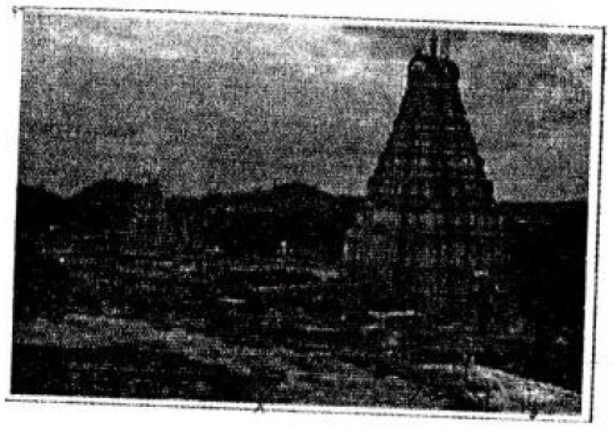
Question 1. Name the temple.
Answer: The photograph depicts the historic Virupaksha Temple.
In simple words: The building shown in the picture is the Virupaksha Temple.
Exam Tip: Identify the building as the Virupaksha Temple, situated in Hampi.
Question 2. Name the empire and the capital city where it was built.
Answer: The temple was constructed in the capital city of Hampi, which served as the administrative heart of the Vijayanagar Empire.
In simple words: It was built in Hampi, which was the capital city of the Vijayanagar Empire.
Exam Tip: State 'Hampi' as the capital and 'Vijayanagar' as the empire.
Question 3. Who was the greatest ruler of the empire? Mention the name of the book written by him.
Answer: Maharaja Krishnadeva Raya is recognized as the greatest ruler of the empire. According to this curriculum, his notable literary works include books such as 'Veera-Saivanruta' and 'Bhava-Chinta-Ratna'.
In simple words: The greatest ruler was Krishnadeva Raya, who wrote books like Veera-Saivanruta and Bhava-Chinta-Ratna.
Exam Tip: Provide the name 'Krishnadeva Raya' as the greatest ruler and list the books specified in your textbook.
Additional Questions
EXERCISES
A. Fill in the blanks:
1. Vijayanagar was established by two brothers, Harihara and Bukka Rai.
2. The Vijayanagar kingdom which was ruled by sixteen kings, was very powerful for 230 years and became the centre of Hindu civilization and culture.
3. The Raichur Doab became a battleground for the prolonged struggle between the Vijayanagar and Bahmani kingdoms.
4. Each province in the Vijayanagar kingdom was placed under a Governor who was responsible for the administration of that province.
5. The two main sources of revenue for the Vijayanagar kingdom were taxes on land and trade.
6. The Bahmani kingdom was established by Alauddin Hassan. It lasted for about 200 years and was ruled by eighteen kings.
B. Match the following:
| Column A | Column B (Correct Match) |
|---|---|
| 1. Krishnadeva Raya | (c) a brilliant general |
| 2. Vithalaswami temple | (e) Vijayanagar kingdom |
| 3. Domingo Paes | (a) Portugal |
| 4. Mahmud Gawan | (b) spartan lifestyle |
| 5. Gol Gumbaz | (d) Bijapur |
C. Choose the correct answer:
Question 1. Who was the greatest ruler of the Vijayanagar kingdom?
(a) Harihara
(b) Bukka Raya I
(c) Krishnadeva Raya
(d) None of the options
Answer: (c) Krishnadeva Raya
In simple words: Maharaja Krishnadeva Raya is celebrated as the most successful and greatest ruler of the Vijayanagar Empire.
Exam Tip: Always identify Krishnadeva Raya as the most prominent king of the dynasty.
Question 2. The Vijayanagar kingdom was divided into how many provinces?
(a) six provinces
(b) nine provinces
(c) eight provinces
(d) None of the options
Answer: (a) six provinces
In simple words: To manage administration efficiently, the kings divided their entire empire into six large provinces.
Exam Tip: State 'six' as the number of administrative provinces in the Vijayanagar kingdom.
Question 3. Which administrative unit was at the bottom rung of the administrative ladder in the Vijayanagar kingdom?
(a) province
(b) village
(c) district
(d) None of the options
Answer: (b) village
In simple words: The village was the smallest and most basic unit of administration at the bottom of their government system.
Exam Tip: Identify the village as the lowest administrative unit in the regional government hierarchy.
Question 4. The Bahmani kingdom reached the height of its glory under the leadership of:
(a) Mahmud Gawan
(b) Alauddin Bahman Shah
(c) Adil Shah
(d) None of the options
Answer: (a) Mahmud Gawan
In simple words: The Bahmani state reached its greatest success and power during the administration of its prime minister, Mahmud Gawan.
Exam Tip: Although he was a prime minister rather than a king, Mahmud Gawan led the kingdom to its cultural and political peak.
Question 5. The Bahmani rulers patronized which of the following?
(a) Hinduism
(b) Buddhism
(c) Islam
(d) None of the options
Answer: (c) Islam
In simple words: The sultans of the Bahmani Dynasty were followers of Islam and actively promoted its teachings, built mosques, and supported scholars.
Exam Tip: State 'Islam' as the official religion patronized by the Bahmani rulers.
D. State whether the following are true or false:
1. The founders of the Vijayanagar kingdom brought the whole of South India, from the Tungabhadra to Cape Comorin, under their control.
Answer: True
2. The Vijayanagar kingdom had established trade relations with the Dutch.
Answer: False (Correct statement: The Vijayanagar kingdom had established trade relations with the Portuguese.)
3. Vijayanagar was one of the wealthiest kingdoms in the Deccan in the 15th and 16th centuries CE.
Answer: True
4. Mahmud Gawan slept on a mat and ate in earthen vessels.
Answer: True
5. The Bahmani rulers used Persian and Arabic as court languages.
Answer: True
E. Answer the following questions in one or two words/ sentences:
Question 1. How did the collapse of the Sultanate impact North India?
Answer: The collapse and weakening of the Delhi Sultanate left Northern India in a state of political fragmentation, marked by continuous instability and local conflicts.
In simple words: The fall of the Sultanate led to a period of political chaos, leaving Northern India divided and unstable.
Exam Tip: Use terms like 'political turmoil' or 'instability' to describe the scenario in the north.
Question 2. What was Krishnadeva Raya’s contribution to literature and art?
Answer: Maharaja Krishnadeva Raya was an outstanding patron of literature and fine arts. An accomplished writer himself, he composed literature in Sanskrit and wrote celebrated poetry in Telugu. He maintained a grand court that supported numerous poets, philosophers, and artists.
In simple words: He was a great supporter of art and literature, wrote books in Sanskrit and Telugu, and kept a grand court filled with talented writers and poets.
Exam Tip: Mention his personal talent as a Sanskrit and Telugu writer alongside his patronage of other court scholars.
Question 3. What is the significance of the Battle of Talikota?
Answer: The Battle of Talikota (1565) was a major turning point in South Indian history. The five successor Deccan Sultanates - Bijapur, Ahmadnagar, Berar, Golconda, and Bidar - formed a unified alliance to defeat the Vijayanagar Empire. This crushing defeat led to the destruction of their capital, ending the political dominance of the Hindu empire in southern India.
In simple words: In 1565, an alliance of five Deccan states defeated the Vijayanagar Empire at Talikota, destroying its capital and ending their dominant rule in the South.
Exam Tip: State the year (1565) and explain that the defeat of Vijayanagar by the combined Deccan Sultanates ended their dominance.
Question 4. What major change was introduced in the village administration of the Vijayanagar kingdom?
Answer: The Vijayanagar rulers restructured local administration by reviving the older feudal system. They appointed hereditary officers to govern and collect taxes at the village level, which sat at the bottom of the state administrative ladder.
In simple words: They revived the old feudal system, placing villages under the control of hereditary officers whose jobs were passed down through families.
Exam Tip: Focus on the revival of the feudal system and the introduction of hereditary village officers.
Question 5. What measures did the Vijayanagar rulers take to develop agriculture?
Answer: To boost agricultural production, the rulers cleared vast forest areas to create new farm lands. They also built extensive irrigation infrastructure, constructing dams, canals, and large storage tanks to supply water to dry fields.
In simple words: They cleared forests to make more fields for farming and built canals, dams, and water tanks to irrigate the crops.
Exam Tip: Discuss their dual strategy: land expansion (clearing forests) and water management (building dams and canals).
Question 6. Why were there no major social or cultural changes in the Vijayanagar kingdom?
Answer: Social and cultural structures remained largely unchanged because the rulers strictly followed traditional Vedic customs and maintained a highly conservative social setup. The rigid caste system positioned the Brahmins as superior authorities, and this orthodox leadership actively discouraged any progressive social or cultural reforms.
In simple words: Society remained conservative because the rulers followed ancient Vedic customs and a rigid caste system, where orthodox leaders opposed any major changes.
Exam Tip: Cite the rigid caste system, the dominance of the priestly class, and their strict commitment to ancient Vedic customs as the reasons.
Question 7. Give one example to show that the Vijayanagar kings were tolerant and liberal.
Answer: Although the Vijayanagar kings were devout Hindus, they maintained an open and tolerant administration. For instance, they recruited Muslim soldiers and officers into their army and government, ensuring equal treatment for Hindus, Muslims, Christians, and Jews alike.
In simple words: Even though they were devout Hindus, they hired Muslims for high military and government jobs and treated people of all religions equally.
Exam Tip: The recruitment of Muslim soldiers into their state army is the primary example of their religious tolerance.
Question 8. Name any one foreign traveller whose observations are an important literary source of information about the Vijayanagar kingdom.
Answer: A valuable eyewitness account of the empire was written by the Portuguese traveler Domingo Paes, who visited the court during the 16th century.
In simple words: One famous foreign traveler who wrote about them was Domingo Paes from Portugal.
Exam Tip: You can name either Domingo Paes or Abdur Razzaq as a key foreign source.
Question 9. What was the extent of the Bahmani kingdom?
Answer: The Bahmani Kingdom spanned the southern peninsula from the Arabian Sea in the west to the Bay of Bengal in the east, covering the northern Deccan region with the Krishna River marking its southern border.
In simple words: The kingdom stretched from the Arabian Sea to the Bay of Bengal, covering the northern Deccan with the Krishna River as its southern boundary.
Exam Tip: Define its borders: stretching from coast to coast and bounded by the Krishna River in the south.
Question 10. Give one example to show that Mahmud Gawan was a patron of learning.
Answer: Mahmud Gawan was a dedicated supporter of education. To promote learning, he established a grand college in the capital city of Bidar, donated his personal library of 3,000 books to the institution, and offered scholarships to help poor students.
In simple words: Mahmud Gawan built a large college in Bidar, donated his personal collection of 3,000 books to it, and gave scholarships to help poor students.
Exam Tip: Cite his construction of the famous madrasa in Bidar and his donation of a 3,000-book personal library as key proof.
F. Answer the following questions briefly:
Question 1. What did Krishnadeva Raya do to make the make the Vijayanagar kingdom powerful and prosperous?
Answer: Maharaja Krishnadeva Raya implemented several key measures to ensure the wealth and power of his empire:
1. Foreign Trade: He actively promoted international trade with Portuguese merchants on the Malabar Coast, which brought wealth into the region.
2. Fiscal Management: He boosted state revenues by regulating customs duties and taxes on commercial goods.
3. Agricultural Development: He took active steps to support farmers, clearing forest lands to expand cultivation.
4. Water Projects: He constructed a network of canals, dams, and irrigation tanks to supply water to dry agricultural regions.
In simple words: Krishnadeva Raya made his empire rich by encouraging trade with the Portuguese, managing custom taxes, clearing forests for farming, and building dams and canals to irrigate agricultural fields.
Exam Tip: Discuss his major initiatives: promoting trade with the Portuguese, regulating customs, and developing agricultural irrigation.
Question 2. Mention two important features of each of the following in the Vijayanagar kingdom: (a) central government (b) provincial government.
Answer: The administrative structure of the Vijayanagar Empire was organized into central and provincial branches:
(a) Central Government:
1. Absolute Monarchy: The king acted as the supreme administrative head whose decisions were absolute and carried the force of law.
2. Advisory Council: A dedicated council of ministers, chosen directly by the king, assisted and advised him in running the government.
(b) Provincial Government:
1. Six Provinces: The entire empire was divided into six large provinces, each placed under the charge of a Governor who held local administrative and military powers.
2. Local Divisions: These provinces were further divided into districts, which were split into sub-districts containing several village units.
In simple words: At the center, the king was an absolute ruler whose word was law, assisted by a council of ministers. Provincially, the empire was split into six provinces governed by appointed leaders, which were further divided into districts and villages.
Exam Tip: List two points for each section: absolute royal authority and the council of ministers for (a); and the six provinces with governors and district sub-divisions for (b).
Question 3. Vijayanagar was one of the wealthiest kingdoms in the 15th and 16th centuries Explain.
Answer: During the 15th and 16th centuries, the Vijayanagar Empire rose to become one of the wealthiest states in India, fueled by agricultural and commercial growth:
1. Agricultural Revenue: Land tax served as a primary source of state revenue, varying between one-third and one-sixth of the yield depending on soil quality. To boost harvests, the state cleared forests for farming and constructed dams, reservoirs, and canals.
2. International Trade: Active maritime trade enriched the imperial treasury. The capital's busy markets were filled with imported luxury goods, including Arabian horses, Chinese silks, and Sri Lankan elephants.
3. Exports: The empire exported high-value goods, including fine cotton textiles, sandalwood, rice, sugar, and spices, bringing immense wealth into the country.
In simple words: Vijayanagar grew extremely rich through successful farming and international trade. The government collected fair land taxes, built irrigation dams, exported spices and textiles, and imported luxury goods like Arabian horses and Chinese silks.
Exam Tip: Explain the two main sources of state wealth: land revenue and international trade.
Question 4. Describe (a) the importance of trade in Vijayanagar and (b) the position of women in society.
Answer: The economic and social aspects of life in the Vijayanagar Empire are described below:
(a) Importance of Trade:
International trade was vital to the empire's wealth. Rulers like Krishnadeva Raya encouraged trade relations with Portuguese merchants on the Malabar Coast. The state earned substantial revenues by imposing customs duties on imports and exports. This trade wealth also funded infrastructure projects, such as building dams and canals to develop agriculture.
(b) Position of Women:
While women were generally treated with respect, they had limited personal freedom. Social evils like child marriage and the practice of Sati were widespread. However, women from wealthy, upper-class families enjoyed greater opportunities, sometimes holding high administrative positions and participating actively in social, literary, and political affairs.
In simple words: Trade was highly important and brought massive wealth through custom taxes, especially through partnerships with Portuguese merchants. Women were generally respected but had limited freedom, with child marriage being common, though some wealthy women became scholars or held high government jobs.
Exam Tip: For part (a), focus on their trade relations with the Portuguese. For part (b), contrast the prevalence of child marriage and Sati with the achievements of upper-class women.
Question 5. Briefly discuss the conflict between the Vijayanagar and Bahmani kingdoms over the Raichur Doab.
Answer: The Raichur Doab, a fertile tract of agricultural land situated between the Krishna and Tungabhadra rivers, served as the border land between the southern Vijayanagar Empire and the northern Bahmani Kingdom. Because of its exceptional fertility and high crop yields, the region was a major source of tax revenue. Both kingdoms fought constantly to control it, and the territory repeatedly changed hands over decades of warfare. This long-standing conflict only ended in 1565 after the Vijayanagar forces were defeated at the Battle of Talikota.
In simple words: The Raichur Doab was a fertile border region between the two kingdoms. Because it produced high tax revenues, both sides fought constantly to control it, and the territory changed hands repeatedly until Vijayanagar's defeat at Talikota in 1565.
Exam Tip: Define the Raichur Doab as the fertile land between the Krishna and Tungabhadra rivers, and note that the conflict over it ended with the 1565 Battle of Talikota.
Question 6. Give an account of the achievements of Mahmud Gawan.
Answer: Mahmud Gawan was an exceptionally capable prime minister and general who led the Bahmani Kingdom to its peak:
1. Military Successes: As a talented general, he expanded the kingdom's borders and successfully captured the strategic trade port of Goa from the Vijayanagar Empire.
2. Administrative Reforms: He was a skilled administrator who reformed land taxes and promoted agriculture, bringing economic stability and wealth to the state.
3. Patron of Education: He was a highly learned scholar who established a grand college in the capital city of Bidar, donated his personal collection of 3,000 books to its library, and offered scholarships to help poor students.
In simple words: Mahmud Gawan was a brilliant general who captured the port of Goa, an efficient administrator who helped farming grow, and a supporter of education who built a college in Bidar and donated 3,000 books to it.
Exam Tip: List achievements across his three roles: his military victories, his agricultural reforms, and his educational contributions.
Question 7. What was the actual position of the Bahmani kings in the administrative set-up?
Answer: While the Bahmani sultans held absolute power in theory, their actual authority depended on their control of the army. Weak rulers were often manipulated and controlled by powerful court nobles and religious scholars.
In simple words: The kings had absolute power in theory, but in reality, their power depended on the strength of their army. Weak kings were often controlled by powerful nobles and priests.
Exam Tip: Explain that their real authority depended on military backing, and note the political influence of nobles and ulemas over weaker rulers.
Question 8. What did the Bahmani rulers do to patronize Islam?
Answer: The Bahmani rulers took several steps to promote and patronize Islam:
1. Building Mosques: They constructed grand mosques in their capital cities of Gulbarga and Bidar.
2. Educational Centers: They established colleges and libraries dedicated to promoting Islamic studies.
3. Official Language: They adopted Persian and Arabic as the official languages of the royal court and administration.
In simple words: They built grand mosques in Gulbarga and Bidar, set up libraries and colleges to study Islam, and used Persian and Arabic as official court languages.
Exam Tip: Name their key initiatives: constructing mosques in Gulbarga and Bidar, establishing madrasas for religious studies, and using Persian and Arabic at court.
Question 9. Why were the sultans of the Deccan easily overpowered by the Mughal emperor of the north?
Answer: The Deccan Sultanates were easily conquered by the Mughal Empire because they were constantly divided by mutual rivalries and fought wars against each other. These continuous conflicts drained their military resources and wealth, leaving them vulnerable to Mughal conquest.
In simple words: The Deccan rulers fought among themselves constantly due to regional rivalries, which wasted their money and soldiers, making it easy for the Mughals to conquer them.
Exam Tip: Focus on their internal divisions, mutual rivalries, and the resulting financial and military exhaustion as the main reasons for their defeat.
G. Picture study
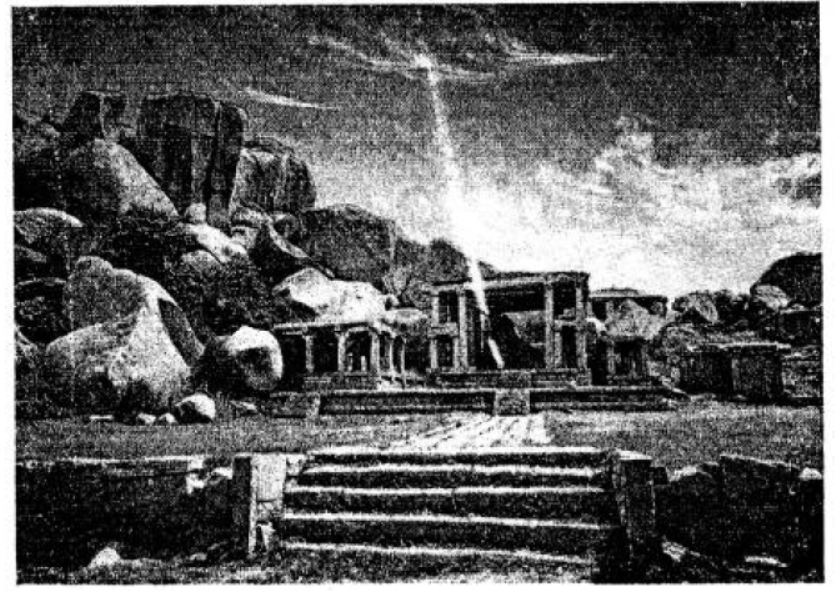
Question 1. Identify the city and name the kingdom.
Answer: The photograph depicts the ruins of the capital city of Hampi, which was the heart of the Vijayanagar Empire.
In simple words: The ruins are of the capital city of Hampi, belonging to the Vijayanagar Empire.
Exam Tip: Identify 'Hampi' as the city and 'Vijayanagar' as the empire.
Question 2. Who was the greatest ruler of this kingdom?
Answer: The most prominent and celebrated ruler of this kingdom was Maharaja Krishnadeva Raya.
In simple words: The greatest king of this empire was Krishnadeva Raya.
Exam Tip: Provide the name 'Krishnadeva Raya' clearly.
Question 3. Mention any five achievements of this ruler.
Answer: Five major achievements of Krishnadeva Raya include:
1. Trade Growth: He encouraged international trade, establishing friendly ties with Portuguese merchants on the Malabar Coast.
2. Fiscal Expansion: He increased state revenues by regulating customs duties and taxes on traded goods.
3. Irrigation Projects: He developed farming by building a network of canals, dams, and reservoirs to irrigate dry agricultural fields.
4. Support for Literature: He was a major patron of art and literature, composing books in Sanskrit and Telugu.
5. Court Culture: He maintained a magnificent court that hosted and supported celebrated poets and scholars.
In simple words: He boosted trade with the Portuguese, increased tax revenues, built canals and dams to improve farming, wrote books in Sanskrit and Telugu, and supported scholars in his grand court.
Exam Tip: List all five distinct achievements: promoting foreign trade, regulating custom taxes, building canals, writing literature, and supporting court scholars.
Question 4. Describe briefly the capital city of this kingdom.
Answer: Hampi, the capital city of the Vijayanagar Empire, was celebrated as a magnificent metropolis:
1. Defensive Fortifications: The city was protected by a system of seven concentric defensive walls, spanning a total circumference of 96 kilometers.
2. Urban Planning: The streets were well-paved, organized, and lined with gardens, fresh lakes, large mansions, and beautiful temples.
3. Wealth and Markets: The city was exceptionally wealthy; markets overflowed with fresh flowers, and precious gemstones like diamonds, rubies, pearls, and emeralds were openly traded in busy bazaars, with most citizens wearing fine jewelry.
In simple words: Hampi was a grand city protected by seven strong walls. It had well-planned, paved streets with beautiful gardens, lakes, and temples. The city was extremely wealthy, with diamonds, rubies, and pearls being sold openly in crowded bazaars.
Exam Tip: Describe the seven concentric walls protecting the city and its prosperous bazaars where precious gems were openly traded.
Question 5. What is the most outstanding feature of the Gol Gumbaz?
Answer: The most famous feature of the Gol Gumbaz is its massive whispering dome. Any slight sound or whisper made inside the dome's inner gallery echoes clearly nine times back to the speaker.
In simple words: Its most famous feature is its massive whispering dome, where even a tiny whisper echoes back clearly nine times.
Exam Tip: Identify the 'whispering dome' as its most outstanding feature, explaining that sounds echo back nine times.
Free study material for History Civics
ICSE Study Resources for Class 7 History Civics Chapter 06 The Vijayanagar And Bahmani Kingdom
About ICSE Solutions for Class 7 History Civics Chapter 06 The Vijayanagar And Bahmani Kingdom
Review accurate ICSE solutions for Chapter 06 The Vijayanagar And Bahmani Kingdom tailored for Class 7 History Civics students. Use these step-by-step notes to simplify difficult textbook exercises and improve exam readiness.
Concept Clarification for Chapter 06 The Vijayanagar And Bahmani Kingdom
Tackle complex theorems and numerical problems easily by cross-referencing your working steps with our structured solution guides.
Effective Revision Strategies for Chapter 06 The Vijayanagar And Bahmani Kingdom
Wrap up your chapter revision by verifying core concepts against standard ICSE question formats. All resources on our platform are free to access.
FAQs
You can download the verified Goyal Brothers solutions for Chapter 06 The Vijayanagar And Bahmani Kingdom on StudiesToday.com. Our teachers have prepared answers for Class 7 History Civics as per 2026-27 ICSE academic session.
Yes, our solutions for Chapter 06 The Vijayanagar And Bahmani Kingdom are designed as per new 2026 ICSE standards. 40% competency-based questions required for Class 7, are included to help students understand application-based logic behind every History Civics answer.
Yes, every exercise in Chapter 06 The Vijayanagar And Bahmani Kingdom from the Goyal Brothers textbook has been solved step-by-step. Class 7 students will learn History Civics conceots before their ICSE exams.
Yes, follow structured format of these Goyal Brothers solutions for Chapter 06 The Vijayanagar And Bahmani Kingdom to get full 20% internal assessment marks and use Class 7 History Civics projects and viva preparation as per ICSE 2026 guidelines.