

Class 7 History Civics Chapter 05 Government Society And Culture Under The Delhi Sultanate: Goyal Brothers Study Material
Review the Goyal Brothers Solutions for ICSE Class 7 History Civics Chapter 5 Government Society And Culture Under The Delhi Sultanate designed for Class 7 History Civics students. Published under the latest ICSE guidelines for 2026-27, these chapter-wise solutions provide the foundational knowledge required for exam success.
Chapter 05 Government Society And Culture Under The Delhi Sultanate Answer Guide
Navigate directly to the Chapter 05 Government Society And Culture Under The Delhi Sultanate solutions using the digital viewer below. Organizing your study sessions chapter-by-chapter allows for seamless offline study and quick reference during revision.
Government, Society and Culture Under The Delhi Sultanate
Important Words
- Qazis: Administered justice according to the Islamic law, in cases that involved Muslims.
- Amir Khusrau: A famous Persian poet who invented the Indian sitar.
- Qawwali: The Persian style of group singing which was popularized by Sufi saints.
- Kathak: A dance form which originated during the Sultanate period. It combines Hindu themes with Persian costumes.
I. Fill in the blanks:
1. The village administration was managed by Muqaddam.
2. Firoz Shah Tughlaq made the Iqtdary system hereditary.
3. Iqtdar received Iqtas.
4. Firoz Shah Tughlaq arranged irrigation facilities for the farmers.
5. The mixture of Persian and Hindu style in architecture is called Indo-Islamic style.
II. Match Column A with Column B:
| Column A | Column B (Correct Match) |
|---|---|
| 1. Qazi | (e) Chief Justice |
| 2. Tughlaqabad Fort | (c) Delhi |
| 3. Qutab Minar | (b) Qutub-ud-din Aibak |
| 4. Urdu | (f) Camp |
| 5. Minhaj-us-Siraj | (a) Historian |
| 6. Amir Khusrau | (d) Great poet of Persian and Hindi |
III. State whether the following statements are True or False:
1. Urdu, a new language, developed in the Sultanate period.
Answer: True
2. The Sufi saints believed in one God.
Answer: False
3. The Sultanate was a military rule.
Answer: True
4. The village administration was managed by the Bakshi.
Answer: False
5. The culture of the sultanate period saw healthy blending of Hindu and Muslim traditions.
Answer: True
IV. Answer the following questions briefly:
Question 1. How did the government function during the Sultanate Period?
Answer: During the Delhi Sultanate, the central administration was divided into several specialized departments, each overseen by a minister or senior officer:
1. Diwan-i-Wazarat (Finance Department): Directed by the Wazir, who managed all land revenue collections and state expenditures.
2. Diwan-i-Arz (Military Department): Led by the Ariz-i-Mumalik, this office was responsible for recruiting, equipping, training, and paying the state soldiers.
3. Diwan-i-Risalat (Religious and Judicial Department): Handled religious matters, public endowments, and scholarships. This was supervised by the Chief Sadr, who often acted as the Chief Qazi (head of the judicial department).
4. Diwan-i-Insha (State Correspondence Department): Handled all domestic and international state correspondence.
At the local level, village administration was run by the Muqaddam, while financial records were supervised by the Munsif and recorded by the Patwari.
In simple words: The Sultanate government operated through departments: the Wazir managed taxes, the Ariz-i-Mumalik ran the army, the Chief Sadr handled religious matters, and the Diwan-i-Insha managed state letters. Villages were run by the Muqaddam.
Exam Tip: List the four central departments along with their respective heads and duties to earn full marks.
Question 2. What do you understand by Iqta system? How was this system organised?
Answer: The Iqta system was a unique land revenue and military arrangement introduced by the Delhi Sultans. Instead of paying cash salaries to military officers and nobles, the state granted them the right to collect land revenue from a specific region or village.
The system was organized as follows:
1. Role of the Iqtadar: The officer in charge was responsible for collecting taxes from their assigned territory.
2. Salary and Troops: From this collected revenue, the iqtadar kept a portion as their personal salary. The remaining funds were spent on maintaining a designated contingent of soldiers to assist the Sultan during wars.
3. State Tribute: Iqtadars had to pay a fixed surplus amount annually to the royal treasury and maintain detailed financial accounts of their collections and expenses.
In simple words: Instead of receiving a cash salary, officers were given pieces of land to collect taxes from. They kept a portion as their salary, used the rest to maintain soldiers for the Sultan, and sent any extra surplus money back to the treasury.
Exam Tip: Define 'Iqta' as a revenue-yielding land assignment and explain the iqtadar's dual duty: maintaining troops and submitting surplus revenue to the Sultan.
Question 3. How was society divided during the Sultanate period?
Answer: During the Delhi Sultanate, society was divided into four main social classes:
1. The Aristocratic Class: The most powerful and influential group, composed of the Sultan, royal princes, nobles, and high-ranking state officials. They possessed immense wealth and lived highly luxurious lives.
2. The Priestly and Scholar Class: Composed of the Muslim Ulemas and Hindu priests. They served as influential advisors, guiding the administration and the judiciary in accordance with sacred religious laws.
3. The Town Dwellers (Middle Class): Composed of merchants, traders, local administrative clerks, and skilled artisans who maintained a comfortable standard of living.
4. The Peasantry and Common People: Formed the vast majority of the population. They were mostly landless farmers and laborers who lived in poverty, struggling to meet their basic daily needs.
In simple words: Society was divided into four classes: the rich aristocracy, the religious scholars, the middle-class town dwellers, and the poor peasants who made up the majority of the population.
Exam Tip: Be ready to list all four classes in order of social hierarchy: the aristocracy, the religious/priestly class, the middle-class merchants, and the poor peasantry.
Question 4. Describe the important developments which took place in the following fields during the Sultanate period (a) Language (b) Music and (c) Dance.
Answer: The Sultanate period witnessed significant cultural exchanges across different artistic fields:
(a) Language: Persian was adopted as the official language of the administration and the court, while Arabic was commonly used by traders from Western Asia. Sanskrit remained the language of higher learning among Hindus. The interaction of Persian and Hindi gave rise to a new language, Urdu, which was developed so that soldiers from different linguistic backgrounds could communicate in military camps.
(b) Music: This era saw the blending of Perso-Arabic and classical Indian musical traditions, creating the Hindustani music style. New musical instruments, such as the tabla, sitar, and sarangi, were developed. The Persian style of group singing, known as Qawwali, was also popularized by Sufi saints.
(c) Dance: The classical dance form Kathak originated during this era. This style combined traditional Hindu mythological themes with Persian courtly costumes and movements.
In simple words: In language, Persian was used for government work, while the blending of Persian and Hindi created Urdu. In music, Perso-Arabic and Indian styles mixed to create Hindustani music, introducing instruments like the sitar and tabla. In dance, Kathak emerged, blending Hindu themes with Persian costumes.
Exam Tip: Use the three sub-headings to explain linguistic changes, musical innovations, and dance developments.
Question 5. With examples explain how the Turks and the Arabs influenced the architecture of the Sultanate period.
Answer: Turkish and Arab architectural styles brought distinctive features and engineering techniques to India, laying the foundation of Indo-Islamic architecture:
1. Engineering Features: Builders made extensive use of red sandstone, bricks, structural arches, columns, domes, beams, and balconies, which were new to traditional Indian building styles.
2. Decorative Elements: Since Islam prohibited carving human or animal figures, buildings were decorated with intricate geometric patterns, floral designs, and panels of Arabic script featuring verses from the Koran carved on the walls.
3. Notable Examples: Celebrated monuments from this era include the Qutub Minar complex, the grand Alai Darwaza, the tomb of Ghiyasuddin Tughlaq, the ruins of Firoz Shah Kotla, the Tughlaqabad Fort, and the tombs of the Lodi kings.
In simple words: The Turks and Arabs introduced the use of large arches, domes, and red sandstone in Indian buildings. Since they did not carve human figures, they decorated their buildings with beautiful geometric patterns, flowers, and verses from the Quran, as seen in the Qutub Minar and Alai Darwaza.
Exam Tip: Identify 'arches, domes, and red sandstone' as the key structural imports, and list the Qutub Minar or Alai Darwaza as primary examples.
V. Picture study:
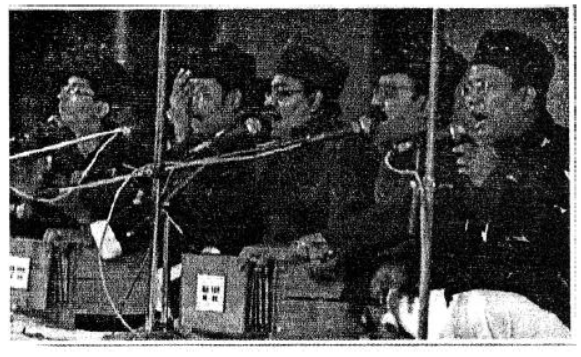
Question 1. What is the name of this form of music?
Answer: The photograph depicts a traditional Qawwali performance, a popular style of Sufi devotional music.
In simple words: This form of music is called Qawwali.
Exam Tip: Identify it as Qawwali, a form of collective devotional singing popular among Sufis.
Question 2. Name the famous personality who created this.
Answer: The celebrated Persian poet and musician Amir Khusrau is credited with creating and popularizing this musical style.
In simple words: This style of music was created by the famous poet and musician, Amir Khusrau.
Exam Tip: Identify 'Amir Khusrau' as the pioneer of this musical style.
Question 3. What is the theme of the music?
Answer: The primary theme of this music is devotional love and spiritual praise, often using the Ghazal style, which combines lyrical poetry with classical melodies to express devotion.
In simple words: The theme of the music is spiritual devotion and love for the Divine, often written as lyrical poems called Ghazals.
Exam Tip: Mention that the music centers on spiritual devotion and utilizes the Ghazal format.
A. Fill in the blanks:
1. The rule of the Delhi Sultans lasted for over three centuries.
2. Society during the Sultanate period was divided into four major groups.
3. The Turks introduced Arabic and Persian architectural styles.
4. New musical instruments such as the tabla, sitar and sarangi were developed during the Sultanate period.
5. The establishment of the Turkish rule in India led to the replacement of Sanskrit by Persian as the official language in many regions.
B. Match the following:
| Column A | Column B (Correct Match) |
|---|---|
| 1. The ulemas | (e) Muslim religious leaders |
| 2. Alai Darwaza | (a) Qutb Minar |
| 3. Qawwali | (b) chorus singing |
| 4. Kathak | (c) combines Hindu themes with Persian costumes |
| 5. Yunani | (d) a system of medicine which was a legacy of Turkish rule |
C. Choose the correct answer:
Question 1. Under the Delhi Sultanate, which class was the most powerful class in society?
(a) the aristocrats
(b) the priests
(c) the peasants
(d) None of the options
Answer: (a) the aristocrats
In simple words: The aristocrats, consisting of the Sultan and court nobles, held most of the land and wealth, making them the most powerful social class.
Exam Tip: Identify the aristocracy as the supreme social and economic class of this era.
Question 2. Which group served as the chief advisors to the sultans?
(a) the brahmanas
(b) the ulema
(c) the merchants
(d) None of the options
Answer: (b) the ulema
In simple words: The ulema, who were Muslim religious scholars and legal experts, advised the Sultans on running the state according to Islamic laws.
Exam Tip: The ulema exercised significant political influence as advisors on religious and judicial administration.
Question 3. The life of which group was one of drudgery and poverty?
(a) the peasants
(b) the nobles
(c) the priests
(d) None of the options
Answer: (a) the peasants
In simple words: Ordinary peasants had to pay heavy taxes and work extremely hard, making their lives very difficult and poor.
Exam Tip: Point to the peasantry as the most exploited class who bore the primary tax burden of the state.
Question 4. The caste system was followed in what way by Hindus?
(a) strictly
(b) sometimes followed
(c) ignored
(d) None of the options
Answer: (a) strictly
In simple words: Despite the influence of other cultures, Hindu society continued to follow the traditional caste system very strictly.
Exam Tip: Note that traditional social hierarchies like the caste system remained rigid and unchanged among Hindus during the Sultanate.
Question 5. Amir Khusrau is believed to have invented which musical instrument?
(a) harmonium
(b) sitar
(c) veena
(d) None of the options
Answer: (b) sitar
In simple words: Amir Khusrau is credited with inventing the sitar by combining elements of the South Indian veena with the Persian tanpura.
Exam Tip: Identify the sitar as the famous stringed instrument invented by Amir Khusrau during this era.
D. State whether the following are true or false:
1. The ruling class in the Delhi Sultanate enjoyed a lavish lifestyle.
Answer: True
2. The Delhi sultans always allowed the ulema to influence their policies.
Answer: False (Correct statement: The Delhi sultans did not always allow the ulema to influence their state policies.)
3. The purdah system was strictly observed by Muslim women.
Answer: True
4. The Rajput style of miniature painting continued in the Sultanate period.
Answer: True
5. New types of food, such as bread and wine, became a part of Indian cuisine during the Sultanate period.
Answer: True
E. Answer the following questions in one or two words/ sentences:
Question 1. Why was the aristocracy the most powerful social group during the Sultanate period?
Answer: The aristocracy held supreme social status because they controlled the vast land revenues of the state and wielded complete military and political authority.
In simple words: The aristocrats were the most powerful group because they held almost all the country's wealth, land, and political power.
Exam Tip: Point to their control over land revenues and military offices as the sources of their absolute power.
Question 2. What was the chief source of revenue for the government?
Answer: The primary source of income for the Sultanate treasury was the land tax collected directly from agricultural harvests and the peasantry.
In simple words: The main source of money for the government was the land tax paid by the farming peasants.
Exam Tip: Specify the 'land tax' paid by the peasants as the primary revenue stream for the state treasury.
Question 3. During whose reign did the life and conditions of the peasants improve?
Answer: The living conditions of the peasantry improved significantly during the reign of Firoz Shah Tughlaq, who built canals, reduced tax burdens, and offered agricultural loans.
In simple words: Peasants lived more comfortably during the reign of Firoz Shah Tughlaq, who built irrigation canals and reduced their taxes.
Exam Tip: Name 'Firoz Shah Tughlaq' as the Sultan whose public works and tax cuts benefited the farmers.
Question 4. Why did some Hindus convert to Islam?
Answer: Many lower-caste Hindus chose to adopt Islam to escape the economic burden of the Jizya collected only from non-Muslims, and to seek relief from the rigid Hindu caste discrimination.
In simple words: Many lower-caste Hindus converted to escape paying the Jizya tax and to find equality outside the rigid caste system.
Exam Tip: Focus on their desire to escape the 'Jizya' and find relief from rigid caste inequalities.
Question 5. How do we know that women during the Sultanate period were oppressed?
Answer: The oppression of women during this era is proven by the widespread prevalence of restrictive social practices, such as child marriage, the custom of Sati, and the strict enforcement of the Purdah system.
In simple words: Women faced harsh restrictions as practices like child marriage, Sati, and the strict Purdah system became very common.
Exam Tip: List specific restrictive customs - such as Sati, child marriage, and the Purdah system - as evidence of their social oppression.
Question 6. What is the characteristic feature of Sultanate architecture?
Answer: The defining elements of Sultanate building design include the widespread use of bricks and red sandstone, along with structural arches, domes, columns, beams, and balconies.
In simple words: Their architecture is known for using red sandstone, bricks, large arches, and round domes.
Exam Tip: Identify 'arches and domes' as the signature engineering imports of this architectural style.
Question 7. Which two styles of music influenced the development of Hindustani music?
Answer: Hindustani classical music developed as a unique fusion, combining traditional Perso-Arabic melodies with native Indian classical music styles.
In simple words: Hindustani music grew out of the blending of Perso-Arabic and classical Indian musical styles.
Exam Tip: Specify the 'Perso-Arabic' and 'Indian classical' styles as the two primary influences.
Question 8. By whom were qawwalis popularized?
Answer: The Persian style of group devotional singing, known as Qawwali, was popularized throughout India by Sufi mystics and saints.
In simple words: The group singing style called Qawwali was popularized by Sufi saints during their devotional meetings.
Exam Tip: Identify the 'Sufi saints' as the key group who popularized this musical form.
Question 9. Which style of painting was patronized by the Lodi sultans?
Answer: The later Lodi rulers patronized the delicate Persian style of miniature painting, using it primarily to illustrate manuscripts and books.
In simple words: The Lodi kings supported the Persian style of miniature painting to decorate and illustrate books.
Exam Tip: Name 'Persian miniature painting' as the specific artistic style favored by the Lodi Dynasty.
Question 10. How did the Turkish rulers gradually become Indianized?
Answer: Over time, Turkish nobles settled in India and contracted marriages with local Indian Muslims. Through these marital ties, they adopted regional languages, food habits, and customs, gradually becoming Indianized.
In simple words: By marrying local Indian Muslims, the Turkish rulers naturally adopted local customs, food, and culture, gradually becoming part of Indian society.
Exam Tip: Explain that intermarriage with local Indian Muslims led to the adoption and assimilation of regional cultural customs.
F. Answer the following questions briefly:
Question 1. What effect did several centuries of interaction between traditional Indian culture and Islamic culture have on the Indian society?
Answer: The prolonged coexistence and interaction of indigenous Indian traditions and Islamic culture deeply impacted medieval society, leading to a unique cultural synthesis. This harmonious blend of styles is known as Indo-Islamic culture, visible in art, music, language, and architecture.
In simple words: The meeting of Indian and Islamic cultures led to a beautiful blend of styles in building, speaking, and living, which we call Indo-Islamic culture.
Exam Tip: Focus on the term 'Indo-Islamic culture' to describe the cultural fusion that resulted from these exchanges.
Question 2. Describe the main features of society during the Sultanate period with reference to (a) the aristocracy and (b) the peasants.
Answer: Medieval society during this era was deeply unequal, divided into distinct social classes:
(a) The Aristocracy: This powerful upper class was composed of the Sultan, court nobles, royal princes, Hindu rajas, and wealthy landowners. They controlled the vast resources of the state, maintained private armies, and lived extremely luxurious lives.
(b) The Peasantry: Composing the vast majority of the population, farmers and laborers lived in extreme poverty. They worked hard, performed menial tasks, and had to pay heavy land taxes to the state, leaving them with barely enough to survive.
In simple words: The aristocracy was the wealthy ruling class of nobles and princes who held all the power. The peasants, who made up the majority, were extremely poor, worked hard, and paid heavy taxes to the state.
Exam Tip: In your answer, contrast the luxurious lives of the aristocracy with the poverty and heavy taxation faced by the peasantry.
Question 3. Discuss the distinctive features of Sultanate architecture.
Answer: Indo-Islamic architecture introduced several distinctive features and engineering techniques to India:
1. Structural Features: Builders made extensive use of red sandstone, bricks, structural arches, columns, domes, beams, and balconies, which were new to traditional Indian building styles.
2. Decorative Elements: Since Islamic tradition prohibited carving human or animal figures, buildings were decorated with intricate geometric patterns, floral designs, and panels of Arabic script featuring verses from the Koran carved on the walls.
3. Prominent Examples: Major monuments from this era include the Qutub Minar complex, the grand Alai Darwaza, the tomb of Ghiyasuddin Tughlaq, the ruins of Firoz Shah Kotla, the Tughlaqabad Fort, and the tombs of the Lodi kings.
In simple words: The Turks and Arabs introduced the use of large arches, domes, and red sandstone in Indian buildings. Since they did not carve human figures, they decorated their buildings with beautiful geometric patterns, flowers, and verses from the Quran, as seen in the Qutub Minar and Alai Darwaza.
Exam Tip: Identify 'arches, domes, and red sandstone' as the key structural imports, and list the Qutub Minar or Alai Darwaza as primary examples.
Question 4. Music and dance during the Sultanate period was the outcome of the fusion of Indo-Islamic culture. Explain.
Answer: The fusion of Indian and Islamic traditions deeply transformed performing arts during this era:
- Music: Hindustani classical music developed from the blending of Perso-Arabic melodies with native Indian classical music styles. This era introduced several iconic instruments, including the sitar, the tabla, and the sarangi. Additionally, Sufi mystics popularized the group devotional singing style known as Qawwali at their spiritual gatherings.
- Dance: The classical dance form Kathak developed during this era, beautifully combining traditional Hindu mythological themes with Persian courtly costumes and movements.
In simple words: In music, Perso-Arabic and Indian styles mixed to create Hindustani music, introducing instruments like the sitar and tabla. In dance, Kathak emerged, blending Hindu themes with Persian costumes.
Exam Tip: Discuss specific innovations: the invention of the sitar by Amir Khusrau, the rise of Qawwali group singing, and the origin of Kathak dance.
Question 5. Explain how new customs and practices changed the traditional lifestyle of the Indians.
Answer: The arrival of Turkish and Persian settlers introduced new lifestyles, customs, and cuisines to India:
1. Clothing: People adopted new styles of clothing, such as pyjama-kurtas, kaftans, and salwar-kameez, which became common attire for both Hindus and Muslims and remain popular today.
2. Cuisine: Indian culinary traditions were enriched by the introduction of rich, flavorful dishes such as biryani, along with new types of bread and wines, permanently transforming Indian cuisine.
In simple words: New customs transformed Indian lifestyles: people adopted clothes like pyjama-kurtas and salwar-kameez, and Indian cuisine was enriched with delicious dishes like biryani.
Exam Tip: Discuss two main areas of change: clothing and food.
G Picture study:
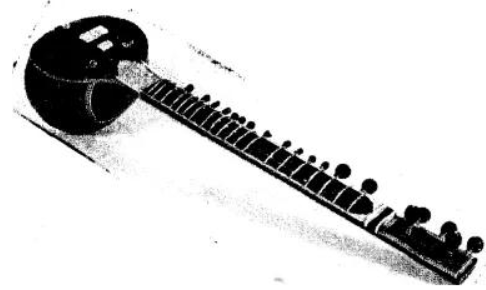
Question 1. Identify the muscial instrument.
Answer: The photograph depicts the Sitar, a popular stringed musical instrument.
In simple words: The musical instrument shown in the picture is the Sitar.
Exam Tip: Identify the instrument as the Sitar, a signature stringed instrument of Hindustani music.
Question 2. During which period in medieval Indian history was this instrument invented?
Answer: This instrument was invented during the era of the Delhi Sultanate.
In simple words: The Sitar was invented during the Delhi Sultanate period.
Exam Tip: State the 'Delhi Sultanate' as the historical period of its invention.
Question 3. By whom and how was it invented?
Answer: The sitar is believed to have been invented by the celebrated court poet and musician, Amir Khusrau. He designed it by combining elements of the South Indian veena with the Persian tanpura.
In simple words: It was invented by Amir Khusrau, who combined the South Indian veena with the Persian tanpura to create this new stringed instrument.
Exam Tip: Name Amir Khusrau as the inventor, and explain that he designed it by combining the Indian veena with the Persian tanpura.
Question 4. Name two other musical instruments that were developed during this period
Answer: Two other prominent musical instruments developed during this era were the tabla and the sarangi.
In simple words: Two other instruments created during this time were the tabla and the sarangi.
Exam Tip: List the 'tabla' and the 'sarangi' as the two other musical instruments developed during the Sultanate.
Free study material for History Civics
Verified Textbook Solutions for Class 7 History Civics Chapter 05 Government Society And Culture Under The Delhi Sultanate
ICSE Chapter Solutions: Class 7 History Civics Chapter 05 Government Society And Culture Under The Delhi Sultanate
Strengthen your preparation with comprehensive answers for Class 7 History Civics Chapter 05 Government Society And Culture Under The Delhi Sultanate. These expert-reviewed solutions make tracking your academic progress straightforward and efficient.
Concept Clarification for Chapter 05 Government Society And Culture Under The Delhi Sultanate
Tackle complex theorems and numerical problems easily by cross-referencing your working steps with our structured solution guides.
Effective Revision Strategies for Chapter 05 Government Society And Culture Under The Delhi Sultanate
Pair your solution review with additional practice papers to test your execution speed and ensure total preparedness for school exams.
FAQs
You can download the verified Goyal Brothers solutions for Chapter 05 Government Society And Culture Under The Delhi Sultanate on StudiesToday.com. Our teachers have prepared answers for Class 7 History Civics as per 2026-27 ICSE academic session.
Yes, our solutions for Chapter 05 Government Society And Culture Under The Delhi Sultanate are designed as per new 2026 ICSE standards. 40% competency-based questions required for Class 7, are included to help students understand application-based logic behind every History Civics answer.
Yes, every exercise in Chapter 05 Government Society And Culture Under The Delhi Sultanate from the Goyal Brothers textbook has been solved step-by-step. Class 7 students will learn History Civics conceots before their ICSE exams.
Yes, follow structured format of these Goyal Brothers solutions for Chapter 05 Government Society And Culture Under The Delhi Sultanate to get full 20% internal assessment marks and use Class 7 History Civics projects and viva preparation as per ICSE 2026 guidelines.