

Official Goyal Brothers Textbook Solutions for Class 7 History Civics
Explore the complete Goyal Brothers textbook solutions for Class 7 History Civics. Tailored for the 2026-27 curriculum, this resource breaks down complex topics to support daily study and targeted revision.
Read and Download Chapter 04 The Delhi Sultanate Solutions
View or download the dedicated Chapter 04 The Delhi Sultanate resource below. This chapter-by-chapter structuring ensures easy navigation for daily study routines and immediate access to core academic concepts.
The Delhi Sultanate
Important Words
- Price control: The practice where the king or the government controls the prices of goods to prevent shopkeepers from increasing prices.
- Devagiri: The city which Muhammad bin Tughlaq chose to shift his capital to. He renamed it Daulatabad.
- Token currency: The system of currency introduced by Muhammad bin Tughlaq where brass and copper coins were to have the same value as silver and gold coins.
- The ulema: The group of Muslim religious scholars who also advised the king.
I. Fill in the blanks:
1. Qutab-ud-din Aibak was the real founder of the Slave Dynasty.
2. Razia was nominated by Iltutmish as his successor.
3. Balban’s theory of kingship was divine.
4. Jalal-ud-din Khalji was the first Khalji ruler.
5. Malik Kafur led many campaigns in North India and every time he brought a huge booty of gold, jewels, elephants and horses.
6. Amir Khusrau was a well-known poet in the court of Ala- ud-din Khalji.
7. Ala-ud-din constructed a big tank called Hauz khas.
8. Muhammad-bin-Tughlaq shifted his capital from Delhi to Devagiri.
9. Amir Timur invaded India in AD 1398.
10. Muhammad-bin-Tughlaq introduced copper coins in place of gold and silver coins.
II. Match Column A with Column B:
| Column A | Column B (Correct Match) |
|---|---|
| 1. Razia | (d) the only woman ruler of the Delhi Sultanate. |
| 2. Balban | (c) believed in absolute monarchy |
| 3. Iltutmish | (a) nominated his daughter to the throne |
| 4. Aibak | (b) founder of the Slave Dynasty |
| 5. Ala-ud-din Khalji | (e) introduced control of prices and rationing system. |
| 6. Muhammad-bin-Tughlaq introduced | (g) token currency |
| 7. Doab means | (f) land between two rivers |
| 8. Bahlol Lodi | (i) Founder of Lodi dynasty. |
| 9. AD 1526 | (h) First Battle of Panipat was fought. |
III. State weather the following statements are True Or False:
1. Qutub-ud-din Aibak built the Qutab Minar of Delhi.
Answer: True
2. Balban believed in absolute monarchy.
Answer: True
3. Malik Kafur was also known as Hazar Dinari because he was bought for a thousand dinars.
Answer: True
4. Muhammad-bin-Tughlaq is known as a ‘mixture of opposites’.
Answer: True
5. Firoz Shah Tughlaq was Muhammad-bin-Tughlaq’s son.
Answer: False
6. Sikandar Lodi lost control over the Gangetic Valley.
Answer: False
7. Khizr Khan was the founder of Sayyid dynasty.
Answer: False
IV. Answer the following questions briefly:
Question 1. What were the difficulties that Iltutmish had to face and how did he tackle them?
Answer: Upon ascending the throne, Iltutmish faced immediate opposition and challenges because he lacked a hereditary claim to royalty, starting his reign as a former slave. However, he met these threats with outstanding administrative and military skills, acting as a strong, clever, and highly efficient ruler to subdue internal rebellions and consolidate his control over northern India.
In simple words: Iltutmish faced immediate rebellions because he did not inherit the throne. However, he overcame these challenges by proving to be a highly capable and strong military ruler who consolidated his power.
Exam Tip: Point out that his lack of a hereditary claim was his primary initial challenge, which he overcame through strong and efficient governance.
Question 2. Write in brief about the rise and fall of Razia Sultan.
Answer: Razia Sultan rose to power as a courageous and highly intelligent ruler, nominated directly by her father, Iltutmish. She possessed strong leadership qualities, choosing to dress in male attire, ride horses, and hold open courts to manage administrative affairs. Despite inheriting a kingdom in complete chaos, she successfully restored law and order, proving to be a wise, compassionate, and benevolent monarch who personally led her armies into battles. However, her reign faced continuous opposition from orthodox Turkish nobles who deeply resented being governed by a woman. This discontent grew when she showed special favor to an African slave named Yakut, which served as a major pretext for the nobles to rebel, leading to her sudden defeat and downfall.
In simple words: Razia Sultan was a brave and intelligent ruler who restored order, led armies, and ruled in open courts. However, she was overthrown because noblemen did not want to be ruled by a woman, especially after she showed favor to a slave named Yakut.
Exam Tip: Discuss her administrative capabilities alongside her major challenges: the nobility's prejudice against a female ruler and her alliance with Yakut.
Question 3. Who was Balban? What step»did he take to consolidate the Sultanate?
Answer: Ghiyas-ud-din Balban was the father-in-law of Sultan Nasir-ud-din, who assumed absolute power in AD 1266 following the Sultan's death. To stabilize and consolidate the Delhi Sultanate, Balban implemented several systematic reforms:
1. Reorganizing the Army: He reformed the military department, increasing its efficiency and combat readiness.
2. Establishing Royal Prestige: He created a strong sense of awe and absolute respect for the monarchy among the general public and nobles.
3. Securing Loyalty: He forced the powerful Turkish nobles and subjects to show absolute, unquestioning loyalty to the crown.
4. Restoring Order: He reorganized the civil administration, successfully restoring law and order across the provinces.
5. Defending the Borders: He built strong frontier forts to successfully defend the kingdom from repeated Mongol invasions.
6. Implementing Espionage: He established an exceptionally efficient spy system to gather intelligence on conspiracies.
7. Divine Kingship Theory: He promoted the 'divine theory' of kingship, declaring that the king serves as God's representative on earth, making his authority absolute.
In simple words: Balban became Sultan in 1266. He secured his empire by strengthening the army, building a strong spy network, repelling Mongol invasions, and forcing his nobles to show absolute loyalty by declaring that the king was God's representative on earth.
Exam Tip: List at least four of Balban's consolidation steps, such as his military reforms, frontier fortresses, espionage network, and the 'divine theory' of kingship.
Question 4. Who was the greatest of the two - Iltutmish or Balban? Give reason for your answer.
Answer: Iltutmish is considered the greater ruler because he successfully established and defended the infant Delhi Sultanate against numerous internal and external threats:
1. Suppressing Internal Rivals: He crushed the opposition of the powerful Turkish nobles who challenged his claim to the throne.
2. Quelling Provincial Rebellions: He successfully put down the rebellion led by the Khalji governor of Bengal, bringing the province back under central control.
3. Defeating External Competitors: He destroyed the power of his primary rivals, the rulers of Ghazni and Multan, securing his borders.
4. Saving India from Mongols: When the Mongol conqueror Chenghiz Khan reached the borders of India pursuing the fleeing Shah of Persia, Iltutmish wisely refused to grant the Shah refuge in Delhi. This diplomatic decision saved India from a devastating Mongol invasion.
5. Territorial Expansion and Recognition: After securing his borders, he defeated the Rajput rulers of Ujjain, Ranthambore, Malwa, and Gwalior, expanding the Sultanate's control across northern India to the Narmada River. His sovereign status was officially recognized by the Caliph of Baghdad.
In simple words: Iltutmish was the greater ruler because he secured the young Sultanate by defeating regional rivals, putting down provincial revolts, and strategically avoiding a Mongol invasion by refusing shelter to the fleeing Persian Shah. He also won the official recognition of the Caliph of Baghdad.
Exam Tip: Discuss his major achievements, such as his military campaigns against rivals, territorial expansion up to the Narmada, and his diplomatic success in avoiding Chenghiz Khan's invasion.
Question 5. Discuss briefly Ala-ud-din’s conquest of the North.
Answer: Alauddin Khilji launched a series of aggressive campaigns to establish complete control over northern India:
1. He first captured the strategic fortress of Ranthambore.
2. In 1303, he laid siege to Chittor, the capital of Mewar. Despite a brave defense by the Rajputs, the fort fell to his forces.
3. He then turned his forces toward Central India, capturing the wealthy cities of Mandu, Ujjain, Dhar, and Chanderi in Malwa.
By 1305 CE, these conquests made Alauddin the undisputed master of almost the entirety of northern India.
In simple words: Alauddin Khilji conquered northern India by capturing major forts like Ranthambore and Chittor, and taking control of wealthy central cities like Ujjain and Mandu. By 1305, he ruled all of northern India.
Exam Tip: Describe his campaigns in chronological order, naming key conquests like Ranthambore, Chittor, and the cities of Malwa.
Question 6. What was the system of chehra and dagh introduced by Ala-ud-din Khalji?
Answer: To prevent corruption and improve military discipline, Alauddin Khilji introduced two key reforms:
1. Chehra: A detailed registry system that kept a physical description of every soldier in the standing army, acting as an early identity card system.
2. Dagh: A branding system where war horses were marked with a royal stamp, ensuring that officers did not replace high-quality cavalry horses with weaker ones.
In simple words: Chehra was an identity-card system keeping physical descriptions of soldiers, and Dagh was a system of branding war horses with a royal stamp to prevent corruption.
Exam Tip: Define both terms clearly: 'Chehra' for soldier identification and 'Dagh' for horse branding.
Question 7. What was the consequence of Muhammad-bin-Tughlaq’s project of shifting his capital?
Answer: The decision to shift the imperial capital from Delhi to Daulatabad led to several disastrous consequences:
1. Rise of External Threats: In the Sultan's absence, Delhi was left vulnerable, leading to renewed invasions by the Mongols.
2. Forced Retreat: Realizing his strategic mistake, Muhammad bin Tughlaq ordered the entire population to march back to Delhi after only two years, causing immense hardship and resentment among his subjects.
3. Economic Ruin: The expensive double relocation drained the state treasury.
4. Destruction of Delhi's Grandeur: The once-prosperous capital of Delhi was reduced to a desolate city, while Daulatabad ended up as a deserted monument to misdirected resources.
In simple words: The capital shift was a total failure. It left Delhi open to Mongol attacks, drained the treasury, and caused immense suffering for the citizens who were forced to move back and forth, leaving Daulatabad deserted and Delhi ruined.
Exam Tip: List the key consequences: increased Mongol threats to Delhi, the drain on the treasury, the suffering of the forced migrants, and the eventual abandonment of Daulatabad.
Question 8. Who was Timur? When did he invade India?
Answer: Amir Timur was a powerful Central Asian conqueror. He launched a devastating invasion of India in AD 1398, sacking Delhi and paving the way for the establishment of the Sayyid Dynasty by his deputy, Khizr Khan.
In simple words: Timur was a Central Asian conqueror who invaded India in AD 1398, destroying Delhi and weakening the Sultanate.
Exam Tip: Specify the year AD 1398 as the date of Timur's invasion, which dealt a fatal blow to the Tughlaq Dynasty.
Question 9. Why is Muhammad-bin-Tughlaq called an ill-starred idealist?
Answer: Muhammad-bin-Tughlaq is often described as an "ill-starred idealist" due to the contrast between his brilliant intellect and his failed policies:
1. Exceptional Intellect: He was highly educated, possessing deep knowledge in mathematics, astronomy, philosophy, and physical sciences.
2. Lack of Practical Judgment: Although a capable military general, he lacked practical common sense, designing grand administrative projects that failed during execution.
3. Independent Secular Approach: He refused to allow religious scholars to interfere in administrative or political decisions.
4. Visionary Nature: Many historians suggest his ideas - such as the introduction of token currency - were highly innovative but introduced far ahead of his time.
In simple words: He is called an ill-starred idealist because he was a brilliant scholar and philosopher, but his grand plans failed because he lacked the practical common sense to execute them properly, introducing ideas that were ahead of his time.
Exam Tip: Explain that his plans were theoretically brilliant but failed due to poor execution and a lack of practical judgment.
V. Give Reason why:
Question 1. Mahmud of Ghazni attacked India.
Answer: Mahmud of Ghazni launched repeated raids on India primarily to plunder its immense wealth, using the looted treasures to enrich his capital of Ghazni, rather than seeking to establish a permanent empire in the subcontinent.
In simple words: Mahmud of Ghazni raided India because he wanted to plunder its gold and riches, rather than conquer land to build an empire.
Exam Tip: Clarify that his main motive was the acquisition of wealth to enrich his central Asian capital, rather than territorial conquest.
Question 2. Turks succeeded against Rajputs
Answer: Although the Rajputs were courageous warriors and expert swordsmen, they were ultimately defeated by the Turkish forces due to several critical weaknesses:
1. Internal Division: The Rajput rulers lacked political unity, often fighting among themselves. For example, Prithviraj Chauhan and Jaichand of Kanauj failed to unite against the invasion of Muhammad Ghori.
2. Mutual Jealousy: Constant rivalries and personal jealousy among Rajput chiefs prevented them from coordinating a unified defense.
3. Absence of a Standing Army: They did not maintain a professional standing army, relying instead on temporary military contributions from feudal lords.
4. Outdated Cavalry Tactics: The Rajput forces were unable to counter the rapid, highly mobile cavalry and advanced tactics used by the Central Asian warriors.
In simple words: The Turks succeeded because the Rajputs were politically divided, lacked a professional standing army, and relied on slow-moving forces that were easily defeated by the fast, highly mobile Turkish cavalry.
Exam Tip: Explain that political disunity and the absence of a professional standing army were the key causes of the Rajput defeat.
Question 3. Nobles rebelled against Razia.
Answer: The orthodox Turkish nobles launched a rebellion against Razia Sultan because they strongly resented her independent authority and rejected the idea of being governed by a woman.
In simple words: The nobles rebelled because they did not want to accept a woman as their ruler.
Exam Tip: Point to the conservative mindset of the Turkish nobility, who refused to accept a female monarch, as the primary reason.
Question 4. Muhammad-bin-Tughlaq’s toktn currency failed.
Answer: The token currency project introduced by Muhammad-bin-Tughlaq failed because the new copper and brass coins were given the same legal value as silver and gold coins. However, the government failed to establish a monopoly over minting, allowing citizens to easily forge these coins at their homes and flood the market with counterfeit currency.
In simple words: The token currency failed because the government did not control the minting process, allowing people to easily fake the copper and brass coins at home, which ruined the economy.
Exam Tip: Explain that the failure to establish state control over minting allowed widespread counterfeiting, which collapsed the system.
VI. Picture study:
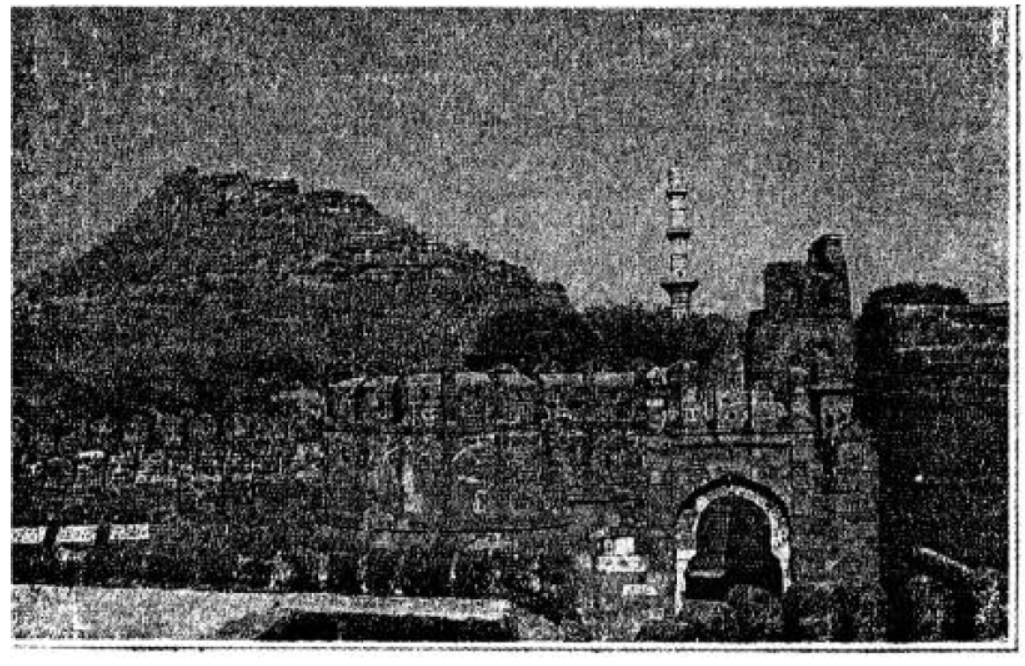
Question 1. Name the ruler who built it.
Answer: The Daulatabad Fort was heavily expanded and utilized by Sultan Muhammad-bin-Tughlaq.
In simple words: The fort was built and used by Sultan Muhammad-bin-Tughlaq.
Exam Tip: Identify the ruler as Muhammad-bin-Tughlaq.
Question 2. Write the two reasons behind the transfer of capital from Delhi to Daulatabad.
Answer: The two primary reasons behind the capital transfer to Daulatabad were:
1. Strategic Central Location: Following the expansion of the Sultanate into southern India, Devagiri was centrally located and nearly equidistant from Delhi and other regional centers, making it easier to administer the south.
2. Defense Against Mongols: Delhi faced constant threats of Mongol raids, whereas Daulatabad in the south offered a safe capital at a secure distance from the invaders.
In simple words: First, Daulatabad was centrally located, making it easier to rule both north and south India. Second, it was far away from the northwest border, making it safe from Mongol attacks.
Exam Tip: Clearly state both reasons: its central geographical position and its safety from Mongol invasions.
Question 3. What were the results of the transfer of capital?
Answer: The capital relocation project ended in complete disaster:
1. Delhi left vulnerable: Leaving Delhi empty exposed it to renewed Mongol threats.
2. Forced Return: Realizing his mistake, the Sultan ordered the entire population to march back to Delhi after only two years, causing immense hardship and anger.
3. Financial Ruin: The double relocation drained the state treasury.
4. Destruction of Delhi's Glory: The once-prosperous capital of Delhi was left desolate, while Daulatabad ended up as a deserted monument to wasted resources.
In simple words: The project was a total failure. It left Delhi open to Mongol attacks, drained the treasury, and caused immense suffering for the citizens who were forced to move back and forth, leaving Daulatabad deserted.
Exam Tip: Highlight key results: increased Mongol threats to Delhi, the drain on the treasury, and the suffering of the forced migrants.
I. Time To Do
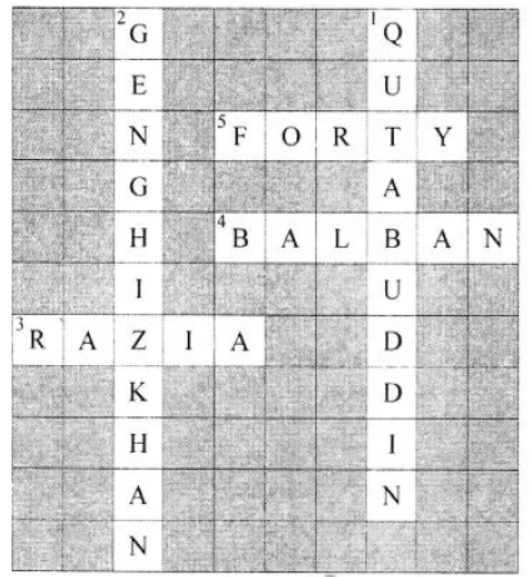
Crossword Puzzle Solved Clues:
Down:
1. Founder of Slave Dynasty - Qutub-ud-din Aibak
2. Leader of Mongols - Genghis Khan
Across:
3. Daughter of Iltutmish - Razia
4. Group of Turkish nobles called - Forty
5. Important Sultan - Balban
Additional Questions
A. Fill in the blanks:
1. The founder of the Khilji dynasty was Jalaluddin - Khilji.
2. Alauddin was a brilliant general and a shrewd administrator.
3. Alauddin was the first Turkish ruler to build an empire in India.
4. Ghiyasuddin Tughlaq was an efficient administrator and a capable military commander.
5. Muhammad bin Tughlaq realized the importance of a strong and powerful army to strengthen and secure the position of the ruler. He needed additional revenue to increase military resources.
6. Firoze Shah’s economic reforms improved agricultural production and made the peasants prosperous and happy.
7. Alauddin built a strong defence system to protect his empire from Mongol raids.
8. Iltutmish defeated the Rajput rulers of Ujjain, Ranthambore, Malwa, and Gwalior and brought the whole of North India upto the river Narmada under his control.
9. The Caliph of Baghdad recognized Iltutmish as the sovereign of India. He was succeeded by his daughter Razia.
B. Match the following:
| Column A | Column B (Correct Match) |
|---|---|
| 1. Jalaluddin Khilji | (c) a mild and pious man |
| 2. Alauddin Khilji | (d) a brilliant general and a shrewd administrator |
| 3. Chanderi | (b) Malwa |
| 4. Warangal | (e) Deccan |
| 5. Price control | (a) Shahna |
C. State weather the following statements are True Or False:
Question 1. Under the Delhi Sultanate, which class was the most powerful class in society?
(a) the aristocrats
(b) the priests
(c) the peasants
(d) None of the options
Answer: (a) the aristocrats
In simple words: The aristocrats, consisting of the Sultan and court nobles, held most of the land and wealth, making them the most powerful social class.
Exam Tip: Identify the aristocracy as the supreme social and economic class of this era.
Question 2. Which group served as the chief advisors to the sultans?
(a) the brahmanas
(b) the ulema
(c) the merchants
(d) None of the options
Answer: (b) the ulema
In simple words: The ulema, who were Muslim religious scholars and legal experts, advised the Sultans on running the state according to Islamic laws.
Exam Tip: The ulema exercised significant political influence as advisors on religious and judicial administration.
Question 3. The life of which group was one of drudgery and poverty?
(a) the peasants
(b) the nobles
(c) the priests
(d) None of the options
Answer: (a) the peasants
In simple words: Ordinary peasants had to pay heavy taxes and work extremely hard, making their lives very difficult and poor.
Exam Tip: Point to the peasantry as the most exploited class who bore the primary tax burden of the state.
Question 4. The caste system was followed in what way by Hindus?
(a) strictly
(b) sometimes followed
(c) ignored
(d) None of the options
Answer: (a) strictly
In simple words: Despite the influence of other cultures, Hindu society continued to follow the traditional caste system very strictly.
Exam Tip: Note that traditional social hierarchies like the caste system remained rigid and unchanged among Hindus during the Sultanate.
Question 5. Amir Khusrau is believed to have invented which musical instrument?
(a) harmonium
(b) sitar
(c) veena
(d) None of the options
Answer: (b) sitar
In simple words: Amir Khusrau is credited with inventing the sitar by combining elements of the South Indian veena with the Persian tanpura.
Exam Tip: Identify the sitar as the famous stringed instrument invented by Amir Khusrau during this era.
D. State whether the following are true or false:
1. Alauddin dreamt of conquering the whole world.
Answer: True
2. Under Alauddin, spies were kept in every unit of the army.
Answer: True
3. Alauddin’s death was followed by great political turmoil.
Answer: True
4. Muhammad bin Tughlaq was a diligent ruler who undertook projects that were brilliantly conceived and executed.
Answer: False (Correct statement: Muhammad bin Tughlaq was a diligent ruler who undertook projects that were brilliantly conceived but poorly executed.)
5. Muhammad bin Tughlaq’s of increasing the taxes in the Ganga-Yamuna Doab region led to the development of agriculture in that region.
Answer: False (Correct statement: The policy of increasing the taxes in the Ganga-Yamuna Doab region led to the severe setback of agriculture in that region.)
6. Muhammad bin Tughlaq stayed in Daulatabad for 5 years.
Answer: False (Correct statement: Muhammad bin Tughlaq stayed in Daulatabad for 2 years.)
E. Answer the following questions in one or two words/ sentences:
Question 1. Under what circumstances did Alauddin ascend the throne of Delhi?
Answer: Alauddin Khilji seized the throne of Delhi by assassinating his uncle, the reigning Sultan Jalaluddin Khilji. During Jalaluddin's mild and pious rule, the state suffered from lawlessness, rebellions, and administrative breakdown. Alauddin took advantage of this political instability to launch a coup and declare himself Sultan.
In simple words: Alauddin became Sultan by killing his uncle, Jalaluddin Khilji. He took advantage of the lawlessness and rebellions that had broken out during his uncle's weak and mild rule to seize power.
Exam Tip: Identify the assassination of his uncle Jalaluddin Khilji and the prevailing political instability as the key circumstances.
Question 2. How did Alauddin Khilji win over the rebellious nobles after capturing the throne?
Answer: After seizing the throne, Alauddin Khilji quickly won over the support of the hostile and rebellious court nobles by distributing massive bribes of gold and valuable gifts.
In simple words: He won over the rebellious noblemen by giving them massive bribes and expensive gifts of gold.
Exam Tip: Simply explain that he used the plundered gold and wealth to bribe and pacify the hostile nobles.
Question 3. Name the capital of Mewar.
Answer: The capital city of the Rajput kingdom of Mewar was Chittor.
In simple words: The capital of Mewar was Chittor.
Exam Tip: Provide the name 'Chittor' clearly as the capital of Mewar.
Question 4. What did the Rajput women in the royal palace do when Alauddin Khilji captured Chittor?
Answer: When Chittor fell to Alauddin's forces, the royal Rajput women performed Jauhar, choosing to immolate themselves on a sacred pyre to protect their honor from the enemy.
In simple words: They performed Jauhar, burning themselves to death to protect their honor from being captured by the enemy.
Exam Tip: Use the term 'Jauhar' to describe the ritual self-immolation performed by the Rajput women.
Question 5. Who led Alauddin’s Deccan campaigns?
Answer: The military expeditions launched by Alauddin Khilji into the Deccan were led by his trusted general, Malik Kafur.
In simple words: The military campaigns in the south were led by his general, Malik Kafur.
Exam Tip: The general's name is 'Malik Kafur' (also known as Hazar Dinari).
Question 6. Why do modern historians reject the account of a mass exodus from Delhi to Daulatabad?
Answer: Modern historians reject the traditional claims of a complete mass evacuation because archaeological and literary evidence proves that Delhi was never fully depopulated. Records show that construction and administrative projects continued in Delhi even during the capital relocation period.
In simple words: Historians do not believe everyone was forced to leave Delhi because records show that construction work and daily activities continued in the city during that time.
Exam Tip: Point to the continued construction activities in Delhi during the transfer period as key proof against a total mass evacuation.
Question 7. Mention any one economic reform introduced in the Doab region by Firozc Shah Tughlaq.
Answer: As part of his economic reforms in the fertile Doab region, Firoz Shah Tughlaq significantly reduced land taxes, abolished several oppressive municipal levies, and cancelled all agricultural loans that had been given during the previous famine.
In simple words: Firoz Shah Tughlaq reduced land taxes and cancelled all the loans that had been given to farmers during the famine.
Exam Tip: You can name either the reduction of land taxes, the abolition of minor levies, or the cancellation of famine loans.
Question 8. Give one example to show that Firoze Shah wasconcerned about the welfare of his poor subjects.
Answer: To help his poor subjects, Firoz Shah Tughlaq established free public hospitals in Delhi, providing medicine and care to those in need.
In simple words: He built free public hospitals to provide medical care to his poor subjects.
Exam Tip: The establishment of free public hospitals is a primary example of his welfare policies.
F. Answer the following questions briefly:
Question 1. With reference to the following conquests, briefly explain how Alauddin extended the boundaries of the – Delhi Sultanate: (a) Conquest of Gujarat (b) Conquest of the Rajput states.
Answer: (a) Conquest of Gujarat: Alauddin expanded his territories westward by sending a military force to Gujarat, which was conquered and annexed into the Delhi Sultanate, opening up rich sea ports for international trade.
(b) Conquest of the Rajput States: He launched aggressive campaigns in Rajasthan and Central India. He first captured the strategic fortress of Ranthambore, followed by a long siege of Chittor, the capital of Mewar, defeating its brave Rajput defenders. His forces then marched into Malwa, capturing wealthy cities like Mandu, Ujjain, Dhar, and Chanderi. By 1305 CE, these conquests made him the master of almost all of northern India.
In simple words: He annexed Gujarat through a military expedition to control its trade ports. In Rajasthan and central India, he captured strategic forts like Ranthambore and Chittor, and took over wealthy cities like Ujjain and Mandu, ruling all of northern India by 1305.
Exam Tip: Explain both campaigns clearly: the annex of Gujarat for trade ports in (a), and the siege of Chittor/conquest of Malwa in (b).
Question 2. Give an account of Alauddin Khilji’s (a) Deccan conquest and (b) Deccan policy.
Answer: (a) Deccan Conquests: Alauddin Khilji was the first Muslim ruler to send military expeditions south of the Vindhyas. Led by his general Malik Kafur, the Mughal forces defeated the southern kingdoms of Devagiri, Warangal, and Dwarasamudra, and raided as far south as Madurai.
(b) Deccan Policy: Unlike his northern campaigns, Alauddin chose not to annex the southern kingdoms. He realized that controlling these distant provinces directly from Delhi was impractical. Instead, his main objective was to acquire wealth to fund his massive army. He allowed the defeated southern kings to keep their thrones, provided they accepted his suzerainty and paid heavy annual tributes as a mark of submission.
In simple words: Alauddin was the first sultan to send armies south of the Vindhyas, led by Malik Kafur, defeating kingdoms in Devagiri, Warangal, and Madurai. His policy was not to annex these lands because they were too far to control from Delhi; instead, he forced them to pay heavy annual tributes to fund his army.
Exam Tip: Describe how Malik Kafur led the conquests in (a), and explain the strategic reason for his non-annexation policy in (b).
Question 3. How did Alauddin protect the Delhi Sultanate from repeated Mongol invasions?
Answer: To defend his empire from repeated Mongol invasions, Alauddin Khilji took several strict military measures:
1. Border Fortifications: He repaired and strengthened the line of fortresses along the northwestern invasion routes, placing these frontier provinces under his most experienced generals.
2. Army Reorganization: He rebuilt, modernized, and expanded his standing army, keeping them combat-ready.
3. Harsh Punishments: Captured Mongol leaders were executed in a brutal manner, often being trampled by war elephants to scare invaders.
4. Eliminating Internal Threats: Fearing a conspiracy, he ordered the execution of the 'New Muslims' - Mongols who had converted to Islam and settled in Delhi during the previous reign.
In simple words: Alauddin repaired the northwestern forts and placed them under his best generals, strengthened his standing army, executed captured Mongol leaders brutally using elephants, and eliminated the converted Mongols living in Delhi to prevent any internal conspiracies.
Exam Tip: List at least three measures: fortifying northwestern borders, reorganizing his standing army, and implementing harsh deterrent punishments.
Question 4. Why is Muhammad bin Tughlaq regarded as one of the most accomplished and learned scholars of his times?
Answer: Muhammad bin Tughlaq is considered one of the most learned scholars of medieval India due to his deep intellectual curiosity and passion for diverse subjects. Blessed with an exceptional memory, he mastered several complex fields, including logic, philosophy, mathematics, astronomy, and physical sciences. Furthermore, he held a deep appreciation for Persian literature, calligraphy, fine arts, and music, and always sought the company of scholars and philosophers.
In simple words: He is regarded as a great scholar because he was highly educated, possessed an exceptional memory, and mastered mathematics, astronomy, logic, and philosophy, while actively supporting writers, artists, and poets at court.
Exam Tip: Discuss his mastery over diverse fields like logic, astronomy, and mathematics, and note his patronization of scholars.
Question 5. Discuss the causes and results of the taxation scheme of Muhammad bin Tughlaq in the Doab.
Answer: The taxation scheme in the fertile Doab region had several causes and disastrous results:
- Causes: The Sultan wanted to build a strong and powerful standing army to secure his empire, which required additional revenue. To raise these funds, he decided to increase the land taxes in the fertile region of the Ganga-Yamuna Doab.
- Results: Unfortunately, the tax increase coincided with a severe drought and famine. Facing starvation, the peasants were unable to pay the increased taxes. However, tax collectors showed no mercy, demanding payment strictly. This harsh collection ruined the farmers, forcing many to abandon their lands and flee into the forests, which brought farming in the region to a halt.
In simple words: The tax increase was introduced to raise money to fund a strong army. However, it was a disaster because a drought struck the region. Tax collectors refused to show mercy, forcing ruined farmers to abandon their fields and flee to the forests.
Exam Tip: Explain that the tax was increased to fund his army, but the scheme failed because it coincided with a severe famine, forcing farmers to abandon their lands.
Question 6. Why was the capital transferred from Delhi to Daulatabad? Explain the consequences of this project.
Answer: Sultan Muhammad bin Tughlaq decided to transfer the capital from Delhi to Daulatabad for two main reasons:
1. Strategic Location: Following the expansion of the Sultanate into southern India, Daulatabad was centrally located and nearly equidistant from Delhi and other major regional centers, making it easier to administer the south.
2. Defense Against Mongols: Delhi faced constant threats of Mongol raids, whereas Daulatabad in the south offered a safe capital at a secure distance from the invaders.
Consequences of the Project: The project ended in a total failure:
1. Delhi left vulnerable: Leaving Delhi empty exposed it to renewed Mongol threats.
2. Forced Retreat: Realizing his mistake, the Sultan ordered the entire population to march back to Delhi after only two years, causing immense hardship and anger.
3. Financial Ruin: The double relocation drained the state treasury and reduced the prosperous city of Delhi to a mere shadow of its former self, while Daulatabad became a deserted monument to wasted resources.
In simple words: He moved the capital to have a central city to govern the south and stay safe from Mongol attacks. However, it was a disaster: Delhi became vulnerable to attacks, the double journey caused massive suffering for the citizens, the treasury was drained, and Daulatabad was left deserted.
Exam Tip: State both reasons and list three major consequences.
Question 7. What arrangements did Muhammad bin Tughlaq make to achieve his ambition of a world empire? Why did his scheme fail?
Answer: To fulfill his ambition of building a massive world empire, Muhammad bin Tughlaq planned a grand expedition to conquer Khurasan, Persia, and Iraq:
1. His Preparations: He mobilized a massive standing army, equipped them with weapons, and paid the soldiers a full year's salary in advance.
2. Why It Failed: Ultimately, the campaign had to be abandoned before starting. The Sultan realized that transporting and supplying such a massive force across the snowy, rugged passes of the Himalayas was practically impossible. This abandoned project drained the royal treasury, leaving the state in financial distress.
In simple words: The Sultan raised a massive army and paid them a full year's salary in advance to conquer Persia and Khurasan. However, the plan failed because he realized it was impossible to lead such a large force across the snowy Himalayan mountains, leaving his treasury empty.
Exam Tip: State his objective, explain his preparations, and identify the geographic barrier that caused the failure.
Question 8. What was the condition of the Delhi Sultanate at the end of Muhammad bin Tughlaq’s reign?
Answer: Following his twenty-five-year reign, Muhammad bin Tughlaq's failed projects, heavy taxation, and financial crises left the Delhi Sultanate in a severe state of economic decay, administrative collapse, and territorial disintegration.
In simple words: By the end of his twenty-five-year reign, his failed plans and financial crises left the Delhi Sultanate weak, poor, and breaking apart.
Exam Tip: Use terms like 'decay', 'administrative collapse', and 'territorial disintegration' to describe the state of the empire.
Question 9. To what would you attribute the failure of Muhammad bin Tughlaq’s schemes - personal character or prevailing conditions? Give reasons for your answer.
Answer: The failure of his various reforms was due to a combination of his personal shortcomings and the difficult conditions of his time:
1. Personal Shortcomings: Although highly intelligent, the Sultan lacked practical common sense, patience, and the ability to foresee the operational challenges of executing his grand plans.
2. Prevailing Conditions: The contemporary population was conservative and unprepared to accept radical reforms, such as the introduction of token copper coins or the relocation of the capital, viewing his innovative ideas with suspicion and resistance.
In simple words: Both his personality and the times were to blame. Personally, he lacked the practical sense to implement his ideas successfully. At the same time, his subjects were conservative and resistant to accepting radical reforms like copper token coins.
Exam Tip: Attribute the failure to both his lack of practical judgment and the conservative mindset of his subjects who resisted his reforms.
Question 10. What evidence do we have to prove that Alauddin was a patron of art and learning?
Answer: The cultural achievements of Alauddin Khilji's reign prove his active patronage of arts, literature, and architecture:
1. Support for Scholars: His royal court hosted many celebrated scholars, writers, and artists, with the famous Persian poet Amir Khusrau being the most prominent.
2. Architectural Legacy: He commissioned several grand monuments and mosques, with the exquisite Alai Darwaza standing as a masterpiece of medieval architecture. He also constructed the fortified city of Siri Fort and the famous Palace of a Thousand Pillars.
In simple words: Alauddin supported arts and learning by hosting famous scholars like the poet Amir Khusrau at his court. He also built magnificent monuments and fortresses, including the Alai Darwaza, the Siri Fort, and the Palace of a Thousand Pillars.
Exam Tip: Name Amir Khusrau as his court poet and cite the Alai Darwaza, Siri Fort, and the Palace of a Thousand Pillars as prime architectural examples.
G Picture study:
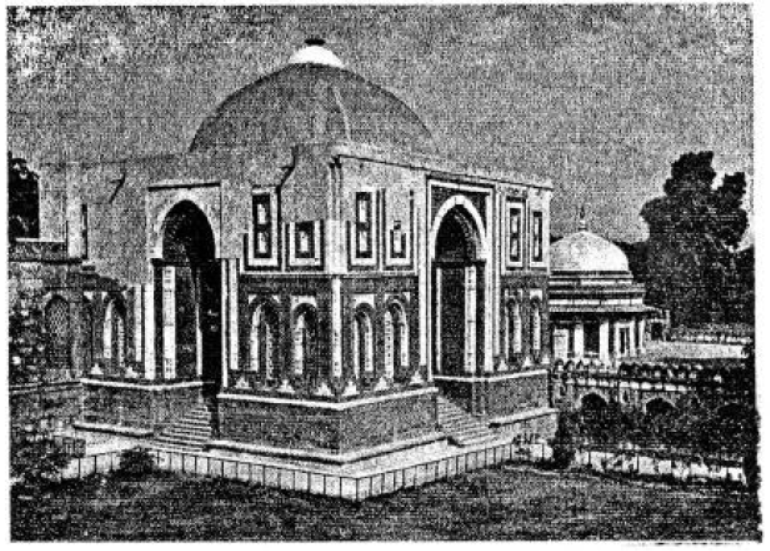
Question 1. Identify the monument.
Answer: The photograph depicts the Alai Darwaza, the grand entrance gateway.
In simple words: The monument shown in the picture is the Alai Darwaza.
Exam Tip: Identify the monument as the Alai Darwaza, the entrance gateway to the Qutub Minar complex.
Question 2. During whose reign was it built?
Answer: The monument was constructed during the reign of Sultan Alauddin Khilji.
In simple words: It was built during the reign of Sultan Alauddin Khilji.
Exam Tip: State 'Alauddin Khilji' as the Sultan who built this gateway.
Question 3. With reference to the reign of this ruler, mention two important features of each of the following: (a) Reorganization of the army (b) Revenue reforms (c) Market control policy
Answer: Sultan Alauddin Khilji introduced several highly organized reforms across different administrative sectors:
(a) Reorganization of the Army:
1. Standing Army: He was the first Sultan to establish a large, permanent standing army paid directly in cash by the state treasury.
2. Prevention of Corruption: He introduced the 'dagh' and 'chehra' systems to prevent corruption, and stationed military spies in every regiment.
(b) Revenue Reforms:
1. Scientific Assessment: He ordered a systematic measurement of all agricultural land to fix the state's tax share fairly.
2. Strict Tax Collection: He appointed specialized revenue officials to ensure direct, strict collection of taxes, eliminating local middle-men.
(c) Market Control Policy:
1. Price Regulation: He fixed the maximum prices of all essential commodities, keeping everyday items cheap and affordable.
2. Market Superintendents: He set up three distinct markets in Delhi, placing each under a superintendent to monitor weights, check hoarding, and severely punish dishonest traders, while maintaining state grain warehouses for emergencies.
In simple words: First, Alauddin built a large standing army, branding horses and keeping descriptive rolls to stop corruption. Second, he measured agricultural land to calculate taxes fairly and hired specialized tax officers. Third, he set up three regulated markets in Delhi, fixing the prices of all essential items, appointing superintendents to stop hoarding, and building state warehouses for emergencies.
Exam Tip: Structure your answer into parts (a), (b), and (c). For (a), focus on horse branding; for (b), mention land measurement; and for (c), explain price regulation under the Shahna.
Free study material for History Civics
Verified Textbook Solutions for Class 7 History Civics Chapter 04 The Delhi Sultanate
Verified Problem Answers for Class 7 History Civics Chapter 04 The Delhi Sultanate
Find reliable chapter-wise explanations for Class 7 History Civics Chapter 04 The Delhi Sultanate. Curated to follow standard ICSE guidelines, these problem solutions assist students in building strong conceptual foundations.
Concept Clarification for Chapter 04 The Delhi Sultanate
Verify your answers instantly using the comprehensive breakdowns provided for each problem, ensuring complete syllabus coverage across all sub-topics.
Effective Revision Strategies for Chapter 04 The Delhi Sultanate
Pair your solution review with additional practice papers to test your execution speed and ensure total preparedness for school exams.
FAQs
You can download the verified Goyal Brothers solutions for Chapter 04 The Delhi Sultanate on StudiesToday.com. Our teachers have prepared answers for Class 7 History Civics as per 2026-27 ICSE academic session.
Yes, our solutions for Chapter 04 The Delhi Sultanate are designed as per new 2026 ICSE standards. 40% competency-based questions required for Class 7, are included to help students understand application-based logic behind every History Civics answer.
Yes, every exercise in Chapter 04 The Delhi Sultanate from the Goyal Brothers textbook has been solved step-by-step. Class 7 students will learn History Civics conceots before their ICSE exams.
Yes, follow structured format of these Goyal Brothers solutions for Chapter 04 The Delhi Sultanate to get full 20% internal assessment marks and use Class 7 History Civics projects and viva preparation as per ICSE 2026 guidelines.