

Download ICSE Class 7 History Civics Solutions by Goyal Brothers
Access the official Goyal Brothers textbook solutions for Class 7 History Civics, updated for the 2026-27 academic year. This digital resource is structured to help students build strong conceptual clarity and prepare effectively for school examinations.
Access Chapter 03 The Turkish Invaders Solutions for Class 7 History Civics
Navigate directly to the Chapter 03 The Turkish Invaders solutions using the digital viewer below. Organizing your study sessions chapter-by-chapter allows for seamless offline study and quick reference during revision.
Important Words
- Ghazni and Ghor: The two major kingdoms set up by Turkish rulers in Afghanistan.
- Sultans: The rulers who governed the Delhi Sultanate from their capital, Delhi.
- Shahnama: A famous book written by the Persian poet Firdausi, telling the life story of Sultan Mahmud of Ghazni.
- Lakhbaksh: A title meaning "giver of lakhs," given to Qutbuddin Aibak because he was extremely generous.
- Muezzin: A person who makes the call to prayer for Muslims, usually from a mosque's tall tower.
- Iqtas: The provincial areas into which the empire was split, managed by officers called Iqtadars (or Muqtis).
- Divine Kingship: The belief that a king represents God on Earth and rules with divine authority.
Time To Learn
I. Fill in the blanks:
Question 1. Mahmud Ghazni invaded India __________ to plunder its wealth.
Answer: 17 times.
In simple words: Mahmud of Ghazni launched 17 raids on India to plunder its treasures.
Exam Tip: Always remember that his 17 raids occurred over a period of 25 years (1000-1025 AD).
Question 2. Muhammad Ghori defeated Prithviraj in the second battle of Tarain.
Answer: Prithviraj.
In simple words: Muhammad Ghori defeated the Rajput king Prithviraj in the second battle.
Exam Tip: This battle took place in 1192 CE and established Turkish rule in India.
Question 3. Alberuni, spent 10 years in India and wrote a book Kitab- ul-Hind.
Answer: Kitab-ul-Hind.
In simple words: Alberuni spent 10 years studying in India and wrote the book Kitab-ul-Hind.
Exam Tip: This book serves as an exceptionally rich source of information on medieval Indian society and culture.
Question 4. Firdausi wrote a famous epic named Shahnama.
Answer: Shahnama.
In simple words: The famous book written by the Persian poet Firdausi is the Shahnama.
Exam Tip: The Shahnama is the biography of Sultan Mahmud of Ghazni.
Question 5. Mahmud Ghazni plundered Somnath temple in 1025 AD
Answer: Somnath temple.
In simple words: Mahmud of Ghazni attacked and looted the rich Somnath temple in 1025 AD.
Exam Tip: This was his 16th and most famous raid on India.
II. Match Column A with Column B:
| Column A | Column B |
|---|---|
| 1. AD 1025 | (a) First battle of Tarain. |
| 2. AD 1192 | (b) Muhammad Ghori defeated Prithviraj Chauhan at Tarain. |
| 3. AD 1194 | (c) Mahmud of Ghazni attacked and destroyed the Hindu temple at Somnath. |
| 4. AD 1191 | (d) Muhammad Ghori defeated and killed Jaichand of Kanauj. |
Answer:
1. AD 1025 - (c) Mahmud of Ghazni attacked and destroyed the Hindu temple at Somnath.
2. AD 1192 - (b) Muhammad Ghori defeated Prithviraj Chauhan at Tarain.
3. AD 1194 - (d) Muhammad Ghori defeated and killed Jaichand of Kanauj.
4. AD 1191 - (a) First battle of Tarain.
In simple words: This list matches key years with the major battles and events of the Turkish invasions in India.
Exam Tip: Memorize the dates of the two Battles of Tarain (1191 and 1192) as they are frequently tested.
III. State whether the following statements are True or False:
Question 1. Muhammad Ghori established the Muslim rule in India.
Answer: True.
In simple words: Yes, Ghori established the political foundations of Turkish and Muslim rule in India.
Exam Tip: Unlike Mahmud of Ghazni who only looted, Ghori laid the political foundations of an empire.
Question 2. Mahmud was interested in setting up an empire in India.
Answer: False.
In simple words: This is false because Mahmud was only interested in looting India's wealth to beautify Ghazni, not in building an empire here.
Exam Tip: Make sure you state that his primary interest lay in India's wealth rather than territorial expansion.
Question 3. The Rajputs united to face the Turks or Muslims but failed.
Answer: False.
In simple words: This is false because the Rajputs were divided by jealousy and did not unite to fight the Turkish invaders.
Exam Tip: This lack of unity among Rajput chiefs (like the rivalry between Prithviraj and Jaichand) was a major reason for their defeat.
Question 4. Jaichand defeated Muhammad Ghori.
Answer: False.
In simple words: This is false because Muhammad Ghori actually defeated and killed Jaichand in the Battle of Chandawar in 1194.
Exam Tip: Jaichand was the ruler of Kanauj who was defeated by Ghori two years after the defeat of Prithviraj.
Question 5. Firdausi wrote Kitab-ul-Hind.
Answer: False.
In simple words: This is false because Alberuni wrote Kitab-ul-Hind. Firdausi wrote the Shahnama.
Exam Tip: Associate Alberuni with 'Kitab-ul-Hind' and Firdausi with 'Shahnama' to avoid confusion.
IV. Answer the following questions briefly:
Question 1. Mention three most important invasions of Mahmud of Ghazni.
Answer: Three of the most important invasions by Mahmud of Ghazni were:
1. His first raid in 1000 AD: After this first attack, he raided India 17 times. He defeated local rulers like King Jaipal and his son Anandpal.
2. His raids between 1009 and 1026 AD: During this period, he captured and looted major cities like Delhi, Mathura, Kanauj, and regions like Punjab and Kashmir.
3. His raid on the Somnath Temple: Located in Gujarat, this was his most famous and largest invasion. He attacked the secure temple and looted all of its immense treasures and gold.
In simple words: Mahmud of Ghazni's three key invasions were his first raid in 1000 AD against Jaipal, his raids on rich cities like Kanauj and Mathura, and his massive loot of the Somnath temple in Gujarat.
Exam Tip: Be sure to write about his raids in three separate points, specifically mentioning the Somnath temple and the year 1000 AD.
Question 2. When and between whom were the Battles of Tarain fought?
Answer: The Battles of Tarain were fought between Muhammad Ghori and Prithviraj Chauhan:
1. The First Battle of Tarain occurred in 1191, in which Prithviraj defeated Ghori.
2. The Second Battle of Tarain took place in 1192, in which Ghori won the battle and defeated Prithviraj.
In simple words: The two battles were fought between Ghori and Prithviraj Chauhan. Prithviraj won the first battle in 1191, but Ghori won the second battle in 1192.
Exam Tip: State both years (1191 and 1192) clearly and note who won each battle.
Question 3. How were the raids of Mahmud Ghazni different from the raids of Muhammad Ghori?
Answer: The main differences between their raids were:
- Mahmud of Ghazni: He ruled for 33 years and made 17 raids on India. His only goal was to loot India's immense wealth, not to build a lasting empire.
- Muhammad Ghori: He attacked India 150 years later with the goal of establishing an empire. He defeated local Rajput kingdoms and captured key cities like Multan, Peshawar, and Punjab, laying the foundations of Turkish rule in India.
In simple words: Mahmud of Ghazni raided India 17 times only to loot its wealth. On the other hand, Muhammad Ghori raided India to capture land and set up a lasting Turkish empire.
Exam Tip: Contrast their primary motives: Ghazni's motive was purely economic (looting wealth), whereas Ghori's motive was political (empire building).
V. Give Reason why:
Question 1. Mahmud of Ghazni attacked India
Answer: Mahmud of Ghazni attacked India because he wanted to acquire its immense wealth, rather than establishing a political empire in the region.
In simple words: He attacked India because he wanted to plunder its gold and treasures, not to rule the country.
Exam Tip: Always state that his primary interest lay in India's wealth rather than territorial expansion.
Question 2. Turks succeeded against Rajputs
Answer: Although the Rajputs were brave, they were defeated due to these reasons:
1. They lacked unity and were constantly fighting each other. Leaders like Prithviraj and Jaichand did not unite against Ghori.
2. Rajput chiefs were highly jealous of one another, which prevented cooperation.
3. They did not maintain a large standing army, relying instead on feudal lords for troops.
4. Their forces were slower and could not match the quick, swift cavalry of the Central Asian Turkish warriors.
In simple words: The Turks won because the Rajputs were divided by jealousy and constant fights. They also had no permanent army and were slower than the fast Turkish horsemen.
Exam Tip: Focus on 'lack of unity' and 'superior Turkish cavalry' as the most crucial reasons for the Rajput defeat.
VI. Guess who it is:
Question 1. wrote a book Kitab-ul-Hind.
Answer: Alberuni.
In simple words: Alberuni was the scholar who wrote the book Kitab-ul-Hind.
Exam Tip: Alberuni was a famous scholar who accompanied Mahmud of Ghazni to India.
Question 2. First Turkish invader to enter India north-west side.
Answer: Mahmud of Ghazni.
In simple words: Mahmud of Ghazni was the first Turkish invader to enter India from the north-west.
Exam Tip: He launched his first raid on India in 1000 AD.
Question 3. Beautified his city the most beautiful one, with the wealth gained in India.
Answer: Mahmud of Ghazni.
In simple words: Mahmud of Ghazni used the treasures looted from India to make his capital city of Ghazni extremely beautiful.
Exam Tip: He adorned Ghazni with splendid mosques, libraries, and museums using Indian gold.
Question 4. Laid the foundation of Turkish rule in India.
Answer: Muhammad Ghori.
In simple words: Muhammad Ghori was the leader who successfully established Turkish rule in India.
Exam Tip: His victory in the Second Battle of Tarain in 1192 CE laid this foundation.
Question 5. Invaded India 17 times.
Answer: Mahmud of Ghazni.
In simple words: Mahmud of Ghazni was the ruler who raided India 17 times.
Exam Tip: His 17 raids occurred over a period of 25 years.
Additional Questions
(The Turkish Invaders)
A. Fill in the blanks:
Question 1. Mahmud of Ghazni invaded India seventeen times in the course of __________ years
Answer: twenty-five.
In simple words: Mahmud of Ghazni raided India 17 times over a period of 25 years.
Exam Tip: He conducted these 17 raids between 1000 and 1025 AD.
Question 2. Mahmud’s raids exposed the __________ of the northern states and paved the way for the __________ of India.
Answer: weakness, conquest.
In simple words: His raids showed how weak the northern kingdoms were, which made it easier for others to conquer India later.
Exam Tip: The division and political weakness of northern India were fully exposed by his continuous raids.
Question 3. Qutbuddin Aibak took control of Muhammad Ghori’s __________ possessions and laid the foundation of the __________.
Answer: Indian, Delhi Sultanate.
In simple words: Qutbuddin Aibak took charge of Ghori's lands in India and established the Delhi Sultanate.
Exam Tip: This marked the beginning of the Slave (Mamluk) Dynasty in 1206 AD.
Question 4. Iltutmish defeated the Rajput rulers of __________ and brought the whole of North India upto the river Narmada under his control.
Answer: Ujjain, Ranthambore, Malwa, and Gwalior.
In simple words: Iltutmish defeated Rajput rulers in places like Malwa and Gwalior, bringing northern India under his control.
Exam Tip: These victories consolidated the territory of the Delhi Sultanate up to the Narmada River.
Question 5. The __________ recognized Iltutmish as the sovereign of India. He was succeeded by __________.
Answer: Caliph of Baghdad, his daughter Razia.
In simple words: The Caliph of Baghdad officially recognized Iltutmish as ruler, and he was succeeded by his daughter Razia.
Exam Tip: Razia Sultan was the first and only female Muslim ruler of the Delhi Sultanate.
B. Match the following:
Question. Match the following:
| Column A | Column B |
|---|---|
| 1. Mahmud of Ghazni | (a) general of Ghori |
| 2. First Battle of Tarain | (b) Prithviraj was defeated by Muhammad Ghori. |
| 3. Second Battle of Tarain | (c) Prithviraj defeated Muhammad Ghori |
| 4. Qutbuddin Aibak | (d) patron of art and learning |
| 5. Muhammad bin Bakhtiar Khalji | (e) viceroy of Ghori |
Answer:
1. Mahmud of Ghazni - (d) patron of art and learning.
2. First Battle of Tarain - (c) Prithviraj defeated Muhammad Ghori.
3. Second Battle of Tarain - (b) Prithviraj was defeated by Muhammad Ghori.
4. Qutbuddin Aibak - (e) viceroy of Ghori.
5. Muhammad bin Bakhtiar Khalji - (a) general of Ghori.
In simple words: This list matches Turkish rulers and generals with their correct descriptions, actions, or historical achievements.
Exam Tip: Be sure to match the First Battle of Tarain with Prithviraj defeating Ghori, and the Second Battle with Ghori winning.
C. Choose the correct answer:
Question 1. Mahmud of Ghazni was a:
(a) powerful ruler
(b) weak ruler
(c) inefficient ruler
(d) None of the options
Answer: (a) powerful ruler
In simple words: Mahmud of Ghazni was a highly powerful and military-minded ruler.
Exam Tip: His military strength let him conduct 17 successful campaigns into India without defeat.
Question 2. Where was Mahmud of Ghazni interested in expanding his territory?
(a) South Asia
(b) Central Asia
(c) West Asia
(d) None of the options
Answer: (b) Central Asia
In simple words: He used Indian wealth to fund and expand his territory in Central Asia, not in India.
Exam Tip: His interest in India was purely to loot wealth, while his political ambitions lay in Central Asia.
Question 3. What was Firdausi known as?
(a) mathematician
(b) historian
(c) poet
(d) None of the options
Answer: (c) poet
In simple words: Firdausi was a highly famous Persian poet who wrote the Shahnama.
Exam Tip: He was patronized by Mahmud of Ghazni and wrote the 'Shahnama' (Book of Kings).
Question 4. Nasiruddin Mahmud was a weak and inexperienced ruler and the affairs of the state were managed by:
(a) Balban on his behalf
(b) Iltutmish on his behalf
(c) Qutbuddin Aibak on his behalf
(d) None of the options
Answer: (a) Balban on his behalf
In simple words: Nasiruddin Mahmud was a weak king, so his prime minister, Balban, ran the state.
Exam Tip: Balban held real power during Nasiruddin's reign and later succeeded him as the Sultan.
Question 5. Muhammad Ghori was as great a military leader as Mahmud of Ghazni.
(a) True
(b) False
Answer: (b) False
In simple words: This is false because Ghori suffered many defeats, whereas Mahmud was a far superior military leader who never lost a battle.
Exam Tip: While Ghori was a better empire builder, Mahmud was historically a more skilled tactical military general.
Question 6. Which sultan never smiled or allowed others to laugh or joke in his court?
(a) Iltutmish
(b) Qutbuddin Aibak
(c) Balban
(d) None of the options
Answer: (c) Balban
In simple words: Balban maintained strict discipline and never smiled or allowed joking in his court.
Exam Tip: Balban believed in maintaining absolute royal dignity and prestige through strict court protocols.
D. State whether the following are true or false
Question 1. The kingdoms of Ghazni and Ghor were established by the Abbasids.
Answer: False.
In simple words: This is false because these two kingdoms were set up by Turkish rulers, not the Abbasid Arabs.
Exam Tip: These states arose in Afghanistan as the Abbasid Caliphate began to decline.
Question 2. During Mahmud’s time, North India was divided and there was no unity.
Answer: True.
In simple words: Yes, during his attacks, northern India was split into many small kingdoms that constantly fought each other.
Exam Tip: This lack of unity made it easy for Mahmud to invade and loot Indian states repeatedly.
Question 3. Iltutmish failed to crush the power of the governor of Bengal.
Answer: False.
In simple words: This is false because Iltutmish successfully defeated and crushed the rebellious governor of Bengal.
Exam Tip: Defeating the Bengal governor was essential for consolidating Iltutmish's rule over northern India.
Question 4. Razia Sultan was brave, intelligent and just.
Answer: True.
In simple words: Yes, Razia Sultan was a highly brave, wise, and fair ruler who possessed all the qualities of a great monarch.
Exam Tip: Despite her excellent qualities, the Turkish nobles opposed her simply because she was a woman.
Question 5. Balban made the monarchy weak and dependent on the nobles.
Answer: False.
In simple words: This is false because Balban actually crushed the power of the nobles and made the king's power absolute and supreme.
Exam Tip: Balban introduced policies like 'Sijda' and 'Paibos' to force nobles to show absolute submission to the crown.
Question 6. Sultan Mahmud annexed Punjab to create a gateway to India for future invasions.
Answer: True.
In simple words: Yes, Mahmud captured Punjab so he would have a secure base to launch future attacks on India.
Exam Tip: Annexing Punjab was Mahmud's only major territorial acquisition inside India.
Question 7. Mahmud of Ghazni was the founder of the Turkish rule in India.
Answer: False.
In simple words: This is false because Muhammad Ghori, not Mahmud of Ghazni, founded Turkish political rule in India.
Exam Tip: Mahmud of Ghazni was only interested in looting, while Ghori laid the political foundations of empire.
Question 8. Muhammad Ghori was as great a military leader as Mahmud of Ghazni.
Answer: False.
In simple words: This is false because Ghori lost several battles, whereas Mahmud was a brilliant general who never suffered a defeat.
Exam Tip: While Ghori was a superior empire builder, Mahmud was historically a more skilled military strategist.
E. Answer the following questions in one or two words/ sentences:
Question 1. What happened to the Abbasid Caliphate by the 9th century ce?
Answer: By the late ninth century, the powerful Abbasid Empire broke apart into several independent kingdoms led by Turkish chiefs who had once served in the Caliph's army.
In simple words: In the 800s, the big Abbasid Arab empire broke apart. Many independent states arose, ruled by Turkish generals.
Exam Tip: This disintegration of the Abbasid power allowed independent Turkish kingdoms like Ghazni to grow.
Question 2. Name the author of the great epic Shahnama.
Answer: The grand epic *Shahnama* was written by the famous Persian poet Firdausi.
In simple words: Firdausi was the Persian poet who wrote the Shahnama.
Exam Tip: Firdausi was the court poet patronized by Sultan Mahmud of Ghazni.
Question 3. What is the significance of the defeat of Prithviraj in the Second Battle of Tarain?
Answer: The defeat of Prithviraj Chauhan ended Rajput supremacy in northern India. Delhi was captured by Muhammad Ghori, and from that point onward, the city was ruled by Muslim dynasties until 1858.
In simple words: This defeat ended Rajput rule and began centuries of Muslim rule in Delhi, lasting until 1858.
Exam Tip: This battle is considered the decisive turning point that established Turkish political control in India.
Question 4. Who did Muhammad Ghori appoint as his viceroy?
Answer: Before traveling back to Ghor, Muhammad Ghori appointed his trusted general, Qutbuddin Aibak, as his viceroy in India.
In simple words: Ghori made his general, Qutbuddin Aibak, his viceroy in India before going back home.
Exam Tip: Qutbuddin Aibak later established the Slave Dynasty and founded the Delhi Sultanate in 1206 AD.
Question 5. For how many years did the sultans of Delhi rule the country?
Answer: The Sultans of Delhi ruled over the country for more than 300 years.
In simple words: The Delhi Sultans ruled India for about 300 years (from 1206 to 1526).
Exam Tip: This era spanned from 1206 (Slave Dynasty) to 1526 (defeat of Ibrahim Lodi by Babur).
Question 6. Mention one important reason for the decline of Buddhism in India after the Turkish invasion.
Answer: General Muhammad bin Bakhtiar Khalji deliberately destroyed major Buddhist temples, monasteries, and libraries (like Nalanda). This served as a crushing blow that led to the decline of Buddhism in India.
In simple words: The Turkish general Bakhtiar Khalji destroyed famous Buddhist schools and libraries, which severely damaged and ended Buddhism's influence in India.
Exam Tip: Specifically mention Bakhtiar Khalji's destruction of monasteries like Nalanda as the main cause.
Question 7. Name the founder of the Turkish kingdom in India.
Answer: Muhammad Ghori was the founder who established the Turkish kingdom in India.
In simple words: Muhammad Ghori founded the Turkish kingdom in India.
Exam Tip: While Ghazni only looted, Ghori laid the foundations for political empire.
Question 8. Why was Qutbuddin known as ‘lakhbaksh’?
Answer: Qutbuddin Aibak was called Lakhbaksh, meaning "giver of lakhs," due to his highly generous and charitable nature.
In simple words: He was called Lakhbaksh (giver of lakhs) because he was extremely generous and gave a lot of charity.
Exam Tip: 'Lakhbaksh' is a crucial term often tested in short-answer questions.
Question 9. How did Iltutmish save India from the threat of a Mongol invasion?
Answer: When the Mongol chief Genghis Khan reached India's borders, he was chasing the Shah of Persia who was seeking refuge in India. By politely refusing to give shelter to the Persian Shah, Iltutmish avoided angering Genghis Khan and saved India from a Mongol attack.
In simple words: Iltutmish saved India by refusing to give shelter to the Persian King, who was being chased by Genghis Khan. This kept the Mongols from attacking India.
Exam Tip: Explain his diplomatic wisdom in refusing refuge to the Shah, which kept Genghis Khan out of the Sultanate.
Question 10. Why did Iltutmish nominate his daughter Razia as his successor?
Answer: Iltutmish chose his daughter Razia as his successor because his sons were lazy, weak, and irresponsible. While they wasted time on luxuries and fun, Razia was brave, wise, and fair, possessing all the qualities needed in a great ruler.
In simple words: Iltutmish chose Razia because his sons were lazy and weak. Razia, on the other hand, was brave, smart, and fully fit to be a queen.
Exam Tip: Emphasize that his sons were weak and pleasure-loving, whereas Razia had the qualities of a great monarch.
Question 11. Give any one example to show that Mahmud was a patron of learning.
Answer: Mahmud supported art and education, keeping scholars in his court. For example, he patronized the famous Persian poet Firdausi (author of *Shahnama*) and the prominent historian Alberuni.
In simple words: Mahmud loved learning and gave money to support great scholars like the poet Firdausi and the historian Alberuni in his court.
Exam Tip: Name both Firdausi and Alberuni to prove his patronage of learning.
Question 12. Name the famous Rajput ruler of Delhi and Ajmer.
Answer: Prithviraj Chauhan was the prominent Rajput king of Delhi and Ajmer.
In simple words: Prithviraj Chauhan was the famous Rajput king of Delhi and Ajmer.
Exam Tip: Prithviraj was Ghori's primary opponent in the Battles of Tarain.
Question 13. Mention one important reason for the victory of Muhammad Ghori in the Second Battle of Tarain.
Answer: Prithviraj tried to form a union of Rajput chiefs to fight Ghori. However, the most powerful Rajput king, Raja Jaichand of Kanauj, refused to join and help him, leading to Prithviraj's defeat.
In simple words: Ghori won because the most powerful Rajput ruler, Raja Jaichand, refused to join and help Prithviraj Chauhan.
Exam Tip: Mention this division among Rajput rulers (especially the rivalry between Prithviraj and Jaichand) as the main cause of Ghori's victory.
F. Answer the following questions briefly:
Question 1. How did Sultan Mahmud transform his capital, Ghazni? How do we know he was a patron of art and learning?
Answer: Sultan Mahmud rebuilt his capital, Ghazni, into a grand, beautiful city. He decorated it with gorgeous mosques, libraries, and a large museum. His court was filled with gems and treasures, and he spent heavily to support and patronize famous poets and scholars of his time.
In simple words: Mahmud used gold from India to build beautiful mosques and museums in Ghazni. He also supported famous poets and writers, proving he loved art and learning.
Exam Tip: Mention both his construction projects in Ghazni and his support for scholars like Firdausi to fully address both parts of the question.
Question 2. Discuss the (a) causes and (b) results of the First and Second Battles of Tarain.
Answer: (a) Causes: Supporting his campaign to capture India's vast wealth and establish his empire in northern India.
(b) Results of the Battles:
- First Battle of Tarain (1191 CE): Prithviraj Chauhan completely defeated Ghori's invading army, forcing Ghori to retreat with severe injuries.
- Second Battle of Tarain (1192 CE): Ghori returned next year with a superior cavalry force and defeated Prithviraj Chauhan. This victory opened the gateway for Turkish rule in India.
In simple words: Ghori wanted to conquer India's wealth. Prithviraj won the first battle in 1191, but Ghori won the second battle in 1192, establishing Turkish rule in Delhi.
Exam Tip: Clearly distinguish between the results of the two battles (1191 and 1192) and state their historical significance.
Question 3. Give any five reasons to prove that Iltutmish was a shrewd, clever and capable ruler.
Answer: Iltutmish proved to be an extremely capable and clever ruler because:
1. He quickly crushed the rebellious Turkish nobles who challenged his right to rule.
2. He successfully stopped the rebellion of the governor in Bengal.
3. He defeated and destroyed his main external rivals in Multan and Ghazni.
4. He diplomatically turned away the Persian Shah who was fleeing Genghis Khan, saving India from a Mongol invasion.
5. He defeated key Rajput rulers and brought northern India under his control up to the Narmada River, winning official recognition from the Caliph.
In simple words: Iltutmish was clever because he defeated all his rivals, crushed rebellions in Bengal, and kept the Mongols from invading India through smart diplomacy.
Exam Tip: Be sure to write at least five distinct points, specifically highlighting the Mongol incident as it best demonstrates his cleverness.
Question 4. Discuss the important developments that took place during the reign of Razia Sultan.
Answer: During Razia Sultan's brief rule, several state governors rebelled against her. When she marched to crush these revolts, she was defeated and put in prison. She cleverly married the leader of the rebels, Altunia, to win his support. However, their joint attempt to win back the throne of Delhi failed, and they were both killed in 1240.
In simple words: Razia faced many rebellions from her governors. She was defeated and imprisoned, but married her captor Altunia. They tried to win back Delhi but failed, and both were killed in 1240.
Exam Tip: Mention the roles of the rebellious governors, her marriage to Altunia, and her tragic death in 1240.
G. Picture study
This is the picture of a Turkish invader who was involved in the Battles of Tarain.
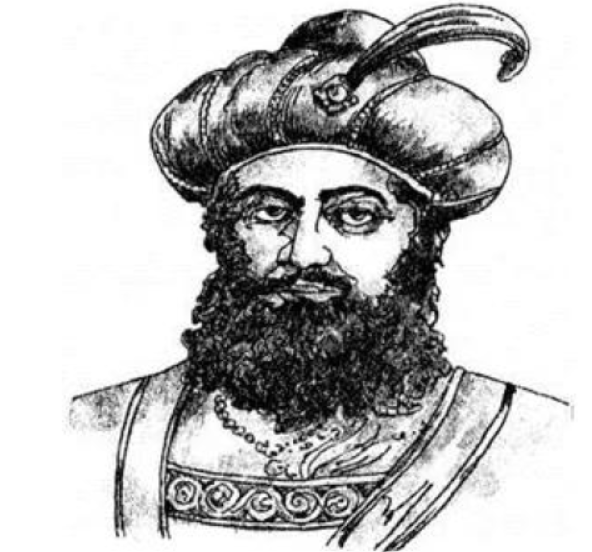
Question 1. Identify the person in the picture.
Answer: The person shown in this picture is Muhammad Ghori.
In simple words: The picture shows Muhammad Ghori.
Exam Tip: Muhammad Ghori was the founder who laid the political foundations of Turkish rule in India.
Question 2. Why did he invade India?
Answer: In the late twelfth century, Muhammad Ghori decided to invade India to conquer territories and bring India's immense wealth back to his kingdom of Ghor. To achieve this, he first brought border areas like Multan, Sindh, and Punjab under his control.
In simple words: Ghori invaded India to capture territory and take India's wealth back to his kingdom of Ghor in Afghanistan.
Exam Tip: State that his goal was both economic (enriching Ghor) and political (empire building).
Question 3. The Battles of Tarain laid the foundations of Turkish rule in North India. Do you agree? Why?
Answer: Yes, because Ghori's victory in these battles led directly to the capture of Delhi and northern India. Two years later, he defeated and killed King Jaichand of Kanauj, added these vast territories to his empire, and appointed Qutbuddin Aibak as his viceroy to rule on his behalf.
In simple words: Yes, because Ghori's victory let him capture Delhi and Kanauj, leaving his general Qutbuddin Aibak to rule and start the Delhi Sultanate.
Exam Tip: Explain how his military victories directly established political administration under his viceroy, Qutbuddin Aibak.
Question 4. Explain the causes of the success of the Turkish invaders against the Rajputs.
Answer: The Turkish success against the Rajputs was mainly due to the division and lack of unity among the Rajput chiefs. For example, the most powerful Rajput king, Raja Jaichand of Kanauj, refused to join Prithviraj Chauhan's union to fight Ghori. This allowed Muhammad Ghori's swift and disciplined cavalry forces to easily defeat the divided Rajput army in 1192 CE.
In simple words: The Turks succeeded because the Rajputs were divided. The most powerful king, Jaichand, refused to help Prithviraj, letting Ghori's fast army win.
Exam Tip: Highlight the lack of unity among Rajputs as the decisive factor for the Turkish military success.
Free study material for History Civics
Step-by-Step Solutions for Class 7 History Civics Chapter 03 The Turkish Invaders
Download ICSE Answers for Class 7 History Civics Chapter 03 The Turkish Invaders
Access structured ICSE solutions for Class 7 History Civics Chapter 03 The Turkish Invaders designed to match CISCE curriculum standards. These verified answers help clarify complex numericals and support daily homework revision.
Concept Clarification for Chapter 03 The Turkish Invaders
Tackle complex theorems and numerical problems easily by cross-referencing your working steps with our structured solution guides.
Effective Revision Strategies for Chapter 03 The Turkish Invaders
Explore our broader library of study materials and chapter notes to support your continuous revision and secure higher marks.
FAQs
You can download the verified Goyal Brothers solutions for Chapter 03 The Turkish Invaders on StudiesToday.com. Our teachers have prepared answers for Class 7 History Civics as per 2026-27 ICSE academic session.
Yes, our solutions for Chapter 03 The Turkish Invaders are designed as per new 2026 ICSE standards. 40% competency-based questions required for Class 7, are included to help students understand application-based logic behind every History Civics answer.
Yes, every exercise in Chapter 03 The Turkish Invaders from the Goyal Brothers textbook has been solved step-by-step. Class 7 students will learn History Civics conceots before their ICSE exams.
Yes, follow structured format of these Goyal Brothers solutions for Chapter 03 The Turkish Invaders to get full 20% internal assessment marks and use Class 7 History Civics projects and viva preparation as per ICSE 2026 guidelines.