

Download ICSE Class 7 History Civics Solutions by Goyal Brothers
Explore the complete Goyal Brothers textbook solutions for Class 7 History Civics. Tailored for the 2026-27 curriculum, this resource breaks down complex topics to support daily study and targeted revision.
Access Chapter 07 Foundation Of Mughal Empire Solutions for Class 7 History Civics
View or download the dedicated Chapter 07 Foundation Of Mughal Empire resource below. This chapter-by-chapter structuring ensures easy navigation for daily study routines and immediate access to core academic concepts.
Important Words
- Sarkars: The provinces in Sher Shah's empire. His territory was divided into 47 of these, each of which was further split into smaller districts called parganas.
- Shiqdars: Administrative officers who were responsible for keeping law and order inside each pargana.
- Munsifs: Government officers in charge of civil court cases and the collection of land taxes.
- Patwaris: Village-level officials responsible for collecting land taxes from farmers.
- Muqaddams: Village leaders whose main duty was to maintain peace and order in their local areas.
- Sarais: Safe rest houses constructed by Sher Shah along major roads for travelers and merchants.
- Dak Chaukis: Postal stations built along roads where two horsemen were always kept ready to quickly carry mail to the next post.
- Rupia: The standard silver coin of uniform weight introduced by Sher Shah to improve trade.
- Patta: A formal legal document that served as a title deed, proving a farmer's ownership of land.
- Qubuliat: A signed agreement in which a farmer officially accepted the land ownership terms and tax duties.
Time To Learn
I. Fill in the blanks:
Question 1. Babur’s eldest son assumed the title Humayun which means fortunate.
Answer: fortunate.
In simple words: The name Humayun, chosen by Babur's oldest son, means fortunate.
Exam Tip: Remember that 'fortunate' is the meaning of the name Humayun, even though his life was marked by many difficulties.
Question 2. Humayun reconquered the throne of Delhi in 1555 AD.
Answer: 1555 AD.
In simple words: Humayun won back his throne in Delhi in the year 1555.
Exam Tip: Memorize the year 1555 AD as the time when Mughal rule was restored in India by Humayun.
Question 3. Humayun was in Persia after 1540.
Answer: Persia.
In simple words: After losing his throne in 1540, Humayun lived in exile in Persia.
Exam Tip: It was the Shah of Persia who later helped Humayun with an army to recapture his lost territories.
Question 4. Sher Shah ruled Delhi for five years.
Answer: five.
In simple words: Sher Shah Suri ruled over Delhi for a short period of five years.
Exam Tip: His reign lasted from 1540 to 1545, during which he introduced outstanding administrative reforms.
II. Match Column A with Column B:
| Column A | Column B |
|---|---|
| 1. 1526 | (a) Use of artillery |
| 2. 1529 | (b) was defeated in the First Battle of Panipat. |
| 3. 1539 | (c) Ruler of Gujarat |
| 4. Humayun re-established Mughal power in India | (d) Battle of Chausa |
| 5. Babur won victory due to | (e) in 1555 |
| 6. Ibrahim Lodi | (f) First Battle of Panipat |
| 7. Bahadur Shah | (g) Battle of Ghagra |
Answer:
1. 1526 - (f) First Battle of Panipat.
2. 1529 - (g) Battle of Ghagra.
3. 1539 - (d) Battle of Chausa.
4. Humayun re-established Mughal power in India - (e) in 1555.
5. Babur won victory due to - (a) Use of artillery.
6. Ibrahim Lodi - (b) was defeated in the First Battle of Panipat.
7. Bahadur Shah - (c) Ruler of Gujarat.
In simple words: This list matches key years and rulers of the early Mughal era with their correct battles or descriptions.
Exam Tip: Be sure to match 1526 with the First Battle of Panipat, as it marks the starting year of the Mughal Empire.
III. State whether the following statements are True or False:
Question 1. The First Battle of Panipat decided once for all the fate of the Lodi dynasty.
Answer: True.
In simple words: Yes, this battle completely ended the rule of the Lodi dynasty in India.
Exam Tip: Ibrahim Lodi's defeat and death in 1526 brought a permanent end to the Delhi Sultanate.
Question 2. The Battle of Khanwa was fought between Rana Sanga and Babur.
Answer: True.
In simple words: Yes, the Battle of Khanwa was fought in 1527 between Rana Sanga of Mewar and Babur.
Exam Tip: This battle was highly important as it broke the power of the Rajput confederacy.
Question 3. Babur introduced many new reforms for the administration of his new empire in India.
Answer: False.
In simple words: This is false because Babur did not have time to make administrative reforms. It was Sher Shah Suri who introduced these major reforms.
Exam Tip: Babur spent his brief four-year reign fighting battles to secure his empire, leaving little time for administrative changes.
Question 4. Humayun died in 1550 AD.
Answer: False.
In simple words: This is false because Humayun actually passed away in 1556 AD due to an accidental fall.
Exam Tip: Humayun died in 1556, shortly after winning back his empire, from a fall down the stairs of his library.
Question 5. Sher Shah built the Grand Trunk Road.
Answer: True.
In simple words: Yes, Sher Shah Suri built the famous Grand Trunk Road, which connected Peshawar to Bengal.
Exam Tip: The Grand Trunk Road is one of his most lasting contributions to public welfare and trade.
IV. Answer the following questions briefly:
Question 1. Why was the First Battle of Panipat fought? What were its results?
Answer: The First Battle of Panipat was fought in 1526 between Babur and Ibrahim Lodi. It occurred due to Ibrahim Lodi's cruel policies, which turned his own nobles and officials against him. He severely punished and put to death any noble who dared to rebel. Consequently, unhappy leaders like Daulat Khan Lodi and Alam Khan invited Babur to invade India and overthrow him.
The main result of the battle was a decisive victory for Babur. He took control of Delhi and declared himself the "Emperor of Hindustan," marking the foundation of the Mughal Empire in India.
In simple words: Ibrahim Lodi treated his nobles poorly, leading them to invite Babur to invade India. Babur won the battle in 1526, took over Delhi, and declared himself the Emperor.
Exam Tip: Be sure to write both the reasons for the conflict (rebellious nobles) and the final result (establishment of the Mughal Empire).
Question 2. What were the reasons for Babur’s victory in the First Battle of Panipat?
Answer: The main reasons for Babur's victory at Panipat were:
1. Babur introduced and used gunpowder and artillery, which were completely unknown to the Indian forces.
2. His soldiers were highly disciplined, and his cavalry was far superior to the Sultan's army.
3. He used advanced military strategies to surprise and defeat Ibrahim Lodi's larger army.
In simple words: Babur won because he used cannons and guns, which the Indians had never seen before. His army was also highly trained and had superior horsemen.
Exam Tip: Highlighting 'artillery' and 'highly trained cavalry' is crucial to earning maximum marks on this question.
Question 3. What difficulties did Humayun face in the beginning?When and how did Humayun reconquer India?
Answer: When Humayun inherited the throne in 1530, he faced several major challenges:
1. Political instability: The Mughal Empire was very large but not yet consolidated or secure.
2. An empty treasury: Government funds were empty because tax collection was not organized.
3. Troublesome relatives: His own ambitious brothers rebelled against his authority.
4. Division of land: Splitting the empire into lands (jagirs) made it difficult to manage.
5. Poor administration: The government machinery was not organized, making it hard to maintain power.
In 1555, taking advantage of the weak successors of Sher Shah (who died in 1545), Humayun invaded India with the help of the Shah of Persia. He successfully defeated the Afghan rulers, recaptured Delhi and Agra, and restored Mughal rule.
In simple words: Humayun started with an empty treasury, rebellious brothers, and a poorly organized empire. In 1555, after Sher Shah's successors turned out to be weak, Humayun used help from Persia to win back Delhi.
Exam Tip: List the five initial difficulties clearly, and remember to mention that Humayun won back Delhi in 1555 with Persian help.
Question 4. Why is Sher Shah known as a-good administrator?
Answer: Sher Shah is famous for his excellent administration due to these reasons:
1. He divided his vast empire into provinces called sarkars.
2. He appointed a governor and a team of officers to run each sarkar smoothly.
3. He further split sarkars into smaller districts named parganas, which were made of several villages. The village served as the basic administrative unit.
4. Each pargana was run by two top officers: the Shiqdar (who kept law and order) and the Munsif (who collected taxes).
5. At the village level, local councils (panchayats) managed daily affairs.
6. The two key village officers were the Patwari (tax collector) and the Muqaddam (who maintained peace).
In simple words: Sher Shah organized his empire into provinces (sarkars), districts (parganas), and villages. He appointed efficient officers at every level to maintain law, order, and collect taxes fairly.
Exam Tip: Be sure to write down the hierarchy: Sarkars, Parganas, and Villages, naming the specific officers in charge of each.
V. Give reasons.
Question 1. Sher Khan was able to strengthen his position in Bengal and Bihar.
Answer: Sher Khan was able to strengthen his position in Bengal and Bihar due to these reasons:
1. He personally oversaw the hiring and training of his soldiers, ensuring they stayed strictly disciplined.
2. He brought back Alauddin's military reforms, like branding horses (dagh) and keeping detailed descriptions of soldiers (chehra).
3. He paid regular wages to his troops according to their skills and talent.
4. He built strong forts and garrisons in key areas to quickly move his army during emergencies.
5. He used an efficient spy network to monitor his officers. He also transferred government officials every two to three years to prevent corruption.
In simple words: Sher Shah strengthened his power by building a highly trained, disciplined army with regular pay, building strong forts, and setting up an efficient spy system to stop corruption.
Exam Tip: Mention both his military reforms (dagh and chehra) and administrative controls (spy system and official transfers) as reasons.
Question 2. Sher Shah was named so.
Answer: Sher Shah's birth name was Farid Khan, and he was the son of a jagirdar in Sasaram, Bihar. While working for the ruler of Bihar, he killed a fully grown tiger completely on his own. Because of this brave act, he was given the name Sher Khan. Later, after capturing many territories and becoming the emperor, he took the title Sher Shah.
In simple words: Born as Farid Khan, he was named 'Sher Khan' after killing a tiger all by himself. He later became the king and took the title 'Sher Shah.'
Exam Tip: Clearly trace his names: Farid Khan (original name), Sher Khan (after killing the tiger), and Sher Shah (after becoming ruler).
Question 3. We say that Sher Shah looked after the welfare of his people.
Answer: We say that Sher Shah cared deeply for the welfare of his people due to these actions:
1. He built a grand network of roads, including the famous Grand Trunk Road connecting Peshawar to Sonargaon, as well as roads between Lahore and Multan, and Agra to Chittor.
2. To make long journeys comfortable, he built over 1,700 rest houses (sarais) and dug wells along the roads.
3. He planted shade-giving trees on both sides of his roads. These rest houses also grew into busy marketplaces and trade centers.
4. He appointed special officers (Muqaddams) to protect travellers from robbers.
5. His highway network established an efficient postal system and encouraged trade across the country.
6. These vital roads and rest houses were rightly called the 'arteries of the empire' because they kept trade and communication flowing.
7. He set up an efficient administrative structure by splitting his empire into 47 sarkars, which were further divided into parganas to help look after the public.
In simple words: Sher Shah looked after his people by building the Grand Trunk Road, planting trees, digging wells, and building 1,700 rest houses (sarais) guarded by officers to keep travellers safe.
Exam Tip: Be sure to write at least four welfare measures, specifically mentioning the Grand Trunk Road and the 1,700 rest houses (sarais).
Additional Questions
(Foundation of The Mughal Empire)
Fill in the blanks:
Question 1. Babur lost both Farghana and Samarkand and became a homeless wanderer. In 1504 ce, he became the ruler of __________.
Answer: Kabul.
In simple words: After losing his home, Babur wandered around before becoming the ruler of Kabul in 1504.
Exam Tip: The city of Kabul acted as Babur's base before he invaded India in 1526.
Question 2. Humayun lacked the qualities necessary to __________ the vast empire he had inherited.
Answer: consolidate.
In simple words: Humayun did not have the skills needed to make his large inherited empire strong and united.
Exam Tip: Focus on the word 'consolidate' as it describes his major administrative failure.
Question 3. Sher Shah based his administration on the principle of a __________ state.
Answer: welfare.
In simple words: Sher Shah set up his government to help and protect his citizens, making it a welfare state.
Exam Tip: 'Welfare state' is a key concept that highlights how his reforms focused on public help and safety.
Question 4. Sher Shah established a large standing army and introduced several reforms to make it disciplined, __________ and __________.
Answer: efficient and strong.
In simple words: Sher Shah built a giant army and made it highly organized, efficient, and strong.
Exam Tip: Remember to use the adjectives 'efficient' and 'strong' to complete this sentence.
B. Match the following:
Question. Match the following:
| Column A | Column B |
|---|---|
| 1. First Battle of Panipat | (a) Defeat of the Rajput confederacy |
| 2. Battle of Khanwa | (b) Humayun's son |
| 3. Battle of Ghagra | (c) Humayun's brother |
| 4. Akbar | (d) 1526 CE |
| 5. Kamran | (e) Babur's victory over the Afghans |
Answer:
1. First Battle of Panipat - (d) 1526 CE.
2. Battle of Khanwa - (a) Defeat of the Rajput confederacy.
3. Battle of Ghagra - (e) Babur's victory over the Afghans.
4. Akbar - (b) Humayun's son.
5. Kamran - (c) Humayun's brother.
In simple words: This list matches battles and family members with their correct years, roles, or key results.
Exam Tip: Be sure to match Kamran with Humayun's brother, as his rivalry was a major trouble for Humayun.
C. Choose the correct answer:
Question 1. Who invited Babur to invade India in 1522 ce?
(a) Ibrahim Lodi
(b) Sher Khan Suri
(c) Daulat Khan Lodi
(d) None of the options
Answer: (c) Daulat Khan Lodi
In simple words: Daulat Khan Lodi was the governor who invited Babur to invade India to help overthrow the cruel Sultan Ibrahim Lodi.
Exam Tip: Daulat Khan Lodi thought Babur would defeat Ibrahim Lodi and return, but Babur chose to stay and establish his own empire.
Question 2. With the help of the Shah of which country did Humayun return to India in the year 1555?
(a) Persia
(b) Afghanistan
(c) Sind
(d) None of the options
Answer: (a) Persia
In simple words: The Shah of Persia gave Humayun the military support he needed to win back his lost empire in 1555.
Exam Tip: The military alliance with Safavid Persia was key to Humayun's successful return to Delhi.
Question 3. Into which 47 units did Sher Shah divide his empire?
(a) sarkars
(b) parganas
(c) villages
(d) None of the options
Answer: (a) sarkars
In simple words: Sher Shah divided his vast empire into 47 provinces called sarkars.
Exam Tip: This administrative division was a highly important reform that helped him govern the country efficiently.
Question 4. What metal was the rupia introduced by Sher Shah made of?
(a) gold
(b) silver
(c) copper
(d) None of the options
Answer: (b) silver
In simple words: The standard coin introduced by Sher Shah, called the rupia, was made of silver.
Exam Tip: This silver rupia set the standard weight and design that influenced currency in India for centuries.
Question 5. What was considered Sher Shah's greatest achievement?
(a) construction of new roads
(b) issuing of coins
(c) his revenue system
(d) None of the options
Answer: (c) his revenue system
In simple words: Out of all his reforms, his land tax and revenue system is seen as his greatest achievement.
Exam Tip: His land revenue system was so efficient that it was later adopted and improved by Akbar.
D. State whether the following are true or false:
Question 1. Babur was a descendant of Timur and Chenghiz Khan.
Answer: True.
In simple words: Yes, Babur came from the families of both Timur (on his father's side) and Genghis Khan (on his mother's side).
Exam Tip: This royal lineage gave Babur prestige and a strong claim to rule.
Question 2. Babur’s war-weary and homesick soldiers wanted to return to Kabul after the Battle of Panipat.
Answer: True.
In simple words: Yes, after the battle, Babur's tired soldiers wanted to go back home to Kabul.
Exam Tip: Babur had to deliver a speech to convince his homesick troops to stay and build an empire in India.
Question 3. Babur won the Battle of Khanwa through treachery and cunning.
Answer: False.
In simple words: This is false because Babur won the Battle of Khanwa due to his superior cannons, guns, and military discipline, not because of trickery.
Exam Tip: His tactical positioning of cannons and mobile cavalry was key to defeating Rana Sanga's army.
Question 4. Sher Shah ruled for 15 years.
Answer: False.
In simple words: This is false because Sher Shah only ruled for 5 years (from 1540 to 1545) before he died.
Exam Tip: Despite ruling for only five short years, Sher Shah introduced reforms that outlasted many longer reigns.
Question 5. To prevent the officers from becoming corrupt, Sher Shah introduced the system of periodical transfers.
Answer: True.
In simple words: Yes, Sher Shah moved his officers to different places every two or three years to stop them from becoming too powerful or corrupt.
Exam Tip: This system of regular transfers is a modern administrative practice that was introduced early on by Sher Shah.
E. Answer the following questions in one or two words/ sentences:
Question 1.Why did Daulat Khan Lodi invite Babur to invade India?
Answer: In 1522, Daulat Khan Lodi invited Babur to invade India to help remove Ibrahim Lodi, who was a cruel and highly unpopular ruler.
In simple words: He invited Babur to help get rid of the cruel and hated ruler, Ibrahim Lodi.
Exam Tip: Explain that Lodi nobles were deeply unhappy with the Sultan's harsh behavior towards them.
Question 2.Between whom was the First Battle of Panipat fought?
Answer: The First Battle of Panipat was fought between Babur and Ibrahim Lodi in the year 1526.
In simple words: The battle was fought between Babur and Ibrahim Lodi in 1526.
Exam Tip: Always state both participants (Babur and Ibrahim Lodi) and the exact year (1526 CE).
Question 3.What was the significance of the Battle of Panipat (1526 ce)?
Answer: This battle was highly significant because it ended Lodi rule, brought Delhi under Babur's control, and founded the Mughal Empire in India.
In simple words: This battle was important because it ended the old Delhi Sultanate and started the Mughal Empire.
Exam Tip: Note that Babur declared himself the 'Emperor of Hindustan' immediately after this victory.
Question 4.What is the name of Babur’s autobiography?
Answer: Babur's autobiography is titled *Tuzuk-i-Baburi*. Written in Turkish, it is widely praised as an exceptional historical memoir.
In simple words: His autobiography is called Tuzuk-i-Baburi, written in Turkish.
Exam Tip: Remember both the name 'Tuzuk-i-Baburi' and the language it was written in (Turkish).
Question 5.Who was Humayun’s most dangerous enemy?
Answer: Humayun's most dangerous rival and enemy was Sher Khan (Sher Shah Suri).
In simple words: Sher Khan, also known as Sher Shah Suri, was his biggest and most dangerous enemy.
Exam Tip: Sher Khan defeated Humayun in key battles, forcing him into a 15-year exile.
Question 6.How did Humayun escape after his deafeat in the Battle of Chausa (1539 ce)?
Answer: After his defeat, Humayun escaped by jumping into the Ganga River. He floated to safety with the help of a water carrier's inflated leather bag.
In simple words: Humayun jumped into the Ganga River and floated to safety using a water carrier's inflated bag.
Exam Tip: This water carrier (Nizam) was later rewarded by Humayun by being allowed to sit on the throne for a day.
Question 7.How many years did Humayun spend in exile?
Answer: Humayun spent fifteen years in exile, wandering from place to place looking for shelter.
In simple words: Humayun spent 15 years in exile, traveling around in search of a safe place.
Exam Tip: His exile lasted from 1540 to 1555, during which his son Akbar was born.
Question 8.Who helped Humayan to recover Kabul and Kandahar?
Answer: With the help of the Shah of Persia, Humayun captured Kabul and Kandahar from his brother, Prince Kamran.
In simple words: The Shah of Persia helped Humayun win back Kabul and Kandahar from his brother Kamran.
Exam Tip: This Persian support was essential for Humayun to rebuild his army and return to India.
Question 9.What is the significance of the Battle of Kanauj (1540 CE)?
Answer: This battle was highly significant because it ended early Mughal rule, forcing Humayun into exile, and established the Sur (Afghan) dynasty in Delhi.
In simple words: This battle was important because it temporarily ended Mughal rule and started the Afghan rule under Sher Shah.
Exam Tip: The Battle of Kanauj is also called the Battle of Bilgram, which occurred in 1540.
Question 10.How were the affairs of the villages managed during Sher Shah’s reign?
Answer: Local village councils (panchayats), made of village elders, ran daily village affairs. Sher Shah stayed in contact with local people through village officers like Patwaris and Muqaddams.
In simple words: Village councils of elders ran daily tasks, while Sher Shah kept in touch with villages using local officers like Patwaris and Muqaddams.
Exam Tip: Note that the village was the smallest unit of administration in his empire, managed by village elders.
Question 11.Explain the Chehra system in Sher Shah’s military administration.
Answer: Sher Shah reintroduced the Chehra system, which kept a detailed description and record of every soldier to prevent fraud. Along with this, he used the Dagh system to brand royal horses to stop officers from swapping them with low-quality ones.
In simple words: The Chehra system kept written descriptions of every soldier, and the Dagh system branded horses so officers could not cheat the king.
Exam Tip: The combination of Dagh (branding horses) and Chehra (recording soldier descriptions) was originally introduced by Alauddin Khalji and revived by Sher Shah.
Question 12.Mention one reason why Sher Shah built an excellent network of good roads?
Answer: One key reason he built roads was to make it easy for government officials and troops to travel quickly across the empire, which also boosted trade and made journeys comfortable for citizens.
In simple words: He built roads to help his soldiers and officials move fast around the country and to make trade and travel easier for everyone.
Exam Tip: Focus on how these roads served both military (quick troop movement) and commercial (trade growth) goals.
F. Answer the following questions briefly:
Question 1. Give a brief account of Babur’s early life.
Answer: Babur lost his father when he was only eleven years old. At this young age, he inherited and became the ruler of a small Central Asian state called Farghana. By age fourteen, he achieved his dream of capturing the city of Samarkand. However, he quickly lost both Farghana and Samarkand, becoming a homeless wanderer. Thanks to his courage and determination, he eventually conquered Kabul and became its ruler.
In simple words: Babur became the ruler of Farghana at age eleven and conquered Samarkand at fourteen. He soon lost both cities, but his bravery helped him conquer Kabul and become its ruler.
Exam Tip: Be sure to name the two early regions he lost (Farghana and Samarkand) and the one he conquered (Kabul).
Question 2. Give an account of the causes, events and consequences of the First Battle of Panipat.
Answer: In 1526, Babur faced Ibrahim Lodi's army at Panipat. Although Lodi had a larger army, they were no match for Babur's small, highly disciplined force, which had excellent horses and cannons. Babur was a talented leader and experienced general. Within a few hours, his forces completely defeated the Sultan's army. By evening, Ibrahim Lodi and 15,000 of his soldiers lay dead. The next day, Babur entered Delhi and declared himself the Emperor of Hindustan, starting the Mughal Empire.
In simple words: In 1526, Babur's small but highly disciplined army defeated Ibrahim Lodi's larger forces at Panipat using cannons. This victory established Mughal rule in Delhi.
Exam Tip: Make sure you list the three components: cause (Ibrahim Lodi's unpopularity), events (short battle, use of artillery), and consequences (founding of the Mughal Empire).
Question 3. How many battles did Babur have to fight after the Battle of Panipat? Mention the significance of his victory in each of these battles.
Answer: After Panipat, Babur fought three more important battles:
1. Battle of Khanwa: Fought between Babur and Rana Sanga of Mewar. Babur's victory gave him supreme control over central India and removed major challenges to Mughal rule.
2. Battle of Chanderi: Fought against Medini Rai of Malwa. Babur captured the fort of Chanderi, ensuring no other Rajput chief could challenge his authority.
3. Battle of Ghagra: Fought against Afghan chiefs who ruled Bengal and Bihar. After defeating them, Babur secured his control over Punjab, Delhi, and the fertile Ganga plains.
In simple words: Babur fought three more battles: Khanwa (defeated Rajputs), Chanderi (captured the fort), and Ghagra (defeated Afghan chiefs). These wins gave him full control of northern and central India.
Exam Tip: Memorize the three battles (Khanwa, Chanderi, and Ghagra) in chronological order with their respective opponents.
Question 4. Give a brief account of Sher Shah’s early life.
Answer: Sher Shah Suri was born as Farid Khan, the son of a jagirdar in Sasaram, Bihar. He was given the name Sher Khan after bravely killing a tiger on his own. Later, he joined Babur's Mughal army to study their military tactics and warfare.
In simple words: Born as Farid Khan, he won the name 'Sher Khan' after killing a tiger alone. He later joined the Mughal army to learn their fighting techniques.
Exam Tip: State his original name, how he got the title 'Sher Khan', and his experience in the Mughal army under Babur.
Question 5. With reference to Sher Shah’s enlightened rule, explain: (a)How was the central government organized? (b) The important features of provincial administration.
Answer:
(a) Central Government:
Sher Shah served as the absolute head of the central government. He organized the administration into various departments, placing each under a minister who was assisted by other officials.
(b) Provincial and District Government:
The empire was divided into 47 provinces called sarkars, run by an Afghan chief. Each sarkar was further split into smaller districts called parganas, composed of several villages. Village councils (panchayats), made of village elders, ran daily village tasks. Each pargana was run by two top officers: the Shiqdar (law and order) and the Munsif (revenue collection and civil cases).
In simple words: Sher Shah ran the central government with ministers, and divided his empire into 47 sarkars (provinces) and parganas (districts). He put efficient officers in charge of law, order, and taxes.
Exam Tip: Divide your answer under (a) and (b) to ensure you address both the central and provincial levels of government.
Question 6. Sher Shah introduced several measures to make the army disciplined, efficient and strong. Explain?
Answer: Sher Shah used several measures to build a disciplined and strong army:
1. He took personal interest in recruiting and training his soldiers.
2. He fixed the salaries of soldiers and officers according to their skill and merit.
3. He divided the army into distinct units, placing each under a specific commander.
4. His soldiers (both cavalry and infantry) were highly trained, strictly disciplined, and equipped with cannons.
In simple words: Sher Shah hired and trained soldiers himself, paid them based on their skills, divided the army into units with commanders, and gave them cannons.
Exam Tip: Be sure to list his military reforms clearly, emphasizing the merit-based salary system and training.
Question 7. Discuss the important measures taken by Sher Shah to boost the growth of trade and commerce.
Answer: To encourage trade and commerce, Sher Shah introduced several key reforms:
1. He built a great network of roads and rest houses (sarais) to make travel safe and comfortable.
2. He abolished all internal custom duties, keeping only two taxes on goods to make trade cheaper.
3. He ordered his officers to treat merchants with respect and protect their interests.
4. He made village headmen responsible for any robberies, ensuring high safety for traders.
5. He introduced new, uniform weights and measures, along with gold, silver, and copper coins of standard weights.
In simple words: Sher Shah boosted trade by building roads, removing unnecessary taxes, protecting merchants from robbers, and introducing standard weights and coins.
Exam Tip: Mention both economic reforms (abolishing duties, standard coins) and infrastructure measures (roads, sarais) to write a complete answer.
Question 8. What steps did Sher Shah take to maintain law and order in his kingdom?
Answer: To keep law and order, Sher Shah treated all citizens equally and set up a strict system:
1. His criminal laws were very harsh, and he gave out severe punishments.
2. He made village headmen and local chiefs responsible for any crimes committed in their areas.
3. If they failed to catch a robber or murderer, they were severely punished themselves, which kept crime very low.
In simple words: Sher Shah made very strict laws. He held local village chiefs responsible for any crimes in their area, forcing them to find criminals.
Exam Tip: Emphasize this local accountability of village headmen, which was his unique and highly effective law-and-order strategy.
Question 9. Sher Shah’s greatest achievement was his land revenue system. In this context explain: (a) Land assessments (b) Taxation policy and its impact
Answer:
(a) Land Assessment:
Sher Shah arranged for all farm lands to be carefully measured and surveyed every year. The average crop yield was calculated based on how fertile the soil was.
(b) Tax Policy and Impact:
Farmers had to pay one-third of their crop yield as tax, either in cash or as crops. Lands were split into three classes - good, medium, and poor - on the basis of fertility, and taxes were charged accordingly to keep the system fair.
In simple words: Lands were measured every year and divided by soil fertility (good, medium, and poor). Farmers had to pay one-third of their average crop yield as tax, keeping it fair.
Exam Tip: Remember that the tax rate was exactly one-third of the produce, charged based on soil fertility.
Question 10. Sher Shah is one of the most striking personalities in medieval India. In this context, briefly state the important achievements of his 5-years reign.
Answer: During his five-year rule, Sher Shah built a powerful and prosperous empire. His major achievements were:
1. He established a highly stable central government and efficient administration.
2. He created a giant, well-organized, and disciplined standing army.
3. He set up a fair, efficient land tax system that protected poor farmers.
4. He built a great network of roads and safe rest houses (sarais) for travellers and traders.
5. He introduced standardized weights and coins of uniform value.
6. He followed a policy of religious tolerance, giving high government jobs to competent Hindus.
In simple words: In just five years, Sher Shah built a strong army, created a fair tax system, built roads and rest houses, standardized coins, and gave top jobs to capable Hindus.
Exam Tip: Try to list at least four distinct achievements, focusing on tax reforms, roads, currency, and his policy of tolerance.
G. Picture study
This is a picture of the tomb of the successor of Babur.
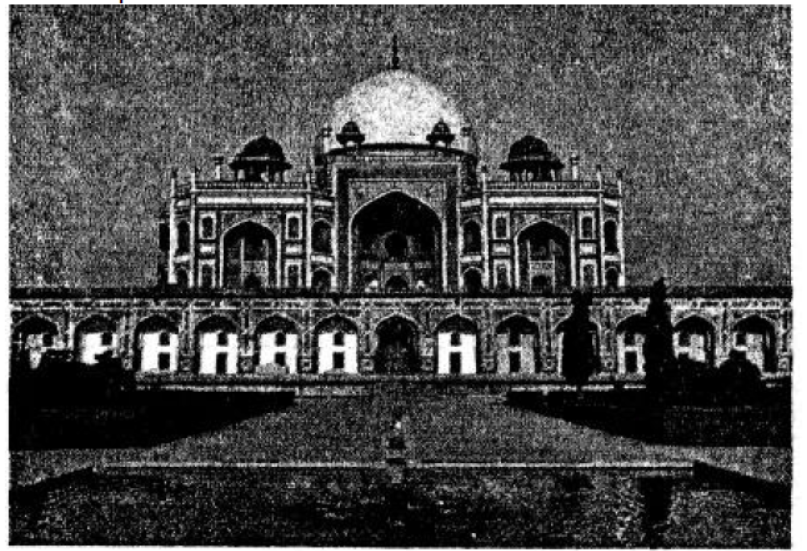
Question 1. Name the Mughal emperor who is buried in this tomb.
Answer: Emperor Humayun is buried in this grand tomb.
In simple words: Humayun is buried inside this tomb.
Exam Tip: The tomb was commissioned by his wife, Hamida Banu Begum, and is famous as Humayun's Tomb.
Question 2. Where is this monument located?
Answer: It is located in Nizamuddin, Delhi.
In simple words: It is located in Nizamuddin, Delhi.
Exam Tip: Humayun's Tomb is located in New Delhi and is recognized as a UNESCO World Heritage Site.
Question 3. In which book could you find a detailed account of his life? Who wrote it?
Answer: A detailed account of his life is found in the book *Humayun-nama*, written by his sister, Gulbadan Begum.
In simple words: His life story is written in the book Humayun-nama by his sister, Gulbadan Begum.
Exam Tip: Remember both the book name 'Humayun-nama' and the author 'Gulbadan Begum.'
Question 4. Why did he spend 15 years in exile?
Answer: After being defeated by Sher Khan, Humayun lost his throne and was forced into a 15-year exile, wandering in search of shelter. Since his brothers refused to help him, he faced great hardships. During this difficult exile in 1542, his son Akbar was born in Amarkot, Sind.
In simple words: He had to flee because Sher Khan defeated him in battle. His brothers did not help him, and he had to wander for 15 years, during which Akbar was born.
Exam Tip: Explain his defeat by Sher Khan and the birth of Akbar in 1542 as key events during his exile.
Question 5. How did he reconquer his lost empire?
Answer: With the military support of the Persian Shah, Humayun captured Kabul and Kandahar from his brother Kamran. By 1554, he had made his position strong in Afghanistan. After Sher Shah died in 1545, his successors turned out to be weak. Taking advantage of this, Humayun marched back into India and recaptured Delhi and Agra in 1555, restoring Mughal rule.
In simple words: Humayun used soldiers from the Shah of Persia to win back Kabul and Kandahar. In 1555, because Sher Shah's successors were weak, he invaded India and won back Delhi.
Exam Tip: Mention the two steps: securing Kabul with Persian help, and taking advantage of Sher Shah's weak successors in 1555.
Free study material for History Civics
Step-by-Step Solutions for Class 7 History Civics Chapter 07 Foundation Of Mughal Empire
Verified Problem Answers for Class 7 History Civics Chapter 07 Foundation Of Mughal Empire
Strengthen your preparation with comprehensive answers for Class 7 History Civics Chapter 07 Foundation Of Mughal Empire. These expert-reviewed solutions make tracking your academic progress straightforward and efficient.
Concept Clarification for Chapter 07 Foundation Of Mughal Empire
Every exercise question in this chapter includes step-by-step working steps, allowing you to self-evaluate, catch mistakes early, and understand the underlying logic.
Effective Revision Strategies for Chapter 07 Foundation Of Mughal Empire
Wrap up your chapter revision by verifying core concepts against standard ICSE question formats. All resources on our platform are free to access.
FAQs
You can download the verified Goyal Brothers solutions for Chapter 07 Foundation Of Mughal Empire on StudiesToday.com. Our teachers have prepared answers for Class 7 History Civics as per 2026-27 ICSE academic session.
Yes, our solutions for Chapter 07 Foundation Of Mughal Empire are designed as per new 2026 ICSE standards. 40% competency-based questions required for Class 7, are included to help students understand application-based logic behind every History Civics answer.
Yes, every exercise in Chapter 07 Foundation Of Mughal Empire from the Goyal Brothers textbook has been solved step-by-step. Class 7 students will learn History Civics conceots before their ICSE exams.
Yes, follow structured format of these Goyal Brothers solutions for Chapter 07 Foundation Of Mughal Empire to get full 20% internal assessment marks and use Class 7 History Civics projects and viva preparation as per ICSE 2026 guidelines.