

Official Frank Brothers Textbook Solutions for Class 10 Biology
Explore the complete Frank Brothers textbook solutions for Class 10 Biology. Tailored for the 2026-27 curriculum, this resource breaks down complex topics to support daily study and targeted revision.
Read and Download Chapter 03 Principles Of Genetics Solutions
Navigate directly to the Chapter 03 Principles Of Genetics solutions using the digital viewer below. Organizing your study sessions chapter-by-chapter allows for seamless offline study and quick reference during revision.
1. Who was the 'Father of Genetics'?
Gregor Johann Mendel. He studied pea plants in his garden and discovered how traits like height and color pass from parent plants to their babies. This is why we call him the Father of Genetics.
2. What is Genetics? AnswerGenetics is the branch of biology that deals with the study of transmission of characters from parents to offspring.
Genetics is the branch of biology that deals with the study of transmission of characters from parents to offspring. For example, if your father has brown eyes and your mother has black hair, genetics helps us understand how these traits pass to you. It explains why children often look like their parents.
3. What is heredity?
The term heredity may be defined as the transmission of genetically based characteristics from parents to offspring. For example, if your father has brown eyes, you might also have brown eyes. This happens because genes pass from parents to their children through special cells.
4. In which cross is 3:1 ratio obtained?
Monohybrid cross. This is when we cross two plants that differ in only one trait, like tall and short height. The 3:1 ratio appears in the second generation when we cross the offspring from the first generation.
5. What is the dihybrid cross ratio?
Dihybrid cross ratio is 9:3:3:1. This means if you cross two plants that differ in two traits like height and flower color, you get this pattern in their babies. For every 16 offspring, 9 will show both dominant traits, 3 will show the first dominant trait only, 3 will show the second dominant trait only, and 1 will show both recessive traits.
6. Which seven characters did Mendel use for his experiments?
Mendel used seven characters in his experiments on pea plants: (1) Plant height - tall or dwarf, (2) Seed shape - round or wrinkled, (3) Seed color - yellow or green, (4) Pod shape - inflated or constricted, (5) Pod color - green or yellow, (6) Flower color - purple or white, (7) Flower position - axial or terminal. Just like how you can see different traits in your family members, Mendel could easily spot these different features in pea plants. This made it simple for him to count and record the results of his crosses.
7. Define the following:(i) Genotype(ii) Phenotype(iii) Homozygous(iv) Heterozygous(v) Allele(vi) Dominant(vii) Recessive
(i) Genotype – The genetic expression of a character in terms of alleles written in symbols is called genotype.(ii) Phenotype – The physical or external and observable expression of a character is called phenotype. For example, if you have brown eyes, that's your phenotype - what people can actually see.(iii) Homozygous – Diploid condition where both the alleles are identical is called homozygous.(iv) Heterozygous – Diploid condition where both the alleles are different is called heterozygous.(v) Allele – Alternative forms of the same gene which determine contrasting characters is called an allele.(vi) Dominant – An allele which expresses itself externally when present in homozygous or heterozygous conditions.(vii) Recessive – An allele which expresses itself externally when present in homozygous condition but remains suppressed in heterozygous condition.
8. Who was Mendel?
Gregor Johann Mendel was a biologist who carried out experiments on garden pea and derived a few fundamental principles in genetics. He studied how tall and short pea plants passed their height to their babies. He is called the 'Father of Genetics'.
9. Name Mendel’s laws
Mendel's laws are: Law of Dominance, Law of Segregation, Law of Independent Assortment. These laws explain how traits like eye color or height pass from parents to children. Each law shows a different pattern of how genes work in living things.
10. What do you understand by monohybrid cross? AnswerMonohybrid cross is one where the parents used for hybridization differ in only one pair of contrasting characters or alleles.
Monohybrid cross is one where the parents used for hybridization differ in only one pair of contrasting characters or alleles. For example, crossing a tall plant with a short plant where height is the only trait being studied. This means we focus on just one feature at a time to see how it passes from parents to children.
11. Explain dihybrid cross.
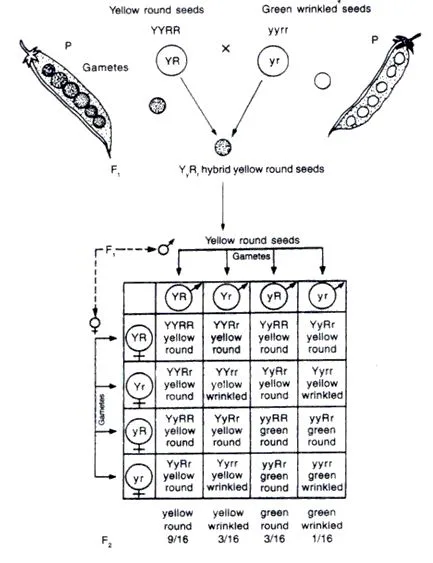
In a dihybrid cross, two pairs of alleles or contrasting characters are considered in parents. For example, cotyledon color and seed shape of pea are used as two pairs of alleles. Suppose, among the two parents, one was true breeding dominant i.e. yellow colored cotyledons and rounded seeds, YYRR and the other was a true breeding recessive i.e. green colored cotyledons and wrinkled seeds, yyrr. On crossing the two parents, F1 generation so obtained had all yellow and round seeds. This is similar to how a child might get both hair color from one parent and eye color from another parent. On self pollinating, the hybrids - YyRr produced four types of seeds in F2 generation Yellow cotyledons and round seeds (YYRR) Yellow cotyledons and wrinkled seeds (YYrr) Green cotyledons and round seeds (yyRR) Green cotyledons and wrinkled seeds (yyrr) Thus the phenotypic ratio of a dihybrid cross is 9:3:3:1.
12. What do you infer from the law of segregation?
The law of segregation explains that the characteristics of an organism are determined by internal alleles that occur in pairs. For example, you get one allele for eye color from your mother and one from your father. These allele pairs separate during meiosis in gamete formation and the pair gets restored upon random fusion in zygote.
13. Why is the law of segregation called law of purity of gametes?
Law of segregation is also called the law of purity of gametes because the two members of a pair of factors do not blend but segregate or separate into different gametes. Think of it like having two different colored marbles in a bag - they don't mix their colors but stay separate when you take them out one by one. This keeps each gamete pure with only one type of factor.
14. Elucidate "Law of independent Assortment". Explain how Mendel achieved it.
According to the law of independent assortment when there are two pairs of contrasting characters, the distribution of the members of one pair into the gametes is independent of the distribution of the other pair. Think of it like choosing your shirt color and pant color separately - they don't affect each other's choice. Based on dihybrid ratio of 9:3:3:1 in F2 generation, Mendel observed that when a plant with two dominant alleles was crossed with another having the corresponding recessive alleles it was possible to obtain new combinations of characters where a plant had one dominant and the other recessive allele. These were new recombinations were not present in either parent or F1 generation.
15. How are Mendel's laws important?
Importance of Mendel's Laws: Dominant and recessive characters can be found. A hybrid with desired characters can be produced easily. For example, farmers can create corn that is both sweet and grows tall. Crops can be improved. Pure recessive characters can be used where needed. Genotypes and phenotypes of next generation can be predicted even before cross is made.
16. Give three exceptions to Mendel's laws.
Exceptions to Mendel's Laws: Incomplete Dominance - In few cases, F1 generation has an intermediate phenotype between dominant and recessive alleles. For example, when red and white flowers cross, they produce pink flowers instead of just red or white. Linkage - Genes on the same chromosomes are said to be linked and are inherited together. Multiple Allelism - Each character may have more than two alleles which can't be explained by Mendel's laws.
17. On which plant Mendel performed his experiments?
Mendel performed his experiments on the garden pea plant or Pisum sativum. Pea plants were perfect for his work because they grow quickly and have clear traits like tall or short height. He could easily see the differences in each generation of plants.
18. What determines the sex of a child in humans?
Sex chromosomes determine the sex of a child in humans. Boys have XY chromosomes while girls have XX chromosomes. The father's sperm carries either an X or Y chromosome, and this decides if the baby will be a boy or girl.
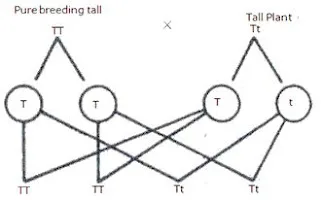
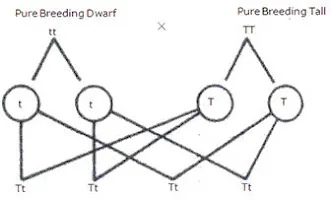
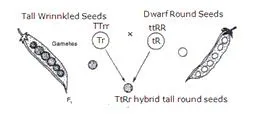
19. Predict the genotype and phenotype of the following crosses in pea. (a) TT × Tt (b) tt × TT (c) TTrr × ttRR (d) TtRr × TtRr (capital letters show dominance) (i) Give the ratio of phenotypes of these crosses. (ii) Mention whether the cross is a monohybrid or dihybrid.
(a) Genotype - TT: Tt will be 2:2 or 1:1 Phenotype - All tall plants (b) Genotype - Tt Phenotype - All tall (c) Genotype - TtRr - All Hybrid Phenotype - All tall and round seeds (d) Genotype - 1TTRR : 2TTRr : 2TtRR : 1ttRR : 4TtRr : 1TTrr : 2TTrr : 2ttRR : ttrr Phenotype - 9 tall and round seeds; 3 Tall and wrinkled seeds; 3 Dwarf and round seeds; 1 Dwarf and wrinkled seeds. Just like how a tall parent can have both tall and short children depending on their hidden genes, plants also pass on both visible and hidden traits to their offspring. (i) Phenotypic ratio of: (a) TT × Tt - All progeny plants will be tall. (b) tt × TT - All the progeny plants will be tall (c) TTrr × ttRR = All progeny will be tall having round seeds. (d) TtRr × TtRr = 9:3:3:1 (9 tall and round seeds; 3 Tall and wrinkled seeds; 3 Dwarf and round seeds; 1 Dwarf and wrinkled seeds) (ii) (a) Monohybrid (b) Monohybrid (c) Dihybrid (d) Dihybrid
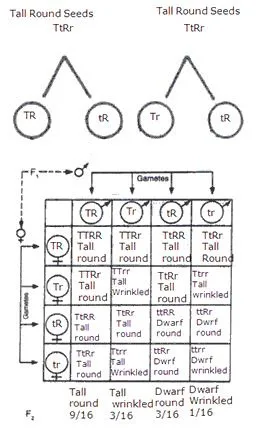
20. Note down the allele pairs studied by Mendel. Mention which allele is dominant.
The allele pairs studied by Mendel were: 1) Tall (T) and dwarf (t) for plant height - where tall is dominant, 2) Round (R) and wrinkled (r) for seed shape - where round is dominant, 3) Yellow (Y) and green (y) for seed color - where yellow is dominant, 4) Purple (P) and white (p) for flower color - where purple is dominant. Think of it like having two options for each trait, where one always wins over the other when both are present together. 5) Inflated (I) and constricted (i) for pod shape - where inflated is dominant, 6) Green (G) and yellow (g) for pod color - where green is dominant, and 7) Axial (A) and terminal (a) for flower position - where axial is dominant.
21. How did Mendel's work come to light?
Mendel's work did not receive much notice till 1900. His discoveries were forgotten for 35 years because other scientists did not understand their importance. Then three scientists: Hugo de Vries, Carl Correns and Erich von Tschermak working independently rediscovered his work and brought Mendel's experiment to limelight.
22. Define the following: (i) Autosomes(ii) Sex chromosomes(iii) Sex-linked charactersAnswer (i) Autosomes: The chromosomes other than sex chromosomes present in the body are called autosomes.(ii) Sex chromosomes: The chromosomes which determine the sex of an individual are called sex chromosomes.(iii) Sex-linked characters: Such characters or traits that are controlled by genes occurring on sex chromosomes are called sex-linked characters.
(i) Autosomes: The chromosomes other than sex chromosomes present in the body are called autosomes. Humans have 22 pairs of autosomes which control things like height, hair color, and eye color. (ii) Sex chromosomes: The chromosomes which determine the sex of an individual are called sex chromosomes. In humans, these are called X and Y chromosomes. (iii) Sex-linked characters: Such characters or traits that are controlled by genes occurring on sex chromosomes are called sex-linked characters.
23. How is sex of zygote determined in humans?
The sex of the zygote is determined by the sperm which fertilizes the ovum. Think of it like a lottery - the father's sperm carries either X or Y, while the mother's egg always has X. If an X bearing sperm fuses with an ovum in man, the offspring would be female and if a Y chromosome bearing sperm fuses with an ovum the offspring will be a boy.
24. What do you understand by sex-linked inheritance?
The inheritance of sex linked genes controlling sex linked characters is called sex linkage or sex linked inheritance. For example, color blindness is more common in boys than girls because it is a sex-linked trait. This happens because these genes are located on the X or Y chromosomes.
25. What do you know about haemophilia?
Haemophilia is X-linked inherited disease in which the diseased person is unable to synthesize a normal blood protein called Antihaemophilia globulin that helps in clotting. This means the blood cannot form a thick covering over wounds to stop bleeding. Normal people's blood becomes thick and stops flowing within a few minutes of getting hurt. Haemophilia is also called Bleeder's disease as the haemophilia person bleeds for a long time even from a minor cut.
26. What is color blindness?
Color blindness is a sex-linked inherited disease in which the diseased person is not able to distinguish between red and green color. This means they might see a red apple and a green leaf as the same brownish color. It happens more in boys than girls.
27. What is the cause of haemophilia and color blindness?
Cause of Haemophilia: Haemophilia is an X-linked inherited disease. Homozygosity for recessive haemophilia gene is must to be seen in a female while a single affected X chromosome makes the male a haemophilia victim. This is why boys get these diseases more often than girls. Cause of Color Blindness - Color blindness is the effect of a recessive gene. In case of female, both the X chromosomes must have the recessive gene but as males have only one X chromosome, just a single affected chromosome causes color blindness.
28. Why do you think that more males are affected by sex-linked diseases?
More males are affected by sex linked diseases because they have a single X chromosome and the sex linked diseases occur due recessive gene on X chromosome. This means if a boy gets one bad copy of a gene on his X chromosome, he will get the disease because he has no second X chromosome to protect him. Girls have two X chromosomes, so even if one has the bad gene, the other good X chromosome can still work properly.
29. Why can't a man transfer a sex linked disease directly to his son?
A man can never transfer a sex-linked gene directly to his son because the son inherits only the Y chromosome from his father. Think of it like this - the father gives his Y chromosome to make a boy, not his X chromosome. The sex linked diseases are present on the X chromosome.
30. A woman has normal vision but her father was color blind. If she is married to a color blind person, report on the occurrence of the disease in the progeny.
The progeny of the woman and the haemophilia man will have one son and one daughter as colorblind, one daughter as a carrier and one son will be normal. Color blindness is passed from mothers to sons just like how some traits skip generations in families. This happens because the gene for color vision is located on the X chromosome.
31. What is the other name of Bleeder's disease?
Haemophilia. In this condition, a person's blood does not clot properly when they get hurt. This means even a small cut can bleed for a very long time.
32. What is sex-linked inheritance? AnswerThe inheritance of sex linked genes controlling sex linked characters is called sex linkage or sex linked inheritance.
The inheritance of sex linked genes controlling sex linked characters is called sex linkage or sex linked inheritance. For example, color blindness is more common in boys than girls because it is sex-linked. This happens because some genes are located on the X or Y chromosomes.
33. (i) State Mendel's law of dominance. (ii) Suppose you are given two pairs of contrasting characters: Seed color → yellow and green, seed coat → round and wrinkled. Fill in the following table to show that F2 generation according to the principle of independent assortment as given by Mendel.
Mendel's law of Dominance: It states that in a given cross between two organisms with pure contrasting alleles or characters only one allele is expressed in F1 generation. Think of it like having both a loud voice and a soft voice - only the loud one is heard. The character that appears is called dominant and the other is recessive.
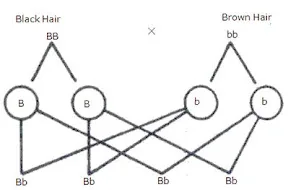
34. Answer the following briefly:(i) Explain with the help of a chart what will be the color of a child's hair if father has got dominant gene for black hair and mother has recessive gene for brown hair?(ii) Explain the following terms:(a) Laws of Inheritance.(b) Identical twins.(iii) Define the term heredity.
(i) In F1 generation, all progeny produced will be hybrids Bb but will have black hair. This is just like when a tall parent and short parent have children - the tall trait usually wins. (ii) (a) Laws of Inheritance: Gregor Johann Mendel performed experiments with different varieties of garden pea and then formulated a few laws to study the inheritance of characters in living organisms. (b) Identical twins: A single fertilized egg or zygote splits into two parts after conception, resulting in the development of two individual embroys which later develop into identical twins. (iii) The term heredity may be defined as the transmission of genetically based characteristics from parents to offspring.
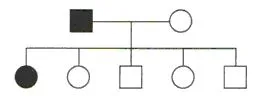
35. A family consists of two parents and their five children and the pedigree chart below shows the inheritance of the trait color blindness. (i) Who is color blind in parents - Father or Mother? (ii) How many daughters and sons have been born in the family? (iii) What does the child 1 indicate about this trait? (iv) Complete the depiction of all probabilities of the trait among the children 2-5 in the chart. (v) On which chromosome is the gene of this trait located? (vi) Name one other trait in humans which follows the similar mode of inheritance.
(i) Father is color blind.(ii) 3 daughters and two sons.(iii) Child 1 is color blind.(iv) All daughters from 2-5 are carriers while all the sons are normal. This means the daughters can pass the trait to their children even though they can see colors normally. Color blindness mainly affects boys more than girls because of this special inheritance pattern.(v) X chromosome.(vi) Haemophilia.
Choose the Correct Answer
(i) Mendel conducted his hybridization experiments on
- (a) potato
- (b) garden pea ✓
- (c) cow pea
- (d) pigeon pea
Answer: (b) garden pea
(ii) If a homozygous tall plant is crossed with a heterozygous tall plant, the proportion of tall progeny would be
- (a) 25%
- (b) 50%
- (c) 75%
- (d) 100% ✓
Answer: (d) 100%
(iii) Mendel used ______ pairs of a characters for his experiments.
- (a) 5
- (b) 6
- (c) 7 ✓
- (d) 4
Answer: (c) 7
(iv) Father of genetics
- (a) Darwin
- (b) Pasteur
- (c) Lamarck
- (d) Mendel ✓
Answer: (d) Mendel
(v) The allele which masks the effect of its complement is
- (a) dominant ✓
- (b) recessive
- (c) monohybrid
- (d) dihybrid
Answer: (a) dominant
(vi) If any of Mendel's characters were linked; one would have been unable to derive.
- (a) Law of Dominance
- (b) Law of Segregation
- (c) Law of Independent Assortment ✓
- (d) None of these
Answer: (c) Law of Independent Assortment
(vii) The contrasting characters used by Mendel are called
- (a) alleles ✓
- (b) heteromorphs
- (c) genes
- (d) none of the above
Answer: (a) alleles
(viii) If a pea plant with round seeds is selfed and the offspring are in the ratio 3:1, then the plant is
- (a) homozygous
- (b) heterozygous ✓
- (c) both
- (d) none of these
Answer: (b) heterozygous
(ix) A cross where two pairs of alleles are considered is a
- (a) dihybrid cross ✓
- (b) monohybrid cross
- (c) polyhybrid cross
- (d) test cross
Answer: (a) dihybrid cross
(x) Mendel was born in
- (a) Czechoslovakia ✓
- (b) Austria
- (c) England
- (d) Portugal
Answer: (a) Czechoslovakia
(xi) Human sex chromosomes are
- (a) X and O
- (b) Y and O
- (c) X and Y ✓
- (d) none of these
Answer: (c) X and Y
(xii) Haemophilia is due to recessive gene on
- (a) X chromosome ✓
- (b) Y chromosome
- (c) autosome
- (d) none of these
Answer: (a) X chromosome
(xiii) Chromosomes identical in male and female are called
- (a) sex chromosomes
- (b) autosomes ✓
- (c) heterosomes
- (d) dominant
Answer: (b) autosomes
(xiv) Males have more chances of suffering from sex-linked disease because of
- (a) one Y chromosome
- (b) one X chromosome ✓
- (c) autosomes
- (d) none of these
Answer: (b) one X chromosome
(xv) A single recessive trait, able to express must be on
- (a) Y chromosome
- (b) X chromosomes in male ✓
- (c) X chromosome in female
- (d) autosome
Answer: (b) X chromosomes in male
(xvi) A carrier haemophilia woman marries a haemophilia man. What are the chances for her progeny to be haemophilia
- (a) 25%
- (b) 75%
- (c) 50% ✓
- (d) 100%
Answer: (c) 50%
(xvii) A color blind woman marries a normal man, in the progeny
- (a) one son and one daughter are normal
- (b) sons are color blind and daughters are normal
- (c) sons are color blind and daughters are carriers ✓
- (d) none of these
Answer: (c) sons are color blind and daughters are carriers
(xviii) A man can transfer his sex-linked gene to his
- (a) son
- (b) daughter ✓
- (c) both
- (d) none of these
Answer: (b) daughter
Step-by-Step Solutions for Class 10 Biology Chapter 03 Principles Of Genetics
ICSE Chapter Solutions: Class 10 Biology Chapter 03 Principles Of Genetics
Access structured ICSE solutions for Class 10 Biology Chapter 03 Principles Of Genetics designed to match CISCE curriculum standards. These verified answers help clarify complex numericals and support daily homework revision.
Concept Clarification for Chapter 03 Principles Of Genetics
Every exercise question in this chapter includes step-by-step working steps, allowing you to self-evaluate, catch mistakes early, and understand the underlying logic.
Effective Revision Strategies for Chapter 03 Principles Of Genetics
Wrap up your chapter revision by verifying core concepts against standard ICSE question formats. All resources on our platform are free to access.
FAQs
You can download the verified Frank Brothers solutions for Chapter 03 Principles Of Genetics on StudiesToday.com. Our teachers have prepared answers for Class 10 Biology as per 2026-27 ICSE academic session.
Yes, our solutions for Chapter 03 Principles Of Genetics are designed as per new 2026 ICSE standards. 40% competency-based questions required for Class 10, are included to help students understand application-based logic behind every Biology answer.
Yes, every exercise in Chapter 03 Principles Of Genetics from the Frank Brothers textbook has been solved step-by-step. Class 10 students will learn Biology conceots before their ICSE exams.
Yes, follow structured format of these Frank Brothers solutions for Chapter 03 Principles Of Genetics to get full 20% internal assessment marks and use Class 10 Biology projects and viva preparation as per ICSE 2026 guidelines.