

Class 10 Biology Chapter 02 Structure Of Chromosomes: Frank Brothers Study Material
Explore the complete Frank Brothers textbook solutions for Class 10 Biology. Tailored for the 2026-27 curriculum, this resource breaks down complex topics to support daily study and targeted revision.
Chapter 02 Structure Of Chromosomes Answer Guide
Navigate directly to the Chapter 02 Structure Of Chromosomes solutions using the digital viewer below. Organizing your study sessions chapter-by-chapter allows for seamless offline study and quick reference during revision.
1. What is chromatin?
Chromatin is an extremely thin, long nuclear fibre occurring in the nucleus before cell division. Think of it like thin threads of wool tangled up inside a ball. It contains all the genetic information needed to make a new cell.
2. How is chromatin observed in an interphase cell?
In interphase, the chromatin appears as a network of long, extremely thin fibres. Think of it like very fine threads spread out inside the cell. These fibres are so thin that they look like a tangled web under the microscope.
3. What happens to chromatin during prophase and metaphase of mitosis?
During prophase of mitosis, the chromatin fibres shorten and become thick to form chromosomes. Think of it like loose thread being twisted into a tight rope. During metaphase, the chromosomes appear more distinct and clear and each consists of two parallel strands called chromatids joined by a centromere.
4. What are chromosomes? Why are they called so?
Chromosomes are the thread like structures or chromatin material present inside the nucleus. Think of them like tiny strings that carry all the instructions for making you who you are. Chromosomes are so called because they take up certain basic dye and stain very rapidly. The word chromosome comes from two words "chromos" meaning color and "soma" meaning body.
5. Mention the contribution of the scientists given below in the study of chromosomes:(i) Strasburger(ii) Balbiani(iii) Waldeyer(iv) Sutton and Boveri
(i) Strasburger – He observed thread like structures during cell division.(ii) Balbiani – Described rod like structures in nucleus before cell division. Think of these structures like tiny strings inside each cell that carry all the information about how you look and grow. (iii) Waldeyer – Coined the term 'chromosomes'.(iv) Sutton and Boveri – They described chromosomes as physical structures and transmitters of hereditary traits.
6. Briefly mention the structure of a typical chromosome.
Chromosomes are the thread like structures present in the nucleus of the cell. They are covered with a sheath made up of proteins and filled with granular matter called matrix. Inside the matrix, there are two threads called chromonemata. Think of it like a rope that has two smaller threads twisted together inside. The chromosome consists of two symmetrical strands called chromatids. Each chromosome consists of a distinct constriction called centromere which gets attached to the spindle network.
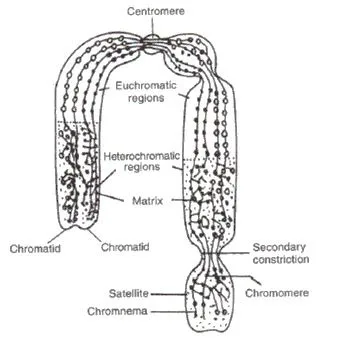
7. Write a sentence about each of the following:(i) Sheath(ii) Matrix(iii) Chromonemata(iii) Centromere(v) Secondary constriction(iv) Telomere
(i) Sheath – It is a proteinaeous covering present around the chromosomes.(ii) Matrix – It is a granular matter present inside the sheath.(iii) Chromonemata – They are the subunits of chromatids. Think of chromonemata like the threads in a rope that make up the whole rope.(iv) Centromere – A constriction in the chromosome is called centromere.(v) Secondary Constriction – A constriction other than primary constriction is called a secondary constriction.(vi) Telomere – The ends of the chromosomes is termed as telomere.
8. At which stage are chromosomes best observed?
Chromosomes are best observed at metaphase. During this stage, the chromosomes line up neatly in the middle of the cell like students standing in a straight line during assembly.
9. What are autosomes? How many are present in man?
The chromosomes other than sex chromosomes present in the human body are called autosomes. These autosomes carry genes for traits like height, hair color, and blood type. 22 pairs of autosomes are present in man.
10. What do you understand by sex chromosomes?
The chromosomes which determine the sex of an individual are called sex chromosomes. In humans, girls have XX chromosomes and boys have XY chromosomes. These special chromosomes decide whether a baby will be born as a boy or girl.
11. How are sex chromosomes significant?
Sex chromosomes are significant as they determine the sex of an individual. In humans, girls have XX chromosomes and boys have XY chromosomes. This is why some families have more boys or more girls - it depends on which chromosome the father passes on.
12. What are the sex chromosomes in man?
In man, there is a pair of sex chromosomes. In males, it is X and Y while in female, the sexchromosomes are X and X which are identical to each other. Think of it like this - boys get one chromosome from mom (X) and one from dad (Y), while girls get X from both parents.
13. Give the importance of chromosomes as hereditary material.
Chromosomes are the main source of chemical information which determines that the cell should become like its parent cell. This is why you look like your parents - you got chromosomes from both of them. During the developmental stage they also determine that the cells of the organism will give the animal or the plant, the characteristic features of its species.
14. Name the two nucleic acids. Who discovered them?
DNA and RNA are the two nucleic acids. DNA is like a recipe book that tells your body how to make you look like your parents. Frederick Miescher discovered DNA
15. What are nucleic acids made of?
Nucleic acids are made up of three types of molecules: a pentose sugar, nitrogenous bases and a phosphate. Think of these three parts like the ingredients in your favorite laddu - you need flour, sugar, and ghee to make it complete. Each part has a special job in making the nucleic acid work properly.
16. What are the chemical composition of chromosome?
The chemical composition of chromosome consists of: Approximately 40% of DNA 50% of Histone proteins. Think of DNA as the instruction book and histone proteins as the packaging material that keeps it organized. 8.5% Non histone proteins Metallic ions like magnesium and calcium in traces.
17. Mention the names of the nitrogen bases present in DNA.
Two nitrogenous bases present in DNA are: Purines – Adenine and Guanine. Think of these bases like the letters in our alphabet that make words. Pyrimidines – Cytosine and Thymine.
18. Difference between DNA and RNA.
DNA (Deoxyribonucleic acid) is a double-stranded molecule that stores genetic information in the nucleus of cells, while RNA (Ribonucleic acid) is usually single-stranded and helps in protein synthesis. Think of DNA like a master recipe book that stays safe in the kitchen, while RNA is like a photocopy of one recipe that goes to the cooking area. DNA contains the sugar deoxyribose and the bases A, T, G, C, whereas RNA contains ribose sugar and A, U, G, C bases. DNA is found mainly in the nucleus and is responsible for heredity, while RNA is found in both nucleus and cytoplasm and carries out various functions like protein synthesis and gene regulation.
19. Write a short note on features of DNA.
Features of DNA: DNA consists of two strands which are spirally arranged around an axis. This is called a double helical arrangement. Each DNA strand is made up of nitrogenous bases, pentose sugar and phosphate. Sugars are pentose type; bases are adenine, guanine, cytosine and thymine. Think of DNA like a twisted ladder where the sides are made of sugar and phosphate, and the steps are the bases. Both strands are connected with hydrogen bonds. There are two bonds between adenine and thymine and three bonds between guanine and cytosine. In the DNA, bases are inside and sugars are outside and two sugars are connected with phosphoric acid. Each DNA strand replicates and from each replicated DNA a new DNA is formed. This is called replication of DNA.
20. Who described the detailed structure of DNA? AnswerWatson and Crick described the detailed structure of DNA.
Watson and Crick described the detailed structure of DNA. They found that DNA looks like a twisted ladder with two sides. This discovery happened in 1953 and changed how we understand life itself.
21. What is the importance of DNA? AnswerImportance of DNA: DNA is most important because it is the hereditary material. It acts as the director of protein synthesis. Some DNA of chromosomes forms nucleolus. DNA in presence of enzymes forms mRNA which acts as messenger.
DNA is most important because it is the hereditary material. It acts as the director of protein synthesis. Think of DNA like a recipe book that tells your body how to make everything from your eye color to your height. Some DNA of chromosomes forms nucleolus. DNA in presence of enzymes forms mRNA which acts as messenger.
22. What are the rungs of the "DNA ladder" made of?
The rungs of "DNA ladder" are made up of two types of nitrogenous bases: Purines: Adenine and Guanine. Think of these bases like puzzle pieces that only fit with their perfect partner. Pyrimidines: Cytosine and Thymine.
23. Name the repeating components of each DNA strand lengthwise.
Repeating components of each DNA strand length wise are pentose sugar and phosphate group. Think of it like a chain where the same two parts keep repeating over and over again. These two components form the backbone of DNA that holds everything together.
24. Fill in the blanks:(i) DNA replicates in the ______ of the cell cycle.(ii) Chromatin fibre is made up of DNA and ______.(iii) There are two nucleic acids ______ and ______.(iv) DNA acts as director of ______ synthesis.(v) DNA stands are made up of, pentose sugar and four types of ______ bases.
(i) Interphase (ii) histone proteins (iii) RNA, DNA. Think of DNA like a recipe book in your kitchen - it contains all the instructions needed to make different dishes. Just like how you need the right ingredients to follow a recipe, cells need DNA to make proteins. (iv) Protein (v) Nitrogen
25. State whether the following sentences are true or false:(i) Each spiral of the DNA has 12 nucleotides.(ii) The two DNA chains are parallel to each other.(iii) Genes are arranged in a linear order on a chromosome.(iv) In any specimen of DNA, the total molar amount of A + G = T+ C.
(i) False (ii) False - DNA chains are like two ribbons twisted together but running in opposite directions, not side by side. (iii) True (iv) True
26. Label the lettered parts of the given figure and answer the following questions:(i) What does this diagram represent?(ii) What is the importance of 'd'?(iii) What are the 'staining' properties of 'b' and 'c'?(iv) Who gave the term used for this structure today?(v) What is a?(vi) Is 'e' present in all chromosomes?
(i) This diagram represents the structure of chromosome.(ii) 'd' is centromere which gets attached to the spindle fibres.(iii) 'b' is heterochromatin which is darkly stained region when stained with acetocarmine and 'c' is euchromatin which when stained with acetocarmine or felugen gets lightly stained. Think of it like a dark blue shirt and a light blue shirt - both are blue but one appears darker than the other under the same light.(iv) Waldeyer(v) Matrix(vi) No, secondary constriction or 'e' is not present in all chromosomes.
Choose the Correct Answer
(i) The network of fine threads in nucleus is called?
- (a) chromosome
- (b) chromonemata
- (c) chromatid
- (d) chromatin ✓
Answer: (d) chromatin
(ii) The term 'chromosome' was coined by?
- (a) Balbiani
- (b) Darwin
- (c) Waldeyer ✓
- (d) Sutton and Boveri
- (c) Waldeyer ✓
Answer: (c) Waldeyer
(iii) The primary constriction contains?
- (a) centromere ✓
- (b) centriole
- (c) chromatid
- (d) telomere
Answer: (a) centromere
(iv) This structure is not present in all chromosomes?
- (a) centromere
- (b) chromonemata
- (c) secondary constriction ✓
- (d) telomere
Answer: (c) secondary constriction
(v) Chromosomes are thin and thread like at?
- (a) interphase ✓
- (b) metaphase
- (c) anaphase
- (d) pachytene
Answer: (a) interphase
(vi) Thick short chromosomes can be observed at (in mitosis)?
- (a) metaphase
- (b) telophase
- (c) anaphase
- (d) prophase ✓
Answer: (d) prophase
(vii) Chromosomes largely consist of?
- (a) DNA and histones ✓
- (b) DNA and RNA
- (c) RNA and histones
- (d) histones and ions
Answer: (a) DNA and histones
(viii) Chromosome number of man is?
- (a) 46 ✓
- (b) 23
- (c) 64
- (d) 45
Answer: (a) 46
(ix) Telocentric chromosomes are?
- (a) I shaped ✓
- (b) V shaped
- (c) J shaped
- (d) L shaped
Answer: (a) I shaped
(x) A 'V' shaped chromosomes has to?
- (a) acrocentric
- (b) metacentric ✓
- (c) telocentric
- (d) sub-metacentric
Answer: (b) metacentric
(xi) Sex chromosomes in man are?
- (a) XX
- (b) YY
- (c) XY ✓
- (d) none of these
Answer: (c) XY
(xii) Sex of an individual is determined by?
- (a) autosomes
- (b) sex chromosomes ✓
- (c) lampbrush
- (d) polytene chromosomes
Answer: (b) sex chromosomes
(xiii) DNA model was given by?
- (a) Watson and Crick ✓
- (b) Sutton and Boveri
- (c) Balbiani and Darwin
- (d) Waldeyer and Carlson
Answer: (a) Watson and Crick
(xiv) Adenine is a?
- (a) nitrogen base ✓
- (b) pentose sugar
- (c) fatty acid
- (d) enzyme
Answer: (a) nitrogen base
(xv) Which of these is not present in DNA?
- (a) Adenine
- (b) Thymine
- (c) Uracil ✓
- (d) Cytosine
Answer: (c) Uracil
(xvi) RNA has uracil instead of?
- (a) adenine
- (b) thymine ✓
- (c) guanine
- (d) cytosine
Answer: (b) thymine
(xvii) Spirally coiled double strands are observed in?
- (a) DNA ✓
- (b) chromosome
- (c) RNA
- (d) chromatin
Answer: (a) DNA
ICSE Textbook Solutions for Class 10 Biology Chapter 02 Structure Of Chromosomes
About ICSE Solutions for Class 10 Biology Chapter 02 Structure Of Chromosomes
Review accurate ICSE solutions for Chapter 02 Structure Of Chromosomes tailored for Class 10 Biology students. Use these step-by-step notes to simplify difficult textbook exercises and improve exam readiness.
Concept Clarification for Chapter 02 Structure Of Chromosomes
Tackle complex theorems and numerical problems easily by cross-referencing your working steps with our structured solution guides.
Effective Revision Strategies for Chapter 02 Structure Of Chromosomes
Wrap up your chapter revision by verifying core concepts against standard ICSE question formats. All resources on our platform are free to access.
FAQs
You can download the verified Frank Brothers solutions for Chapter 02 Structure Of Chromosomes on StudiesToday.com. Our teachers have prepared answers for Class 10 Biology as per 2026-27 ICSE academic session.
Yes, our solutions for Chapter 02 Structure Of Chromosomes are designed as per new 2026 ICSE standards. 40% competency-based questions required for Class 10, are included to help students understand application-based logic behind every Biology answer.
Yes, every exercise in Chapter 02 Structure Of Chromosomes from the Frank Brothers textbook has been solved step-by-step. Class 10 students will learn Biology conceots before their ICSE exams.
Yes, follow structured format of these Frank Brothers solutions for Chapter 02 Structure Of Chromosomes to get full 20% internal assessment marks and use Class 10 Biology projects and viva preparation as per ICSE 2026 guidelines.