

Official Frank Brothers Textbook Solutions for Class 10 Biology
Review the Frank Brothers Solutions for ICSE Class 10 Biology Chapter 1 Cell Division for Class 10 designed for Class 10 Biology students. Published under the latest ICSE guidelines for 2026-27, these chapter-wise solutions provide the foundational knowledge required for exam success.
Read and Download Chapter 01 Cell Division for Class 10 Solutions
View or download the dedicated Chapter 01 Cell Division for Class 10 resource below. This chapter-by-chapter structuring ensures easy navigation for daily study routines and immediate access to core academic concepts.
1. Why is cell division necessary ?
Cell division is important for a variety of reasons. One reason is that cell division is important for the growth of an organism. It is also important for cells to divide so that they can remain efficient. Think about how a small baby grows into a tall adult - this happens because cells keep dividing to make new cells. As all the cells are produced by the division of pre-existing cells, so each organism needs new cells for growth, replacement, repair and reproduction.
2. What do you understand by cell cycle?
The cell cycle is a series of events that take place in a cell leading to its division and duplication. Just like how you follow a daily routine of waking up, eating, studying and sleeping, cells also follow steps in order. This process helps living things grow bigger and repair damaged parts.
3. How is interphase important?
Interphase is a long resting phase in the cell cycle during which the cell grows, multiplication of DNA, synthesis of RNA and proteins takes place. Think of it like a student preparing for exams by studying and gathering all materials needed. During this time, the cell doubles its size and makes copies of all important parts. Thus interphase is important in the cell cycle as it allows the cell to grow and develop into a mature cell before it is able to reproduce.
4. Which cell division results in formation of ova?
Meiosis results in the formation of ova. This special type of cell division reduces the number of chromosomes by half. Meiosis results in the formation of ova.
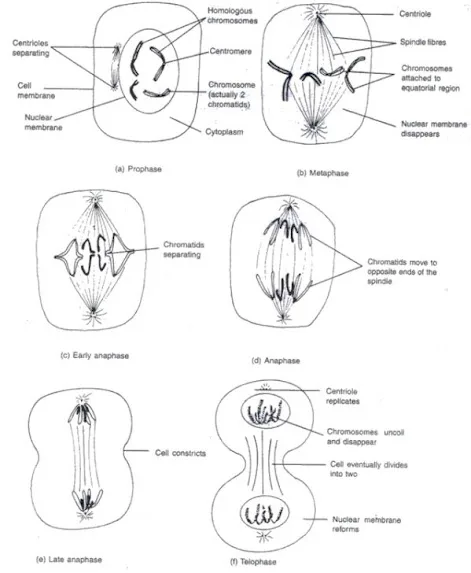
5. Draw labeled diagram of different steps of mitosis.
Mitosis is the process of cell division where one parent cell divides to form two identical daughter cells. The main steps are: Prophase - chromosomes become visible and nuclear membrane disappears. Think of it like packing your school bag before leaving home - everything gets organized and ready. Metaphase - chromosomes line up at the center of the cell. Anaphase - chromosomes separate and move to opposite ends. Telophase - nuclear membranes reform around each set of chromosomes. Finally, cytokinesis occurs where the cytoplasm divides completely forming two separate cells.
6. Describe anaphase in mitosis.
In anaphase, the two chromatids separate at the centromere and begin to move in opposite direction towards either end of the spindle network called the poles. This happens because the spindle fibers pull them apart like invisible ropes. The chromosomes bend around the centromere showing a 'V' or 'J' or 'L' shaped structure based on the length of its arms.
7. Write down the phases of mitosis.
The different phases of mitosis are Prophase, Metaphase, Anaphase and Telophase. Think of it like a school assembly where students first gather, then line up in the middle, then split into two groups, and finally form two separate classes.
8. Where does mitosis occur?
Mitosis takes place in the body cells or somatic cells of the organisms. This includes cells in your skin, muscles, and organs. These are different from the special cells that make babies.
9. How is mitosis important?
Mitosis is important because: It helps in the growth of tissues, organs and thus the entire organism. It helps in the repair of damaged tissues and organs. For example, when you get a cut on your skin, new cells are made through mitosis to heal the wound. It is the method by which lower organisms reproduce. It helps in the maintenance of the hereditary characters by the replication of chromosomes
10. Mention characteristic features of mitosis.
Some characteristic features of mitosis are: It takes place in somatic cells. Chromosome number is preserved. This is why you have the same number of chromosomes in every cell of your body. Daughter cells produced are identical to the parent cell. It results in increase in the number of cells.
11. Give important character of meiosis.
Few important characteristics of Meiosis are: Meiosis occurs in germ cells only. It results in the formation of gametes. This is why you get features from both your mother and father. Chromosome number of the parent cell is halved. Daughter cells differ from the parent cell.
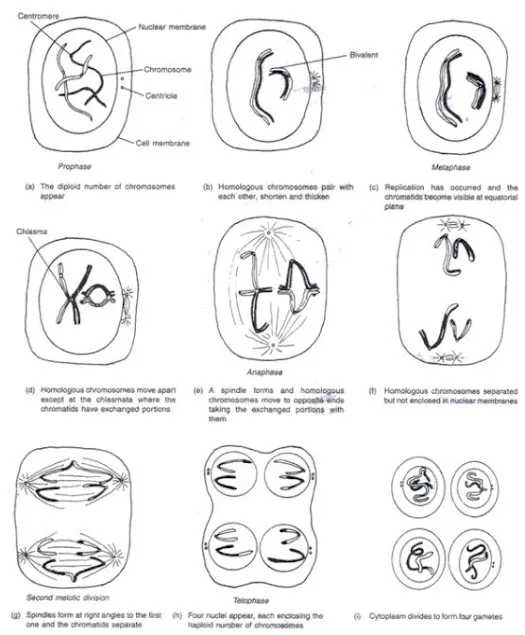
12. With well labelled explain meiosis.
Different stages involved in meiosis: This process happens inside the reproductive organs of your body to make special cells. Think of it like dividing your favorite chocolates equally between friends - one cell becomes four smaller cells with half the genetic material each.
13. Where does meiosis take place in humans?
In humans, meiosis occurs in testes producing sperms and in the ovaries resulting in ova. This is why boys and girls can have babies when they grow up. Meiosis makes special cells with half the normal number of chromosomes.
14. What is the significance of meiosis?
Due to meiosis, chromosome number is reduced to half in gametes and chromosome number of species is maintained. This is why humans always have 46 chromosomes even though sperm and egg cells have only 23 each. Genetic variations occur due to meiosis. The zygote on fertilization gets one maternal and one paternal chromosome in each homologous pair.
15. What is the significance of crossing over?
As a result of crossing over, the paternal and maternal homologous chromosomes of an organism pair up and exchange certain portions of their chromatids which lead to genetic variations. Think of it like mixing cards from two different decks to create new combinations. It makes the genetic information in each haploid cell unique
16. Compare meiotic and mitotic telophase.
In mitotic telophase, one nuclear membrane forms around each set of chromosomes at opposite poles of the cell, and the chromosomes begin to uncoil. Think of it like unwrapping gifts after a birthday party. In meiotic telophase I, nuclear membranes may or may not form around the chromosome sets, and in telophase II, nuclear membranes form around each of the four sets of chromosomes, resulting in four nuclei instead of two.
17. Is cytokinesis necessary after karyokinesis in meiosis I?
No, cytokinesis is not necessary after karyokinesis in meiosis I. Think of it like dividing the nucleus first, then waiting to split the whole cell later. It generally takes place at the end of meiosis II when the four daughter cells are formed.
18. Define the following: (i) Karyokinesis (ii) Cytokinesis (iii) Chiasmata Answer(i) Karyokinesis – It is the nuclear division where nucleus divides into two.(ii) Cytokinesis – It is the division of cytoplasm in which the entire cell splits separating each nuclei.(iii) Chiasmata – is the point where two homologous non-sister chromatids exchange genetic material in chromosomal crossover during meiosis.
(i) Karyokinesis – It is the nuclear division where nucleus divides into two. Think of it like splitting a ball into two equal halves. (ii) Cytokinesis – It is the division of cytoplasm in which the entire cell splits separating each nuclei. This happens right after the nucleus has divided. (iii) Chiasmata – is the point where two homologous non-sister chromatids exchange genetic material in chromosomal crossover during meiosis.
19. How does cytokinesis differ in a plant and animal cell?
In an animal cell, the cytoplasm between the two daughter nuclei constricts i.e. a furrow starts forming in the plasma membrane at the middle. This deepens towards the interior of the cell and the cytoplasm splits into two similar daughter cells. Think of it like pinching a balloon in the middle until it splits into two parts. In plant cells on the other hand, the constriction is not observed during cytokinesis. Instead a new cell wall is laid down along the equatorial region of the spindle network beginning at the Centre. Thus, two distinct, daughter cells are cut off.
20. Give five main differences between mitosis and meiosis.
Difference between mitosis and meiosis: 1) Mitosis produces two identical diploid cells, while meiosis produces four genetically different haploid cells. 2) Mitosis involves one division, while meiosis involves two divisions. Think of it like photocopying - mitosis makes exact copies while meiosis mixes things up like shuffling cards. 3) Mitosis maintains the same chromosome number, while meiosis reduces it by half. 4) Mitosis occurs in somatic cells for growth and repair, while meiosis occurs in reproductive cells. 5) Crossing over rarely happens in mitosis, but it is common in meiosis.
21. Why is reduction division important? Why is meiosis referred to as such?
Meiosis is a reductional division as in meiosis the number of chromosomes of parent cell is reduced to half in the daughter cells. For example, if a parent cell has 46 chromosomes, each daughter cell will have only 23 chromosomes. Now, this reductional division is significant because it restores the number of chromosomes in a species.
22. Is it right to say that meiosis is responsible for maintaining chromosome number of a species?
Yes, meiosis is responsible for maintaining the chromosome number of a species as meiosis being a reductional division involves formation of daughter cells with half the number of chromosomes. For example, humans have 46 chromosomes but their egg and sperm cells have only 23 chromosomes each. When fertilization happens, the full 46 chromosomes are restored in the baby.
23. How many daughter cells would you expect if 4 cells undergo (i) Mitosis (ii) Meiosis (iii) Amitosis
(i) If four cells undergo mitosis, eight daughter cells will be produced. This is like how your skin cells divide to heal a cut. (ii) Sixteen daughter cells will be produced.(iii) Eight daughter cells will be produced if four cells undergo amitosis.
24. Fill in the blanks: (i) ______ takes place in body cells resulting in growth and development.(ii) The energy for cell division is stored as ______.(iii) Both ______ and heterotypic divisions occur in meiosis.(iv) Meiotic division is also called ______ division. (v) ______ is the indirect cell division.
(i) Mitosis(ii) ATP(iii) Homotypic(iv) Reduction(v) Mitosis. Think of mitosis like making copies of your school notebook - each new cell gets exactly the same information as the original cell. ATP works like a battery that gives power to the cell during division.
25. The diagram given alongside represents a stage in cell division. Study the same and answer the question that follow: (i) Identify the stage of cell division. (ii) Name the parts labeled A, B, C and D. (iii) What is the unique feature observed in this stage? (iv) Where does this type of cell division usually occur? (v) How many daughter of cells are formed from this type of cell division? (vi) Is the dividing cell shown a plant or an animal cells? Give a reason to support your answer.
(i) Anaphase in a plant cell(ii) A – Spindle fiberB – Cell wall(iii) The homologous daughter chromatids or chromosomes begin to move towards opposite poles. Think of it like two groups of people walking to opposite ends of a room. (iv) This type of cell division occurs usually in the somatic cells.(v) Two daughter cells are formed from this type of cell division.(vi) The dividing cell shown is a plant cell because of the presence of cell wall and the absence of centriole.
26. The fig given alongside shows a certain stage in a cell division in a cell with four chromosomes. (i) Name the parts of the chromosome labeled A and B. (ii) Name the structure C. What it its function? (iii) Name the type of division. Give a reason. (iv) Name the stage of division (v) Name the stages before and after the stage shown in the diagram.
(i) A – Duplicated chromosomesB – Centromere(ii) The structure C is Spindle fiber. Its function is to help in the movement of chromosomes. Think of spindle fibers like invisible ropes that pull chromosomes to their right places. (iii) The type of cell division is mitosis because all chromosomes appear to be same as there is no crossing over.(iv) Metaphase.(v) Prophase occurs before metaphase and after metaphase anaphase takes place
Choose the Correct Answer
(1) Which division takes most time?
- (a) mitosis
- (b) amitosis
- (c) meiosis ✓
- (d) none of these
Answer: (c) Meiosis
(2) Somatic cells divide by?
- (a) mitosis ✓
- (b) meiosis
- (c) both of these
- (d) none of these
Answer: (a) Mitosis
(3) Cytokinesis involves?
- (a) Constriction in animal cell
- (b) plate formation in plant cell
- (c) both of these ✓
- (d) none of these
Answer: (c) Both of these
(4) In meiosis, chromosome number is reduced by?
- (a) 1/2 ✓
- (b) 1/4
- (c) 3/4
- (d) 1/3
Answer: (a) 1/2
(5) Mitosis results in?
- (a) gamete
- (b) growth and repair ✓
- (c) both
- (a) &
- (d) none of these
Answer: (b) Growth and repair
(6) Centromere is related to?
- (a) movement of chromosomes ✓
- (b) DNA replication
- (c) all of these
- (d) spindle formation
Answer: (a) Movement of chromosomes
(7) Crossing over is a feature of?
- (a) meiosis ✓
- (b) mitosis
- (c) amitosis
- (d) none of these
Answer: (a) Meiosis
(8) DNA replication takes place in?
- (a) mitosis
- (b) amitosis
- (c) meiosis
- (d) both ✓
- (a) and
Answer: (d) Both (a) and (c)
(9) In an interphase cell chromosome are as?
- (a) microtubules
- (b) chromatin ✓
- (c) flagella
- (d) chromatid
Answer: (b) Chromatin
(10) During mitosis which of the following disintegrate?
- (a) nucleolus
- (b) nuclear membrane
- (c) both ✓
- (a) and
- (d) none of these
Answer: (c) Both (a) and (b)
(11) Chromosomes appear at equator in?
- (a) anaphase
- (b) metaphase ✓
- (c) prophase
- (d) telophase
Answer: (b) Metaphase
(12) Chromosomes number is halved in?
- (a) meiosis I ✓
- (b) meiosis II
- (c) mitosis
- (d) amitosis
Answer: (a) Meiosis I
(13) If after karyokinesis, cytokinesis does not occur, then result would be?
- (a) two nuclei, two cells
- (b) one nucleus, two
- (c) two cells, no nuclei
- (d) one cell, two nuclei ✓
Answer: (d) One cell, two nuclei
(14) Gametes are formed by?
- (a) meiosis ✓
- (b) mitosis
- (c) amitosis
- (d) none of these
Answer: (a) Meiosis
(15) Minimum coiling in chromosome is at?
- (a) prophase
- (b) metaphase
- (c) anaphase
- (d) telophase ✓
Answer: (d) Telophase
(16) Chromosome is most coiled at (in mitosis)?
- (a) telophase
- (b) anaphase
- (c) metaphase
- (d) prophase ✓
Answer: (d) Prophase
(17) Nuclear membrane reappears in?
- (a) metaphase
- (b) prophase
- (c) telophase ✓
- (d) anaphase
Answer: (c) Telophase
ICSE Textbook Solutions for Class 10 Biology Chapter 01 Cell Division for Class 10
Detailed Textbook Solutions: Chapter 01 Cell Division for Class 10 (Class 10 Biology)
Find reliable chapter-wise explanations for Class 10 Biology Chapter 01 Cell Division for Class 10. Curated to follow standard ICSE guidelines, these problem solutions assist students in building strong conceptual foundations.
Detailed Problem Solving for ICSE Class 10 Biology
Tackle complex theorems and numerical problems easily by cross-referencing your working steps with our structured solution guides.
Next Steps in Your Class 10 Biology Preparation
Pair your solution review with additional practice papers to test your execution speed and ensure total preparedness for school exams.
FAQs
You can download the verified Frank Brothers solutions for Chapter 01 Cell Division for Class 10 on StudiesToday.com. Our teachers have prepared answers for Class 10 Biology as per 2026-27 ICSE academic session.
Yes, our solutions for Chapter 01 Cell Division for Class 10 are designed as per new 2026 ICSE standards. 40% competency-based questions required for Class 10, are included to help students understand application-based logic behind every Biology answer.
Yes, every exercise in Chapter 01 Cell Division for Class 10 from the Frank Brothers textbook has been solved step-by-step. Class 10 students will learn Biology conceots before their ICSE exams.
Yes, follow structured format of these Frank Brothers solutions for Chapter 01 Cell Division for Class 10 to get full 20% internal assessment marks and use Class 10 Biology projects and viva preparation as per ICSE 2026 guidelines.