

Download ICSE Class 10 Biology Solutions by Frank Brothers
Review the Frank Brothers Solutions for ICSE Class 10 Biology Chapter 4 Absorption By Roots designed for Class 10 Biology students. Published under the latest ICSE guidelines for 2026-27, these chapter-wise solutions provide the foundational knowledge required for exam success.
Access Chapter 04 Absorption By Roots Solutions for Class 10 Biology
Access the complete PDF for Chapter 04 Absorption By Roots below. This focused excerpt allows students to isolate specific topics for thorough review and uninterrupted reading, complementing standard ICSE textbooks.
1. Define the following:(i) Osmosis(ii) Diffusion(iii) Turgor pressure(iv) Hypertonic solution(v) Plasmolysis
(i) Osmosis: Osmosis is the movement of solvent molecules from a region of higher concentration to a region of lower concentration through a semi-permeable membrane. This is like when water moves through a tea bag to make tea. (ii) Diffusion: It is the movement of molecules or ions from a region of higher concentration to a region of lower concentration to equalize the concentration of the two regions. (iii) Turgor Pressure: It is the actual hydrostatic pressure developed inside a cell as a result of entry of water into it. (iv) Hypertonic solution: A solution whose concentration is more than that of cell sap is called hypertonic solution. (v) Plasmolysis: The shrinkage of cytoplasm of a living cell as a result of exosmosis is known as plasmolysis.
2. What is the difference between diffusion and osmosis?
Diffusion is the movement of particles from a region of higher concentration to a region of lower concentration. This happens when you spray perfume in a room and everyone can smell it after some time. Osmosis is the movement of water molecules through a semi-permeable membrane from a region of lower solute concentration to a region of higher solute concentration. Both processes help substances move in living things without using energy.
3. What is the difference between endosmosis and exosmosis?
Endosmosis is the movement of water into a cell when the cell is placed in a hypotonic solution, causing the cell to swell. Think of a raisin becoming plump when soaked in water. Exosmosis is the movement of water out of a cell when the cell is placed in a hypertonic solution, causing the cell to shrink.
4. Define root pressure.
The pressure of water developed inside the roots due to active absorption of water when transpiration is very low and the rate of absorption is high is known as root pressure. This is like when you drink water through a straw and create pressure inside it. You can actually see this pressure working when water drops come out of leaf tips early in the morning.
5. What is permeability?
Permeability is the property of a membrane to allow the passage of both solute and solvent molecules. Think of it like a cloth filter that lets both tea leaves and water pass through it. This means everything can move freely across the membrane.
6. Which part of the root absorbs maximum water and why?
Root hairs absorb maximum water because in this region, the xylem is not fully mature but the epidermis and endodermis are still permeable to water. Think of root hairs as tiny straws that can easily soak up water from soil. This makes them perfect for quick water absorption.
7. What are the functions of root?
Roots help in the absorption of water. Just like how a straw sucks up water from a glass, roots suck up water from soil. They also help in the absorption of minerals.
8. Distinguish between the following:(i) Filtration and diffusion(ii) Turgor pressure and osmotic pressure(iii) Hypotonic and hypertonic solutions(iv) Osmosis and diffusion(v) Flaccid condition and turgid condition(vi) Plasmolysis and deplasmolysis
(i) Difference between Filtration and Diffusion (ii) Difference between Turgor Pressure and Osmotic Pressure (iii) Difference between Hypotonic and Hypertonic Solution. Think of a raisin becoming plump when soaked in water - that's hypotonic solution at work! (iv) Difference between Osmosis and Diffusion (v) Difference between Flaccid condition and Turgid condition (vi) Difference between Plasmolysis and Deplasmolysis
9. What is the utility of plasmolysis?
Plasmolysis helps in the preservation of meat and fish by salting. It is also helpful in the preservation of jellies and jams by adding concentrated sugar solution to them. This is why your grandmother adds lots of sugar when making mango pickle at home. It helps in plasmolysing the spores of bacteria and fungi.
10. Give an account of the importance of turgor pressure in a herbaceous plant.
Turgor pressure keeps the soft organs like flowers, young shoots, leaves, etc. in stretched form. Think of how a balloon stays round when filled with air. It is also essential for the growth of the cells. Changes in the turgor pressure causes opening and closing of stomata.
11. Mention two ways in which root hairs are permeable to water.
The epidermis and endodermis of root hairs are permeable to water. Think of them like tiny doors that let water pass through easily. Root hairs have a very large surface area.
12. (i) How is root hair adapted for the absorption of water from the soil?(ii) What part is played by(a) the cell wall?(b) The cytoplasm in the uptake of water into the root hair?(iii) What would happen to the root hair of a potted plant if the soil was watered with an extremely concentrated solution of sodium chloride?
(i) The main root with its many branches form a network in the soil. The root hairs get entangled in the soil particles and remain in close contact with the capillary water surrounding the soil particles. The epidermal cells of root hairs have vacuoles which contain cell sap. Generally, the cell sap is more concentrated than the soil solution. Think of it like a sponge soaking up water from wet soil. As a result the water enters inside the root hair cells by endosmosis. This water dilutes the epidermal cell sap solution. Then water enters into the cortical cells by osmosis and reaches the endodermal cells and then pericycle cells. From this layer water then enters in the xylem tissue. In this way, the water is absorbed and translocated up to xylem of In this way, the water is absorbed and translocated up to xylem of the root by osmosis. (ii) (a) Cell wall separates the two solutions - cell sap and soil solution and is permeable which means it allows the water to enter inside the root hair cells by endosmosis.(b) The cytoplasm contains vacuoles having cell sap or solution of mineral salts. This cell sap being more concentrated than the soil solution help in water absorption by endosmosis. (iii) If the soil was watered with extremely concentrated solution of sodium chloride, the water will move out from the root hair due to osmosis and thus, plasmolysis will take place.
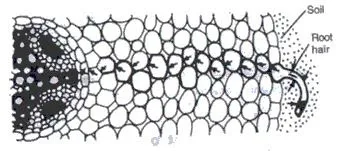
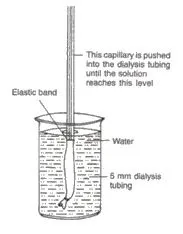
13. The apparatus arranged alongside signifies an important process. (i) Name the process.(ii) Where does this process occur in plants?(iii) What solution is placed inside the dialysis tubing?(iv) What happens to the level of the solution in the capillary tube?
(i) Osmosis(ii) Root hair(iii) Sugar solution. This is similar to how raisins swell up when kept in water - water moves from outside into the raisin through its skin.(iv) The level of the liquid in the capillary tube rises.
14. Name the following:(i) The pressure with which the molecules of a substance diffuse.(ii) Two solutions having same concentrations.(iii) The force developing in shoot responsible for most of the absorption of water.(iv) The uptake of mineral ions against concentration gradient.(v) Tissue concerned with upward conduction of water.(vi) Condition of cell in which the cell contents are shrunken.(vii) The inward movement of solvent molecules through the plasma membrane of cell.(viii) The process by which raisins swell up when placed in a beaker of water.(ix) Movement of molecules from a region of high concentration to a region of low concentration.
(i) Osmotic pressure(ii) Isotonic solutions(iii) Cohesive force(iv) Active absorption(v) Xylem. This is like tiny pipes in plants that carry water from roots to leaves. (vi) Plasmolysis(vii) Endosmosis(viii) Endosmosis(ix) Diffusion
15. Define Cell wall Cell membrane Vacuole Cytoplasm Nucleus
Cell wall: It is freely permeable which surround the cell membrane of the cell. Cell membrane: It is semi-permeable that allows only water to pass through it and surround cytoplasm of the cell. Think of it like a security guard at a building who only lets certain people enter. Vacuole: It contains cell sap. The concentration of cell sap is more than the soil water. So, endosmosis takes place. Cytoplasm: It is the fluid which fills up the cell and contains all the cell organelle. Nucleus: A nucleus is a membrane-bound organelle that contains the cell's chromosomes. Pores in the nuclear membrane allow for the passage of molecules in and out of the nucleus.
16. Name the tissue concerned with upward conduction of water in plants.
Xylem is the tissue that carries water from roots to leaves, just like how pipes carry water to different floors of a building.
17. Name the condition in which the cell contents are shrunken.
Plasmolysis. This happens when plant cells lose water and shrink away from their cell walls, just like how a grape becomes a raisin when it dries out.
18. Explain briefly why do not root hairs become flaccid when fertilizers are added to the moist soil around them?
The root hairs become flaccid when fertilizers are added to the moist soil around them because fertilizers with moist soil become hypertonic which causes plasmolysis in the cells of the root hair. This is like when you put too much salt in pickle water - it draws out water from vegetables. The turgidity is lost and the cell becomes flaccid.
19. Name the process by which molecules distribute themselves evenly within the space they occupy ______ (Fill in the blank).
Diffusion is the process by which molecules distribute themselves evenly within the space they occupy. When you spray perfume in one corner of a room, it slowly spreads everywhere. This happens because molecules are always moving and spreading out from areas where there are many molecules to areas where there are fewer molecules.
20. Name the term for the inward movement of solvent molecules through the plasma membrane of a cell.
Endosmosis is the term for the inward movement of solvent molecules through the plasma membrane of a cell. This happens when water moves into a cell because there is more salt or sugar inside the cell than outside. It's like water flowing into a sponge when you dip it in a bowl.
21. The diagram given below represents a plant cell after being placed in a strong sugar solution. Guidelines 1 to 5 indicate the following:1. Strong sugar solution2. Cell wall3. Protoplasm4. Large vacuole5. NucleusStudy the diagram and answer the questions that follow:(i) What is the state of the cell shown in the diagram?(ii) Name the structure which acts as a selectively permeable membrane.(iii) If the cell had been placed in distilled water instead of strong sugar solution which feature would not have been present?(iv) If the cell in the diagram possessed chloroplasts where would these be present?(v) Name any one feature of this plant cell which is not present in animal cells.
(i) The cell shown in the diagram is in a plasmolysed state. (ii) The cell membrane acts as a selectively permeable membrane. (iii) If the cell had been placed in distilled water instead of strong sugar solution, plasmolysis would not have occurred. Think of it like a raisin - when you put a grape in sugar water, it shrinks and becomes wrinkled like a raisin. (iv) If the cell possessed chloroplasts, they would be present in the protoplasm/cytoplasm. (v) One feature of this plant cell which is not present in animal cells is the cell wall.
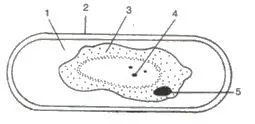
1. Plasmolysed cell2. Plasma membrane3. Large vacuole4. The chloroplasts would be present in the shrunken protoplast.5. Cell wall
1. Plasmolysed cell 2. Plasma membrane 3. Large vacuole. When you put salt on a cut cucumber, it becomes soft because water leaves the cells just like in plasmolysis. This happens when plant cells lose water and shrink. 4. The chloroplasts would be present in the shrunken protoplast. 5. Cell wall
22. Explain why:(i) Raisins swell up in water.(ii) We gargle with saline solution in case of throat infection.(iii) Bacteria and fungi do not grow in pickles, jams, jellies and squashes.(iv) The leaves of wilted lettuce, if kept in cold water, become crisp.
The raisins swell up when placed in water because the water is hypotonic as compared to the raisins so the water enters inside the raisins as a result of endosmosis. Saline water is hypertonic. So any infectious agent such as bacteria in the throat gets plasmolysed and this cures the infection. This is why doctors tell us to gargle with salt water when we have a sore throat. Jam, jellies and pickles are kept in hypertonic solution of sugar or salt in which plasmolysis of bacteria and fungi takes place. This kills the bacteria and fungi and hence, pickles, jam and jellies are preserved properly. The leaves of the wilted lettuce become crisp when kept in cold water because they take up water due to endosmosis in hypotonic solution.
23. Define ascent of sap.
Ascent of sap is the movement of water from the roots to the upper part of the plant. Think of it like drinking juice through a straw - the plant pulls water up through tiny tubes called xylem vessels.
24. Why do plants die when salt is sprinkled over them?
Plants die when salt is sprinkled over them due to plasmolysis of cells. This is like when you put salt on cucumber slices and they become soft and watery. The salt makes the solution hypertonic inside the plant cells which lead to shrinkage of cells or exosmosis.
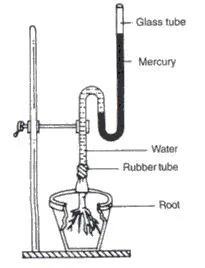
25. Define root pressure. How would you demonstrate it experimentally?
Root Pressure is the pressure exerted on the liquid contents of the cortical cells of the root, under fully turgid condition, forcing a quantity of water into the xylem vessels and through them upwards into the stem up to a certain height. This is like how a pump pushes water up through pipes in your building. Demonstration of Root pressure: Take a well matured healthy herbaceous plant. The stem of the plant is cut a few centimeters above the base with a sharp knife and attached to a manometer through a rubber tube. After a few hours, the level of mercury rises in the manometer. This is due to the pressure created by water exuded from the cut end of the plant on account of root pressure generated due to entry of water in the root cells.
26. Give at least three uses of water to green plants.
Water is one of the raw materials for photosynthesis. Water is important for seed germination. Just like how we need water to stay alive, plants also drink water through their roots. Water controls the opening and closing of stomata.
27. What will happen if a concentrated solution of a fertilizer is given to the potted plants?
Plants begin to die when concentrated solution of a fertilizer is given to potted plants because fertilizer along with soil water act as a hypertonic solution. This is like adding too much salt to water - it becomes very strong. When this happens, water moves out of the plant roots instead of going in, resulting in exosmosis.
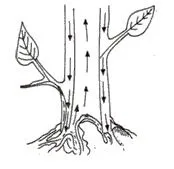
28. The figure shows a diagrammatic representation of the movement of certain substances inside the stem of a certain plant. Write five sentences on whatever you can explain about the processes or the arrangement of structures indicated in the diagram.Note: - Each sentence must include one or more of the following four words, and each word can be used several times. Xylem, phloem, roots, leaves.
(i) Plants absorb water by their roots.(ii) Roots supply water to the stem and leaves of the plant.(iii) In root hairs, the xylem is not fully mature and the endodermis and epidermis are permeable to water. Think of xylem as tiny water pipes carrying water up from roots to leaves. The phloem works like food delivery tubes carrying sugar made in leaves down to roots.(iv) Water is absorbed by the plants through xylem in all directions.(v) The food on the other hand is transported with the help of phloem.
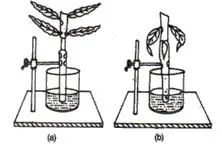
29. The diagram given below represents the results of an experiment conducted on two freshly taken leafy shoots of a herbaceous plant. The lower ends of the shoots dip in ordinary water.(i) What is the aim of the experiment?(ii) Some parts of the stem in both the shoots have been removed. Name the conducting tissue in shoot (a) and in shoot (b) that has been removed.(iii) What are the results of this experiment? (i) The aim of the experiment is to show that conduction of water in plants takes place through xylem.(ii) In shoot, (a) phloem has been removed. In shoot (b), xylem has been removed.(iii) In shoot (b), xylem has been removed so the leaves are wilted. But in shoot (a), xylem has not been removed so the leaves are turgid.
(i) The aim of the experiment is to show that conduction of water in plants takes place through xylem.(ii) In shoot, (a) phloem has been removed. In shoot (b), xylem has been removed. Think of xylem like drinking straws that carry water up from roots to leaves. When these water pipes are cut, plants cannot get water.(iii) In shoot (b), xylem has been removed so the leaves are wilted. But in shoot (a), xylem has not been removed so the leaves are turgid.
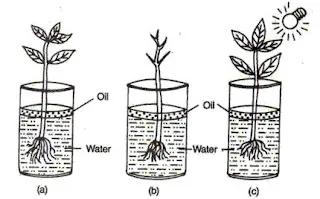
30. Three plants (a), (b) and (c) were placed in beakers containing colored water. The water in each beaker was covered with a layer of oil. The leaves were removed from plant (b), while plant (c) was exposed to strong light.(i) In which plant, (a), (b) or (c) would the water move up the fastest?(ii) In which plant (a), (b) or (c), would the water move up slowly?(iii) Why was the water covered with a layer of oil?(iv) What is being investigated by this experiment?
(i) In (c), the water would move up the fastest.(ii) In (b), the water would move up slowly. This is like how a plant wilts when you remove its leaves because it cannot pull water up properly. The oil layer works just like putting plastic wrap over a glass of water.(iii) To prevent evaporation of water.(iv) Absorption of water by the roots.
(i) Osmosis involves diffusion of
(ii) An example of a selective permeable membrane is
- (a) cell wall
- (b) mitochondrial membrane
- (c) chloroplast membrane
- (d) plasma lemma ✓
Answer: (d) plasma lemma
(iii) Plasmolysis will occur when the cell is placed in a
- (a) hypotonic solution
- (b) isotonic solution
- (c) hypertonic solution ✓
- (d) acidic solution
Answer: (c) hypertonic solution
(iv) Grapes when placed in a strong sugar solution shrink because of
- (a) diffusion
- (b) plasmolysis ✓
- (c) exosmosis
- (d) endosmosis
Answer: (b) plasmolysis
(v) Cell turgidity is caused by
- (a) endosmosis ✓
- (b) exosmosis
- (c) plasmolysis
- (d) diffusion
Answer: (a) endosmosis
(vi) If a marine plant is transferred to fresh water, it bursts due to
- (a) exosmosis
- (b) endosmosis ✓
- (c) plasmolysis
- (d) diffusion
Answer: (b) endosmosis
(vii) Which one is semi-permeable?
- (a) Plasma lemma ✓
- (b) Cell wall
- (c) Endoplasmic reticulum
- (d) Golgi body
Answer: (a) Plasma lemma
(viii) Swelling of wooden doors during rains is caused by
- (a) endosmosis
- (b) imbibition ✓
- (c) capillarity
- (d) osmosis
Answer: (b) imbibition
(ix) Meaning of ascent of sap is
- (a) absorption of water from soil.
- (b) alteration of water against gravitational force.
- (c) reaching of water upwards against gravitational force. ✓
- (d) origin of cohesive force in water.
Answer: (c) reaching of water upwards against gravitational force.
(x) Process of ascent of sap in plants occurs
- (a) by cortex
- (b) by xylem ✓
- (c) by phloem
- (d) by cambium
Answer: (b) by xylem
(xi) Which tissue makes passage for ascent of sap?
- (a) Cortex
- (b) Endodermis
- (c) Phloem
- (d) Xylem ✓
Answer: (d) Xylem
(xii) Absorption of water from soil takes place by
- (a) root cap region
- (b) root hairs ✓
- (c) elongation
Answer: (b) root hairs
(xiii) In ascent of sap water reaches upwards
- (a) In the form of a solid column.
- (b) in the form of a fragile column.
- (c) to some places in the form of solid and to some places in liquid form.
- (d) none of the above. ✓
Answer: (d) none of the above.
(xiv) The water is translocated upwards from the roots through
- (a) xylem ✓
- (b) phloem
- (c) pith
- (d) endodermis
Answer: (a) xylem
(xv) Exudation or bleeding is associated with
- (a) capillarity
- (b) imbibition
- (c) hydrostatic pressure in the root ✓
- (d) pulsation in the innermost layer of cortex
Answer: (c) hydrostatic pressure in the root
(xvi) Wilting of plants occurs when
- (a) phloem is blocked.
- (b) xylem is blocked. ✓
- (c) a few old roots are removed.
- (d) both xylem and phloem are blocked.
Answer: (b) xylem is blocked.
Step-by-Step Solutions for Class 10 Biology Chapter 04 Absorption By Roots
Download ICSE Answers for Class 10 Biology Chapter 04 Absorption By Roots
Find reliable chapter-wise explanations for Class 10 Biology Chapter 04 Absorption By Roots. Curated to follow standard ICSE guidelines, these problem solutions assist students in building strong conceptual foundations.
Concept Clarification for Chapter 04 Absorption By Roots
Tackle complex theorems and numerical problems easily by cross-referencing your working steps with our structured solution guides.
Effective Revision Strategies for Chapter 04 Absorption By Roots
Pair your solution review with additional practice papers to test your execution speed and ensure total preparedness for school exams.
FAQs
You can download the verified Frank Brothers solutions for Chapter 04 Absorption By Roots on StudiesToday.com. Our teachers have prepared answers for Class 10 Biology as per 2026-27 ICSE academic session.
Yes, our solutions for Chapter 04 Absorption By Roots are designed as per new 2026 ICSE standards. 40% competency-based questions required for Class 10, are included to help students understand application-based logic behind every Biology answer.
Yes, every exercise in Chapter 04 Absorption By Roots from the Frank Brothers textbook has been solved step-by-step. Class 10 students will learn Biology conceots before their ICSE exams.
Yes, follow structured format of these Frank Brothers solutions for Chapter 04 Absorption By Roots to get full 20% internal assessment marks and use Class 10 Biology projects and viva preparation as per ICSE 2026 guidelines.