

Download NCERT Class 10 Science Textbooks
Explore the complete NCERT textbook for Class 10 Science. Tailored for the 2026-27 curriculum, this resource breaks down complex topics to help students prepare effectively for school examinations.
Access Chapter 04 Carbon and Its Compounds for Class 10 Science
Access the complete PDF for Chapter 04 Carbon and Its Compounds below. This focused excerpt allows students to isolate specific topics for thorough review. Cross-reference your textbook exercises with our detailed NCERT Solutions for Class 10 Science.
CHAPTER4
Carbon and its Compounds
Look at the items that come in the last column – your teacher will be able to tell you that most of them are made up of compounds of carbon. Can you think of a method to test this? What would be the product if a compound containing carbon is burnt? Do you know of any test to confirm this? Food, clothes, medicines, books, or many of the things that you listed are all based on this versatile element carbon. In addition, all living structures are carbon based. The amount of carbon present in the earth’s crust and in the atmosphere is quite meagre. The earth’s crust has only 0.02% carbon in the form of minerals (like carbonates, hydrogencarbonates, coal and petroleum) and the atmosphere has 0.03% of carbon dioxide. In spite of this small amount of carbon available in nature, the importance of carbon seems to be immense. In this Chapter, we will be looking at the properties of carbon which lead to this anomaly.
4.1 BONDING IN CARBON – THE COVALENT BOND
In the previous Chapter, we have studied the properties of ionic compounds. We saw that ionic compounds have high melting and boiling points and conduct electricity in solution or in the molten state. We also saw how the nature of bonding in ionic compounds explains these properties. Let us now study the properties of some carbon compounds. Melting and boiling points of some carbon compounds are given in Most carbon compounds are poor conductors of electricity as we have seen in Chapter 2. From the data on the boiling and melting points of the above compounds, we can conclude that the forces of attraction between these molecules are not very strong. Since these compounds are largely nonconductors of electricity, we can conclude that the bonding in these compounds does not give rise to any ions. In Class IX, we learnt about the combining capacity of various elements and how it depends on the number of valence electrons. Let us now look at the electronicconfiguration of carbon. The atomic number of carbon is 6. What wouldbe the distribution of electrons in various shells for carbon? How many valence electrons will carbon have?
We know that the reactivity of elements is explained as their tendency to attain a completely filled outer shell, that is, attain noble gas configuration. Elements forming ionic compounds achieve this by either gaining or losing electrons from the outermost shell. In the case of carbon, it has four electrons in its outermost shell and needs to gain or lose four electrons to attain noble gas configuration. If it were to gain or lose electrons –
(i) It could gain four electrons forming C4– anion. But it would be difficult for the nucleus with six protons to hold on to ten electrons, that is, four extra electrons.
(ii) It could lose four electrons forming C4+ cation. But it would require a large amount of energy to remove four electrons leaving behind a carbon cation with six protons in its nucleus holding on to just two electrons. Carbon overcomes this problem by sharing its valence electrons with other atoms of carbon or with atoms of other elements. Not just carbon, but many other elements form molecules by sharing electrons in this manner. The shared electrons ‘belong’ to the outer shells of both the atoms and lead to both atoms attaining the noble gas configuration. Before going on to compounds of carbon, let us look at some simple molecules formed by the sharing of valence electrons.
Question. IUPAC name of isopentane is :
(A) 2-ethyl propane
(B) pentane
(C) 2-methyl butane
(D) 2,2-dimethyl propane
Answer : D
Question. The number of coordinate covalent bonds in the structure of nitric acid is :
(A) 0
(B) 1
(C) 2
(D) 3
Answer : B
Question. The compounds which contains both ionic and covalent bonds is :
(A) CH4
(B) Cl2
(C) NaCN
(D) KCl
Answer : C
Question. IUPAC name of the following compound will be:

(A) 2–Keto hexan –6 oic acid
(B) 5– Keto hexanoic acid
(C) Methyl Ketone butanoic acid
(D) 5–Aldo hexanoic acid
Answer : B
Question. Benzene (C6H6) have:
(A) 12 covalent bonds
(B) 15 covalent bonds
(C) 18 covalent bonds
(D) 9 covalent bonds
Answer : B
Question. In the following compound which two are not isomers to each other :
(A) (CH3)2CHCH3.(CH3)2CHCH2CH3
(B) CH3CH2OH, CH3-O-CH3
(C) C2H5-O-C2H5, CH3-O-C3H7
(D) CH3CH2CHO, CH3COCH3
Answer : A
Question. The reaction of AgNO3 with acetylene shows which type of property of acetylene
(A) Acidic
(B) Oxidizing
(C) Basic
(D) Reducing
Answer : A
Question. Which reagent will be helpful differentiating ethanoic acid from ethanol ?
(A) Br2/CCl4
(B) Dilute NaOH
(C) Dilute HCl solution
(D) NaHCO3
Answer : D
Question. Two organic compounds ‘X and ‘Y’ react with sodium metal and both produce same gas ‘A’. With sodium hydrogen carbonate only compound ‘Y’ reacts to produce gas ‘B’ identity X, Y, A and B.
(A) X =C2H4 ,Y= C2H6OH, A=CO2 ,B=H2
(B) X = C2H5OH, Y= CH3COOH, A =H2 ,B=CO2
(C) X = CH3OH , Y = C2H5OH, A = H2 , B =CO2
(D) X = CH3COOH, Y = HCOOH, A= CO2 ,B =H2
Answer : B
Question. The I.U.P.A.C. name of following compound is.
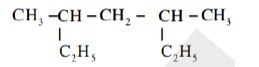
(A) 2,4,- Diethyl pantane
(B) 2-ethyl-4-methyl hexane
(C) 3,5 Diemethyl hexane
(D) 3,5 – Dimethyl heptane
Answer : B
Question. IUPAC Name of
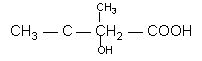
(A) 2-Hydroxy-2-methyl butanoic acid
(B) 3-Hydroxy-2-methyl butane
(C) 3,3-Diethyl butane
(D) 3-Ethyl-2-methyl propane
Answer : A
Question. When a vegetative oiI is treated with Hydrogen in the presence of Nickel catalyst it forms fat (Vegetable Ghee). This is an example of
(A). Displacement reaction
(B) Decompostion reaction
(C). Addition Reaction
(D) Double displacement reaction
Answer : C
Question. How many isomers are possible for the hydrocarbon with molecular formula C6H14 ?
(A) 4
(B) 5
(C) 6
(D) 7
Answer : B
Question. When propanol is treated with excess hot concentrated sulphuric acid, the resulting product will be :
(A) ethane
(B) ethane
(C) Propane
(D) propene
Answer : D
Question. C4H8O2 and C4H8O are the molecular formula of the organic compounds of which class ?
(A) Aldehyde and Ketone
(B) Carboxylic acid and Ester
(C) Ester and Aldehyde
(D) Esters and Ethers
Answer : C
QUESTION
1. How would you distinguish experimentally between an alcohol and a carboxylic acid?
2. What are oxidising agents?
Please refer to attached file for NCERT Class 10 Science Carbon and its Compounds
Free study material for Science
Official NCERT Textbook PDF: Class 10 Science Chapter 04 Carbon and Its Compounds
NCERT Book Class 10 Science Chapter 04 Carbon and Its Compounds
Secure your copy of the NCERT Textbook for Class 10 Science Chapter 04 Carbon and Its Compounds. Widely adopted across educational institutions, final question papers map directly to the framework outlined in this chapter.
Access NCERT English Medium Textbooks
Explore our exhaustive library of NCERT books in English Medium spanning all subjects in Class 10. Every chapter features comprehensive explanations followed by extensive end-of-chapter exercises.
Enhance Learning with Official Textbooks
The Class 10 Science Chapter 04 Carbon and Its Compounds text is carefully engineered to build rock-solid foundational concepts. For an enriched academic journey, learners should pair this with our online NCERT Solutions and revision notes.
FAQs
You can download the latest, teacher-verified PDF for NCERT Book Class 10 Science Carbon and its Compounds PDF Download for free on StudiesToday.com. These digital editions are updated as per 2026-27 session and are optimized for mobile reading.
Yes, our collection of Class 10 Science NCERT books follow the 2026 rationalization guidelines. All deleted chapters have been removed and has latest content for you to study.
Downloading chapter-wise PDFs for Class 10 Science allows for faster access, saves storage space, and makes it easier to focus in 2026 on specific topics during revision.
NCERT books are the main source for NCERT exams. By reading NCERT Book Class 10 Science Carbon and its Compounds PDF Download line-by-line and practicing its questions, students build strong understanding to get full marks in Science.