✔INTRODUCTION
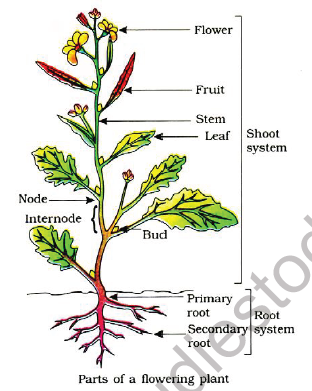
♦ Morphology – (Morphe = form + logos = study). It deals with the study of forms and features of different plant organs like roots, stems, leaves, flowers, seeds, fruits etc.
♦ The body of a typical angiospermic plant is differentiated into :
• an underground root system
• an aerial shoot system.
The shoot system consists of stem (including branches), leaves, flowers and fruits.
♦ The roots, stems and leaves are vegetative parts, while flowers constitute the reproductive part.
✔ CLASSIFICATION OF PLANTS
Depending upon their life span, plants are classified as –
♦ Annuals – Complete their life cycle in one year or single growing season or few weeks to a few months. They pass the unfavourable period in the form of seeds eg. Mustard, Pea.
♦ Biennials – Complete their life cycle in two years-growing, vegetative and storing food in the first year, flowering and fruiting in the second year. They die off after producing flowers and fruits
eg. Radish, turnip, carrot are biennial in colder areas. They become annual in warmer places
♦ Perennials – Survives for several years. These plants usually bears flowers and fruits every year and do not die after producing flowers. eg. Mango, Banana, Guava
ROOT
Radicle comes out/arise from the seed coat in the form of soft structure and move toward the soil. It develops and forms primary root.
♦ General Characters :
♦ Roots are non green, underground, (+) geotropic, (–) phototropic and (+) hydrotropic.
♦ Roots do not bear buds.
♦ Buds present for vegetative propagation in sweet potato (Ipomea) and Indian red wood (Dalbergia)
♦ Roots do not bear nodes and internodes.
♦ Roots have unicellular root hairs.
✔ TYPES OF ROOTS
Roots are of two types :
✧ Tap root
✧ Adventitious root
♦ Tap root : It develops from radicle and made up of one main branch and other sub branches. The primary roots and its branches constitute tap root system. e.g. Dicot roots.
♦ Adventitious roots : In some plants, after sometime of the growth of tap root which arises from radicle, stops and then roots, develop from other part of plant, which are branched or unbranched, fibrous or storage, are known as adventitious roots and constitute fibrous root system. e.g. Monocot roots.

✔ REGIONS OF ROOTS
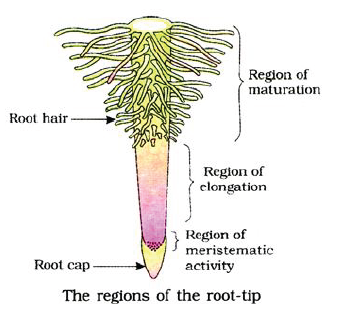
Morphologically four distinct regions are present in roots.
♦ Root cap : It is terminal structure. It protects tender apex of root.
♦ Meristematic zone : Cells of this regions are very small and thin walled. They divide repeatedly and increase cell number
♦ Elongation region : The cells proximal to meristematic zone undergo rapid elongation and enlargement and are responsible for rapid growth of roots.
♦ Maturation region : Cells proximal to region of elongation gradually differentiate and mature. Root hairs are present in maturation zone.
✔ MODIFICATION OF ROOTS
1. Modified tap root for storage :
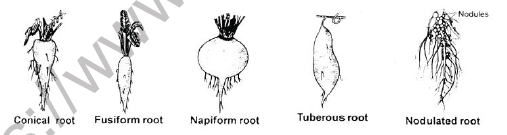
♦ Fusiform roots : These root are thicker in the middle and tappered on both ends. In this type of roots both hypocotyl and root help in storage of food. eg. Radish.
♦ Conical roots : These roots are thicker at their upper side and tapering at basal end. eg. Carrot.
♦ Napiform : These roots become swollen and spherical at upper end and tappered like a thread at their lower end. eg. Turnip (Brassica rapa), Sugarbeet
♦ Tuberous root : Such roots do not have regular shape and get swollen & fleshy at any portion of roots.
eg. Mirabilis.
2. Nodulated root : Nodules are formed on branches of roots by nitrogen fixing bacteria, (Rhizobium). eg. Plants of leguminosae family (Papilionatae) – Pea
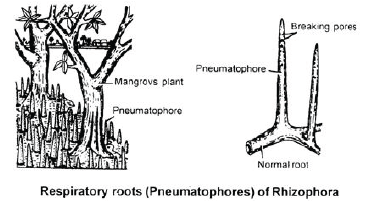
3. Respiratory roots : Halophyte or mangrove grow in oxygen deficient marshy area. Some branches of tap root in these plant grow vertically & comes out from soil. These roots are called pneumatophores through which air entered inside the plant. eg. Rhizophora, Heritiera, Sonaratia and other mangrove plant.
Modification of adventitious roots :
1. Storage adventitious roots
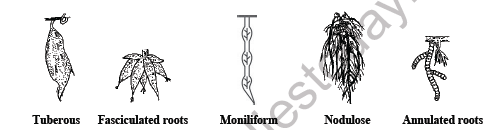
✧ Tuberous root : When food is stored in these roots, they become swollen and form a bunch. eg. Sweet potato (Ipomea batata)
✧ Fasciculated – Roots arise in bunch (cluster) from lower node of the stem and become fleshy eg. Dahlia, Asparagus.
✧ Nodulose : In this type, tips of roots swell up. eg. Melilotus, Curcuma amoda.
✧ Beaded or moniliform : When root swells up like a bead at different places after a regular interval. eg. Vitis, Momordica (Bitter gourd), Portulaca.
✧ Annulated : Roots having series of ring like swellings eg. Psychrotia
2. Stilt roots or brace roots : When root arises from lower nodes and enter in soil obliquely, known as stilt roots eg. Maize, Sugarcane, Pandanus (screwpine)
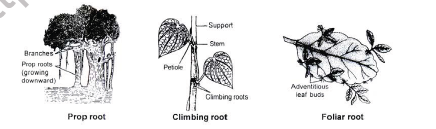
3. Prop root or pillar roots : when root arises from branches of plant and grows downward towards soil. Itfunction as supporting stem for the plant. eg. Banyan.
4. Butteress root – Such roots appear from the basal part of stem and spread in different directions in the soil.eg. Ficus, Bombax , Terminalia. It is a characteristic feature of tropical rain forest.
5. Climbing roots – These roots arise from nodes and helps the plant in climbing. eg. Money plant (Pothos),Betel, Black pepper, Techoma.
6. Foliar roots or Epiphyllous roots – When roots arise from leaf they are called as foliar roots. eg.Bryophyllum, Bignonia.
7. Sucking or haustorial roots or Parasitic roots : In parasitic plant roots enter in the stem of host plant to absorbed nutrition from host. eg. Dendrophthoe, Cuscuta, Viscum.
8. Assimilatory roots : The aerial roots of Tinospora and submerged roots of Trapa (Water chestnut) become green and synthesize food. Podostemon also has green assimilatory roots.
9. Hygroscopic roots : These are found in epiphytes, specially in orchids and help in absorption of moisture from the atmosphere using special tissue called velamen. eg. Orchids, Banda
10. Contractile roots : They shrink 60 – 70% of the original length and bring underground organ at proper depth in the soil e.g., corm of Crocus (saffron), Fresia.
11. Root thorns : These are hard, thick and pointed thorns e.g. Pothos armatus.
Reproductive roots : These are fleshy, adventitious roots used for vegetative reproduction e.g., sweet potato (Ipomea batata), Dahlia.
Leaf roots : In Salvinia, one leaf of each node modifies into root like structure for balancing the plant in water.