NEET Botany Plant Kingdom Chapter Notes

Download the latest NEET Botany Plant Kingdom Chapter Notes in PDF format. These Full Course Plant Kingdom revision notes are carefully designed by expert teachers to align with the 2025-26 syllabus. These notes are great daily learning and last minute exam preparation and they simplify complex topics and highlight important definitions for Full Course students.

Chapter-wise Revision Notes for Full Course Plant Kingdom Plant Kingdom

To secure a higher rank, students should use these Full Course Plant Kingdom Plant Kingdom notes for quick learning of important concepts. These exam-oriented summaries focus on difficult topics and high-weightage sections helpful in school tests and final examinations.

Plant Kingdom Revision Notes for Full Course Plant Kingdom


Learning Objectives:-
 
The learner will be able to,
• Outline the classification of plants
• Illustrate the life cycles in plants
• Recognize the general characteristic features and reproduction of Algae
• Describe the structure, reproduction of Oedogonium and Chara
• Recognize the general characteristic features of Bryophytes
• Describe the structure, reproduction of Marchantia and Funaria
• Recognize the general characteristic features of Pteridophytes
• Describe the structure, reproduction of Selaginella and Adiantum
• Describe the general characteristic features of Gymnosperms
• Explain the structure, reproduction of Cycas and Pinus
• Recognize the salient features of Angiosperms
 
Chapter Outline
 
2.1 Classification of Plants
2.2 Life Cycle patterns in Plants
2.3 Algae
2.4 Bryophytes
2.5 Pteridophytes
2.6 Gymnosperms
2.7 Angiosperms
NEET Botany Plant Kingdom Chapter Notes
 
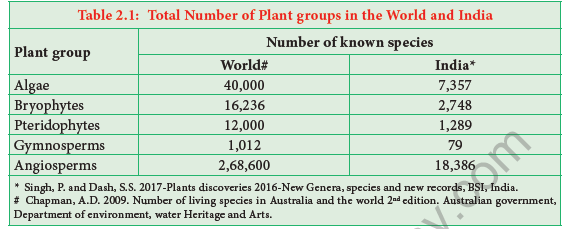
Traditionally organisms existing on the earth were classified into plants and animals based on nutrition, locomotion and presence or absence of cell wall. Bacteria, Fungi, Algae, Bryophytes, Pteridophytes, Gymnosperms and Angiosperms were included under plant group. Recently, with the aid of molecular characteristics the Bacteria and Fungi were segregated and placed under separate kingdoms. Botany is one of the oldest science in the world because its origin was from time immemorial as early men explored and identified plants for the needs of food, clothing, medicine, shelter etc., Plants are unique living entities as they are endowed with the power to harvest the light energy from the sun and to convert it to chemical energy in the form of food through the astounding reaction, photosynthesis. They not only supply nutrients to all living things on earth but sequester carbon-di-oxide during photosynthesis thus minimizing the effect of one of the major green house gases that increase the global temperature. Plants are diverse in nature, ranging from microscopic algae to macroscopic highly developed angiosperms. There are mysteries and wonders in the plant world in terms of size, shape, habit, habitat, reproduction etc., Although plants are all made up of cells there exists high diversity in form and structure (Table 2.1).
NEET-Botany-Plant-Kingdom-Chapter-Notes 1
 
2.1 Classification of Plants
 
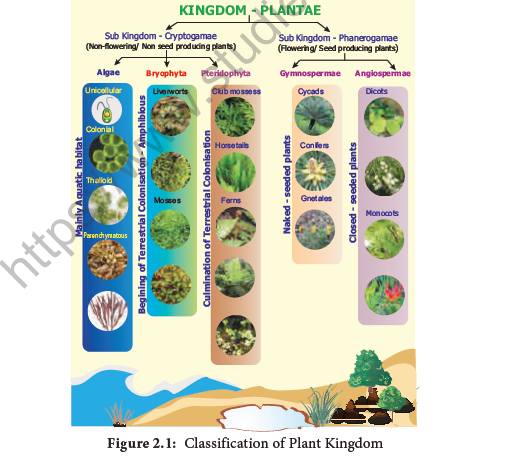
Classification widely accepted for plants now include Embryophyta which is divided into Bryophyta and Tracheophyta. The latter is further divided into Pteridophyta
 
and Spermatophyta (Gymnospermae and Angiospermae). An outline Classification of Plant Kingdom is given in Figure 2.1
NEET-Botany-Plant-Kingdom-Chapter-Notes 2
2.2 Life Cycle Patterns in Plants
 
Alternation of Generation
 
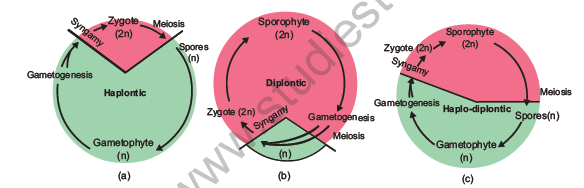
Alternation of generation is common in all plants. Alternation of the haploid gametophytic phase (n) with diploid sporophytic phase (2n) during the life cycle is called alternation of generation. Following type of life cycles are found in plants (Figure 2.2).
 
Haplontic Life Cycle
Gametophytic phase is dominant, photosynthetic and independent, whereas sporophytic phase is represented by the zygote. Zygote undergoes meiosis to restore haploid condition. Example: Volvox, Spirogyra
 
Diplontic Life Cycle
Sporophytic phase (2n) is dominant,photosynthetic and independent. The gametophytic phase is represented by the single to few celled gametophyte.The gametes fuse to form Zygote which develops into Sporophyte. Example: Fucus, Gymnosperms and Angiosperms
 
Haplodiplontic Life Cycle
This type of life cycle is found in Bryophytes and pteridophytes which is intermediate between haplontic and diplontic type. Both the phases are multicellular. but they differ in their dominant phase.
NEET-Botany-Plant-Kingdom-Chapter-Notes 3
Figure 2.2: Life cycle patterns in plants a) Haplontic, b) Diplontic, c) Haplo-diplontic
 
Reproduction in Flowering Plants
NEET Botany Reproductive Morphology Chapter Notes

NEET Full Course Plant Kingdom Plant Kingdom Notes

Students can use these Revision Notes for Plant Kingdom to quickly understand all the main concepts. This study material has been prepared as per the latest NEET syllabus for Full Course. Our teachers always suggest that Full Course students read these notes regularly as they are focused on the most important topics that usually appear in school tests and final exams.

NCERT Based Plant Kingdom Summary

Our expert team has used the official NCERT book for Full Course Plant Kingdom to design these notes. These are the notes that definitely you for your current academic year. After reading the chapter summary, you should also refer to our NCERT solutions for Full Course. Always compare your understanding with our teacher prepared answers as they will help you build a very strong base in Plant Kingdom.

Plant Kingdom Complete Revision and Practice

To prepare very well for y our exams, students should also solve the MCQ questions and practice worksheets provided on this page. These extra solved questions will help you to check if you have understood all the concepts of Plant Kingdom. All study material on studiestoday.com is free and updated according to the latest Plant Kingdom exam patterns. Using these revision notes daily will help you feel more confident and get better marks in your exams.

Where can I download latest NEET Full Course Plant Kingdom Plant Kingdom notes

You can download notes for Full Course Plant Kingdom Plant Kingdom for latest academic session from StudiesToday.com

Are the revision notes available for Plant Kingdom Full Course Plant Kingdom for the latest NEET academic session

Yes, the notes issued for Full Course Plant Kingdom Plant Kingdom have been made available here for latest NEET session

Is there any charge for the Full Course Plant Kingdom Plant Kingdom notes

There is no charge for the notes for NEET Full Course Plant Kingdom Plant Kingdom, you can download everything free of charge

Which is the best online platform to find notes for Plant Kingdom Full Course Plant Kingdom

www.studiestoday.com is the best website from which you can download latest notes for Plant Kingdom Plant Kingdom Full Course

Where can I find topic-wise notes for Full Course Plant Kingdom Plant Kingdom

Come to StudiesToday.com to get best quality topic wise notes for Full Course Plant Kingdom Plant Kingdom