NEET Botany Biomolecules Chapter Notes

Download the latest NEET Botany Biomolecules Chapter Notes in PDF format. These Full Course Biomolecules revision notes are carefully designed by expert teachers to align with the 2025-26 syllabus. These notes are great daily learning and last minute exam preparation and they simplify complex topics and highlight important definitions for Full Course students.

Chapter-wise Revision Notes for Full Course Biomolecules Biomolecules

To secure a higher rank, students should use these Full Course Biomolecules Biomolecules notes for quick learning of important concepts. These exam-oriented summaries focus on difficult topics and high-weightage sections helpful in school tests and final examinations.

Biomolecules Revision Notes for Full Course Biomolecules


Learning Objective

The learner will be able to,
 
• List out the inorganic and organic components of a cell.
 
• Understand about bonding pattern of water and properties of water.
 
• Familiarise with the classification of carbohydrates and its functions.
 
• Recognise the basic structure of carbohydrates, proteins, lipids and nucleic acids and differentiate the various pattern of classification with respect to structure.
 
• Identify the structure and functions of carbohydrates.
 
• Familiarise with the general structure of amino acids and its classification based on the functional group.
 
• Comparative study of the primary, secondary, tertiary and quaternary structure of proteins.
 
• Know the structure and classification of enzymes.
 
• Know about the factors affecting the mode of action of enzymes with relevant examples.
 
• Understand lipids as a biomolecule and discuss the properties of lipids.
 
• Have a deeper knowledge about structure of nucleic acids.
 
• Recognize nucleic acids as a polymer which plays a vital role in carrying the genetic information.
 
• Learn about the different forms of DNA and types of RNA.
 
Chapter Outline
 
8.1 Water
8.2 Primary and Secondary Metabolites
8.3 Carbohydrates – Classification and Structure
8.4 Lipids – Classification and Structure
8.5 Proteins and Amino Acids –
Classification and Structure,
8.6 Enzymes – Classification, Nomenclature, Structure and Concepts, Mechanism of Enzyme Action, Activation energy, factors affecting enzyme action.
8.7 Nucleic Acids general Structure and composition – Forms of DNA and Types of RNA.
 
 NEET-Botany-Biomolecules-Chapter-Notes 1
 
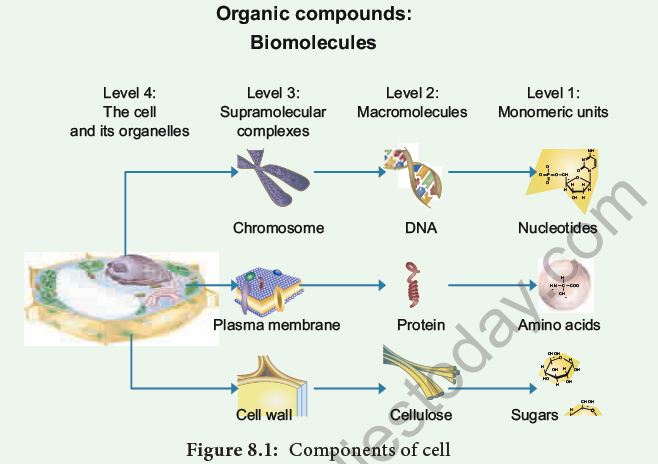
Having learnt the structure of the cell, we can now understand that each component of the cell is responsible for a specific function. The cell components are made of collection of molecules called as cellular pool, which consists of
both inorganic and organic compounds.Inorganic compounds include salts, mineral ions and water.
 
Organic compounds are carbohydrates,lipids, amino acids, proteins, nucleotides,hormones and vitamins. Some organic molecules remain in colloidal form in the aqueous intracellular fluid. Others exist in non-aqueous phases like the lipid membrane and cell walls. The cell maintains this pool by the intake and elimination of specific molecules (Figure 8.1).
 
The minerals essential for plant growth are of two types: macronutrients,which are required in larger amounts (Eg. Potassium, phosphorus, calcium,magnesium, sulphur and iron) and micronutrients, which are required in
trace amounts (Eg. Cobalt, zinc, boron,copper, molybdenum and manganese) and are essential for enzyme action.Example, Manganese is required for activity of enzyme needed for synthesis of oligosaccharides and glycoproteins. Molybdenum is necessary for fixation of nitrogen by enzyme nitrogenase.
 
NEET-Botany-Biomolecules-Chapter-Notes 2
NEET-Botany-Biomolecules-Chapter-Notes 3
 
8.1 Water
 
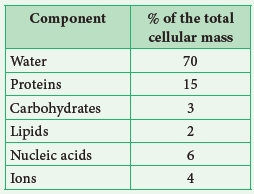
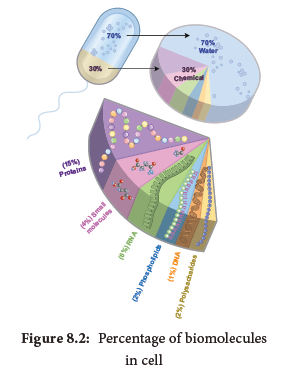
Water is the most abundant component in living organisms. Life on earth is inevitably linked to water. Water makes up 70% of human cell and upto 95% of mass of a plant cell (Figure 8.2).
NEET-Botany-Biomolecules-Chapter-Notes 4
8.1.1 Chemistry of Water
 
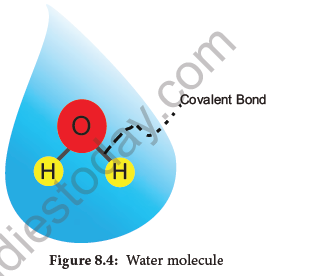
Water is a tiny polar molecule and can readily pass through membranes.Two electronegative atoms of oxygen share a hydrogen bonds of two water molecule. Thus, they can stick together by cohesion and results in lattice formation (Figure 8.4).
NEET-Botany-Biomolecules-Chapter-Notes 5
 
8.1.2 Properties of Water
 
• Adhesion and cohesion property
 
• High latent heat of vaporisation
 
• High melting and boiling point
 
• Universal solvent
 
• Specific heat capacity
NEET-Botany-Biomolecules-Chapter-Notes 6
Reproduction in Flowering Plants
NEET Botany Reproductive Morphology Chapter Notes

NEET Full Course Biomolecules Biomolecules Notes

Students can use these Revision Notes for Biomolecules to quickly understand all the main concepts. This study material has been prepared as per the latest NEET syllabus for Full Course. Our teachers always suggest that Full Course students read these notes regularly as they are focused on the most important topics that usually appear in school tests and final exams.

NCERT Based Biomolecules Summary

Our expert team has used the official NCERT book for Full Course Biomolecules to design these notes. These are the notes that definitely you for your current academic year. After reading the chapter summary, you should also refer to our NCERT solutions for Full Course. Always compare your understanding with our teacher prepared answers as they will help you build a very strong base in Biomolecules.

Biomolecules Complete Revision and Practice

To prepare very well for y our exams, students should also solve the MCQ questions and practice worksheets provided on this page. These extra solved questions will help you to check if you have understood all the concepts of Biomolecules. All study material on studiestoday.com is free and updated according to the latest Biomolecules exam patterns. Using these revision notes daily will help you feel more confident and get better marks in your exams.

Where can I download latest NEET Full Course Biomolecules Biomolecules notes

You can download notes for Full Course Biomolecules Biomolecules for latest academic session from StudiesToday.com

Are the revision notes available for Biomolecules Full Course Biomolecules for the latest NEET academic session

Yes, the notes issued for Full Course Biomolecules Biomolecules have been made available here for latest NEET session

Is there any charge for the Full Course Biomolecules Biomolecules notes

There is no charge for the notes for NEET Full Course Biomolecules Biomolecules, you can download everything free of charge

Which is the best online platform to find notes for Biomolecules Full Course Biomolecules

www.studiestoday.com is the best website from which you can download latest notes for Biomolecules Biomolecules Full Course

Where can I find topic-wise notes for Full Course Biomolecules Biomolecules

Come to StudiesToday.com to get best quality topic wise notes for Full Course Biomolecules Biomolecules