The students should be able to,
• Analyze primary and secondary growth.
• Discuss the increase in length and width of the plant.
• Explain secondary growth in dicot stems.
• Understand the use of wood products to lead comfortable life.
• Explain secondary growth in dicot roots.
• Discuss anomalous secondary growth in dicots and monocots.
• Explain the seasoning, grain, texture and figure of wood.
Chapter Outline
10.1 Secondary Growth in Dicot Stem
10.2 Secondary Growth in Dicot Root
10.3 Anomalous Secondary Growth
10.4 Timber
We have studied in the previous chapters the primary internal structure of monocots and dicots. If you look at the stem of grass (monocot), it is soft , whereas in the neem
(dicot), the stem is very hard and woody, why? It is the secondary growth which confers the hardness to wood of dicot stems and roots. In monocots, usually there is no
secondary growth and so they are soft .
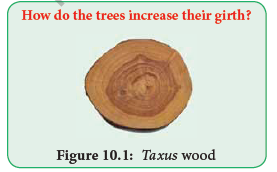
The increase in girth is called secondary growth or growth in girth and we shall discuss the details of secondary growth in this chapter.
The plant organs originating from the apical meristems pass through a period of expansion in length and width. The roots and stems grow in length with the help of apical meristems. Th is is called primary growth or longitudinal growth.
The gymnosperms and most angiosperms, including some monocots, show an increase in thickness of stems and roots by means of secondary growth or latitudinal growth. The secondary growth in dicots and gymnosperms is brought about by two lateral meristems.
• Vascular Cambium and
• Cork Cambium
Activity
Generally monocots do not have secondary growth, but palms and bamboos have woody stems. Find the reason.
10.1 Secondary Growth in Dicot Stem
Vascular Cambium
The vascular cambium is the lateral meristem that produces the secondary vascular tissues. i.e., secondary xylem and secondary phloem.
Origin and Formation of Vascular Cambium
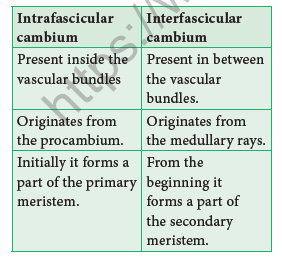
A strip of vascular cambium that is believed to originate from the procambium is present between xylem and phloem of the vascular bundle. This cambial strip is known as intrafascicular or fascicular cambium. In between the vascular bundles, a few parenchymatous cells of the medullary rays that are in line with the fascicular cambium become meristematic and form strips of vascular cambium. It is called interfascicular cambium.
This interfascicular cambium joins with the intrafascicular cambium on both sides to form a continuous ring. It is called a vascular cambial ring. The differences between interfascicular and intrafascicular cambia are summarised below:
Organization of Vascular Cambium
The cells of vascular cambium do not fit into the usual description of meristems which have isodiametric cells, with a dense cytoplasm and large nuclei. While the active vascular cambium possesses cells with large central vacuole (or vacuoles) surrounded by a thin, layers of dense cytoplasm. Further, the most important character of the vascular cambium is the presence of two kinds of initials, namely, fusiform initials and ray initials.
Fusiform Initials
These are vertically elongated cells. They give rise to the longitudinal or axial system of the secondary xylem (treachery elements, fibers, and axial parenchyma) and phloem (sieve elements, fibers, and axial parenchyma).
Based on the arrangement of the fusiform initials, two types of vascular cambium are recognized.
Storied (Stratified cambium) and Non-Storied (Non-stratified cambium)
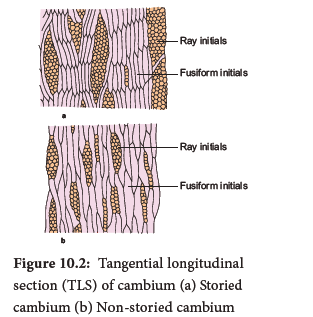
If the fusiform initials are arranged in horizontal tiers, with the end of the cells of one tier appearing at approximately the same level, as seen in tangential longitudinal section (TLS), it is called storied (stratified) cambium.
It is the characteristic of the plants with short fusiform initials. Whereas in plants with long fusiform initials, they strongly overlap at the ends, and this type of cambium is called non-storied (nonstartified) cambium.
Ray Initials
These are horizontally elongated cells.They give rise to the ray cells and form the elements of the radial system of secondary xylem and phloem.
Activity of Vascular Cambium
The vascular cambial ring, when active,cuts off new cells both towards the inner and outer side. The cells which are produced outward form secondary
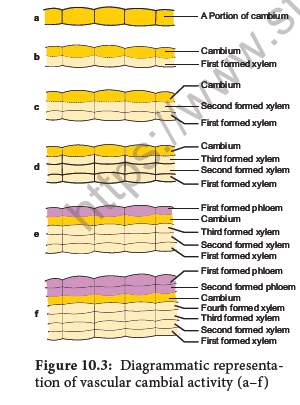
phloem and inward secondary xylem.At places, cambium forms some narrow horizontal bands of parenchyma which passes through secondary phloem and xylem. These are the rays.Due to the continued formation of secondary xylem and phloem through vascular cambial activity, both the primary xylem and phloem get gradually crushed.
Secondary Xylem
The secondary xylem, also called wood, is formed by a relatively complex meristem,the vascular cambium, consisting of vertically (axial) elongated fusiform initials and horizontally (radially) elongated ray initials

The axial system consists of vertical files of treachery elements, fibers, and wood parenchyma. Whereas the radial system consists of rows of parenchymatous cells oriented at right angles to the longitudinal axis of xylem elements.
The secondary xylem varies very greatly from species to species with reference to relative distribution of the different cell types, density and other properties. It is of two types.
Porous Wood or Hard Wood
Generally, the dicotyledonous wood,which has vessels is called porous wood or hard wood. Example: Morus rubra.