Learning Objectives:-
The learner will be able to,
• Differentiate living and non-living things.
• Appreciate the attributes of living organisms.
• Compare the different classifications proposed by biologists.
• Recognize the general characters, structure and reproduction of Bacteria.
• Identify the characteristic features of Archaebacteria, Cyanobacteria, Mycoplasma and Actinomycetes.
• Describe the characteristic features of fungi.
• Outline the classification of fungi.
• Describe the structure and reproduction in Rhizopus and Agaricus.
• Discuss the structure and uses of Mycorrhizae and Lichens.
Chapter Outline
1.1 Attributes of Living organisms
1.2 Viruses
1.3 Classification of Living world
1.4 Bacteria
1.5 Fungi
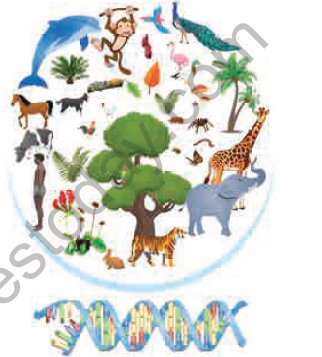
Earth was formed some 4.6 billion years ago. It is the life supporting planet with land forms like mountains, plateaus, glaciers, etc., Life on earth exists within a complex structure called biosphere. There exist many mysteries and wonders in the living world some are not visible but the activity of some capture the attention of all. For example the response of sunflower to the sunlight, the twinkling firefly in the dark forest, the rolling water droplets on the surface of lotus leaf, the closure of the leaf of venus fly trap on insect touch and a squid squeezing ink to escape from its predator. From this it is clear that the wonder planet earth harbors both landforms and life forms. Have you thought of DNA molecule? It is essential for the regulation of life and is made up of carbon, hydrogen, oxygen, nitrogen and phosphorus thus nonliving and living things exist together to make our planet unique.
According to a survey made by Mora et al., 2011 the number of estimated species on earth is 8.7 million. The living world includes microbes, plants, animals and human beings which possess unique and distinct characteristic feature.
1.1 Attributes of living organisms
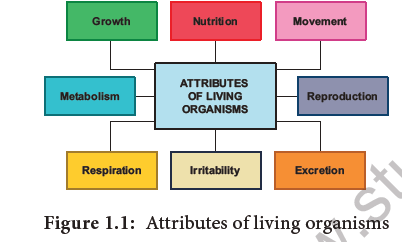
The attributes of living organisms are given below and is represented in Figure 1.1
Growth
Growth is an intrinsic property of all living organisms through which they can increase cells both in number and mass. Unicellular and multicellular organisms grow by cell division. In plants, growth is indefinite and occurs throughout their life. In animals, growth is definite and occurs for some period. However, cell division occurs in living organisms to repair and heal the worn out tissues. Growth in non-living objects is extrinsic. Mountains, boulders and sand mounds grow by simple aggregation of material on the surface. Living cells grow by the addition of new protoplasm within the cells. Therefore, growth in living thing is intrinsic. In unicellular organisms like bacteria and amoeba growth occurs by cell division and such cell division also leads to the growth of their population. Hence,growth and reproduction are mutually inclusive events.
Cellular structure
All living organisms are made up of cells which may be prokaryotic or eukaryotic.Prokaryotes are unicellular, lack membrane bound nuclei and organelles like mitochondria, endoplasmic reticulum,golgi bodies and so on (Example: Bacteria
and Blue green algae). In Eukaryotes a definite nucleus and membrane bound organelles are present. Eukaryotes may be unicellular (Amoeba) or multicellular (Oedogonium).
Reproduction
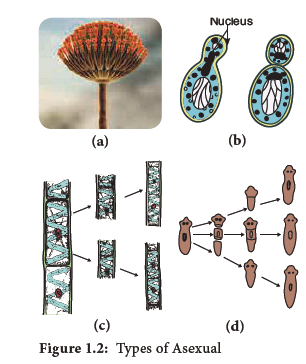
Reproduction is one of the fundamental characteristic features of living organisms.It is the tendency of a living organism to perpetuate its own species. There are two types of reproduction namely asexual and sexual (Figure 1.2). Asexual reproduction refers to the production of the progeny possessing features more or less similar to those of parents. The sexual reproduction brings out variation through recombination. Asexual reproduction in living organisms occurs by the production of conidia (Aspergillus, Penicillium), budding (Hydra and Yeast),binary fission (Bacteria and Amoeba) fragmentation (Spirogyra), protonema (Mosses) and regeneration (Planaria).
Exceptions are the sterile worker bees and mules
Reproduction
(a) Conidia formation-Penicillium,
(b) Budding-Yeast, (c) Fragmentation-Spirogyra, (d) Regeneration-Planaria
Response to stimuli
All organisms are capable of sensing their environment and respond to various physical, chemical and biological stimuli.Animals sense their surroundings by sense organs. This is called Consciousness. Plants also respond to the stimuli. Bending of plants towards sunlight, the closure of leaves in touch-me-not plant to touch are some examples for response to stimuli in plants. This type of response is called Irritability.
Homeostasis
Property of self-regulation and tendency to maintain a steady state within an external environment which is liable to change is called Homeostasis. It is essential for the living organism to maintain internal condition to survive in the environment.
Movement, Nutrition, Respiration and Excretion are also considered as the property of living things.
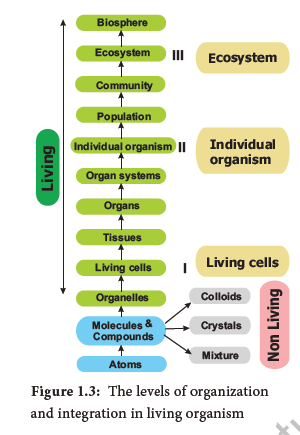
The levels of organization in living organism begin with atoms and end in Biosphere. Each level cannot exist in isolation instead they form levels of integration as given in Figure 1.3.
Metabolism
The sum total of all the chemical reactions taking place in a cell of living organism is called metabolism. It is broadly divided into anabolism and catabolism. The difference between anabolism and catabolism is given in Table 1.1