NEET Biology Enhancement In Food Production Revision Notes

Download the latest NEET Biology Enhancement In Food Production Revision Notes in PDF format. These Full Course Biology revision notes are carefully designed by expert teachers to align with the 2025-26 syllabus. These notes are great daily learning and last minute exam preparation and they simplify complex topics and highlight important definitions for Full Course students.

Chapter-wise Revision Notes for Full Course Biology Food

To secure a higher rank, students should use these Full Course Biology Food notes for quick learning of important concepts. These exam-oriented summaries focus on difficult topics and high-weightage sections helpful in school tests and final examinations.

Food Revision Notes for Full Course Biology

Enhancement in Food Production

Poultry
 
Poultry includes the birds like chicken (hen), ducks, geese and turkey. Poultry farming deals with the rearing of them for their eggs and meat. it has become an important small scale industry due to
modern need for palatable and nutritive food which it provides in the form of eggs as well as adult animal. An egg laying poultry bird is called layer and the poultry birds groomed for obtaining meat
are called chicken or broilers.
 
Livestock
 
The word livestock refers to the domestic animals kept or dealt in for use or profit. It includes cattle, buffaloes, sheep, goats, pigs, horses, mules, donkeys and camels. The most important of these are cattle and buffaloes.
 
Importance of cattle and Buffaloes: Cattle and buffalo are most important forms of domesticated animals. They are next to land in use for farmers. They are widely used for:
 
(a) Agricultural Operations:
(b) Milk:
(c) Transport:
(d) Manure and fuel:
(e) Leather: .
(f) Glue and gelatin:
(g) Meat:
(h) Hair:
(i) Hybridisation:
 

NEET Biology Enhancement in Food Production Revision Notes

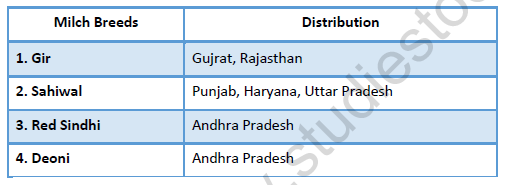
Some Breeds of Indian Cattle

NEET-Biology-Enhancement-in-Food-Production-Revision-Notes 1

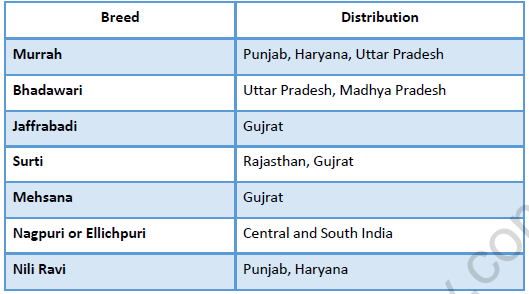
Some Breeds of Indians Buffaloes
Apiculture
(1) Apiculture is the science of rearing honeybees for obtaining honey, wax and venom. It is a profitable money-making hobby. It forms a cottage industry, when carried out on a large scale.
 
(2) Three species of honey bees are commonly found in india vig. Apis indica (The small indian bee). Apis florea(The little indian bee) and. Apis dorsata (the giant bee) other important species include Apis milifera (the common European bee.
(i) Honeybee-Apis: Like termites, honeybees are social insects known for producing honey and beeswax, and for living in very highly organized colonies. These feed upon nectar and pollen of flowers, possess “sucking and chewing” mouth parts, and undergo complete metamorphosis. Each colony has its own nest called honeycomb or beehive.
 
(ii) Division of labour and polymorphism: Each beehive harbours a colony of thousands of polymorphic bees belonging to a single family. The polymorphic individuals are of three main types (i) a single queen (fertile female)(ii) one to a few hundred drones (fertile males) and (iii) thousands (upto 60,000) of worker bees (sterile females).
 
(iii) Life History: Queen lays about 2,000 eggs a day. The eggs are laid in the comb, one in each cell. They hatch out into larvae in three days. They are fed on royal jelly for a few days. But the larva which develops into the queen will be fed on royal jelly continuously.During breeding, the queen bee flies in the air along with the males. This phenomenon is called nuptial flight. During nuptial flight the queen copulates with a male Copulation occurs in the air. Then the bees return to the comb and the queen starts laying eggs.
 
(iv) Bee-Hive: Honey bee is one of the few domesticated insects. In modern days bee colonies are reared in artificial wooden boxes for maximum production of honey and wax. The artificial box where the bee colony is maintained and managed is called hive. The place where hives are kept and managed is called apiary.
 
(v) Honey extraction: Honey is stored in combs of super frames. It is extracted from the comb by a simple machine called honey extractor. It has a drum containing a rack inside to hold the super frames. It is made to rotate by a set of two-gear wheels, operated by a handle.The super frames are removed from the hive. The caps of the comb cells are cut off by a double edged knife. Then the frames are fixed in the rack and the rack is made to rotate by operating the handle. The honey is forced out into the drum from the comb cells. From the drum the honey is collected in vessels through an exit present in the drum.
 
(vi) Location of Apiary
(a) The hives should be set, in places where there are plenty of flowering plants.
(b) They should be placed in shady places.
(c) The place should be neat and clean and free from any obnoxious smell.
(d) There should be clean drinking water nearby because each bee colony requires two glasses of water per day for their survival
 
(viii)Chemical composition: Honey contains nearly 80 different substances of importance to human beings. The important chemicals are as follows:It contains a large amount of glucose or fructose.
 
Fisheries
(i) Fishes are a valuable and easily accessible source of food, rich in protein, highly nutritious and easily digestible. By the aquatic animals, they are abundantly available from sea, rivers, lakes, ponds and marshes.

(ii) Classification of cultivable fish species
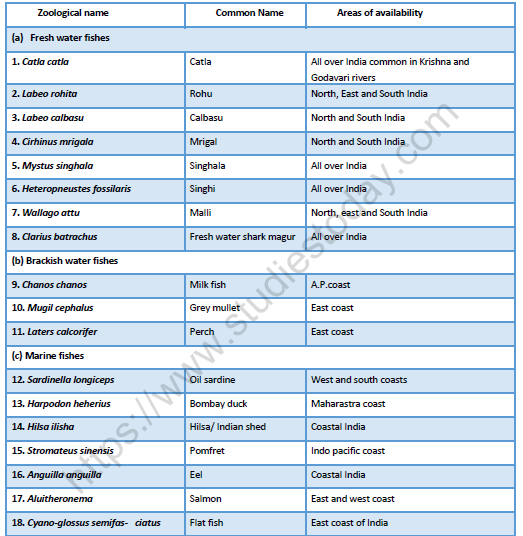
NEET-Biology-Enhancement-in-Food-Production-Revision-Notes 2

(iii) Culture method: The success in fish culture and the high production of table - size fish through carp culture depends largely on the designing and construction of ponds. The basic principles involved in designing and construction of carp culture ponds are of very specialized nature and vary from region to region depending upon several factors like topography, soil types, water supply etc. The requirements with regard to the designing and construction of fish farm are entirely different from those attributed to agriculture and animal husbandry farms.


Please click the link below to download pdf file of NEET Biology Enhancement in Food Production Revision Notes


Reproduction in Flowering Plants
NEET Botany Reproductive Morphology Chapter Notes

NEET Full Course Biology Food Notes

Students can use these Revision Notes for Food to quickly understand all the main concepts. This study material has been prepared as per the latest NEET syllabus for Full Course. Our teachers always suggest that Full Course students read these notes regularly as they are focused on the most important topics that usually appear in school tests and final exams.

NCERT Based Food Summary

Our expert team has used the official NCERT book for Full Course Biology to design these notes. These are the notes that definitely you for your current academic year. After reading the chapter summary, you should also refer to our NCERT solutions for Full Course. Always compare your understanding with our teacher prepared answers as they will help you build a very strong base in Biology.

Food Complete Revision and Practice

To prepare very well for y our exams, students should also solve the MCQ questions and practice worksheets provided on this page. These extra solved questions will help you to check if you have understood all the concepts of Food. All study material on studiestoday.com is free and updated according to the latest Biology exam patterns. Using these revision notes daily will help you feel more confident and get better marks in your exams.

Where can I download latest NEET Full Course Biology Food notes

You can download notes for Full Course Biology Food for latest academic session from StudiesToday.com

Are the revision notes available for Food Full Course Biology for the latest NEET academic session

Yes, the notes issued for Full Course Biology Food have been made available here for latest NEET session

Is there any charge for the Full Course Biology Food notes

There is no charge for the notes for NEET Full Course Biology Food, you can download everything free of charge

Which is the best online platform to find notes for Food Full Course Biology

www.studiestoday.com is the best website from which you can download latest notes for Food Biology Full Course

Where can I find topic-wise notes for Full Course Biology Food

Come to StudiesToday.com to get best quality topic wise notes for Full Course Biology Food