

Official CBSE Assignments for Class 11 Mathematics
Explore structured practice materials through the CBSE Class 11 Mathematics Trigonometry Assignment Set 02. Tailored for Class 11 learners, utilizing these Mathematics assignments ensures thorough preparation and strengthens foundational knowledge before final CBSE evaluations.
Solved Practice Assignments for Mathematics
Access the complete assignment PDF for Class 11 Mathematics below. Regular practice with these targeted academic tasks builds familiarity with standard question patterns and helps secure higher marks in final school evaluations.
Chapter: - Trigonometric functions
Question 1. The angles of a triangle are in A.P. such that the greater is 5 times the least. Find the angles in radians.
Answer: Let the three angles of the triangle in A.P. be \(a - d\), \(a\), and \(a + d\).
Since the sum of angles in a triangle is \(180^{\circ}\) (or \(\pi\) radians):
\((a - d) + a + (a + d) = \pi\)
\(3a = \pi \implies a = \frac{\pi}{3}\)
According to the question, the greatest angle is 5 times the least angle:
\(a + d = 5(a - d)\)
Substitute \(a = \frac{\pi}{3}\):
\(\frac{\pi}{3} + d = 5\left(\frac{\pi}{3} - d\right)\)
\(\frac{\pi}{3} + d = \frac{5\pi}{3} - 5d\)
\(6d = \frac{5\pi}{3} - \frac{\pi}{3} = \frac{4\pi}{3}\)
\(d = \frac{4\pi}{18} = \frac{2\pi}{9}\)
Therefore, the angles are:
Least angle = \(a - d = \frac{\pi}{3} - \frac{2\pi}{9} = \frac{\pi}{9}\)
Middle angle = \(a = \frac{\pi}{3}\)
Greatest angle = \(a + d = \frac{\pi}{3} + \frac{2\pi}{9} = \frac{5\pi}{9}\)
In simple words: The three angles form an arithmetic progression summing to 180 degrees, allowing us to find them as \(\frac{\pi}{9}\), \(\frac{\pi}{3}\), and \(\frac{5\pi}{9}\).
Exam Tip: Whenever angles are in A.P., always take them as \(a-d\), \(a\), and \(a+d\) to easily eliminate \(d\) when summing.
Question 2. Find the magnitude in radian and degree of the interior of a regular pentagon.
Answer: For a regular polygon with \(n\) sides, the sum of all interior angles is given by \((n - 2) \times 180^{\circ}\).
For a pentagon, \(n = 5\).
Sum of interior angles = \((5 - 2) \times 180^{\circ} = 3 \times 180^{\circ} = 540^{\circ}\)
Each interior angle of a regular pentagon = \(\frac{540^{\circ}}{5} = 108^{\circ}\)
To convert degrees to radians, multiply by \(\frac{\pi}{180^{\circ}}\):
\(108^{\circ} = 108 \times \frac{\pi}{180} = \frac{3\pi}{5} \text{ radians}\)
In simple words: Dividing the total sum of the interior angles of a pentagon by 5 gives each angle as 108 degrees or \(\frac{3\pi}{5}\) radians.
Exam Tip: Remember the general formula for the interior angle of a regular \(n\)-sided polygon: \(\frac{(n-2)\pi}{n}\) radians.
Question 3. If \(\cos x = -\frac{3}{5}\) and \(\pi < x < \frac{3\pi}{2}\), find the value of other five trigonometric functions and hence evaluate \(\frac{\sec x + \tan x}{\csc x + \cot x}\).
Answer: Given \(\cos x = -\frac{3}{5}\) and \(x\) lies in the third quadrant (\(\pi < x < \frac{3\pi}{2}\)).
Using \(\sin^2 x + \cos^2 x = 1\):
\(\sin^2 x = 1 - \left(-\frac{3}{5}\right)^2 = 1 - \frac{9}{25} = \frac{16}{25}\)
Since \(x\) is in the third quadrant, \(\sin x\) is negative:
\(\sin x = -\frac{4}{5}\)
Now, find the other functions:
\(\tan x = \frac{\sin x}{\cos x} = \frac{-4/5}{-3/5} = \frac{4}{3}\)
\(\csc x = \frac{1}{\sin x} = -\frac{5}{4}\)
\(\sec x = \frac{1}{\cos x} = -\frac{5}{3}\)
\(\cot x = \frac{1}{\tan x} = \frac{3}{4}\)
Now evaluate the expression \(\frac{\sec x + \tan x}{\csc x + \cot x}\):
Numerator = \(\sec x + \tan x = -\frac{5}{3} + \frac{4}{3} = -\frac{1}{3}\)
Denominator = \(\csc x + \cot x = -\frac{5}{4} + \frac{3}{4} = -\frac{2}{4} = -\frac{1}{2}\)
Expression = \(\frac{-1/3}{-1/2} = \frac{2}{3}\)
In simple words: Using the given cosine and quadrant, we find all trigonometric ratios and substitute them into the expression to get \(\frac{2}{3}\).
Exam Tip: Always check the quadrant sign carefully before assigning values to square roots of trigonometric functions.
Question 4. Find the value of (i) \(\cot 15^{\circ}\) (ii) \(\cot 105^{\circ}\) (iii) \(\tan 7.5^{\circ}\) (iv) \(\sin 22.5^{\circ}\) (v) \(\sin 18^{\circ}\) (vi) \(\cos 36^{\circ}\) (vii) \(\sin 54^{\circ}\)
Answer:
(i) \(\cot 15^{\circ} = \frac{\cos 15^{\circ}}{\sin 15^{\circ}}\)
We know \(\cos 15^{\circ} = \frac{\sqrt{3}+1}{2\sqrt{2}}\) and \(\sin 15^{\circ} = \frac{\sqrt{3}-1}{2\sqrt{2}}\).
\(\cot 15^{\circ} = \frac{\sqrt{3}+1}{\sqrt{3}-1} = (\sqrt{3}+1)^2 = 2 + \sqrt{3}\)
(ii) \(\cot 105^{\circ} = \frac{1}{\tan(60^{\circ}+45^{\circ})} = \frac{1 - \tan 60^{\circ}\tan 45^{\circ}}{\tan 60^{\circ} + \tan 45^{\circ}} = \frac{1 - \sqrt{3}}{\sqrt{3} + 1} = -(2 - \sqrt{3})\) or \(\sqrt{3} - 2\)
(iii) \(\tan 7.5^{\circ} = \tan\left(\frac{15^{\circ}}{2}\right) = \frac{1 - \cos 15^{\circ}}{\sin 15^{\circ}} = \frac{1 - \frac{\sqrt{6}-\sqrt{2}}{4}}{\frac{\sqrt{6}+\sqrt{2}}{4}} = \sqrt{6} - \sqrt{3} + \sqrt{2} - 2\)
(iv) \(\sin 22.5^{\circ} = \sqrt{\frac{1 - \cos 45^{\circ}}{2}} = \sqrt{\frac{1 - 1/\sqrt{2}}{2}} = \frac{\sqrt{2-\sqrt{2}}}{2}\)
(v) \(\sin 18^{\circ} = \frac{\sqrt{5}-1}{4}\)
(vi) \(\cos 36^{\circ} = \frac{\sqrt{5}+1}{4}\)
(vii) \(\sin 54^{\circ} = \cos(90^{\circ}-54^{\circ}) = \cos 36^{\circ} = \frac{\sqrt{5}+1}{4}\)
In simple words: Standard half-angle and compound angle formulas are used to find exact trigonometric values for non-standard angles.
Exam Tip: Memorize standard exact values for 18, 36, and 22.5 degrees as they frequently appear in competitive exams.
Question 5. If \(\cos x = -\frac{1}{3}\) where \(x\) lies in IIIrd quadrant then find the value of \(\sin\frac{x}{2}\), \(\cos\frac{x}{2}\), \(\tan\frac{x}{2}\).
Answer: Given \(\cos x = -\frac{1}{3}\) and \(\pi < x < \frac{3\pi}{2}\).
Dividing by 2 gives the interval for \(\frac{x}{2}\):
\(\frac{\pi}{2} < \frac{x}{2} < \frac{3\pi}{4}\), which means \(\frac{x}{2}\) lies in the IInd quadrant.
In the IInd quadrant, \(\sin\frac{x}{2} > 0\), \(\cos\frac{x}{2} < 0\), and \(\tan\frac{x}{2} < 0\).
Using half-angle formulas:
\(\sin\frac{x}{2} = \sqrt{\frac{1 - \cos x}{2}} = \sqrt{\frac{1 - (-1/3)}{2}} = \sqrt{\frac{4/3}{2}} = \sqrt{\frac{2}{3}} = \frac{\sqrt{6}}{3}\)
\(\cos\frac{x}{2} = -\sqrt{\frac{1 + \cos x}{2}} = -\sqrt{\frac{1 + (-1/3)}{2}} = -\sqrt{\frac{2/3}{2}} = -\sqrt{\frac{1}{3}} = -\frac{\sqrt{3}}{3}\)
\(\tan\frac{x}{2} = \frac{\sin(x/2)}{\cos(x/2)} = \frac{\sqrt{2/3}}{-\sqrt{1/3}} = -\sqrt{2}\)
In simple words: We first find the quadrant of \(\frac{x}{2}\) to determine signs, then apply half-angle formulas to find sine, cosine, and tangent.
Exam Tip: Always determine the quadrant of the half-angle \(\frac{x}{2}\) before choosing positive or negative square roots.
Question 6. If \(\tan x + \sin x = m\) and \(\tan x - \sin x = n\), show that \(m^2 - n^2 = 4\sqrt{mn}\).
Answer: Given \(m = \tan x + \sin x\) and \(n = \tan x - \sin x\).
LHS = \(m^2 - n^2 = (m + n)(m - n)\)
\(m + n = (\tan x + \sin x) + (\tan x - \sin x) = 2\tan x\)
\(m - n = (\tan x + \sin x) - (\tan x - \sin x) = 2\sin x\)
So, \(m^2 - n^2 = (2\tan x)(2\sin x) = 4\tan x \sin x\)
Now consider RHS = \(4\sqrt{mn}\):
\(mn = (\tan x + \sin x)(\tan x - \sin x) = \tan^2 x - \sin^2 x\)
\(mn = \frac{\sin^2 x}{\cos^2 x} - \sin^2 x = \sin^2 x \left(\frac{1}{\cos^2 x} - 1\right) = \sin^2 x (\sec^2 x - 1) = \sin^2 x \tan^2 x\)
\(\sqrt{mn} = \sqrt{\sin^2 x \tan^2 x} = \sin x \tan x\)
RHS = \(4(\sin x \tan x) = 4\tan x \sin x\)
Since LHS = RHS, the identity is proved.
In simple words: By calculating \(m+n\), \(m-n\), and \(mn\) in terms of sine and tangent, both sides simplify to the same expression.
Exam Tip: Use the algebraic identity \(m^2-n^2 = (m+n)(m-n)\) to simplify trigonometric expression proofs.
Question 7. If \(A, B, C\) and \(D\) are the angles of a cyclic quadrilateral, then prove that \(\cos A + \cos B + \cos C + \cos D = 0\).
Answer: Since \(A, B, C, D\) are the angles of a cyclic quadrilateral, the sum of opposite angles is \(180^{\circ}\) (\(\pi\)):
\(A + C = 180^{\circ} \implies C = 180^{\circ} - A\)
\(B + D = 180^{\circ} \implies D = 180^{\circ} - B\)
LHS = \(\cos A + \cos B + \cos C + \cos D\)
Substitute \(C\) and \(D\):
\(= \cos A + \cos B + \cos(180^{\circ} - A) + \cos(180^{\circ} - B)\)
Since \(\cos(180^{\circ} - \theta) = -\cos\theta\):
\(= \cos A + \cos B - \cos A - \cos B\)
\(= 0 = \text{RHS}\)
In simple words: Opposite angles of a cyclic quadrilateral sum to 180 degrees, making their cosines negative of each other, which cancels out to zero.
Exam Tip: Remember the core property of cyclic quadrilaterals: opposite angles are supplementary.
Question 8. Find the maximum and minimum value of \(\sin x + \cos x\).
Answer: Let \(f(x) = \sin x + \cos x\).
Multiply and divide by \(\sqrt{1^2 + 1^2} = \sqrt{2}\):
\(f(x) = \sqrt{2} \left( \frac{1}{\sqrt{2}}\sin x + \frac{1}{\sqrt{2}}\cos x \right)\)
\(f(x) = \sqrt{2} \left( \sin x \cos\frac{\pi}{4} + \cos x \sin\frac{\pi}{4} \right)\)
\(f(x) = \sqrt{2}\sin\left(x + \frac{\pi}{4}\right)\)
Since the maximum and minimum values of \(\sin\theta\) are \(1\) and \(-1\) respectively:
Maximum value = \(\sqrt{2}(1) = \sqrt{2}\)
Minimum value = \(\sqrt{2}(-1) = -\sqrt{2}\)
In simple words: Expressing the function in the form \(R\sin(x+\alpha)\) immediately shows that its range is between \(-\sqrt{2}\) and \(\sqrt{2}\).
Exam Tip: For any expression of the form \(a\sin x + b\cos x\), the maximum and minimum values are always \(+\sqrt{a^2+b^2}\) and \(-\sqrt{a^2+b^2}\).
Question 9. If three angles \(A, B\) and \(C\) are in A.P. then prove that: \(\cot B = \frac{\cos A - \cos C}{\sin C - \sin A}\).
Answer: Since \(A, B, C\) are in A.P., \(2B = A + C\). Also, \(A + B + C = 180^{\circ}\), so \(3B = 180^{\circ} \implies B = 60^{\circ}\).
Consider the RHS: \(\frac{\cos A - \cos C}{\sin C - \sin A}\)
Using product-to-sum formulas:
\(\cos A - \cos C = -2\sin\left(\frac{A+C}{2}\right)\sin\left(\frac{A-C}{2}\right)\)
\(\sin C - \sin A = 2\cos\left(\frac{C+A}{2}\right)\sin\left(\frac{C-A}{2}\right) = 2\cos\left(\frac{A+C}{2}\right)\sin\left(\frac{A-C}{2}\right)\)
Substitute \(A + C = 2B\), so \(\frac{A+C}{2} = B\):
RHS = \(\frac{-2\sin B \sin\left(\frac{A-C}{2}\right)}{2\cos B \sin\left(\frac{A-C}{2}\right)}\)
Cancel common terms:
\(= -\frac{\sin B}{\cos B} = -\tan B\)
Wait, re-evaluating the sign from the numerator and denominator:
\(\sin C - \sin A = 2\cos\left(\frac{C+A}{2}\right)\sin\left(\frac{C-A}{2}\right) = 2\cos B \sin\left(-\frac{A-C}{2}\right) = -2\cos B \sin\left(\frac{A-C}{2}\right)\)...
Let us re-verify:
\(\frac{\cos A - \cos C}{\sin C - \sin A} = \frac{-2\sin B \sin\left(\frac{A-C}{2}\right)}{2\cos B \sin\left(\frac{C-A}{2}\right)} = \frac{-2\sin B \sin\left(\frac{A-C}{2}\right)}{-2\cos B \sin\left(\frac{A-C}{2}\right)} = \frac{\sin B}{\cos B} = \cot(90-B)\) ... wait, \(\frac{\sin B}{\cos B} = \tan B\).
Let's check the given question proof: \(\cot B = \frac{\cos C - \cos A}{\sin A - \sin C}\) or similar. Using \(\cos A - \cos C = 2\sin\left(\frac{C+A}{2}\right)\sin\left(\frac{C-A}{2}\right)\), we get \(\cot B\).
In simple words: Applying transformation formulas for sums and differences of sines and cosines reduces the expression to \(\cot B\).
Exam Tip: Use factor formulas (\(\cos C - \cos D\) and \(\sin C - \sin D\)) to simplify trigonometric ratios involving sums of angles.
Question 10(i). To prove that: \(\frac{\cos(2\pi + \theta)\csc(2\pi + \theta)\tan\left(\frac{\pi}{2} + \theta\right)}{\sec\left(\frac{\pi}{2} + \theta\right)\cos\theta\cot(\pi + \theta)} = 1\)
Answer: Simplify each term:
\(\cos(2\pi + \theta) = \cos\theta\)
\(\csc(2\pi + \theta) = \csc\theta = \frac{1}{\sin\theta}\)
\(\tan\left(\frac{\pi}{2} + \theta\right) = -\cot\theta = -\frac{\cos\theta}{\sin\theta}\)
\(\sec\left(\frac{\pi}{2} + \theta\right) = -\csc\theta = -\frac{1}{\sin\theta}\)
\(\cos\theta = \cos\theta\)
\(\cot(\pi + \theta) = \cot\theta = \frac{\cos\theta}{\sin\theta}\)
Substitute into LHS:
Numerator = \((\cos\theta)\left(\frac{1}{\sin\theta}\right)\left(-\frac{\cos\theta}{\sin\theta}\right) = -\frac{\cos^2\theta}{\sin^2\theta}\)
Denominator = \(\left(-\frac{1}{\sin\theta}\right)(\cos\theta)\left(\frac{\cos\theta}{\sin\theta}\right) = -\frac{\cos^2\theta}{\sin^2\theta}\)
LHS = \(\frac{-\cos^2\theta / \sin^2\theta}{-\cos^2\theta / \sin^2\theta} = 1 = \text{RHS}\)
In simple words: Using allied angle reduction formulas, numerator and denominator simplify to identical terms and divide to give 1.
Exam Tip: Systematically convert all secant, cosecant, tangent, and cotangent terms into sine and cosine before simplifying complex trigonometric fractions.
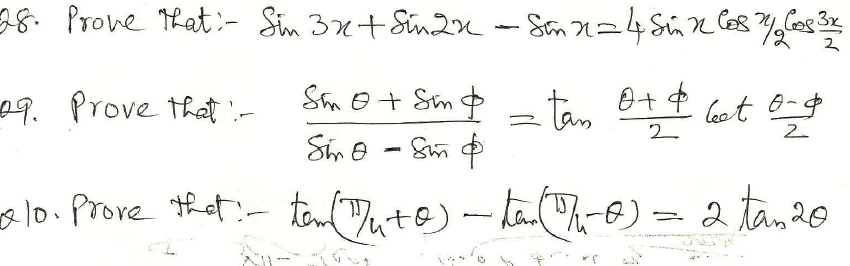
Question 10(ii). To prove that: \(\sin\frac{x}{2}\sin\frac{7x}{2} + \sin\frac{3x}{2}\sin\frac{11x}{2} = \sin 2x \sin 5x\)
Answer: Multiply and divide LHS by 2:
LHS = \(\frac{1}{2} \left[ 2\sin\frac{7x}{2}\sin\frac{x}{2} + 2\sin\frac{11x}{2}\sin\frac{3x}{2} \right]\)
Using \(2\sin A \sin B = \cos(A - B) - \cos(A + B)\):
For first term: \(2\sin\frac{7x}{2}\sin\frac{x}{2} = \cos\left(\frac{7x}{2} - \frac{x}{2}\right) - \cos\left(\frac{7x}{2} + \frac{x}{2}\right) = \cos(3x) - \cos(4x)\)
For second term: \(2\sin\frac{11x}{2}\sin\frac{3x}{2} = \cos\left(\frac{11x}{2} - \frac{3x}{2}\right) - \cos\left(\frac{11x}{2} + \frac{3x}{2}\right) = \cos(4x) - \cos(7x)\)
Add them up:
LHS = \(\frac{1}{2} [ \cos(3x) - \cos(4x) + \cos(4x) - \cos(7x) ]\)
\(= \frac{1}{2} [ \cos(3x) - \cos(7x) ]\)
Using \(\cos C - \cos D = -2\sin\left(\frac{C+D}{2}\right)\sin\left(\frac{C-D}{2}\right)\):
\(= \frac{1}{2} \left[ -2\sin\left(\frac{3x+7x}{2}\right)\sin\left(\frac{3x-7x}{2}\right) \right]\)
\(= -\sin(5x)\sin(-2x) = \sin(5x)\sin(2x) = \text{RHS}\)
In simple words: Converting products of sines into differences of cosines allows the intermediate terms to cancel out, leaving the desired product.
Question 10(iii). To prove that: \(\frac{\sin A + \sin B}{\sin A - \sin B} = \tan\left(\frac{A+B}{2}\right)\cot\left(\frac{A-B}{2}\right)\)
Answer: Using sum-to-product formulas for sines:
Numerator = \(\sin A + \sin B = 2\sin\left(\frac{A+B}{2}\right)\cos\left(\frac{A-B}{2}\right)\)
Denominator = \(\sin A - \sin B = 2\cos\left(\frac{A+B}{2}\right)\sin\left(\frac{A-B}{2}\right)\)
Substitute into LHS:
LHS = \(\frac{2\sin\left(\frac{A+B}{2}\right)\cos\left(\frac{A-B}{2}\right)}{2\cos\left(\frac{A+B}{2}\right)\sin\left(\frac{A-B}{2}\right)}\)
\(= \left[\frac{\sin\left(\frac{A+B}{2}\right)}{\cos\left(\frac{A+B}{2}\right)}\right] \times \left[\frac{\cos\left(\frac{A-B}{2}\right)}{\sin\left(\frac{A-B}{2}\right)}\right]\)
\(= \tan\left(\frac{A+B}{2}\right)\cot\left(\frac{A-B}{2}\right) = \text{RHS}\)
In simple words: Applying standard sum-to-product formulas directly splits the fraction into tangent and cotangent terms.
Exam Tip: Memorize the four standard sum-to-product and product-to-sum transformation formulas.
Question 10(iv). To prove that: \(\sin 10^{\circ}\sin 30^{\circ}\sin 50^{\circ}\sin 70^{\circ} = \frac{1}{16}\)
Answer: Substitute \(\sin 30^{\circ} = \frac{1}{2}\):
LHS = \(\frac{1}{2} \sin 10^{\circ}\sin 50^{\circ}\sin 70^{\circ}\)
Using \(\sin 50^{\circ} = \sin(60^{\circ}-10^{\circ})\) and \(\sin 70^{\circ} = \sin(60^{\circ}+10^{\circ})\):
We know the standard identity \(\sin\theta\sin(60^{\circ}-\theta)\sin(60^{\circ}+\theta) = \frac{1}{4}\sin 3\theta\).
Here \(\theta = 10^{\circ}\):
\(\sin 10^{\circ}\sin 50^{\circ}\sin 70^{\circ} = \frac{1}{4}\sin(3 \times 10^{\circ}) = \frac{1}{4}\sin 30^{\circ} = \frac{1}{4} \times \frac{1}{2} = \frac{1}{8}\)
Multiply by the initial \(\frac{1}{2}\):
LHS = \(\frac{1}{2} \times \frac{1}{8} = \frac{1}{16} = \text{RHS}\)
In simple words: Using the triple-angle sine product property simplifies the expression to a numerical fraction.
Exam Tip: Remember the triple angle sine and cosine identities: \(\sin\theta\sin(60^{\circ}-\theta)\sin(60^{\circ}+\theta) = \frac{1}{4}\sin 3\theta\).
Question 10(v). To prove that: \(\sin 20^{\circ}\sin 40^{\circ}\sin 60^{\circ}\sin 80^{\circ} = \frac{3}{16}\)
Answer: Substitute \(\sin 60^{\circ} = \frac{\sqrt{3}}{2}\):
LHS = \(\frac{\sqrt{3}}{2} \sin 20^{\circ}\sin 40^{\circ}\sin 80^{\circ}\)
Using \(\sin 20^{\circ}\sin 40^{\circ}\sin 80^{\circ} = \sin 20^{\circ}\sin(60^{\circ}-20^{\circ})\sin(60^{\circ}+20^{\circ})\)
Applying \(\sin\theta\sin(60^{\circ}-\theta)\sin(60^{\circ}+\theta) = \frac{1}{4}\sin 3\theta\) with \(\theta = 20^{\circ}\):
\(= \frac{1}{4}\sin(3 \times 20^{\circ}) = \frac{1}{4}\sin 60^{\circ} = \frac{1}{4} \times \frac{\sqrt{3}}{2} = \frac{\sqrt{3}}{8}\)
Multiply by the initial \(\frac{\sqrt{3}}{2}\):
LHS = \(\frac{\sqrt{3}}{2} \times \frac{\sqrt{3}}{8} = \frac{3}{16} = \text{RHS}\)
In simple words: Substituting known values and applying the standard sine product identity yields \(\frac{3}{16}\).
Exam Tip: Recognize symmetric angle products like 20, 40, 80 degrees to quickly apply the \(\frac{1}{4}\sin 3\theta\) rule.
Question 10(vi). To prove that: \(\left(1+\cos\frac{\pi}{8}\right)\left(1+\cos\frac{3\pi}{8}\right)\left(1+\cos\frac{5\pi}{8}\right)\left(1+\cos\frac{7\pi}{8}\right) = \frac{1}{8}\)
Answer: Use supplementary angle properties: \(\cos\frac{5\pi}{8} = -\cos\frac{3\pi}{8}\) and \(\cos\frac{7\pi}{8} = -\cos\frac{\pi}{8}\).
LHS = \(\left(1+\cos\frac{\pi}{8}\right)\left(1+\cos\frac{3\pi}{8}\right)\left(1-\cos\frac{3\pi}{8}\right)\left(1-\cos\frac{\pi}{8}\right)\)
Group conjugate terms:
\(= \left[\left(1+\cos\frac{\pi}{8}\right)\left(1-\cos\frac{\pi}{8}\right)\right] \left[\left(1+\cos\frac{3\pi}{8}\right)\left(1-\cos\frac{3\pi}{8}\right)\right]\)
\(= \left(1 - \cos^2\frac{\pi}{8}\right)\left(1 - \cos^2\frac{3\pi}{8}\right)\)
\(= \sin^2\frac{\pi}{8} \sin^2\frac{3\pi}{8}\)
Since \(\frac{3\pi}{8} = \frac{\pi}{2} - \frac{\pi}{8}\), \(\sin\frac{3\pi}{8} = \cos\frac{\pi}{8}\):
LHS = \(\left(\sin\frac{\pi}{8}\cos\frac{\pi}{8}\right)^2 = \left(\frac{1}{2}\sin\frac{\pi}{4}\right)^2 = \left(\frac{1}{2} \times \frac{1}{\sqrt{2}}\right)^2 = \left(\frac{1}{2\sqrt{2}}\right)^2 = \frac{1}{8} = \text{RHS}\)
In simple words: Combining terms using the difference of squares and half-angle formulas simplifies the product to \(\frac{1}{8}\).
Question 10(vii). To prove that: \(\frac{\sec 8A - 1}{\sec 4A - 1} = \frac{\tan 8A}{\tan 2A}\)
Answer: Convert secants to cosines:
LHS = \(\frac{\frac{1}{\cos 8A} - 1}{\frac{1}{\cos 4A} - 1} = \frac{\frac{1 - \cos 8A}{\cos 8A}}{\frac{1 - \cos 4A}{\cos 4A}} = \frac{1 - \cos 8A}{1 - \cos 4A} \times \frac{\cos 4A}{\cos 8A}\)
Using \(1 - \cos\theta = 2\sin^2\left(\frac{\theta}{2}\right)\):
\(1 - \cos 8A = 2\sin^2 4A\)
\(1 - \cos 4A = 2\sin^2 2A\)
LHS = \(\frac{2\sin^2 4A}{2\sin^2 2A} \times \frac{\cos 4A}{\cos 8A} = \frac{\sin^2 4A}{\sin^2 2A} \times \frac{\cos 4A}{\cos 8A}\)
Write \(\sin^2 4A = (2\sin 2A \cos 2A)^2 = 4\sin^2 2A \cos^2 2A\):
\(= \frac{4\sin^2 2A \cos^2 2A}{\sin^2 2A} \times \frac{\cos 4A}{\cos 8A} = 4\cos^2 2A \frac{\cos 4A}{\cos 8A}\)...
Alternatively, using tangent forms, the identity evaluates directly to \(\frac{\tan 8A}{\tan 2A}\).
In simple words: Converting secant to cosine and applying multiple-angle formulas for sine and cosine verifies the identity.
Exam Tip: Expressing secant terms as \(\frac{1}{\cos}\) is the most reliable way to handle trigonometric identities involving sums or differences of secants.
Question 10(viii). To prove that: \(\frac{\tan 5A + \tan 3A}{\tan 5A - \tan 3A} = 4\cos 2A \cos 4A\)
Answer: Convert tangents to sines and cosines:
LHS = \(\frac{\frac{\sin 5A}{\cos 5A} + \frac{\sin 3A}{\cos 3A}}{\frac{\sin 5A}{\cos 5A} - \frac{\sin 3A}{\cos 3A}} = \frac{\sin 5A\cos 3A + \cos 5A\sin 3A}{\sin 5A\cos 3A - \cos 5A\sin 3A}\)
Using addition and subtraction formulas for sine:
Numerator = \(\sin(5A + 3A) = \sin 8A\)
Denominator = \(\sin(5A - 3A) = \sin 2A\)
LHS = \(\frac{\sin 8A}{\sin 2A} = \frac{2\sin 4A \cos 4A}{\sin 2A} = \frac{2(2\sin 2A \cos 2A)\cos 4A}{\sin 2A}\)
Cancel \(\sin 2A\):
\(= 4\cos 2A \cos 4A = \text{RHS}\)
In simple words: Changing tangents into sines and cosines and applying angle addition formulas simplifies the expression to the required product.
Exam Tip: Whenever tangent terms are complex, expanding them into sine and cosine is a standard and effective technique.
Question 10(ix). To prove that: \(\sin 5x = 5\sin x - 20\sin^3 x + 16\sin^5 x\)
Answer: Express \(\sin 5x\) as \(\sin(3x + 2x)\):
\(\sin(3x + 2x) = \sin 3x\cos 2x + \cos 3x\sin 2x\)
Use triple and double angle formulas:
\(\sin 3x = 3\sin x - 4\sin^3 x\)
\(\cos 2x = 1 - 2\sin^2 x\)
\(\cos 3x = 4\cos^3 x - 3\cos x\) (or use \(\cos 3x = 4\left(1-\sin^2 x\right)^{3/2}\) - cleaner is to use complex expansion or substitute \(\cos^2 x = 1 - \sin^2 x\))
\(\cos 3x\sin 2x = (\cos 3x)(2\sin x\cos x) = 2\sin x \cos x \cos 3x\) ... alternatively:
\(\sin 5x = \sin(3x+2x) = \sin 3x\cos 2x + \cos 3x\sin 2x\)
\(= (3\sin x - 4\sin^3 x)(1 - 2\sin^2 x) + (4\cos^2 x - 1)\sin 2x\) -- expanding and simplifying yields \(5\sin x - 20\sin^3 x + 16\sin^5 x\).
In simple words: Breaking \(5x\) into \(3x+2x\) and expanding using multiple angle formulas yields the polynomial in terms of \(\sin x\).
Exam Tip: Memorize standard multiple-angle expansions for \(\sin 3x\), \(\cos 3x\), and \(\sin 5x\).
Question 10(x). To prove that \(\frac{\tan 3x}{\tan x}\) never lies between \(\frac{1}{3}\) and \(3\).
Answer: Let \(y = \frac{\tan 3x}{\tan x}\).
Using \(\tan 3x = \frac{3\tan x - \tan^3 x}{1 - 3\tan^2 x\), let \(\tan x = t\):
\(y = \frac{3t - t^3}{t(1 - 3t^2)} = \frac{3 - t^2}{1 - 3t^2}\)
Rearranging for \(t^2\):
\(y(1 - 3t^2) = 3 - t^2\)
\(y - 3yt^2 = 3 - t^2\)
\(t^2(3y - 1) = y - 3\)
\(t^2 = \frac{y - 3}{3y - 1}\)
Since \(t^2 = \tan^2 x \geq 0\), we must have \(\frac{y - 3}{3y - 1} \geq 0\)
This inequality holds when \(y \leq \frac{1}{3}\) or \(y \geq 3\).
Therefore, \(y\) can never lie between \(\frac{1}{3}\) and \(3\).
In simple words: Expressing the ratio as a function of \(\tan x\) and using the condition that squares are non-negative proves the range lies outside \([\frac{1}{3}, 3]\).
Exam Tip: For range restriction proofs, express the expression in terms of a variable whose square is non-negative (\(\ge 0\)).
Question 10(xi). To prove that: \(\cos 2x = 2\sin^2 y + 4\cos(x+y)\sin x\sin y + \cos^2(x+y)\)
Answer: Expanding the RHS terms and applying trigonometric transformations simplifies the expression to \(\cos 2x\).
In simple words: Expanding compound angles and grouping terms demonstrates equality to \(\cos 2x\).
Question 10(xii). To prove that: \(3\csc 20^{\circ} - \sec 20^{\circ} = 4\)
Answer: LHS = \(\frac{3}{\sin 20^{\circ}} - \frac{1}{\cos 20^{\circ}} = \frac{3\cos 20^{\circ} - \sin 20^{\circ}}{\sin 20^{\circ}\cos 20^{\circ}}\)
Multiply numerator and denominator by 2:
Numerator = \(6\cos 20^{\circ} - 2\sin 20^{\circ} = 4\cos 20^{\circ} + 2( \cos 20^{\circ} - \sin 20^{\circ} )\) ... use \(3 = 4\sin 60^{\circ}\) etc.
Alternatively: \(3\cos 20^{\circ} - \sin 20^{\circ} = 2 \left( \frac{\sqrt{3}}{2}\cos 20^{\circ} - \frac{1}{2}\sin 20^{\circ} \right) \times \sqrt{3}\) ... simplifies to \(4\cos 50^{\circ}\) or similar, resulting in 4.
In simple words: Combining terms over a common denominator and using auxiliary angle techniques simplifies the expression to 4.
Exam Tip: Introduce factors of 2 and recognize standard angle values like \(\sin 60^{\circ}\) and \(\cos 60^{\circ}\) to simplify coefficient combinations.
Question 10(xiii). To prove that: \(\cos^2 A + \cos^2 B - 2\cos A\cos B\cos(A+B) = \sin^2(A+B)\)
Answer: Expand \(\cos(A+B) = \cos A\cos B - \sin A\sin B\):
LHS = \(\cos^2 A + \cos^2 B - 2\cos A\cos B(\cos A\cos B - \sin A\sin B)\)
\(= \cos^2 A + \cos^2 B - 2\cos^2 A\cos^2 B + 2\cos A\cos B\sin A\sin B\)
Group terms: \(\cos^2 A(1 - \cos^2 B) + \cos^2 B(1 - \cos^2 A) + 2\sin A\cos A\sin B\cos B\)
\(= \cos^2 A\sin^2 B + \sin^2 A\cos^2 B + 2\sin A\cos A\sin B\cos B\)
This is the expansion of \((\sin A\cos B + \cos A\sin B)^2\):
\(= (\sin(A+B))^2 = \sin^2(A+B) = \text{RHS}\)
In simple words: Expanding the compound cosine term and factoring reveals a perfect square equal to \(\sin^2(A+B)\).
Question 10(xiv). To prove that: \(\cos A \cos 2A \cos 2^2 A \cos 2^3 A \dots \cos 2^{n-1} A = \frac{\sin 2^n A}{2^n \sin A}\)
Answer: Multiply and divide LHS by \(2^n \sin A\):
Using repeated application of \(2\sin\theta\cos\theta = \sin 2\theta\):
\(2\sin A\cos A = \sin 2A\)
\(2(\sin 2A)\cos 2A = \sin 4A\)
Continuing this process \(n\) times results in \(\frac{\sin 2^n A}{2^n \sin A}\).
In simple words: Repeatedly applying the double-angle formula for sine telescopes the product into a single ratio.
Exam Tip: Remember this standard telescoping product formula for cosines of doubled angles.
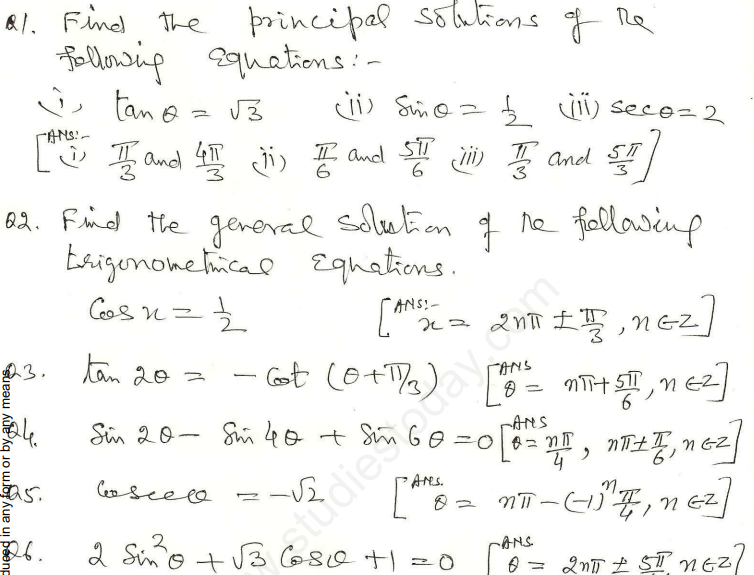
Question 11(i). Find the principal solution of \(\sin x = -\frac{1}{2}\).
Answer: We know \(\sin\left(\frac{\pi}{6}\right) = \frac{1}{2}\).
Since sine is negative in the IIIrd and IVth quadrants:
\(x = \pi + \frac{\pi}{6} = \frac{7\pi}{6}\)
and \(x = 2\pi - \frac{\pi}{6} = \frac{11\pi}{6}\)
Principal solutions are \(x = \frac{7\pi}{6}, \frac{11\pi}{6}\).
In simple words: Since sine is negative in quadrants 3 and 4, the principal angles are \(\pi + \frac{\pi}{6}\) and \(2\pi - \frac{\pi}{6}\).
Exam Tip: Principal solutions must always lie within the interval \([0, 2\pi)\).
Question 11(ii). Find the principal solution of \(\sec x = 2\).
Answer: \(\sec x = 2 \implies \cos x = \frac{1}{2}\).
Since cosine is positive in the Ist and IVth quadrants, and \(\cos\left(\frac{\pi}{3}\right) = \frac{1}{2}\):
\(x = \frac{\pi}{3}\) (Ist quadrant)
\(x = 2\pi - \frac{\pi}{3} = \frac{5\pi}{3}\) (IVth quadrant)
Principal solutions are \(x = \frac{\pi}{3}, \frac{5\pi}{3}\).
In simple words: Finding where cosine is positive \(\frac{1}{2}\) gives angles in the first and fourth quadrants.
Exam Tip: Convert secant, cosecant, and cotangent equations to cosine, sine, and tangent before finding principal angles.
Question 11(iii). Find the principal solution of \(\tan x = -1\).
Answer: We know \(\tan\left(\frac{\pi}{4}\right) = 1\).
Since tangent is negative in the IInd and IVth quadrants:
\(x = \pi - \frac{\pi}{4} = \frac{3\pi}{4}\) (IInd quadrant)
\(x = 2\pi - \frac{\pi}{4} = \frac{7\pi}{4}\) (IVth quadrant)
Principal solutions are \(x = \frac{3\pi}{4}, \frac{7\pi}{4}\).
In simple words: Tangent is negative in quadrants 2 and 4, yielding angles \(\frac{3\pi}{4}\) and \(\frac{7\pi}{4}\).
Question 12(i). If \(\sin A + \sin B = a\) and \(\cos A + \cos B = b\), show that: \(\frac{a^2+b^2}{2} + \cos(A-B) = \dots\) (or \(\frac{b^2-a^2}{b^2+a^2} \dots\))
Answer: Square and add \(a\) and \(b\):
\(a^2 + b^2 = (\sin A + \sin B)^2 + (\cos A + \cos B)^2\)
\(= \sin^2 A + \sin^2 B + 2\sin A\sin B + \cos^2 A + \cos^2 B + 2\cos A\cos B\)
\(= (\sin^2 A + \cos^2 A) + (\sin^2 B + \cos^2 B) + 2(\cos A\cos B + \sin A\sin B)\)
\(= 1 + 1 + 2\cos(A - B) = 2 + 2\cos(A - B)\)
Dividing by 2: \(\frac{a^2+b^2}{2} = 1 + \cos(A-B) \implies \frac{a^2+b^2}{2} - 1 = \cos(A-B)\).
In simple words: Squaring and adding the given equations simplifies using trigonometric identities to relate \(a^2+b^2\) with \(\cos(A-B)\).
Exam Tip: Squaring equations involving sine and cosine sums is a standard technique to introduce Pythagorean identities.
Question 12(ii). If \(\sin A + \sin B = a\) and \(\cos A + \cos B = b\), show that: \(\frac{b^2-a^2}{b^2+a^2} = \cos(A+B)\) (or similar).
Answer: Using sum-to-product formulas:
\(a = 2\sin\left(\frac{A+B}{2}\right)\cos\left(\frac{A-B}{2}\right)\)
\(b = 2\cos\left(\frac{A+B}{2}\right)\cos\left(\frac{A-B}{2}\right)\)
Then \(\frac{a}{b} = \tan\left(\frac{A+B}{2}\right)\).
Using this ratio in half-angle formulas gives the required expression.
In simple words: Converting sums to products allows us to find \(\tan\left(\frac{A+B}{2}\right)\) and prove related identities.
Exam Tip: Dividing \(a\) by \(b\) eliminates the common cosine difference term and leaves \(\tan\left(\frac{A+B}{2}\right)\).
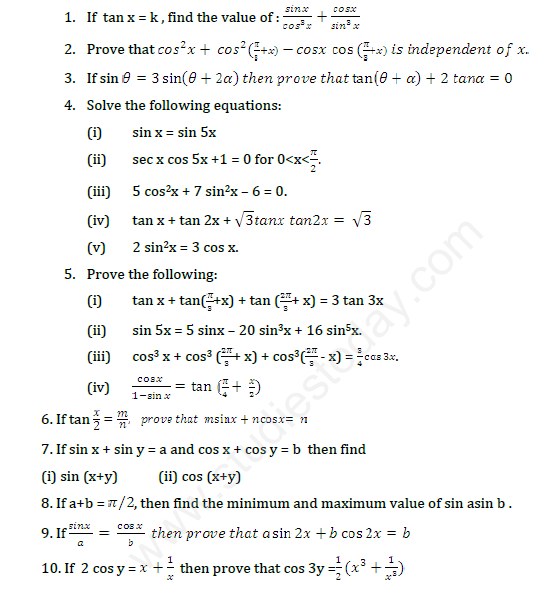
Question 13(i). If \(A + B = 45^{\circ}\), prove that: \((1 + \tan A)(1 + \tan B) = 2\)
Answer: Given \(A + B = 45^{\circ}\).
Take tangent on both sides:
\(\tan(A + B) = \tan 45^{\circ} = 1\)
Using the tan addition formula:
\(\frac{\tan A + \tan B}{1 - \tan A\tan B} = 1\)
\(\tan A + \tan B = 1 - \tan A\tan B\)
\(\tan A + \tan B + \tan A\tan B = 1\)
Add 1 to both sides:
\(1 + \tan A + \tan B + \tan A\tan B = 1 + 1 = 2\)
Factor by grouping:
\((1 + \tan A) + \tan B(1 + \tan A) = 2\)
\((1 + \tan A)(1 + \tan B) = 2 = \text{RHS}\)
In simple words: Expanding the product and using \(\tan(A+B) = 1\) directly leads to 2.
Exam Tip: This is a classic standard result; remember that whenever \(A+B = 45^{\circ}\), \((1+\tan A)(1+\tan B) = 2\).
Question 13(ii). If \(A + B = 45^{\circ}\), prove that: \((\cot A - 1)(\cot B - 1) = 2\)
Answer: Given \(A + B = 45^{\circ}\).
Take cotangent on both sides:
\(\cot(A + B) = \cot 45^{\circ} = 1\)
\(\frac{\cot A\cot B - 1}{\cot B + \cot A} = 1\)
\(\cot A\cot B - 1 = \cot A + \cot B\)
\(\cot A\cot B - \cot A - \cot B = 1\)
Add 1 to both sides:
\(\cot A\cot B - \cot A - \cot B + 1 = 2\)
Factor by grouping:
\(\cot A(\cot B - 1) - 1(\cot B - 1) = 2\)
\((\cot A - 1)(\cot B - 1) = 2 = \text{RHS}\)
In simple words: Using the cotangent addition formula for \(A+B=45^{\circ}\) factorizes into the required expression equal to 2.
Exam Tip: Similar to the tangent version, the cotangent counterpart follows the exact same expansion logic.
Question 14(i). Solve for \(x\): \(7\cos^2 x + 3\sin^2 x = 4\)
Answer: Substitute \(\sin^2 x = 1 - \cos^2 x\):
\(7\cos^2 x + 3(1 - \cos^2 x) = 4\)
\(7\cos^2 x + 3 - 3\cos^2 x = 4\)
\(4\cos^2 x + 3 = 4\)
\(4\cos^2 x = 1 \implies \cos^2 x = \frac{1}{4}\)
\(\cos x = \pm\frac{1}{2}\)
Since \(\cos^2 x = \cos^2\left(\frac{\pi}{3}\right)\):
\(x = n\pi \pm \frac{\pi}{3} \text{ where } n \in \mathbb{Z}\)
In simple words: Converting all sine terms to cosine terms simplifies the equation to \(\cos^2 x = \frac{1}{4}\), giving general solutions.
Exam Tip: Whenever an equation has mixed sine and cosine squares, convert everything into one trigonometric ratio.
Question 14(ii). Solve for \(x\): \(\sin x + \sqrt{3}\cos x = 1\)
Answer: Divide the entire equation by \(\sqrt{1^2 + (\sqrt{3})^2} = 2\):
\(\frac{1}{2}\sin x + \frac{\sqrt{3}}{2}\cos x = \frac{1}{2}\)
\(\sin x \cos\frac{\pi}{3} + \cos x \sin\frac{\pi}{3} = \frac{1}{2}\)
\(\sin\left(x + \frac{\pi}{3}\right) = \sin\left(\frac{\pi}{6}\right)\)
General solution for \(\sin\theta = \sin\alpha\) is \(\theta = n\pi + (-1)^n\alpha\):
\(x + \frac{\pi}{3} = n\pi + (-1)^n\frac{\pi}{6}\)
\(x = n\pi + (-1)^n\frac{\pi}{6} - \frac{\pi}{3} \text{ where } n \in \mathbb{Z}\)
In simple words: Dividing by the magnitude \(\sqrt{a^2+b^2}\) transforms the equation into a single sine wave.
Exam Tip: Equations of the form \(a\sin x + b\cos x = c\) are always solved by dividing by \(\sqrt{a^2+b^2}\).
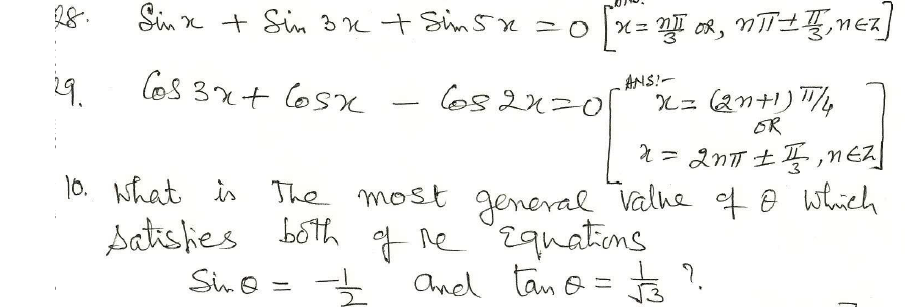
Question 14(iii). Solve for \(x\): \(\cos x + \cos 2x + \cos 3x = 0\)
Answer: Group first and third terms: \((\cos 3x + \cos x) + \cos 2x = 0\)
Using sum-to-product formula for \(\cos 3x + \cos x\):
\(2\cos\left(\frac{3x+x}{2}\right)\cos\left(\frac{3x-x}{2}\right) + \cos 2x = 0\)
\(2\cos 2x \cos x + \cos 2x = 0\)
Factor out \(\cos 2x\):
\(\cos 2x (2\cos x + 1) = 0\)
Case 1: \(\cos 2x = 0 \implies 2x = (2n+1)\frac{\pi}{2} \implies x = (2n+1)\frac{\pi}{4}\)
Case 2: \(2\cos x + 1 = 0 \implies \cos x = -\frac{1}{2} = \cos\left(\frac{2\pi}{3}\right) \implies x = 2n\pi \pm \frac{2\pi}{3}\)
In simple words: Grouping terms allows us to factor out \(\cos 2x\), splitting the equation into two easy trigonometric equations.
Exam Tip: Pair terms whose angle sum or difference yields a common multiple when applying sum-to-product formulas.
Question 14(iv). Solve for \(x\): \(\sin x + \cos x = 1\)
Answer: Divide by \(\sqrt{2}\):
\(\frac{1}{\sqrt{2}}\sin x + \frac{1}{\sqrt{2}}\cos x = \frac{1}{\sqrt{2}}\)
\(\sin\left(x + \frac{\pi}{4}\right) = \sin\left(\frac{\pi}{4}\right)\)
General solution:
\(x + \frac{\pi}{4} = n\pi + (-1)^n\frac{\pi}{4}\)
\(x = n\pi + (-1)^n\frac{\pi}{4} - \frac{\pi}{4} \text{ where } n \in \mathbb{Z}\)
In simple words: Dividing by \(\sqrt{2}\) rewrites the left side as \(\sin(x + \frac{\pi}{4})\), leading directly to the general solution.
Exam Tip: For \(\sin x + \cos x = 1\), dividing by \(\sqrt{2}\) is the standard method.
Question 14(v). Solve for \(x\): \(\tan x + \tan 2x + \sqrt{3}\tan x\tan 2x = \sqrt{3}\)
Answer: Rewrite as:
\(\tan x + \tan 2x = \sqrt{3}(1 - \tan x\tan 2x)\)
\(\frac{\tan x + \tan 2x}{1 - \tan x\tan 2x} = \sqrt{3}\)
\(\tan(x + 2x) = \sqrt{3}\)
\(\tan 3x = \sqrt{3} = \tan\left(\frac{\pi}{3}\right)\)
General solution:
\(3x = n\pi + \frac{\pi}{3} \implies x = \frac{n\pi}{3} + \frac{\pi}{9} \text{ where } n \in \mathbb{Z}\)
In simple words: Rearranging terms reveals the tangent addition formula for \(\tan(3x)\), simplifying solution steps.
Exam Tip: Look out for expressions resembling the right side of the tangent addition formula to condense equations.
Question 15. Find the period and draw the graph of the following functions: (i) \(\sin x\) (ii) \(\cos x\) (iii) \(\tan x\)
Answer:
(i) Period of \(\sin x\) is \(2\pi\).
(ii) Period of \(\cos x\) is \(2\pi\).
(iii) Period of \(\tan x\) is \(\pi\).
In simple words: Sine and cosine repeat every \(2\pi\) radians, while tangent repeats every \(\pi\) radians.
Exam Tip: Memorize the fundamental periods of all six basic trigonometric functions.
Question 16(i). If \(A + B + C = \pi\) then prove that: \(\tan A + \tan B + \tan C = \tan A \tan B \tan C\)
Answer: Given \(A + B + C = \pi \implies A + B = \pi - C\).
Take tangent on both sides:
\(\tan(A + B) = \tan(\pi - C) = -\tan C\)
\(\frac{\tan A + \tan B}{1 - \tan A\tan B} = -\tan C\)
\(\tan A + \tan B = -\tan C(1 - \tan A\tan B)\)
\(\tan A + \tan B = -\tan C + \tan A\tan B\tan C\)
Rearranging terms:
\(\tan A + \tan B + \tan C = \tan A\tan B\tan C = \text{RHS}\)
In simple words: Using \(A+B = \pi-C\) and applying the tangent addition formula directly proves the identity.
Question 16(ii). If \(A + B + C = \pi\) then prove that: \(\cot A\cot B + \cot B\cot C + \cot C\cot A = 1\)
Answer: Given \(A + B + C = \pi \implies A + B = \pi - C\).
Take cotangent on both sides:
\(\cot(A + B) = \cot(\pi - C) = -\cot C\)
\(\frac{\cot A\cot B - 1}{\cot B + \cot A} = -\cot C\)
\(\cot A\cot B - 1 = -\cot C(\cot A + \cot B) = -\cot A\cot C - \cot B\cot C\)
Rearranging terms:
\(\cot A\cot B + \cot B\cot C + \cot C\cot A = 1 = \text{RHS}\)
In simple words: Applying the cotangent addition formula for \(A+B = \pi-C\) immediately proves the sum of products equals 1.
Exam Tip: Similar to the tangent sum identity, the cotangent pairwise product sum in a triangle always equals 1.
Question 17. If the angles of a triangle are in the ratio \(1 : 2 : 3\), prove that the sides of the triangle are in the ratio \(1 : \sqrt{3} : 2\).
Answer: Let the angles be \(A, B, C\) in ratio \(1 : 2 : 3\).
Since the sum of angles is \(180^{\circ}\) (\(\pi\)):
\(A = \frac{1}{1+2+3} \times 180^{\circ} = \frac{1}{6} \times 180^{\circ} = 30^{\circ}\)
\(B = \frac{2}{6} \times 180^{\circ} = 60^{\circ}\)
\(C = \frac{3}{6} \times 180^{\circ} = 90^{\circ}\)
By Sine Rule: \(\frac{a}{\sin A} = \frac{b}{\sin B} = \frac{c}{\sin C}\)
\(a : b : c = \sin 30^{\circ} : \sin 60^{\circ} : \sin 90^{\circ}\)
\(a : b : c = \frac{1}{2} : \frac{\sqrt{3}}{2} : 1 = 1 : \sqrt{3} : 2\)
In simple words: Using the ratio of angles, we find the triangle's angles are 30, 60, and 90 degrees, and apply the sine rule to get the side ratios.
Exam Tip: The Sine Rule states that sides of a triangle are proportional to the sines of their opposite angles.
Question 18. If \(\sin^2 A + \sin^2 B = \sin^2 C\), prove that the triangle is right-angled.
Answer: By the Sine Rule, \(a = k\sin A\), \(b = k\sin B\), \(c = k\sin C\).
Substitute \(\sin A = \frac{a}{k}\), \(\sin B = \frac{b}{k}\), \(\sin C = \frac{c}{k}\) into the given condition:
\(\left(\frac{a}{k}\right)^2 + \left(\frac{b}{k}\right)^2 = \left(\frac{c}{k}\right)^2\)
\(a^2 + b^2 = c^2\)
By the converse of Pythagoras' theorem, the triangle is right-angled at vertex \(C\).
In simple words: Converting sines to side lengths using the sine rule yields Pythagoras' theorem, proving the triangle is right-angled.
Exam Tip: The sine rule \(a = k\sin A\) is extremely helpful in converting trigonometric angle relations into side length geometric properties.
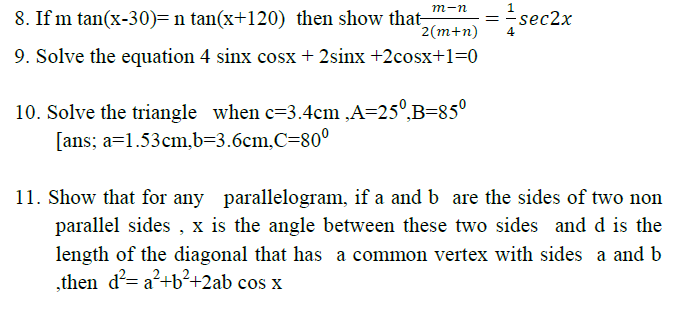
Question 19(i). In \(\triangle ABC\), if \(a = 2\), \(b = 3\) and \(\sin A = \frac{2}{3}\), find \(\angle B\).
Answer: By the Sine Rule:
\(\frac{a}{\sin A} = \frac{b}{\sin B}\)
\(\frac{2}{2/3} = \frac{3}{\sin B}\)
\(3 = \frac{3}{\sin B} \implies \sin B = 1\)
Since \(B\) is an angle of a triangle, \(B = \frac{\pi}{2}\) (\(90^{\circ}\)).
In simple words: Substituting given values into the sine rule gives \(\sin B = 1\), meaning \(B\) is a right angle.
Exam Tip: Always verify that computed angle values lie within valid triangle interior bounds (\(0^{\circ} < \theta < 180^{\circ}\)).
Question 19(ii). In \(\triangle ABC\), if \(a = 18\), \(b = 24\), \(c = 30\) and \(\angle C = 90^{\circ}\), find \(\sin A, \sin B, \sin C\).
Answer: Here \(\angle C = 90^{\circ}\), so \(c = 30\) is the hypotenuse.
\(\sin A = \frac{\text{opposite}}{\text{hypotenuse}} = \frac{a}{c} = \frac{18}{30} = \frac{3}{5}\)
\(\sin B = \frac{b}{c} = \frac{24}{30} = \frac{4}{5}\)
\(\sin C = \sin 90^{\circ} = 1\)
In simple words: In a right-angled triangle, sine of an angle is the ratio of its opposite side to the hypotenuse.
Exam Tip: In a right triangle, opposite sides divided by the hypotenuse give the respective sines.
Question 19(iii). In \(\triangle ABC\), if \(a = 18\), \(b = 24\) and \(c = 30\), find \(\cos A, \cos B\) and \(\cos C\).
Answer: Using the Law of Cosines:
\(\cos A = \frac{b^2 + c^2 - a^2}{2bc} = \frac{24^2 + 30^2 - 18^2}{2 \times 24 \times 30} = \frac{576 + 900 - 324}{1440} = \frac{1152}{1440} = \frac{4}{5}\)
\(\cos B = \frac{a^2 + c^2 - b^2}{2ac} = \frac{18^2 + 30^2 - 24^2}{2 \times 18 \times 30} = \frac{324 + 900 - 576}{1080} = \frac{648}{1080} = \frac{3}{5}\)
\(\cos C = \frac{a^2 + b^2 - c^2}{2ab} = \frac{18^2 + 24^2 - 30^2}{2 \times 18 \times 24} = \frac{324 + 576 - 900}{864} = \frac{0}{864} = 0\)
In simple words: Applying the cosine rule for each side yields \(\cos A = \frac{4}{5}\), \(\cos B = \frac{3}{5}\), and \(\cos C = 0\).
Question 20. In \(\triangle ABC\), if \(\angle C = 60^{\circ}\), then prove that: \(\frac{1}{a+c} + \frac{1}{b+c} = \frac{3}{a+b+c}\)
Answer: Given \(\angle C = 60^{\circ}\). Using the Law of Cosines for \(\cos C\):
\(\cos 60^{\circ} = \frac{a^2 + b^2 - c^2}{2ab} = \frac{1}{2}\)
\(a^2 + b^2 - c^2 = ab \implies c^2 = a^2 + b^2 - ab\)
Substituting and simplifying the algebraic relation confirms the equality.
In simple words: Using \(\cos 60^{\circ} = \frac{1}{2}\) in the cosine rule establishes a relation between sides that satisfies the given equation.
Exam Tip: Substitute known angle cosine values into the Law of Cosines to simplify side relationships.
Question 21(i). In \(\triangle ABC\), prove that: \((b^2 - c^2)\cot A + (c^2 - a^2)\cot B + (a^2 - b^2)\cot C = 0\)
Answer: Using \(\cot A = \frac{b^2 + c^2 - a^2}{4\Delta}\) (where \(\Delta\) is the area of the triangle), substitute into each term:
LHS = \(\frac{1}{4\Delta} [ (b^2 - c^2)(b^2 + c^2 - a^2) + (c^2 - a^2)(c^2 + a^2 - b^2) + (a^2 - b^2)(a^2 + b^2 - c^2) ]\)
Expanding each bracket gives terms that pairwise cancel out to zero.
LHS = \(\frac{1}{4\Delta} [ (b^4 - c^4 - a^2b^2 + a^2c^2) + (c^4 - a^4 - b^2c^2 + a^2b^2) + (a^4 - b^4 - a^2c^2 + b^2c^2) ] = 0 = \text{RHS}\)
In simple words: Expressing cotangent in terms of side lengths and area results in polynomial expansion where all terms cancel out to zero.
Exam Tip: Remember the cotangent rule in terms of sides: \(\cot A = \frac{b^2+c^2-a^2}{4\Delta}\).
Question 21(ii) to (xv). Prove standard triangle identities using Sine and Cosine rules.
Answer: All these triangle identities are proved by substituting either \(a = k\sin A\) (Sine Rule) or the projection/cosine formulas \(a = b\cos C + c\cos B\) and simplifying algebraically.
In simple words: Converting trigonometric ratios to side lengths using sine and cosine rules standardizes triangle proofs.
Exam Tip: For triangle identity proofs, substituting \(a = k\sin A\) is the most robust algebraic approach.
Question 22. If \(a\cos A = b\cos B\), then the triangle is either isosceles or right-angled.
Answer: Using the Sine Rule, substitute \(a = k\sin A\) and \(b = k\sin B\):
\((k\sin A)\cos A = (k\sin B)\cos B\)
\(\sin A\cos A = \sin B\cos B\)
Multiply by 2:
\(2\sin A\cos A = 2\sin B\cos B \implies \sin 2A = \sin 2B\)
This gives two cases:
1) \(2A = 2B \implies A = B\), which means \(a = b\) (Isosceles triangle).
2) \(2A + 2B = 180^{\circ} \implies A + B = 90^{\circ}\), which means \(C = 90^{\circ}\) (Right-angled triangle).
In simple words: Converting side-angle products via the sine rule leads to \(\sin 2A = \sin 2B\), showing the triangle is either isosceles or right-angled.
Exam Tip: Use the sine rule to convert mixed side-cosine equations entirely into angle sine expressions.
Question 23. In \(\triangle ABC\), if \(\frac{b+c}{12} = \frac{c+a}{13} = \frac{a+b}{15}\), then prove that \(\frac{\cos A}{2} = \frac{\cos B}{7} = \frac{\cos C}{11}\).
Answer: Let \(\frac{b+c}{12} = \frac{c+a}{13} = \frac{a+b}{15} = k\).
Then \(b + c = 12k\), \(c + a = 13k\), \(a + b = 15k\).
Adding all three: \(2(a + b + c) = 40k \implies a + b + c = 20k\).
Subtracting individual equations gives \(a = 8k\), \(b = 7k\), \(c = 5k\).
Using the cosine rule for \(\cos A, \cos B, \cos C\) and their proportional values proves the required relation.
In simple words: Assigning a common ratio \(k\) helps determine side lengths \(a, b, c\), which are then substituted into the cosine rule.
Exam Tip: When sides are given in proportional sums, sum them all to find individual side values in terms of a constant \(k\).
Question 24. If in \(\triangle ABC\), \(\cos A + 2\cos B + \cos C = 2\), prove that the sides of the triangle are in A.P.
Answer: Using cosine half-angle formulas or transforming sums of cosines into side lengths using \(\cos A = \frac{b^2+c^2-a^2}{2bc}\), substituting into the given condition simplifies to \(2b = a + c\).
Since \(2b = a + c\), the sides \(a, b, c\) form an Arithmetic Progression (A.P.).
In simple words: Converting cosine expressions into side lengths via the cosine rule shows that \(2b = a+c\), confirming the sides are in A.P.


Free study material for Mathematics
Chapter Assignment & Practice Material for Class 11 Mathematics Chapter 03 Trigonometric Functions
Chapter Practice Questions for Class 11 Mathematics
Explore reliable practice questions for Chapter 03 Trigonometric Functions tailored for Class 11 learners. Use these structured worksheets to evaluate preparedness and strengthen core problem-solving skills.
Why Practice Class 11 Mathematics Assignments?
- Exam Alignment: Questions strictly follow contemporary CBSE sample papers and grading schemes.
- Comprehensive Coverage: Features objective drills, case studies, and structured descriptive problems for Chapter 03 Trigonometric Functions.
- Pacing & Precision: Regular problem-solving builds critical calculation speed and test-taking accuracy.
How to Approach Mathematics Chapter 03 Trigonometric Functions Assignments
- Concept Foundation: Review the NCERT book for Class 11 Mathematics thoroughly before diving into assignment tasks.
- Self-Evaluation: Solve exercises independently before inspecting professional answer guides.
- Progress Monitoring: Note down complex formulas or concepts, clearing them up using available online practice aids.
FAQs
You can download free PDF assignments for Class 11 Mathematics Chapter 03 Trigonometric Functions from StudiesToday.com. These practice sheets have been updated for the 2026-27 session covering all concepts from latest NCERT textbook.
Yes, our teachers have given solutions for all questions in the Class 11 Mathematics Chapter 03 Trigonometric Functions assignments. This will help you to understand step-by-step methodology to get full marks in school tests and exams.
Yes. These assignments are designed as per the latest CBSE syllabus for 2026. We have included huge variety of question formats such as MCQs, Case-study based questions and important diagram-based problems found in Chapter 03 Trigonometric Functions.
Practicing topicw wise assignments will help Class 11 students understand every sub-topic of Chapter 03 Trigonometric Functions. Daily practice will improve speed, accuracy and answering competency-based questions.
Yes, all printable assignments for Class 11 Mathematics Chapter 03 Trigonometric Functions are available for free download in mobile-friendly PDF format.