

Official CBSE Assignments for Class 11 History
Access comprehensive school assignments for Themes In World History Chapter 02 An Empire Across Three Continents using the CBSE Class 11 History An Empire Across Three Continents Concepts and Assignment. Designed to align with the 2026-27 CBSE academic guidelines, these practice sets help Class 11 History students reinforce core concepts and improve their problem-solving accuracy.
Solved Practice Assignments for History
Navigate directly to the solved History assignments using the digital viewer below. Each practice set includes detailed step-by-step solutions, allowing students to instantly cross-check their work and identify areas requiring further revision.
Model Questions
2 Marks Questions :
Question 1. Give two features of Ancient Roman Religion.
Answer: (i) The Romans were polytheists and worshipped various gods and goddesses such as Jupiter, Mars, and Juno.
(ii) Judaism was another prominent religion practiced within the empire, along with the later emergence and official adoption of Christianity.
In simple words: The Roman religion included belief in multiple traditional gods and later saw the rise of monotheistic faiths like Judaism and Christianity.
Exam Tip: Mention polytheism and specific deities to score full marks in 2-mark questions.
Question 2. Mention four archaeological sources of Ancient Roman Empire.
Answer: (i) Amphorae (oil and wine containers)
(ii) Aqueducts
(iii) Colosseum and amphitheatres
(iv) Statues and monumental buildings
In simple words: Physical remains like pottery, water structures, and public buildings serve as key archaeological evidence.
Exam Tip: List exact archaeological artifacts and structures studied by historians.
Question 3. What do you mean by Republic ?
Answer: Republic is the name for a regime in which real power lay with the Senate, a body dominated by a small group of wealthy families, rather than with a monarch.
In simple words: A republic is a form of government where power rests with an elite governing body like the Senate rather than a king.
Question 4. Name two historians of Ancient Roman civilization.
Answer: (i) Tacitus
(ii) Strabo (or Pliny / Olympiodorus)
In simple words: Ancient writers like Tacitus and Strabo documented the history and geography of the Roman Empire.
Exam Tip: Memorize at least two contemporary Roman or classical historians.
Question 5. Name the three main players of the political history of ancient Roman Empire.
Answer: (i) The Emperor
(ii) The Aristocracy (Senate)
(iii) The Army
In simple words: The emperor, the Senate, and the military were the three pillars that held political power in Rome.
Exam Tip: This is a standard and frequently asked question in board examinations.
5 Marks Questions :
Question 1. Name the ancient empire which was expanded across three continents. Why is the empire known so ?
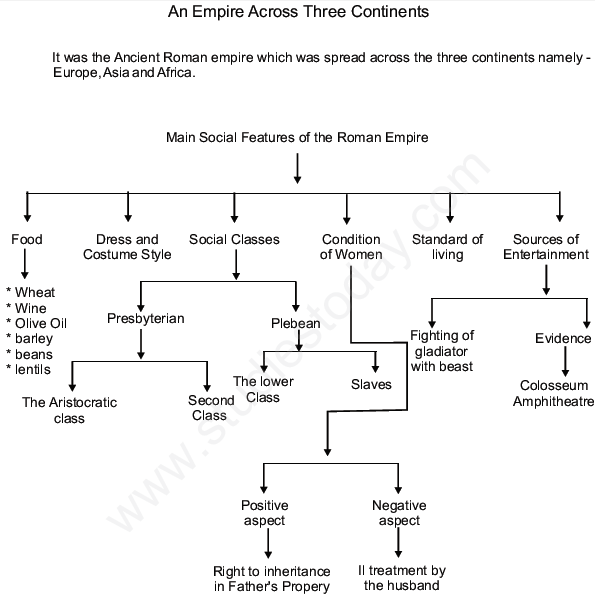
Answer: The ancient empire was the Roman Empire. It is known as an empire across three continents because its vast territories spanned across Europe, Asia, and North Africa. Specifically, it included large parts of modern-day Europe up to the Rhine and Danube rivers, the fertile regions of North Africa along the Mediterranean coast, and parts of the Near East in Asia up to the Euphrates.
In simple words: The Roman Empire covered lands across Europe, Asia, and Africa, earning it the title of an empire across three continents.
Exam Tip: Clearly name the three continents and mention geographical boundaries like rivers or seas.
Question 2. Name the famous emperors of the early Empire in Rome. What were their contributions in the making of the empire ?
Answer: Famous emperors of the early empire included Julius Caesar, Octavian Augustus, Tiberius, and Trajan. Their contributions include:
(i) Augustus established the principate in 27 BCE, bringing an end to decades of civil war and establishing internal peace.
(ii) Trajan expanded the empire's territorial boundaries to their greatest extent, conquering regions like Dacia and Mesopotamia.
(iii) They centralized administration, strengthened the provincial governance system, and built monumental infrastructure.
In simple words: Early emperors brought peace, expanded borders, and organized administration to strengthen Roman rule.
Exam Tip: Highlight Augustus for establishing peace and Trajan for territorial expansion.
Question 3. What is meant by the early empire ? Discuss its significance in the history of the Ancient Roman Civilization.
Answer: The period from the establishment of the principate by Augustus in 27 BCE to the major crisis of the third century CE is known as the Early Roman Empire. Significance:
(i) It brought long-term internal stability and peace known as the Pax Romana across the Mediterranean region.
(ii) It witnessed remarkable economic expansion, flourishing trade networks, and urban growth.
(iii) Administrative structures were standardized across diverse provinces, integrating various cultures into a unified imperial framework.
In simple words: The early empire was a golden age of peace, economic growth, and administrative integration.
Exam Tip: Mention the time frame (27 BCE onwards) and the concept of Pax Romana.
Question 4. Explain the impact of the crisis of the third Century on the Early Roman Empire.
Answer: The third-century crisis was a period of severe political, military, and economic turbulence characterized by frequent changes of emperors and external invasions. Impacts:
(i) Political instability as internal military commanders fought for the throne, leading to the rapid turnover of emperors.
(ii) Economic disruption, inflation, and devaluation of currency, especially the Roman silver coin (denarius).
(iii) Germanic tribes launched successful incursions across the Rhine and Danube frontiers, forcing the empire to abandon certain territories like Dacia.
In simple words: The crisis brought economic ruin, political chaos, and barbarian invasions, shaking the empire to its core.
Exam Tip: Divide your answer into political, economic, and military impacts for clear structuring.
Question 5. Who was Saint Augustine ? Why is he famous in the history of the Roman civilization ?
Answer: Saint Augustine was a prominent Christian theologian, philosopher, and bishop of Hippo Regius in North Africa during the late Roman period (4th-5th century CE). He is famous for his profound intellectual contributions that shaped Christian theology and philosophy during the transition from the classical Roman world to the Middle Ages. His seminal works, such as 'City of God' and 'Confessions', addressed the fall of Rome and provided a Christian interpretation of history.
In simple words: Saint Augustine was a key Christian thinker whose philosophical writings influenced Western thought during the decline of Rome.
Exam Tip: Mention his role as Bishop of Hippo and his famous work 'City of God'.
10 marks Questions :
Question 1. Explain the main features of Ancient Roman society. How independent were women in the Roman society ? Compare the situation of Roman family with the family in India.
Answer: Main Features of Roman Society:
(i) Social Stratification: Roman society was sharply divided into the patricians (aristocracy), plebeians (common people), second class, lower class, and a large population of slaves.
(ii) Patriarchal Structure: The head of the household (paterfamilias) held legal control over family members, including children and slaves.
Independence of Women:
(i) Roman women enjoyed considerable legal rights. They could own, manage, and inherit property independently.
(ii) Under typical forms of marriage, a woman retained her rights in her natal family's property and did not automatically transfer authority to her husband.
(iii) Divorce was legally accessible to both men and women.
Comparison with the Indian Family:
(i) Both Roman and traditional Indian families are patriarchal in nature, with senior male members holding authority.
(ii) While Roman women historically enjoyed independent property ownership rights from an early era, traditional Hindu law in India historically granted limited property rights to women until modern legal reforms (such as the Hindu Succession Amendment Act).
(iii) Arranged marriages were common in both societies, but Roman society permitted relatively easy divorce compared to traditional Indian social norms.
In simple words: Roman society was hierarchical and patriarchal, yet women enjoyed significant property and legal rights compared to many contemporary ancient civilizations, offering interesting parallels and contrasts with traditional Indian families.
Exam Tip: Structure your answer clearly with headings for social features, women's independence, and the comparison with India.
Hot Questions
2 Marks Questions
Question 1. Name four languages, spoken in the Roman Empire.
Answer: (i) Latin
(ii) Greek
(iii) Coptic
(iv) Aramaic (or Punic, Berber)
In simple words: Latin and Greek were the dominant administrative languages, while regional languages like Coptic and Aramaic were spoken locally.
Exam Tip: List Latin and Greek first as they were the major literary and administrative languages.
Question 2. Define the term civil war.
Answer: Civil war refers to armed struggles for power within the same country or state, fought between rival organized factions or political groups.
In simple words: A civil war is an internal conflict where different groups within the same nation fight for political control.
Question 3. What do you mean by Draconian ? Answer in the context of Roman Laws.
Answer: In the context of legal codes, 'Draconian' means extremely harsh or severe. It originates from Draco, an early 6th century BCE Greek law maker who prescribed death as the penalty for most crimes, influencing subsequent legal traditions in the classical world.
In simple words: Draconian laws are exceptionally harsh laws carrying severe punishments.
Exam Tip: Explain the origin of the term from the ancient Greek law maker Draco.
Question 4. Give two contributions of Diocletian.
Answer: (i) Abandoned territories of little economic and strategic importance to consolidate the empire's borders.
(ii) Carried out administrative and military reorganization, splitting the empire into smaller administrative units.
In simple words: Emperor Diocletian restructured the administration and withdrew from vulnerable territories to secure the empire.
Exam Tip: Focus on border consolidation and administrative reforms.
Question 5. Who was Olympiodorus ?
Answer: Olympiodorus of Thebes was a contemporary historian and writer of the 5th century CE who documented the wealth, economic prosperity, and extravagant incomes of the Roman aristocracy.
In simple words: Olympiodorus was an ancient historian whose writings describe the immense wealth of Roman senators.
Exam Tip: Mention his identity as a contemporary writer and his accounts of senatorial wealth.
5 Marks Questions :
Question 1. How was the large Roman Empire administered? Discuss the role of the Provincial administration.
Answer: Administration of the Roman Empire:
(i) The vast empire was divided into provinces overseen by appointed governors.
(ii) The emperor and the Senate held supreme authority, supported by a professional standing army and a network of bureaucrats.
Role of Provincial Administration:
(i) Provinces formed the tax base of the empire, generating revenue through direct and indirect taxation.
(ii) Local elites in provincial cities (civitates) were co-opted to manage local administration, tax collection, and public works.
(iii) Urban centers served as administrative hubs that spread Roman culture, law, and civic life across conquered territories.
In simple words: The Roman Empire was managed through provinces governed by officials and local elites who maintained order and collected taxes.
Exam Tip: Explain the role of governors and local urban elites in maintaining imperial control.
Question 2. ''The emperor, the aristocracy and the army were the three main players in the political history of the empire.'' Discuss was Roman Republic a true republic in the real sense of the term ?
Answer: The Roman Republic was not a true democracy or republic in the modern egalitarian sense:
(i) Real power was concentrated in the hands of the Senate, which was an oligarchy dominated by a small group of wealthy, influential patrician families.
(ii) Ordinary citizens (plebeians) had limited political voice and voting power, which was often outweighed by the wealthy elite.
(iii) Magistrates and officials were drawn almost exclusively from the aristocratic class.
(iv) Therefore, it functioned more as an oligarchy ruled by the rich rather than a representative government of the people.
In simple words: The Roman Republic was controlled by a wealthy elite in the Senate rather than being a true democracy representing all citizens.
Exam Tip: Distinguish between the ancient Roman republic and modern democratic republics.
Question 3. How can we find gender differences in Roman society ? Give examples.
Answer: Gender differences in Roman society are evident in legal, social, and domestic spheres:
(i) Marriage and Age Gap: Marriages were generally arranged, and there was a considerable age gap between spouses. Men typically married in their late twenties or early thirties, whereas women were married off in their late teens or early twenties.
(ii) Domestic Control: Women were subject to legal dominance by husbands or fathers (paterfamilias), and instances of domestic abuse, such as wives being beaten by husbands, occurred.
(iii) Legal Property Rights: Despite patriarchal dominance, women enjoyed considerable legal autonomy in owning, managing, and inheriting property independently after their father's death.
In simple words: While women faced patriarchal control and age gaps in marriage, they enjoyed surprising independence in property ownership.
Question 4. How can we find cultural diversity in the Roman empire ? Discuss with examples.
Answer: Cultural diversity was a hallmark of the Roman Empire due to its vast multi-continental expanse:
(i) Plurality of Languages: A wide variety of languages were spoken across different regions, including Latin and Greek in administrative centers, alongside Coptic, Punic, Aramaic, and Berber locally.
(ii) Religious Diversity: The empire accommodated diverse religious traditions, from traditional Roman polytheism and imperial cults to Judaism and eventually Christianity.
(iii) Regional Customs and Architecture: Distinct regional traditions, indigenous art styles, and local legal practices coexisted under the overarching umbrella of Roman administration.
In simple words: The empire embraced diverse languages, religions, and regional cultures across its three continents.
Question 5. How were slaves treated in ancient Roman society ? Discuss.
Answer: Slaves formed the backbone of the Roman economy, and their treatment varied but was generally harsh:
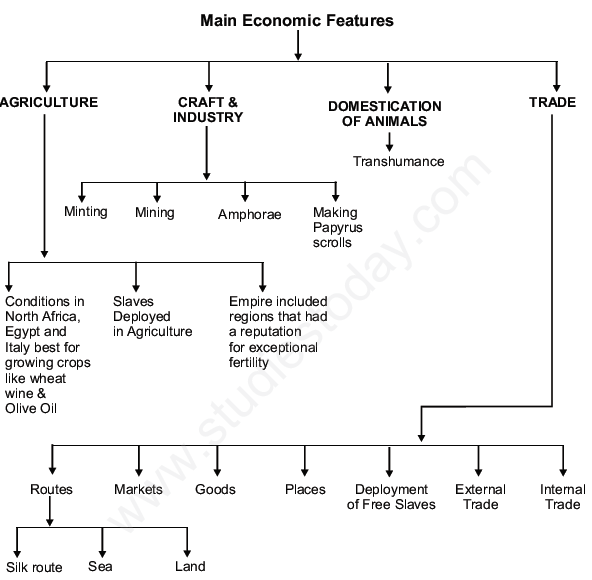
(i) Economic Role: Slaves were deployed extensively in agriculture, mines, craft industries, and domestic service, driving the empire's economic productivity.
(ii) Lack of Rights: Slaves were treated as property (chattel) with no legal personhood or rights of their own; their masters exercised absolute control over their lives and labor.
(iii) Harsh Conditions: Agricultural slaves often worked in chains under brutal conditions in large estates (latifundia), though domestic slaves sometimes experienced relatively milder treatment.
In simple words: Slaves were treated as property and forced to perform hard labor in mines and farms under strict control.
Question 1. How did fertility of Roman empire was the cause of the prosperity of the empire ? Explain in the context of ancient Mesopotamian civilisation.
Answer: (i) Agricultural Abundance: The Roman Empire included regions renowned for exceptional soil fertility, such as Campania in Italy, Sicily, Fayum in Egypt, Byzacium in Tunisia, and Baetica in Spain.
(ii) Surplus Production: These fertile lands produced vast surpluses of wheat, barley, wine, and olive oil, which were transported across the Mediterranean to feed urban populations like Rome.
(iii) Comparison with Mesopotamia: Similar to the ancient Mesopotamian civilization, which flourished in the fertile river valley between the Tigris and Euphrates rivers due to intensive agriculture and irrigation, the Roman Empire leveraged its fertile provincial lands as the economic engine for imperial wealth and urban prosperity.
In simple words: High agricultural fertility provided the food surplus and economic wealth that sustained both the Roman and Mesopotamian civilizations.
Question 2. Give your views on the religious features of Ancient Roman Empire. How did rise of Islam affect the empire. Explain.
Answer: Religious Features:
(i) Polytheism: Romans practiced traditional polytheism, worshipping gods like Jupiter, Mars, and Juno, and participated in emperor worship.
(ii) Monotheistic Shift: Over time, mystery cults, Judaism, and ultimately Christianity gained prominence, with Christianity becoming the official state religion under Constantine and his successors.
Impact of the Rise of Islam:
(i) The emergence of Islam in the 7th century CE in the Arabian Peninsula led to rapid Arab-Islamic conquests.
(ii) These conquests resulted in the loss of vital eastern and southern provinces of the Eastern Roman (Byzantine) Empire, including Syria, Palestine, and Egypt.
(iii) This fundamentally altered the geopolitical and economic landscape of the Mediterranean world, permanently shrinking the Roman sphere of influence.
In simple words: Roman religion evolved from polytheism to Christianity, while the later rise of Islam led to the loss of key eastern provinces.
Question 3. What do the Social Hierarchies tell us about Ancient Roman society ? Discuss the role of the Knights in the empire. Do you find any similarity between the feudal knights and these knights ?
Answer: Social Hierarchies:
(i) Roman social hierarchy reveals a deeply stratified class structure divided between the elite ruling minority and the exploited labor force (slaves and lower classes).
Role of the Knights (Equites):
(i) The Equites or knights formed an influential middle-upper class below the senators, engaged in commerce, tax farming, and administrative posts.
Comparison with Feudal Knights:
(i) Roman equites were primarily wealthy businessmen, traders, and administrators rather than armored mounted warriors.
(ii) Medieval feudal knights were military nobility bound by chivalry and vassalage, differing fundamentally in function from the Roman commercial equites.
In simple words: Roman social hierarchies show a sharp division of classes, and while Roman knights were businessmen, medieval knights were armed warriors.
Question 4. Who was Constantine ? Discuss his achievements in the final centuries of Roman world.
Answer: Emperor Constantine was one of the most influential Roman emperors of the 4th century CE. Key achievements:
(i) Patronage of Christianity: He favored Christianity, issued the Edict of Milan granting religious toleration, and paved the way for it to become the official state religion.
(ii) Founding of Constantinople: He established a new capital at Byzantium, renaming it Constantinople, which became the thriving center of the Eastern Roman Empire.
(iii) Monetary Reforms: He introduced the gold coin known as the 'solidus', which stabilized the imperial currency and boosted monetary trade.
In simple words: Constantine legalized Christianity, founded Constantinople, and stabilized the economy with gold coins.
Question 5. ''If rome plundered, it civilized the world as well''. Discuss the statement in the context of contributions of the ancient Roman civilization.
Answer: (i) Infrastructure and Technology: Romans built extensive networks of roads, aqueducts, harbors, amphitheatres, and advanced water-milling technology that laid infrastructural foundations across Europe.
(ii) Law and Administration: Roman legal codes, concepts of citizenship, and administrative systems profoundly shaped modern European legal and political structures.
(iii) Culture and Literacy: The spread of Latin literature, historical writings by scholars like Tacitus and Pliny, and urban civic culture integrated diverse regions.
(iv) Critique: While military conquest involved brutal plunder and enslavement, it simultaneously created a unified Mediterranean commonwealth that fostered long-term economic and cultural development.
In simple words: Despite violent conquests, Roman civilization left behind enduring legacies in law, engineering, and administration that shaped the modern world.
Chapter Assignment & Practice Material for Class 11 History Themes In World History Chapter 02 An Empire Across Three Continents
Chapter Practice Questions for Class 11 History
Access structured practice assignments for Themes In World History Chapter 02 An Empire Across Three Continents designed in alignment with the latest CBSE curriculum for Class 11 History. These printable sets cover objective and descriptive problem types to support thorough revision.
Maximize Exam Scores with Chapter Practice Sets
- Exam Alignment: Questions strictly follow contemporary CBSE sample papers and grading schemes.
- Comprehensive Coverage: Features objective drills, case studies, and structured descriptive problems for Themes In World History Chapter 02 An Empire Across Three Continents.
- Pacing & Precision: Regular problem-solving builds critical calculation speed and test-taking accuracy.
How to Approach History Themes In World History Chapter 02 An Empire Across Three Continents Assignments
- Initial Reading: Begin by reading the NCERT book for Class 11 History to build a baseline understanding.
- Independent Testing: Attempt assignment questions unassisted, then verify work using provided answer keys.
- Supplementary Aids: Leverage revision notes and worksheets whenever you encounter difficult topics.
FAQs
You can download free PDF assignments for Class 11 History Themes In World History Chapter 02 An Empire Across Three Continents from StudiesToday.com. These practice sheets have been updated for the 2026-27 session covering all concepts from latest NCERT textbook.
Yes, our teachers have given solutions for all questions in the Class 11 History Themes In World History Chapter 02 An Empire Across Three Continents assignments. This will help you to understand step-by-step methodology to get full marks in school tests and exams.
Yes. These assignments are designed as per the latest CBSE syllabus for 2026. We have included huge variety of question formats such as MCQs, Case-study based questions and important diagram-based problems found in Themes In World History Chapter 02 An Empire Across Three Continents.
Practicing topicw wise assignments will help Class 11 students understand every sub-topic of Themes In World History Chapter 02 An Empire Across Three Continents. Daily practice will improve speed, accuracy and answering competency-based questions.
Yes, all printable assignments for Class 11 History Themes In World History Chapter 02 An Empire Across Three Continents are available for free download in mobile-friendly PDF format.