

School Assignments for IPCC Costing: Reconciliation Of Cost And Financial Account Solutions
Access comprehensive school assignments for Reconciliation Of Cost And Financial Account Solutions using the CA IPCC Reconciliation of Cost and Financial Account Solutions. Designed to align with the 2026-27 Chartered Accountancy academic guidelines, these practice sets help IPCC Costing students reinforce core concepts and improve their problem-solving accuracy.
Practice IPCC Costing Assignments: Reconciliation Of Cost And Financial Account Solutions
Access the complete assignment PDF for IPCC Costing below. Regular practice with these targeted academic tasks builds familiarity with standard question patterns and helps secure higher marks in final school evaluations.
CA IPCC Reconciliation of Cost and Financial Account Solutions to Questions for CA IPCC Cost Accounting also includes notes, Questions and answers. CA IPCC Students please refer to the attached file for solutions for important questions which came in previous examinations for Cost Accounting and also study notes. Refer to other links too for detailed study notes/ question banks and solutions on all chapters of Cost Accounting for CA IPCC Refer to the attached file for CA IPCC Reconciliation of Cost and Financial Account Solutions
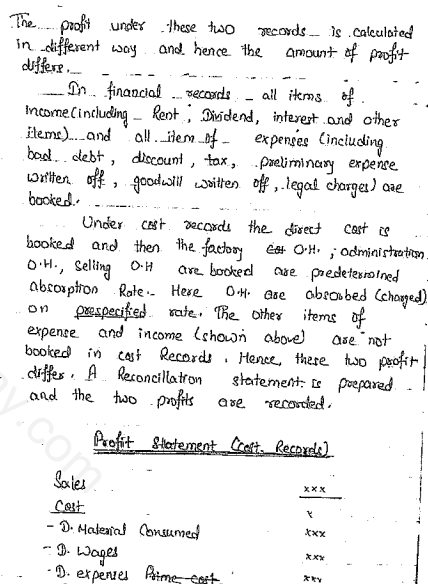
Question 1. The profit under cost and financial records is calculated in a different way and hence the amount of profit differs. In financial records, all items of income (including rent, dividend, interest and other items) and all items of expenses (including bad debt, discount, tax, preliminary expense written off, goodwill written off, legal charges) are booked. Under cost records, the direct cost is booked and then the factory overhead, administration overhead, selling overhead are booked and these overheads are absorbed on a prespecified rate. Here, other items of expense and income (shown above) are not booked in cost records. Hence, these two profit differs. A Reconciliation Statement is prepared and the two profits are recorded.
Answer: The difference in profit between cost and financial accounts arises due to the treatment of items of pure financial nature (such as pure financial incomes and pure financial expenses) and differences in the valuation of opening and closing stock, as well as methods of overhead absorption.
In simple words: Cost accounts show operational profitability based on estimations, whereas financial accounts show overall business profitability including all actual incomes and expenses.
Exam Tip: Always categorize items into pure financial incomes, pure financial expenses, overhead under/over absorptions, and valuation differences to correctly reconcile profits.
Question 2. Explain the treatment of over-absorption and under-absorption of overheads in cost accounts versus financial records and how it affects profit reconciliation.
Answer: In cost records, overheads (factory, administration, selling) are charged to production based on predetermined recovery rates. When actual overheads incurred differ from the overheads absorbed, under-absorption or over-absorption occurs.
If overheads are under-absorbed (actual overheads > absorbed overheads), it means expenses are understated in cost accounts, leading to a higher cost profit. Therefore, under-absorption is deducted from cost profit during reconciliation.
If overheads are over-absorbed (actual overheads < absorbed overheads), it means expenses are overstated in cost accounts, leading to a lower cost profit. Therefore, over-absorption is added to cost profit during reconciliation.
In simple words: Over-absorption increases cost profit so we add it back (or vice versa) when reconciling with financial profit.
Exam Tip: Remember the golden rule for overhead reconciliation starting from Cost Profit: Add Over-absorbed overheads and Deduct Under-absorbed overheads.
Question 3. Prepare a comprehensive Reconciliation Statement format showing the treatment of items causing differences between Cost Profit and Financial Profit.
Answer:
Profit as per Cost Records = Rs. \(X\)
Add: Pure financial incomes not recorded in cost books (e.g., Interest received, Dividend received, Rent received)
Add: Over-absorption of overheads in cost records
Add: Under-valuation of opening stock in cost records
Add: Over-valuation of closing stock in cost records
Less: Pure financial expenses not recorded in cost books (e.g., Income tax, Goodwill written off, Preliminary expenses written off, Loss on sale of assets)
Less: Under-absorption of overheads in cost records
Less: Over-valuation of opening stock in cost records
Less: Under-valuation of closing stock in cost records
Profit as per Financial Records = Rs. \(Y\)
In simple words: Start with cost profit, add items that increase financial profit relative to cost profit, and subtract items that decrease it.
Exam Tip: Always verify whether you are reconciling from Cost Profit to Financial Profit or vice versa to ensure the signs (plus/minus) are applied correctly.
Reconciliation Of Cost And Financial Account Solutions Printable Assignments & Solutions for IPCC Costing
Revision Assignment: Reconciliation Of Cost And Financial Account Solutions (Chartered Accountancy)
Access structured practice assignments for Reconciliation Of Cost And Financial Account Solutions designed in alignment with the latest Chartered Accountancy curriculum for IPCC Costing. These printable sets cover objective and descriptive problem types to support thorough revision.
Why Practice IPCC Costing Assignments?
- Curriculum Standards: Assignments match modern Chartered Accountancy sample formats to ensure relevant preparation.
- Thorough Revision: Detailed problem sets reinforce core concepts and eliminate conceptual weak spots.
- Execution Speed: Timed practice with assignment sets sharpens overall response timing.
Steps to Complete Reconciliation Of Cost And Financial Account Solutions Assignments Successfully
- Concept Foundation: Review the NCERT book for IPCC Costing thoroughly before diving into assignment tasks.
- Self-Evaluation: Solve exercises independently before inspecting professional answer guides.
- Progress Monitoring: Note down complex formulas or concepts, clearing them up using available online practice aids.
FAQs
You can download free PDF assignments for IPCC Costing Reconciliation Of Cost And Financial Account Solutions from StudiesToday.com. These practice sheets have been updated for the 2026-27 session covering all concepts from latest NCERT textbook.
Yes, our teachers have given solutions for all questions in the IPCC Costing Reconciliation Of Cost And Financial Account Solutions assignments. This will help you to understand step-by-step methodology to get full marks in school tests and exams.
Yes. These assignments are designed as per the latest Chartered Accountancy syllabus for 2026. We have included huge variety of question formats such as MCQs, Case-study based questions and important diagram-based problems found in Reconciliation Of Cost And Financial Account Solutions.
Practicing topicw wise assignments will help IPCC students understand every sub-topic of Reconciliation Of Cost And Financial Account Solutions. Daily practice will improve speed, accuracy and answering competency-based questions.
Yes, all printable assignments for IPCC Costing Reconciliation Of Cost And Financial Account Solutions are available for free download in mobile-friendly PDF format.