

IPCC Costing Practice Assignments: CA IPCC Process and Joint Product Costing Solutions
Explore structured practice materials through the CA IPCC Process and Joint Product Costing Solutions. Tailored for IPCC learners, utilizing these Costing assignments ensures thorough preparation and strengthens foundational knowledge before final Chartered Accountancy evaluations.
Download Process And Joint Product Costing Solutions Assignment PDF with Solutions
Navigate directly to the solved Costing assignments using the digital viewer below. Each practice set includes detailed step-by-step solutions, allowing students to instantly cross-check their work and identify areas requiring further revision.
CA IPCC Process and Joint Product Costing Solutions to Questions for CA IPCC Cost Accounting also includes notes, Questions and answers. CA IPCC Students please refer to the attached file for solutions for important questions which came in previous examinations for Cost Accounting and also study notes. Refer to other links too for detailed study notes/ question banks and solutions on all chapters of Cost Accounting for CA IPCC Refer to attached file for CA IPCC Process and Joint Product Costing Solutions
Process Costing and Joint Product Costing Overview
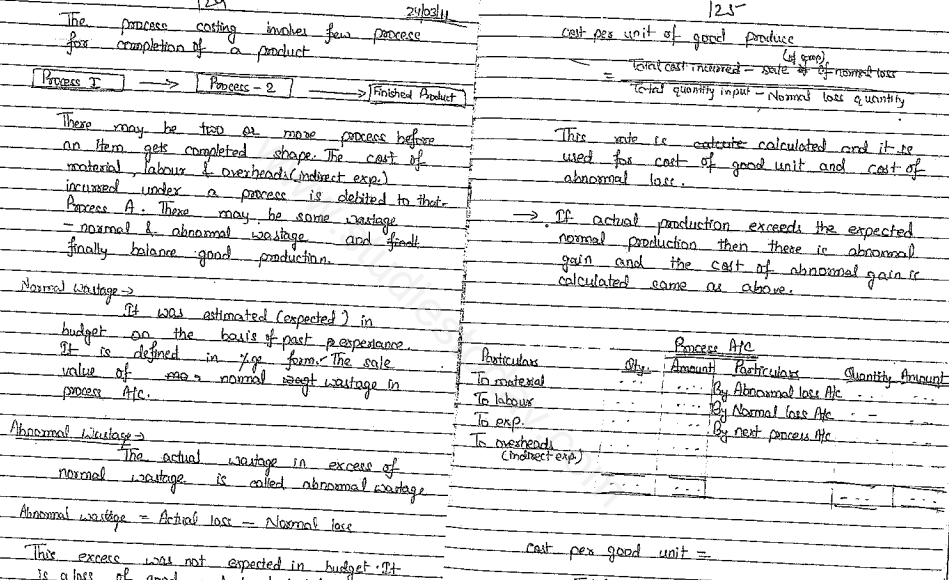
Question 1. Explain the basic concepts of Process Costing, Normal Wastage, Abnormal Wastage, and Abnormal Gain in process manufacturing.
Answer: Process costing is a method of costing used to ascertain the cost of a product at each stage of manufacturing where goods are produced through one or more continuous processes.
1. Normal Wastage: It is the expected or unavoidable loss estimated on the basis of past experience or standard percentage of input. It is controllable in the sense that it is anticipated, and its scrap value is credited to the process account.
2. Abnormal Wastage: The actual wastage in excess of normal wastage is called abnormal wastage. It represents an unexpected loss and is valued at the cost of good units.
\(\text{Cost of Abnormal Waste} = (\text{Actual Loss} - \text{Normal Loss}) \times \text{Cost per good unit}\)
3. Abnormal Gain: If actual production exceeds expected normal production, the difference is an abnormal gain (or efficiency). Its cost is calculated in the same manner as normal loss.
In simple words: Process costing tracks expenses step-by-step through manufacturing stages while accounting for expected and unexpected material losses.
Exam Tip: Always deduct the scrap value of normal loss from total input cost before calculating the cost per good unit: \(\text{Cost per good unit} = \frac{\text{Total Input Cost} - \text{Realizable Value of Normal Loss}}{\text{Total Input Quantity} - \text{Normal Loss Quantity}}\).
Joint Products and By-Products
Question 2. Describe the methods of allocating joint costs to joint products and by-products.
Answer: When common raw materials, labor, and manufacturing facilities are used in a process to produce two or more products jointly, they are called joint products.
Methods for allocating joint costs include:
1. Physical Quantity Method: Allocation based on the physical weight or volume of production at the split-off point.
2. Sales Value at Split-off Point Method: Allocation based on the relative sales value of products at the split-off point.
3. Net Realizable Value (N.R.V.) Method: Allocation based on final sales value minus further processing costs incurred after the split-off point.
4. Working Back (Reverse Cost Method): Working backward from final sales value by deducting estimated profit margins, further processing costs, and selling expenses to arrive at the joint cost share.
In simple words: Joint cost allocation divides shared manufacturing expenses among multiple products using physical proportions or relative market values.
Exam Tip: When selling prices at the split-off point are known, always prefer the sales value at the split-off method for joint cost allocation as it is the most logical approach.
Equivalent Production and Valuation Methods (FIFO and Average Method)
Question 3. Explain the treatment of opening and closing Work-In-Progress (W.I.P.) under Weighted Average and FIFO methods in process costing.
Answer:
1. Weighted Average Method: Opening W.I.P. costs are pooled with current period costs without distinction, and a single average cost per equivalent unit is calculated.
\(\text{Cost per equivalent unit} = \frac{\text{Cost of Opening W.I.P.} + \text{Current Period Cost}}{\text{Equivalent units of production}}\)
2. FIFO (First-In, First-Out) Method: Assumes that the units of opening W.I.P. are completed first before starting new units. The cost of opening W.I.P. is kept separate from current period costs, and equivalent units relate only to work done during the current period.
In simple words: The average method blends old and new inventory costs together, whereas FIFO finishes existing incomplete units first before processing new ones.
Exam Tip: Under FIFO, remember to calculate the degree of completion needed to finish the opening stock units during the current period.
Process And Joint Product Costing Solutions Printable Assignments & Solutions for IPCC Costing
Revision Assignment: Process And Joint Product Costing Solutions (Chartered Accountancy)
Explore reliable practice questions for Process And Joint Product Costing Solutions tailored for IPCC learners. Use these structured worksheets to evaluate preparedness and strengthen core problem-solving skills.
Why Practice IPCC Costing Assignments?
- Syllabus Compliance: Sets reflect current Chartered Accountancy evaluation criteria and official marking frameworks.
- Multi-Format Practice: Includes varied problem types designed to deepen comprehension across all sub-topics.
- Time Management: Routine practice optimizes pacing to finish school examinations comfortably within schedule.
How to Approach Costing Process And Joint Product Costing Solutions Assignments
- Initial Reading: Begin by reading the NCERT book for IPCC Costing to build a baseline understanding.
- Independent Testing: Attempt assignment questions unassisted, then verify work using provided answer keys.
- Supplementary Aids: Leverage revision notes and worksheets whenever you encounter difficult topics.
FAQs
You can download free PDF assignments for IPCC Costing Process And Joint Product Costing Solutions from StudiesToday.com. These practice sheets have been updated for the 2026-27 session covering all concepts from latest NCERT textbook.
Yes, our teachers have given solutions for all questions in the IPCC Costing Process And Joint Product Costing Solutions assignments. This will help you to understand step-by-step methodology to get full marks in school tests and exams.
Yes. These assignments are designed as per the latest Chartered Accountancy syllabus for 2026. We have included huge variety of question formats such as MCQs, Case-study based questions and important diagram-based problems found in Process And Joint Product Costing Solutions.
Practicing topicw wise assignments will help IPCC students understand every sub-topic of Process And Joint Product Costing Solutions. Daily practice will improve speed, accuracy and answering competency-based questions.
Yes, all printable assignments for IPCC Costing Process And Joint Product Costing Solutions are available for free download in mobile-friendly PDF format.