

Class 10 Physics Chapter 07 Sound: Selina Concise Study Material
Access the official Selina Concise textbook solutions for Class 10 Physics, updated for the 2026-27 academic year. This digital resource is structured to help students build strong conceptual clarity and prepare effectively for school examinations.
Chapter 07 Sound Answer Guide
View or download the dedicated Chapter 07 Sound resource below. This chapter-by-chapter structuring ensures easy navigation for daily study routines and immediate access to core academic concepts.
Exercise 7(A)
Question 1. Define following terms in relation to a wave: (a) amplitude (b) frequency (c) wavelength and (d) wave velocity
Answer:
(a) Amplitude: The maximum displacement of the particle of medium on either side of its mean position is called the amplitude of wave. Its S.I. unit is metre (m).
(b) Frequency: The number of vibrations made by a particle of the medium in one second is called the frequency of the waves. It is also defined as the number of waves passing through a point in one second. Its S.I. unit is hertz (Hz).
(c) Wavelength: The distance travelled by the wave in one time period of vibration of particle of medium is called its wavelength. Its S.I. unit is metre (m).
(d) Wave velocity: The distance travelled by a wave in one second is called its wave velocity. Its S.I. unit is metre per second (ms⁻¹).
In simple words: Amplitude is how high or low the wave goes. Frequency is how many waves pass by in one second. Wavelength is the distance between two peaks of a wave. Wave velocity is how fast the wave moves.
📝 Teacher's Note: Show students a rope wave. Pull it up and down to show amplitude. Count how many waves you make in one second for frequency. Use your hand to measure distance between two peaks for wavelength.
🎯 Exam Tip: Always write the S.I. units for each term. Examiners give marks for units. Remember: amplitude and wavelength in metres, frequency in hertz, velocity in metres per second.
Question 2. A wave passes from one medium to another medium. Mention the property of the wave (i) which changes, (ii) which does not change.
Answer:
(i) Wavelength (or speed) of the wave changes, when it passes from one medium to another medium.
(ii) Frequency of a wave does not change when it passes from one medium to another medium.
In simple words: When a wave goes from air to water, its speed and wavelength change. But the number of waves per second (frequency) stays the same.
📝 Teacher's Note: Compare this to a person walking from carpet to tiles. Their speed changes but they still take the same number of steps per minute. The frequency of steps is constant.
🎯 Exam Tip: Write clearly: "frequency remains constant" and "wavelength/speed changes". These exact words get you marks.
Question 3. State two factors on which the speed of a wave travelling in a medium depends.
Answer: Two factors on which the speed of a wave travelling in a medium depends are:
(i) Density: The speed of sound is inversely proportional to the square root of density of the gas.
(ii) Temperature: The speed of sound increases with the increase in temperature.
In simple words: Sound travels slower in heavy gases and faster in light gases. Sound also travels faster when it is hot and slower when it is cold.
📝 Teacher's Note: Tell students that sound travels faster in helium (light gas) than in air. Also, sound travels faster on a hot day than on a cold day. This is why we hear thunder differently in different weather.
🎯 Exam Tip: Write "inversely proportional to density" and "directly proportional to temperature". Use these scientific terms to get full marks.
Question 4. State two differences between the light and sound waves.
Answer:
(i) The light waves can travel in vacuum while sound waves need a material medium for propagation.
(ii) The light waves are electromagnetic waves while sound waves are the mechanical waves.
In simple words: Light can travel through empty space but sound cannot. Light is made of electric and magnetic fields. Sound needs air or water or solid things to travel through.
📝 Teacher's Note: Explain that we see sunlight from space but cannot hear any sound from space. This shows light travels through vacuum but sound needs matter.
🎯 Exam Tip: Write "light travels in vacuum, sound needs medium" and "light is electromagnetic, sound is mechanical". These key words are important.
Question 5. What is meant by an echo? What is the condition necessary for an echo to be heard distinctly?
Answer: If a person stands at some distance from a wall or a hillside and produces a sharp sound, he hears two distinct sounds: one is original sound heard almost instantaneously and the other one is heard after reflection from the wall or hillside, which is called echo.
The condition for the echo: An echo is heard only if the distance between the person producing the sound and the rigid obstacle is long enough to allow the reflected sound to reach the person at least 0.1 second after the original sound is heard.
In simple words: Echo is when you hear your own sound coming back to you. You need to be far enough from a wall so the sound takes 0.1 second to come back.
📝 Teacher's Note: Take students to a big hall or playground near a wall. Clap loudly and let them hear the echo. Explain that mountains and big buildings make good echoes.
🎯 Exam Tip: Always write "0.1 second" as the minimum time gap. This is a key number that examiners look for in echo questions.
Question 6. A man is standing at a distance of 12 m from a cliff. Will he be able to hear a clear echo? Give a reason for your answer.
Answer: \( t = \frac{2d}{V} = \frac{2 \times 12}{340} = \frac{24}{340} < 0.1 \) seconds so the man will not be able to hear the echo. This is because the sensation of sound persists in our ears for about 0.1 second after the exciting stimulus ceases to act.
In simple words: The sound comes back too quickly (less than 0.1 second). Our ears cannot tell the difference between the original sound and the echo when they are too close together.
📝 Teacher's Note: Show students that 12 m is too close. The sound travels to the cliff and back in less than 0.1 second. Our ears need at least 0.1 second gap to hear echo clearly.
🎯 Exam Tip: Show the calculation clearly: time = 2d/v. Then compare with 0.1 second. Write your final conclusion clearly: "No echo heard" or "Echo heard".
Question 7. State two applications of echo.
Answer: The applications of echo:
(i) Dolphins detect their enemy and obstacles by emitting the ultrasonic waves and hearing their echo.
(ii) In medical science, the echo method of ultrasonic waves is used for imaging the human organs such as the liver, gall bladder, uterus, womb etc. This is called ultrasonography.
In simple words: Animals like dolphins use echo to find food and avoid danger. Doctors use echo to see inside our body without cutting it open.
📝 Teacher's Note: Show students pictures of ultrasound scans. Explain that the same principle that makes echo in mountains helps doctors see babies inside mothers.
🎯 Exam Tip: Write "echolocation" for animals and "ultrasonography" for medical use. These technical terms show you understand the applications.
Question 8. Explain how the speed of sound can be determined by the method of echo.
Answer: Sound is produced from a place at a known distance say, d at least 50 m from the reflecting surface. The time interval t in which the echo reaches the place from where the sound was produced, is noted by a stop watch having the least count 0.01 s. then the speed of sound is calculated by using the following relation:
\( V = \frac{\text{total distance travelled}}{\text{time interval}} = \frac{2d}{t} \) m/s
In simple words: Stand far from a wall, clap your hands, and measure the time for echo to return. The sound travels twice the distance (to wall and back), so divide 2d by time to get speed.
📝 Teacher's Note: Draw a diagram showing person, wall, and path of sound. Mark that sound goes to wall and comes back, so total distance is 2d, not just d.
🎯 Exam Tip: Always write the formula v = 2d/t. Remember the "2" because sound travels to the obstacle and back. Missing the "2" loses marks.
Question 9. State the use of echo by a bat, dolphin and fisherman.
Answer: Bats, dolphin and fisherman detect their enemies or obstacles or position of fish by emitting/sending the ultrasonic waves and hearing/detecting the echo.
In simple words: These animals and people send out sounds and listen to the echo to find things around them. It is like seeing with sound instead of light.
📝 Teacher's Note: Explain that bats hunt insects at night using sound. Dolphins find fish underwater using sound. Fishermen use machines that work like dolphin's natural ability.
🎯 Exam Tip: Write "echolocation" as the scientific term. Also mention "ultrasonic waves" - this shows you know the type of sound used.
Question 10. How do bats avoid obstacles in their way, when in flight?
Answer: Bats can produce and detect the sound of very high frequency up to about 1000kHz. The sounds produced by flying bats get reflected back from any obstacle in front of it. By hearing the echoes, bats come to know even in the dark where the obstacles are. So they can fly safely without colliding with the obstacles.
In simple words: Bats make very high sounds that we cannot hear. These sounds bounce back from trees and walls. The bat hears the echo and knows where things are, even in complete darkness.
📝 Teacher's Note: Tell students that bats are like flying with closed eyes but using ears instead. Their hearing is so good they can catch tiny insects while flying fast.
🎯 Exam Tip: Write "ultrasonic waves" and "echolocation". Mention that bats can navigate in darkness using this method. These keywords get you marks.
Question 11. What is meant by sound ranging? Give one use of sound ranging.
Answer: The process of detecting obstacles with the help of echo is called sound ranging. It's used by the animals like bats, dolphin to detect their enemies.
In simple words: Sound ranging means finding things by using echo. Animals use this to hunt food and avoid enemies.
📝 Teacher's Note: Explain that "ranging" means measuring distance. Sound ranging is measuring how far things are by using sound echoes.
🎯 Exam Tip: Define sound ranging clearly as "detecting obstacles using echo". Then give one example like bats, dolphins, or sonar in ships.
Question 12. Name the waves used for sound ranging. Why are the waves mentioned by you audible to us?
Answer: The ultrasonic waves are used for the sound ranging. Ultrasonic waves have a frequency more than 20,000 Hz but the range of audibility of human ear is 20Hz to 20,000 Hz
In simple words: We use ultrasonic waves (very high sounds) for sound ranging. Humans cannot hear these waves because they are too high for our ears.
📝 Teacher's Note: Explain that there is a mistake in the question. Ultrasonic waves are NOT audible to us. The question should ask why they are NOT audible.
🎯 Exam Tip: Write "ultrasonic waves" and the frequency range "above 20,000 Hz". Also write human hearing range "20 Hz to 20,000 Hz".
Question 13. What is sonar? State the principle on which it is based.
Answer: Sonar is sound navigation and ranging. Ultrasonic waves are sent in all directions from the ship and they are received on their return after reflection from the obstacles. They use the method of echo.
In simple words: Sonar is a machine that uses sound to find things underwater. Ships send out sound waves and listen for echoes to find fish, rocks, or enemy submarines.
📝 Teacher's Note: Tell students that sonar works like bat's echolocation but underwater. Ships use it to avoid hitting underwater rocks or to find fish.
🎯 Exam Tip: Write the full form "Sound Navigation And Ranging". Mention "echo principle" as the working method. These show complete understanding.
Question 14. Name the waves which are used in sonar to find the depth of a sea. Give one reason for their use.
Answer: Ultrasonic waves are used in the sonar to find the depth of sea because of these waves travel undeviated through long distances.
In simple words: Ultrasonic waves are used in sonar. These waves travel straight and far through water without bending or getting weak quickly.
📝 Teacher's Note: Explain that ultrasonic waves go straight down to the sea bottom and come straight back up. This makes it easy to measure depth accurately.
🎯 Exam Tip: Write "ultrasonic waves" and give reason "travel undeviated through long distances". This technical language gets full marks.
Question 15. State the use of echo in medical science.
Answer: In medical science, echo method of ultrasonic waves is used for the imaging of human organs such as liver, gall bladder, uterus, womb; which is called ultrasonography.
In simple words: Doctors use sound echoes to take pictures of organs inside our body. This is called ultrasound scan. It is safe and does not hurt.
📝 Teacher's Note: Show students ultrasound pictures if possible. Explain that pregnant mothers get ultrasound scans to see their babies safely without harmful radiation.
🎯 Exam Tip: Write "ultrasonography" as the technical term. List some organs like liver, uterus to show you know the applications.
Multiple Choice Type
Question 1. The minimum distance between the source and the reflector in air. So that an echo is heard is approximately equal to:
(a) 10 m
(b) 17 m
(c) 34 m
(d) 50 m
Answer: (b) 17 m
Explanation: An echo is heard distinctly if it reaches the ear at least 0.1 s after the original sound. If d is the distance between the observer and the obstacle and V is the speed of sound, then the total distance travelled by the sound to reach the obstacle and then to come back is 2d and the time taken is, \( t = \frac{2d}{V} \) or, \( d = \frac{Vt}{2} \). Putting t = 0.1 s and V = 340 m/s in air at ordinary temperature, we get: \( d = \frac{340 \times 0.1}{2} = 17 \) m. Thus, to hear an echo distinctly, the minimum distance between the source and the reflector in air is 17 m.
In simple words: For clear echo, sound must take 0.1 second to come back. Using speed of sound 340 m/s, we calculate minimum distance as 17 metres.
📝 Teacher's Note: This is a standard formula question. Make students remember: time = 0.1 s, speed = 340 m/s, distance = speed × time ÷ 2.
🎯 Exam Tip: Show the calculation step by step. Write the formula d = vt/2, substitute values, and get 17 m. This gets full marks.
Question 2. To detect the obstacles in their path, bats produce:
(a) infrasonic waves
(b) ultrasonic waves
(c) electromagnetic waves
(d) radio waves
Answer: (b) ultrasonic waves
In simple words: Bats make very high frequency sounds called ultrasonic waves. These are too high for humans to hear but perfect for echolocation.
📝 Teacher's Note: Remind students that "ultra" means above and "sonic" means sound. So ultrasonic means above normal sound frequency.
🎯 Exam Tip: Remember ultrasonic waves for bats, dolphins, and sonar. This is a common exam question pattern.
Numericals
Question 1. The wavelength of waves produces on the surface of water is 20 cm. If the wave velocity is 24 m s⁻¹, calculate: (i) the number of waves produces in one second, and (ii) the time in which one wave is produced.
Answer:
Given:
Wavelength = 20 cm = 20 × 10⁻² m
Wave velocity = 24 m s⁻¹
Step 1: Find frequency (number of waves per second)
Frequency = \( \frac{\text{Velocity}}{\text{Wavelength}} = \frac{24}{20 \times 10^{-2}} = \frac{24}{0.2} = 120 \) Hz
Step 2: Find time for one wave
Time = \( \frac{1}{\text{frequency}} = \frac{1}{120} = 8.3 \times 10^{-3} \) seconds
Answer: (i) 120 waves per second (ii) 8.3 × 10⁻³ seconds
In simple words: Using the wave equation, we find 120 waves pass by in one second. Each wave takes about 0.0083 seconds to form.
📝 Teacher's Note: Make sure students convert cm to m first. The formula v = fλ can be rearranged to find frequency f = v/λ and time period T = 1/f.
🎯 Exam Tip: Always convert units first. Show both parts clearly with proper units. Write frequency in Hz and time in seconds for full marks.
Question 2. Calculate the minimum distance in air required between the source of sound and the obstacle to hear an echo. Take speed of sound in air = 350 m s⁻¹
Answer:
Given:
Speed of sound in air = 350 m s⁻¹
Time for echo = 0.1 s (minimum time to hear distinct echo)
Step 1: Use the echo formula.
Velocity = \( \frac{2D}{\text{Time}} \)
Step 2: Substitute values.
\( 350 = \frac{2 \times D}{0.1} \)
Step 3: Solve for distance.
\( D = \frac{350 \times 0.1}{2} = 17.5 \text{ m} \)
Minimum distance = 17.5 m
In simple words: For echo to be heard clearly, sound must travel to obstacle and back in 0.1 seconds. So obstacle must be at least 17.5 meters away.
📝 Teacher's Note: Tell students that 0.1 second is the minimum time gap needed between original sound and echo. Our ear cannot tell them apart if the gap is smaller.
🎯 Exam Tip: Always write the formula first, then substitute given values. Remember to use 0.1 seconds as the minimum time for distinct echo.
Question 3. What should be the minimum distance between source and reflector in water so that echo is heard distinctly? (The speed of sound in water = 1400 m s⁻¹)
Answer:
Given:
Speed of sound in water = 1400 m s⁻¹
Time for echo = 0.1 s
Step 1: Use the echo formula.
Velocity = \( \frac{2D}{\text{Time}} \)
Step 2: Substitute values.
\( 1400 = \frac{2 \times D}{0.1} \)
Step 3: Solve for distance.
\( D = \frac{1400 \times 0.1}{2} = 70 \text{ m} \)
Minimum distance = 70 m
In simple words: Sound travels much faster in water than in air. So the obstacle must be farther away (70 m) to get the same 0.1 second gap between original sound and echo.
📝 Teacher's Note: Compare with air example. Sound is 4 times faster in water, so distance needed is also 4 times more. This helps students remember the relationship.
🎯 Exam Tip: Notice that speed is higher in water, so distance is also higher. Write the comparison to show you understand the concept.
Question 4. A man standing 25 m away from a wall produces a sound and receives the reflected sound. (a) Calculate the time after which he receives the reflected sound if the speed of the sound in air is 350 m s⁻¹. (b) Will the man be able to hear a distinct echo? Explain the answer.
Answer:
(a) Given:
Distance = 25 m
Speed of sound = 350 m s⁻¹
Step 1: Use the echo formula.
Velocity = \( \frac{2D}{\text{Time}} \)
Step 2: Solve for time.
Time = \( \frac{2 \times 25}{350} = 0.143 \text{ seconds} \)
(b) Yes, because the reflected sound reaches the man 0.143 second after the original sound is heard and this is greater than 0.1 second (minimum time needed for distinct echo).
In simple words: The echo takes 0.143 seconds to return. Since this is more than 0.1 seconds, the man can hear the echo clearly as a separate sound from the original.
📝 Teacher's Note: Emphasize that 0.1 second is the magic number. Any echo that returns after 0.1 seconds can be heard distinctly. Less than 0.1 seconds means no clear echo.
🎯 Exam Tip: Always compare your calculated time with 0.1 seconds. If more than 0.1 s, write "Yes, distinct echo heard". If less, write "No distinct echo".
Question 5. A radar sends a signal to an aeroplane at a distance 45 km away with a speed of 3 × 10⁸ m s⁻¹. After how much time is the signal received back from the aeroplane?
Answer:
Given:
Distance = 45 km = 45,000 m
Speed of signal = 3 × 10⁸ m s⁻¹
Step 1: Use the echo formula.
Velocity = \( \frac{2D}{\text{Time}} \)
Step 2: Solve for time.
Time = \( \frac{2 \times 45 \times 1000}{3 \times 10^8} = \frac{90000}{3 \times 10^8} = 3 \times 10^{-4} \text{ second} \)
Time = 3 × 10⁻⁴ second
In simple words: Radar signals are electromagnetic waves that travel at the speed of light. They are very fast, so the signal comes back in just 0.0003 seconds.
📝 Teacher's Note: Explain that radar uses radio waves, not sound waves. Radio waves travel at light speed (3 × 10⁸ m/s), which is much faster than sound (350 m/s).
🎯 Exam Tip: Convert km to meters first. Write the speed in scientific notation carefully. Don't forget the power of 10 in your final answer.
Question 6. A man standing 48 m away from a wall fires a gun calculate the time after which an echo is heard. (The speed of sound in air is 320 m s⁻¹).
Answer:
Given:
Distance = 48 m
Speed of sound = 320 m s⁻¹
Step 1: Use the echo formula.
Time after which an echo is heard = \( \frac{2D}{\text{Velocity}} = \frac{2 \times 48}{320} = 0.3 \text{ seconds} \)
Time = 0.3 seconds
In simple words: The sound travels 48 m to the wall, bounces back, and travels another 48 m to reach the man. Total distance is 96 m, which takes 0.3 seconds at 320 m/s speed.
📝 Teacher's Note: Draw a simple diagram showing sound going to wall and coming back. This helps students understand why we use 2D in the formula.
🎯 Exam Tip: Remember the echo formula: Time = 2D/V. The "2" is because sound travels to obstacle and back, covering twice the distance.
Question 7. A ship on the surface of water sends a signal and receives it back from a submarine inside water after 4 s. Calculate the distance of the submarine from the ship. (The speed of sound in water is 1450 m s⁻¹)
Answer:
Given:
Time = 4 s
Speed of sound in water = 1450 m s⁻¹
Step 1: Use the formula for echo.
\( 2D = \text{velocity} \times \text{time} \)
Step 2: Calculate distance.
\( D = \frac{\text{velocity} \times \text{time}}{2} = \frac{1450 \times 4}{2} = 2900 \text{ m} = 2.9 \text{ km} \)
Distance = 2.9 km
In simple words: The signal travels down to the submarine and bounces back up. In 4 seconds, it covers total distance of 5800 m. So one-way distance to submarine is 2900 m or 2.9 km.
📝 Teacher's Note: This is like sonar used by ships to detect objects underwater. The principle is same as echo - sound bounces back from objects.
🎯 Exam Tip: Convert final answer to km if the distance is large (more than 1000 m). Write both units - meters and kilometers.
Question 8. A pendulum has a frequency of 5 vibrations per second. An observer starts the pendulum and fires a gun simultaneously. He hears echo from the cliff after 8 vibrations of the pendulum. If the velocity of sound in air is 340 m s⁻¹, find the distance between the cliff and the observer.
Answer:
Given:
Frequency of pendulum = 5 vibrations per second
Echo heard after = 8 vibrations
Velocity of sound = 340 m s⁻¹
Step 1: Find the time taken.
5 vibrations occur in 1 second
So 8 vibrations occur in \( \frac{8}{5} = 1.6 \text{ seconds} \)
Step 2: Use echo formula.
Velocity = \( \frac{2 \times D}{\text{time}} \)
\( 340 = \frac{2 \times D}{1.6} \)
Step 3: Solve for distance.
\( D = \frac{340 \times 1.6}{2} = 272 \text{ m} \)
Distance = 272 m
In simple words: The pendulum acts like a timer. 8 swings take 1.6 seconds. In this time, sound travels to cliff and back, covering distance of 272 m each way.
📝 Teacher's Note: This is a clever way to measure time without a stopwatch. Students should practice converting vibrations to time using frequency.
🎯 Exam Tip: First convert vibrations to time using the frequency. Then use normal echo formula. Show both steps clearly to get full marks.
Question 9. A person standing between the two vertical cliffs produces a sound. Two successive echoes are heard at 4 s and 6 s. Calculate the distance between the cliffs. (speed of sound in air = 320 m s⁻¹)
Answer:
Given:
First echo at = 4 s
Second echo at = 6 s
Speed of sound = 320 m s⁻¹
Step 1: Find distance to first cliff.
The distance of first cliff from the person, \( 2 \times D_1 = \text{velocity} \times \text{time} \)
\( D_1 = \frac{320 \times 4}{2} = 640 \text{ m} \)
Step 2: Find distance to second cliff.
Distance of the second cliff from the person, \( D_2 = \frac{320 \times 6}{2} = 960 \text{ m} \)
Step 3: Calculate total distance between cliffs.
Distance between cliffs = \( D_1 + D_2 = 640 + 960 = 1600 \text{ m} \)
Distance between cliffs = 1600 m
In simple words: Person stands between two cliffs. Sound bounces off the nearer cliff first (640 m away), then off the farther cliff (960 m away). Total gap between cliffs is 1600 m.
📝 Teacher's Note: Draw a diagram with person in middle and cliffs on both sides. This helps students visualize why we add the two distances.
🎯 Exam Tip: Calculate distance to each cliff separately first. Then add both distances to get total distance between cliffs. Don't forget this last step.
Question 10. A man fires a gun and hears its echo after 5 s. The man then moves 310 m towards the hill and fires his gun again. This time he hears the echo after 3 s. Calculate the speed of sound.
Answer:
Given:
First echo time = 5 s
Second echo time = 3 s (after moving 310 m closer)
Step 1: Set up equations for both positions.
Distance of hill from the man initially
\( D_1 = \frac{v \times 5}{2} \) ----------- (equation 1)
After moving 310 m closer
\( D_1 - 310 = \frac{v \times 3}{2} \) ----------- (equation 2)
Step 2: Subtract equation 2 from equation 1.
\( 310 = v \times (\frac{5}{2} - \frac{3}{2}) \)
\( 310 = v \times 1 \)
\( v = 310 \text{ m/s} \)
Speed of sound = 310 m/s
In simple words: By moving 310 m closer, the man reduced echo time by 2 seconds. This tells us that sound travels 310 m in 1 second, so speed is 310 m/s.
📝 Teacher's Note: This is a reverse problem where speed is unknown. Show students how moving closer reduces the distance and hence the echo time.
🎯 Exam Tip: Set up two equations carefully. The key is that moving 310 m closer reduces the distance in equation 2. Subtract equations to eliminate the unknown distance.
Question 11. On sending an ultrasonic wave from a ship towards the bottom of a sea, the time interval between sending the wave and receiving it back is found to be 1.5 s. If the velocity of wave in sea water is 1400 m s⁻¹, find the depth of the sea.
Answer:
Given:
Time = 1.5 s
Velocity of wave in sea water = 1400 m s⁻¹
Step 1: Use echo formula for depth.
Depth of the sea = \( \frac{\text{velocity} \times \text{time}}{2} = \frac{1400 \times 1.5}{2} = 1050 \text{ m} \)
Depth of sea = 1050 m
In simple words: The ultrasonic wave travels down to sea bottom and bounces back up. In 1.5 seconds, it covers total distance of 2100 m. So one-way depth is 1050 m.
📝 Teacher's Note: This is how ships measure sea depth using sonar. Ultrasonic waves work better underwater than audible sound waves.
🎯 Exam Tip: Use the same formula as echo problems. Divide by 2 because wave travels down and up, covering twice the depth.
Exercise 7(B)
Question 1. What do you understand by free vibrations of a body? Give one example.
Answer: The vibrations of a body in the absence of any external force on it are called the free vibrations. When a body vibrates freely, it vibrates at its natural frequency without any outside push or pull.
Example: When we strike the keys of a piano, various strings are set into vibration at their natural frequencies.
In simple words: Free vibrations happen when you give something a push and then leave it alone to vibrate by itself. Like a guitar string after you pluck it - it vibrates freely until it stops.
📝 Teacher's Note: Show students a tuning fork or guitar string. Strike it once and let students observe how it vibrates and gradually stops. This is free vibration.
🎯 Exam Tip: Write "absence of external force" and "natural frequency" - these are key phrases. Always give a musical instrument as example.
Question 2. What is meant by the natural frequency of vibration of a body? On what factors does it depend?
Answer: When each body capable of vibrating is set to vibrate freely, it vibrates with a specific frequency f. This frequency is called the natural frequency of vibration of the body.
The natural frequency of vibration of a body depends on the shape and size of the body. Different shaped and sized objects have different natural frequencies.
In simple words: Every object has its own special vibration speed when left alone to vibrate freely. A big drum has low natural frequency, a small drum has high natural frequency.
📝 Teacher's Note: Bring different sized containers or bottles. Blow across them to show how size affects the natural frequency of sound produced.
🎯 Exam Tip: Write "specific frequency at which body vibrates freely" and mention "shape and size" as the main factors affecting natural frequency.
Question 3. Draw a graph between displacement from mean position and time for a body executing free vibrations in vacuum.
Answer:
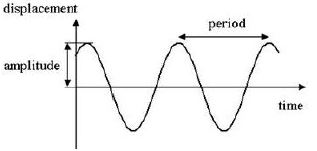
Displacement-time graph for the free vibrations
In simple words: In vacuum (no air), the vibrating body keeps swinging with the same strength forever. The graph shows a perfect wave pattern that never gets smaller.
📝 Teacher's Note: Contrast this with vibrations in air, where amplitude decreases due to air resistance. In vacuum, amplitude stays constant.
🎯 Exam Tip: Draw a perfect sine wave with constant amplitude. Label amplitude, period, and write "constant amplitude" to show it's in vacuum.
Question 4. State one condition for a body to execute free vibrations.
Answer: The free vibrations of a body occur only in vacuum because the presence of medium offers some resistance due to which the amplitude of the vibration does not remain constant, but it continuously decreases.
For true free vibrations, there should be no air or any other medium around the vibrating body.
In simple words: For perfect free vibrations, the object must be in empty space (vacuum) with no air around it. Air acts like invisible brakes that slowly stop the vibrations.
📝 Teacher's Note: Demonstrate with a pendulum in a jar. Show how it swings longer when air is pumped out. This proves air resistance affects vibrations.
🎯 Exam Tip: Write "absence of medium" or "vacuum condition" as the main requirement. Explain that medium causes resistance which reduces amplitude.
Question 5. Name one factor on which the frequency of sound emitted due to vibrations in an air column depends.
Answer: The frequency of sound emitted due to vibration in an air column depends on the length of the air column.
Shorter air column produces higher frequency sound, longer air column produces lower frequency sound.
In simple words: Think of a flute or pipe organ. Short pipes make high-pitched sounds, long pipes make low-pitched sounds. The length of air inside the pipe controls the pitch.
📝 Teacher's Note: Use drinking straws of different lengths or bottles with different amounts of water. Blow across them to show length effect on pitch.
🎯 Exam Tip: Write "length of air column" clearly. You can also mention that frequency is inversely proportional to length for extra marks.
Question 6. State one way of increasing the frequency of a note produced by an air column.
Answer: The frequency of the note produced in the air column can be increased by decreasing the length of the air column.
When we make the air column shorter, the frequency increases and we get a higher pitched sound.
In simple words: To get a higher pitch from a wind instrument, make the tube shorter. Like covering holes on a flute - this makes the effective length shorter and pitch higher.
📝 Teacher's Note: Show students how a slide whistle works - pulling it makes it shorter and pitch higher. Or demonstrate with a flute and finger holes.
🎯 Exam Tip: Write "decrease the length" as the method. Remember: shorter length = higher frequency = higher pitch.
Question 7. State two ways of increasing the frequency of vibrations of a stretched string.
Answer: The frequency of vibration of the stretched string can be increased by:
- Increasing the tension in the string
- Decreasing the length of the string
In simple words: To make a guitar string produce higher pitch: either tighten it more (increase tension) or press it to make the vibrating part shorter (decrease length).
📝 Teacher's Note: Demonstrate with a guitar or rubber band. Show how tightening or shortening increases pitch. Students can feel and hear the difference.
🎯 Exam Tip: Write both methods clearly. Remember: more tension = higher pitch, shorter length = higher pitch.
Question 8. What adjustments would you make for tuning a stringed instrument for it to emit a note of a desired frequency?
Answer: A stringed instrument is provided with the provision for adjusting the tension of the string. By varying the tension, we can get desired frequency.
Musicians turn the tuning pegs to increase or decrease string tension until they get the exact pitch they want.
In simple words: To tune a guitar or violin, you turn the tuning pegs. This makes the strings tighter or looser until they produce the right musical notes.
📝 Teacher's Note: Show students tuning pegs on a guitar. Explain how musicians use their ears and electronic tuners to get exact frequencies for each string.
🎯 Exam Tip: Mention "adjusting tension" as the main method. You can add that electronic tuners help musicians get exact frequencies.
Question 9. The diagram below in Fig. 7.11 shows three ways in which the string of an instrument can vibrate.
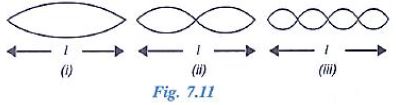
(a) Which of the diagram shows the principal note? (b) Which has the frequency four times that of the first? (c) What is the ratio of the frequency of the vibration in (i) and (ii)?
Answer:
- (i) Diagram is showing the principal note.
- (iii) Diagram has frequency four times that of the first.
- Ratio is 1:2
[Diagram: Three string vibration patterns are shown - (i) shows one complete wave along the string length, (ii) shows two complete waves, (iii) shows four complete waves.]
In simple words: Pattern (i) is the basic vibration with lowest frequency. Pattern (ii) has twice the frequency. Pattern (iii) has four times the frequency of pattern (i).
📝 Teacher's Note: Explain that more waves along the same string length means higher frequency. The fundamental mode has the lowest frequency.
🎯 Exam Tip: Count the number of complete waves in each diagram. More waves = higher frequency. The simplest pattern is always the fundamental or principal note.
Question 10. Explain why strings of different thicknesses are provided on a stringed instrument.
Answer: Natural frequency of vibration of a stretched string is inversely proportional to the radius (or thickness) of string. Therefore, strings of different thicknesses are provided on a stringed instrument so that notes of different frequencies can be produced by vibrating different strings.
Thick strings produce low frequency (low pitch) sounds, while thin strings produce high frequency (high pitch) sounds.
In simple words: A guitar has thick strings for low bass notes and thin strings for high treble notes. Different thickness gives different pitch, so musicians can play a complete range of musical notes.
📝 Teacher's Note: Show students a guitar or piano. Point out how bass strings (low notes) are thicker than treble strings (high notes). This is true for all stringed instruments.
🎯 Exam Tip: Write "inversely proportional to thickness" and explain that thick = low frequency, thin = high frequency. This gives the instrument a wide range of notes.
Question 10. Strings of different thickness are provided on a stringed instrument to produce different frequency sound waves because the natural frequency of vibration of a stretched string is inversely proportional to the radius (thickness) of the string.
Answer: Strings of different thickness are provided on a stringed instrument to produce different frequency sound waves because the natural frequency of vibration of a stretched string is inversely proportional to the radius (thickness) of the string.
In simple words: Thick strings vibrate slowly and make low sounds. Thin strings vibrate fast and make high sounds. That is why guitars have thick and thin strings.
📝 Teacher's Note: Show students a guitar or violin. Let them pluck thick and thin strings. They will hear the difference clearly. Thick strings make deep sounds like a man's voice.
🎯 Exam Tip: Write "inversely proportional to thickness" clearly. Also mention that thicker strings have lower frequency and thinner strings have higher frequency.
Question 11. A blade, fixed at one end, is made to vibrate by pressing its other end and then releasing it. State one way in which the frequency of vibrations of the blade can be lowered.
Answer: The frequency of vibrations of the blade can be lowered by increasing the length of the blade or by sticking a small weight on the blade at its free end.
In simple words: To make the blade vibrate slower, make it longer or stick something heavy on the free end. It is like a see-saw — longer ones move slower.
📝 Teacher's Note: Use a ruler on the edge of a table. Show how a longer part sticking out vibrates slower than a shorter part. Students can see and hear this easily.
🎯 Exam Tip: Give both methods: "increase length" or "add weight at free end". Either one gets full marks but both methods show complete understanding.
Question 12. How does the medium affect the amplitude of free vibrations of a body?
Answer: The presence of the medium offers some resistance to motion, so the vibrating body continuously loses energy due to which the amplitude of the vibration continuously decreases.
In simple words: The air around a vibrating object slows it down. Like when you wave your hand in water, it becomes harder to move. So the vibrations get weaker and weaker.
📝 Teacher's Note: Ask students to wave their hands in air, then in water. In water it is harder and they get tired faster. Same thing happens to vibrating objects in any medium.
🎯 Exam Tip: Write "medium offers resistance" and "energy is lost" and "amplitude decreases". These are the key phrases examiners want to see.
Question 13. What are damped vibrations? How do they differ from free vibrations? Give one example of each.
Answer: The periodic vibrations of a body of decreasing amplitude in the presence of resistive force are called the damped vibrations. The amplitude of the free vibrations remains constant and vibrations continue forever. But, the amplitude of damped vibrations decreases with time and ultimately the vibrations ceases. For example, When a slim branch of a tree is pulled and then released, it makes damped vibrations. A tuning fork vibrating in air execute damped vibrations.
In simple words: Damped vibrations get weaker and weaker until they stop. Free vibrations keep going with the same strength forever. Like a swing that slowly stops versus a swing that goes forever.
📝 Teacher's Note: Push a child on a swing and let go. It slowly stops — that is damped. If you kept pushing with the same force every time, it would be free vibrations.
🎯 Exam Tip: Always mention "decreasing amplitude" for damped and "constant amplitude" for free vibrations. Give clear examples for both types.
Question 14. The diagram in Fig. 7.12 shows the displacement – time graph of vibrating body.
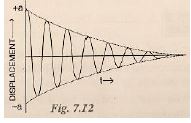
(i) name the kind of vibrations
(ii) Give one example of such vibrations
(iii) why is the amplitude of vibrations gradually decreasing?
(iv) what happens to the vibrations of the body after some time?
Answer:
(i) Damped vibrations
(ii) Example: When a slim branch of a tree is pulled and then released, it makes damped vibrations.
(iii) The amplitude of vibrations gradually decreases due to the frictional (or resistive) force which the surrounding medium exerts on the body vibrating in it. As a result, the vibrating body continuously loses energy in doing work against the force of friction causing a decrease in its amplitude.
(iv) After sometime, the vibrating body loses all of its energy and stops vibrating.
In simple words: This graph shows vibrations that get smaller and smaller. Like a ball bouncing lower each time until it stops bouncing.
📝 Teacher's Note: Draw this graph on the board. Start with big waves and make them smaller. Students can see how the energy is being lost step by step.
🎯 Exam Tip: For part (i) write "damped vibrations". For part (iii) mention "friction" and "energy loss". For part (iv) write "stops vibrating".
Question 15. A tuning fork is set into vibration in air. Name the kind of vibrations it executes.
Answer: The tuning fork vibrates with the damped oscillations.
In simple words: When you hit a tuning fork, it makes sound that gets softer and softer until you cannot hear it. That is damped vibrations.
📝 Teacher's Note: Hit a tuning fork and hold it up. Students can hear the sound getting weaker. Explain that air is slowing it down like invisible friction.
🎯 Exam Tip: Write "damped vibrations" or "damped oscillations". Both answers are correct. The key is that the vibrations decrease in air.
Question 16. Draw a sketch showing the displacement of a body executing damped vibrations against time.
Answer: Displacement time graph of damped vibrations.
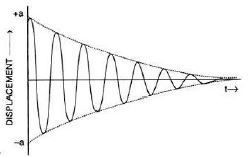
In simple words: The graph looks like waves that start big and get smaller and smaller until they become a flat line.
📝 Teacher's Note: Make students draw this graph step by step. Start with regular waves, then make each wave smaller than the previous one. This helps them understand the concept visually.
🎯 Exam Tip: Draw clear waves that get smaller over time. Label the axes as "Displacement" and "Time". The envelope should show decreasing amplitude.
Question 17. What are forced vibrations? Give one example to illustrate your answer.
Answer: The vibrations of a body which take place under the influence of an external periodic force acting on it, are called the forced vibrations. For example: when guitar is played, the artist forces the strings of the guitar to execute forced vibrations.
In simple words: Forced vibrations happen when you make something vibrate by applying force from outside. Like when you pluck a guitar string with your finger.
📝 Teacher's Note: Show students how you have to keep pushing a swing to keep it going. The push is the external force. Without it, the swing would stop.
🎯 Exam Tip: Write "external periodic force" clearly. Give a good example like guitar strings, piano keys, or drum being hit. Show you understand external force is needed.
Question 18. Distinguish between the free (or natural) and forced vibrations.
Answer:
(i) The vibrations of a body in the absence of any resistive force are called the free vibrations. The vibrations of a body in the presence of an external force are called forced vibrations.
(ii) In free vibrations, the frequency of vibration depends on the shape and size of the body. In forced vibrations, the frequency is equal to the frequency of the force applied.
In simple words: Free vibrations happen naturally with the body's own frequency. Forced vibrations happen when something outside makes the body vibrate at a different frequency.
📝 Teacher's Note: Compare a tuning fork hit once (free) versus someone continuously shaking it (forced). Free vibrations use the object's natural frequency. Forced vibrations use the applied frequency.
🎯 Exam Tip: Make a clear table showing differences. Mention "natural frequency" for free and "applied frequency" for forced vibrations.
Question 19. What is meant by resonance? Describe a simple experiment to illustrate the phenomenon of resonance and explain it.
Answer: Resonance is a special case of forced vibrations. When the frequency of an externally applied periodic force on a body is equal to its natural frequency, the body rapidly begins to vibrate with an increased amplitude. This phenomenon is known as resonance. Mount two identical tuning forks A and B of same frequency upon two separate sound boxes such that their open ends face each other as shown.
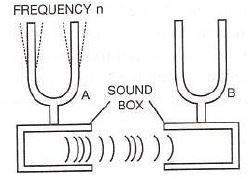
If the prong A is struck on a rubber pad, it starts vibrating. On putting A on its sound box, tuning fork B also starts vibrating and a loud sound is heard. The vibrations produced in B are due to resonance.
In simple words: Resonance happens when you push something at exactly the right frequency. Like pushing a swing at the right time makes it go higher and higher.
📝 Teacher's Note: Use two identical tuning forks in class. Hit one and place it on a sound box. Students will hear the second fork start vibrating on its own. This shows resonance clearly.
🎯 Exam Tip: Define resonance as "frequency of applied force equals natural frequency". Describe the tuning fork experiment step by step. Mention "increased amplitude".
Question 20. State the condition for the occurrence of resonance.
Answer: Condition for resonance: Resonance occurs when the frequency of the applied force is exactly equal to the natural frequency of the vibrating body.
In simple words: For resonance to happen, the outside force must push at exactly the same frequency as the object naturally wants to vibrate.
📝 Teacher's Note: Use the swing example again. If you push too fast or too slow, the swing does not go high. You must push at exactly the right time (frequency) for maximum height.
🎯 Exam Tip: Write the condition clearly: "Applied frequency = Natural frequency". Use the word "exactly equal" to show precision is needed.
Question 21. Complete the following sentence: Resonance is a special case of …………….. vibrations, when frequency of the driving force is ……… natural frequency of the body.
Answer: Resonance is a special case of forced vibrations, when frequency of the driving force is equal to the natural frequency of the body.
In simple words: Fill in the blanks with "forced" and "equal to". Resonance is forced vibrations at the perfect frequency.
📝 Teacher's Note: This is a fill-in-the-blank question. Make students understand that resonance is always a type of forced vibrations, but with a special condition.
🎯 Exam Tip: The answers are "forced" and "equal to". Do not write "same as" — write "equal to" for the exact match examiners want.
Question 22. Differentiate between the forced and resonant vibrations.
Answer:
| Forced Vibrations | Resonant Vibrations |
|---|---|
| These are vibrations of a body under an external periodic force of frequency different than the natural frequency of the body. | These are vibrations of a body under an external periodic force of frequency exactly equal to the natural frequency of the body. |
| The amplitude of the vibration is usually small. | The amplitude of vibration is very large. |
In simple words: Forced vibrations happen at any outside frequency but with small movement. Resonant vibrations happen at the perfect frequency with very big movement.
📝 Teacher's Note: Show students the difference by gently shaking a ruler (forced, small amplitude) versus shaking it at just the right speed (resonance, large amplitude).
🎯 Exam Tip: Make a clear table. Key differences are: frequency match (different vs equal) and amplitude (small vs large). Both points must be mentioned.
Question 23. Why is a loud sound heard at resonance?
Answer: At resonance, the body vibrates with large amplitude thus conveying more energy to the ears so a loud sound is heard.
In simple words: When something vibrates with big movements, it pushes more air. More air movement means louder sound reaching our ears.
📝 Teacher's Note: Compare gently tapping a drum (soft sound) versus hitting it hard (loud sound). Bigger vibrations always make louder sounds.
🎯 Exam Tip: Write "large amplitude" and "more energy". Connect these to "loud sound". The examiner wants to see you understand the energy-amplitude-loudness connection.
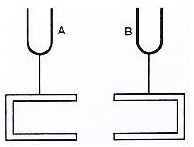
Question 24. Fig 7.13 shows two tuning forks A and B of the same frequency mounted on separate sound boxes with their open ends facing each other. The fork A is set into vibration. (a) Describe your observation. (b) state the principle illustrated by this experiment.
Answer:
(a) The vibrating tuning fork A produces the forced vibrations in the air column of its sound box. These vibrations are of large amplitude because of the large surface area of air in the sound box. They are communicated to the sound box of the fork B. The air column of B starts vibrating with the frequency of the fork A. Since the frequency of these vibrations is same as the natural frequency of the fork B, the fork B picks up these vibrations and starts vibrating due to resonance.
(b) On putting the tuning fork A to vibrate, the other tuning fork B will also start vibrating. The vibrations produced in the second tuning fork B are due to resonance.
In simple words: Fork A makes sound waves. These waves travel to fork B. Since both forks are identical, fork B starts vibrating on its own. This shows resonance.
📝 Teacher's Note: Do this experiment in class if possible. Students are amazed when the second fork starts vibrating by itself. Explain that sound waves carry energy from one fork to the other.
🎯 Exam Tip: For part (a), describe step by step: A vibrates → sound waves → travel to B → B resonates. For part (b), simply state "principle of resonance".
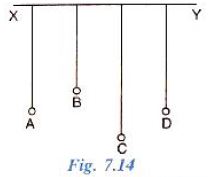
Question 25. In fig . 7.14 A, B, C and D are four pendulums suspended from the same elastic string XY. Lengths of pendulum A and D are equal, while the length of pendulum B is smaller and the pendulum C is longer. The pendulum A is set into vibration. (a) what is your observation? (b) Give reason for your observation.
Answer:
(a) Set the pendulum A into vibration by displacing it to one side, normal to its length. It is observed that pendulum D also starts vibrating initially with a small amplitude and ultimately it acquires the same amplitude as the pendulum A initially had. When the amplitude of the pendulum D becomes maximum, the amplitude of the pendulum A becomes minimum since the total energy is constant. After some time the amplitude of the pendulum D will decreases and amplitude of A increases. The exchange of energy takes place only between the pendulums A and D because their natural frequencies are same. The pendulums B and C also vibrate, but with very small amplitudes.
In simple words: When you swing pendulum A, pendulum D (same length) starts swinging too. They share energy back and forth. B and C move a little but not much because they are different lengths.
📝 Teacher's Note: If possible, make this setup with strings and small weights. Students can see how only the pendulums with same length share energy. Different lengths do not resonate.
🎯 Exam Tip: Mention "same natural frequency" for A and D. Explain energy exchange between them. Note that B and C vibrate with "small amplitude" only.
Question 26. A vibrating tuning fork held over an air column of a given length with its one end closed, produces a loud audible sound. Name the phenomenon responsible for it and explain the observation.
Answer: The phenomenon responsible for producing a loud audible sound is named resonance. The vibrating tuning fork causes the forced vibrations in the air column. For a certain length of air column, a loud sound is heard. This happens when the frequency of the air column becomes equal to the frequency of the tuning fork.
In simple words: When the tuning fork vibrates, it makes the air inside the tube vibrate too. When both vibrate at the same speed, the sound becomes very loud. It's like pushing a swing at the right time - it goes higher!
📝 Teacher's Note: Show students a real tuning fork and tube experiment. Let them hear the difference when the tube length changes. The loud sound only comes at certain lengths.
🎯 Exam Tip: Write "resonance" clearly and explain that frequencies must be equal. Also mention "forced vibrations" - examiners look for these key terms.
Question 27. In Fig. 7.15, A, B, C and D represent test tube each of height 20 cm which are filled with water up to heights of 12 cm, 14 cm, 16cm and 18cm respectively. If a vibrating tuning fork is placed over the mouth if test tube D, a loud sound is heard.
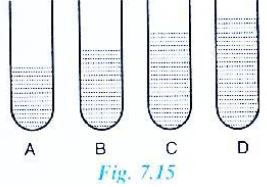
(a) Describe the observations with the tubes A, B and C when the vibrating tuning fork is placed over the mouth of these tubes.
(b) Give the reason for your observation in each case.
(c) State the principle illustrated by the above experiment.
Answer:
(a) No loud sound is heard with the tubes A and C, but a loud sound is heard with the tube B.
(b) Resonance occurs with the air column in tube B whereas no resonance occurs in the air column of tubes A and C. The frequency of vibrations of air column in tube B is same as the frequency of vibrations of air column in tube D because the length of the air column in tube D is 20-18 = 2cm and that in tube B is 20-14 = 6 cm (3 times). On the other hand, the frequency of vibrations of air column in tubes A and C is not equal to the frequency vibrations of air column in tube B.
(c) When the frequency of vibrations of air column is equal to the frequency of the vibrating tuning fork, resonance occurs.
In simple words: Only tube B makes a loud sound like tube D. This is because tube B has the right air length to vibrate at the same speed as the tuning fork. Tubes A and C have wrong air lengths.
📝 Teacher's Note: Use bottles with different water levels to show this. Students can hear which bottles make loud sounds. The air column length is the key - not the water level.
🎯 Exam Tip: Calculate air column lengths correctly: Total height minus water height. Write that only matching frequencies give resonance. Show your calculations clearly.
Question 28. When a troop crosses a suspension bridge the soldiers are asked to break steps. Explain the reason.
Answer: When a troop crosses a suspension bridge, the soldiers are asked to break steps. The reason is that when soldiers march in steps, all the separate periodic forces exerted by them are in same phase and therefore forced vibrations of a particular frequency are produced in the bridge. Now, if the natural frequency of the bridge happens to be equal to the frequency of the steps, the bridge will vibrate with large amplitude due to resonance and suspension bridge could crumble.
In simple words: When all soldiers walk together in rhythm, they create a repeating force on the bridge. If this matches the bridge's natural shaking speed, the bridge can shake so much that it breaks. Breaking steps means walking out of rhythm to avoid this danger.
📝 Teacher's Note: Show a video of the Tacoma Bridge collapse. Explain how wind created resonance. Students understand better when they see real examples of resonance disasters.
🎯 Exam Tip: Mention "resonance", "natural frequency", and "large amplitude". Explain that breaking steps prevents all soldiers from creating the same frequency together.
Question 29. Why are the stringed instruments like guitar provided with a hollow sound box?
Answer: The sound box is constructed such that the column of the air inside it, has a natural frequency which is the same as that of the strings stretched on it, so that when the strings are made to vibrate, the air column inside the box is set into forced vibrations. Since the sound box has a large area, it sets a large volume of air into vibration, the frequency of which is same as that of the string. So, due to resonance a loud sound is produced.
In simple words: The hollow box makes the guitar sound louder. The air inside the box vibrates at the same speed as the guitar string. Since the box is big, it moves more air and creates a louder sound than just the thin string alone.
📝 Teacher's Note: Let students pluck a guitar string without the body, then with the body. They can clearly hear the difference. The box acts like a loudspeaker for the string.
🎯 Exam Tip: Write about "resonance", "large surface area", and "large volume of air". Explain that the box amplifies the string's sound through resonance.
Question 30. How do you tune your radio set to a particular station? Name the phenomenon involved in doing so and define it.
Answer: When we tune a radio receiver, we merely adjust the values of the electronic components to produce vibrations of frequency equal to that of the radio waves which we want to receive. When the two frequencies match, due to resonance the energy of the signal of that particular frequency is received from the incoming waves. The signal received is then amplified in the receiver set.
The phenomenon involved is resonance. It is a special case of forced vibrations. When the frequency of an externally applied periodic force on a body is equal to its natural frequency, the body rapidly begins to vibrate with an increased amplitude. This phenomenon is known as resonance.
In simple words: When you turn the radio dial, you change the radio's vibration speed to match the radio station's signal speed. When they match exactly, the radio picks up that station clearly. This matching is called resonance.
📝 Teacher's Note: Show students an old radio with a dial. Let them tune to different stations. Explain that each station broadcasts at a different frequency, like different musical notes.
🎯 Exam Tip: Define resonance properly: "when applied frequency equals natural frequency, amplitude increases". Mention that radio tuning uses this principle to select stations.
Multiple Choice Type
Question 1. A wire stretched between two fixed supports, is plucked exactly in the middle and then released. It executes (neglect the resistance of the medium):
(a) resonant vibrations
(b) free vibrations
(c) damped vibrations
(d) forced vibrations
Answer: (b) free vibrations
In simple words: When you pluck a guitar string and let it go, it vibrates on its own without anyone pushing it. This is called free vibration - the string moves by itself at its natural speed.
📝 Teacher's Note: Pluck a rubber band or guitar string in class. Once released, no external force acts on it. It vibrates freely until friction stops it.
🎯 Exam Tip: Remember: free vibrations happen when there is no external force after the initial disturbance. Write "no external force" in your explanation.
Question 2. When a body vibrates under a periodic force, the vibrations of the body are:
(a) free vibrations
(b) damped vibrations
(c) forced vibration
(d) resonant vibrations
Answer: (c) forced vibration
In simple words: When someone keeps pushing a swing again and again, the swing moves because of that pushing force. The swing is being forced to move - these are called forced vibrations.
📝 Teacher's Note: Push a pendulum continuously with your finger. The pendulum vibrates because of your external force. Without your push, it would stop.
🎯 Exam Tip: Key phrase is "under a periodic force". This means an external force is acting repeatedly. Always write "external periodic force" in your answer.
Question 3. A tuning fork of frequency 256 Hz will resonate with another tuning fork of frequency:
(a) 128 Hz
(b) 256 Hz
(c) 384 Hz
(d) 512 Hz
Answer: (b) 256 Hz
In simple words: Two tuning forks will only create loud sound together if they vibrate at exactly the same speed. 256 Hz will only match with another 256 Hz fork.
📝 Teacher's Note: If possible, bring two identical tuning forks to class. Strike one and hold it near the other - the second fork will start vibrating too!
🎯 Exam Tip: For resonance, frequencies must be exactly equal. Don't get confused with harmonics - this question asks for basic resonance only.
Exercise 7(C)
Question 1. Name three characteristics of a musical sound.
Answer: The following three characteristics of sound are:
- Loudness
- Pitch or shrillness
- Quality or timber
In simple words: Musical sound has three main qualities: how loud it is (loudness), how high or low it sounds (pitch), and what makes it different from other instruments playing the same note (quality).
📝 Teacher's Note: Play the same note on a piano and flute. Students can hear they have same pitch and loudness but different quality. This makes the concept very clear.
🎯 Exam Tip: Write all three characteristics clearly. You can also write "timber" as "timbre" - both spellings are correct in exams.
Question 2. (a) Which of the following quality determines the loudness of a sound wave?
(i) wavelength (ii) frequency and (iii) amplitude
(b) How is loudness related to the quantity mentioned above in part(a)?
Answer:
(a) Amplitude - The louder sound corresponds to the wave of large amplitude.
(b) Loudness is directly proportional to the square of amplitude.
In simple words: Amplitude means how big the wave is. Big waves make loud sounds, small waves make soft sounds. If you make the wave twice as big, the sound becomes four times louder.
📝 Teacher's Note: Draw wave diagrams on the board. Show that loud sounds have tall waves (big amplitude) and soft sounds have short waves (small amplitude).
🎯 Exam Tip: Write the relationship clearly: "Loudness ∝ (amplitude)²". Remember it's square of amplitude, not just amplitude. This relationship is very important.
Question 3. If the amplitude of a wave is doubled, what will be the effect on its loudness?
Answer: Loudness will be four times because loudness is directly proportional to the square of amplitude.
In simple words: When you double the wave height, the loudness becomes 2 × 2 = 4 times more. This is because loudness depends on amplitude squared (amplitude × amplitude).
📝 Teacher's Note: Use numbers to show this: if amplitude = 2, loudness ∝ 2² = 4. If amplitude becomes 4, loudness ∝ 4² = 16. Students understand better with numbers.
🎯 Exam Tip: Always show the calculation: 2² = 4. Write "four times" clearly as your final answer. Show the proportionality relationship in your working.
Question 4. Two waves of the same pitch have amplitudes in the ratio 1:3. What will be the ratio of their (i) loudness (ii) frequencies?
Answer:
(a) Ratio of loudness will be 1:9
(b) The ratio of frequency will be 1:1
In simple words: The loudness ratio is 1² : 3² = 1:9. The frequency ratio stays 1:1 because both waves have the same pitch (pitch depends on frequency, not amplitude).
📝 Teacher's Note: Explain that "same pitch" means same frequency. Amplitude only affects loudness, not pitch. Students often confuse these two properties.
🎯 Exam Tip: For loudness, square the amplitude ratio: (1:3)² = 1²:3² = 1:9. For frequency, same pitch means same frequency, so ratio is 1:1.
Question 5. How does the wave pattern of a loud note differ from a soft note? Draw a diagram.
Answer:
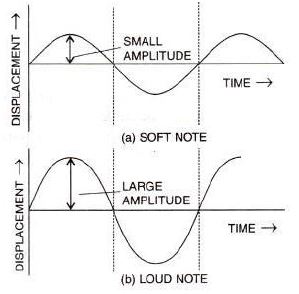
In simple words: A loud note has tall waves (big amplitude). A soft note has short waves (small amplitude). But both waves repeat at the same speed if they have the same pitch.
📝 Teacher's Note: Draw both wave patterns on the board side by side. Make sure students see that frequency (wave spacing) is same but amplitude (wave height) is different.
🎯 Exam Tip: Draw clear diagrams with labels. Show that amplitude is different but wavelength/frequency remains the same. Label your waves as "loud" and "soft".
Question 6. Name the unit in which loudness of sound is measured.
Answer: The unit of loudness is phon.
In simple words: Just like we measure length in meters and weight in kilograms, we measure how loud a sound is in units called phons.
📝 Teacher's Note: Tell students that phon is different from decibel. Phon measures loudness as we hear it, decibel measures sound intensity. Don't confuse the two.
🎯 Exam Tip: Write "phon" clearly. Don't write "decibel" - that's the unit for sound intensity, not loudness. These are different quantities.
Question 7. Why is the loudness of the sound heard by a plucked wire increased when it is mounted on a sound board?
Answer: Because the board provides comparatively a large area and forces a large volume of air to vibrate and thereby increases the sound energy reaching our ears.
In simple words: A thin wire can only push a little bit of air. But a big board can push lots of air around it. More moving air means louder sound reaching our ears.
📝 Teacher's Note: Compare plucking a guitar string with and without the body. The string alone is very quiet. The big wooden body makes it much louder by moving more air.
🎯 Exam Tip: Write about "large surface area" and "large volume of air". Explain that more air movement means more sound energy reaches the ear.
Question 8. Define the term intensity of a sound wave. State the unit in which it is measured.
Answer: Intensity of a sound wave is the amount of sound energy passing through a unit area in unit time. The unit of intensity is watt per square meter (W/m²).
In simple words: Intensity tells us how much sound energy passes through one square meter in one second. It's like measuring how much water flows through a pipe - but for sound energy instead of water.
📝 Teacher's Note: Don't confuse intensity with loudness. Intensity is energy per area per time. Loudness is how we hear the sound. They are related but different quantities.
🎯 Exam Tip: Definition must include "energy per unit area per unit time". Unit is W/m² (watts per square meter). Don't confuse with loudness which is measured in phons.
Question 8. What is the intensity at any point in the medium? What is its unit?
Answer: The intensity at any point of the medium is the amount of sound energy passing per second normally through unit area at that point. Its unit is microwatt per metre².
In simple words: Intensity tells us how much sound energy passes through a small area every second. Think of it like counting raindrops falling on one tile of your floor.
📝 Teacher's Note: Use the example of sunlight falling on a table. More light means more intensity. Same way, more sound energy means more intensity.
🎯 Exam Tip: Write "sound energy per unit area per unit time" and don't forget the unit "microwatt per metre²". These exact words get you marks.
Question 9. How is loudness of sound related to the intensity of wave producing it?
Answer: Relationship between loudness L and intensity I is given as: \( L = K \log I \), where K is a constant of proportionality.
In simple words: Loudness and intensity are connected by a math formula. When intensity increases, loudness also increases but not in a straight line way.
📝 Teacher's Note: Tell students that our ears don't hear intensity directly. They hear loudness which is related to intensity by this log formula.
🎯 Exam Tip: Always write the formula \( L = K \log I \) and explain that K is a constant. This shows you know the exact relationship.
Question 10. Comment on the statement 'loudness of sound is a subjective quantity, while intensity is an objective quantity.'
Answer: The intensity at any point of the medium is the amount of sound energy passing per second normally through unit area at that point. The loudness of a sound depends on the energy conveyed by the sound wave near the eardrum of the listener. Loudness, being a sensation, also depends on the sensitivity of the ears of the listener. Thus the loudness of sound of a given intensity may differ from listener to listener. Further, two sounds of the same intensity but of different frequencies may differ in loudness even to the same listener because of the sensitivity of ears is different for different frequencies. So, loudness is a subjective quantity while intensity being a measurable quantity is an objective quantity for the sound wave.
In simple words: Intensity can be measured with machines - it's the same for everyone. But loudness depends on each person's ears. What sounds loud to you may sound soft to your friend.
📝 Teacher's Note: Play the same sound to different students. Some will say it's loud, some will say it's soft. But a sound meter will show the same intensity reading for all.
🎯 Exam Tip: Write "subjective means depends on person" and "objective means can be measured". Use these key words to show the difference clearly.
Question 11. State three factors on which loudness of sound heard by a listener depends.
Answer: The loudness of the sound heard depends on:
- Loudness is proportional to the square of the amplitude.
- Loudness is inversely proportional to the square of distance.
- Loudness depends on the surface area of the vibrating body.
In simple words: Loudness depends on how big the vibration is, how far you are from the sound, and how big the thing making the sound is.
📝 Teacher's Note: Demonstrate with a drum. Hit harder (more amplitude), move away (more distance), use bigger drum (more surface area). Students can hear the difference.
🎯 Exam Tip: Remember the three factors: amplitude, distance, and surface area. Write "proportional to" and "inversely proportional to" correctly.
Question 12. Name the unit used to measure the sound level.
Answer: Decibel is the unit used to measure the sound level.
In simple words: Decibel (dB) is like meter for length or kilogram for weight. It measures how strong a sound is.
📝 Teacher's Note: Tell students that normal talking is about 60 dB and a rock concert is about 120 dB. This helps them understand the scale.
🎯 Exam Tip: Write "decibel" or "dB" - both are correct. This is a very common one-mark question.
Question 13. What is the safe limit of sound level in dB for our ears?
Answer: Upto 120 dB
In simple words: Sounds above 120 dB can hurt your ears badly. It's like the danger limit for your hearing.
📝 Teacher's Note: Compare with everyday sounds - normal talk (60 dB), traffic (90 dB), rock concert (120 dB). Above 120 dB causes pain and damage.
🎯 Exam Tip: Write "120 dB" clearly with the unit. Some books say 85 dB for long exposure, but 120 dB is the pain threshold.
Question 14. What is meant by noise pollution? Name one source of sound causing noise pollution.
Answer: The disturbance produced in the environment due to undesirable loud and harsh sound of level above 120 dB from the various sources such as loudspeaker, moving vehicles etc. is called noise pollution.
In simple words: Noise pollution means too much loud, unwanted sound that disturbs people and hurts the environment. Like very loud music or truck horns.
📝 Teacher's Note: Ask students about sounds that disturb them at home or school. Construction noise, loud vehicles, and loudspeakers are common examples they will recognize.
🎯 Exam Tip: Define noise pollution and give at least one example source like "loudspeakers" or "vehicles". Both parts are needed for full marks.
Question 15. What determines the pitch of a sound?
Answer: Pitch of sound is determined by its wavelength or the frequency. Two notes of the same amplitude and sounded on the same instrument will differ in pitch when their vibrations are of different wavelengths or frequencies.
In simple words: Pitch tells us if a sound is high (like a whistle) or low (like a drum). It depends on how fast the sound wave vibrates.
📝 Teacher's Note: Use a guitar or piano. High notes have high frequency (fast vibrations), low notes have low frequency (slow vibrations). Students can see and hear this easily.
🎯 Exam Tip: Write "frequency" as the main answer. You can also write "wavelength" but frequency is more commonly expected in exams.
Question 16. Name the subjective property of sound related to its frequency.
Answer: Pitch
In simple words: Pitch is what we hear when frequency changes. High frequency sounds high-pitched, low frequency sounds low-pitched.
📝 Teacher's Note: Remind students that frequency is objective (can be measured) but pitch is subjective (depends on what we hear). Same frequency may sound different to different people.
🎯 Exam Tip: Just write "pitch" - it's a simple one-word answer that gets full marks.
Question 17. Name and define the characteristic which enables one to distinguish two sounds of same loudness, but of different frequencies, given by the same instrument.
Answer: Pitch is the characteristic of sound which enables us to distinguish different frequencies sound. Pitch is the characteristic of sound by which an acute note can be distinguished from a grave or flat note.
In simple words: Pitch helps us tell the difference between high sounds and low sounds even when they are equally loud. Like telling the difference between a bird chirp and a lion roar.
📝 Teacher's Note: Play two notes of same loudness but different pitch on the same instrument. Students can easily hear that they are different even though both are equally loud.
🎯 Exam Tip: Name the characteristic (pitch) and then define it clearly. Both naming and defining are needed for full marks in this type of question.
Question 18. Draw a diagram to show the wave pattern of high pitch note and a low pitch note, but of the same loudness.
Answer: The first diagram is high pitch note and second one is low pitch note.
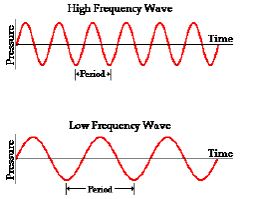
In simple words: High pitch waves are squeezed together (high frequency). Low pitch waves are spread apart (low frequency). But both have same height because loudness is same.
📝 Teacher's Note: Draw both waves with same amplitude (height) but different frequency. Make sure students understand that more waves in same time means higher pitch.
🎯 Exam Tip: Draw two clear wave patterns with same amplitude but different frequencies. Label them "high pitch" and "low pitch" to get full marks.
Question 19. How is it possible to detect the filling of a bottle under a water tap by hearing the sound at a distance?
Answer: As the water level in a bottle kept under a water tap rises, the length of air column decreases, so the frequency of sound produced increases i.e., sound becomes shriller and shriller. Thus by hearing sound from a distance, one can get the idea of water level in the bottle.
In simple words: When the bottle fills up, there is less empty space for air. This makes the sound get higher and higher in pitch. So you can tell when the bottle is full just by listening.
📝 Teacher's Note: Demonstrate with an empty bottle and water. Students will hear the pitch getting higher as the bottle fills. This is a practical application they can try at home.
🎯 Exam Tip: Explain the connection: less air column → higher frequency → higher pitch sound. This step-by-step explanation gets full marks.
Question 20. The frequencies of notes given by flute, guitar and 500 Hz. Which one of these has the highest pitch?
Answer: Trumpet. Because its frequency is highest.
In simple words: Higher frequency means higher pitch. So the instrument with the highest frequency number will sound highest.
📝 Teacher's Note: The question seems incomplete as written, but the principle is clear - highest frequency gives highest pitch. Make sure students understand this direct relationship.
🎯 Exam Tip: Always remember: higher frequency = higher pitch. State which instrument and give the reason "because its frequency is highest".
Question 21. Complete the following sentences:
(a) The pitch of sound increases if its frequency …………..
(b) If the amplitude of a sound is halved, its loudness becomes ………………
Answer:
(a) increases
(b) one-fourth
In simple words: When frequency goes up, pitch goes up too. When amplitude is cut in half, loudness becomes four times less because loudness depends on square of amplitude.
📝 Teacher's Note: For part (b), remind students that loudness is proportional to square of amplitude. So if amplitude becomes half, loudness becomes (1/2)² = 1/4.
🎯 Exam Tip: Part (a) is straightforward. For part (b), remember the square relationship between amplitude and loudness to get "one-fourth".
Question 23. Name the characteristic which enables one to distinguish the sound of two musical instruments even if they are of the same pitch and same loudness.
Answer: Quality or timber of sound.
In simple words: Quality (or timbre) is what makes a piano sound different from a guitar even when they play the same note at the same volume. Each instrument has its own sound character.
📝 Teacher's Note: Play the same note on different instruments at same volume. Students can hear they sound different. That difference is quality or timbre.
🎯 Exam Tip: Write "quality" or "timbre" - both terms are correct. This characteristic is different from pitch and loudness.
Question 24. How does the two sounds of same loudness and same pitch produced by different instruments differ? Draw diagrams to illustrate your answer.
Answer: The two sounds of same loudness and same pitch produced by different instruments differ due to their different waveforms. The waveforms depend on the number of the subsidiary notes and their relative amplitude along with the principal note. Diagram below shows the wave patterns of two sounds of same loudness and same pitch but emitted by two different instruments. They produce different sensation to ears because they differ in waveforms: one is a sine wave, while the other is a triangular wave.
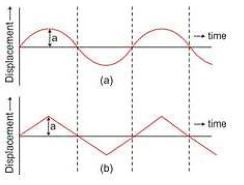
In simple words: Even with same pitch and loudness, different instruments make different wave shapes. These different shapes make each instrument sound unique to our ears.
📝 Teacher's Note: Show students that a violin and piano playing middle C at same volume still sound different because their wave shapes are different.
🎯 Exam Tip: Explain that waveforms are different and draw two different wave shapes with same frequency and amplitude. Mention "subsidiary notes" for extra marks.
Question 25. Two identical guitars are played by two persons to give notes of the same pitch. Will they differ in quality? Give a reason for your answer.
Answer: Since the guitars are identical, they will have a similar waveform and so the similar quality.
In simple words: If the guitars are exactly the same, they will sound almost the same. Same instrument design means same sound quality.
📝 Teacher's Note: Explain that quality depends on the instrument's physical structure. Identical instruments produce similar waveforms and hence similar quality.
🎯 Exam Tip: Answer should be "No, they will not differ" and give reason "because identical guitars produce similar waveforms".
Question 26. Two musical notes of the same pitch and same loudness are played on two different instruments. Their wave patterns are as shown in Fig. 7.24. Explain why the wave patterns are different.
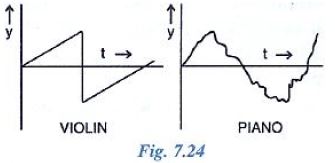
Answer: Different instruments emit different subsidiary notes. A note played on one instrument has a large number of subsidiary notes while the same note when played on other instrument contains only few subsidiary notes. So they have different waveforms.
In simple words: Each instrument adds its own extra small vibrations to the main note. These extra vibrations make the wave shape different for each instrument.
📝 Teacher's Note: Explain that the main note is the same but each instrument adds harmonics (subsidiary notes) in different amounts, creating unique waveforms.
🎯 Exam Tip: Key concept is "subsidiary notes" or "harmonics". Different instruments produce different amounts of these, creating different waveforms.
Question 27. How is it possible to recognize a person by his voice without seeing him?
Answer: It is because the vibrations produced by the vocal chord of each person have a characteristic waveform which is different for different persons.
In simple words: Each person's voice box makes a unique sound pattern, just like each person has unique fingerprints. That's why every voice sounds different.
📝 Teacher's Note: Compare with fingerprints - each person has unique vocal cords that create unique sound patterns. Students can relate to recognizing family members by voice.
🎯 Exam Tip: Write "characteristic waveform" and "vocal cords" to show you understand the scientific reason behind voice recognition.
Question 28. State the factors that determine.
(i) the pitch of a note,
(ii) the loudness of the sound heard,
(iii) the quality of the note.
Answer:
(i) The pitch of a note is determined by frequency
(ii) The loudness of the sound heard is determined by amplitude
(iii) The quality of the note is determined by waveform
In simple words: Pitch depends on how fast it vibrates, loudness depends on how big the vibration is, and quality depends on the shape of the vibration.
📝 Teacher's Note: This is a summary question covering all three main characteristics of sound. Help students remember: frequency-pitch, amplitude-loudness, waveform-quality.
🎯 Exam Tip: Give one clear factor for each part. This is often asked as a 3-mark question with one mark for each part.
Question 28:
Answer:
(i) Frequency
(ii) Amplitude
(iii) Waveform
In simple words: These three things decide how a sound will be - how high or low it sounds, how loud it is, and what makes it special from other sounds.
📝 Teacher's Note: Use a guitar to show students. Frequency is how tight the string is. Amplitude is how hard you pluck. Waveform is what makes guitar sound different from piano.
🎯 Exam Tip: Write all three words clearly - frequency, amplitude, waveform. These are the key words examiners look for.
Question 29. Name the characteristic of the sound affected due to a change in its (i) amplitude (ii) wave form (iii) frequency.
Answer:
(i) Loudness
(ii) Quality or timbre
(iii) Pitch
In simple words: Amplitude changes how loud the sound is. Waveform changes the type of sound (like guitar vs piano). Frequency changes how high or low the sound is.
📝 Teacher's Note: Make students remember: Amplitude = Loudness, Frequency = Pitch, Waveform = Quality. This is a very common exam question.
🎯 Exam Tip: Write "timbre" as well as "quality" for part (ii). Some examiners prefer one word over the other. Writing both is safe.
Question 30. In what respect does the wave pattern of a noise and a music differ? Draw diagram to explain your answer.
Answer: Wave pattern is regular in music while it is quite irregular in noise.
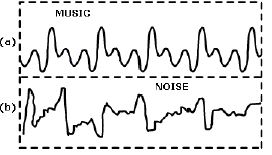
In simple words: Music waves look neat and repeat the same pattern. Noise waves look messy and have no fixed pattern.
📝 Teacher's Note: Draw both waves on the board. Music wave looks like smooth hills. Noise wave looks like a jagged mountain range. Students can see the difference easily.
🎯 Exam Tip: Always write "regular pattern for music" and "irregular pattern for noise". Draw both wave types if asked. This gets you full marks.
Question 31. The sketches I to IV in Fig. 7.25 show sound waves, all formed in the same time interval.
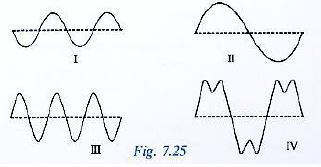
Which diagram shows
(i) a note from a musical instrument
(ii) a soft (not loud) note,
(iii) a bass (low frequency) note.
Answer:
(i) IV
(ii) I
(iii) II
In simple words: Musical notes have regular shapes (IV). Soft sounds have small height (I). Bass sounds have fewer waves in the same time (II).
📝 Teacher's Note: Show students that regular waves mean musical sounds. Small amplitude means soft sounds. Fewer complete waves in same time means low frequency or bass.
🎯 Exam Tip: Look at wave shape for music (regular). Look at wave height for loudness (small = soft). Look at how many complete waves for frequency (fewer = bass).
Question 32. A microphone is connected to the Y-input of a C.R.O Three different sounds are made in turn in front of the microphone. Their traces (a), (b) and (c) produces on the screen are shown in Fig. 7.26
(i) which trace is due to the loudest sound? Give reason for your answer.
(ii) Which trace is due for the sound with the lowest pitch? Explain your answer.
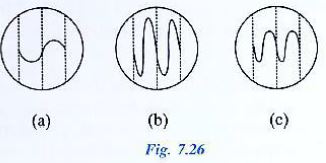
Answer:
(i) b, since amplitude is largest
(ii) a, since frequency is lowest
In simple words: The loudest sound has the tallest wave (b). The lowest pitch has the fewest waves packed together (a).
📝 Teacher's Note: Teach students to look at wave height for loudness and wave spacing for pitch. Taller waves = louder. More spread out waves = lower pitch.
🎯 Exam Tip: Always give the reason. Write "largest amplitude" for loudness and "lowest frequency" for lowest pitch. Just writing the letter gets half marks only.
Question 33. State one difference between a musical note and a noise.
Answer: Musical note is pleasant, smooth and agreeable to the ear while noise is harsh, discordant and displeasing to the ear. In musical note, waveform is regular while in noise waveform is irregular.
In simple words: Music sounds nice and has a neat wave pattern. Noise sounds bad and has a messy wave pattern.
📝 Teacher's Note: Play a musical note and then make a harsh noise. Students can hear the difference. Then show the wave patterns on paper.
🎯 Exam Tip: Write about both how they sound (pleasant vs harsh) AND their wave patterns (regular vs irregular). This shows complete understanding.
Multiple Choice Type:
Question 1. By reducing the amplitude of a sound wave, its:
(a) pitch increases
(b) loudness decreases
(c) loudness increases
(d) pitch decreases
Answer: (b) loudness decreases
In simple words: Amplitude controls loudness. Smaller amplitude means softer sound. Think of turning down the volume on your phone.
📝 Teacher's Note: Show students by speaking softly (small amplitude) and loudly (big amplitude). They can connect amplitude to loudness easily.
🎯 Exam Tip: Remember: Amplitude = Loudness. Frequency = Pitch. Never mix these up. This is a very common mistake.
Question 2. Two sounds of same loudness and same pitch produced by two different instruments differ in their:
(a) amplitudes
(b) frequencies
(c) wave forms
(d) all of the options
Answer: (c) wave forms
In simple words: When guitar and piano play the same note at same volume, they sound different. This is because their wave shapes are different.
📝 Teacher's Note: Play the same note on different instruments or ask students to hum and whistle the same note. They sound different because of waveform.
🎯 Exam Tip: When loudness and pitch are same, the difference is always in waveform. This is what makes each instrument special.
Question 3. Two sounds A and B are of same amplitude, same wave forms but of frequencies f and 2f respectively. Then:
(a) B differ in quality from A
(b) B is grave, A is shrill
(c) B is shrill, A is grave
(d) B is louder than A.
Answer: (c) B is shrill, A is grave
In simple words: B has higher frequency (2f vs f). Higher frequency means shriller sound. Like a bird's tweet (shrill) vs a lion's roar (grave).
📝 Teacher's Note: Teach students: Higher frequency = Shrill sound. Lower frequency = Grave sound. Use examples like bird sounds vs elephant sounds.
🎯 Exam Tip: Remember the rule: Higher frequency = Shrill. Lower frequency = Grave. B has frequency 2f which is higher than A's frequency f.
ICSE Textbook Solutions for Class 10 Physics Chapter 07 Sound
ICSE Chapter Solutions: Class 10 Physics Chapter 07 Sound
Strengthen your preparation with comprehensive answers for Class 10 Physics Chapter 07 Sound. These expert-reviewed solutions make tracking your academic progress straightforward and efficient.
Concept Clarification for Chapter 07 Sound
Every exercise question in this chapter includes step-by-step working steps, allowing you to self-evaluate, catch mistakes early, and understand the underlying logic.
Effective Revision Strategies for Chapter 07 Sound
Explore our broader library of study materials and chapter notes to support your continuous revision and secure higher marks.
FAQs
You can download the verified Selina Concise solutions for Chapter 07 Sound on StudiesToday.com. Our teachers have prepared answers for Class 10 Physics as per 2026-27 ICSE academic session.
Yes, our solutions for Chapter 07 Sound are designed as per new 2026 ICSE standards. 40% competency-based questions required for Class 10, are included to help students understand application-based logic behind every Physics answer.
Yes, every exercise in Chapter 07 Sound from the Selina Concise textbook has been solved step-by-step. Class 10 students will learn Physics conceots before their ICSE exams.
Yes, follow structured format of these Selina Concise solutions for Chapter 07 Sound to get full 20% internal assessment marks and use Class 10 Physics projects and viva preparation as per ICSE 2026 guidelines.