

Official Selina Concise Textbook Solutions for Class 10 Physics
Access the official Selina Concise textbook solutions for Class 10 Physics, updated for the 2026-27 academic year. This digital resource is structured to help students build strong conceptual clarity and prepare effectively for school examinations.
Read and Download Chapter 06 Spectrum Solutions
Access the complete PDF for Chapter 06 Spectrum below. This focused excerpt allows students to isolate specific topics for thorough review and uninterrupted reading, complementing standard ICSE textbooks.
Exercise 6(A)
Question 1. Name three factors on which the deviation produces by a prism depends and state how does it depend on the factors stated by you.
Answer: The deviation produced by the prism depends on the following four factors:
(a) The angle of incidence - As the angle of incidence increases, first the angle of deviation decreases and reaches to a minimum value for a certain angle of incidence. By further increasing the angle of incidence, the angle of deviation is found to increase.
(b) The material of prism (i.e., on refractive index) - For a given angle of incidence, the prism with a higher refractive index produces a greater deviation than the prism which has a lower refractive index.
(c) Angle of prism - Angle of deviation increases with the increase in the angle of prism.
(d) The colour or wavelength of light used - Angle of deviation increases with the decrease in wavelength of light.
In simple words: Prism bends light more when light hits at certain angles, when prism material is denser, when prism is thicker, and when light has shorter wavelength (like blue light).
📝 Teacher's Note: Use different coloured pencils to show how blue light bends more than red light. Students can see the difference easily with colours.
🎯 Exam Tip: Always mention all four factors. Write "decreases with increase in wavelength" - this exact phrase gets marks.
Question 2. How does the deviation produced by a triangular prism depend on the colours (or wavelengths) of light incident on it?
Answer: The deviation caused by a prism increases with the decrease in the wavelength of light incident on it.
In simple words: Blue light (short wavelength) bends more than red light (long wavelength). Think of short waves as easier to push around.
📝 Teacher's Note: Show students a rainbow and explain that violet is at the top because it bends most. Red is at bottom because it bends least.
🎯 Exam Tip: Write "deviation increases with decrease in wavelength" - remember it's opposite relationship.
Question 3. Which colour of white light is deviated by a glass prism the most and which the least?
Answer: A glass prism deviates the violet light most and the red light least.
In simple words: Violet light bends the most. Red light bends the least. This is why we see violet at one end of rainbow and red at the other end.
📝 Teacher's Note: Use the memory trick VIBGYOR - violet comes first because it bends most, red comes last because it bends least.
🎯 Exam Tip: Always write both colours - "violet most, red least". Don't forget to mention both parts.
Question 4. Define the term dispersion of light.
Answer: The phenomenon of splitting of white light by a prism into its constituent colours is known as dispersion of light.
In simple words: When white light goes through a prism, it breaks into seven colours like a rainbow. This breaking is called dispersion.
📝 Teacher's Note: Use a torch and prism in a dark room to show dispersion. Students love seeing the rainbow colours appear on the wall.
🎯 Exam Tip: Write "splitting of white light into constituent colours" - these are the key words examiners want to see.
Question 5. Explain the cause of dispersion of white light through a prism.
Answer: When white light is incident on the first surface of a prism and enters in glass, light of different colours due to different speeds in glass, is refracted or deviated through different angles. Thus the dispersion of white light into its constituent colours takes place at the first surface of prism. Thus the cause of dispersion is the change in speed of light with wavelength or frequency.
In simple words: Different colours travel at different speeds inside glass. This makes them bend at different angles. So white light separates into different colours.
📝 Teacher's Note: Compare to runners of different speeds entering a narrow path - they spread out because of different speeds.
🎯 Exam Tip: Write "different speeds in glass cause different angles of refraction" - this explains the cause clearly.
Question 6. Explain briefly, with the help of a neat labelled diagram, how white light gets dispersed by a prism.
Answer: When white light is incident on the first surface of a prism and enters in glass, light of different colours due to different speeds in glass, is refracted or deviated through different angles. Thus the dispersion of white light into its constituent colours takes place at the first surface of prism.
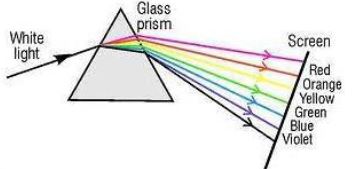
On the second surface, only refraction takes place and different colours are deviated through different angles. As a result, the colours get further separated on refraction at the second surface (violet being deviated the most and red the least).
In simple words: White light enters prism and splits into colours at first surface. At second surface, colours spread out more and we see rainbow on screen.
📝 Teacher's Note: Draw the diagram step by step. Show how colours separate more at the second surface than the first surface.
🎯 Exam Tip: Always draw and label the diagram. Write "violet most deviated, red least deviated" near the emergent rays.
Question 7. The diagram shown below in Fig. 6.11 shows the path taken by a narrow beam of yellow monochromatic light passing through an equiangular glass prism. Now the yellow light is replaced by a narrow beam of white light incident at the same angle. Draw another diagram to show the passage of white light through the prism and label it to show the effect of prism on the white light.
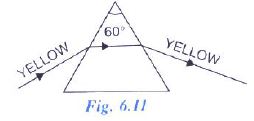
Answer:
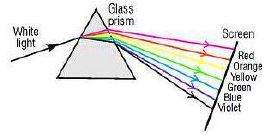
In simple words: Instead of single yellow ray coming out, we get seven different coloured rays spreading out like a fan. White light breaks into rainbow colours.
📝 Teacher's Note: Compare the single yellow ray with the multiple coloured rays. This shows clearly what dispersion means.
🎯 Exam Tip: Draw all seven colours clearly. Label them in order: VIBGYOR from top to bottom.
Question 8. How does the speed of light in glass change on increasing the wavelength of light?
Answer: Speed of light increases with increase in the wavelength.
In simple words: Longer wavelength light (like red) travels faster in glass than shorter wavelength light (like blue).
📝 Teacher's Note: Tell students that red light is like a big truck - moves faster on highway. Blue light is like a small car - slower in traffic (glass).
🎯 Exam Tip: Write "speed increases with wavelength" - don't confuse with the deviation relationship which is opposite.
Question 9. Which colour of white light travels (a) fastest (b) slowest, in glass?
Answer: Red colour travels fastest and Blue colour travels slowest in glass.
In simple words: Red light moves fastest through glass. Blue light moves slowest through glass. That's why red bends less and blue bends more.
📝 Teacher's Note: Connect speed with bending - faster colours bend less, slower colours bend more. This helps students remember both facts together.
🎯 Exam Tip: Write both answers clearly: "Red fastest, Blue slowest". Some questions ask for violet instead of blue - both are correct.
Question 10. Fig 6.12 shows a thin beam of white light from a source S striking on one face of a prism.
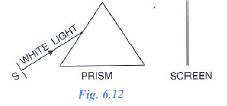
(a) Complete the diagram to show effect of prism on the beam and to show what is seen on the screen.
(b) A slit is placed in between the prism and the screen to pass only the light of green colour. What will you then observe on the screen?
(c) What conclusion do you draw from the observation in part (b) above?
Answer:
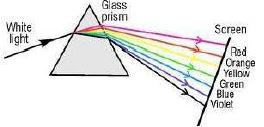
(a) Constituent colours of white light are seen on the screen after dispersion through the prism.
(b) When a slit is introduced in between the prism and screen to pass only the light of green colour, only green light is observed on the screen.
(c) From the observation, we conclude that prism itself produces no colour.
In simple words: (a) Rainbow appears on screen. (b) Only green colour passes through slit. (c) Prism doesn't make colours - it just separates colours that were already in white light.
📝 Teacher's Note: The slit experiment is very important. It proves that prism doesn't create colours but only separates existing colours from white light.
🎯 Exam Tip: For part (c), write "prism produces no colour" or "prism only separates existing colours" - this is the key conclusion.
Question 11. (a) If a monochromatic beam of light undergoes minimum deviation through an equiangular prism, how does the beam pass through the prism, with respect to its base?
(b) If white light is used in same way as in part (a) above, what change is expected in the emergent beam?
(c) what conclusion do you draw about the nature of white light in part (b)?
Answer:
(a) If a monochromatic beam of light undergoes minimum deviation through an equi-angular prism, then the beam passes parallel to the base of prism.
(b) White light splits into its constituent colours i.e., spectrum is formed.
(c) We conclude that white light is polychromatic.
In simple words: (a) Light ray travels parallel to bottom of prism. (b) White light breaks into seven colours. (c) White light contains many colours mixed together.
📝 Teacher's Note: Draw the prism and show how the ray inside goes parallel to base during minimum deviation. This is a special position.
🎯 Exam Tip: Write "parallel to base" for part (a) and "polychromatic" for part (c) - these are the exact terms needed.
Question 12. What do you understand by the term spectrum?
Answer: The colour band obtained on a screen on passing white light through a prism is called the spectrum.
In simple words: When white light goes through prism, we see a band of seven colours on the screen. This coloured band is called spectrum.
📝 Teacher's Note: Show students how spectrum looks like a stretched rainbow. The word spectrum comes from Latin meaning "to look at".
🎯 Exam Tip: Write "colour band on screen" - don't just say "rainbow" because examiners want the technical description.
Question 13. A ray of white light is passed through a glass prism and spectrum is obtained on a screen.
(a) Name the seven colours of the spectrum in order.
(b) Do the colours have the same width in the spectrum?
(c) which of the colour of the spectrum of white light deviates (i) the most, (ii) the least?
Answer:
(a) Violet, Indigo, Blue, Green, Yellow, Orange, Red.
(b) No, different colours have different widths in the spectrum.
(c) (i) Violet colour is deviated the most. (ii) Red colour is deviated the least.
In simple words: (a) The seven colours are VIBGYOR in order. (b) Some colours take more space than others in the spectrum. (c) Violet bends most, red bends least.
📝 Teacher's Note: Teach the memory trick VIBGYOR. Students remember it as "Very Intelligent Boys Generally Yield Outstanding Results".
🎯 Exam Tip: Write all seven colours in correct order. For part (b), say "different widths" not just "no" - explain the answer.
Question 14. The wavelengths for the light of red and blue colours are roughly \(7.8 \times 10^{-7}\) m and \(4.8 \times 10^{-7}\) m respectively.
(a) Which colour has the greater speed in vacuum?
(b) Which colour has the greater speed in glass?
Answer:
(a) In vacuum, both have the same speeds.
(b) In glass, red light has a greater speed.
In simple words: (a) In empty space, all colours travel at same speed. (b) In glass, red travels faster than blue.
📝 Teacher's Note: Explain that vacuum has no particles to slow down light, so all colours travel at same speed. Glass has particles that slow down different colours differently.
🎯 Exam Tip: Remember: same speed in vacuum, different speeds in glass. Red has longer wavelength so travels faster in glass.
Question 15.
(i) Draw a diagram to show the splitting of white light by a prism into its constituent colour.
(ii) Draw another diagram to show how the colours of spectrum of white light can be combined to give the effect of white light.
Answer: Color of light is related to its wavelength.
In simple words: When white light passes through a prism, it breaks into seven colors. Each color has a different wavelength. This is why we see a rainbow of colors.
📝 Teacher's Note: Show students a real prism and shine a torch through it. They can see the rainbow colors on the wall. This makes the concept very clear.
🎯 Exam Tip: Draw the prism diagram neatly. Show white light going in and seven colors coming out. Label the colors: VIBGYOR.
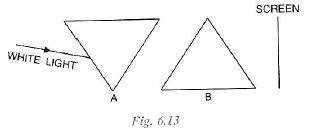
Question 16. Complete the ray diagram given below to show the nature of light produced on the screen.
Answer:
i. \( 4000 \text{ Å to } 8000 \text{ Å} \)
ii. 400 nm to 800 nm
In simple words: The visible light range is from 4000 to 8000 angstrom units. This is the light our eyes can see.
[Diagram: A ray diagram showing white light entering a prism and splitting into spectrum colors on a screen]
📝 Teacher's Note: Explain that angstrom and nanometer are very small units to measure light waves. One nanometer is 10 angstrom units.
🎯 Exam Tip: Remember the range 4000 to 8000 angstrom for visible light. Write both angstrom and nanometer values if asked.
Question 17. Name the subjective property of light related to its wavelength.
Answer:
(i) For blue light, approximate wavelength=4800 Å
(ii) For red light, approximate wavelength=8000 Å
In simple words: The subjective property is color. Different wavelengths give us different colors. Blue has shorter wavelength, red has longer wavelength.
📝 Teacher's Note: The word "subjective" means what we feel or see. Color is what we see when light of different wavelengths hits our eyes.
🎯 Exam Tip: Write "color" as the subjective property. Remember blue light has shorter wavelength than red light.
Question 18. What is the range of wavelength of the spectrum of white light in (i) Å, (ii) nm?
Answer: Seven prominent colours of the white light spectrum in order of their increasing frequencies: Red, Orange, Yellow, Green, Blue, Indigo, Violet
In simple words: White light has seven main colors. They are arranged by how fast they vibrate. Red vibrates slowest, violet vibrates fastest.
📝 Teacher's Note: Teach the memory trick VIBGYOR for the seven colors. But remember this is in order of decreasing frequency, not increasing.
🎯 Exam Tip: For increasing frequency order, write: Red, Orange, Yellow, Green, Blue, Indigo, Violet. Don't mix up with wavelength order.
Question 19. Write the approximate wavelengths for (i) blue and (ii) red light.
Answer: Green, Yellow orange and red have wavelength longer than blue light.
In simple words: Red light has longer wavelength than blue light. Green and yellow also have longer wavelengths than blue.
📝 Teacher's Note: Use the example of long and short waves in water. Long waves are like red light, short waves are like blue light.
🎯 Exam Tip: Remember: Red has longest wavelength in visible light. Blue has shorter wavelength. Write specific values if asked.
Multiple Choice Type
Question 1. When a white light ray falls on a prism, the ray at its first surface suffers.
(a) no refraction
(b) only dispersion
(c) only deviation
(d) both deviation and dispersion
Answer: (d) both deviation and dispersion
In simple words: When white light hits a prism, it bends (deviation) and also splits into colors (dispersion). Both things happen together.
📝 Teacher's Note: Show students that light bends when it enters glass. Also show that it splits into colors. Both happen at the same time.
🎯 Exam Tip: Write "both deviation and dispersion" clearly. Explain that deviation means bending and dispersion means splitting into colors.
Question 2. In the spectrum of white light by a prism, the colour at the extreme end opposite to the base of prism is:
(a) violet
(b) yellow
(c) red
(d) blue
Answer: (c) red
In simple words: Red light bends the least when passing through a prism. So it appears at the far end, opposite to the prism base.
📝 Teacher's Note: Red light has the longest wavelength so it bends least. Violet bends most. Draw this on the board to show students.
🎯 Exam Tip: Remember red is at the end opposite to base. Violet is near the base. Red bends least, violet bends most.
Numericals
Question 1. Calculate the frequency of yellow light of wavelength 550nm. The speed of light is 3×10⁸ m/s⁻¹
Answer:
Given:
wavelength λ = 550 nm = 550 × 10⁻⁹ m
Speed of light, c = 3 × 10⁸ m/s
Step 1: Use the formula
Frequency = \( \frac{\text{Speed of light}}{\text{wavelength}} \)
Step 2: Substitute values
frequency = \( \frac{3 \times 10^8}{550 \times 10^{-9}} = 5.4 \times 10^{14} \text{ Hz} \)
In simple words: We use the formula that connects speed, frequency and wavelength. Yellow light vibrates about 540 trillion times per second!
📝 Teacher's Note: Teach the formula c = f × λ first. Make sure students convert nanometer to meter before calculating.
🎯 Exam Tip: Always convert units first. Write the formula clearly. Show all steps. Don't forget to write Hz for frequency.
Question 2. The frequency range of visible light is from 3.75 x 10¹⁴ Hz to 7.5 x 10¹⁴ Hz. Calculate its wavelength range. Take speed of light = 3 x 10⁸m/s⁻¹
Answer:
Given:
Speed of light, c = 3 × 10⁸ m/s
Frequency range = 3.75 × 10¹⁴ Hz to 7.5 × 10¹⁴ Hz
Step 1: Use formula λ = c/ν
Step 2: For frequency = 3.75 × 10¹⁴ Hz
λ = \( \frac{3 \times 10^8}{3.75 \times 10^{14}} = 8 \times 10^{-7} \text{ m} = 8000 \text{ Å} \)
Step 3: For frequency = 7.5 × 10¹⁴ Hz
λ = \( \frac{3 \times 10^8}{7.5 \times 10^{14}} = 4 \times 10^{-7} \text{ m} = 4000 \text{ Å} \)
Wavelength range = 4000 Å to 8000 Å
In simple words: Higher frequency means shorter wavelength. Lower frequency means longer wavelength. This is the range our eyes can see.
📝 Teacher's Note: Show that when frequency is high, wavelength is small. When frequency is low, wavelength is big. Like a see-saw.
🎯 Exam Tip: Calculate both ends of the range separately. Convert meters to angstrom by multiplying by 10¹⁰. Show both calculations clearly.
Exercise 6B
Question 1.
(a) Give a list of at least five radiations, in order of their increasing frequencies, which make up the complete electromagnetic spectrum.
(b) Which of the radiation mentioned in answer to part (a) has the highest penetrating power?
Answer:
(a) Five radiations, in the order of their increasing frequencies are: Infrared waves, Visible light, Ultraviolet, X-rays and Gamma rays.
(b) Gamma rays have the highest penetrating power.
In simple words: The electromagnetic spectrum has many types of waves. Gamma rays vibrate fastest and can pass through most materials easily.
📝 Teacher's Note: Explain that gamma rays can pass through thick metal sheets. X-rays can pass through skin but not bones. This is penetrating power.
🎯 Exam Tip: Write the order correctly: Infrared, Visible, Ultraviolet, X-rays, Gamma rays. Remember gamma has highest penetrating power.
Question 2.
(a) Arrange the following radiations in the order of their increasing wavelength: X-rays, infrared rays, ratio waves, gamma ray and micro waves?
(b) Which radiation is used for satellite communication?
Answer:
(a) Gamma rays, X-rays, infrared rays, micro waves, radio waves.
(b) Microwave is used for satellite communication.
In simple words: Gamma rays have shortest wavelength. Radio waves have longest wavelength. Satellites use microwaves to send signals.
📝 Teacher's Note: Show that wavelength order is opposite of frequency order. Short wavelength means high frequency. Long wavelength means low frequency.
🎯 Exam Tip: For increasing wavelength, start with gamma (shortest) and end with radio (longest). Remember microwaves for satellite communication.
Question 3. A wave has a wavelength of 0.01 Å. (a) Name the wave. (b) State its one property different from light.
Answer:
(a) Gamma ray.
(b) Gamma rays have strong penetrating power.
In simple words: Very small wavelength means it is gamma ray. Gamma rays can pass through thick materials, but light cannot.
📝 Teacher's Note: Explain that 0.01 angstrom is extremely small. This tells us it is gamma ray. Light cannot pass through walls, but gamma can.
🎯 Exam Tip: Wavelength less than 0.1 angstrom is gamma ray. Write "strong penetrating power" as the different property from light.
Question 4.
(a) Name the high energetic invisible electro-magnetic wave which helps in the study of structure of crystals.
(b) State one more use of the wave named in part (a).
Answer:
(a) X-rays are used in the study of crystals.
(b) It is also used to detect fracture in bones.
In simple words: X-rays can pass through soft materials but get stopped by hard materials. This helps us see inside crystals and bones.
📝 Teacher's Note: Show X-ray pictures of broken bones. Explain how X-rays pass through skin but get blocked by bones, so we can see the bone shape.
🎯 Exam Tip: X-rays are used for crystal structure study and medical diagnosis. Write both uses clearly in exams.
Question 5. What is the range of the wavelength of the following electromagnetic waves?
(a) Gamma rays, (b) X-rays, (c) Ultraviolet (d) Visible, (e) Infrared, (f) Micro waves and (g) Radio waves.
Answer:
(a) Gamma rays-wavelength shorter than 0.1 Å
(b) X-rays-wavelength range 0.1 Å to 100 Å
(c) Ultraviolet rays-wavelength range 100 Å to 4000 Å
(d) Visible light-wavelength range 4000 Å to 8000 Å
(e) Infrared radiations-wavelength range 8000 Å to 10⁷ Å
(f) Microwaves-wavelength range 10⁷ Å to 10¹¹ Å
(g) Radio waves-wavelength above 10¹¹ Å
In simple words: Each type of electromagnetic wave has its own range of wavelengths. Gamma has shortest, radio has longest.
📝 Teacher's Note: Make students memorize the visible light range 4000-8000 angstrom. This is most important for exams.
🎯 Exam Tip: Remember visible light range: 4000 to 8000 angstrom. This is the most commonly asked range in exams.
Question 6. Give the range of wavelength of the electromagnetic waves visible to us.
Answer: 4000 Å to 8000 Å .
In simple words: Our eyes can only see light waves between 4000 and 8000 angstrom units. This is called visible light.
📝 Teacher's Note: Explain that our eyes are like special detectors that only work for this small range of electromagnetic waves.
🎯 Exam Tip: Write exactly "4000 Å to 8000 Å" for visible light range. This is a direct answer question.
Question 7. Name the region beyond (i) the red end and (ii) the violet end, of the spectrum.
Answer:
(i) Infrared
(ii) Ultraviolet
In simple words: Beyond red color is infrared light. Beyond violet color is ultraviolet light. We cannot see these with our eyes.
📝 Teacher's Note: Use the memory trick: "Infra" means below, so infrared is below red. "Ultra" means beyond, so ultraviolet is beyond violet.
🎯 Exam Tip: Infrared beyond red end. Ultraviolet beyond violet end. Remember the prefixes infra and ultra.
Question 8. What do you understand by the invisible spectrum? How will you investigate the existence of radiation beyond the red and violet ends of the spectrum?
Answer: The part of spectrum beyond the red and the violet ends is called the invisible spectrum as our eyes do not respond to the spectrum beyond the red and the violet extremes.
In simple words: Invisible spectrum means the light we cannot see. It exists beyond red and violet colors. Special instruments can detect these invisible rays.
📝 Teacher's Note: Explain that our eyes are limited. Many animals can see infrared or ultraviolet light. We need special cameras to detect them.
🎯 Exam Tip: Define invisible spectrum as radiation beyond red and violet ends. Mention that our eyes cannot detect them.
Question 9. State the approximate range of wavelength associated with (i) the ultraviolet rays, (ii) the visible light and (iii) infrared rays.
Answer:
(i) Ultraviolet rays-wavelength range 100 Å to 4000 Å
(ii) Visible light-wavelength range 4000 Å to 8000 Å
(iii) Infrared radiations-wavelength range 8000 Å to \( 10^7 \) Å
In simple words: Different types of light have different wavelengths. Ultraviolet rays are very short waves. Visible light is in the middle. Infrared rays are long waves.
📝 Teacher's Note: Draw a simple diagram showing short, medium, and long waves. Tell students UV rays are like tiny ripples, visible light is like normal waves, and IR rays are like big waves.
🎯 Exam Tip: Remember the order: UV (shortest) → Visible → IR (longest). Write the exact wavelength ranges given in the answer.
Question 10. Name the radiations of wavelength just (i) longer than \( 8 \times 10^{-7} \)m, (ii) Shorter than \( 4 \times 10^{-7} \) m.
Answer:
(i) Infrared radiations are longer than \( 8 \times 10^{-7} \)m.
(ii) Ultraviolet radiations are shorter than \( 4 \times 10^{-7} \) m.
In simple words: The numbers given are at the edges of visible light. Anything longer than red light is infrared. Anything shorter than violet light is ultraviolet.
📝 Teacher's Note: Show students that \( 8 \times 10^{-7} \) m is at the red end and \( 4 \times 10^{-7} \) m is at the violet end. Beyond these limits, we get invisible radiations.
🎯 Exam Tip: Remember: longer wavelength = infrared, shorter wavelength = ultraviolet. Write the full names clearly.
Question 11. Name two electromagnetic waves of frequency greater than that of violet light. State one use of each.
Answer: X-rays and ultraviolet rays are electromagnetic waves of frequency greater than that of violet light.
Uses:
X-rays are used for studying atomic arrangement in crystals.
Ultraviolet rays are used for detecting the purity of gems, eggs, ghee etc.
In simple words: Higher frequency means more energy. X-rays and UV rays have more energy than violet light. X-rays help us see inside things. UV rays help us check if things are pure.
📝 Teacher's Note: Explain that higher frequency means the wave vibrates faster. This gives it more energy to do special jobs like going through skin or checking purity.
🎯 Exam Tip: Write both wave names and one clear use for each. Remember: higher frequency = more energy = more useful for special tasks.
Question 12. Give one use each of (i) microwaves, (ii) ultraviolet radiations, (iii) infrared radiations, and (iv) gamma rays.
Answer:
(i) Microwaves are used for satellite communication.
(ii) Ultraviolet radiations are used for detecting the purity of gems, eggs, ghee etc.
(iii) Infrared radiations are used in remote control of television and other gadgets.
(iv) Gamma rays are used in medical science to kill cancer cells.
In simple words: Each type of radiation does different jobs. Microwaves carry messages to satellites. UV rays check if things are real. IR rays work in TV remotes. Gamma rays fight cancer.
📝 Teacher's Note: Give real examples students can see - microwave oven, UV light checking money notes, TV remote, and hospital treatments.
🎯 Exam Tip: Learn one clear use for each radiation type. Write the exact application mentioned in the answer.
Question 13. Name the rays or waves (i) of highest frequency, (ii) used for taking photographs in dark, (iii) produced by the changes in the nucleus of an atom, (iv) of wavelength nearly 0.1 nm.
Answer:
(i) Gamma rays are of highest frequency.
(ii) Infrared rays are used for taking photographs in dark.
(iii) Gamma rays are produced by the changes in the nucleus of an atom.
(iv) X-Rays are of wavelength nearly 0.1 nm.
In simple words: Gamma rays are the most powerful waves. Infrared rays can see heat in darkness. Gamma rays come from inside atoms. X-rays are very short waves.
📝 Teacher's Note: Explain that gamma rays are like super-strong light. IR cameras can see body heat even in dark rooms. Show students how small 0.1 nm is compared to visible light.
🎯 Exam Tip: Remember gamma rays for highest frequency and nuclear changes. IR rays for dark photography. X-rays for 0.1 nm wavelength.
Question 14. Two waves A and B have wavelength 0.01 Å and 9000 Å respectively. (a) Name the two waves. (b) Compare the speeds of these waves when they travel in vacuum.
Answer:
(a) A- Gamma rays, B-infrared radiations
(b) Ratio of speeds of these waves in vacuum is 1:1 as all electromagnetic waves travel with the speed of light in vacuum.
In simple words: Wave A is very short (gamma rays). Wave B is very long (infrared). But both travel at the same speed in empty space - the speed of light.
📝 Teacher's Note: Compare to runners of different heights running at the same speed. All electromagnetic waves are like different sized runners but they all run at light speed in vacuum.
🎯 Exam Tip: Very short wavelength (0.01 Å) = gamma rays. Long wavelength (9000 Å) = infrared. All EM waves have same speed in vacuum.
Question 15. Name two sources, each of infrared radiations and ultraviolet radiations.
Answer: All heated bodies such as a heated iron ball, flame, fire etc., are the sources of infrared radiations. The electric arc and sparks give ultraviolet radiations.
In simple words: Hot things make infrared rays. Electric sparks make ultraviolet rays. Any warm object gives off heat rays (infrared).
📝 Teacher's Note: Show students a hot iron and explain it gives off heat rays even when it looks normal. Electric welding sparks give UV rays that can hurt eyes.
🎯 Exam Tip: For infrared: any heated object. For ultraviolet: electric arc or sparks. Give two clear examples for each.
Question 16. What are infrared radiations? How are they detected? State one use of these radiations.
Answer: Infrared radiations are the electromagnetic waves of wavelength in the range of 8000Å to \( 10^7 \)Å.
Detection: If a thermometer with a blackened bulb is moved from the violet end towards the red end, it is observed that there is a slow rise in temperature, but when it is moved beyond the red region, a rapid rise in temperature is noticed. It means that the portion of spectrum beyond the red end has certain radiations which produce a strong heating effect, but they are not visible. These radiations are called the infrared radiations.
Use: The infrared radiations are used for therapeutic purposes by doctors.
In simple words: Infrared rays are heat rays beyond red light. We find them by seeing where a thermometer gets hottest. Doctors use them to treat patients with heat.
📝 Teacher's Note: Use a simple prism and thermometer demo if possible. Explain that beyond red light, the thermometer gets very hot even though we see nothing there.
🎯 Exam Tip: Write the wavelength range, describe the thermometer detection method, and give a medical use. Mention "beyond red end" clearly.
Question 17. What are ultraviolet radiations? How are they detected? State one use of these radiations.
Answer: The electromagnetic radiations of wavelength from 100Å to 4000Å are called the ultraviolet radiations.
Detection: If the different radiations from the red part of the spectrum to the violet end and beyond it, are made incident on the silver-chloride solution, it is observed that from the red to the violet end, the solution remains unaffected. However just beyond the violet end, it first turns violet and finally it becomes dark brown. Thus there exist certain radiations beyond the violet end of the spectrum, which are chemically more active than visible light, called ultraviolet radiations.
Use: Ultraviolet radiations are used for sterilizing purposes.
In simple words: UV rays are invisible rays beyond violet light. We find them using a special chemical that changes color. They are strong enough to kill germs.
📝 Teacher's Note: Explain that silver chloride is like a detector that changes color when hit by UV rays. UV rays are so strong they can break chemical bonds and kill bacteria.
🎯 Exam Tip: Write the wavelength range, describe silver chloride detection turning dark brown, and mention sterilizing use. Say "beyond violet end".
Question 18. Name three properties of ultraviolet radiations which are similar to visible light.
Answer:
(a) Ultraviolet radiations travel in a straight line with a speed of \( 3 \times 10^8 \) m in air (or vacuum).
(b) They obey the laws of reflection and refraction.
(c) They affect the photographic plate.
In simple words: UV rays behave like light in many ways. They travel straight, bounce off mirrors, bend through glass, and can expose camera film.
📝 Teacher's Note: Show students that UV rays are just like visible light but invisible. They follow the same basic rules of light - straight travel, reflection, refraction.
🎯 Exam Tip: Write speed, reflection/refraction laws, and photographic effects. These show UV rays are electromagnetic waves like light.
Question 19. Give two properties of ultraviolet radiations which differ from the visible light.
Answer:
(a) Ultraviolet radiations produce fluorescence on striking a zinc sulphide screen.
(b) They cause health hazards like cancer on the body.
In simple words: UV rays can make certain materials glow (fluorescence). They are also dangerous and can cause skin cancer if we get too much.
📝 Teacher's Note: Explain fluorescence using examples like whitening agents in detergent or UV lamps that make things glow. Warn about sun safety and UV protection.
🎯 Exam Tip: Write fluorescence effect and health hazards. These are key differences from safe visible light.
Question 20. Mention three properties of infrared radiations similar to the visible light.
Answer:
(a) Infrared radiations travel in straight line as light does, with a speed equal to \( 3 \times 10^8 \)m/s in vacuum.
(b) They obey the laws of reflection and refraction.
(c) They do not cause fluorescence on zinc sulphide screen.
In simple words: Infrared rays behave like normal light. They travel straight, reflect and refract like light, and don't make things glow.
📝 Teacher's Note: Emphasize that IR rays follow the same basic light rules. The no-fluorescence property shows they are less energetic than UV rays.
🎯 Exam Tip: Write speed, reflection/refraction laws, and no fluorescence. These show IR rays are gentler electromagnetic waves.
Question 21. Give two such properties of infrared radiations which are not true for visible light.
Answer:
(a) Infrared radiations are invisible.
(b) They do not affect the ordinary photographic film.
In simple words: We cannot see infrared rays with our eyes. Normal camera film cannot detect them either.
📝 Teacher's Note: Explain that our eyes can only see a small part of electromagnetic spectrum. IR rays need special cameras to be detected.
🎯 Exam Tip: Write invisibility and no effect on photographic film. These show IR rays are different from visible light.
Question 22. Explain the following:
(i) Infrared radiations are used for photography in fog.
(ii) Infrared radiations are used as signals during war
(iii) the photographic darkrooms are provided with infrared lamps.
(iv) A rock salt prism is used instead of a glass prism to obtain the infrared spectrum.
(v) A quartz is required for obtaining the spectrum of the ultraviolet light.
(vi) Ultraviolet bulbs have a quartz envelope instead of glass
Answer:
(i) Infrared radiations are used in photography in fog because they are not much scattered by the atmosphere, so they can penetrate appreciably through it.
(ii) Infrared radiations are used as signals during the war as they are not visible and they are not absorbed much in the medium.
(iii) Infrared lamps are used in dark rooms for developing photographs since they do not affect the photographic film chemically, but they provide some visibility.
(iv) Infrared spectrum can be obtained only with the help of a rock-salt prism since the rock-salt prism does not absorb infrared radiations whereas a glass prism absorbs them.
(v) A quartz prism is used to obtain the spectrum of the ultraviolet radiations as they are not absorbed by quartz, whereas ordinary glass absorbs the ultraviolet light.
(vi) Ultraviolet bulbs have a quartz envelope instead of glass as they are not absorbed by quartz, whereas ordinary glass absorbs the ultraviolet light.
In simple words: IR rays can go through fog and are invisible, so good for secret signals. They don't spoil camera film. Different materials let different rays pass through - rock salt for IR, quartz for UV.
📝 Teacher's Note: Explain with examples: IR cameras see through fog, night vision uses IR, photo labs use red lights. Different materials are transparent to different radiations.
🎯 Exam Tip: Each part has a key reason: penetration through fog, invisibility, no chemical effect on film, material transparency. Write these clearly.
Multiple Choice Type:
Question 1. The most energetic electromagnetic radiations are:
(a) Microwaves
(b) ultraviolet waves
(c) X-rays
(d) gamma rays
Answer: (d) gamma rays
In simple words: Gamma rays have the highest energy of all electromagnetic waves. They are the most powerful and dangerous.
📝 Teacher's Note: Explain that higher frequency means higher energy. Gamma rays have the highest frequency, so they have the most energy.
🎯 Exam Tip: Remember the energy order: gamma rays > X-rays > UV > visible > IR > microwaves. Gamma rays are always the most energetic.
Question 2. The source of ultraviolet light is:
(a) electric bulb
(b) red hot iron ball
(c) sodium vapour lamp
(d) carbon arc-lamp
Answer: (d) carbon arc-lamp
In simple words: Carbon arc-lamps make very bright light with UV rays. These are special lamps that create electric sparks between carbon rods.
📝 Teacher's Note: Show students that UV light is invisible but very powerful. Carbon arc-lamps are used in welding because they make strong UV light. Regular bulbs don't make much UV.
🎯 Exam Tip: Remember carbon arc-lamp for UV light source. Write the full name clearly. Don't confuse with sodium lamp which gives yellow light.
Question 3. A radiations A is focused by a proper device on the bulb of a thermometer. Mercury in the thermometer shows a rapid increase. The radiations A is:
(a) infrared radiation
(b) visible light
(c) ultraviolet radiation
(d) X-rays
Answer: (a) infrared radiation
In simple words: Infrared rays carry heat. When they hit the thermometer, the mercury gets hot and rises up. Think of sitting near a fire - you feel warm because of infrared rays.
📝 Teacher's Note: Use a hair dryer or heater to show students how infrared makes things warm. The key word is "heating effect" - only infrared does this strongly.
🎯 Exam Tip: When you see "thermometer shows increase" or "heating effect", always choose infrared radiation. This is the main property of infrared rays.
Numericals
Question 1. An electromagnetic wave has a frequency of 500 MHz and a wavelength of 60 cm.
(a) Calculate the velocity of the wave.
(b) name the medium through which it is travelling
Answer:
Given:
Frequency = 500MHz = \( 500 \times 10^6 \) Hz
Wavelength = 60 cm = 0.6 m
Step 1: Use the wave equation
Velocity of wave = frequency × wavelength
\( v = f \times \lambda \)
Step 2: Calculate velocity
\( v = 500 \times 10^6 \times 0.6 = 3 \times 10^8 \) m/s
Step 3: Identify the medium
Since velocity = \( 3 \times 10^8 \) m/s (speed of light), the electromagnetic wave is travelling through air.
(a) Velocity = \( 3 \times 10^8 \) m/s
(b) Medium = Air
In simple words: We use the formula speed = frequency × wavelength. When we get \( 3 \times 10^8 \) m/s, this is the speed of light in air.
📝 Teacher's Note: Teach students that \( 3 \times 10^8 \) m/s is always the speed of light in air or vacuum. This number helps identify the medium. In water or glass, speed would be less.
🎯 Exam Tip: Always convert units first (MHz to Hz, cm to m). Show all steps clearly. When you get \( 3 \times 10^8 \) m/s, the medium is air or vacuum.
Question 2. The wavelength of X-rays is 0.01 Å. Calculate its frequency.
Answer:
Given:
Wavelength = 0.01Å = \( 0.01 \times 10^{-10} \) m
Speed of X-rays = \( 3 \times 10^8 \) m/s
Step 1: Use the wave equation
Speed of light = frequency × wavelength
C = νλ
Step 2: Find frequency
\( \nu = \frac{c}{\lambda} = \frac{3 \times 10^8 \text{ m/s}}{0.01 \times 10^{-10} \text{ m}} \)
Step 3: Calculate
\( \nu = \frac{3 \times 10^8}{0.01 \times 10^{-10}} = 3 \times 10^{20} \) Hz
Frequency = \( 3 \times 10^{20} \) Hz
In simple words: X-rays have very small wavelength, so they have very high frequency. Small wavelength means high frequency - they are opposite to each other.
📝 Teacher's Note: Show students that Angstrom (Å) is a very small unit. \( 1Å = 10^{-10} \) m. X-rays have tiny wavelengths but huge frequencies.
🎯 Exam Tip: Convert Angstrom to meters first. Use \( \nu = \frac{c}{\lambda} \) formula. X-ray frequencies are always very high numbers with big powers like \( 10^{20} \).
Exercise 6 (C)
Question 1. What is meant by scattering of light?
Answer: When white light from sun enters the earth's atmosphere, the light gets scattered i.e., the light spreads in all directions by the dust particles, free water molecules and the molecules of the gases present in the atmosphere. This phenomenon is called scattering of light.
In simple words: Scattering means light bounces in all directions when it hits tiny particles in air. Like throwing a ball at many small stones - it bounces everywhere.
📝 Teacher's Note: Use a torch in a dusty room to show scattering. Students can see the light beam because dust particles scatter light towards their eyes.
🎯 Exam Tip: Write "light spreads in all directions" and mention dust particles, water molecules and gas molecules. These are key points examiners look for.
Question 2. How does the intensity of scattered light depends on the wavelength of incident light? State conditions when this dependence holds.
Answer: The intensity of scattered light is found to be inversely proportional to the fourth power of wavelength of light. This relation holds when the size of air molecules is much smaller than the wavelength of the light incident.
In simple words: Short wavelength light (like blue) scatters more than long wavelength light (like red). This happens when air particles are much smaller than the light waves.
📝 Teacher's Note: Explain that "fourth power" means wavelength multiplied by itself 4 times. Blue has short wavelength so it scatters much more than red which has long wavelength.
🎯 Exam Tip: Write "inversely proportional to fourth power of wavelength" exactly. Also mention the condition about particle size being smaller than wavelength.
Question 3. When sunlight enters the earth's atmosphere, state which colour of light is scattered the most and which the least.
Answer: Violet colour is scattered the most and red the least as the intensity of scattered light is found to be inversely proportional to the fourth power of wavelength of light.
In simple words: Violet has the shortest wavelength, so it scatters most. Red has the longest wavelength, so it scatters least. Think of violet as a small ball that bounces everywhere, red as a big ball that goes straight.
📝 Teacher's Note: Make students remember VIBGYOR order. Violet has shortest wavelength (scatters most), red has longest wavelength (scatters least). This explains why sky is blue, not violet.
🎯 Exam Tip: Always write "violet scatters most, red scatters least" and give the reason about wavelength. Don't write blue - technically violet scatters more than blue.
Question 4. The danger signal is red. Why?
Answer: Since the wavelength of red light is the longest in the visible light, the light of red colour is scattered the least by the air molecules of the atmosphere and therefore the light of red colour can penetrate to a longer distance. Thus red light can be seen from the farthest distance as compared to other colours of same intensity. Hence it is used for danger signal so that the signal may be visible from the far distance.
In simple words: Red light travels the farthest without getting scattered. So people can see red signals from far away. This makes red perfect for danger warnings.
📝 Teacher's Note: Show students traffic lights and ask which color they can see from farthest. Red travels through fog and dust better than other colors because it scatters less.
🎯 Exam Tip: Write "red has longest wavelength, scatters least, travels farthest distance". This complete chain of reasoning gets full marks.
Question 5. How would the sky appear when seen from the space (or moon)? Give reason for your answer.
Answer: On the moon, since there is no atmosphere, therefore there is no scattering of sun light incident on the moon surface. Hence to an observer on the surface of moon (space), no light reaches the eye of the observer except the light directly from the sun. Thus the sky will have no colour and will appear black to an observer on the moon surface.
In simple words: Moon has no air, so no scattering happens. You only see light coming straight from stars and sun. Everything else looks black, like a dark room.
📝 Teacher's Note: Show students photos from moon landings where sky is black even in daytime. Explain that Earth's sky is blue only because we have atmosphere to scatter light.
🎯 Exam Tip: Write "no atmosphere, no scattering, sky appears black". This is the key chain of logic. Mention that only direct light from sun/stars is visible.
Question 6. What characteristic property of light is responsible for the blue colour of the sky?
Answer: Scattering property of light is responsible for the blue colour of the sky as the blue colour is scattered the most due to its short wavelength.
In simple words: Scattering makes sky blue. Blue light bounces around in all directions more than other colors because it has short wavelength.
📝 Teacher's Note: Remind students that scattering is the key property. Without scattering, sky would be black like on moon. Blue scatters more than red, that's why sky is blue not red.
🎯 Exam Tip: Write "scattering property" as the answer, then explain about blue having short wavelength. The property name is what the question asks for.
Question 7. The colour of sky, in direction other than of the sun, is blue. Explain.
Answer: As the light travels through the atmosphere, it gets scattered in different directions by the air molecules present in its path. The blue light due to its short wavelength is scattered more as compared to the red light of long wavelength. Thus the light reaching our eye directly from sun is rich in red colour, while the light reaching our eye from all other directions is the scattered blue light. Therefore, the sky in direction other than in the direction of sun is seen blue.
In simple words: Blue light bounces around in all directions. Red light goes mostly straight to us from sun. So when we look away from sun, we see the bounced blue light everywhere.
📝 Teacher's Note: Tell students to look at sky away from sun - it's blue. Look towards sun (safely) - it's more yellow/red. This shows blue scatters away, red comes straight.
🎯 Exam Tip: Explain the difference between direct light from sun (red-rich) and scattered light from other directions (blue). This comparison shows understanding.
Question 8. Why does the sun appear red at sunrises and sunset?
Answer: At the time of sunrise and sunset, the light from sun has to travel the longest distance of atmosphere to reach the observer. The light travelling from the sun loses blue light of short wavelength due to scattering, while the red light of long wavelength is scattered a little, so is not lost much. Thus blue light is almost absent in sunlight reaching the observer, while it is rich in red colour.
In simple words: At sunrise and sunset, sunlight travels through more air. Blue light gets scattered away on this long journey. Only red light reaches us, so sun looks red.
📝 Teacher's Note: Draw the path of sunlight at noon (short path) and at sunset (long path through atmosphere). More air means more scattering of blue light.
🎯 Exam Tip: Write "longest distance through atmosphere" and "blue light gets scattered away, red light reaches us". This shows cause and effect clearly.
Question 9. The sky at noon appears white. Give reason.
Answer: At noon, the sun is above our head, so we get light rays directly from the sun without much scattering of any particular colour. Further, light has to travel less depth of atmosphere; hence the sky is seen white.
In simple words: At noon, sunlight travels through less air. Not much scattering happens, so we get almost all colors mixed together. This makes white light.
📝 Teacher's Note: Compare noon sky (white/pale blue) with evening sky (deep blue). Less air to travel through means less scattering and more white appearance.
🎯 Exam Tip: Write "sun overhead, less atmosphere to travel, less scattering, appears white". Show the connection between path length and scattering.
Question 10. The clouds are seen white. Explain
Answer: The clouds are nearer the earth surface and they contain dust particles and aggregates of water molecules of sizes bigger than the wavelength of visible light. Therefore, the dust particles and water molecules present in clouds scatter all colours of incident white light from sun to the same extent and hence when the scattered light reaches our eye, the clouds are seen white.
In simple words: Cloud particles are bigger than light wavelength. Big particles scatter all colors equally. When all colors mix, we see white.
📝 Teacher's Note: Explain that cloud droplets are much bigger than air molecules. Big particles don't choose colors - they scatter everything equally. Equal scattering of all colors gives white.
🎯 Exam Tip: Write "particles bigger than wavelength" and "scatter all colors equally". This size comparison is the key point examiners want.
Multiple Choice Type:
Question 1. In white light of sun, maximum scattering by the air molecular present in the earth's atmosphere is for:
(a) red colour
(b) yellow colour
(c) green colour
(d) blue colour
Answer: (d) blue colour
In simple words: Blue light has short wavelength. Air molecules are about the same size as blue wavelength, so they scatter blue light most. This is why sky looks blue.
📝 Teacher's Note: Remind students about VIBGYOR. Blue has shorter wavelength than red, yellow, green. Shorter wavelength means more scattering. Size of air molecules matches blue wavelength best.
🎯 Exam Tip: Remember that blue scatters most in atmosphere. This is a very common exam question. Don't confuse with violet - blue is the practical answer for atmosphere.
Verified Textbook Solutions for Class 10 Physics Chapter 06 Spectrum
About ICSE Solutions for Class 10 Physics Chapter 06 Spectrum
Review accurate ICSE solutions for Chapter 06 Spectrum tailored for Class 10 Physics students. Use these step-by-step notes to simplify difficult textbook exercises and improve exam readiness.
Concept Clarification for Chapter 06 Spectrum
Verify your answers instantly using the comprehensive breakdowns provided for each problem, ensuring complete syllabus coverage across all sub-topics.
Effective Revision Strategies for Chapter 06 Spectrum
Pair your solution review with additional practice papers to test your execution speed and ensure total preparedness for school exams.
FAQs
You can download the verified Selina Concise solutions for Chapter 06 Spectrum on StudiesToday.com. Our teachers have prepared answers for Class 10 Physics as per 2026-27 ICSE academic session.
Yes, our solutions for Chapter 06 Spectrum are designed as per new 2026 ICSE standards. 40% competency-based questions required for Class 10, are included to help students understand application-based logic behind every Physics answer.
Yes, every exercise in Chapter 06 Spectrum from the Selina Concise textbook has been solved step-by-step. Class 10 students will learn Physics conceots before their ICSE exams.
Yes, follow structured format of these Selina Concise solutions for Chapter 06 Spectrum to get full 20% internal assessment marks and use Class 10 Physics projects and viva preparation as per ICSE 2026 guidelines.