

Selina Concise Solutions for Class 8 Mathematics: Chapter 21 Surface Area Volume and Capacity Cuboid Cube and Cylinder
Explore the complete Selina Concise textbook solutions for Class 8 Mathematics. Tailored for the 2026-27 curriculum, this resource breaks down complex topics to support daily study and targeted revision.
Chapter-wise Solutions: Chapter 21 Surface Area Volume and Capacity Cuboid Cube and Cylinder
Navigate directly to the Chapter 21 Surface Area Volume and Capacity Cuboid Cube and Cylinder solutions using the digital viewer below. Organizing your study sessions chapter-by-chapter allows for seamless offline study and quick reference during revision.
Exercise 21(A)
Question 1. Find the volume and the total surface area of a cuboid, whose :
(i) length = 15 cm, breadth = 10 cm and height = 8 cm.
(ii) l = 3.5 m, b = 2.6 m and h = 90 cm,
Answer:
(i) Given dimensions: length \( = 15\text{ cm} \), breadth \( = 10\text{ cm} \), and height \( = 8\text{ cm} \).
The volume of the cuboid is calculated as:
Volume \( = \text{length} \times \text{breadth} \times \text{height} \)
\( = 15 \times 10 \times 8 \)
\( = 1200\text{ cm}^3 \)
The total surface area is calculated using the formula:
Total Surface Area \( = 2(lb + bh + hl) \)
\( = 2(15 \times 10 + 10 \times 8 + 8 \times 15) \)
\( = 2(150 + 80 + 120) \)
\( = 2(350) \)
\( = 700\text{ cm}^2 \)
(ii) Given dimensions: length \( = 3.5\text{ m} \), breadth \( = 2.6\text{ m} \), and height \( = 90\text{ cm} \).
First, we convert the height to meters:
Height \( = \frac{90}{100}\text{ m} = 0.9\text{ m} \).
The volume of the cuboid is:
Volume \( = l \times b \times h \)
\( = 3.5 \times 2.6 \times 0.9 \)
\( = 8.19\text{ m}^3 \)
The total surface area is:
Total Surface Area \( = 2(lb + bh + hl) \)
\( = 2(3.5 \times 2.6 + 2.6 \times 0.9 + 0.9 \times 3.5) \)
\( = 2(9.1 + 2.34 + 3.15) \)
\( = 2(14.59) \)
\( = 29.18\text{ m}^2 \)
In simple words: To find the space inside a cuboid (volume), multiply its three sides. To find the outside covering (surface area), add the areas of all six rectangular faces. Make sure all measurements are in the same units before calculating.
Exam Tip: Always double-check that all dimensions are converted to matching units (like converting cm to m) before starting your calculations.
Question 2.
(i) The volume of a cuboid is 3456 cm3 . If its length = 24 cm and breadth = 18 cm ; find its height.
(ii) The volume of a cuboid is 7.68 m3 . If its length = 3.2 m and height = 1.0 m; find its breadth.
(iii) The breadth and height of a rectangular solid are 1.20 m and 80 cm respectively. If the volume of the cuboid is 1.92 m3 ; find its length.
Answer:
(i) Here, the cuboid's volume is \( 3456\text{ cm}^3 \), with length \( = 24\text{ cm} \) and breadth \( = 18\text{ cm} \).
Using the relationship:
Volume \( = \text{length} \times \text{breadth} \times \text{height} \)
We set up the equation:
\( 24 \times 18 \times \text{Height} = 3456 \)
\( 432 \times \text{Height} = 3456 \)
To solve for height:
Height \( = \frac{3456}{432} \)
\( \text{Height} = 8\text{ cm} \)
(ii) We are given a volume of \( 7.68\text{ m}^3 \), length \( = 3.2\text{ m} \), and height \( = 1.0\text{ m} \).
Using the volume relation:
\( \text{length} \times \text{breadth} \times \text{height} = \text{Volume} \)
\( 3.2 \times \text{breadth} \times 1.0 = 7.68 \)
\( 3.2 \times \text{breadth} = 7.68 \)
Solving for breadth:
Breadth \( = \frac{7.68}{3.2} \)
\( \text{Breadth} = 2.4\text{ m} \)
(iii) The volume of the rectangular solid is \( 1.92\text{ m}^3 \).
The breadth is \( 1.20\text{ m} \) and height is \( 80\text{ cm} \).
Convert height to meters:
Height \( = \frac{80}{100}\text{ m} = 0.8\text{ m} \).
Applying the volume equation:
\( \text{length} \times \text{breadth} \times \text{height} = \text{Volume} \)
\( \text{length} \times 1.20 \times 0.8 = 1.92 \)
\( \text{length} \times 0.96 = 1.92 \)
Solving for length:
Length \( = \frac{1.92}{0.96} \)
\( \text{Length} = 2\text{ m} \)
In simple words: When you know the volume and two sides of a cuboid, multiply the two known sides together, then divide the volume by that result to find the missing side.
Exam Tip: If you are looking for one dimension, rearrange the formula to: Missing Dimension \( = \frac{\text{Volume}}{\text{Product of other two dimensions}} \).
Question 3. The length, breadth and height of a cuboid are in the ratio 5 : 3 : 2. If its volume is 240 cm3 ; find its dimensions. (Dimensions means : its length, breadth and height). Also find the total surface area of the cuboid.
Answer:
Let the proportional constant be \( x \).
So, length \( = 5x \), breadth \( = 3x \), and height \( = 2x \).
The volume of the cuboid is:
Volume \( = \text{length} \times \text{breadth} \times \text{height} \)
\( = 5x \times 3x \times 2x \)
\( = 30x^3 \)
Since the volume is given as \( 240\text{ cm}^3 \), we equate them:
\( 30x^3 = 240 \)
Dividing by 30:
\( x^3 = \frac{240}{30} \)
\( x^3 = 8 \)
Taking the cube root of both sides:
\( x = \sqrt[3]{8} \)
\( x = 2\text{ cm} \)
Now, we calculate the individual dimensions:
Length \( = 5x = 5 \times 2 = 10\text{ cm} \)
Breadth \( = 3x = 3 \times 2 = 6\text{ cm} \)
Height \( = 2x = 2 \times 2 = 4\text{ cm} \)
Next, we compute the total surface area:
Total Surface Area \( = 2(lb + bh + hl) \)
\( = 2(10 \times 6 + 6 \times 4 + 4 \times 10) \)
\( = 2(60 + 24 + 40) \)
\( = 2(124) \)
\( = 248\text{ cm}^2 \)
In simple words: Use a helper variable like x for the ratio parts, write down the volume formula with these parts, and find the value of x. Then multiply the ratio parts by x to get the real lengths, and use them to find the surface area.
Exam Tip: Remember to cube the variable \( x \) when multiplying three dimensions (i.e., \( x \times x \times x = x^3 \)), a very common area where students make mistakes by writing \( 3x \).
Question 4. The length, breadth and height of a cuboid are in the ratio 6 : 5 : 3. If its total surface area is 504 cm2; find its dimensions. Also, find the volume of the cuboid.
Answer:
Let the dimensions be defined in terms of a variable \( x \):
Length \( = 6x \)
Breadth \( = 5x \)
Height \( = 3x \)
The formula for total surface area is:
Total Surface Area \( = 2(lb + bh + hl) \)
Substituting our terms:
\( \text{Total Surface Area} = 2(6x \times 5x + 5x \times 3x + 3x \times 6x) \)
\( = 2(30x^2 + 15x^2 + 18x^2) \)
\( = 2(63x^2) \)
\( = 126x^2 \)
Since the surface area is \( 504\text{ cm}^2 \):
\( 126x^2 = 504 \)
\( x^2 = \frac{504}{126} \)
\( x^2 = 4 \)
Taking the square root of both sides:
\( x = \sqrt{4} \)
\( x = 2\text{ cm} \)
We can now determine the dimensions:
Length \( = 6x = 6 \times 2 = 12\text{ cm} \)
Breadth \( = 5x = 5 \times 2 = 10\text{ cm} \)
Height \( = 3x = 3 \times 2 = 6\text{ cm} \)
Finally, we find the volume of the cuboid:
Volume \( = l \times b \times h \)
\( = 12 \times 10 \times 6 \)
\( = 720\text{ cm}^3 \)
In simple words: Express the sides as 6x, 5x, and 3x. Use the surface area formula to find x squared, then find x. Once you have x, find the exact sides and multiply them to get the volume.
Exam Tip: Be careful with algebra: when you multiply \( 6x \) by \( 5x \), the result is \( 30x^2 \). Do not forget the \( x^2 \) term.
Question 5. Find the volume and total surface area of a cube whose each edge is :
(i) 8 cm
(ii) 2 m 40 cm.
Answer:
(i) Given the edge of the cube \( a = 8\text{ cm} \).
The volume of a cube is:
Volume \( = a^3 \)
\( = 8^3 = 8 \times 8 \times 8 \)
\( = 512\text{ cm}^3 \)
The total surface area of a cube is:
Total Surface Area \( = 6a^2 \)
\( = 6 \times 8^2 = 6 \times 64 \)
\( = 384\text{ cm}^2 \)
(ii) Given the edge of the cube \( a = 2\text{ m } 40\text{ cm} \).
Converting the dimension completely to meters:
\( a = 2.40\text{ m} \).
The volume of the cube is:
Volume \( = a^3 \)
\( = (2.40)^3 = 2.40 \times 2.40 \times 2.40 \)
\( = 13.824\text{ m}^3 \)
The total surface area of the cube is:
Total Surface Area \( = 6a^2 \)
\( = 6 \times (2.40)^2 \)
\( = 6 \times 5.76 \)
\( = 34.56\text{ m}^2 \)
In simple words: For a cube, find the volume by multiplying the side length by itself twice. Find the total surface area by multiplying the area of one square face (side squared) by 6.
Exam Tip: Keep your units clear! Volume is always in cubic units (like \( \text{cm}^3 \) or \( \text{m}^3 \)), while surface area is always in square units (like \( \text{cm}^2 \) or \( \text{m}^2 \)).
Question 6. Find the length of each edge of a cube, if its volume is :
(i) 216 cm3
(ii) 1.728 m3
Answer:
(i) Let the edge of the cube be \( a \).
The volume formula is:
\( a^3 = 216 \)
Taking the cube root of both sides:
\( a = \sqrt[3]{216} \)
By prime factorization, \( 216 = 6 \times 6 \times 6 \).
\( a = 6\text{ cm} \)
(ii) Let the edge of the cube be \( a \).
The volume is given by:
\( a^3 = 1.728\text{ m}^3 \)
This can be written in fractional form as:
\( a^3 = \frac{1728}{1000} \)
Taking the cube root:
\( a = \sqrt[3]{\frac{1728}{1000}} \)
Since \( 1728 = 12 \times 12 \times 12 \) and \( 1000 = 10 \times 10 \times 10 \):
\( a = \frac{12}{10}\text{ m} \)
\( a = 1.2\text{ m} \)
In simple words: To find the side of a cube when you know its volume, find the number that multiplies by itself twice to give that volume (the cube root).
Exam Tip: Memorizing the cubes of numbers from 1 to 15 (e.g., \( 6^3 = 216 \), \( 12^3 = 1728 \)) helps you solve cube-root questions much faster during exams.
Question 7. The total surface area of a cube is 216 cm2. Find its volume.
Answer:
Let the side length of the cube be \( a \).
The total surface area is given by:
\( 6a^2 = 216 \)
Dividing by 6:
\( a^2 = \frac{216}{6} \)
\( a^2 = 36 \)
Taking the square root:
\( a = \sqrt{36} = 6\text{ cm} \)
Now, we find the volume of the cube using the side length:
Volume \( = a^3 \)
\( = 6^3 = 6 \times 6 \times 6 \)
\( = 216\text{ cm}^3 \)
In simple words: Divide the surface area by 6 to find the area of one face, then take the square root to get the side length. Finally, multiply this side length by itself twice to get the volume.
Exam Tip: In this specific problem, the numerical values for surface area and volume are both 216, but remember their units are different (\( \text{cm}^2 \) vs \( \text{cm}^3 \)).
Question 8. A solid cuboid of metal has dimensions 24 cm, 18 cm and 4 cm. Find its volume.
Answer:
The dimensions of the metallic cuboid are:
Length \( = 24\text{ cm} \)
Breadth \( = 18\text{ cm} \)
Height \( = 4\text{ cm} \)
The volume of a cuboid is calculated as:
Volume \( = \text{length} \times \text{breadth} \times \text{height} \)
\( = 24 \times 18 \times 4 \)
\( = 1728\text{ cm}^3 \)
In simple words: Multiply the length, breadth, and height of the metal block together to get its total volume.
Exam Tip: Write down the formula before inserting the numbers to ensure you get step-wise marks in the marking scheme.
Question 9. A wall 9 m long, 6 m high and 20 cm thick, is to be constructed using bricks of dimensions 30 cm, 15 cm and 10 cm. How many bricks will be required.
Answer:
First, we express all the dimensions of the wall and the bricks in centimeters to keep units consistent.
For the wall:
Length \( = 9\text{ m} = 9 \times 100 = 900\text{ cm} \)
Height \( = 6\text{ m} = 6 \times 100 = 600\text{ cm} \)
Thickness (breadth) \( = 20\text{ cm} \)
Volume of the wall is:
\( \text{Volume}_{\text{wall}} = 900 \times 600 \times 20 = 10,800,000\text{ cm}^3 \)
For a single brick:
Length \( = 30\text{ cm} \)
Breadth \( = 15\text{ cm} \)
Height \( = 10\text{ cm} \)
Volume of one brick is:
\( \text{Volume}_{\text{brick}} = 30 \times 15 \times 10 = 4500\text{ cm}^3 \)
The total number of bricks needed is:
Number of bricks \( = \frac{\text{Volume of the wall}}{\text{Volume of one brick}} \)
\( = \frac{10,800,000}{4500} \)
\( = 2400 \)
In simple words: Change all measurements of the wall into centimeters first. Then, divide the total space of the wall by the space of one brick to find how many bricks fit inside.
Exam Tip: Converting meters to centimeters at the very beginning is much easier and less prone to decimal errors than working in cubic meters.
Question 10. A solid cube of edge 14 cm is melted down and recasted into smaller and equal cubes each of edge 2 cm; find the number of smaller cubes obtained.
Answer:
The edge of the larger solid cube is \( 14\text{ cm} \).
Its volume is:
\( \text{Volume}_{\text{large}} = 14 \times 14 \times 14 = 2744\text{ cm}^3 \)
The edge of each smaller cube is \( 2\text{ cm} \).
Its volume is:
\( \text{Volume}_{\text{small}} = 2 \times 2 \times 2 = 8\text{ cm}^3 \)
The number of small cubes made from the large one is:
Number of cubes \( = \frac{\text{Volume of large cube}}{\text{Volume of small cube}} \)
\( = \frac{2744}{8} \)
\( = 343 \)
In simple words: Divide the total volume of the original large cube by the volume of one of the new tiny cubes to find how many small cubes you get.
Exam Tip: You can also write the ratio directly as \( \frac{14 \times 14 \times 14}{2 \times 2 \times 2} = 7 \times 7 \times 7 = 343 \) to simplify the arithmetic and save time.
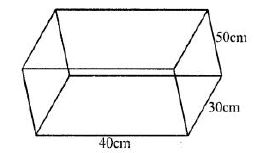
Question 11. A closed box is cuboid in shape with length = 40 cm, breadth = 30 cm and height = 50 cm. It is made of thin metal sheet. Find the cost of metal sheet required to make 20 such boxes, if 1 m2 of metal sheet costs Rs. 45.
Answer:
Given dimensions of the closed box:
Length \( (l) = 40\text{ cm} \)
Breadth \( (b) = 30\text{ cm} \)
Height \( (h) = 50\text{ cm} \)
The total surface area of one closed box is:
Total Surface Area \( = 2(lb + bh + hl) \)
\( = 2(40 \times 30 + 30 \times 50 + 50 \times 40)\text{ cm}^2 \)
\( = 2(1200 + 1500 + 2000)\text{ cm}^2 \)
\( = 2(4700)\text{ cm}^2 \)
\( = 9400\text{ cm}^2 \)
For 20 such boxes, the total area of the metal sheet used is:
Total Area \( = 9400 \times 20 = 188,000\text{ cm}^2 \)
Since the rate is given in terms of square meters, we convert the area into square meters:
Total Area in \( \text{m}^2 = \frac{188,000}{10,000} = 18.8\text{ m}^2 \)
(Since \( 1\text{ m}^2 = 100\text{ cm} \times 100\text{ cm} = 10,000\text{ cm}^2 \))
Now, the cost of the metal sheet at Rs. 45 per \( \text{m}^2 \) is:
Total Cost \( = 18.8 \times 45 \)
\( = \text{Rs. } 846 \
In simple words: Calculate the outer surface area of one box, multiply it by 20 to get the total area for all boxes, convert the result from square centimeters to square meters, and then multiply by the cost per square meter.
Exam Tip: Be careful with area conversion: divide by \( 10,000 \) (not 100) when converting from square centimeters to square meters.
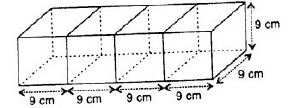
Question 12. Four cubes, each of edge 9 cm, are joined as shown below :
Write the dimensions of the resulting cuboid obtained. Also, find the total surface area and the volume of the resulting cuboid.
Answer:
(i) When four cubes of side \( 9\text{ cm} \) are placed end-to-end, the resulting cuboid has the following dimensions:
Length \( (l) = 9 \times 4 = 36\text{ cm} \)
Breadth \( (b) = 9\text{ cm} \)
Height \( (h) = 9\text{ cm} \)
(ii) The total surface area of this new cuboid is:
Total Surface Area \( = 2(lb + bh + hl) \)
\( = 2(36 \times 9 + 9 \times 9 + 9 \times 36) \)
\( = 2(324 + 81 + 324) \)
\( = 2(729) \)
\( = 1458\text{ cm}^2 \)
(iii) The volume of the resulting cuboid is:
Volume \( = l \times b \times h \)
\( = 36 \times 9 \times 9 \)
\( = 2916\text{ cm}^3 \
In simple words: When you line up four cubes side-by-side, only their total length changes (it becomes four times larger), while the width and height stay the same. Use these new dimensions to calculate the volume and area.
Exam Tip: You can also find the total surface area by realizing that 4 cubes have 24 total faces, but joining them covers 6 interfaces (which means 12 faces disappear), leaving exactly 12 exposed faces: \( 12 \times (9 \times 9) = 1458\text{ cm}^2 \).
Exercise 21(B)
Question 1. How many persons can be accommodated in a big-hall of dimensions 40 m, 25 m and 15 m ; assuming that each person requires 5 m3 of air?
Answer:
The dimensions of the hall are:
Length \( = 40\text{ m} \)
Breadth \( = 25\text{ m} \)
Height \( = 15\text{ m} \)
The total volume of the hall is calculated as:
Volume \( = L \times B \times H \)
\( = 40 \times 25 \times 15 \)
\( = 15000\text{ m}^3 \)
Given that the volume of air needed per person is \( 5\text{ m}^3 \).
The maximum number of people that can stay in the hall is:
Number of persons \( = \frac{\text{Total volume of the hall}}{\text{Air required per person}} \)
\( = \frac{15000}{5} \)
\( = 3000 \)
In simple words: Find the total amount of air inside the hall by multiplying its three dimensions. Then, divide this total air by the amount of air one person needs.
Exam Tip: Make sure to clearly state both formulas used: the volume of a cuboid and the formula for calculating the count of occupants.
Question 2. The dimension of a class-room are; length = 15 m, breadth = 12 m and height = 7.5 m. Find, how many children can be accommodated in this class-room ; assuming 3.6 m3 of air is needed for each child.
Answer:
The dimensions of the classroom are:
Length \( = 15\text{ m} \)
Breadth \( = 12\text{ m} \)
Height \( = 7.5\text{ m} \)
The total volume of the room is:
Volume \( = L \times B \times H \)
\( = 15 \times 12 \times 7.5 \)
\( = 1350\text{ m}^3 \)
Since each child requires \( 3.6\text{ m}^3 \) of air, the maximum number of children that can be accommodated is:
Number of children \( = \frac{\text{Volume of class room}}{\text{Volume of air needed for each child}} \)
\( = \frac{1350}{3.6} \)
\( = 375 \)
In simple words: First, find the room's volume by multiplying its length, width, and height. Then divide this total space by the space required for one child.
Exam Tip: If the final division results in a decimal, always round down to the nearest whole child, as you cannot accommodate a fraction of a child.
Question 3. The length, breadth and height of a room are 6 m, 5.4 m and 4 m respectively. Find the area of :
(i) its four-walls
(ii) its roof.
Answer:
The dimensions of the room are:
Length \( (L) = 6\text{ m} \)
Breadth \( (B) = 5.4\text{ m} \)
Height \( (H) = 4\text{ m} \)
(i) The area of the four walls is calculated using the formula:
Area of four walls \( = 2(L + B) \times H \)
\( = 2(6 + 5.4) \times 4 \)
\( = 2(11.4) \times 4 \)
\( = 22.8 \times 4 \)
\( = 91.2\text{ m}^2 \)
(ii) The area of the roof is equal to the area of the floor:
Area of the roof \( = L \times B \)
\( = 6 \times 5.4 \)
\( = 32.4\text{ m}^2 \)
In simple words: The four walls are like a perimeter band multiplied by the height. The ceiling is simply a single rectangle with the same area as the floor (length times width).
Exam Tip: Area of four walls is also known as the lateral surface area of the cuboid, with the formula \( 2h(l+b) \).
Question 4. A room 5 m long, 4.5 m wide and 3.6 m high has one door 1.5 m by 2.4 m and two windows, each 1 m by 0.75 m. Find :
(i) the area of its walls, excluding door and windows ;
(ii) the cost of distempering its walls at the rate of Rs.4.50 per m2 .
(iii) the cost of painting its roof at the rate of Rs.9 per m2 .
Answer:
Let's write down the dimensions of the room:
Length \( = 5\text{ m} \), Breadth \( = 4.5\text{ m} \), Height \( = 3.6\text{ m} \).
First, we calculate the total area of the four walls:
Area of four walls \( = 2(L + B) \times H \)
\( = 2(5 + 4.5) \times 3.6 \)
\( = 2(9.5) \times 3.6 \)
\( = 19 \times 3.6 \)
\( = 68.4\text{ m}^2 \)
Now, we calculate the areas of the openings:
Area of the door \( = 1.5 \times 2.4 = 3.60\text{ m}^2 \)
Area of one window \( = 1 \times 0.75 = 0.75\text{ m}^2 \)
Area of two windows \( = 2 \times 0.75 = 1.50\text{ m}^2 \)
Total area of openings \( = 3.60 + 1.50 = 5.1\text{ m}^2 \)
(i) The area of the walls excluding the door and windows is:
Net Area \( = 68.4 - 5.1 = 63.3\text{ m}^2 \)
(ii) The cost of distempering the net wall area at Rs. 4.50 per \( \text{m}^2 \):
Cost of distempering \( = 63.3 \times 4.50 = \text{Rs. } 284.85 \)
(iii) The area of the roof (ceiling) is:
Area of the roof \( = L \times B \)
\( = 5 \times 4.5 \)
\( = 22.5\text{ m}^2 \)
The cost of painting the roof at Rs. 9 per \( \text{m}^2 \):
Cost of painting \( = 22.5 \times 9 = \text{Rs. } 202.50 \)
In simple words: Find the total wall area and subtract the areas of the doors and windows. Multiply this remaining wall area by Rs. 4.50 to find the wall cost. For the roof, multiply the ceiling area (length times width) by Rs. 9.
Exam Tip: Be sure to multiply the single window area by 2 since the room has two windows, which is a common place to lose marks.
Question 5. The dining-hall of a hotel is 75 m long ; 60 m broad and 16 m high. It has five - doors 4 m by 3 m each and four windows 3 m by 1.6 m each. Find the cost of :
(i) papering its walls at the rate of Rs.12 per m2 ;
(ii) carpetting its floor at the rate of Rs.25 per m2 .
Answer:
The dimensions of the dining hall are:
Length \( (L) = 75\text{ m} \), Breadth \( (B) = 60\text{ m} \), Height \( (H) = 16\text{ m} \).
First, we find the total area of the four walls:
Area of four walls \( = 2(L + B) \times H \)
\( = 2(75 + 60) \times 16 \)
\( = 2(135) \times 16 \)
\( = 270 \times 16 \)
\( = 4320\text{ m}^2 \)
Next, we calculate the area occupied by the doors and windows:
Area of one door \( = 4 \times 3 = 12\text{ m}^2 \)
Area of 5 doors \( = 5 \times 12 = 60\text{ m}^2 \)
Area of one window \( = 3 \times 1.6 = 4.8\text{ m}^2 \)
Area of 4 windows \( = 4 \times 4.8 = 19.2\text{ m}^2 \)
Total excluded area \( = 60 + 19.2 = 79.2\text{ m}^2 \)
Now, we calculate the net area of the walls to be papered:
Net wall area \( = 4320 - 79.2 = 4240.8\text{ m}^2 \)
(i) Cost of papering the walls at Rs. 12 per \( \text{m}^2 \):
Cost \( = 4240.8 \times 12 = \text{Rs. } 50,889.60 \)
(ii) The area of the floor is:
Area of floor \( = L \times B \)
\( = 75 \times 60 \)
\( = 4500\text{ m}^2 \)
The cost of carpeting the floor at Rs. 25 per \( \text{m}^2 \):
Cost of carpeting \( = 4500 \times 25 = \text{Rs. } 112,500 \)
In simple words: Find the wall area and take away the area of 5 doors and 4 windows. Multiply the leftover wall area by 12 to get the papering cost. For the floor, multiply length by width, then multiply that area by 25.
Exam Tip: Be methodical: calculate individual doors and windows, multiply them by their respective counts, add them together, and only then subtract from the wall area.
Question 6. Find the volume of wood required to make a closed box of external dimensions 80 cm, 75 cm and 60 cm, the thickness of walls of the box being 2 cm throughout.
Answer:
The external dimensions of the closed box are:
External Length \( (L) = 80\text{ cm} \)
External Breadth \( (B) = 75\text{ cm} \)
External Height \( (H) = 60\text{ cm} \)
The external volume of the box is:
External Volume \( = 80 \times 75 \times 60 = 360,000\text{ cm}^3 \)
The thickness of the wood is \( 2\text{ cm} \). Since it is a closed box, we subtract twice the thickness (\( 2 \times 2 = 4\text{ cm} \)) from each external dimension to find the internal dimensions:
Internal Length \( (l) = 80 - 4 = 76\text{ cm} \)
Internal Breadth \( (b) = 75 - 4 = 71\text{ cm} \)
Internal Height \( (h) = 60 - 4 = 56\text{ cm} \)
The internal volume of the box is:
Internal Volume \( = 76 \times 71 \times 56 = 302,176\text{ cm}^3 \)
The volume of wood required is the difference between the external and internal volumes:
Volume of wood \( = \text{External Volume} - \text{Internal Volume} \)
\( = 360,000 - 302,176 \)
\( = 57,824\text{ cm}^3 \)
In simple words: To find the wood volume, calculate the entire box's outer volume, then subtract the empty volume inside. Since the walls are 2 cm thick on both sides, subtract 4 cm from the outside measurements to get the inside measurements.
Exam Tip: For closed boxes, always subtract twice the thickness (\( 2 \times t \)) from each external dimension to get the internal dimensions.
Question 7. A closed box measures 66 cm, 36 cm and 21 cm from outside. If its walls are made of metal-sheet, 0.5 cm thick ; find :
(i) the capacity of the box ;
(ii) volume of metal-sheet and
(iii) weight of the box, if 1 cm3 of metal weights 3.6 gm.
Answer:
Given external dimensions of the closed box:
External Length \( (L) = 66\text{ cm} \)
External Breadth \( (B) = 36\text{ cm} \)
External Height \( (H) = 21\text{ cm} \)
The external volume of the box is:
External Volume \( = 66 \times 36 \times 21 = 49,896\text{ cm}^3 \)
The sheet metal thickness is \( 0.5\text{ cm} \). Since the box is closed, we subtract twice the thickness (\( 2 \times 0.5 = 1\text{ cm} \)) from the external dimensions to obtain the internal dimensions:
Internal Length \( (l) = 66 - 1 = 65\text{ cm} \)
Internal Breadth \( (b) = 36 - 1 = 35\text{ cm} \)
Internal Height \( (h) = 21 - 1 = 20\text{ cm} \)
(i) The capacity of the box is the same as its internal volume:
Capacity \( = 65 \times 35 \times 20 = 45,500\text{ cm}^3 \)
(ii) The volume of the metal sheet used is the difference between the external and internal volumes:
Volume of metal sheet \( = \text{External Volume} - \text{Internal Volume} \)
\( = 49,896 - 45,500 \)
\( = 4396\text{ cm}^3 \)
(iii) The weight of the box is calculated based on the metal volume and its density:
Weight \( = \text{Volume of metal} \times 3.6\text{ gm} \)
\( = 4396 \times 3.6 \)
\( = 15,825.6\text{ gm} \)
(or \( 15.8256\text{ kg} \))
In simple words: The capacity is the inside volume of the box. Subtracting the inner space from the outer volume gives the volume of metal used, which is then multiplied by 3.6 to get the weight.
Exam Tip: Be precise with subtraction: twice of \( 0.5\text{ cm} \) is \( 1\text{ cm} \), so subtract exactly \( 1\text{ cm} \) from each outer dimension to get the inner dimensions.
Question 8. The internal length, breadth and height of a closed box are 1 m, 80 cm and 25 cm respectively. If its sides are made of 2.5 cm thick wood ; find :
(i) the capacity of the box
(ii) the volume of wood used to make the box.
Answer:
Given internal dimensions of the box:
Internal Length \( (l) = 1\text{ m} = 100\text{ cm} \)
Internal Breadth \( (b) = 80\text{ cm} \)
Internal Height \( (h) = 25\text{ cm} \)
(i) The capacity of the box is the internal volume:
Capacity \( = 100 \times 80 \times 25 = 200,000\text{ cm}^3 \)
To convert to cubic meters:
Capacity \( = \frac{200,000}{1,000,000}\text{ m}^3 = 0.2\text{ m}^3 \)
(ii) To find the volume of wood, we first calculate the external dimensions by adding twice the thickness of the wood (\( 2 \times 2.5 = 5\text{ cm} \)) to each internal dimension:
External Length \( (L) = 100 + 5 = 105\text{ cm} \)
External Breadth \( (B) = 80 + 5 = 85\text{ cm} \)
External Height \( (H) = 25 + 5 = 30\text{ cm} \)
The external volume of the box is:
External Volume \( = 105 \times 85 \times 30 = 267,750\text{ cm}^3 \)
The volume of wood used is:
Volume of wood \( = \text{External Volume} - \text{Internal Volume} \)
\( = 267,750 - 200,000 \)
\( = 67,750\text{ cm}^3 \)
To express this in cubic meters:
Volume of wood \( = \frac{67,750}{1,000,000}\text{ m}^3 = 0.06775\text{ m}^3 \)
In simple words: The internal capacity is length times width times height inside. To find the wood volume, add 5 cm (twice the wood thickness) to each inside size to get the outer dimensions, multiply them for outer volume, and subtract the inner volume.
Exam Tip: When internal dimensions are given, you must **add** twice the thickness to find the external dimensions, whereas you **subtract** it when starting from external dimensions.
Question 9. Find the area of metal-sheet required to make an open tank of length = 10 m, breadth = 7.5 m and depth = 3.8 m.
Answer:
Given dimensions of the open tank:
Length \( (L) = 10\text{ m} \)
Breadth \( (B) = 7.5\text{ m} \)
Depth (Height) \( (H) = 3.8\text{ m} \)
Since the tank is open at the top, the metal sheet is needed for the four side walls and the base floor:
Area of the four walls \( = 2(L + B) \times H \)
\( = 2(10 + 7.5) \times 3.8 \)
\( = 2(17.5) \times 3.8 \)
\( = 35 \times 3.8 \)
\( = 133\text{ m}^2 \)
Area of the floor \( = L \times B \)
\( = 10 \times 7.5 \)
\( = 75\text{ m}^2 \)
Total area of the metal sheet required is:
Total Area \( = \text{Area of four walls} + \text{Area of floor} \)
\( = 133 + 75 \)
\( = 208\text{ m}^2 \)
In simple words: Because the tank is open at the top, do not include the top lid. Calculate the area of the four side walls and add it to the area of the bottom floor.
Exam Tip: Be careful not to use the standard total surface area formula \( 2(lb+bh+hl) \) for open tanks; instead, use \( 2h(l+b) + lb \).
Question 10. A tank 30 m long, 24 m wide and 4.5 m deep is to be made. It is open from the top. Find the cost of iron-sheet required, at the rate of Rs. 65 per m2, to make the tank.
Answer:
Given dimensions of the open tank:
Length \( (L) = 30\text{ m} \)
Width \( (B) = 24\text{ m} \)
Depth \( (H) = 4.5\text{ m} \)
Since the tank is open at the top, the sheet area is the sum of the four walls and the bottom floor:
Area of the four walls \( = 2(L + B) \times H \)
\( = 2(30 + 24) \times 4.5 \)
\( = 2(54) \times 4.5 \)
\( = 108 \times 4.5 \)
\( = 486\text{ m}^2 \)
Area of the base floor \( = L \times B \)
\( = 30 \times 24 \)
\( = 720\text{ m}^2 \)
Total area of the iron sheet required is:
Total Area \( = 486 + 720 = 1206\text{ m}^2 \)
The cost of the iron sheet at the rate of Rs. 65 per \( \text{m}^2 \) is:
Total Cost \( = 1206 \times 65 \)
\( = \text{Rs. } 78,390 \)
In simple words: Since the tank has no top, add the area of its four walls to the area of the floor to find the total sheet metal needed. Then, multiply this total area by Rs. 65 to get the final cost.
Exam Tip: Make sure to state both the total area calculation steps and the final multiplication by the rate clearly to score full marks.
Exercise 21(C)
Question 1. The edges of three solid cubes are 6 cm, 8 cm and 10 cm. These cubes are melted and recast into a single cube. Find the edge of the resulting cube.
Answer:
The side of the first cube is 6 cm. Its volume is \( (6)^3 = 216\text{ cm}^3 \).
The side of the second cube is 8 cm. Its volume is \( (8)^3 = 512\text{ cm}^3 \).
The side of the third cube is 10 cm. Its volume is \( (10)^3 = 1000\text{ cm}^3 \).
Adding these values gives the total volume:
\( 216 + 512 + 1000 = 1728\text{ cm}^3 \).
Let the edge of the new large cube be \( a \). Its volume is \( a^3 \).
So, \( a^3 = 1728 \)
\( \implies a^3 = (12)^3 \)
\( \implies a = 12\text{ cm} \).
The side of the resulting cube is 12 cm.
In simple words: Find the volume of each small cube and add them up. This sum is the volume of the new, large cube. From this, we find its side length.
Exam Tip: Always remember that when solid shapes are melted to form a new shape, their total volume stays the same.
Question 2. Three solid cubes of edges 6 cm, 10 cm and x cm are melted to form a single cube of edge 12 cm, find the value of x.
Answer:
The side of the first cube is 6 cm. Its volume is \( (6)^3 = 216\text{ cm}^3 \).
The side of the second cube is 10 cm. Its volume is \( (10)^3 = 1000\text{ cm}^3 \).
The side of the third cube is \( x\text{ cm} \), so its volume is \( x^3\text{ cm}^3 \).
The side of the final big cube is 12 cm. The volume of this final cube is \( (12)^3 = 1728\text{ cm}^3 \).
Since the total volume remains equal:
\( 216 + 1000 + x^3 = 1728 \)
\( 1216 + x^3 = 1728 \)
\( \implies x^3 = 1728 - 216 - 1000 \)
\( \implies x^3 = 512 \)
\( \implies x^3 = (8)^3 \)
\( \implies x = 8\text{ cm} \).
So, the side of the third cube is 8 cm.
In simple words: The total volume of the three smaller cubes must equal the volume of the single large cube. We subtract the known volumes from the total volume to find the unknown cube's volume.
Exam Tip: Double check your calculations when cubing numbers. Knowing basic cubes from 1 to 12 helps you solve these questions much faster.
Question 3. The length of the diagonals of a cube is 8√3 cm. Find its: (i) edge (ii) total surface area (iii) Volume
Answer:
Let the edge of the cube be \( a \).
(i) The diagonal of a cube is given by \( a\sqrt{3} \).
Here, \( a\sqrt{3} = 8\sqrt{3}\text{ cm} \).
Dividing both sides by \( \sqrt{3} \):
\( \implies a = 8\text{ cm} \).
So, the edge of the cube is 8 cm.
(ii) The formula for the total surface area of a cube is \( 6a^2 \).
Substituting \( a = 8\text{ cm} \):
Total surface area = \( 6 \times (8)^2 = 6 \times 64 = 384\text{ cm}^2 \).
(iii) The formula for the volume of a cube is \( a^3 \).
Substituting \( a = 8\text{ cm} \):
Volume = \( (8)^3 = 512\text{ cm}^3 \).
In simple words: First, use the diagonal formula to find the side of the cube. Once you have the side, plug it into the formulas for surface area and volume.
Exam Tip: Remember the formula for the diagonal of a cube: \( d = \text{side} \times \sqrt{3} \). This is a very common shortcut tested in exams.
Question 4. A cube of edge 6 cm and a cuboid with dimensions 4 cm x x cm x 15 cm are equal in volume. Find: (i) the value of x. (ii) total surface area of the cuboid. (iii) total surface area of the cube. (iv) which of these two has greater surface and by how much?
Answer:
The side of the cube is 6 cm. Its volume = \( a^3 = (6)^3 = 216\text{ cm}^3 \).
The dimensions of the cuboid are \( 4\text{ cm} \times x\text{ cm} \times 15\text{ cm} \).
Its volume = \( \text{length} \times \text{breadth} \times \text{height} = 4 \times x \times 15 = 60x\text{ cm}^3 \).
Since both volumes are equal:
\( 60x = 216 \)
\( \implies x = \frac{216}{60} = \frac{36}{10} = 3.6\text{ cm} \).
(i) Thus, the value of \( x \) is 3.6 cm.
(ii) The formula for the total surface area of a cuboid is \( 2(lb + bh + hl) \).
Using \( l = 15\text{ cm} \), \( b = 4\text{ cm} \), and \( h = 3.6\text{ cm} \):
Total surface area = \( 2(4 \times 3.6 + 3.6 \times 15 + 15 \times 4) \)
= \( 2(14.4 + 54.0 + 60)\text{ cm}^2 \)
= \( 2(128.4) = 256.8\text{ cm}^2 \).
(iii) The formula for the total surface area of a cube is \( 6a^2 \).
Using \( a = 6\text{ cm} \):
Total surface area = \( 6 \times (6)^2 = 6 \times 36 = 216\text{ cm}^2 \).
(iv) Comparing the two surface areas:
Difference = \( 256.8 - 216 = 40.8\text{ cm}^2 \).
So, the cuboid has a larger surface area than the cube by \( 40.8\text{ cm}^2 \).
In simple words: Since both shapes have the same volume, we can set their volume formulas equal to find \( x \). Then, we use the respective surface area formulas to see which shape has more outer surface.
Exam Tip: When working with cuboids, always label the length, breadth, and height clearly before putting them into the surface area formula to avoid mixing them up.
Question 5. The capacity of a rectangular tank is 5.2 m3 and the area of its base is 2.6 x 104 cm2; find its height (depth).
Answer:
The volume of the rectangular tank is \( 5.2\text{ m}^3 \).
The base area is given as \( 2.6 \times 10^4\text{ cm}^2 \).
To change this area into square meters, we divide by \( 100 \times 100 \):
Base area = \( \frac{2.6 \times 10000}{100 \times 100} = 2.6\text{ m}^2 \).
The volume of a rectangular tank is \( \text{base area} \times \text{height} \).
Let \( h \) represent the height.
\( 2.6 \times h = 5.2 \)
\( \implies h = \frac{5.2}{2.6} = 2\text{ m} \).
Hence, the height (depth) of the tank is 2 meters.
In simple words: First, turn the base area from square centimeters into square meters. Then, divide the total volume by this base area to get the depth of the tank.
Exam Tip: Pay close attention to the units! Always convert all measurements into the same unit (like meters) before using any formula.
Question 6. The height of a rectangular solid is 5 times its width and its length is 8 times its height. If the volume of the wall is 102.4 cm3, find its length.
Answer:
Let the width of the rectangular solid be \( w\text{ cm} \).
The height is 5 times the width, so height = \( 5w\text{ cm} \).
The length is 8 times the height, so length = \( 8 \times 5w = 40w\text{ cm} \).
The volume of the rectangular solid is given as \( 102.4\text{ cm}^3 \).
Volume = \( \text{length} \times \text{width} \times \text{height} \)
\( 40w \times w \times 5w = 102.4 \)
\( 200w^3 = 102.4 \)
\( \implies w^3 = \frac{102.4}{200} \)
\( \implies w^3 = 0.512 \)
\( \implies w^3 = (0.8)^3 \)
\( \implies w = 0.8\text{ cm} \).
The width is 0.8 cm.
Now, we find the length:
Length = \( 40w = 40 \times 0.8 = 32\text{ cm} \).
In simple words: We write the height and length in terms of the width. Then we multiply them to find the volume, solve for the width, and use it to calculate the length.
Exam Tip: Make sure to express all three dimensions using a single variable like \( w \). This simplifies the volume equation to a single-variable cubic equation.
Question 7. The ratio between the lengths of the edges of two cubes are in the ratio 3 : 2. Find the ratio between their: (i) total surface area (ii) volume.
Answer:
Let the edge of the first cube be \( 3x \) and the edge of the second cube be \( 2x \).
(i) The total surface area of a cube is \( 6 \times (\text{edge})^2 \).
Total surface area of the first cube = \( 6 \times (3x)^2 = 6 \times 9x^2 = 54x^2 \).
Total surface area of the second cube = \( 6 \times (2x)^2 = 6 \times 4x^2 = 24x^2 \).
The ratio of their total surface areas = \( 54x^2 : 24x^2 = 54 : 24 = 9 : 4 \).
(ii) The volume of a cube is \( (\text{edge})^3 \).
Volume of the first cube = \( (3x)^3 = 27x^3 \).
Volume of the second cube = \( (2x)^3 = 8x^3 \).
The ratio of their volumes = \( 27x^3 : 8x^3 = 27 : 8 \).
In simple words: When finding ratios, you can square the side ratio to find the area ratio, and cube the side ratio to find the volume ratio.
Exam Tip: To save time, remember that if the ratio of the sides of two similar shapes is \( a : b \), the ratio of their areas is \( a^2 : b^2 \) and the ratio of their volumes is \( a^3 : b^3 \).
Question 8. The length, breadth and height of a cuboid (rectangular solid) are 4 : 3 : 2. (i) If its surface are is 2548 cm2, find its volume. (ii) If its volume is 3000 m3, find its surface area.
Answer:
Let the length, breadth, and height of the cuboid be \( 4x \), \( 3x \), and \( 2x \) respectively.
(i) The total surface area is \( 2(lb + bh + hl) \).
Total surface area = \( 2(4x \times 3x + 3x \times 2x + 2x \times 4x) \)
= \( 2(12x^2 + 6x^2 + 8x^2) \)
= \( 2 \times 26x^2 = 52x^2 \).
Given that the total surface area is \( 2548\text{ cm}^2 \):
\( 52x^2 = 2548 \)
\( \implies x^2 = \frac{2548}{52} = 49 \)
\( \implies x = 7\text{ cm} \).
Using \( x = 7\text{ cm} \), we can find the dimensions:
Length = \( 4 \times 7 = 28\text{ cm} \)
Breadth = \( 3 \times 7 = 21\text{ cm} \)
Height = \( 2 \times 7 = 14\text{ cm} \)
Volume = \( \text{length} \times \text{breadth} \times \text{height} \)
= \( 28 \times 21 \times 14 = 8232\text{ cm}^3 \).
(ii) If the volume is \( 3000\text{ m}^3 \):
\( 4x \times 3x \times 2x = 3000 \)
\( 24x^3 = 3000 \)
\( \implies x^3 = \frac{3000}{24} = 125 \)
\( \implies x^3 = (5)^3 \)
\( \implies x = 5\text{ m} \).
Using \( x = 5\text{ m} \), we get the dimensions:
Length = \( 4 \times 5 = 20\text{ m} \)
Breadth = \( 3 \times 5 = 15\text{ m} \)
Height = \( 2 \times 5 = 10\text{ m} \)
Now we calculate the total surface area:
Total surface area = \( 2(lb + bh + hl) \)
= \( 2(20 \times 15 + 15 \times 10 + 10 \times 20)\text{ m}^2 \)
= \( 2(300 + 150 + 200)\text{ m}^2 \)
= \( 2 \times 650 = 1300\text{ m}^2 \).
In simple words: Use the ratio to write the dimensions using an unknown factor \( x \). Then, use the given surface area or volume to solve for \( x \), find the dimensions, and calculate the other value.
Exam Tip: Be careful with units: part (i) uses centimeters while part (ii) uses meters. Keep your final answers in the correct corresponding units.
Exercise 21(D)
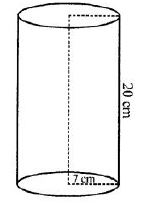
Question 1. The height of a circular cylinder is 20 cm and the diameter of its base is 14 cm. Find: (i) the volume (ii) the total surface area.
Answer:
The height of the cylinder \( h \) is 20 cm. The base diameter \( d \) is 14 cm.
The radius \( r \) is half of the diameter:
\( r = \frac{14}{2} = 7\text{ cm} \).
(i) The formula for the volume of a cylinder is \( \pi r^2 h \).
Substituting the values (using \( \pi = \frac{22}{7} \)):
Volume = \( \frac{22}{7} \times (7)^2 \times 20 \)
= \( \frac{22}{7} \times 7 \times 7 \times 20 \)
= \( 22 \times 7 \times 20 = 3080\text{ cm}^3 \).
(ii) The total surface area is given by \( 2\pi r(h + r) \).
Substituting the values:
Total surface area = \( 2 \times \frac{22}{7} \times 7 \times (20 + 7) \)
= \( 44 \times 27 = 1188\text{ cm}^2 \).
In simple words: First, divide the diameter by 2 to get the radius. Then, plug the radius and height into the standard cylinder formulas for volume and total surface area.
Exam Tip: Always convert diameters into radii first, as most cylinder formulas use the radius \( r \).
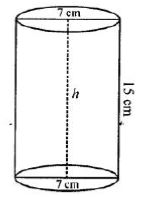
Question 2. Find the curved surface area and the total surface area of a right circular cylinder whose height is 15 cm and the diameter of the cross-section is 14 cm.
Answer:
The diameter of the cylinder base is 14 cm.
The radius \( r \) is \( \frac{14}{2} = 7\text{ cm} \).
The height \( h \) is 15 cm.
The formula for the curved surface area is \( 2\pi rh \).
Substituting the values:
Curved surface area = \( 2 \times \frac{22}{7} \times 7 \times 15 = 44 \times 15 = 660\text{ cm}^2 \).
The formula for the total surface area is \( 2\pi r(h + r) \).
Substituting the values:
Total surface area = \( 2 \times \frac{22}{7} \times 7 \times (15 + 7) \)
= \( 44 \times 22 = 968\text{ cm}^2 \).
In simple words: First, divide the cross-section diameter by 2 to get the radius. Then, calculate both surface areas using the respective formulas.
Exam Tip: Clearly distinguish between 'curved surface area' (only the side) and 'total surface area' (side plus top and bottom circles) in your exams.
Question 3. Find the height of the cylinder whose radius is 7 cm and the total surface area is 1100 cm2.
Answer:
Let the height of the cylinder be \( h\text{ cm} \).
The radius \( r \) is 7 cm, and the total surface area is \( 1100\text{ cm}^2 \).
The formula for the total surface area is:
\( 2\pi r(h + r) = 1100 \)
Substituting \( r = 7 \):
\( 2 \times \frac{22}{7} \times 7 \times (h + 7) = 1100 \)
\( 44(h + 7) = 1100 \)
\( \implies h + 7 = \frac{1100}{44} \)
\( \implies h + 7 = 25 \)
\( \implies h = 25 - 7 = 18\text{ cm} \).
Thus, the height of the cylinder is 18 cm.
In simple words: We write down the formula for the total surface area and fill in the radius we know. Then, we solve the algebraic equation to find the missing height.
Exam Tip: When dividing \( 1100 \) by \( 44 \), look for common factors like \( 11 \) to simplify the division quickly in your head.
Question 4. The curved surface area of a cylinder of height 14 cm is 88 cm2. Find the diameter of the base of the cylinder.
Answer:
Let the base radius of the cylinder be \( r\text{ cm} \).
The height \( h \) is 14 cm.
The curved surface area of the cylinder is \( 88\text{ cm}^2 \).
Using the formula for curved surface area:
\( 2\pi rh = 88 \)
Substituting the values:
\( 2 \times \frac{22}{7} \times r \times 14 = 88 \)
\( 2 \times 22 \times r \times 2 = 88 \)
\( 88r = 88 \)
\( \implies r = 1\text{ cm} \).
The base diameter is twice the radius:
Diameter = \( 2 \times r = 2 \times 1 = 2\text{ cm} \).
In simple words: We set up the formula for curved surface area, plug in the height, and solve for the radius. Finally, we multiply this radius by 2 to get the diameter.
Exam Tip: Be careful: the question asks for the diameter, not the radius. Always read the final line of the question twice to ensure you answer what is asked.
Question 5. The ratio between the curved surface area and the total surface area of a cylinder is 1 : 2. Find the ratio between the height and the radius of the cylinder.
Answer:
Let the radius and the height of the cylinder be \( r \) and \( h \) respectively.
The curved surface area is \( 2\pi rh \).
The total surface area is \( 2\pi r(h + r) \).
The ratio between these two areas is \( 1 : 2 \):
\( \frac{2\pi rh}{2\pi r(h + r)} = \frac{1}{2} \)
We can cancel the common terms \( 2\pi r \) from both the numerator and denominator:
\( \frac{h}{h + r} = \frac{1}{2} \)
Cross-multiplying:
\( 2h = h + r \)
Subtracting \( h \) from both sides:
\( \implies h = r \)
\( \implies \frac{h}{r} = \frac{1}{1} \).
So, the ratio between the height and the radius is \( 1 : 1 \).
In simple words: We write the ratio of the two surface area formulas. After canceling common terms, we cross-multiply and find that height is equal to the radius.
Exam Tip: Simplifying ratios by canceling common algebraic terms first makes solving ratio problems extremely straightforward.
Question 6. Find the capacity of a cylindrical container with internal diameter 28 cm and height 20 cm.
Answer:
The diameter of the cylinder is 28 cm.
The radius \( r \) is \( \frac{28}{2} = 14\text{ cm} \).
The height \( h \) is 20 cm.
The volume (capacity) is given by \( \pi r^2 h \).
Substituting the values:
Volume = \( \frac{22}{7} \times 14 \times 14 \times 20 \)
= \( 22 \times 2 \times 14 \times 20 \)
= \( 44 \times 280 = 12320\text{ cm}^3 \).
In simple words: To find the capacity, we calculate the volume. We divide the diameter by 2 to get the radius, and then use the cylinder volume formula.
Exam Tip: Capacity is another word for volume. If the question asks for capacity in liters, you would divide the cubic centimeters by 1000.
Question 7. The total surface area of a cylinder is 6512 cm2 and the circumference of its bases is 88 cm. Find: (i) its radius (ii) its volume.
Answer:
Let the base radius be \( r \) and the height be \( h \).
(i) The circumference of the base is given by \( 2\pi r \).
We are given:
\( 2\pi r = 88\text{ cm} \)
\( 2 \times \frac{22}{7} \times r = 88 \)
\( \frac{44}{7} \times r = 88 \)
\( \implies r = 88 \times \frac{7}{44} \)
\( \implies r = 14\text{ cm} \).
So, the radius is 14 cm.
(ii) The total surface area of the cylinder is \( 6512\text{ cm}^2 \).
The formula is:
\( 2\pi r(h + r) = 6512 \)
Substituting the values \( 2\pi r = 88 \) and \( r = 14 \):
\( 88(h + 14) = 6512 \)
\( \implies h + 14 = \frac{6512}{88} \)
\( \implies h + 14 = 74 \)
\( \implies h = 74 - 14 = 60\text{ cm} \).
Now we can find the volume:
Volume = \( \pi r^2 h \)
= \( \frac{22}{7} \times 14 \times 14 \times 60 \)
= \( 22 \times 2 \times 14 \times 60 \)
= \( 44 \times 840 = 36960\text{ cm}^3 \).
In simple words: Use the circumference to solve for the radius first. Next, substitute the radius and the circumference into the total surface area formula to find the height, and then calculate the volume.
Exam Tip: Instead of recalculating \( 2\pi r \), notice that \( 2\pi r \) is the same as the given circumference, \( 88\text{ cm} \). Substituting this directly saves computation time.
Question 8. The sum of the radius and the height of a cylinder is 37 cm and the total surface area of the cylinder is 1628 cm2. Find the height and the volume of the cylinder.
Answer:
Let \( r \) be the radius and \( h \) be the height.
We are given:
\( r + h = 37\text{ cm} \)
And the total surface area is:
\( 2\pi r(r + h) = 1628\text{ cm}^2 \)
Substituting \( r + h = 37 \):
\( 2\pi r \times 37 = 1628 \)
\( 2 \times \frac{22}{7} \times r \times 37 = 1628 \)
\( \implies r = \frac{1628 \times 7}{2 \times 22 \times 37} \)
\( \implies r = 7\text{ cm} \).
Since \( r + h = 37 \):
\( 7 + h = 37 \)
\( \implies h = 30\text{ cm} \).
Now we calculate the volume:
Volume = \( \pi r^2 h \)
= \( \frac{22}{7} \times (7)^2 \times 30 \)
= \( \frac{22}{7} \times 7 \times 7 \times 30 \)
= \( 22 \times 7 \times 30 = 4620\text{ cm}^3 \).
In simple words: We know the sum of radius and height is 37. We plug 37 directly into the total surface area formula to find the radius, and then calculate height and volume.
Exam Tip: In algebraic geometry problems, look for direct substitutions like \( r + h = 37 \) to simplify complex-looking products immediately.
Question 9. A cylindrical pillar has radius 21 cm and height 4 m. Find : (i) the curved surface area of the pillar (ii) cost of polishing 36 such cylindrical pillars at the rate of Rs. 12 per m2.
Answer:
Radius of the cylinder = 21 cm = 0.21 m.
Height = 4 m.
(i) Curved surface area of one pillar = \( 2\pi rh \)
= \( 2 \times \frac{22}{7} \times 0.21 \times 4 \)
= \( 2 \times 22 \times 0.03 \times 4 = 5.28\text{ m}^2 \).
(ii) Total area of 36 pillars = \( 36 \times 5.28 = 190.08\text{ m}^2 \).
At the rate of Rs. 12 per m^2:
Total cost of polishing = \( 190.08 \times 12 = \text{Rs. } 2280.96 \).
In simple words: First, convert the radius from centimeters to meters. Then, find the curved surface area of one pillar, multiply it by 36, and calculate the total cost at Rs. 12 per square meter.
Exam Tip: Double check that all units are in meters (m) before calculating costs that are given per square meter.
Question 10. If radii of two cylinders are in the ratio 4 : 3 and their heights are in the ratio 5 : 6, find the ratio of their curved surfaces.
Answer:
Let the radii of the two cylinders be \( r_1 \) and \( r_2 \), and their heights be \( h_1 \) and \( h_2 \) respectively.
We are given:
\( \frac{r_1}{r_2} = \frac{4}{3} \)
\( \frac{h_1}{h_2} = \frac{5}{6} \)
The formula for the curved surface area is \( 2\pi rh \).
The ratio of their curved surface areas is:
\( \frac{2\pi r_1 h_1}{2\pi r_2 h_2} = \frac{r_1}{r_2} \times \frac{h_1}{h_2} \)
Substituting the given ratios:
\( \frac{4}{3} \times \frac{5}{6} = \frac{20}{18} = \frac{10}{9} \).
So, the ratio between their curved surface areas is \( 10 : 9 \).
In simple words: To find the ratio of the surface areas, we multiply the ratio of their radii by the ratio of their heights.
Exam Tip: In ratio questions, constants like \( 2\pi \) cancel out. You only need to multiply the variable ratios directly.
Exercise 21(E)
Question 1. A cuboid is 8 m long, 12 m broad and 3.5 high, Find its (i) total surface area (ii) lateral surface area
Answer:
The cuboid's dimensions are:
Length \( l = 8\text{ m} \)
Breadth \( b = 12\text{ m} \)
Height \( h = 3.5\text{ m} \)
(i) The total surface area is \( 2(lb + bh + hl) \).
Substituting the values:
Total surface area = \( 2(8 \times 12 + 12 \times 3.5 + 3.5 \times 8) \)
= \( 2(96 + 42 + 28) \)
= \( 2 \times 166 = 332\text{ m}^2 \).
(ii) The lateral surface area is \( 2h(l + b) \).
Substituting the values:
Lateral surface area = \( 2 \times 3.5 \times (8 + 12) \)
= \( 7 \times 20 = 140\text{ m}^2 \).
In simple words: Plug the dimensions into the respective formulas for total surface area and lateral (side-only) surface area.
Exam Tip: Remember that lateral surface area only includes the four vertical walls, excluding the top and bottom faces.
Question 2. How many bricks will be required for constructing a wall which is 16 m long, 3 m high and 22.5 cm thick, if each brick measures 25 cm x 11.25 cm x 6 cm ?
Answer:
First, convert all the dimensions of the wall into centimeters:
Length of the wall = \( 16\text{ m} = 16 \times 100 = 1600\text{ cm} \)
Height of the wall = \( 3\text{ m} = 3 \times 100 = 300\text{ cm} \)
Thickness (breadth) of the wall = 22.5 cm.
Now, calculate the volume of the wall:
Volume of the wall = \( 1600 \times 300 \times 22.5 = 1,08,00,000\text{ cm}^3 \).
Next, find the volume of a single brick:
Dimensions of a brick = \( 25\text{ cm} \times 11.25\text{ cm} \times 6\text{ cm} \)
Volume of one brick = \( 25 \times 11.25 \times 6 = 1687.5\text{ cm}^3 \).
To find the total number of bricks:
Number of bricks = \( \frac{\text{Volume of the wall}}{\text{Volume of one brick}} \)
= \( \frac{1,08,00,000}{1687.5} = 6400 \).
In simple words: Convert all units to centimeters first. Find the total volume of the wall and divide it by the volume of one brick to get the number of bricks needed.
Exam Tip: Be extremely careful when dividing large numbers like \( 1,08,00,000 \) by decimal values. Convert the denominator into a fraction to simplify calculations.
Question 3. The length, breadth and height of cuboid are in the ratio 6 : 5 : 3. If its total surface area is 504 cm2, find its volume.
Answer:
Let the length, breadth, and height of the cuboid be \( 6x \), \( 5x \), and \( 3x \) respectively.
The total surface area is given by:
Total surface area = \( 2(lb + bh + hl) \)
= \( 2(6x \times 5x + 5x \times 3x + 3x \times 6x) \)
= \( 2(30x^2 + 15x^2 + 18x^2) \)
= \( 2 \times 63x^2 = 126x^2 \).
Given that the total surface area is \( 504\text{ cm}^2 \):
\( 126x^2 = 504 \)
\( \implies x^2 = \frac{504}{126} = 4 \)
\( \implies x = 2\text{ cm} \).
Using \( x = 2\text{ cm} \), we find the dimensions:
Length = \( 6 \times 2 = 12\text{ cm} \)
Breadth = \( 5 \times 2 = 10\text{ cm} \)
Height = \( 3 \times 2 = 6\text{ cm} \)
Now we calculate the volume:
Volume = \( \text{length} \times \text{breadth} \times \text{height} \)
= \( 12 \times 10 \times 6 = 720\text{ cm}^3 \).
In simple words: Write the dimensions as \( 6x \), \( 5x \), and \( 3x \). Solve for \( x \) using the surface area, then find the actual dimensions and multiply them to get the volume.
Exam Tip: Always substitute \( x \) back into the expressions for length, breadth, and height before calculating the volume.
Question 4. The external dimensions of an open wooden box are 65 cm, 34 cm and 25 cm. If the box is made up of wood 2 cm thick, find the capacity of the box and the volume of wood used to make it.
Answer:
The outer dimensions of the open box are:
Outer length = 65 cm
Outer breadth = 34 cm
Outer height = 25 cm
Outer volume = \( 65 \times 34 \times 25 = 55250\text{ cm}^3 \).
Since the box has thickness 2 cm and is open at the top, the inner dimensions are:
Inner length = \( 65 - (2 \times 2) = 61\text{ cm} \)
Inner breadth = \( 34 - (2 \times 2) = 30\text{ cm} \)
Inner height = \( 25 - 2 = 23\text{ cm} \) (since there is no lid).
The capacity (inner volume) of the box is:
Capacity = \( 61 \times 30 \times 23 = 42090\text{ cm}^3 \).
The volume of the wood used is:
Volume of wood = \( \text{Outer volume} - \text{Inner volume} \)
= \( 55250 - 42090 = 13160\text{ cm}^3 \).
In simple words: An open box has wood on both ends of the length and breadth, but only at the bottom of the height. Subtracting the inner volume from the outer volume gives the volume of the wood.
Exam Tip: For an 'open' box, remember to subtract the thickness only once from the height, but twice from the length and breadth.
Question 5. The curved surface area and the volume of a toy, cylindrical in shape, are 132 cm2 and 462 cm3 respectively. Find, its diameter and its length.
Answer:
Let \( r \) be the radius and \( h \) be the height (length) of the cylinder.
We are given:
Curved surface area = \( 2\pi rh = 132\text{ cm}^2 \)
Volume = \( \pi r^2 h = 462\text{ cm}^3 \)
Divide the volume by the curved surface area:
\( \frac{\text{Volume}}{\text{Curved Surface Area}} = \frac{\pi r^2 h}{2\pi rh} = \frac{r}{2} \)
Substituting the given values:
\( \frac{r}{2} = \frac{462}{132} \)
\( \implies r = 2 \times \frac{462}{132} \)
\( \implies r = 7\text{ cm} \).
The diameter of the toy is:
Diameter = \( 2r = 2 \times 7 = 14\text{ cm} \).
Now, substitute \( r = 7\text{ cm} \) into the curved surface area formula to find \( h \):
\( 2 \times \frac{22}{7} \times 7 \times h = 132 \)
\( 44h = 132 \)
\( \implies h = \frac{132}{44} = 3\text{ cm} \).
Hence, the diameter of the cylindrical toy is 14 cm, and its length is 3 cm.
In simple words: Dividing the volume of a cylinder by its curved surface area gives half of the radius. This is a quick way to find the radius and then calculate the height.
Exam Tip: Using the ratio of volume to curved surface area (\( \frac{V}{\text{CSA}} = \frac{r}{2} \)) is a brilliant shortcut that avoids messy quadratic or high-degree algebra.
Question 6. The floor of a rectangular hall has a perimeter 250 m. If the cost of painting the four walls at the rate of Rs. 10 per m2 is Rs. 15,000, find the height of the hall.
Answer:
Let the length, breadth, and height of the hall be \( l \), \( b \), and \( h \) meters.
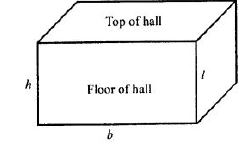
The perimeter of the floor is given as \( 250\text{ m} \):
\( 2(l + b) = 250\text{ m} \).
The area of the four walls is the same as the lateral surface area of the cuboid:
Area of four walls = \( 2h(l + b) \).
Since \( 2(l + b) = 250 \), we can substitute this directly:
Area of four walls = \( h \times 2(l + b) = 250h\text{ m}^2 \).
The cost of painting the four walls is Rs. 10 per square meter, totaling Rs. 15,000:
\( \text{Total Cost} = \text{Area} \times \text{Rate} \)
\( 15000 = 250h \times 10 \)
\( 15000 = 2500h \)
\( \implies h = \frac{15000}{2500} = 6\text{ m} \).
Thus, the height of the hall is 6 meters.
In simple words: The area of the four walls is the floor's perimeter multiplied by the height. We divide the total painting cost by the rate to find the wall area, and then solve for height.
Exam Tip: Remember that the formula for the area of four walls is \( \text{Perimeter of base} \times \text{height} \). This shortcut makes solving wall painting problems very quick.
Question 7. The length of a hall is double its breadth. Its height is 3 m. The area of its four walls (including doors and windows) is 108 m2, find its volume.
Answer:
Let the breadth of the hall be \( x\text{ m} \).
The length of the hall is double the breadth, so length = \( 2x\text{ m} \).
The height \( h \) is 3 m.
The area of the four walls is given as \( 108\text{ m}^2 \).
Using the formula for the area of four walls:
\( 2(l + b)h = 108 \)
Substituting the given values:
\( 2(2x + x) \times 3 = 108 \)
\( 6 \times (3x) = 108 \)
\( 18x = 108 \)
\( \implies x = \frac{108}{18} = 6\text{ m} \).
Thus, the breadth of the hall is 6 m, and the length is:
Length = \( 2 \times 6 = 12\text{ m} \).
Now, we calculate the volume:
Volume = \( \text{length} \times \text{breadth} \times \text{height} \)
= \( 12 \times 6 \times 3 = 216\text{ m}^3 \).
In simple words: We write length and breadth using a variable \( x \) and plug them into the four-wall area formula. We find \( x \), calculate the actual dimensions, and multiply them to get the volume.
Exam Tip: Always read carefully whether the wall area includes doors and windows. Since it does here, you can use the standard lateral surface area formula directly.
Question 8. A solid cube of side 12 cm is cut into 8 identical cubes. What will be the side of the new cube? Also, find the ratio between the surface area of the original cube and the total surface area of all the small cubes formed.
Answer:
Let the side of the original large cube be \( L = 12\text{ cm} \).
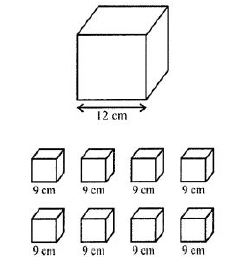
Its volume is \( L^3 = (12)^3 = 1728\text{ cm}^3 \).
This cube is cut into 8 identical smaller cubes. Let the side of each smaller cube be \( a\text{ cm} \).
The volume of 8 smaller cubes is \( 8 \times a^3 \).
Since the total volume remains the same:
\( 8 \times a^3 = 1728 \)
\( \implies a^3 = \frac{1728}{8} = 216 \)
\( \implies a^3 = (6)^3 \)
\( \implies a = 6\text{ cm} \).
So, the side of each new smaller cube is 6 cm.
Now we find the ratio of their surface areas:
Surface area of the original cube = \( 6 \times L^2 = 6 \times (12)^2 \).
Total surface area of all 8 smaller cubes = \( 8 \times 6 \times a^2 = 8 \times 6 \times (6)^2 \).
Ratio = \( \frac{\text{Surface area of original cube}}{\text{Total surface area of all small cubes}} \)
= \( \frac{6 \times 12 \times 12}{8 \times 6 \times 6 \times 6} \)
= \( \frac{144}{8 \times 36} = \frac{144}{288} = \frac{1}{2} = 1 : 2 \).
In simple words: Find the volume of the large cube and divide it by 8 to get the volume of one small cube. Take the cube root to find the small cube's side, then calculate the ratio of their surface areas.
Exam Tip: When a solid is cut into multiple pieces, the total surface area increases even though the total volume remains unchanged. Keep this in mind when checking your area ratios.
Question 9. The diameter of a garden roller is 1.4 m and it 2 m long. Find the maximum area covered by it 50 revolutions?
Answer:
The diameter of the roller is 1.4 m.
The radius \( r = \frac{1.4}{2} = 0.7\text{ m} \).
The length \( h \) is 2 m.
The area rolled in one revolution is equal to the curved surface area of the cylinder:
Curved surface area = \( 2\pi rh \)
= \( 2 \times \frac{22}{7} \times 0.7 \times 2 = 8.8\text{ m}^2 \).
The total area covered in 50 revolutions is:
Total area = \( 8.8 \times 50 = 440\text{ m}^2 \).
In simple words: A roller covers an area equal to its curved surface area in one full turn. Multiply this area by 50 to find the total ground covered.
Exam Tip: Rollers only touch the ground with their curved side. Therefore, you must use the curved surface area formula, not the total surface area.
Question 10. In a building, there are 24 cylindrical pillars. For each pillar, radius is 28 m and height is 4 m. Find the total cost of painting the curved surface area of the pillars at the rate of Rs. 8 per m2.
Answer:
The radius \( r \) of one pillar is 28 m, and the height \( h \) is 4 m.
The curved surface area of a single cylindrical pillar is:
Curved surface area = \( 2\pi rh \)
= \( 2 \times \frac{22}{7} \times 28 \times 4 \)
= \( 2 \times 22 \times 4 \times 4 = 704\text{ m}^2 \).
The total curved surface area of 24 such pillars is:
Total surface area = \( 24 \times 704 = 16896\text{ m}^2 \).
The rate for painting is Rs. 8 per square meter.
Total cost = \( 16896 \times 8 = \text{Rs. } 135168 \).
In simple words: First find the curved surface area of one pillar and multiply it by 24 to get the total area. Then, multiply this total area by the rate of Rs. 8 to get the final cost.
Exam Tip: When painting columns or pillars, only the curved sides are painted (as the top and bottom are connected to the ceiling and floor). Always use curved surface area.
Complete Guide and Answers: Class 8 Mathematics Chapter 21 Surface Area Volume and Capacity Cuboid Cube and Cylinder
Download ICSE Answers for Class 8 Mathematics Chapter 21 Surface Area Volume and Capacity Cuboid Cube and Cylinder
Strengthen your preparation with comprehensive answers for Class 8 Mathematics Chapter 21 Surface Area Volume and Capacity Cuboid Cube and Cylinder. These expert-reviewed solutions make tracking your academic progress straightforward and efficient.
Detailed Problem Solving for ICSE Class 8 Mathematics
Tackle complex theorems and numerical problems easily by cross-referencing your working steps with our structured solution guides.
Next Steps in Your Class 8 Mathematics Preparation
Wrap up your chapter revision by verifying core concepts against standard ICSE question formats. All resources on our platform are free to access.
FAQs
You can download the verified Selina Concise solutions for Chapter 21 Surface Area Volume and Capacity Cuboid Cube and Cylinder on StudiesToday.com. Our teachers have prepared answers for Class 8 Mathematics as per 2026-27 ICSE academic session.
Yes, our solutions for Chapter 21 Surface Area Volume and Capacity Cuboid Cube and Cylinder are designed as per new 2026 ICSE standards. 40% competency-based questions required for Class 8, are included to help students understand application-based logic behind every Mathematics answer.
Yes, every exercise in Chapter 21 Surface Area Volume and Capacity Cuboid Cube and Cylinder from the Selina Concise textbook has been solved step-by-step. Class 8 students will learn Mathematics conceots before their ICSE exams.
Yes, follow structured format of these Selina Concise solutions for Chapter 21 Surface Area Volume and Capacity Cuboid Cube and Cylinder to get full 20% internal assessment marks and use Class 8 Mathematics projects and viva preparation as per ICSE 2026 guidelines.