

Class 8 History Civics Chapter 08 The Great Uprising of 1857: Selina Concise Study Material
Explore the complete Selina Concise textbook solutions for Class 8 History Civics. Tailored for the 2026-27 curriculum, this resource breaks down complex topics to support daily study and targeted revision.
Chapter 08 The Great Uprising of 1857 Answer Guide
Navigate directly to the Chapter 08 The Great Uprising of 1857 solutions using the digital viewer below. Organizing your study sessions chapter-by-chapter allows for seamless offline study and quick reference during revision.
I. Fill in the blanks:
(1) By his policy of Doctrine of Lapse Lord Dalhousie annexed Nagpur and Jhansi.
(2) Rani Laxmibai captured Gwalior with Tantya Tope’s help.
(3) In Lucknow Hazrat Mahal led the revolt.
(4) The rebels proclaimed Bahadur Shah Zafar as the emperor of India.
Answer:
(1) Lord Dalhousie took control of Nagpur and Jhansi using his Doctrine of Lapse policy.
(2) Rani Laxmibai took control of Gwalior by getting help from Tantya Tope.
(3) Hazrat Mahal was the leader who guided the rebellion in Lucknow.
(4) Bahadur Shah Zafar was declared the ruler of India by the mutineers.
In simple words: These lines tell us who the main leaders were and which territories were taken over during the rebellion.
Exam Tip: Pay close attention to spelling proper nouns like Lord Dalhousie, Hazrat Mahal, and Tantya Tope to avoid losing marks.
II. Match the contents of Column A and Column B:
| Column A | Column B |
|---|---|
| 1. Jhansi | (a) Nana Saheb |
| 2. Kanpur | (b) rifle |
| 3. Enfield | (c) Rani Laxmibai |
| 4. Raja of Jodhpur | (d) exiled to Rangoon |
| 5. Bahadur | (e) did not join the revolt |
Answer:
| Column A | Column B (Matched) |
|---|---|
| 1. Jhansi | (c) Rani Laxmibai |
| 2. Kanpur | (a) Nana Saheb |
| 3. Enfield | (b) rifle |
| 4. Raja of Jodhpur | (e) did not join the revolt |
| 5. Bahadur | (d) exiled to Rangoon |
In simple words: This table matches key historical figures, places, and events with their correct roles during the uprising.Exam Tip: Match the Enfield option directly to rifle, and associate historical figures with their respective home regions to solve match-the-following questions correctly.
III. State whether the following statements are True or False:
(1) Awadh was annexed on the ground of malad-ministration.
(2) The British supported Sati.
(3) The Indian soldiers were given lesser salary as compared to their British counterparts.
(4) The Revolt of 1857 did not involve the masses.
Answer:
(1) True (The British took over Awadh by saying the state was poorly managed).
(2) False (The British made laws to stop Sati rather than supporting it).
(3) True (Indian soldiers faced unfair pay and were paid much less than British soldiers).
(4) True (The rebellion mostly remained confined to soldiers, affected rulers, and specific regions, rather than the entire common public).
In simple words: These statements help us understand key facts about British rules and how different groups reacted to them.
Exam Tip: If a statement says the British supported a local practice, recall whether they banned it (like Sati) or supported it to get the correct True/False answer.
Question 1. How were the economic policies of the British responsible for the Revolt of 1857?
Answer: The British completely altered India's economic system.
1. They brought in a new land tax system. This let them seize land if taxes were not paid in cash, making farmers suffer.
2. British machine-made items flooded local markets because of the Industrial Revolution. Local Indian businesses could not compete and shut down.
3. When the British took over an Indian state, they fired local workers and replaced them with company staff, leading to job loss and anger.
In simple words: British rules took away lands from farmers, destroyed local business with factory goods, and made people lose their jobs, leading to the revolt.
Exam Tip: Remember to list three main areas of economic damage: land taxes, decline of handicrafts, and job losses from annexation.
Question 2. Discuss the social and religious causes responsible for the Revolt of 1857.
Answer:
1. The British introduced laws to stop traditional practices like Sati, child marriage, and female infanticide, while allowing widows to remarry. Many Indians felt this was an unwanted entry into their religious practices.
2. People looked at new technologies like the telegraph and trains with worry and doubt.
3. The teaching of Western ideas in schools was seen as a direct threat to ancient Indian values and culture.
4. The British treated Indians poorly based on race, which created deep anger among the people.
In simple words: The British tried to change local customs, brought in strange technologies, and treated Indians with disrespect, making people angry.
Exam Tip: Divide your answer into points covering social reforms, western education, new technologies, and racial bias for maximum marks.
Question 3. Why do you think the Revolt of 1857 failed? Discuss four causes for its failure.
Answer:
1. Even though the rebellion was large, it did not unite all groups of people across India.
2. Major rulers like Holkar, Scindia, and the Raja of Jodhpur helped the British instead of the rebels. Rich traders and educated middle-class groups also stayed away.
3. British troops had superior weapons and highly skilled generals. Indian soldiers fought with old weapons and lacked unified, experienced leaders.
4. The rebels ran short of funds and war supplies, while the British had massive financial and military backing.
5. The uprising lacked coordination and careful planning.
6. The British used the telegraph and postal service to send quick messages, plan moves, and respond fast.
In simple words: The rebels did not have good weapons, enough money, or a clear plan, and many Indian rulers chose to help the British instead.
Exam Tip: When asked for four causes, choose the easiest ones to remember, like lack of unity, modern British weapons, and poor planning.
Question 4. Discuss the nature of the Uprising/Revolt of 1857.
Answer: People hold different opinions about what kind of event the 1857 rebellion was.
- Many British writers and some Indian witnesses of that time, like Munshi Jiwan Lal and Durgadas Bandopadhyaya, saw it merely as a military mutiny that lacked support from common citizens.
- Some describe the event as a racial conflict between the local people and European rulers.
- Others saw it as a clash between Eastern and Western cultures.
- Some believed it was a combined plan by Hindus and Muslims to end foreign rule.
- Many Indian historians proudly call it a well-organized effort and the "first war of Indian Independence."
In simple words: Some people see the revolt as a simple soldier protest, while others call it the first big fight for India's freedom.
Exam Tip: Be sure to mention both viewpoints: the British view (military mutiny) and the Indian view (first war of independence).
V. Give reasons why:
(1) State of Awadh was annexed by the British.
(2) Indian artisans, weavers and craftsmen lost their means of livelihood.
(3) The Indian sepoys refused to bite the cartridges of the Enfield rifle.
Answer:
(1) The British took over Awadh by claiming that the local government was being run poorly.
(2) The rise of factories in Britain flooded Indian markets with cheap, machine-made clothes and goods. Local craftsmen and weavers could not compete with these prices.
(3) Soldiers heard a rumor that the rifle cartridges used grease made from pig and cow fat. Since cows are sacred to Hindus and pigs are forbidden to Muslims, biting these cartridges hurt their religious feelings.
In simple words: These reasons explain why local rulers, workers, and soldiers became extremely angry with British rule.
Exam Tip: For the cartridge reason, clearly state why the cow and the pig are sensitive religious symbols to Hindus and Muslims respectively.
VI. Picture Study
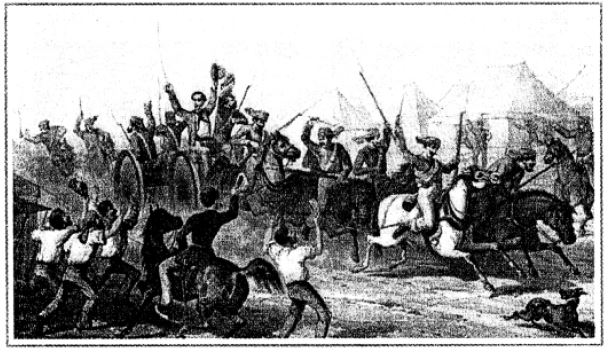
Question 1. How far were the greased cartridges responsible for the Revolt?
Answer: The greased cartridges acted as the immediate trigger that set off the rebellion. Deep anger had already built up among Indians due to harsh taxes, forceful land takeovers, and interference in local traditions. The belief that the cartridges used cow and pig fat was the final straw that united Hindu and Muslim soldiers in revolt.
In simple words: The cartridges were the final spark. The main anger had already built up over a long time due to unfair rules.
Exam Tip: Use terms like "immediate cause" and "underlying causes" to show the examiner you understand the difference between the final spark and long-term problems.
Question 2. Give your opinion as to how the Revolt would have been successful.
Answer: The uprising might have succeeded if there had been a clear, unified plan from the start. It also needed active support from wealthy landlords, traders, and the educated middle class. Furthermore, Indian fighters required modern weapons and highly skilled military leaders to match the British forces.
In simple words: The revolt could have succeeded with a better plan, support from more groups, and better weapons.
Exam Tip: Express this answer as positive solutions to the causes of failure, such as replacing poor weapons with modern ones and adding unified planning.
Additional Questions
Question A. Fill in the blanks:
(1) Dalhousie annexed the states of Satara, Nagpur, and Jhansi on the basis of the Doctrine of Lapse.
(2) Prior to the outbreak of the Revolt, Bahadur Shah Zafar lived in Delhi as a Pensioner of the British.
(3) The Revolt of 1857 started as a Mutiny of the sepoys.
(4) The immediate cause of the Revolt was the issue of the greased cartridges.
(5) The Revolt ended the rule of the English East India Company.
Answer:
(1) Lord Dalhousie took over Satara, Nagpur, and Jhansi using the Doctrine of Lapse rule.
(2) Before the uprising, Bahadur Shah Zafar resided in Delhi, receiving a pension from the British.
(3) The rebellion of 1857 first began as a mutiny among the soldiers.
(4) The spark that immediately started the conflict was the issue surrounding the greased cartridges.
(5) Following the uprising, the reign of the English East India Company was brought to a close.
In simple words: These statements summarize key political and military details of how the revolt started and ended.
Exam Tip: Remember that the end of East India Company's rule is one of the most important outcomes of the 1857 Uprising.
Question B. Match the following:
| Column A | Column B |
|---|---|
| 1. Nana Saheb | (a) confiscation of jagirs |
| 2. Bentinck and Dalhousie | (b) exiled to Rangoon |
| 3. Hindu and Muslim sepoys | (c) adopted son of Peshwa Baji Rao II |
| 4. Bahadur Shah Zafar | (d) Tantya Tope |
| 5. Commander of Nana Saheb | (e) greased cartridges |
Answer:
| Column A | Column B (Matched) |
|---|---|
| 1. Nana Saheb | (c) adopted son of Peshwa Baji Rao II |
| 2. Bentinck and Dalhousie | (a) confiscation of jagirs |
| 3. Hindu and Muslim sepoys | (e) greased cartridges |
| 4. Bahadur Shah Zafar | (b) exiled to Rangoon |
| 5. Commander of Nana Saheb | (d) Tantya Tope |
In simple words: This list links prominent historical leaders and actions directly with their respective facts and consequences.
Exam Tip: Remember that Tantya Tope was the military commander for Nana Saheb to avoid confusing him with other leaders.
Question C. Choose the correct answer:
(1) When Awadh/Nagpur/Jhansi was annexed, the estates of the zamindars and talukdars were confiscated by the British.
(2) The rumour regarding greased cartridges started in Madras/Calcutta/Delhi.
(3) Mangal Pandey was a sepoy at Barrackpore/Nagpur/Satara, who refused to use the greased cartridges in 1857.
(4) The Revolt in Lucknow/Meerut/Kanpur was led by Nana Saheb.
(5) Nana Saheb/Hazrat Mahal/Rani Lakshmibai led the Revolt in Lucknow.
Answer:
(1) Awadh (The lands of the landlords were taken when Awadh was annexed).
(2) Calcutta (The news about the greased cartridges first broke out in Calcutta).
(3) Barrackpore (Mangal Pandey was stationed in Barrackpore when he rebelled).
(4) Kanpur (Nana Saheb became the leader of the uprising in Kanpur).
(5) Hazrat Mahal (Begum Hazrat Mahal guided the rebellion in Lucknow).
In simple words: These multiple-choice options test your knowledge of locations and leaders from the 1857 Uprising.
Exam Tip: Do not confuse the locations: Mangal Pandey is linked to Barrackpore, while the wider mutiny broke out in Meerut.
Question D. State whether the following are true or false:
(1) Indian rulers were quite satisfied with Lord Dalhousie's expansionist policies.
(2) Peasants benefitted from the land revenue system of the British.
(3) Social reforms such as the abolition of sati and female infanticide, and the Widow Remarriage Act caused deep resentment among the orthodox sections of society.
(4) The Doctrine of Lapse was abolished after the Revolt.
(5) The Revolt of 1857 had come as a shock to the British.
Answer:
(1) False (Indian leaders were highly unhappy with Dalhousie's rules to seize states).
(2) False (The heavy land taxes caused extreme trouble and loss for poor farmers).
(3) True (Conservative groups felt these new social laws interfered too much with their traditions).
(4) True (The policy of taking over states using the Doctrine of Lapse was stopped).
(5) True (The scale of this massive uprising was a sudden surprise for the British).
In simple words: This section checks if statements about the impact of British rules on Indian society are correct.
Exam Tip: Remember that both the Indian rulers and peasants were extremely unhappy with British policies, so any statement saying they were satisfied is False.
Question E.1. Why did Rani of Jhansi become a staunch enemy of the British?
Answer: The British used the Doctrine of Lapse to take away her state of Jhansi. This forced the brave queen to stand up as a strong opponent of British rule.
In simple words: The Rani of Jhansi turned against the British because they seized her kingdom using a biased rule.
Exam Tip: The key term to include in this answer is "Doctrine of Lapse" to score full marks.
Question E.2. Why did Nana Saheb fight against the British during the Revolt of 1857?
Answer: Nana Saheb was the adopted son of Peshwa Baji Rao II. When his father passed away, the British refused to give him his father's pension, driving him to lead the rebellion.
In simple words: Nana Saheb fought because the British stopped his family pension after his father died.
Exam Tip: Mention that Nana Saheb was an "adopted son," as this was the reason the British denied him the pension.
Question E.3. Why did the zamindars and talukdars became sworn enemies of the British?
Answer: When the British took control of Awadh, they seized the lands of the local landlords and zamindars, turning them into fierce opponents.
In simple words: The landlords became enemies because the British confiscated their estates.
Exam Tip: Use the word "confiscation" or "seizure" to explain what happened to their estates.
Question E.4. What happened to the nawab’s army when Awadh was annexed?
Answer: The soldiers under the Nawab were sent away and lost their jobs once Awadh was taken over. This created deep anger toward the British.
In simple words: The Nawab's army was disbanded, leaving thousands of soldiers jobless and angry.
Exam Tip: Mention that the army was "disbanded" to show the exact process of how they lost their livelihood.
Question E.5. When and where did the Revolt of 1857 begin?
Answer: The rebellion broke out on May 10, 1857, at the military base in Meerut, North India.
In simple words: The uprising started in Meerut on May 10, 1857.
Exam Tip: State both the exact date (May 10, 1857) and the place (Meerut) clearly in your answer.
Question E.6. Name any two main centres of Revolt.
Answer: Two major hubs of the uprising were Delhi and Kanpur.
In simple words: Delhi and Kanpur were two key locations of the rebellion.
Exam Tip: You can also write Jhansi, Meerut, or Lucknow as they are all correct major centers.
Question E.7. What step was taken by the British to reorganize the army after the Revolt?
Answer: The British rebuilt their military forces by bringing in more European troops and keeping the heavy weapons solely under their own command.
In simple words: They increased the number of British soldiers and kept all big weapons under their control.
Exam Tip: Mention the two steps: increasing British soldiers and taking complete control of the artillery.
Question E.8. Mention any two important results of the Revolt.
Answer:
1. The East India Company lost its power, and the British Crown took direct control.
2. The British promised not to interfere with Indian religious and social customs.
In simple words: The East India Company's rule ended, and the British government promised to respect local traditions.
Exam Tip: Clearly distinguish between the British East India Company and the British Crown in outcomes questions.
F. Answer the following questions briefly:
Question 1. In the context of the Revolt of 1857, answer the following questions:
(1) Mention any three political causes of the Revolt.
(2) Mention the three economic factors that led to the outbreak of the great Revolt.
(3) Explain briefly any four social and religious causes that led to the Revolt of 1857.
Answer:
(1) Political Causes:
- The British grabbed independent states like Satara and Jhansi under the Doctrine of Lapse.
- They stopped paying pensions to leaders like Nana Saheb, the adopted heir of Peshwa Baji Rao II.
- The British took control of Awadh despite its long-term loyalty to them, exiling the ruler.
(2) Economic Causes:
- The land tax system was highly oppressive, leading to extreme poverty among farmers.
- British machine products destroyed local Indian industries, leaving craftsmen without work.
- The sudden takeover of Indian kingdoms led to massive job losses for local court staff and soldiers.
(3) Social and Religious Causes:
- Changes to old practices like Sati and child marriage made orthodox communities believe their customs were under threat.
- Christian missionaries tried to convert locals, which caused widespread panic and suspicion.
- New technologies like trains and the telegraph were feared as strange foreign methods to control people.
- British officers treated local Indians with racial contempt and disrespect.
In simple words: Political takeovers, high taxes, destroyed industries, and forced changes to local customs combined to start the revolt.
Exam Tip: Keep these points separate. Use bold sub-headings for Political, Economic, and Social causes to make your answer structured and readable.
Question 2. In the context of the military causes of the Revolt of 1857, answer the following questions:
(1) Mention any three grievances that the sepoys had against their British masters.
(2) How did the Act passed in 1856 by the British hurt the sentiments of the Hindu sepoys?
(3) Explain the immediate cause of the great Revolt?
Answer:
(1) Grievances of Sepoys:
- Local soldiers received poor salaries and were treated with low respect compared to European soldiers.
- Indian troops could not rise to higher military positions, regardless of how capable they were.
- They were forced to travel across the sea, which clashed with their traditional religious beliefs.
(2) Impact of the 1856 Act:
- The General Service Enlistment Act made it mandatory for new soldiers to serve overseas. Many Hindus feared that crossing the oceans would lead to losing their caste standing.
(3) Immediate Cause:
- Rumors spread in early 1857 that new rifle cartridges were coated with beef and pork fat. Biting these paper cartridges directly violated the religious beliefs of both Hindu and Muslim troops.
In simple words: Indian soldiers were paid less, faced overseas service laws that broke their religious rules, and were forced to use cartridges greased with cow and pig fat.
Exam Tip: For sub-question 2, make sure to name the "General Service Enlistment Act" of 1856 to score full marks.
Question 3. In the context of the Revolt of 1857, briefly discuss:
(1) The decline of the Mughal dynasty
(2) Any four results of the Revolt of 1857
(3) Nature of the Revolt of 1857
Answer:
(1) Fall of the Mughal Dynasty:
- During the uprising, Bahadur Shah Zafar was named the leader, but the British quickly recaptured Delhi. The Emperor was captured and sent away to Rangoon, while his heirs were executed, marking the end of the Mughal line.
(2) Four Outcomes:
- The rule of the East India Company was replaced by direct British Crown rule.
- Queen Victoria promised to respect and care for the interests of the Indian public.
- The British agreed not to disturb local social and religious traditions.
- The military was rearranged to have more European soldiers to prevent future uprisings.
(3) Nature of the Rebellion:
- This was a massive movement that united different parts of society, from soldiers to peasants and local rulers, in their shared goal of removing British rule.
In simple words: The uprising ended the Mughal Empire, finished the East India Company's rule, and showed a united Indian effort to fight foreign power.
Exam Tip: For the results section, state clearly that the rule shifted from the "Company" to the "British Crown."
G. Picture Study
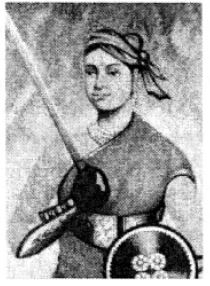
Question 1. Identify the queen.
Answer: Rani Laxmi Bai
In simple words: The picture shows Rani Laxmi Bai of Jhansi.
Exam Tip: Look closely at the warrior costume and sword to easily identify Rani Laxmi Bai in picture-based questions.
Question 2. Name the city where she led the Revolt.
Answer: Jhansi
In simple words: She led the uprising in the city of Jhansi.
Exam Tip: Always associate Rani Laxmi Bai with Jhansi, as she is famously known as the Queen of Jhansi.
Question 3. What were the economic causes of the Revolt of 1857?
Answer: Refer to Section F, Question 1(2) above.
In simple words: The main causes were high land taxes, loss of local craft jobs, and unemployment.
Exam Tip: Do not rewrite the entire long answer; refer back to the economic causes like tax systems and the decline of Indian handicrafts.
Question 4. What was the major outcome of the Revolt of 1857?
Answer: Refer to Section F, Question 3(2) above.
In simple words: The most important outcome was that the British East India Company stopped ruling India.
Exam Tip: State the key outcome clearly - the end of East India Company rule and the start of direct British Crown rule.
Free study material for History Civics
ICSE Textbook Solutions for Class 8 History Civics Chapter 08 The Great Uprising of 1857
ICSE Chapter Solutions: Class 8 History Civics Chapter 08 The Great Uprising of 1857
Strengthen your preparation with comprehensive answers for Class 8 History Civics Chapter 08 The Great Uprising of 1857. These expert-reviewed solutions make tracking your academic progress straightforward and efficient.
Detailed Problem Solving for ICSE Class 8 History Civics
Tackle complex theorems and numerical problems easily by cross-referencing your working steps with our structured solution guides.
Next Steps in Your Class 8 History Civics Preparation
Pair your solution review with additional practice papers to test your execution speed and ensure total preparedness for school exams.
FAQs
You can download the verified Selina Concise solutions for Chapter 08 The Great Uprising of 1857 on StudiesToday.com. Our teachers have prepared answers for Class 8 History Civics as per 2026-27 ICSE academic session.
Yes, our solutions for Chapter 08 The Great Uprising of 1857 are designed as per new 2026 ICSE standards. 40% competency-based questions required for Class 8, are included to help students understand application-based logic behind every History Civics answer.
Yes, every exercise in Chapter 08 The Great Uprising of 1857 from the Selina Concise textbook has been solved step-by-step. Class 8 students will learn History Civics conceots before their ICSE exams.
Yes, follow structured format of these Selina Concise solutions for Chapter 08 The Great Uprising of 1857 to get full 20% internal assessment marks and use Class 8 History Civics projects and viva preparation as per ICSE 2026 guidelines.