

Download ICSE Class 8 History Civics Solutions by Selina Concise
Review the Selina Concise Solutions for ICSE Class 8 History Civics Chapter 11 Struggle for Freedom II designed for Class 8 History Civics students. Published under the latest ICSE guidelines for 2026-27, these chapter-wise solutions provide the foundational knowledge required for exam success.
Access Chapter 11 Struggle for Freedom II Solutions for Class 8 History Civics
View or download the dedicated Chapter 11 Struggle for Freedom II resource below. This chapter-by-chapter structuring ensures easy navigation for daily study routines and immediate access to core academic concepts.
I. Fill in the blanks:
Question 1. The Swaraj Party was led by ________ and ________.
Answer: CR. Das and Motilal Nehru.
In simple words: This political group was headed by two prominent leaders named CR. Das and Motilal Nehru.
Exam Tip: Always remember both names, as examiners frequently ask for both co-founders of the Swaraj Party.
Question 2. All India Trade Union Congress was founded by ________ in ________.
Answer: N.M. Joshi, 1920.
In simple words: This trade union group was started by N.M. Joshi in the year 1920.
Exam Tip: Keep in mind that Lala Lajpat Rai was the first president, though N.M. Joshi was a key founder in 1920.
Question 3. The Quit India Movement took place in the year ________.
Answer: 1942.
In simple words: The Quit India protest was started in the year 1942.
Exam Tip: This landmark movement began specifically in August 1942, which is an important detail for history exams.
Question 4. Congress Socialist Party was formed in ________.
Answer: 1934.
In simple words: The socialist wing within the Congress was established in 1934.
Exam Tip: Remembering the exact year, 1934, is essential for scoring full marks in quick-answer questions.
Question 5. The chairman of the Simon Commission was ________.
Answer: Sir John Simon.
In simple words: Sir John Simon was the head of the Simon Commission.
Exam Tip: The commission was named directly after its chairperson, which makes the name easy to remember.
Question 6. The Congress session of March 1940 was presided over by ________.
Answer: Maulana Abul Kalam Azad.
In simple words: Maulana Abul Kalam Azad led the Congress session held in March 1940.
Exam Tip: Note the spelling of "Azad" carefully, as worksheets sometimes carry minor typos.
Question 7. Subhash Chandra Bose formed the ________ in 1939.
Answer: Forward Bloc.
In simple words: Subhash Chandra Bose started a new group called the Forward Bloc in 1939.
Exam Tip: This group was formed within the Congress framework after Netaji resigned from the presidency.
Question 8. "Dilli Chalo" and "Jai Hind" were two slogans given to us by ________.
Answer: Netaji Subhash Chandra Bose.
In simple words: Netaji Subhash Chandra Bose gave the famous slogans "Dilli Chalo" and "Jai Hind."
Exam Tip: These slogans are associated with the Indian National Army (INA) and are highly important for patriotic history topics.
Question 9. Lord Mountbatten came to India in 1947 as ________.
Answer: Viceroy.
In simple words: Lord Mountbatten arrived in India in 1947 to serve as the Viceroy.
Exam Tip: He was the final British Viceroy of India before the country gained independence.
II. Match the contents of Column A and Column B:
Question. Match the contents of Column A with Column B based on historical events and personalities:
| Column A | Column B |
|---|---|
| 1. Lord Mountbatten | (a) Jawaharlal Nehru |
| 2. 'Do or Die' | (b) Subhash Chandra Bose |
| 3. Revolt of Royal Indian Navy | (c) Mahatma Gandhi |
| 4. Subhash Chandra Bose resigned from Congress presidentship | (d) Viceroy |
| 5. Quit India Movement | (e) 1942 |
| 6. Azad Hind Fauj | (f) 1939 |
| 7. Interim government | (g) 1946 |
Answer:
1. Lord Mountbatten - (d) Viceroy
2. 'Do or Die' - (c) Mahatma Gandhi
3. Revolt of Royal Indian Navy - (g) 1946
4. Subhash Chandra Bose resigned from Congress presidentship - (f) 1939
5. Quit India Movement - (e) 1942
6. Azad Hind Fauj - (b) Subhash Chandra Bose
7. Interim government - (a) Jawaharlal Nehru
In simple words: This match-the-following connects key leaders and historic dates, such as matching Lord Mountbatten with his role as Viceroy, and the "Do or Die" slogan with Gandhiji.
Exam Tip: Pair the years with their respective historical events carefully; matching 1942 with the Quit India Movement and 1946 with the Interim Government helps secure quick marks.
III. State whether the following statements are True or False:
Question 1. State whether the following statement is True or False: The Charkha was a symbol of progress.
Answer: True.
In simple words: Yes, the spinning wheel represented economic progress and self-reliance for India.
Exam Tip: Remember that the Charkha was a key symbol of the Swadeshi movement, standing for self-reliance.
Question 2. State whether the following statement is True or False: The Congress participated in the first Round Table Conference.
Answer: False.
In simple words: The Congress party chose to boycott the first meeting held in London.
Exam Tip: The Congress only participated in the Second Round Table Conference, represented by Mahatma Gandhi.
Question 3. State whether the following statement is True or False: The Congress swept the polls in 8 provinces in the 1937 elections.
Answer: True.
In simple words: The Congress party won a clear majority in eight provinces during these elections.
Exam Tip: This election victory demonstrated the widespread public support the Congress enjoyed at the time.
Question 4. State whether the following statement is True or False: Sir Stafford Cripps was an American officer sent to India.
Answer: False.
In simple words: Sir Stafford Cripps was a British politician, not an American official.
Exam Tip: Cripps was a member of the British Cabinet sent to seek Indian cooperation during World War II.
Question 5. State whether the following statement is True or False: Netaji started the Quit India movement.
Answer: False.
In simple words: The Quit India campaign was actually initiated by Mahatma Gandhi.
Exam Tip: While Netaji fought for independence from abroad, Gandhiji launched the Quit India movement at home.
Question 6. State whether the following statement is True or False: It was because of British presence in India that the country was made a target for Japanese attack.
Answer: True.
In simple words: Since Britain was fighting Japan, British-ruled India became a target for the Japanese military.
Exam Tip: This factor was a major reason why the Congress demanded that the British leave India immediately in 1942.
Question 7. State whether the following statement is True or False: Netaji was the commander of the Indian National Army.
Answer: True.
In simple words: Subhash Chandra Bose took charge as the leader of the Indian National Army.
Exam Tip: Netaji assumed supreme command of the Azad Hind Fauj in Southeast Asia to fight British rule.
Question 8. State whether the following statement is True or False: In 1956, the British government announced its decision to quit India.
Answer: False.
In simple words: The decision to leave India was announced and carried out in 1947, not 1956.
Exam Tip: Be careful with dates; India gained independence on August 15, 1947, ending British rule.
IV. Answer the following questions:
Question 1. Discuss the main aspects of the Non-Cooperation Movement.
Answer: The rising resentment among Indians against British colonial rule gave rise to the Khilafat and Non-Cooperation Movements. Mahatma Gandhi viewed the Khilafat protest as a unique chance to foster Hindu-Muslim unity that might not occur again for a century. This campaign received its name because people resolved to withdraw all cooperation from the colonial administration. Its key strategies included giving up British-awarded titles, boycotting legislative councils, stepping down from government employment, and lawyers boycotting the legal system. Additionally, students withdrew from state-run educational institutions, people boycotted foreign-made merchandise, and citizens stopped paying taxes because they no longer accepted the authority of the British government.
In simple words: Indians refused to work with the British administration to show their anger. They gave up official titles, left government schools and jobs, and boycotted British goods to stand up for their rights.
Exam Tip: Explain the dual objectives of the movement - supporting the Khilafat cause and achieving Swaraj - while listing at least three types of boycotts to secure maximum marks.
Question 2. How and when did the Civil Disobedience Movement start? How did the government suppress it?
Answer: The Civil Disobedience Movement commenced on March 12, 1930, when Mahatma Gandhi began his historic walk from Sabarmati Ashram to the coastal town of Dandi in Gujarat, covering a distance of 375 kilometers. Accompanied by 78 devoted disciples, he broke the unjust salt monopoly by harvesting a handful of natural salt left by ocean tides. This single act of defiance sparked countrywide protests, drawing active participation from women and extending to the Northwest Frontier Province under the leadership of Khan Abdul Ghaffar Khan, who was affectionately known as Frontier Gandhi. To crush the agitation, the British administration used harsh measures, declaring the Indian National Congress an unlawful organization. Public anger erupted across the nation as people refused to pay the Chaukidari tax, ignored forest regulations, and boycotted foreign products, while lakhs of satyagrahis courted arrest and peasants refused to pay land revenues.
In simple words: On March 12, 1930, Gandhiji walked to Dandi to break the British salt law. This started a nationwide protest where people broke unfair laws, leading to a harsh British crackdown and mass arrests.
Exam Tip: Ensure you specify the exact starting date (12 March 1930), the distance (375 km), and mention Khan Abdul Ghaffar Khan ("Frontier Gandhi") to demonstrate complete historical knowledge.
Question 3. Why did the Congress pass the Quit India Resolution? How did the government react to it?
Answer: On August 8, 1942, the All India Congress Committee assembled in Bombay and adopted the historic Quit India Resolution following the collapse of the Cripps Mission. This campaign turned into the largest public revolt against British dominion, severely challenging the colonial administration. During his address, Gandhiji demanded instant independence, asserting that freedom must be obtained without delay. He inspired the nation with his famous slogan, 'Do or Die', urging citizens to either liberate their motherland or perish trying. The massive scale of the uprising proved to the British rulers that the Indian populace was prepared to endure extreme sacrifices for self-rule. In response, the authorities quickly arrested prominent leaders, outlawed the Congress party, and implemented brutal measures to silence the agitation.
In simple words: The Congress started the Quit India Movement in August 1942 after British peace talks failed. Gandhiji gave the slogan "Do or Die," and the British reacted by arresting leaders and banning the Congress.
Exam Tip: Highlight the failure of the Cripps Mission as the main trigger for the resolution, and quote Gandhiji's "Do or Die" slogan for maximum marks.
Question 4. Discuss the main features of the Government of India Act, 1935.
Answer: The Act aimed to set up an All-India Federation and proposed a parliament with two houses (a bicameral federal legislature). Its major features were:
1. Just 14 percent of the adult population in British-ruled India received voting rights.
2. The federal parliament lacked genuine authority, as vital portfolios like foreign relations and defence were kept out of its reach, while the Viceroy retained authority over remaining matters.
3. A revised governance structure introduced provincial autonomy, placing local departments under the charge of ministers who answered to elected assemblies.
4. Despite this, provincial Governors held veto powers over new laws, could enact legislation independently, and maintained authority over the police force and civil administration.
5. Both the Viceroy and the regional Governors remained direct appointees of the British Crown and were answerable only to London.
In simple words: This Act tried to create a federal system with a two-house parliament and more freedom for provinces. However, real power remained with British-appointed officials who could overrule elected Indian ministers.
Exam Tip: Clearly outline both the positive aspect (provincial autonomy) and the negative limitations (veto powers, limited voting rights of 14%) to write a balanced, high-scoring answer.
Question 5. Why did India accept the partition proposal even though it did not accept the two-nation theory?
Answer: Upon taking office as Viceroy in March 1947, Lord Mountbatten proposed a partition scheme to split the subcontinent into two sovereign nations, India and Pakistan. Prior to this, severe sectarian violence had ravaged regions like Bengal and Bihar in 1946, and the official partition announcement triggered even worse bloodletting, particularly across Punjab. The riots left thousands dead and forced countless families to flee their homes. While the Congress leadership completely rejected the premise of the two-nation theory, they reluctantly accepted the partition layout because they believed it was the only viable path to gain independence quickly and stop further mass slaughter.
In simple words: India accepted partition not because it agreed with dividing people by religion, but because horrible riots had broken out. The leaders felt partition was the only way to get independence and stop the violence.
Exam Tip: Clarify the distinction between accepting partition as a practical necessity to end bloodshed versus rejecting the communal two-nation theory in principle.
Question 6. Discuss the contribution of INA in the freedom struggle.
Answer: Organized to liberate India from foreign domination, the Indian National Army (Azad Hind Fauj) was largely made up of Indian prisoners of war captured in Southeast Asia. Under the leadership of Netaji Subhash Chandra Bose, who assumed supreme command of the forces, the movement was energized by inspiring slogans like 'Dilli Chalo' and 'Jai Hind'. After declaring the establishment of a provisional government in Singapore in 1943, Netaji traveled to the Andaman and Nicobar Islands, where he raised the Indian flag on territories handed over by Japanese forces. The INA advanced to the Indian border, capturing strategic towns like Kohima and Imphal. However, this success was temporary; the British military recaptured Burma, leading to the defeat of the INA, which was further compounded when Japan surrendered following the atomic bombings.
In simple words: The Indian National Army (INA), led by Subhash Chandra Bose, fought British forces from outside India's borders. They captured some territory near Burma and raised the Indian flag, but were eventually defeated when their ally, Japan, lost the war.
Exam Tip: Mention the role of prisoners of war, key slogans ('Dilli Chalo', 'Jai Hind'), and the battles of Kohima and Imphal to score full marks on this topic.
Question 7. Discuss the main clauses of the Indian Independence Act of 1947.
Answer: The major terms of the Indian Independence Act of 1947 were:
1. On August 15, 1947, two sovereign dominions, India and Pakistan, would be established. Pakistan would encompass East Bengal, West Punjab, Sind, Baluchistan, and the Northwest Frontier Province, while all other British-administered territories would remain in India.
2. The British Crown would surrender all administrative authority over the two nations starting August 15, 1947, vesting absolute power in the constituent assemblies of India and Pakistan.
3. The position of Viceroy was abolished immediately and replaced by an individual Governor-General appointed for each of the two dominions.
4. The respective constituent assemblies of both nations were empowered to draft their own constitutions and choose whether to remain part of the British Commonwealth.
5. Until new parliaments were formed, the constituent assemblies of both countries would function as their central lawmaking bodies.
6. The legislative organs of the new dominions received complete sovereignty to draft and pass laws for their territories.
7. The British monarch's power to veto provincial laws was revoked, and this authority was instead granted to the respective Governors-General.
8. Until fresh constitutions were successfully implemented, both central governments and their provinces would run under the modified provisions of the Government of India Act, 1935.
9. Princely states were given the choice to integrate with either India or Pakistan, or to choose to remain completely independent.
10. The Governors-General were granted the authority to alter or adapt the 1935 Act as needed up until March 31, 1948.
11. The ministerial post of the Secretary of State for India in the British Cabinet was disbanded.
12. Treaties and agreements with tribal regions in the Northwest Frontier Province were to be directly renegotiated by the appropriate dominion.
In simple words: This Act divided British India into two free countries, India and Pakistan, on August 15, 1947. It gave full power to their assemblies to make laws, choose their own constitutions, and decide the future of the princely states.
Exam Tip: Memorize at least five key clauses, particularly the division of territories, the abolition of the Viceroy's post, and the options given to the princely states.
V. Picture study: Look at the picture given below.
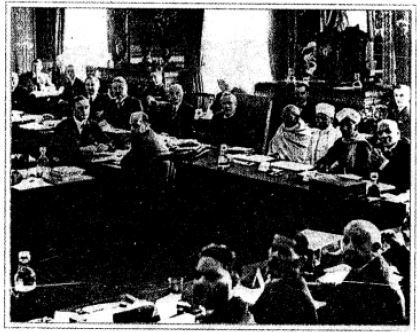
Question. Look at the historical image and answer the questions that follow:
[Image: A group of delegates seated in a grand hall around a large conference table in London, including Mahatma Gandhi and other prominent political leaders]
(i) Which conference is in progress?
(ii) When and where was this conference held?
(iii) Who were the main participants in this conference?
(iv) What was the result of this conference?
Answer:
(i) The image shows the Second Round Table Conference in progress.
(ii) The summit took place in London in the year 1931.
(iii) Prominent figures attending included Mahatma Gandhi, B.R. Ambedkar, Madan Mohan Malviya, and the Aga Khan, alongside other representatives.
(iv) The meeting ended without reaching any agreement, making it a failure.
In simple words: This picture displays the Second Round Table Conference in London in 1931. Important Indian leaders came together to discuss India's future, but they could not agree on key issues, so the meeting failed.
Exam Tip: Be ready to identify this specific photograph as the Second Round Table Conference. Remember that Gandhiji was the sole representative of the Indian National Congress at this assembly.
Additional Questions
A. Fill in the blanks:
Question 1. Gandhi spent about 22 years in ________ as a practicing lawyer.
Answer: South Africa.
In simple words: Gandhiji worked as a lawyer in South Africa for more than twenty years before coming back to India.
Exam Tip: This period in South Africa was crucial as it was where Gandhiji first developed his methods of non-violent resistance.
Question 2. Under ________ leadership, the Indian national movement was transformed into a mass movement.
Answer: Gandhiji's.
In simple words: Under Gandhiji's guidance, India's freedom struggle became a movement supported by millions of common people.
Exam Tip: Mentioning how Gandhiji connected the common masses to the freedom struggle is a key concept in history essays.
Question 3. To protest against the arrest of their leaders, a public meeting was held at ________ in Amritsar in the year 1919.
Answer: Jallianwala Bagh.
In simple words: People gathered at Jallianwala Bagh in Amritsar in 1919 to protest the arrest of their leaders.
Exam Tip: Ensure correct spelling of "Jallianwala Bagh" and remember it is linked directly to the tragic massacre of 13 April 1919.
Question 4. After the British brutalities in Amritsar, Gandhiji declared that it would be a sin to co-operate with the ________.
Answer: satanic government.
In simple words: Following the Amritsar massacre, Gandhiji said it was wrong to work with what he called a "satanic government."
Exam Tip: This moral declaration marked the beginning of Gandhiji's shift toward direct non-cooperation with British rule.
Question 5. At the ________ session of the Congress in 1929, ________ was declared as its goal.
Answer: Lahore, Poorna Swaraj.
In simple words: At the Lahore meeting in 1929, the Congress declared complete independence (Poorna Swaraj) as its ultimate goal.
Exam Tip: The 1929 Lahore session is historically significant for making complete independence the official demand of the nationalist movement.
B. Match the following:
Question. Match the items in Column A with their correct descriptions in Column B:
| Column A | Column B |
|---|---|
| 1. Gandhiji | (a) Symbol of swadeshi |
| 2. Charkha | (b) Boycott of British goods |
| 3. Jallianwala Bagh | (c) Salt Satyagraha |
| 4. Dandi March | (d) 13 April 1919 |
| 5. Non-cooperation Movement | (e) Truth and non-violence |
Answer:
1. Gandhiji - (e) Truth and non-violence
2. Charkha - (a) Symbol of swadeshi
3. Jallianwala Bagh - (d) 13 April 1919
4. Dandi March - (c) Salt Satyagraha
5. Non-cooperation Movement - (b) Boycott of British goods
In simple words: This section matches important symbols and events to their meanings, like linking the Charkha with Swadeshi and the Dandi March with the Salt Satyagraha.
Exam Tip: Practice linking key historical campaigns with their central methods to ensure quick recall during matching exercises.
C. Choose the correct answer:
Question 1. Gandhiji studied law in
(a) England
(b) South Africa
(c) France
(d) None of the options
Answer: (a) England
In simple words: Gandhiji traveled to England to complete his higher education in law.
Exam Tip: Do not confuse where he studied law (England) with where he practiced as a young lawyer (South Africa).
Question 2. Gandhiji organized a workers strike against the exploitative Indian mill owners in
(a) Ahmedabad
(b) Kheda
(c) Champaran
(d) None of the options
Answer: (a) Ahmedabad
In simple words: Gandhiji led a peaceful strike for textile mill workers in the city of Ahmedabad.
Exam Tip: Remember that the Ahmedabad Mill Strike (1918) focused on industrial labor, while Champaran and Kheda dealt with peasant farmers.
Question 3. The Non-Cooperation Movement was launched by Gandhiji in
(a) 1920
(b) 1930
(c) 1940
(d) None of the options
Answer: (a) 1920
In simple words: The Non-Cooperation campaign was officially started in the year 1920.
Exam Tip: Ensure you can differentiate the launching years of the major movements: Non-Cooperation (1920), Civil Disobedience (1930), and Quit India (1942).
Question 4. A resolution declaring 'Poorna Swaraj' was declared as its goal at the
(a) Lahore session of the Congress
(b) Surat session of the Congress
(c) Bombay session of the Congress
(d) None of the options
Answer: (a) Lahore session of the Congress
In simple words: The historic decision to demand complete freedom was taken at the Lahore Congress session.
Exam Tip: The Lahore session of 1929 is among the most frequently tested topics in Indian national movement exams.
Question 5. Which of the following movements was started with the Salt Satyagraha in 1930?
(a) Non-Cooperation Movement
(b) Civil Disobedience Movement
(c) Quit India Movement
(d) None of the options
Answer: (b) Civil Disobedience Movement
In simple words: The Civil Disobedience Movement began with the historic salt protest in 1930.
Exam Tip: Connecting the Salt Satyagraha directly to the start of the Civil Disobedience Movement is essential for full marks.
D. State whether the following are true or false:
Question 1. State whether the following statement is True or False: Gandhiji did not have faith in the capacity of the common masses.
Answer: False.
In simple words: Gandhiji had immense confidence in the strength and determination of ordinary people.
Exam Tip: Gandhiji's entire political strategy relied on mobilizing the rural and working-class population of India.
Question 2. State whether the following statement is True or False: In 1919, General Dyer had issued an order banning all public meetings.
Answer: True.
In simple words: General Dyer had prohibited public gatherings in Amritsar just before the Jallianwala Bagh tragedy.
Exam Tip: The tragedy occurred because the people gathered at Jallianwala Bagh were unaware of this assembly ban.
Question 3. State whether the following statement is True or False: The Non-Cooperation Movement had ended in failure after the Chauri Chaura incident.
Answer: True.
In simple words: The campaign was suddenly stopped by Gandhiji because of the violence at Chauri Chaura.
Exam Tip: Note that Gandhiji suspended the movement because he believed the country was not yet fully prepared for non-violent resistance.
Question 4. State whether the following statement is True or False: Independence Day was celebrated on 26 January in 1930.
Answer: True.
In simple words: Indian nationalists celebrated their first symbolic Independence Day on January 26, 1930.
Exam Tip: This historic date is the reason why India chose January 26 to celebrate Republic Day starting in 1950.
Question 5. State whether the following statement is True or False: Sarojini Naidu was one of the leaders of the Civil disobedience Movement.
Answer: True.
In simple words: Sarojini Naidu played a leading role in the Civil Disobedience protests.
Exam Tip: She famously led the non-violent protest at the Dharasana Salt Works after Gandhiji was arrested.
E. Answer the following questions in one or two words/ sentences:
Question 1. What technique of resistance did Gandhiji evolve in South Africa? What was its basic principle?
Answer: In South Africa, Gandhiji led the campaign against racial discrimination and developed a protest technique called Satyagraha, which relied on the core principles of truth and non-violent resistance.
In simple words: Gandhiji created a protest method called Satyagraha in South Africa, which is based entirely on truth and peaceful action.
Exam Tip: Clearly state "Satyagraha" and define its dual pillars - truth (Satya) and non-violence (Ahimsa) - for a complete answer.
Question 2. Why did Gandhiji lead campaigns in (a) Champaran (b) Kheda?
Answer:
(a) Champaran - He stood up for local tenant farmers who faced exploitation from British indigo landlords, achieving a successful outcome where peasants received fair compensation.
(b) Kheda - When agricultural failure ruined crops, Gandhiji advised the local farmers to halt land revenue payments, resulting in the government conceding to their plea for tax relief.
In simple words: In Champaran, he fought for poor farmers forced to grow indigo. In Kheda, he helped farmers who could not pay taxes because their crops had failed.
Exam Tip: Treat Champaran and Kheda as separate sub-points, and mention "indigo planters" for Champaran and "crop failure/tax remission" for Kheda.
Question 3. Which incident marked the end of the Non-Cooperation Movement and when?
Answer: The Non-Cooperation Movement was called off following the violent Chauri Chaura clash in February 1922.
In simple words: The movement was stopped in 1922 because of the violent clash at Chauri Chaura.
Exam Tip: Remember both the name "Chauri Chaura" and the year "1922" as they are highly critical details for history exams.
Question 4. Under whose leadership was the Lahore session of the Congress held in 1929? What resolution was passed in this session?
Answer: The Lahore session of December 1929 took place under the leadership of Jawaharlal Nehru. At this meeting, the Congress adopted a historic resolution declaring 'Poorna Swaraj' (Complete Independence) as its objective, setting January 26, 1930, as the first celebration of Independence Day.
In simple words: Jawaharlal Nehru led the Lahore session in 1929, where they passed a resolution demanding complete independence from British rule.
Exam Tip: Clearly highlight "Jawaharlal Nehru" and the term "Poorna Swaraj" as these are the primary scoring points.
F. Answer the following questions briefly:
Question 1. With reference to Gandhiji, discuss his views on the following: (a) Truth and non-violence (b) Hindu-Muslim unity (c) Social justice
Answer:
(a) Truth and non-violence: Satyagraha, derived from the Sanskrit words 'satya' (truth) and 'agraha' (insistence), is built upon truth and non-violence. A practitioner of this method resists injustice fearlessly, showing love rather than hatred toward their opponent. By willingly enduring hardships, a satyagrahi hopes to touch the opponent's conscience, transforming them rather than defeating them. Gandhiji emphasized that non-violence is a strength, not a weakness, and must be practiced even during intense provocation.
(b) Hindu-Muslim unity: As a religious man who valued all faiths equally, Gandhiji believed that communal harmony between Hindus and Muslims was essential for India's future. He dedicated his life, and ultimately died, trying to preserve this unity.
(c) Social justice: Gandhiji worked to elevate marginalized groups, advocating for women's rights and the end of untouchability. He referred to lower-caste individuals as 'Harijans' (children of God) and maintained that political independence was incomplete without deep-rooted social reforms.
In simple words: Gandhiji believed that protests must always be peaceful and based on truth. He worked hard to keep Hindus and Muslims united and fought to end unfair treatment of poor people and lower castes.
Exam Tip: When discussing Gandhiji's views, structure your answer under clear subheadings matching parts (a), (b), and (c) to ensure a neat presentation.
Question 2. In the context of the Jallianwala Bagh tragedy, answer the following: (a) Why was a public meeting held in Jallianwala Bagh on 13 April 1919? (b) Why did the troops open fire on the gathering? What happened as a result of the shooting? (c) How did the entire nation and Gandhiji react to the events in Amritsar?
Answer:
(a) To suppress the massive protests against the Rowlatt Act of 1919, the British government used repressive measures, leading to clashes in parts of Punjab. Following the arrest of two prominent local leaders in Amritsar, citizens assembled peacefully at Jallianwala Bagh on April 13, 1919, to register their protest.
(b) The gathering was completely peaceful, but the attendees did not know that General Dyer had banned public meetings in the city. Dyer marched in with his soldiers, blocked the single exit, and commanded them to fire on the trapped crowd without warning. The shooting lasted until their ammunition was exhausted, leaving nearly 400 dead and over a thousand wounded.
(c) The shocking massacre, followed by the enforcement of martial law and widespread public humiliation in Punjab, outraged the nation. Devastated by the cruelty, Gandhiji renounced any belief in British justice and declared that working with such an oppressive administration was a moral sin.
In simple words: People met peacefully to protest the arrest of their leaders. General Dyer blocked the exit and ordered his troops to fire on the unarmed crowd, killing hundreds. This brutality shocked the nation and turned Gandhiji completely against British rule.
Exam Tip: Mention the Rowlatt Act, the arrest of the two local leaders, General Dyer's name, and the exact casualty figures to score full marks.
Question 3. In the context of the Non-Cooperation Movement, answer the following questions: (a) Discuss the programme of the Non-Cooperation Movement. (b) Why did Gandhiji abruptly suspend the Non-Cooperation Movement? (c) State the significance of the Non-Cooperation Movement.
Answer:
(a) The campaign's core activities involved:
1. Refusing to purchase foreign-made goods.
2. Staying away from state schools, colleges, law courts, legislative bodies, and other administrative offices.
3. Boycotting political elections and official government ceremonies.
4. Surrendering honorary titles and awards bestowed by the British authorities.
(b) In early 1922, police fired on a peaceful march of farmers in the village of Chauri Chaura, Uttar Pradesh. The enraged crowd retaliated by setting fire to the local police station, resulting in the deaths of twenty-two police officers. Committed to non-violence, Gandhiji immediately called off the entire campaign.
(c) The Non-Cooperation Movement marked a turning point in India's struggle for independence. Spanning from 1920 to 1922 under the Congress and Gandhiji, it mobilized the masses for the first time on a national scale. It proved that millions of ordinary citizens could unite peacefully to resist colonial power, popularizing the values of self-reliance (using Swadeshi goods) and non-violent resistance (Satyagraha).
In simple words: The movement asked Indians to boycott everything British, including schools, courts, and clothes. Gandhiji stopped it in 1922 when a crowd turned violent at Chauri Chaura. It was highly significant because it united millions of common people for the first time.
Exam Tip: For part (a), present the boycott points as a clear numbered list. For part (b), make sure to name the village "Chauri Chaura" and mention the date (1922).
Question 4. In the context of the Civil Disobedience Movement, answer the following: (a) Give an account of the Salt Satyagraha. (b) How did the government react to the movement? (c) What impact did the Civil Disobedience Movement (1930-34) have on the nation?
Answer:
(a) The campaign began with the Dandi March, where Gandhiji and 78 followers walked 385 kilometers from Sabarmati Ashram to the coast of Dandi. As they walked, crowds of supporters joined them. At the coast, Gandhiji collected a small amount of natural salt, setting an example for Indians everywhere to ignore the salt tax laws and manufacture salt openly.
(b) The British response was swift and violent, as they resorted to lathi charges and gunfire, leaving hundreds of demonstrators wounded or dead. Prominent figures including Gandhiji and Jawaharlal Nehru were jailed, alongside more than 90,000 participants.
(c) This movement popularized the strategy of peaceful, active resistance against unjust colonial legislation. It deepened political awareness across all levels of Indian society and demonstrated the power of collective non-violent action to challenge a powerful empire.
In simple words: Gandhiji walked to Dandi to break the British salt monopoly, inspiring people across India to make their own salt. The British reacted with violence and arrested over 90,000 people. This movement united the country and proved that peaceful resistance could shake British rule.
Exam Tip: Be sure to include the scale of the government response (e.g., the arrest of 90,000 people) to show how deeply the colonial state was shaken by this movement.
G. Picture Study
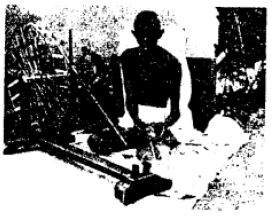
Question. Study the image below showing a prominent historical figure and answer the following questions:
[Image: Mahatma Gandhi seated on a mat, concentrated on spinning thread using a wooden Charkha]
(i) Identify the person.
(ii) What method did he use in the Indian struggle for freedom?
(iii) What are the principles on which his method is based?
(iv) Why is he called the leader of the masses?
(v) Mention the features of his non-violent struggle against the British.
Answer:
(i) The individual shown in the picture is Mahatma Gandhi.
(ii) He introduced and utilized the method of Satyagraha in the struggle for Indian independence.
(iii) This method is built upon the dual pillars of truth and non-violence. Rather than seeking to destroy the opponent, a satyagrahi uses patient endurance and peaceful protest to appeal to the opponent's conscience and bring about a change of heart.
(iv) He is regarded as a mass leader because of his unwavering confidence in the strength of ordinary citizens, transforming the independence movement from an elite campaign into a broad-based popular struggle.
(v) The main elements of his non-violent resistance included:
1. Holding peaceful protests and demonstrations.
2. Deliberately disobeying discriminatory colonial laws.
3. Boycotting British merchandise, institutions, and administrative offices.
4. Promoting self-reliance and the Swadeshi spirit through the use of the Charkha and Khadi cloth.
5. Refusing to pay unjust taxes to bring British governance to a halt.
In simple words: This picture shows Mahatma Gandhi spinning yarn. He led India's freedom fight using non-violent resistance (Satyagraha), bringing millions of ordinary people together to peacefully protest, boycott British goods, and seek self-reliance.
Exam Tip: Identify the Charkha as a key symbol of self-reliance and the Swadeshi spirit in any exam question regarding Gandhiji's economic and political ideas.
Free study material for History Civics
ICSE Textbook Solutions for Class 8 History Civics Chapter 11 Struggle for Freedom II
About ICSE Solutions for Class 8 History Civics Chapter 11 Struggle for Freedom II
Find reliable chapter-wise explanations for Class 8 History Civics Chapter 11 Struggle for Freedom II. Curated to follow standard ICSE guidelines, these problem solutions assist students in building strong conceptual foundations.
Concept Clarification for Chapter 11 Struggle for Freedom II
Tackle complex theorems and numerical problems easily by cross-referencing your working steps with our structured solution guides.
Effective Revision Strategies for Chapter 11 Struggle for Freedom II
Pair your solution review with additional practice papers to test your execution speed and ensure total preparedness for school exams.
FAQs
You can download the verified Selina Concise solutions for Chapter 11 Struggle for Freedom II on StudiesToday.com. Our teachers have prepared answers for Class 8 History Civics as per 2026-27 ICSE academic session.
Yes, our solutions for Chapter 11 Struggle for Freedom II are designed as per new 2026 ICSE standards. 40% competency-based questions required for Class 8, are included to help students understand application-based logic behind every History Civics answer.
Yes, every exercise in Chapter 11 Struggle for Freedom II from the Selina Concise textbook has been solved step-by-step. Class 8 students will learn History Civics conceots before their ICSE exams.
Yes, follow structured format of these Selina Concise solutions for Chapter 11 Struggle for Freedom II to get full 20% internal assessment marks and use Class 8 History Civics projects and viva preparation as per ICSE 2026 guidelines.