

Class 8 History Civics Chapter 01 A Period of Transition: Selina Concise Study Material
Explore the complete Selina Concise textbook solutions for Class 8 History Civics. Tailored for the 2026-27 curriculum, this resource breaks down complex topics to support daily study and targeted revision.
Chapter 01 A Period of Transition Answer Guide
Access the complete PDF for Chapter 01 A Period of Transition below. This focused excerpt allows students to isolate specific topics for thorough review and uninterrupted reading, complementing standard ICSE textbooks.
I. Fill in the blanks
Question 1. The Renaissance thinkers believed in life in this _______.
Answer: World
In simple words: Renaissance thinkers believed in making the most of our life on Earth.
Exam Tip: Remember that Renaissance thinkers shifted focus from the afterlife to the present world.
Question 2. The term Reformation refers to two major developments, the Protestant _______ and the Catholic _______.
Answer: Reformation, Reformation
In simple words: The Reformation had two big parts, which were the Protestant and Catholic movements.
Exam Tip: Always capitalize both Protestant and Catholic when writing these terms.
Question 3. Vasco-da-Gama reached _______ on the West Coast of India.
Answer: Calicut
In simple words: Vasco da Gama was an explorer who arrived at Calicut in India.
Exam Tip: Spelling is important - make sure to spell Calicut correctly.
Question 4. The Industrial Revolution began in England in about _______.
Answer: 1750
In simple words: The big shift to machine-based factories started in England around the year 1750.
Exam Tip: The mid-18th century, specifically around 1750, is the key starting era for the Industrial Revolution.
Question 5. In 1793, Eli Whitney invented a _______.
Answer: Cotton gin
In simple words: Eli Whitney created a machine called the cotton gin to clean cotton quickly.
Exam Tip: "Cotton gin" is two words; ensure both words are written clearly.
II. Match the contents of Column A and Column B
Question 1. Match the contents of Column A with Column B:
| Column A | Column B |
|---|---|
| 1. John Kay | (a) Mule |
| 2. James Hargreaves | (b) Cotton gin |
| 3. Arkwright | (c) Powerloom |
| 4. Samuel Crompton | (d) Steam engine |
| 5. Cartwright | (e) Water frame |
| 6. Whitney | (f) Spinning Jenny |
| 7. James Watt | (g) Flying Shuttle |
Answer:
1. John Kay - (g) Flying Shuttle
2. James Hargreaves - (f) Spinning Jenny
3. Arkwright - (e) Water frame
4. Samuel Crompton - (a) Mule
5. Cartwright - (c) Powerloom
6. Whitney - (b) Cotton gin
7. James Watt - (d) Steam engine
In simple words: This matching lists famous inventors and the machines they built during the Industrial Revolution.
Exam Tip: Matching inventions to their creators is a common question type; memorizing this list will guarantee easy marks.
III. State whether the following statements are true or false:
Question 1. The Renaissance and the Reformation along with new voyages ushered in the Modern Age.
Answer: True
In simple words: Yes, the rebirth of learning, religious reform, and sea voyages helped start the modern era.
Exam Tip: These three factors are considered the core pillars that brought an end to the Middle Ages.
Question 2. The Industrial Revolution began in Germany.
Answer: False
In simple words: This is not true because the Industrial Revolution actually started in England, not Germany.
Exam Tip: Remember that Great Britain (England) was the birthplace of the Industrial Revolution due to its resources and colonies.
Question 3. Me Adam devised railway tracks.
Answer: False
In simple words: This statement is incorrect because John McAdam invented a new way to build roads, not railway tracks.
Exam Tip: McAdam is famous for his road-making method called "macadamisation," which used crushed stones.
Question 4. The Rise of capitalism and imperialism can be attributed to the industrial Revolution.
Answer: True
In simple words: Yes, the growth of factories led directly to capitalism and the desire to control other lands.
Exam Tip: The Industrial Revolution created excess goods and wealth, which drove nations to expand and invest overseas.
Question 5. The East India Company gradually became rulers from being traders.
Answer: True
In simple words: This is correct because the British merchants slowly took political control of India over time.
Exam Tip: The transition from merchants to rulers began with key battles like Plassey and Buxar.
IV. Answer the following questions:
Question 1. How did the Renaissance, Reformation and the new geographical discoveries lead to the Modern Age?
Answer: These three events slowly brought about the modern era. The Renaissance made people think in a more logical way. It encouraged a love for science and questioning. The Reformation helped start the Protestant church. It also helped clean up the Catholic Church from bad habits. Because of this, old superstitious ideas began to fade. People started using reason and science instead. Also, new sea voyages led to finding unknown lands. This opened up many new routes for trade and travel. All of these changes together paved the way for the Industrial Revolution.
In simple words: The rebirth of science, the cleaning up of the church, and the finding of new lands all worked together to start our modern world.
Exam Tip: To get full marks, make sure to write about all three factors - Renaissance, Reformation, and Geographical Discoveries - in separate sentences.
Question 2. Give reasons why did the Industrial Revolution first begin in England?
Answer: In the late 1700s, England had the best conditions for starting this revolution.
1. England made huge profits from sea trade. This gave her plenty of money to invest in new businesses.
2. She had many colonies across the world. These colonies supplied raw materials and bought the finished products.
3. The country had rich reserves of coal and iron. These resources lay close to each other and helped run the new factories.
4. The enclosure movement left many farmers without land or jobs. This created a large group of people ready to work in factories.
5. England had built a very strong fleet of ships. This made it easy to move goods and raw materials anywhere.
In simple words: England had the money, raw materials, coal, workers, and ships needed to start factories before any other nation.
Exam Tip: To score high, list at least three key reasons, such as money, natural resources, and colonies, using bullet points or numbered lists.
Question 3. Discuss the impact of the Industrial Revolution on society, economy and polity.
Answer: The rise of factories changed society, trade, and governments deeply.
1. Factories produced goods on a massive scale. Since these goods had to be sold abroad, European nations began capturing colonies in Asia and Africa.
2. It caused rapid growth of cities as people left villages to find work. These cities became overpopulated. This led to poor housing, dirty slums, and health issues.
3. The new transportation links brought different countries and people closer together.
4. It split society into two main groups - the wealthy factory owners and the poor workers. The owners wanted more profit, which led to unfair treatment of workers and huge social gaps.
In simple words: Factories made lots of goods, which made cities grow and brought countries closer. But it also made a few people very rich while many workers stayed poor.
Exam Tip: Always discuss the impacts on all three areas - society (slums/classes), economy (mass production/colonies), and polity (imperialism) - to get full marks.
Question 4. The rise of socialism and communism can be attributed to the reaction against the evils of capitalism. What is the imperialism? Discuss the factors which give rise to imperialism.
Answer: Imperialism means when one strong country takes control of another country's government and economy.
Several factors led to the rise of imperialism:
1. Excess Goods: Factory owners forced their governments to capture new lands. This let them sell their unsold goods at a profit in Asia and Africa.
2. Demand for Resources: European factories needed huge amounts of raw materials to make things. This need drove countries to take over resource-rich lands.
3. Better Travel and Communication: The creation of steamships, trains, and telegraphs made it easy to travel far. These tools helped countries control distant lands.
4. Overpopulation: Europe became too crowded. Countries looked for new places where their extra population could live.
5. Growth of Capital: Wealthy business owners and bankers had too much money and wanted to invest it safely. They looked for new places abroad to make more profit.
6. Extreme Nationalism: Pride in their own nations made European countries want more land. Having colonies made a country look powerful and respected.
7. Role of Missionaries: Many religious groups wanted to spread Christianity to Asia and Africa. This also helped their home nations gain influence.
8. The 'Civilizing' Excuse: Europeans claimed it was their holy duty to bring modern culture to other parts of the world. They called this duty the 'white man's burden'.
In simple words: Imperialism is when a powerful nation takes over a weaker one. They did this to sell goods, find raw materials, invest money, and show off their power.
Exam Tip: Since this question lists eight factors, focus on memorizing five distinct ones clearly, like raw materials, surplus production, and extreme nationalism, to answer thoroughly.
Question 5. Describe the general impact of imperialism with special reference to South Asia.
Answer: Taking over colonies caused countries to fight with each other. This rivalry eventually led to the First World War (1914-1918) and the Second World War (1939-1945). Imperialism forced countries in Asia and Africa under foreign control. These regions became sources for raw materials and markets for European goods. However, there were some positive sides. Imperialism brought modern railways and roads to these lands. It also united the local people as they fought together for freedom, like in India and Vietnam. Great Britain took over countries like India, Sri Lanka, and Burma. Meanwhile, China was split into different areas controlled by European powers.
In simple words: Imperialism made countries fight for colonies, starting world wars. It took away freedom from Asian countries, but it also built roads and made people unite for freedom.
Exam Tip: Be sure to include both the negative impacts (loss of freedom, world wars) and the positive impacts (railways, national unity) to write a balanced answer.
V. Tell me why
Question 1. Most of the countries in South Asia became colonies of Europe.
Answer: South Asian nations had very large populations but lacked modern weapons to fight European armies. These nations possessed rich resources and offered massive markets for European goods. Furthermore, the idea of national pride and unity had not yet grown in this region. This division made it easy for foreign powers to take control.
In simple words: South Asian countries became colonies because they lacked modern weapons, were not united, and had rich resources that Europeans wanted.
Exam Tip: Highlight the contrast between European military strength and the division among local South Asian rulers to explain their takeover.
Question 2. New inventions and discoveries led to the Industrial Revolution.
Answer: New tools and ideas helped build factories and expand cities very fast. Creating goods on a large scale made business owners want even more profit. Building better roads and transport made it easier to set up these new businesses. Inventions like the spinning jenny, the water frame, the cotton gin, and the steam engine made this entire revolution possible.
In simple words: New machines let factories make goods much faster. This helped owners earn more money and helped cities grow.
Exam Tip: List a few key inventions, such as the steam engine or the spinning jenny, to show how technology directly caused the shift to factory work.
Additional Questions
Fill in the blanks:
Question 1. The Modern Age in India began with the conquest of India by the _________.
Answer: British
In simple words: The modern period in India started when the British took control of the country.
Exam Tip: Keep in mind that "British" should always start with a capital letter.
Question 2. India was ruled by the British for nearly _________ years.
Answer: 200
In simple words: British rule in India lasted for almost two centuries.
Exam Tip: Remember the duration of British rule is roughly 200 years (from the mid-18th century to 1947).
Question 3. The two kinds of source material for the Modern period are _________ sources and _________ sources.
Answer: primary, secondary
In simple words: Historians use direct first-hand records and second-hand reports to study modern history.
Exam Tip: Be clear on the difference between first-hand (primary) and second-hand (secondary) historical records.
Question 4. The Renaissance ushered in revolutionary changes in Europe and marked the transition from the _________ Age to the _________ Age.
Answer: Medieval, Modern
In simple words: The Renaissance marks the point where Europe moved out of the Middle Ages and into the modern world.
Exam Tip: This transition marks the major division line in European history between the old and new ways of life.
Question 5. The four characteristic features of the Renaissance period are the advent of new and powerful ideas of _________, _________, _________ and _________.
Answer: Humanism, rationalism, scientific spirit, spirit of inquiry
In simple words: The key values of the Renaissance were valuing human life, logical thinking, science, and asking questions.
Exam Tip: Memorize these four terms as they are central to understanding any Renaissance topic.
B. Match the Following
Question 1. Match the contents of Column A with Column B:
| Column A | Column B |
|---|---|
| 1. Archaeological sources like monuments | (a) Humanism |
| 2. Renaissance | (b) Primary source |
| 3. Constantionople | (c) Martin Luther |
| 4. Reformation | (d) Taxes levied by Roman church |
| 5. Tithe and Peter's Pence | (e) Capital of the Byzantine empire |
Answer:
1. Archaeological sources like monuments - (b) Primary source
2. Renaissance - (a) Humanism
3. Constantionople - (e) Capital of the Byzantine empire
4. Reformation - (c) Martin Luther
5. Tithe and Peter's Pence - (d) Taxes levied by Roman church
In simple words: This matching links key historical events, terms, and taxes with their correct definitions or associations.
Exam Tip: Be sure to link church taxes like Tithe directly to the Roman Church, and Constantinople to the Byzantine Empire.
C. Choose the correct answer:
Question 1. In India the Modern Period is generally regarded as having begun in the
(a) mid-15th century
(b) mid-18th century
(c) mid-16th century
Answer: (b) mid-18th century
In simple words: Most historians agree that India's modern era started around the middle of the 1700s.
Exam Tip: Note that the modern era started much earlier in Europe (15th century) than in India (18th century).
Question 2. The primary sources for the study of the Modern Period are preserved in
(a) archives
(b) banks
(c) factories
Answer: (a) archives
In simple words: Government records and old letters are kept safe in special rooms called archives.
Exam Tip: "Archives" are official government repositories for historical records, while "museums" house physical objects.
Question 3. The wealthy merchants and the professional class consisting of doctors, lawyers, teachers etc., formed the
(a) upper class
(b) middle class
(c) lower class
Answer: (b) middle class
In simple words: Educated professionals like doctors and lawyers belong to the middle class.
Exam Tip: The emergence of a strong middle class was a key social outcome of the Industrial Revolution.
Question 4. The invention of the _________ helped to spread the ideas of the Renaissance thinkers far and wide.
(a) printing press
(b) telegraph
(c) telephone
Answer: (a) printing press
In simple words: The printing press let people copy books quickly, which spread new ideas to many people.
Exam Tip: Johannes Gutenberg invented the printing press, which played a massive role in spreading knowledge.
Question 5. Martin Luther was
(a) an Italian Christian monk
(b) a German Christian monk
(c) a French Christian monk
Answer: (b) a German Christian monk
In simple words: Martin Luther came from Germany and worked as a monk before starting his reforms.
Exam Tip: Do not confuse Martin Luther with Martin Luther King Jr., who was an American civil rights leader.
D. State whether the following are true or false:
Question 1. The source material of the Modern period is of two kinds - primary and secondary.
Answer: True
In simple words: Yes, history sources are divided into direct first-hand materials and second-hand accounts.
Exam Tip: Be ready to name examples for both primary and secondary sources in written exams.
Question 2. Primary sources of history includes books, reviews, reports and articles.
Answer: False
In simple words: This is wrong because books and reviews written later by other people are secondary sources, not primary.
Exam Tip: Books written by modern historians analyzing past events are secondary, while letters from the actual period are primary.
Question 3. Renaissance scholars shifted the focus from divine affairs to human affairs.
Answer: True
In simple words: Yes, scholars started studying human life on Earth instead of just religious matters.
Exam Tip: This shift is called humanism, which is the defining characteristic of the Renaissance.
Question 4. The voyages of discoveries led to a decline of trade and commerce.
Answer: False
In simple words: This is false because finding new lands actually boosted business and increased trade across the globe.
Exam Tip: Exploration opened up global sea routes, which caused a huge expansion in trade and merchant wealth.
Question 5. The Reformation was also known as the Protestant Movement.
Answer: True
In simple words: Yes, the efforts to reform the church created the Protestant movement.
Exam Tip: Martin Luther led this movement, protesting against the practices of the Catholic Church.
E. Answer the following questions in one or two words/ sentences:
Question 1. The history of most nations can be divided into a number of periods. Name them.
Answer: Most countries divide their history into three main times: ancient, medieval, and modern. Each time has its own special political, economic, social, and religious traits that make it unique.
In simple words: History is split into three parts: ancient, medieval, and modern times. Each part has its own style of life and government.
Exam Tip: The three standard periods are Ancient, Medieval, and Modern. Write these down first to get full marks.
Question 2. What distinguishes one historical period from another ?
Answer: Different eras stand out based on how advanced a specific area or country is at that point in time.
In simple words: History stages are different for each country, because some places grew faster than others.
Exam Tip: Note that historical transitions are not uniform across the globe; they depend on regional progress.
Question 3. In what way is the classification of historical periods useful to us ?
Answer: Grouping history into stages helps us see a clear pattern in how human life has slowly changed over many centuries.
In simple words: Breaking history into periods makes it easier to understand how things changed over time without getting confused.
Exam Tip: Highlight that grouping history helps organize a massive amount of historical facts into a structured, easy-to-learn format.
Question 4. When did the Modern Period begin in (a) Europe (b) India?
Answer: In Europe, the modern era kicked off in the 1400s. In contrast, India's modern era is believed to have started around the middle of the 1700s.
In simple words: The modern times started in the 15th century in Europe, but they did not start until the middle of the 18th century in India.
Exam Tip: Be sure to list both regions separately in your answer: Europe in the 15th century and India in the mid-18th century.
Question 5. Mention any four characteristic features of the Modern Period?
Answer: Four main signs of the modern era are:
1. Growth of busy cities.
2. New scientific and machine discoveries.
3. Creation of democratic systems.
4. Human rights and personal freedoms.
In simple words: The modern era is known for large cities, new machines, democracy, and personal rights.
Exam Tip: Choose any four features like urbanization, industrialization, democracy, and humanism, and present them in a clear bulleted list.
Question 6. Mention any two (a) primary and (b) secondary source materials of the Modern Period.
Answer: (a) Primary sources of this era include:
1. True official letters and documents kept in government archives.
2. Old newspapers published during that time in different languages.
(b) Secondary sources of this era include:
1. Modern books written by historians about the past.
2. Review articles and reports analyzing historical evidence.
In simple words: Primary sources are actual items from the past, like old letters and newspapers. Secondary sources are works written later, like history books and study reports.
Exam Tip: Make sure you give two distinct examples for each category as requested by the question.
Question 7. Why is it important to study developments in Europe to understand the history of modern India ?
Answer: Because modern Indian history started when the British arrived, we must look at Europe to see where these changes began. We cannot truly understand how British rule changed India without knowing the events that were happening back in Europe at that same time.
In simple words: To understand how the British ruled India, we first need to know what was happening in Europe during that time, since the rulers came from there.
Exam Tip: Explain that since the British introduced modern systems to India, the origin of these changes lies in European events like the Industrial Revolution.
Question 8. What is the meaning of Renaissance ?
Answer: The Renaissance was a major movement of change and exploration in Europe that completely transformed how people lived and thought. This term comes from a French word that translates to 'rebirth' or 'revival' of learning.
In simple words: Renaissance is a French word that means rebirth. It was a time when Europeans started thinking in new ways and exploring the world.
Exam Tip: Be sure to write the literal French meaning, "rebirth" or "revival", and mention how it changed people's mindset.
F. Answer the following questions briefly:
Question 1. The capture of Constantinople by the Ottoman Ttirks led to the beginnings of Renaissance in Europe. With reference to this statement answer the following questions:
(a) How did it lead to the revival of classical Greek and Roman learning in Europe ?
(b) What effect did it have on the outlook and attitudes of the people of Europe ?
(c) What effect did it have on trade ?
Answer:
(a) Many Greek teachers fled from Constantinople to Italy, carrying rare, ancient books with them. Wealthy leaders and merchants in cities like Rome and Florence welcomed and supported them. They set up libraries and schools to spread this ancient knowledge.
(b) The revival of ancient learning inspired people to challenge old rules set by kings and the church. Instead of accepting orders blindly, people demanded logical reasons and proof. This new way of thinking helped grow a scientific attitude. This desire for truth led to rapid developments in fields like science, painting, building, and writing.
(c) The Renaissance encouraged a desire to explore, which grew trade immensely. A new class of wealthy traders arose in society. These traders helped kings build strong, rich states, which made kings depend much less on noble landowners.
In simple words: When Constantinople fell, scholars moved to Italy with old books. This made Europeans think for themselves, start trading more, and create new art and science.
Exam Tip: Be sure to label each sub-part (a, b, c) clearly in your answer sheet and address each aspect - learning, outlook, and trade - systematically.
Question 2. With reference to the causes of the Reformation, how did the following contribute to the movement
(a) Renaissance
(b) Evil practices of the Roman catholic Church
(c) Rise of strong and powerful rulers
Answer:
(a) The Renaissance completely changed how people looked at life. It introduced new ideas of logic, science, and questioning. This woke people up, making them find logical answers about their lives instead of relying on blind faith. People started doubting the church's teachings and its power. Additionally, the new printing press helped spread these thoughts very fast.
(b) Over time, many church leaders began living in extreme luxury and ignored their religious duties. The church owned about a third of the land in Europe and forced people to pay heavy taxes like the 'tithe'. Priests charged high fees for ceremonies. Corruption grew, and church positions were bought and sold. The church even sold certificates called 'Indulgences' which claimed to forgive sins in exchange for money.
(c) As the old system of lords ended, strong kings came to power in Europe. These rulers ignored the Pope and refused to let him interfere in how they ran their countries. They also disliked the heavy taxes that sent wealth away from their lands to Rome.
In simple words: The Renaissance made people question the church, the bad habits and greed of church leaders made people angry, and powerful kings wanted to stop the Pope from ruling over them.
Exam Tip: Define key terms like "Indulgences" and "tithe" in your answer to show a deeper understanding of the church's corruption.
G. Picture study: This is a portrait of the German monk who opposed certain activities of the Catholic Church.
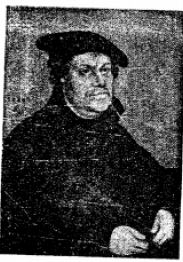
Question 1. Identify the person in the picture.
Answer: The person shown in the picture is Martin Luther.
In simple words: The portrait is of Martin Luther.
Exam Tip: Learn to recognize Martin Luther's face, as this specific portrait is very common in history exams.
Question 2. With which great religious movement is his name associated?
Answer: He is closely associated with the Protestant Reformation.
In simple words: Martin Luther is famous for starting the Reformation movement.
Exam Tip: Be sure to write "Reformation movement" as the direct answer.
Question 3. Where was he born and in which country did he lead his movement ?
Answer: Martin Luther was born in Germany. He led his religious movement in Germany, serving as a monk and teaching at the university in Wittenberg.
In simple words: Martin Luther was born in Germany and led his movement from there, in the town of Wittenberg.
Exam Tip: Make sure to mention Germany as the country and Wittenberg as the key town where his movement started.
Question 4. Mention any four effects of the movement started by him.
Answer: The four main outcomes of his movement were:
1. The Christian Church was permanently split into Catholics and Protestants.
2. Violent civil wars started in several European nations between these two groups.
3. High religious hatred and mistreatment arose, with Catholics and Protestants persecuting each other in different countries.
4. Many English Protestants fled persecution by moving to North America, where they eventually helped build the United States of America.
In simple words: The movement split the church forever, started many wars between Catholics and Protestants, and drove people to settle in America to find religious freedom.
Exam Tip: To score full marks, clearly list four separate consequences of the Reformation, focusing on the division of the church and migration to America.
Free study material for History Civics
ICSE Study Resources for Class 8 History Civics Chapter 01 A Period of Transition
Download ICSE Answers for Class 8 History Civics Chapter 01 A Period of Transition
Review accurate ICSE solutions for Chapter 01 A Period of Transition tailored for Class 8 History Civics students. Use these step-by-step notes to simplify difficult textbook exercises and improve exam readiness.
Concept Clarification for Chapter 01 A Period of Transition
Every exercise question in this chapter includes step-by-step working steps, allowing you to self-evaluate, catch mistakes early, and understand the underlying logic.
Effective Revision Strategies for Chapter 01 A Period of Transition
Wrap up your chapter revision by verifying core concepts against standard ICSE question formats. All resources on our platform are free to access.
FAQs
You can download the verified Selina Concise solutions for Chapter 01 A Period of Transition on StudiesToday.com. Our teachers have prepared answers for Class 8 History Civics as per 2026-27 ICSE academic session.
Yes, our solutions for Chapter 01 A Period of Transition are designed as per new 2026 ICSE standards. 40% competency-based questions required for Class 8, are included to help students understand application-based logic behind every History Civics answer.
Yes, every exercise in Chapter 01 A Period of Transition from the Selina Concise textbook has been solved step-by-step. Class 8 students will learn History Civics conceots before their ICSE exams.
Yes, follow structured format of these Selina Concise solutions for Chapter 01 A Period of Transition to get full 20% internal assessment marks and use Class 8 History Civics projects and viva preparation as per ICSE 2026 guidelines.